
10 Best B2B Marketing Analytics Tools: Compared in 2026
A practical comparison of 10 B2B analytics tools across attribution, connectors, intent data, and product analytics, who they're built for, and what you'll actually pay.
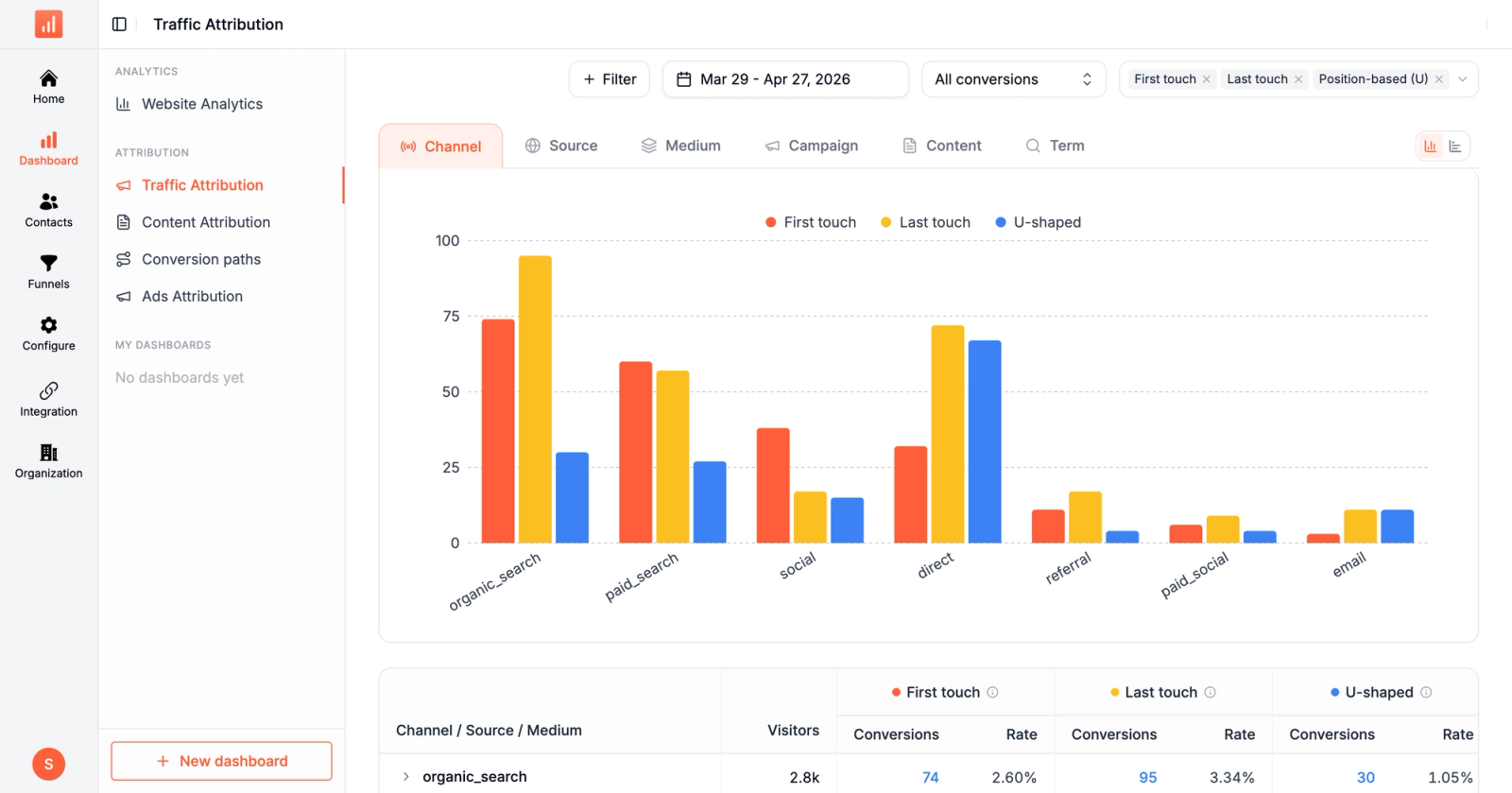
Table of contents
- Quick Comparison of Best B2B Marketing Analytics Tools
- 1. SourceLoop
- Why SourceLoop works well as a B2B analytics layer
- 2. Dreamdata
- 3. HockeyStack
- 4. Supermetrics
- 5. Improvado
- 6. Segment
- 7. 6sense
- 8. Mixpanel
- 9. HubSpot
- 10. Adobe Marketo Measure (formerly Bizible)
- How to choose the best B2B marketing analytics tool
B2B marketing analytics isn't one category.
It's a stack of overlapping use cases: capturing visitor-level source data, modeling multi-touch attribution across long sales cycles, piping ad-platform data into a warehouse, identifying anonymous account-level traffic, scoring intent, and tying everything back to closed-won revenue in your CRM.
No single tool does all of it well.
Below are 10 tools that each solve a different piece of the B2B analytics problem in 2026.
Quick Comparison of Best B2B Marketing Analytics Tools
| Tool | Use case | Starts at |
|---|---|---|
 SourceLoop SourceLoop |
All-in-one analytics + attribution | $49/mo |
 Dreamdata Dreamdata |
B2B revenue attribution | $999/mo |
 HockeyStack HockeyStack |
GTM intelligence + AI analyst | $1,399/mo |
 Supermetrics Supermetrics |
Marketing data connectors | $39/mo |
 Improvado Improvado |
Enterprise marketing ETL | $1,000+/mo |
 Segment Segment |
Customer data platform (CDP) | Free / Custom |
 6sense 6sense |
Intent data + ABM | $60K+/yr |
 Mixpanel Mixpanel |
Product analytics | Free / $24/mo |
 HubSpot HubSpot |
CRM-native attribution | Free / $890/mo |
 Adobe Marketo Measure Adobe Marketo Measure |
Enterprise legacy attribution | Custom |
1. SourceLoop
Best for: B2B, SaaS and agency teams that need journey capture and revenue attribution without an annual contract or a two-month implementation
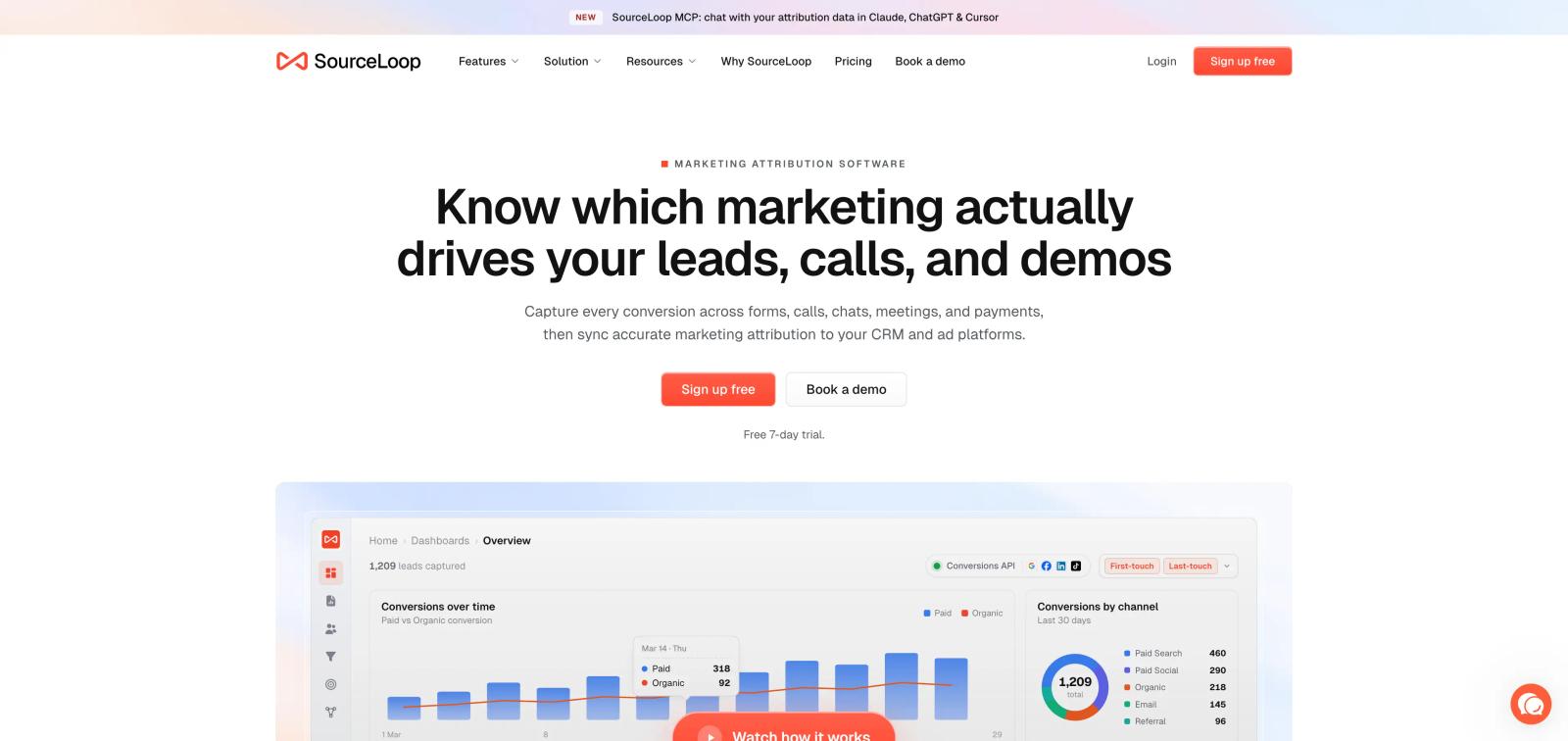
There is a gap in this category and most B2B teams sit in it.
Above it are the dedicated platforms. Dreamdata starts around $750 to $999/mo on an annual contract and typically takes one to two months before the data is reliable. HockeyStack's Growth plan is $1,399/mo. Both are good, and both assume someone owns analytics full time.
Below it is GA4 plus a lead_source picklist in the CRM. That combination is why so much B2B pipeline files under Direct.
The person who read three blog posts in March is not the person who filled the form in June, and neither event carries a UTM by the time it reaches the CRM.
SourceLoop sits in between.
Not a CDP, not a warehouse, just the capture and attribution layer, which for most teams under $10M ARR is the piece actually missing.
Why SourceLoop works well as a B2B analytics layer
1. Demo bookings get captured automatically
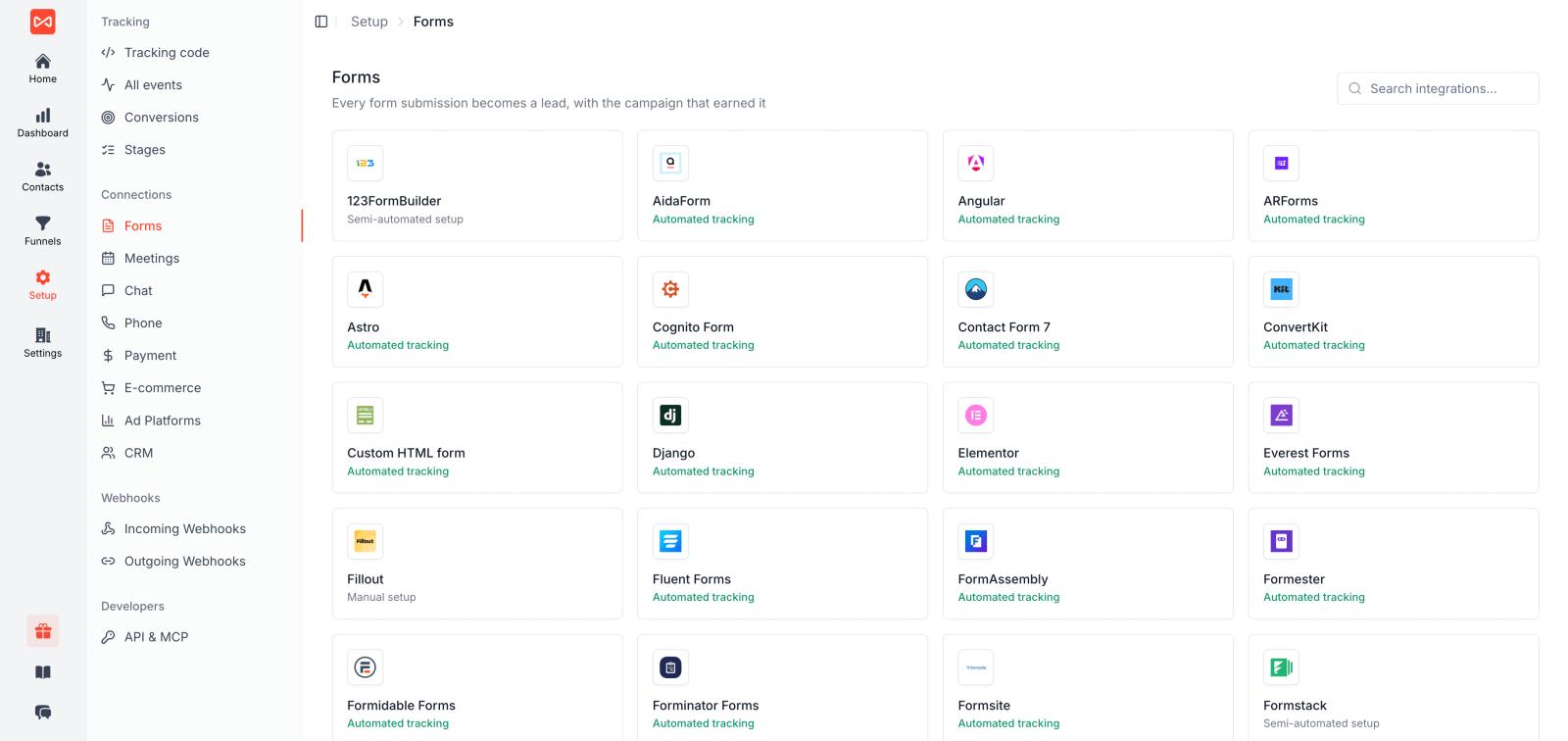
Most analytics tools treat a booking as an event you have to instrument. SourceLoop detects it. Calendly, Cal.com, HubSpot Meetings, Chili Piper, TidyCal, YouCanBookMe, Zoho Bookings and Zoom Scheduler all fire as conversions with source, campaign and click ID attached, with no JavaScript written.
The same applies to forms (Gravity Forms, WPForms, Typeform, Jotform, Webflow, Framer, HubSpot Forms), chat (Intercom, Drift, Crisp, HubSpot Chat, LiveChat, Zendesk Chat) and call tracking (CallRail, CallTrackingMetrics, Invoca). Around 70 tools in total, each with a documented setup.
2. Account-level rollup that does not need a CRM
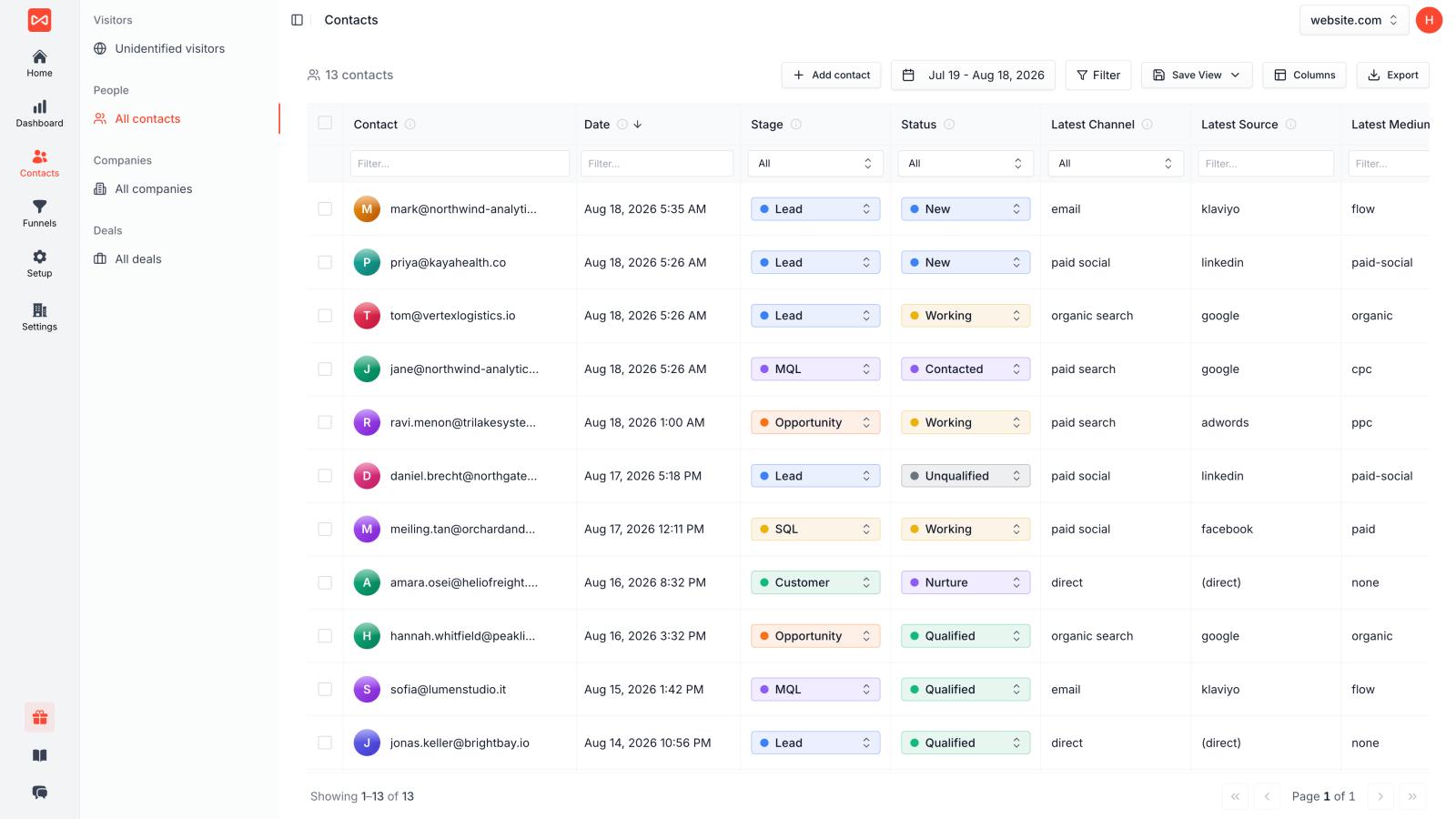
SourceLoop resolves the company from the domain on a captured lead email and merges everyone at that account into one journey, so the blog post someone read in March sits in the same timeline as the demo their VP booked in June.
With a CRM connected, deals inherit first-touch and last-touch attribution derived from the touchpoints of everyone linked to the deal.
To be clear on the boundary: this is domain resolution from a captured email, not IP-to-company identification of anonymous traffic. If reverse-IP matching is the requirement, Dreamdata and 6sense do it and SourceLoop does not.
3. Attribution on visitors who have not converted
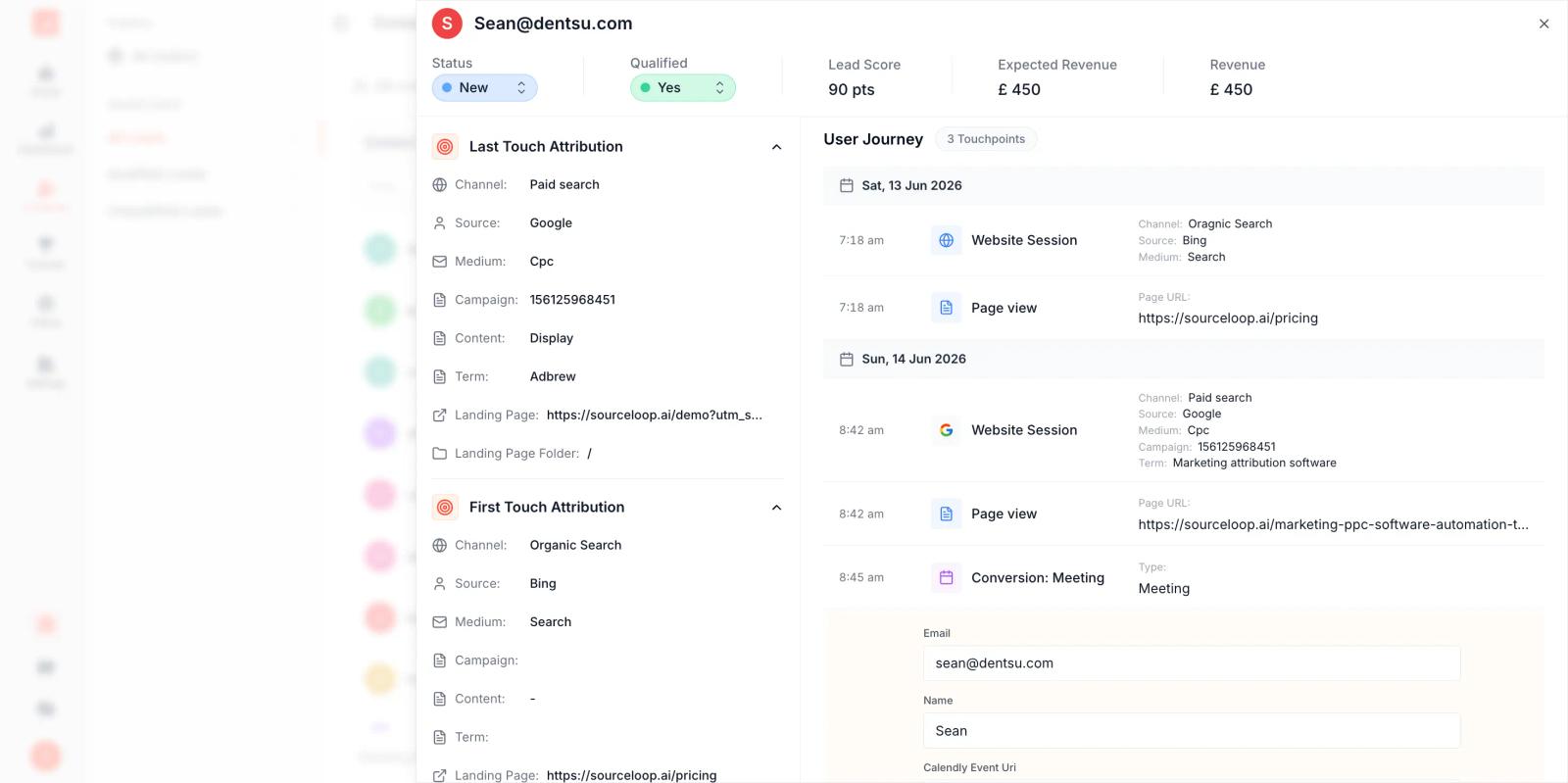
In a six-month cycle, most of your future pipeline is anonymous today.
The Visitors view shows every un-converted browser with its own first and last touch attribution, session count, engagement depth and page-by-page journey. Identity stitching merges those sessions into the contact record the moment someone identifies themselves.
4. Nine click IDs, because auto-tagging overrides UTMs
gclid, gbraid, wbraid, msclkid, fbclid, li_fat_id, ttclid, epik and rdt_cid are read on every landing URL and stored on the session and the lead.
SourceLoop reads them before the referrer. A Google Ads click on iOS Safari arrives with the referrer stripped, and without the gclid it files as Direct, which is the most common reason paid B2B leads show a wrong lead source.
5. Seven attribution models on one journey
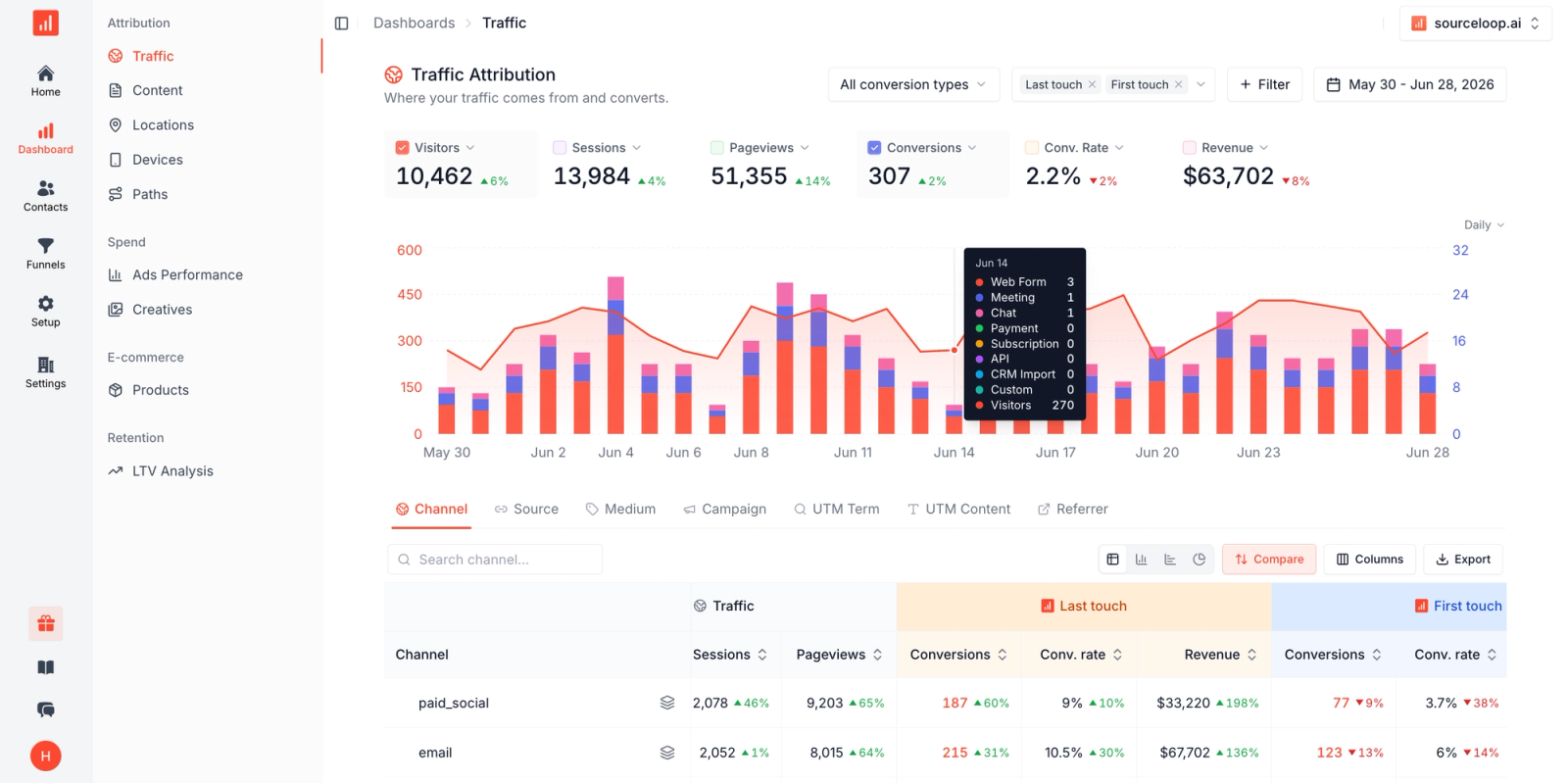
First touch, last touch, linear, position-based, time decay, first non-direct and last non-direct, switched from a dropdown with no re-tagging.
For long cycles the useful comparison is first against last touch on the same channel. Content and paid social almost always look weak under last touch and carry the funnel under first touch.
6. LinkedIn Conversions API, not just Google and Meta
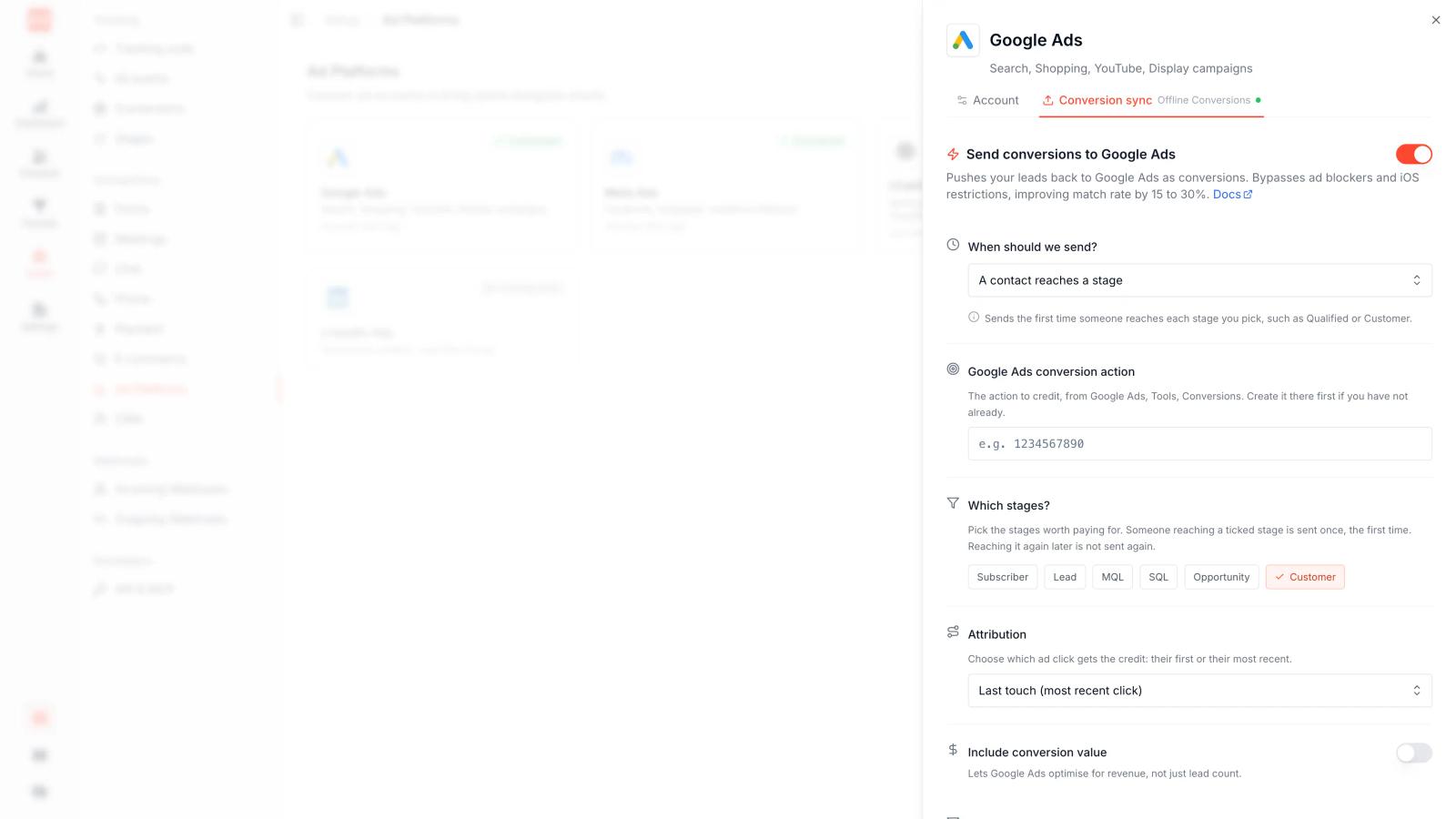
Server-side delivery covers Google Ads Enhanced Conversions, Meta CAPI, LinkedIn CAPI, Microsoft Ads, TikTok, Pinterest and Reddit. LinkedIn is the one that matters for B2B and the one most all-in-one analytics tools skip.
Each mapping picks its trigger, can filter to a single source, chooses first or last touch, and sets the value source and a dedup window, so LinkedIn learns from the leads sales qualified rather than every form fill.
7. Two-way CRM sync with stages mapped
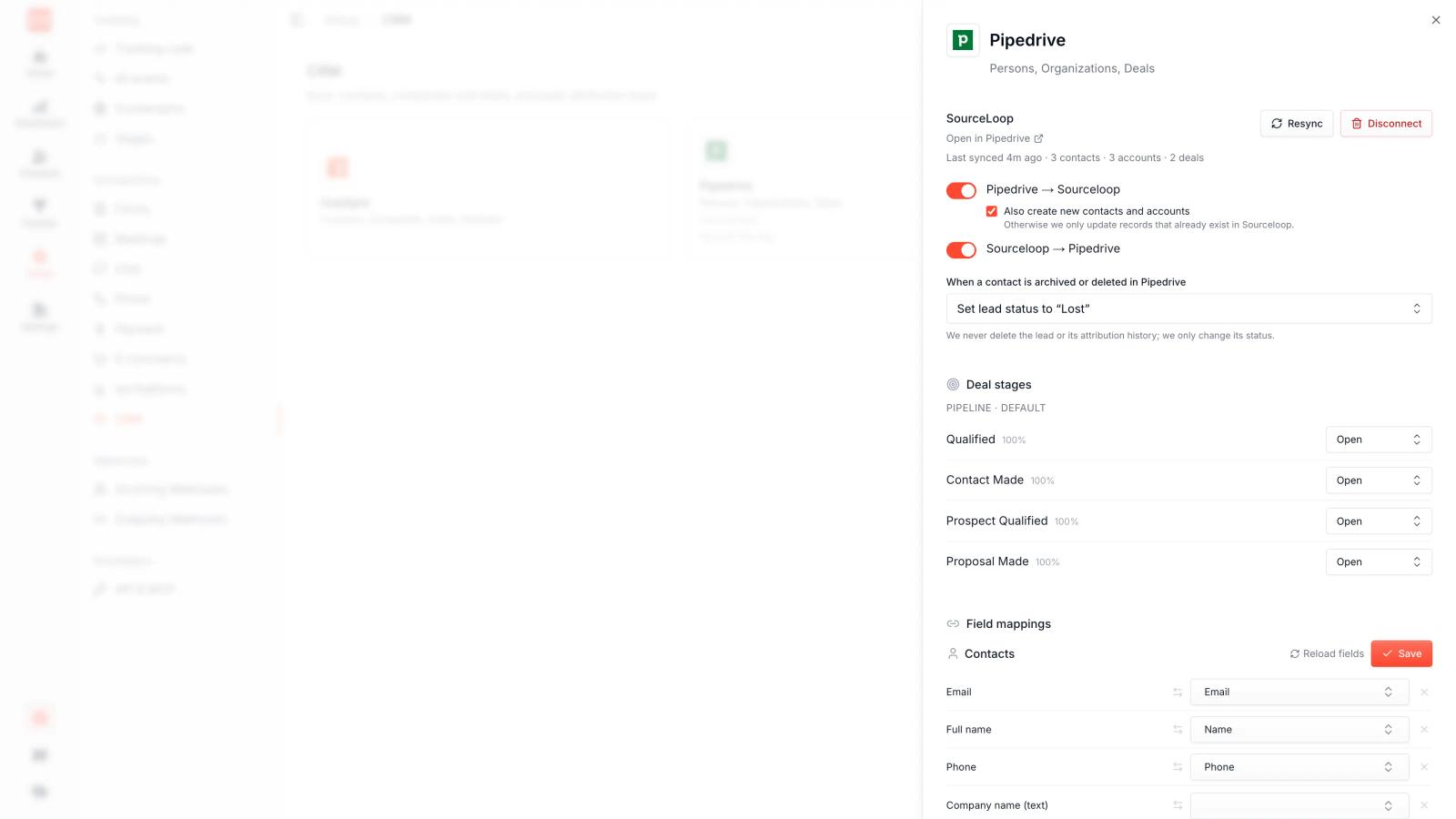
Native to HubSpot, Salesforce, Pipedrive and Zoho. Attribution fields go onto the contact, and deal stages and closed-won values come back, with explicit mapping for HubSpot lifecycle stages, Salesforce lead status and Pipedrive labels.
For self-serve SaaS, Stripe, Paddle, Polar, Lemon Squeezy and Dodo Payments webhooks stitch the payment back to the visitor who first clicked.
8. An MCP server
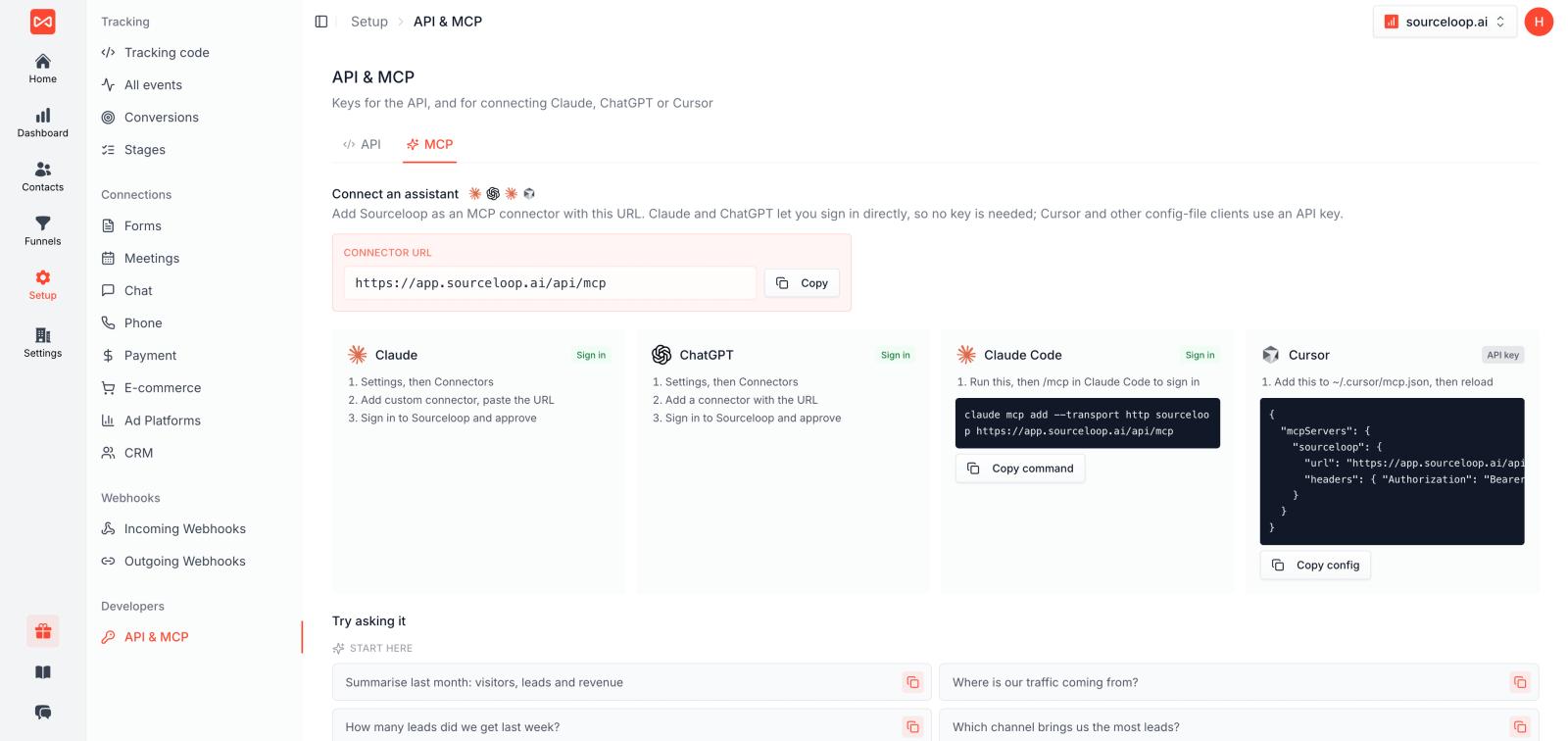
HockeyStack charges $1,399/mo partly for Odin, its AI analyst. SourceLoop exposes the same data through an MCP server any agent can call: headline performance, channel breakdowns, contact lookups, deal attribution, funnel stages, LTV, and the journey behind any conversion. A REST API with a /changes endpoint handles incremental pulls into a warehouse.
Pros:
- Automatic capture of bookings, forms, chat and calls across roughly 70 tools
- Account-level journeys merging everyone at a company, with or without a CRM
- Attribution on anonymous visitors, which matters when the cycle runs months
- LinkedIn CAPI included, with per-event filters on what gets sent and at what value
- Two-way CRM sync with lifecycle stage mapping across four CRMs
- Self-serve: published pricing, 7-day trial, no demo, live in an afternoon
Cons:
- No reverse-IP company identification. Dreamdata's roughly 80% match rate on anonymous visitors is a real capability SourceLoop lacks.
- Not built for enterprise ABM against a named target account list with intent scoring. That is 6sense and Dreamdata territory.
- No native warehouse sync to BigQuery or Snowflake.
- No CDP routing. If your stack fans out through Segment, SourceLoop is a destination, not a replacement.
- Tracked conversions are unlimited on every plan, but the entry tier covers 30k page views a month.
Pricing: Essential $49/mo covers 1 site, 1 user and 30k page views a month. Professional $99/mo adds 3 users and 100k page views. Agency $249/mo covers 3 sites, unlimited users and 2.5M page views. Tracked conversions are unlimited on every plan, annual billing takes 25% off, and there is a 7-day trial with no card.
2. Dreamdata
Best for: B2B SaaS teams with multi-stakeholder buying journeys and CRM-driven pipeline reporting
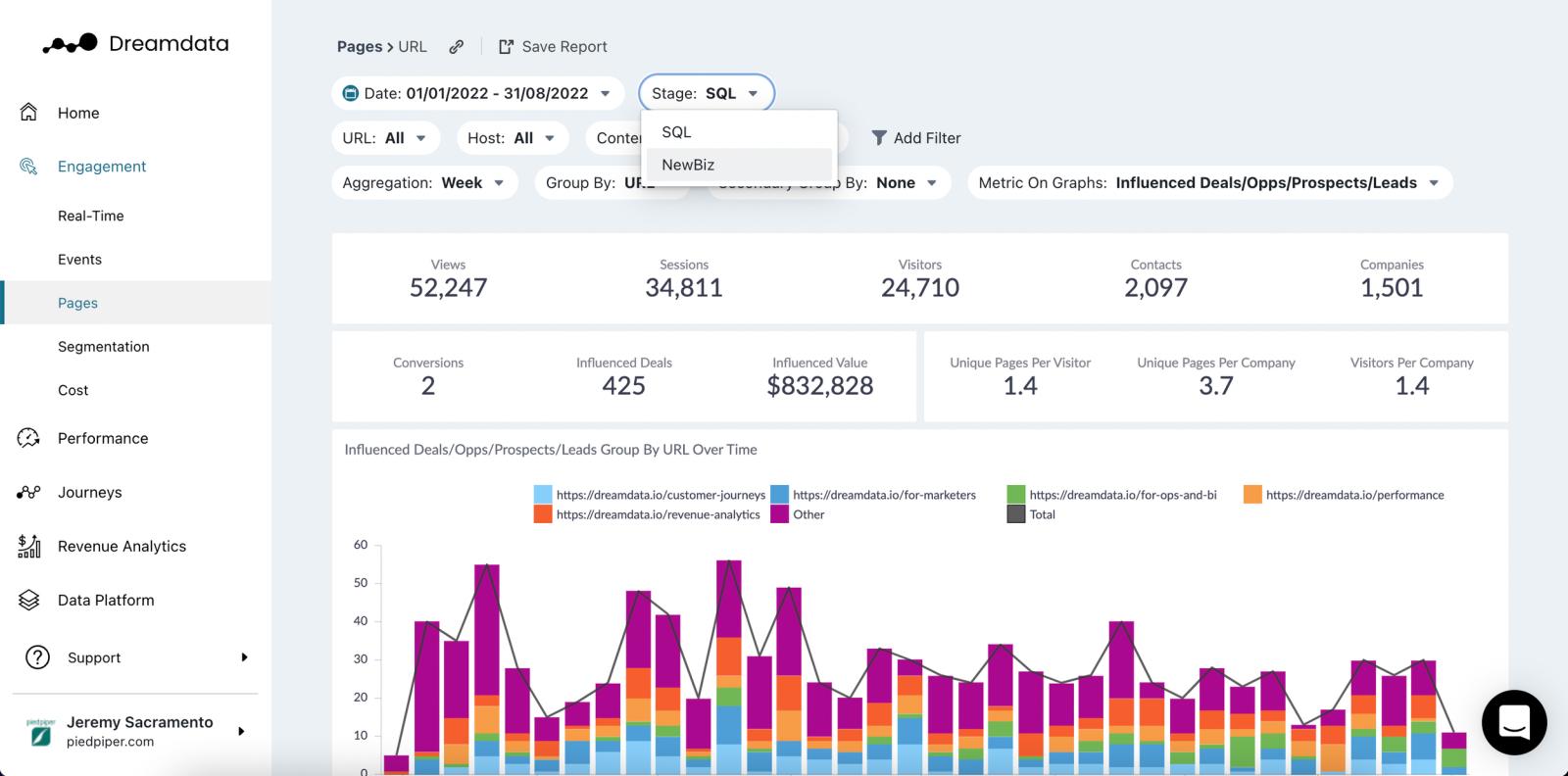
Dreamdata is a B2B revenue attribution platform out of Copenhagen built specifically for long sales cycles. It connects CRMs, marketing automation, ad platforms, intent tools, and product usage into a unified account-level data model and attributes pipeline back to the originating campaigns. The IP-to-company resolution engine identifies up to 80% of companies visiting your site, even when they don't fill out a form.
Dreamdata is rated number one in G2's B2B Attribution category with 230+ reviews. The trade-off is implementation complexity (4-8 week typical onboarding) and a months-long data accumulation period before reports become reliable.
Pros:
- Account-level journey visualization tied to CRM revenue
- Up to 80% company identification rate from anonymous traffic
- BigQuery and Snowflake access on higher tiers
Cons:
- 4-8 week implementation
- Reports are warehouse-locked, with batch processing rather than real-time
- Pricing scales sharply with contact volume
Pricing: Free tier available. Activation Starter at $999/month. Annual contracts typical with contract values often $9,000-$30,000.
3. HockeyStack
Best for: Mid-market and enterprise B2B teams that want unified GTM analytics with an AI analyst on top
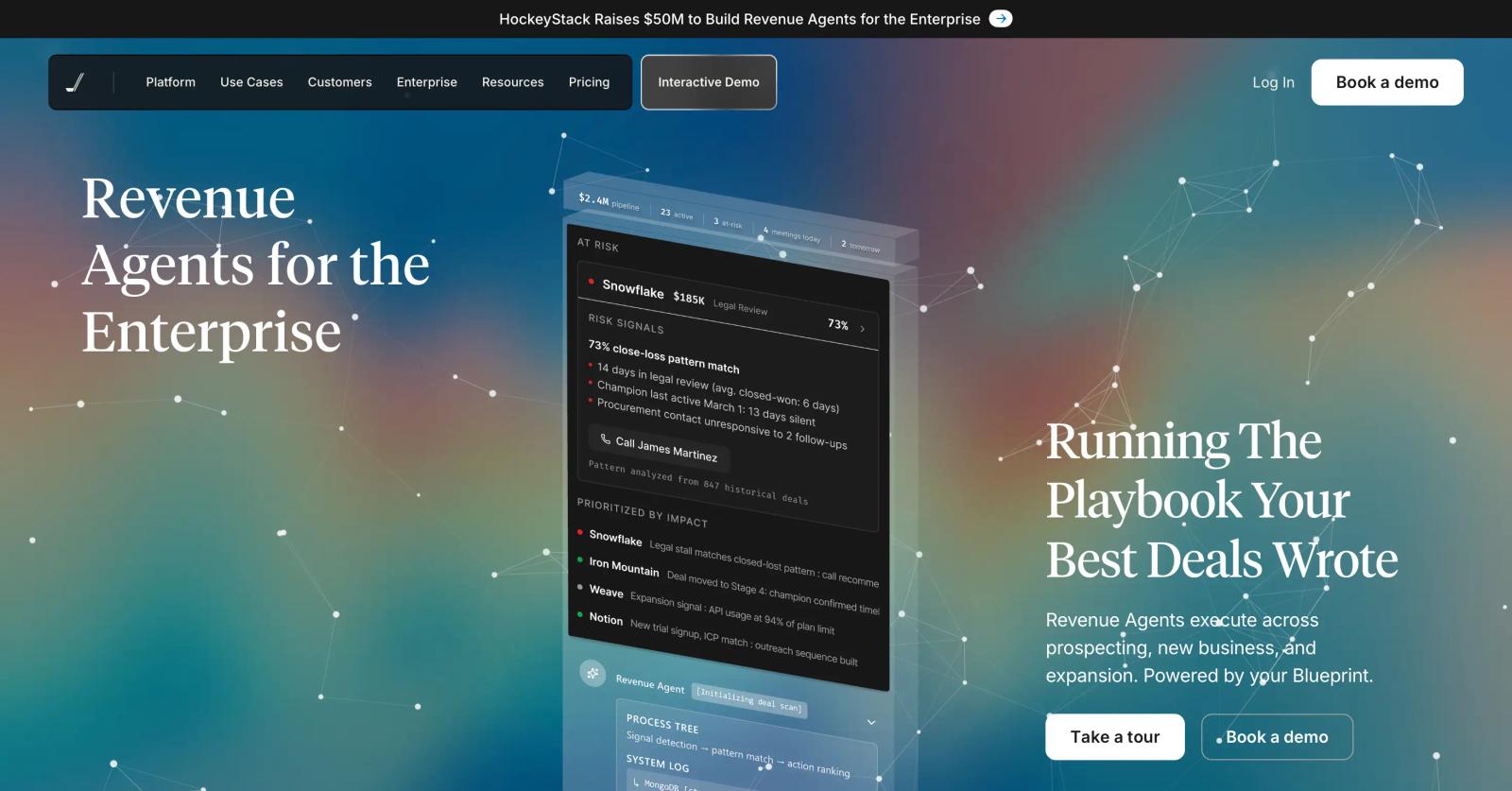
HockeyStack positions itself as a GTM intelligence platform rather than a pure attribution tool. It unifies marketing, sales, CRM, and product engagement data into a single platform, then layers AI agents (Odin for analysis, Nova for sales) that answer GTM questions in natural language.
Marketers can ask "show me which campaigns drove pipeline last quarter" instead of building a custom report.
HockeyStack tracks pipeline across customers including 8x8, DataRobot, RingCentral, and MasterCard. The most-cited negative is the learning curve, with 11 G2 mentions and 8 calling it "steep", and some former customers reporting attribution numbers that change between report pulls.
Pros:
- Unified GTM data across marketing, sales, CRM, and product
- AI agents (Odin, Nova) for natural-language analysis
- Cookieless tracking is core to the architecture
Cons:
- 2-6 weeks to operationalize, no public pricing
- Attribution methodology has been called a black box
- Annual contracts only, demo-gated
Pricing: Growth plan starts around $1,399/month per Docket's research. Some sources put the actual entry point closer to $2,200/month for 30K visitors. Enterprise custom.
4. Supermetrics
Best for: Marketing teams that need to pull ad platform data into Google Sheets, Looker Studio, or a BI tool
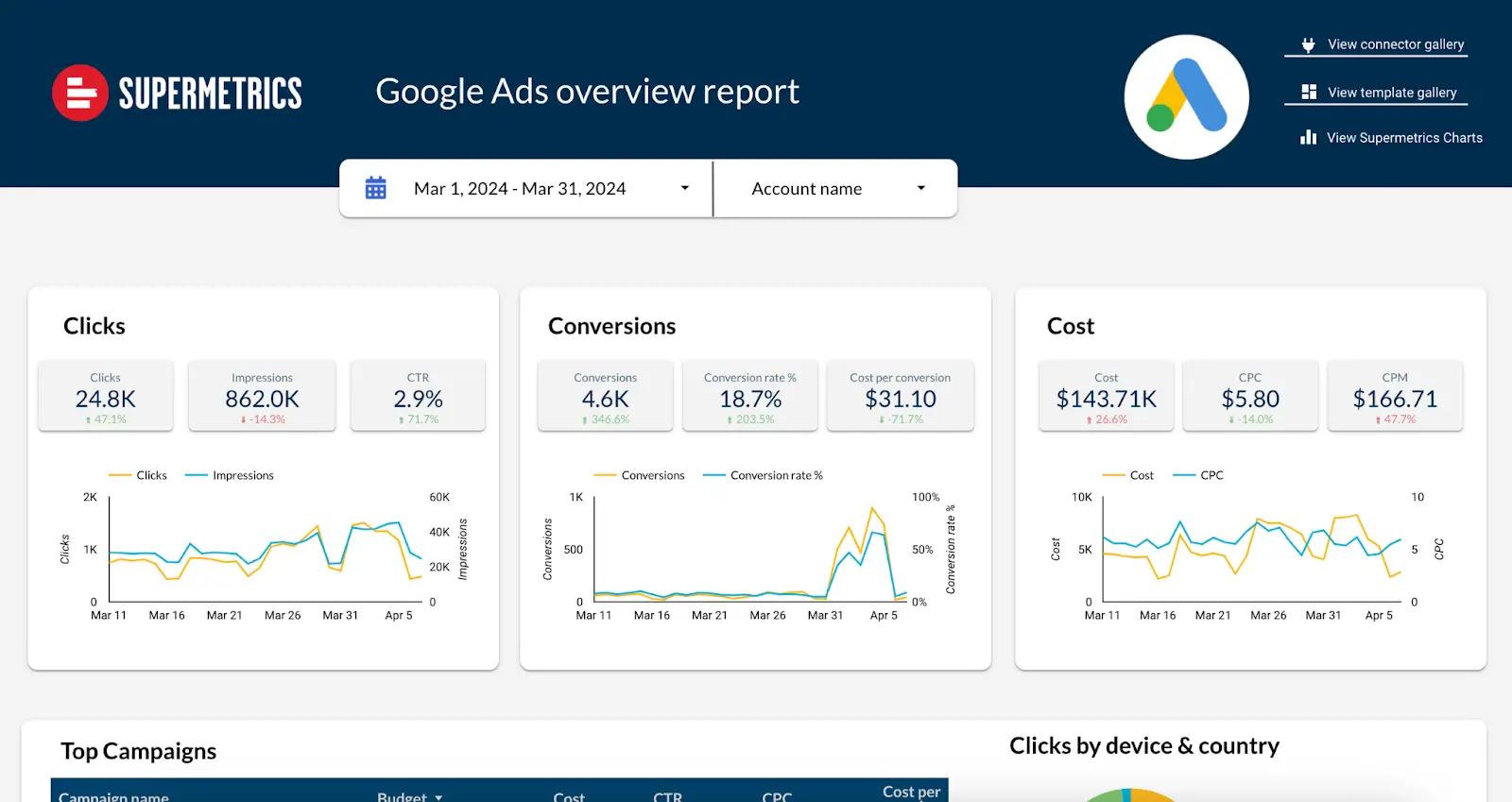
Supermetrics is the dominant marketing data connector platform. It pulls data from 100+ ad platforms, analytics tools, and CRMs into Google Sheets, Excel, Looker Studio, BigQuery, and Snowflake.
For agencies and in-house marketing teams that just want clean ad spend, impressions, clicks, and conversion data flowing into reports, Supermetrics is the standard pick.
The catch is that Supermetrics is extract-and-load, not extract-transform-load. Data arrives in your destination as-is, with platform-specific naming conventions and inconsistent date formats that someone has to clean up. For dedicated marketing ETL with transformation, you need Funnel.io or Improvado instead.
Pros:
- Largest marketing-specific connector library among self-serve tools
- Affordable entry tier for spreadsheet-based reporting
- Mature integrations with Looker Studio and Google Sheets
Cons:
- No data transformation, naming harmonization is manual
- Pricing escalates quickly when you add destinations or warehouses
- Connector breakages reportedly silent, no automatic alerts
Pricing: Google Sheets and Excel from $39/month. Warehouse destinations require sales call. Each additional connector adds $35/month.
5. Improvado
Best for: Enterprise B2B marketing data teams that need ETL with transformation at warehouse scale
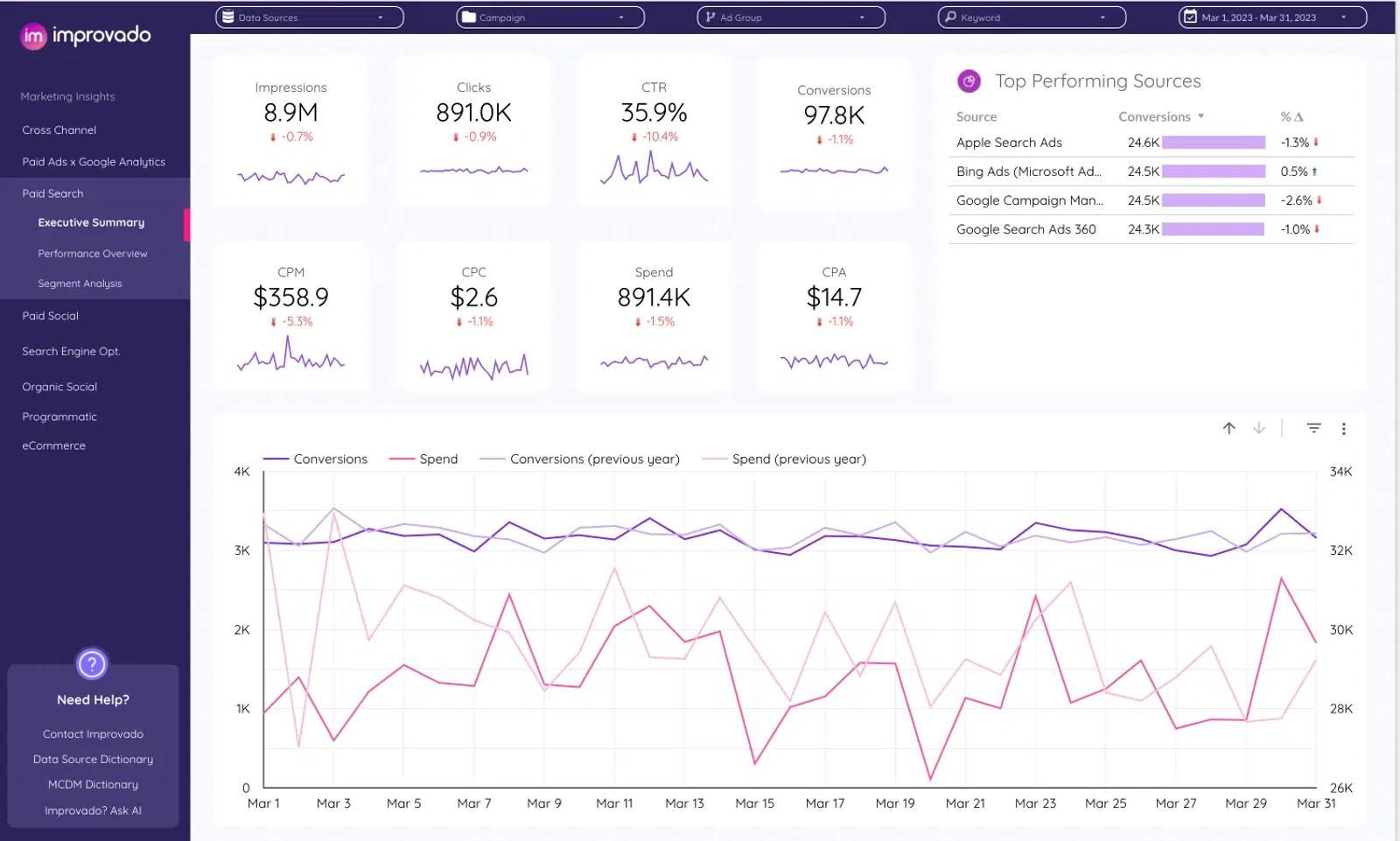
Improvado operates at the data layer, not the dashboard layer. It pulls marketing data from 500+ sources, normalizes inconsistent UTM naming through automated mapping rules, applies transformation logic, and pushes governed data into BigQuery, Snowflake, Redshift, or BI tools like Tableau and Looker.
It's the right tool for organizations with 47 ad accounts and 12 different naming conventions where finance can't reconcile spend to revenue.
For smaller teams, Improvado is overkill. Pricing starts around $1,000/month and scales into $3,000-$10,000/month for typical enterprise implementations.
Pros:
- 500+ connectors with automated transformation rules
- Pushes governed data to data warehouses and BI tools
- Dedicated customer success and engineering support
Cons:
- Enterprise pricing, not viable for small teams
- 4-12 week typical implementation
- Not a reporting tool, you still need Looker Studio or Tableau on top
Pricing: Custom enterprise pricing starting around $1,000/month. Most enterprise implementations $3,000-$10,000/month.
6. Segment
Best for: Engineering-led B2B teams that want a CDP routing first-party events to every analytics and ad destination
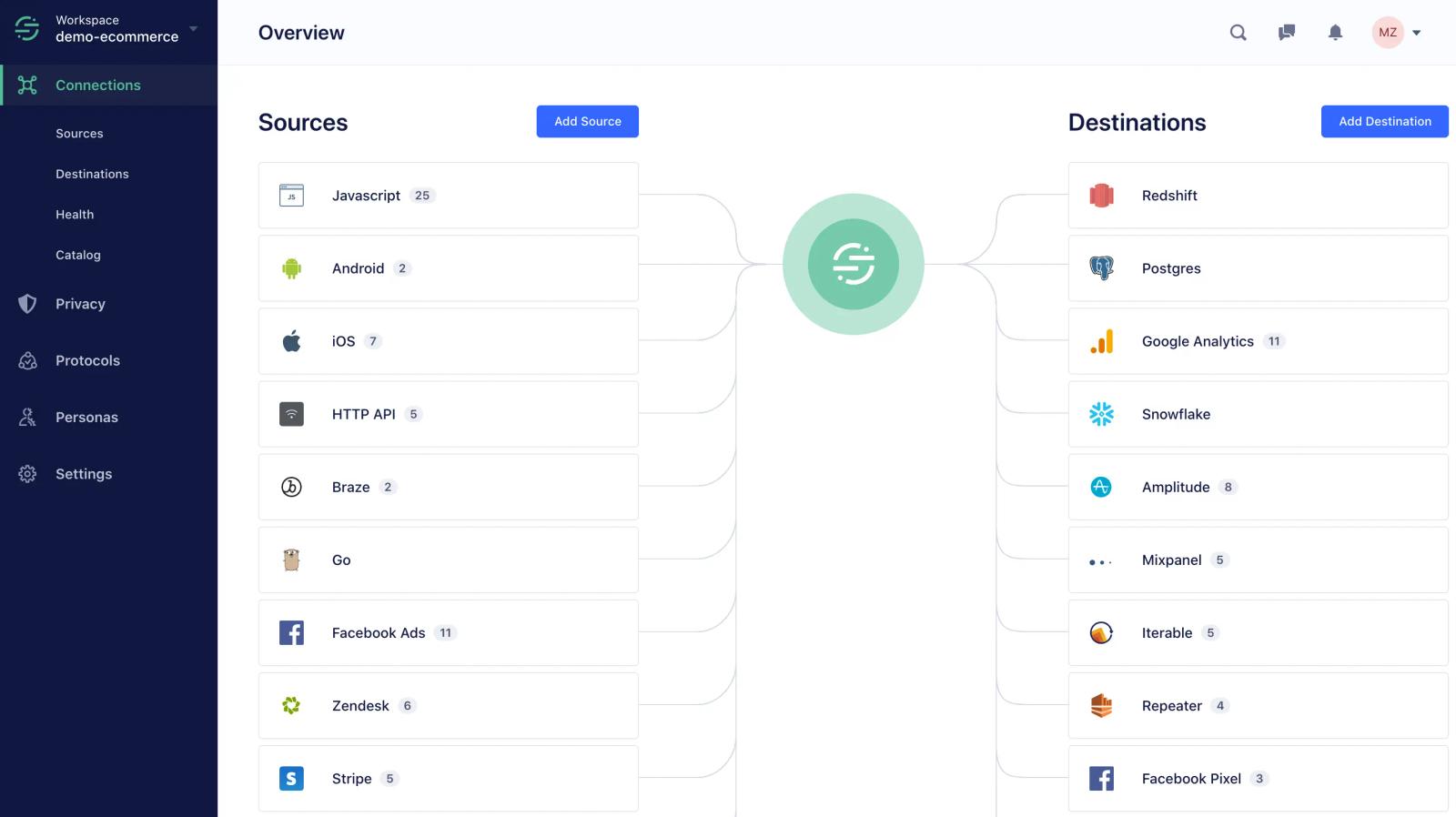
Segment, now owned by Twilio, is the dominant customer data platform. It collects first-party event data from your website, mobile app, or backend, then routes it to over 300 destinations: Meta CAPI, Google Enhanced Conversions, LinkedIn Conversions API, Mixpanel, Amplitude, HubSpot, Salesforce, BigQuery, and many more.
For B2B teams with engineering resources, Segment is the most flexible way to instrument events once and reuse the data everywhere.
The trade-off is complexity: implementing Segment well requires real engineering investment, and pricing scales with monthly tracked users. For teams without dev resources, a managed all-in-one tool like SourceLoop or HubSpot delivers the same outcome with less work.
Pros:
- Most flexible CDP for routing events to ad platform CAPIs
- 300+ destinations, future-proof if you add new tools
- Strong fit for product analytics + ad tracking together
Cons:
- Requires engineering resources to implement
- Pricing scales sharply with MTUs
- Not an attribution or reporting tool by itself
Pricing: Free plan up to 1,000 MTUs. Team plan from $120/month. Business plan custom.
7. 6sense
Best for: Enterprise B2B teams running ABM with substantial intent data and account scoring needs
6sense is the dominant ABM platform combining intent data (third-party signals indicating in-market accounts), AI predictive scoring, and account-level engagement tracking.
It identifies which target accounts are researching competitors or your category before they ever visit your site, then ties that intent to the eventual sales motion.
6sense is an enterprise tool. Pricing typically starts around $60,000/year and goes up sharply with seat count and intent data volume. For Fortune 1000-scale ABM motions or teams with $500K+ ACVs, the math works. For sub-$50K ACV motions, the cost is rarely justified.
Pros:
- Deepest intent data and predictive account scoring on the market
- Strong ABM orchestration features
- Mature integrations with Salesforce, HubSpot, Marketo
Cons:
- $60K+/year minimum, not viable below enterprise scale
- Implementation typically 3-6 months
- Intent data quality varies by industry and region
Pricing: Custom enterprise pricing typically starting around $60,000/year, scaling significantly for full-platform deployments.
8. Mixpanel
Best for: Product-led B2B teams that want to track in-app events alongside marketing source
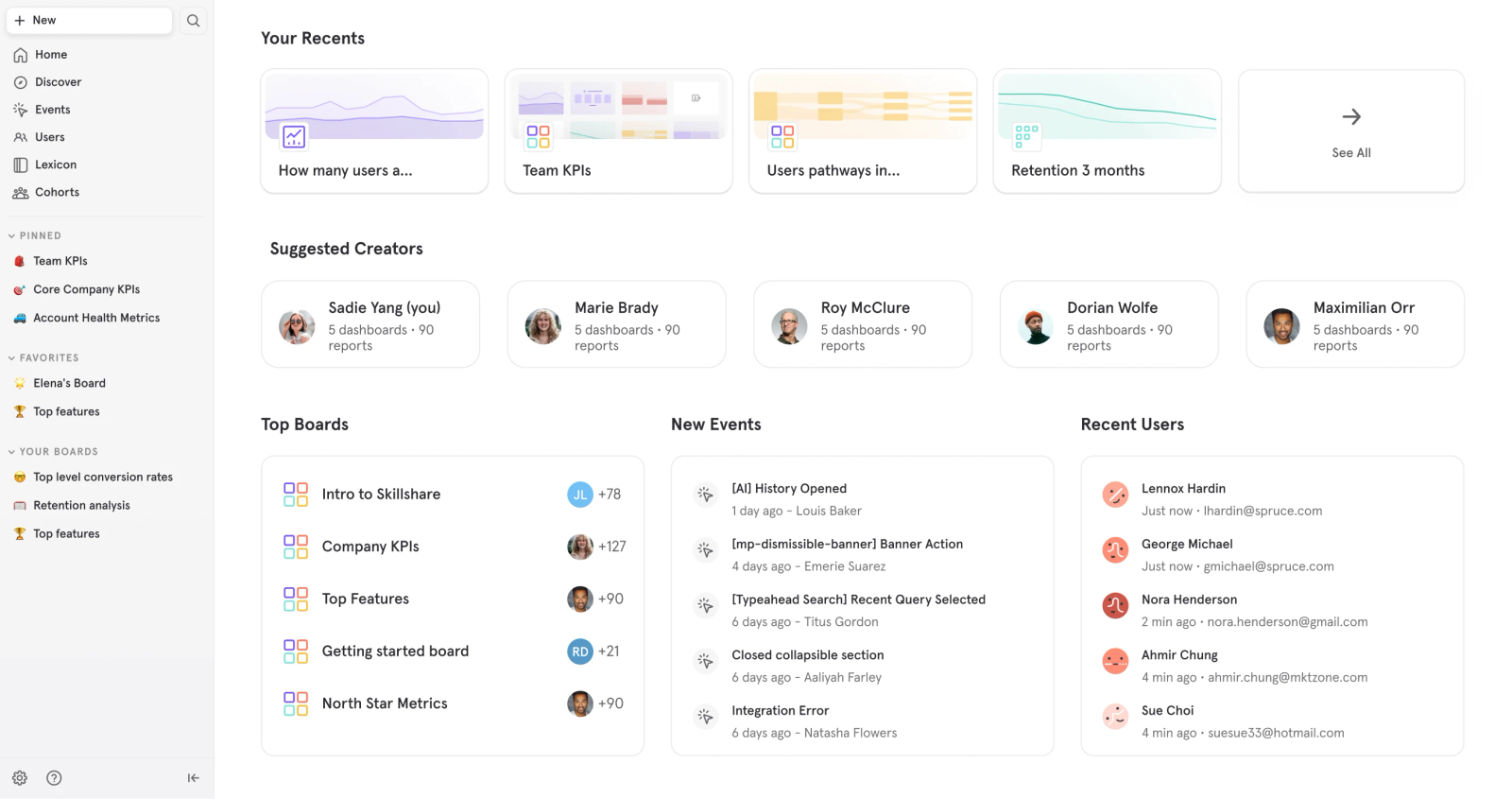
Mixpanel is the standard product analytics tool for tracking what users do inside your app: feature adoption, funnel drop-off, retention cohorts, A/B test results.
For product-led B2B SaaS, this layer is as important as marketing source data because the question shifts from "where did this user come from?" to "which features predict them upgrading or churning?"
Mixpanel doesn't replace a marketing analytics tool. It complements one. Most B2B teams send marketing source as a user property into Mixpanel, then use it to compare retention or LTV by acquisition channel. Pair Mixpanel with SourceLoop or HubSpot on the marketing side for the full picture.
Pros:
- Deepest product analytics for in-app event tracking
- Free tier covers up to 1M monthly events
- Strong cohort analysis and retention reporting
Cons:
- Not a marketing analytics tool, doesn't track ad source natively
- Pricing scales sharply with event volume
- Implementation requires engineering for proper event taxonomy
Pricing: Free tier up to 1M events/month. Growth at $24/month. Enterprise custom.
9. HubSpot
Best for: SMB and mid-market B2B teams that want CRM, marketing automation, and attribution in one place
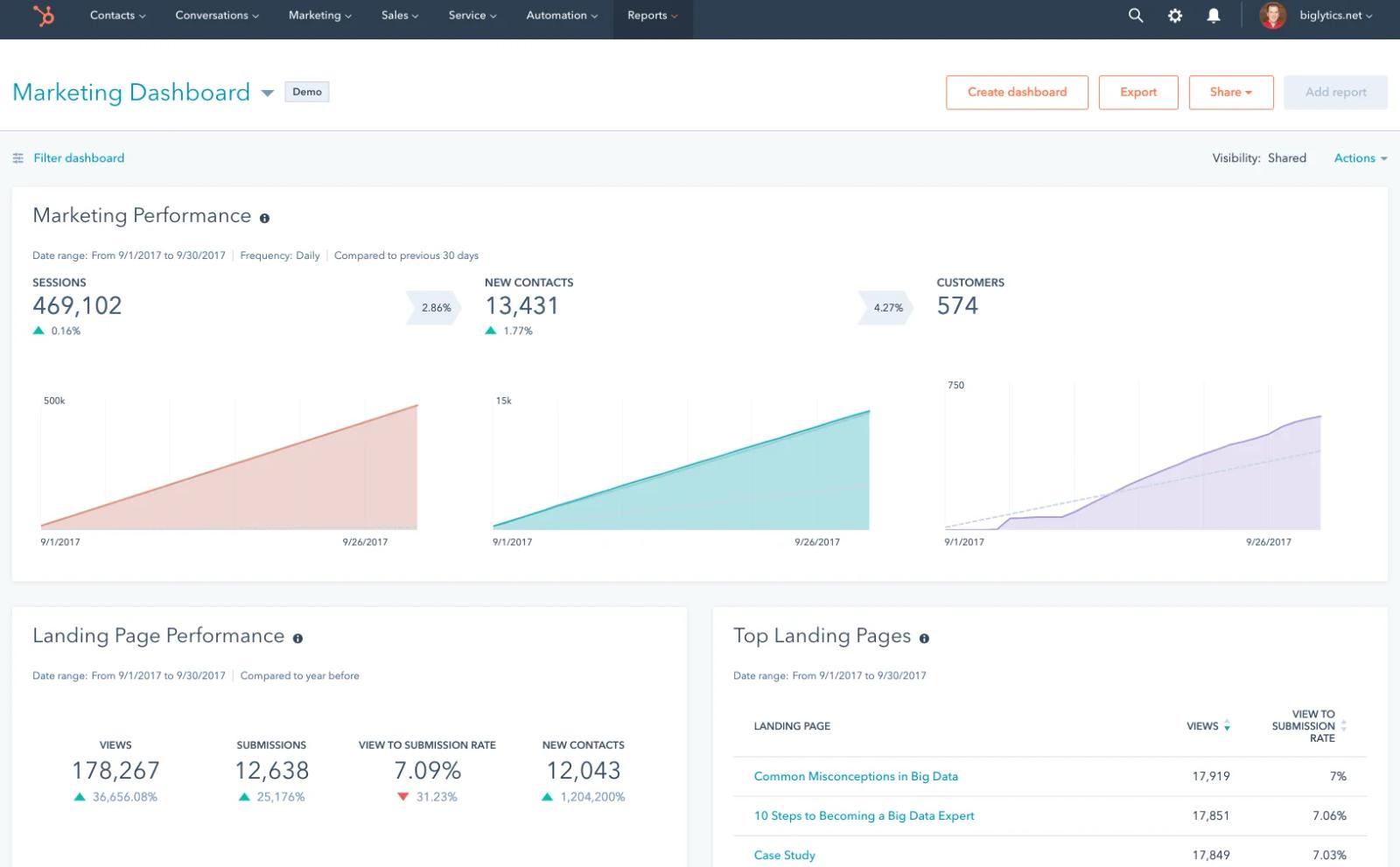
HubSpot captures lead source natively through its tracking code, fills the "Original Source" property automatically on every contact, and ties source data to deals as they progress through the pipeline.
The free CRM tier is genuinely useful for small teams. Marketing automation, multi-touch attribution, and custom reporting depth scale up through Marketing Hub Professional and Enterprise.
The disadvantage is that real attribution depth (multi-touch revenue attribution, custom report types) is gated to Marketing Hub Enterprise at $3,600/month plus a $7,000 onboarding fee. For SMBs, the basic source tracking is free, but for serious attribution work you're at enterprise pricing.
Pros:
- Native lead source on every contact, no setup
- Free CRM tier covers basic SMB needs
- All-in-one marketing automation, CRM, and attribution
Cons:
- Multi-touch attribution is Enterprise-only
- $7,000 onboarding fee on Enterprise
- Channel attribution less granular than dedicated tools
Pricing: CRM and basic Marketing Hub free. Marketing Hub Professional from $890/month. Marketing Hub Enterprise from $3,600/month plus $7,000 one-time onboarding.
10. Adobe Marketo Measure (formerly Bizible)
Best for: Enterprise B2B teams already invested in Adobe Experience Cloud and Marketo Engage
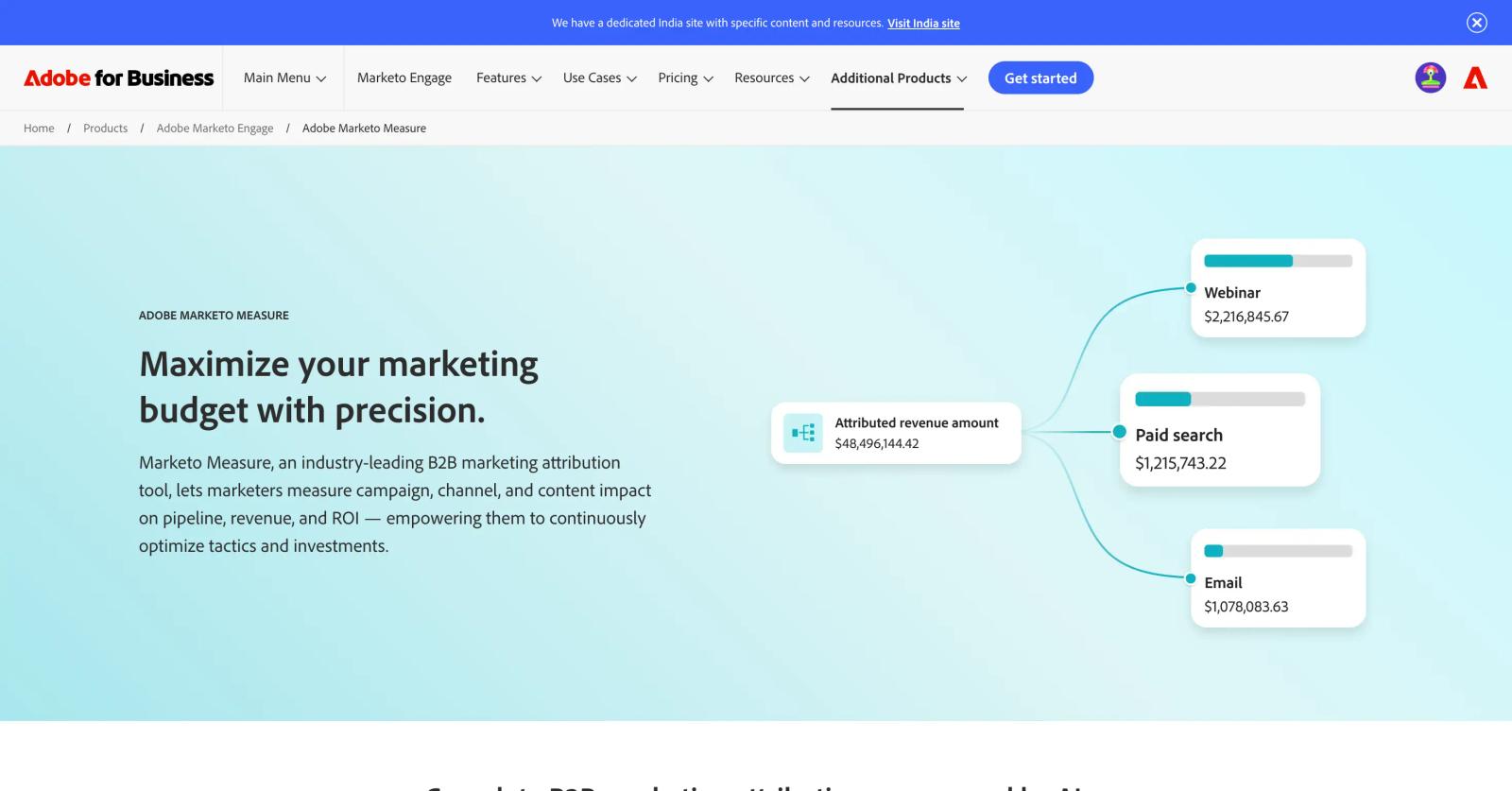
Adobe Marketo Measure is the long-standing enterprise B2B attribution layer, with native integration to Marketo, Salesforce, Microsoft Dynamics, and Adobe Analytics.
It ships every-touch attribution and six built-in models (First Touch, Lead Creation, U-Shaped, W-Shaped, Full Path, Custom).
For organizations already on Adobe Experience Cloud, Marketo Measure is the obvious choice. For everyone else, multiple sources note that the product hasn't innovated quickly since the Adobe acquisition.
Predictive lead scoring, conversion modeling, and incrementality testing all live elsewhere now. Annual costs typically run $50,000+ for mid-market deployments.
Pros:
- Deep Adobe and Marketo integration
- Mature every-touch attribution model
- Enterprise governance and compliance
Cons:
- Pricing not published, enterprise-only
- Limited innovation since Adobe acquisition
- Implementation typically requires dedicated resources for months
Pricing: Custom enterprise pricing only. Multiple sources put annual costs at $50,000+ for typical mid-market deployments.
How to choose the best B2B marketing analytics tool
For most B2B teams, the question isn't "which one tool" but "which combination of tools." Every category on this list does something specific that the others don't.
The lean approach: one tool that covers capture, attribution and revenue. If you are a B2B SaaS or agency under $5M ARR, SourceLoop covers visitor-level lead source capture, automatic demo-booking attribution from Calendly and HubSpot Meetings, server-side CAPI to LinkedIn and the other ad platforms, account-level journeys, and Stripe webhook revenue stitching on one $49/month bill. It does not replace HubSpot or Salesforce, it makes their lead source fields accurate. For most growing B2B teams this is the simplest setup that does not commit you to an annual enterprise contract before you know what you need.
It feeds cleaner data into whatever CRM you're running, so you don't replace HubSpot or Salesforce, you make their lead source fields actually accurate. For most growing B2B teams, this is the simplest setup that doesn't immediately commit you to enterprise pricing.
The traditional B2B stack: if you've outgrown all-in-one tools, you'll likely run a layered stack. Segment as the CDP routing events.
Dreamdata or HockeyStack for B2B revenue attribution. Improvado or Funnel.io for ETL into the warehouse. 6sense for intent data and ABM. Mixpanel for product analytics. HubSpot or Salesforce for CRM. Total cost easily clears $10,000-$50,000/month at mid-market scale.
Frequently asked questions
-
What is B2B marketing analytics software?
B2B marketing analytics software measures how marketing activity contributes to pipeline and closed revenue across long, multi-stakeholder buying journeys. The category covers visitor-level analytics, multi-touch attribution, intent data, ABM scoring, marketing data ETL into warehouses, and product analytics. No single tool covers all of these well, which is why most B2B teams run a stack of three to five tools.
-
What's the difference between B2C and B2B marketing analytics?
B2C analytics typically optimizes around short, individual buying decisions: someone clicks an ad, buys, and the loop closes in days. B2B analytics has to handle 6-18 month sales cycles, multiple stakeholders at the same account, and the gap between marketing source and the eventual closed-won deal. That's why B2B platforms like Dreamdata and HockeyStack focus on account-level (not user-level) journeys and integrate deeply with CRMs.
-
Do I need a B2B attribution tool if I have HubSpot?
HubSpot's Original Source property is automated and fine for SMBs, but it's limited to seven categories (Organic Search, Paid Search, Email, Social, Referrals, Direct, Other Campaigns). Multi-touch revenue attribution is gated behind Marketing Hub Enterprise. For granular, accurate, multi-touch attribution, most mid-market B2B teams add a dedicated tool (SourceLoop, Dreamdata, HockeyStack) on top of HubSpot.
-
How much should I budget for B2B marketing analytics?
Below 50 demos/month or $1M ARR, $49-$250/month tools (SourceLoop, Supermetrics, Mixpanel free tier) cover the basics. Between $1M-$10M ARR, dedicated attribution and CDP tools at $1,000-$5,000/month make sense (Dreamdata, Segment, Improvado). Above $10M ARR or $500K+ ACVs, enterprise platforms (6sense, HockeyStack, Marketo Measure) at $50,000+/year are justified by deal sizes at stake.
-
What's intent data and do I need it?
Intent data is third-party signal indicating which accounts are researching your category, your competitors, or related solutions, even before they visit your site. Tools like 6sense aggregate intent from publisher networks and review sites to score accounts as in-market or not. For enterprise ABM motions targeting specific accounts, intent data is genuinely useful. For SMB or volume-driven B2B, it's usually not worth the $60K+/year minimum.
-
What's the difference between a CDP and a marketing attribution tool?
A CDP (like Segment) collects and routes first-party event data to other tools. It doesn't analyze attribution, score accounts, or report on revenue. An attribution tool (like Dreamdata or SourceLoop) reads that event data and answers "which campaigns drove revenue?" Many B2B stacks run both: Segment as the data router, Dreamdata or SourceLoop as the analytics layer.
-
How long does B2B marketing analytics setup take?
Managed all-in-one tools (SourceLoop, HubSpot) are typically live within a day. Mid-tier tools (Mixpanel, Segment basic implementation) take 1-3 weeks. Enterprise B2B platforms (Dreamdata, HockeyStack, Improvado) typically take 4-12 weeks of onboarding before reliable data flows. 6sense and Marketo Measure can take 3-6 months. Plan for an extra 1-2 months of calibration before you trust attribution numbers for budget decisions.
-
Can I track AI-driven traffic from ChatGPT and Perplexity?
Yes, and the mechanism is worth understanding because it changes what you should expect. When someone clicks a link inside ChatGPT, Claude, Perplexity or Gemini, there is no UTM and no click ID, so the only signal is the referring domain. SourceLoop classifies traffic by referrer after click IDs and UTMs, so those visits land under Referral with the AI tool named as the source (
chatgpt.com,perplexity.aiand so on) rather than disappearing into Direct, and you can filter or group on that source in any report. The caveat, and it applies to every tool in this list, is that AI assistants used inside a native app often strip the referrer entirely. Those visits are genuinely unattributable at the moment. The practical move is to watch the named AI sources you can see as a directional signal, and treat them as a floor rather than a full count.



 Paid Social


