
11 Best Dreamdata Alternatives: I Tested for 2026
Eleven Dreamdata alternatives compared honestly. From enterprise ABM to lean multi-touch attribution, with the simpler option I'd start with for most B2B teams.
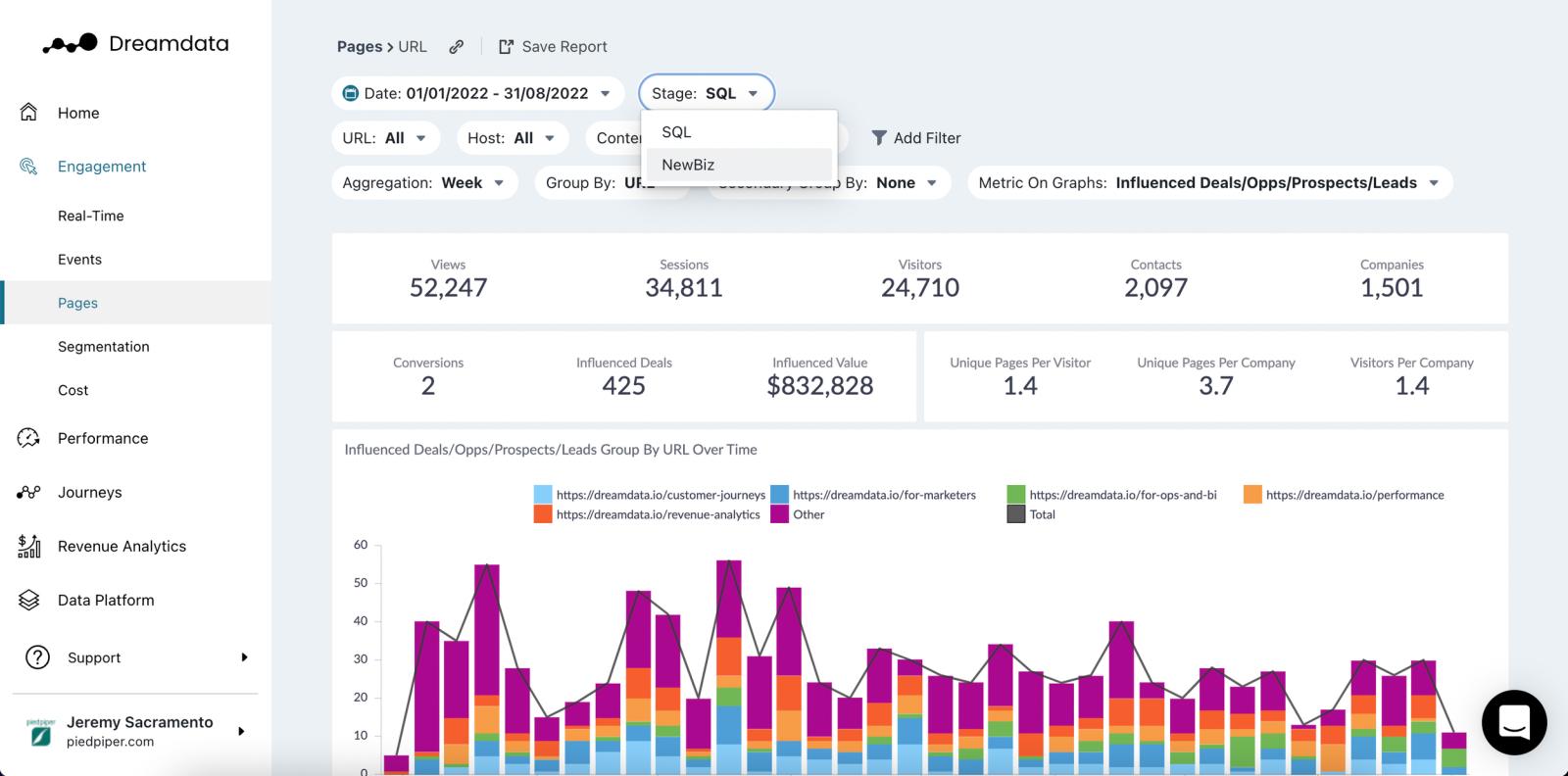
Table of contents
- Quick comparison
- 1. SourceLoop
- How it works
- Where it falls short for Dreamdata-style users
- Pricing
- 2. HockeyStack
- Key capabilities
- Watch-outs
- Pricing
- 3. Factors.ai
- Key capabilities
- Watch-outs
- Pricing
- 4. 6sense
- Key capabilities
- Watch-outs
- Pricing
- 5. Demandbase
- Key capabilities
- Watch-outs
- Pricing
- 6. Adobe Marketo Measure (formerly Bizible)
- Key capabilities
- Watch-outs
- Pricing
- 7. HubSpot Marketing Analytics
- Key capabilities
- Watch-outs
- Pricing
- 8. Ruler Analytics
- Key capabilities
- Watch-outs
- Pricing
- 9. Heap
- Key capabilities
- Watch-outs
- Pricing
- 10. Funnel
- Key capabilities
- Watch-outs
- Pricing
- 11. Attribution (attribution.app)
- Key capabilities
- Watch-outs
- Pricing
- How to pick the right one
B2B revenue attribution is its own corner of the marketing analytics world. Long funnels. Six-month sales cycles. Six-figure deals. Lead count isn't a metric anyone trusts.
Dreamdata is what teams pick when they're done guessing.
Their Salesforce integration is deep, the revenue weighting respects deal size and stage, and the free tier is real (not a glorified trial).
Teams who shop alternatives usually do so for one of three reasons: the $999 floor felt heavy without enough volume to justify it, the setup needed a Salesforce admin who wasn't on the team, or the actual need turned out to be broader than just B2B revenue attribution.
Eleven alternatives, tested over the last three months. The honest take on each.
Quick comparison
| Tool | Best for | Starts at | Setup | Account-level | Multi-touch | Salesforce-native | Free tier |
|---|---|---|---|---|---|---|---|
 SourceLoop SourceLoop |
Most teams, full funnel | $49 / mo | ~1 hour | No | Yes | Via webhook | 7-day trial |
 HockeyStack HockeyStack |
B2B SaaS multi-touch | ~$1,000 / mo | 1-2 weeks | Yes | Yes | Native | No |
 Factors.ai Factors.ai |
Account ID + ABM | ~$899 / mo | 1-2 weeks | Yes | Yes | Native | 15-day trial |
 6sense 6sense |
Enterprise ABM + intent | ~$50k+ / year | 4-8 weeks | Yes | Yes | Native | No |
 Demandbase Demandbase |
Enterprise ABM + ads | ~$50k+ / year | 4-8 weeks | Yes | Yes | Native | No |
 Adobe Marketo Measure Adobe Marketo Measure |
Enterprise B2B revenue ops | ~$2,000+ / mo | 60-90 days | Limited | Yes | Native | No |
 HubSpot Marketing HubSpot Marketing |
HubSpot-native shops | From $800 / mo | Bundled | Limited | Yes | No | No |
 Ruler Analytics Ruler Analytics |
UK lead gen | $199 / mo | ~1 week | No | Yes | Yes | No |
 Heap Heap |
Product + marketing | Free / $3,600+ / yr | ~1 week | Limited | Yes | Yes | Yes |
 Funnel Funnel |
Data pipeline + warehouse | ~$1,500 / mo | 2-4 weeks | Build it | Build it | Via sync | 14-day trial |
 Attribution Attribution |
Cheap source-only | Free / $99 / mo | ~1 hour | No | Yes | Yes | Yes |
1. SourceLoop
For Dreamdata users who don't actually need account-level ABM, SourceLoop is the simpler answer.
Multi-touch attribution, content and dark-social attribution, full-funnel coverage across forms, chats, meetings, and payments. Set up with one snippet and a webhook. $49 to $249 per month.
It's not a like-for-like replacement. SourceLoop won't do anonymous-traffic-to-account stitching the way Dreamdata does.
But for the 70% of B2B teams whose attribution problem is "show me what's working across our funnel" rather than "tell me which Acme Co. employees visited the pricing page last week," it's the lighter option.
How it works
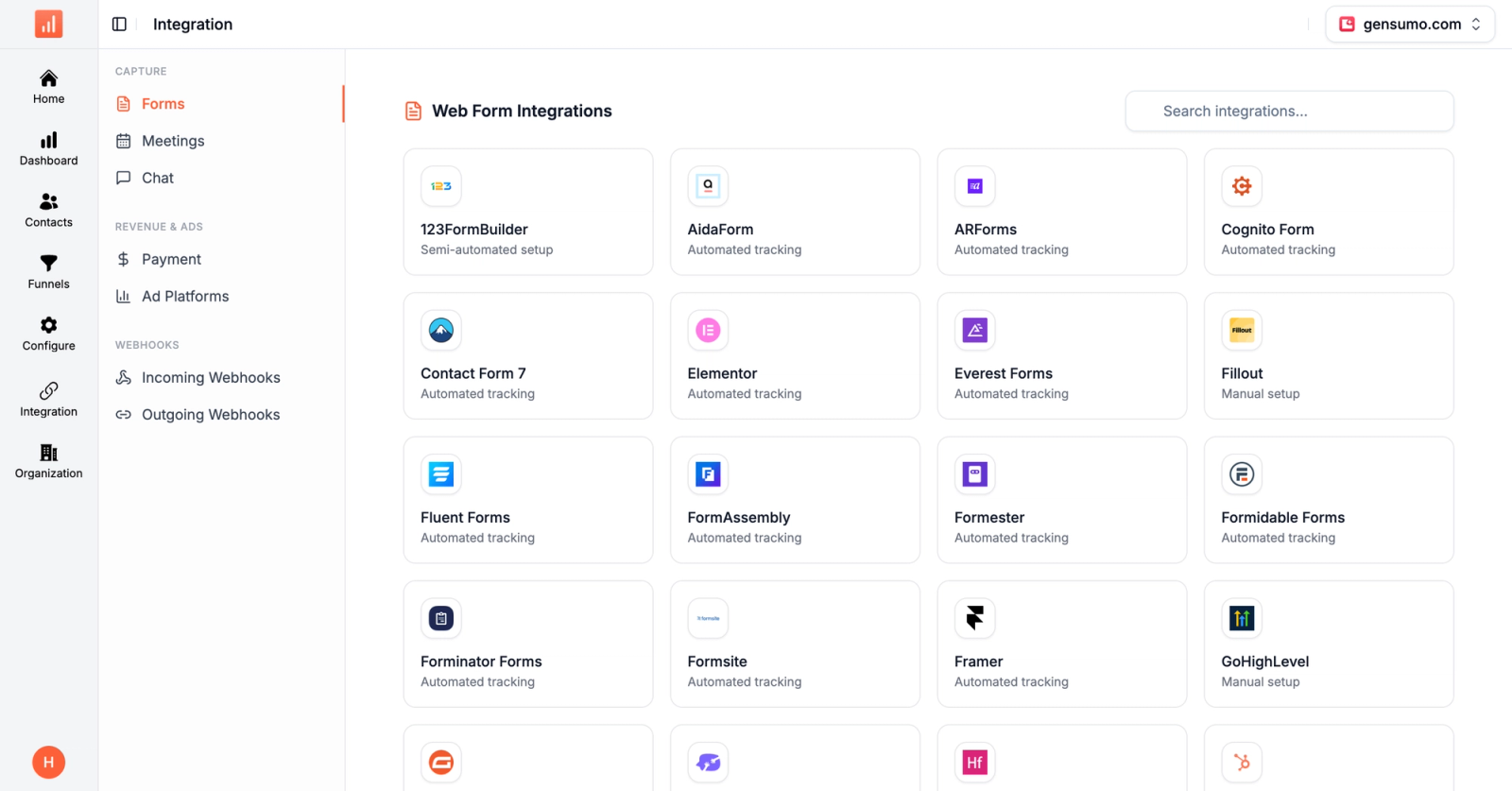
The setup is a snippet on the site and a webhook into your CRM. Most teams have lead source flowing into HubSpot or Salesforce within an hour. There's no required CDP, no rebuild, no implementation fee.
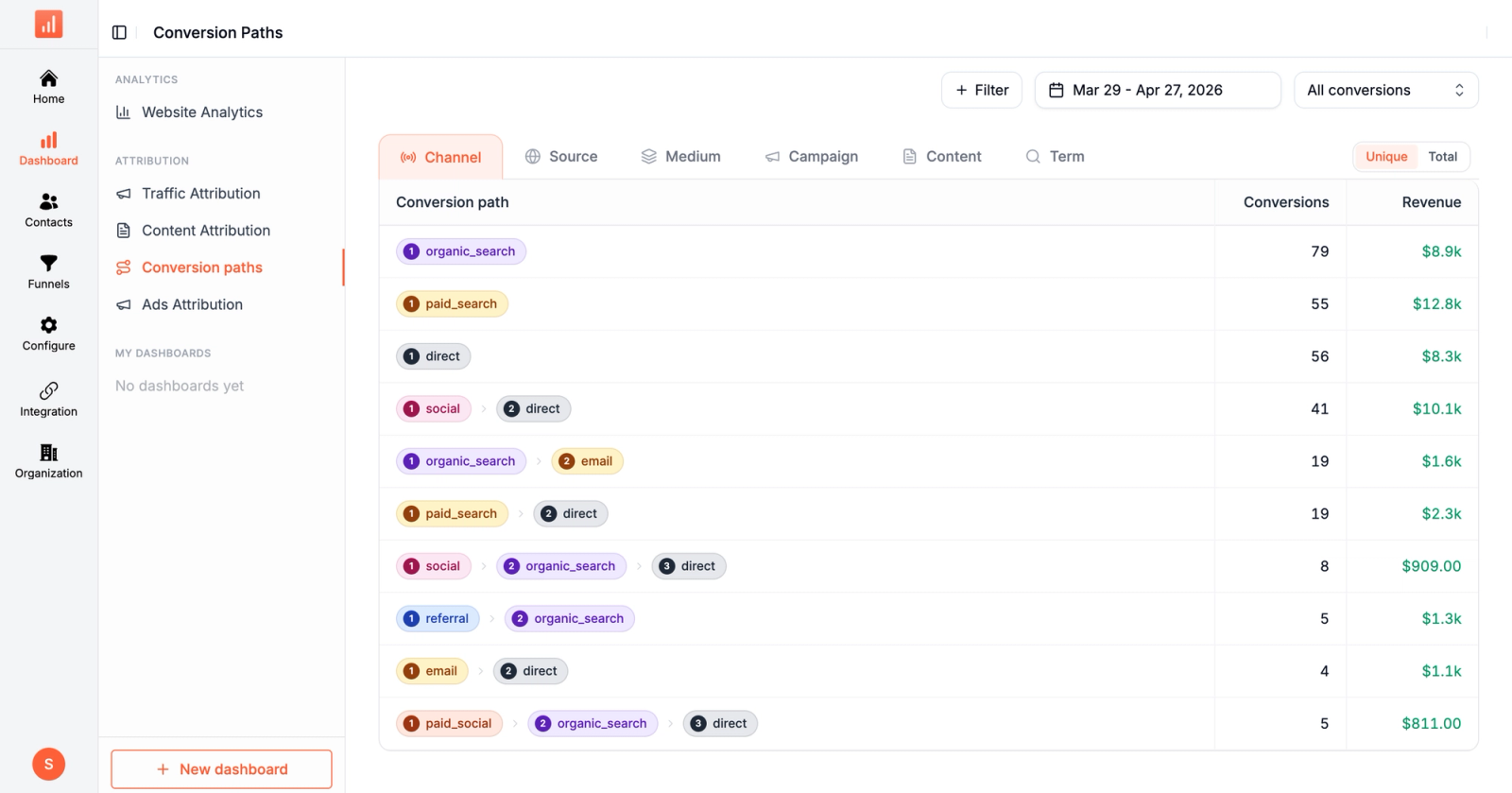
The conversion-path-by-channel report puts first-touch, multi-touch, and last-touch attribution side by side. Switching between models doesn't require re-tagging anything. The data is captured once. The model is applied at read time.
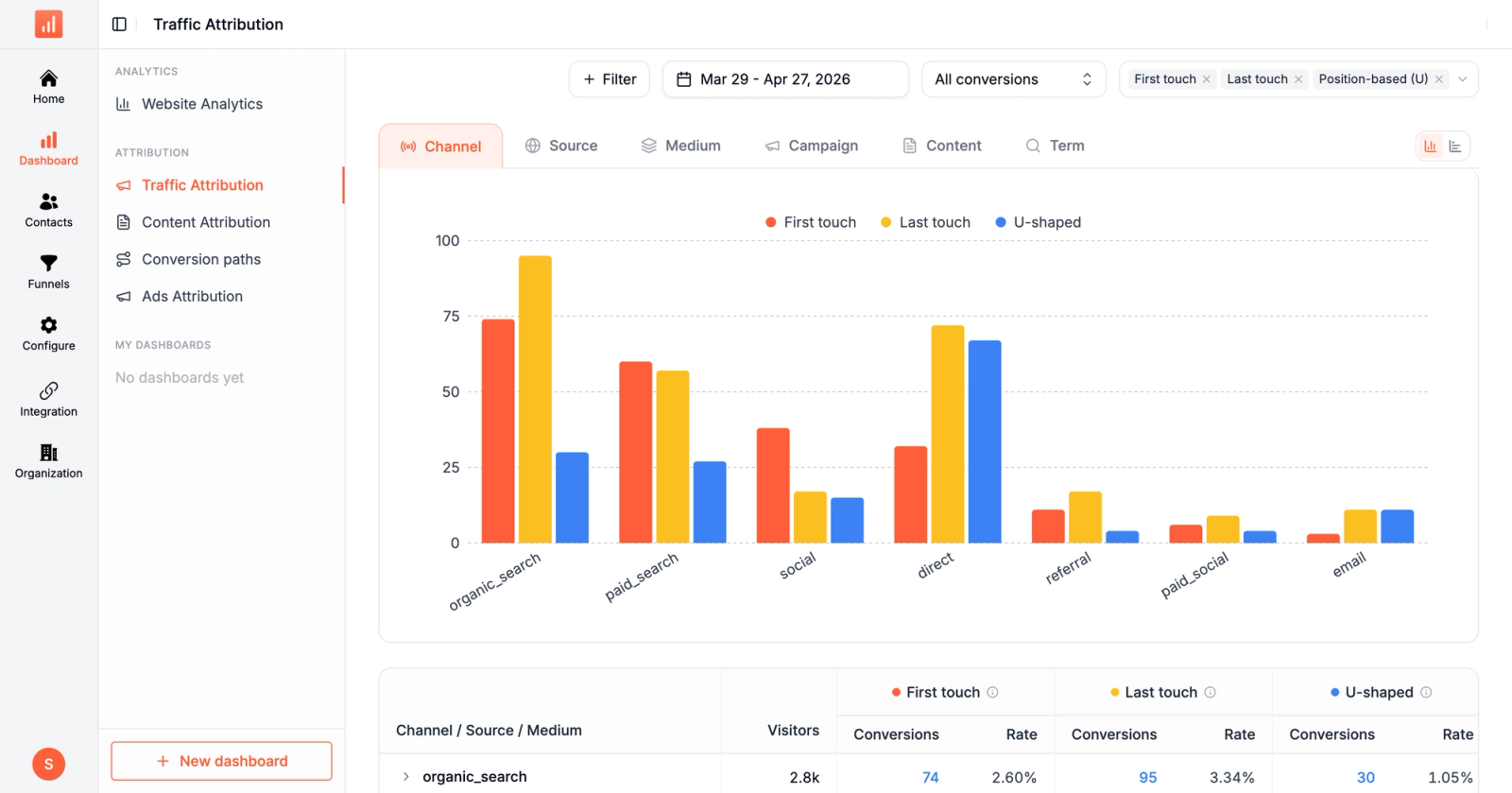
The traffic-attribution view rolls everything to channel-level pipeline and revenue. CAC by channel. Pipeline by source. Revenue by campaign. The questions a CMO needs answered to defend the budget.
The piece most B2B attribution tools punt on is content. Channels are easy because they have UTM parameters.
Content lives in the wild: a blog post shared in Slack, a podcast referenced in a newsletter, a LinkedIn post screenshot and pasted into an email. SourceLoop credits this dark-social activity by combining referrer data, landing-page heuristics, and direct-traffic detection.
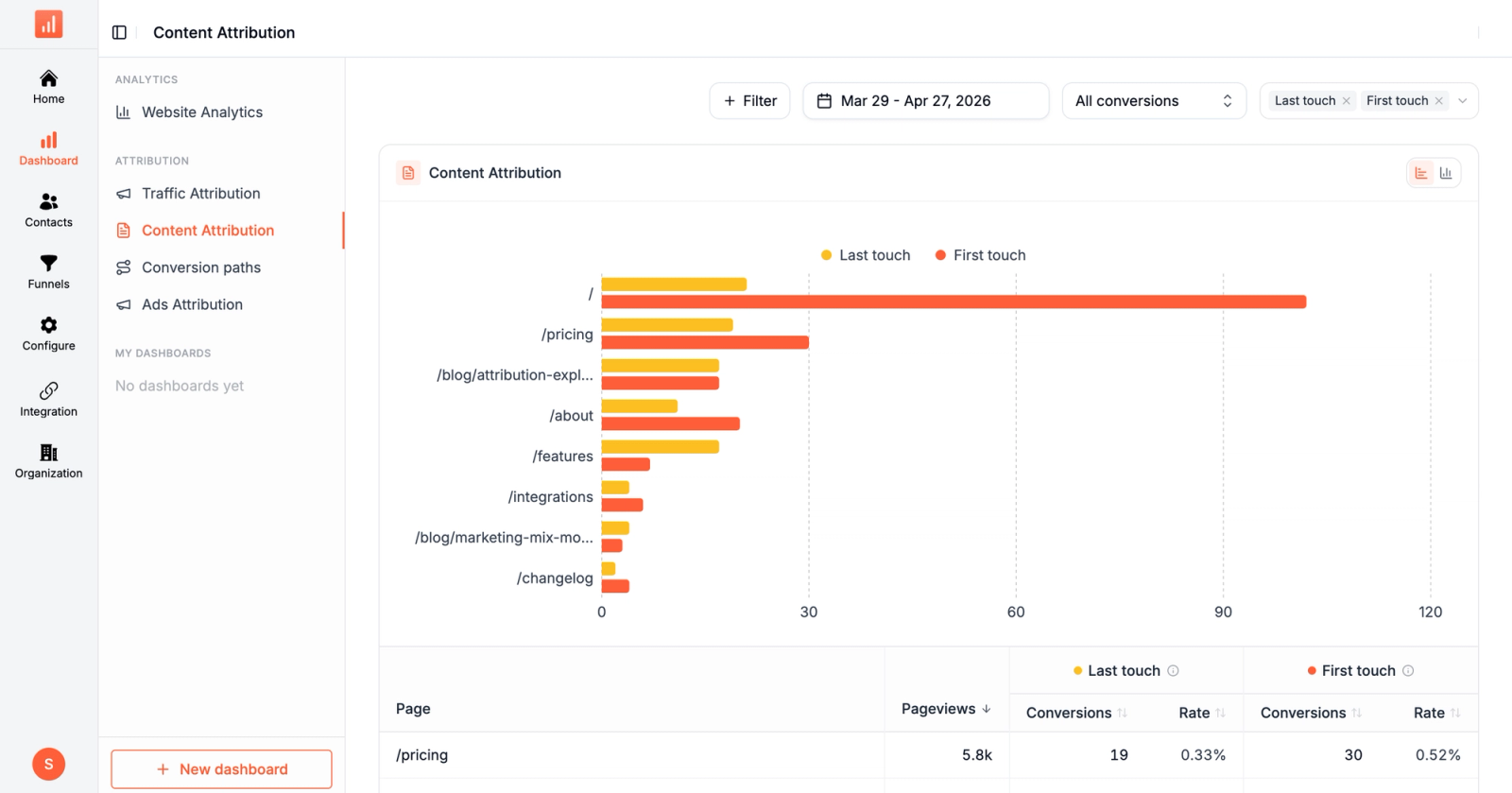
For teams that don't have a paid CRM yet, the built-in Contacts Hub gives you a clean place to see attribution alongside contact records.
For teams with HubSpot, Salesforce, or Pipedrive already, the same data syncs in as custom fields on contacts and deals.
Where it falls short for Dreamdata-style users
There's no account-level stitching of anonymous traffic to target accounts. This is the single biggest reason an ABM team would still pick Dreamdata over SourceLoop.
If you need to know that an anonymous visitor came from Acme Co. before they ever filled out a form (the way 6sense, Demandbase, Factors, and Dreamdata all do), SourceLoop won't do that today.
Salesforce is supported through webhook and Zapier rather than the deep two-way native integration Dreamdata ships. For most B2B teams below mid-market, that's fine.
For teams running mature revenue ops processes inside Salesforce (custom objects, opportunity-stage automation, custom field writes back from the attribution layer), Dreamdata is genuinely deeper.
Pricing
- Essential: $49 / month, 30k page views
- Professional: $99 / month, 100k page views
- Agency: $249 / month
Best for: Most B2B teams whose sales cycle is under 6 months and whose attribution question is broader than just account-based ABM. Create a free SourceLoop account.
2. HockeyStack
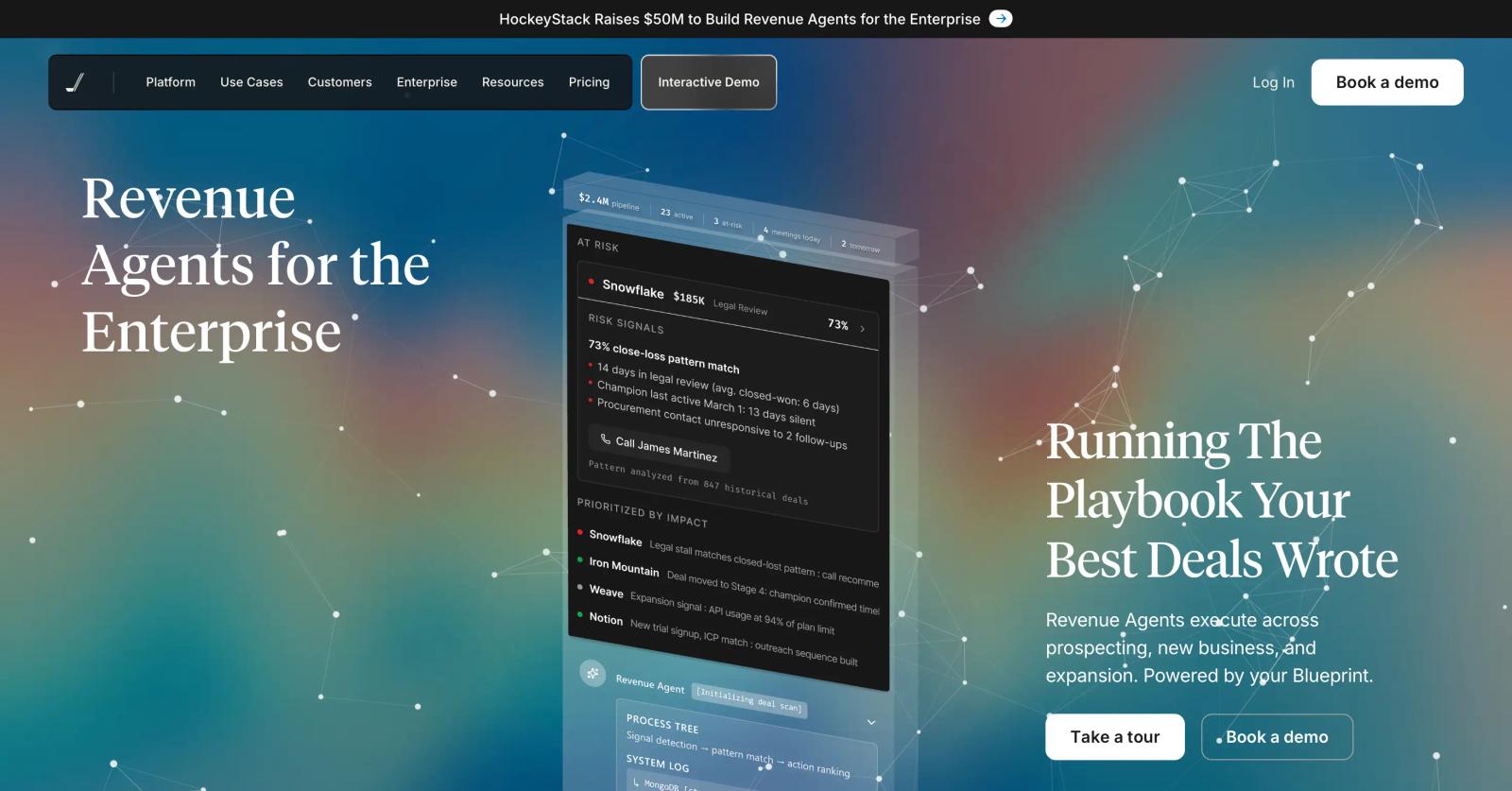
HockeyStack is the closest direct peer to Dreamdata in the B2B SaaS space. It started as account-based analytics and grew into one of the more complete multi-touch attribution platforms for that segment.
If your decision is "Dreamdata vs HockeyStack," it usually comes down to architecture preference: Dreamdata reads Salesforce as truth and writes back; HockeyStack treats CRM and product data as inputs and runs its own modeling layer on top.
Key capabilities
- Account-level journeys that stitch anonymous traffic to target accounts using IP, reverse-DNS, and de-anonymization signals
- Native HubSpot, Marketo, and Salesforce with bi-directional sync, including custom objects on the enterprise tier
- AI assistant ("Odin") that answers natural-language questions with real charts and prose, not generic explanations
- Sub-second query performance on enterprise data sets, with warehouse-grade caching
- Pre-built ABM dashboards for stage progression, deal influence, content performance, and source-of-pipeline by segment
Watch-outs
It's expensive. Pro starts around $1,000 per month at low contact volumes. Enterprise contracts routinely reach $50,000-$60,000 per year for mid-market accounts.
The product is built for B2B SaaS specifically. If your funnel includes a meaningful share of self-serve signups, agency-style multi-client reporting, or DTC-style purchase events, you'll pay for capabilities that don't fit the model.
Pricing
Pro from ~$1,000 / month. Enterprise custom, typically $25,000-$60,000 annually.
Best for: B2B SaaS marketing teams running multi-touch and ABM with serious data volume, where being right about channel ROI matters more than the platform fee.
3. Factors.ai
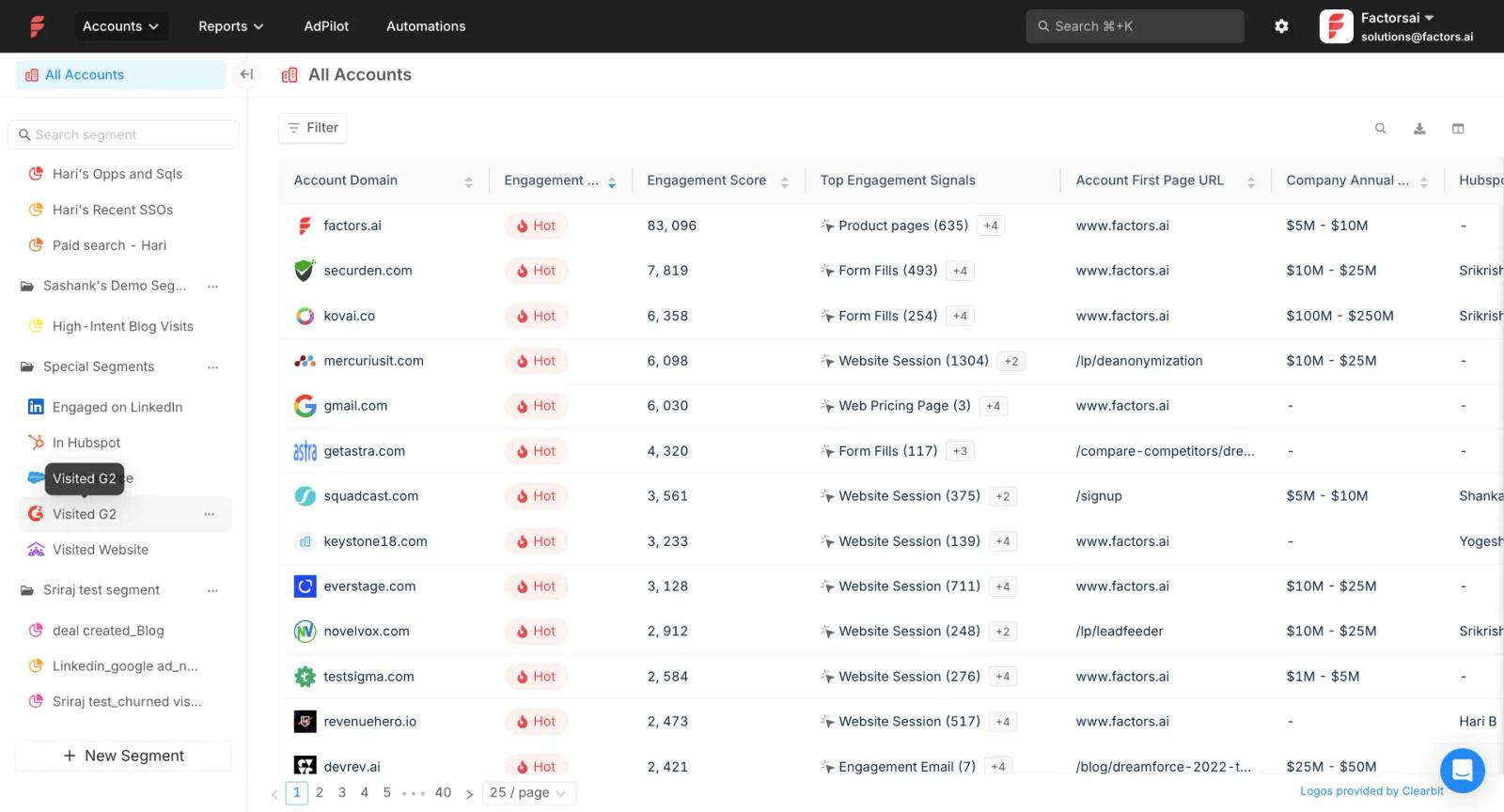
Factors.ai sits between Dreamdata and HockeyStack on the architecture spectrum. It's account-first, with one differentiating feature: native LinkedIn intent integration that surfaces in-market accounts based on engagement patterns across the LinkedIn network.
For teams whose ABM motion runs heavily on LinkedIn, that integration is the reason to look here.
Key capabilities
- Account identification via reverse-IP and de-anonymization (powered by ZoomInfo, Clearbit, and a proprietary signal layer)
- LinkedIn intent integration for in-market account targeting and ad audience activation
- Multi-touch attribution with B2B-specific weighted models that respect deal size, stage progression, and account age
- Salesforce, HubSpot, Marketo native sync with bi-directional updates
- Workflow automation that triggers Slack alerts, Salesforce tasks, or sequence enrollment when accounts hit defined intent thresholds
Watch-outs
Setup is real, not snippet-and-go. Most teams budget 1-2 weeks with help from Factors' onboarding team to get account identification and CRM sync tuned correctly.
The free trial is fixed at 15 days, which isn't long enough to see real attribution data accumulate for accounts with longer cycles. Plan to run a paid pilot if you want to evaluate honestly.
Pricing
Free tier with limits. Paid plans from ~$899 / month. Enterprise custom.
Best for: B2B SaaS and services teams running ABM with LinkedIn as a core channel.
4. 6sense
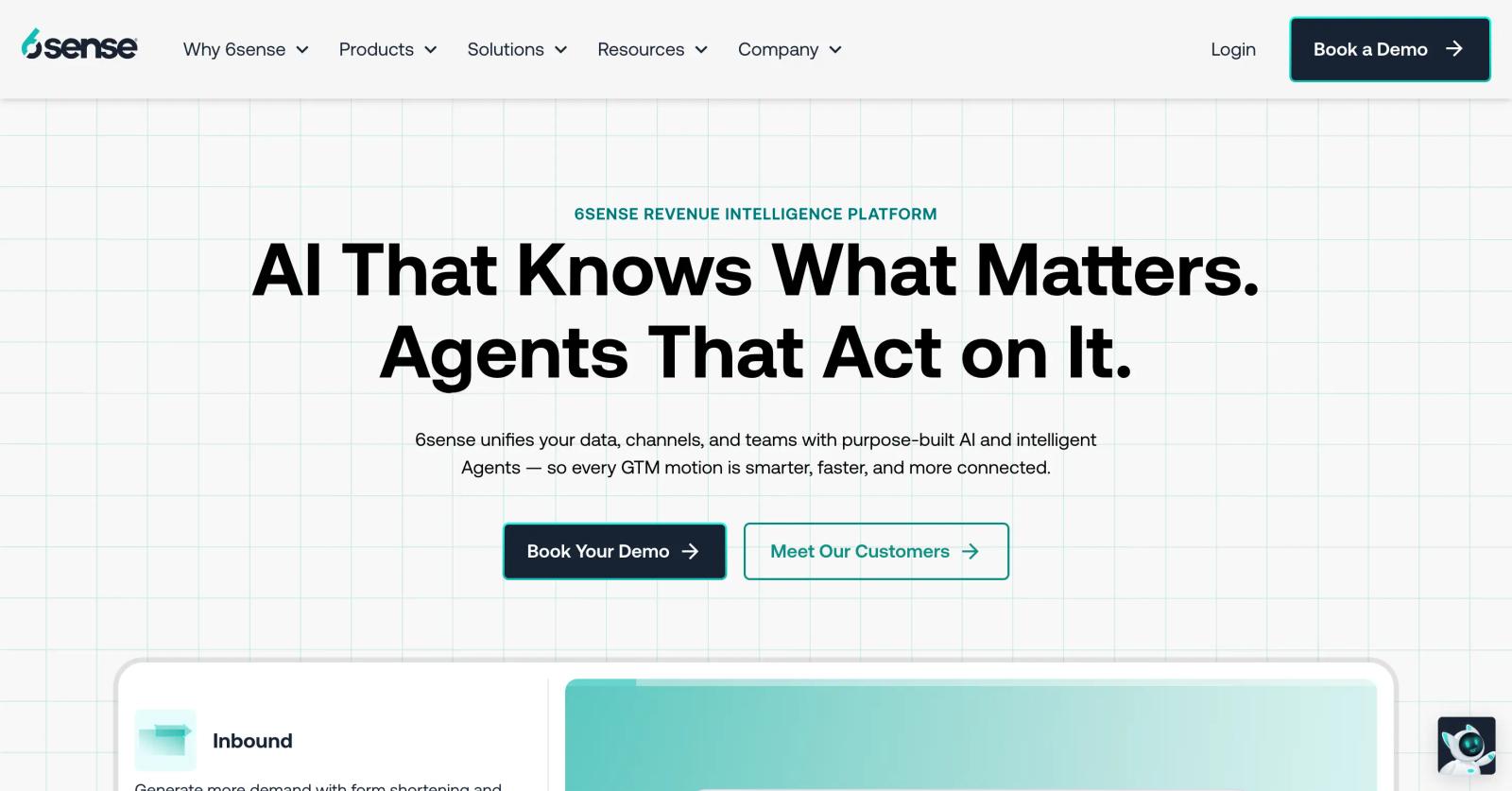
6sense is the most-quoted name in enterprise ABM. The pitch is predictive: instead of waiting for an account to identify itself, 6sense uses third-party intent signals across the public web to predict which accounts are entering a buying cycle, then orchestrates ads, sales outreach, and content personalization at those accounts.
If your sales motion involves outbound to high-value accounts and your team has the headcount to act on intent signals, 6sense pays back fast. If you don't, it's an expensive intent-data subscription.
Key capabilities
- Predictive intent scoring based on third-party signal data (anonymous B2B web behavior captured across 6sense's network)
- Buying-stage detection classifying accounts as Awareness, Consideration, Decision, or Purchase
- ABM orchestration across web personalization, paid ads, sales prospecting, and email
- Anonymous account identification at higher fidelity than most competitors, especially for accounts not yet in your CRM
- Salesforce, Marketo, HubSpot, and Outreach integrations with deep CRM operations and custom workflows
Watch-outs
Pricing is enterprise-only and rarely transparent. Plans typically run $50,000-$120,000 per year, with the higher tiers including the orchestration features that make the platform pay back.
The product is large. Most companies under-use what they buy. Plan for a 4-8 week implementation and a dedicated person on the team who owns the platform.
Pricing
Custom. Typically $50,000+ per year for full deployment.
Best for: Mid-market and enterprise B2B running outbound-led growth with named target accounts and the operational maturity to act on intent.
5. Demandbase
Demandbase is 6sense's longest-running competitor. The pitch is similar (account intent, ABM orchestration, anonymous account ID) with one differentiator: a built-in advertising platform that lets you serve ads directly to identified accounts without going through Meta or LinkedIn.
For teams running serious ABM advertising, that built-in DSP can save real money compared to the same campaigns through public ad platforms.
Key capabilities
- Account intent and engagement scoring combining first-party engagement with third-party signal data
- ABM orchestration across web, ads, outbound sales, and email nurture
- Built-in DSP for serving display ads directly to identified accounts (no Meta or LinkedIn fees)
- Anonymous traffic-to-account stitching with industry-leading match rates for North American B2B
- Salesforce and Marketo native with deep integration into pipeline reporting
Watch-outs
Pricing matches 6sense (enterprise tiers, $50,000+ per year). Implementation is similarly long.
The platform's strength is in advertising orchestration. If you're shopping for revenue attribution as a primary use case (without the ABM advertising layer), Dreamdata or HockeyStack are typically a better fit.
Pricing
Custom. Typically $50,000+ per year.
Best for: Enterprise B2B teams running paid ABM where having the ad platform inside your attribution platform changes the math.
6. Adobe Marketo Measure (formerly Bizible)
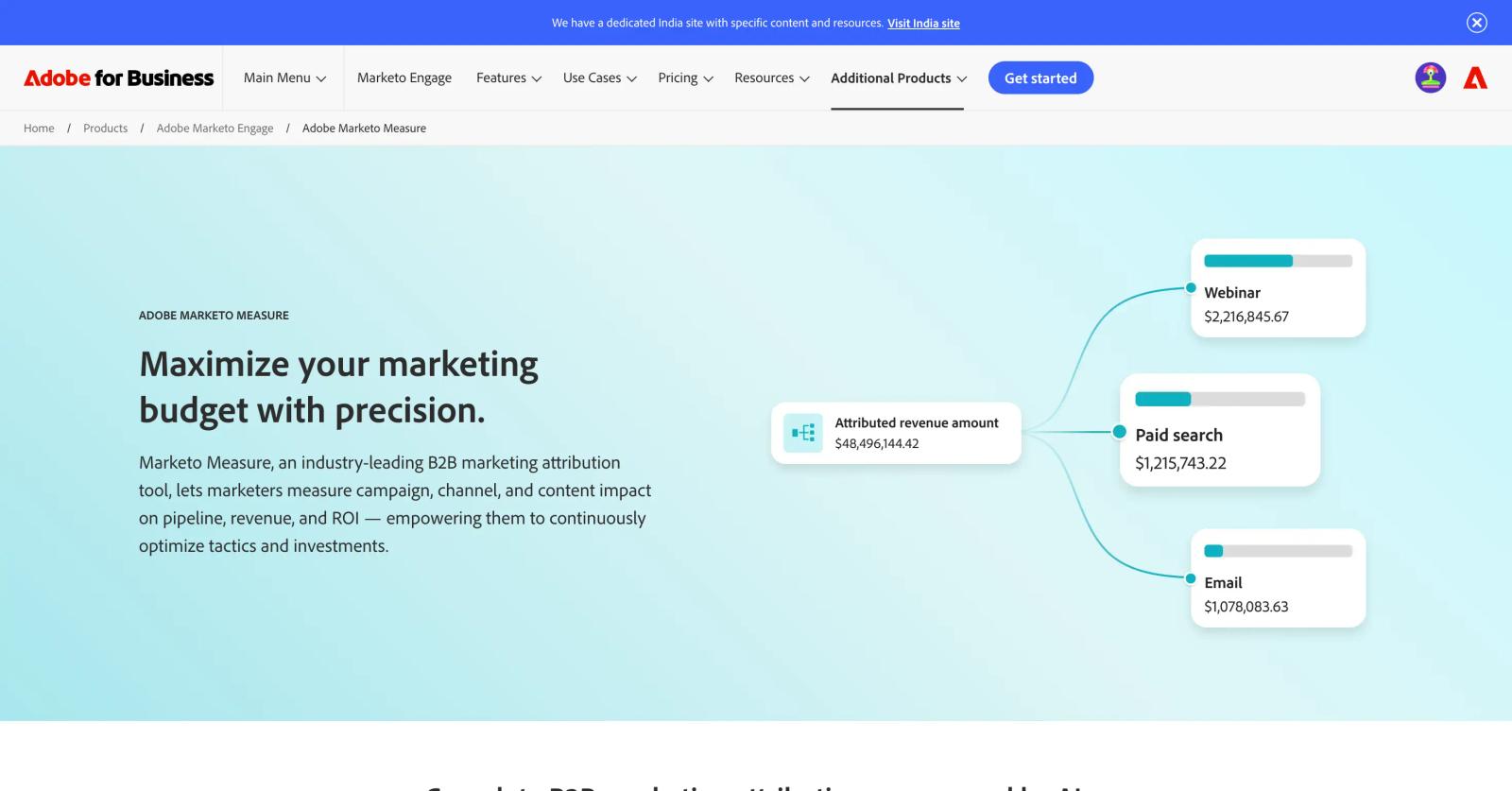
Marketo Measure is the enterprise B2B option, deeply tied to Adobe's stack and Salesforce. It's what large companies pick when board-grade auditability matters more than time-to-value.
If your CFO is going to ask hard questions about how channel ROI is calculated, Marketo Measure has the credibility and the audit trail.
Key capabilities
- Multi-touch revenue attribution at enterprise scale, with custom models defined and audited by your finance team
- Native Salesforce and Marketo integration, including custom-object reads and writes
- Deep Adobe Experience Cloud connectivity, useful if Adobe Analytics or Adobe Target are already in your stack
- Pipeline-stage progression tracking with attribution across stages, not just first-touch
- Custom reporting dashboards that integrate with Salesforce reports and Adobe-native business intelligence
Watch-outs
Implementation is real. Most companies budget 60-90 days, a Salesforce admin, and a Marketo admin. Pricing is custom and rarely below $2,000 per month, often much higher for full deployments.
You're locked into the broader Adobe stack to get the full value. If you're not already running Marketo and Salesforce together, the lift is hard to justify.
Pricing
Custom. Typically $2,000+ per month, often $40,000+ annually for mid-market.
Best for: Enterprise B2B already on Marketo and Salesforce, with mature ops teams and a real need for board-grade attribution.
7. HubSpot Marketing Analytics
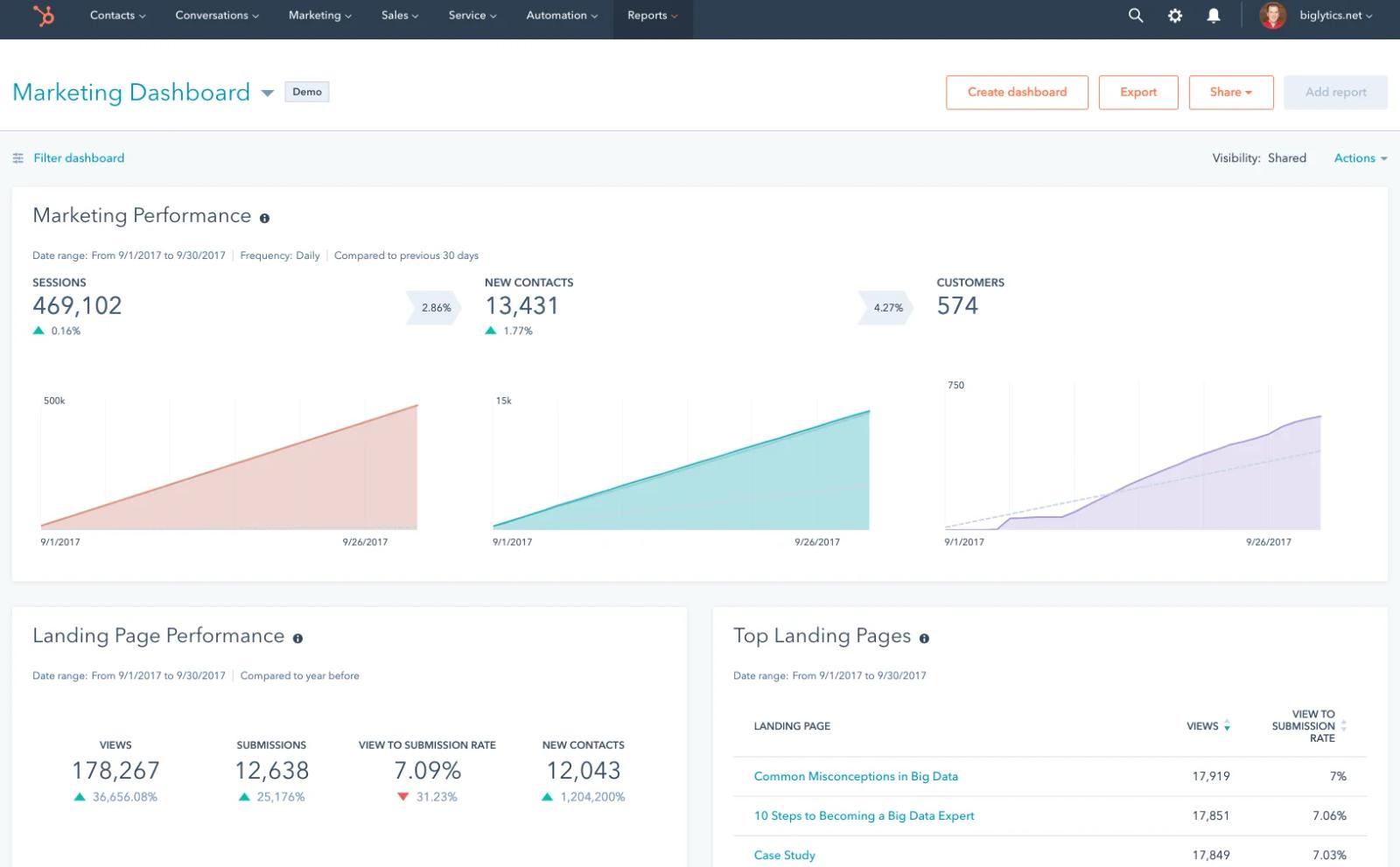
If your stack runs on HubSpot Marketing Hub Professional or Enterprise, the built-in attribution module is worth turning on before evaluating anything else. It tracks first-touch, last-touch, and a few multi-touch models, and reports on revenue at the deal level rather than just contact creation.
The trade-off is depth. HubSpot's attribution is good. Dreamdata's, HockeyStack's, and Marketo Measure's are better.
Key capabilities
- Native integration with everything HubSpot already tracks: forms, contacts, deals, lifecycle stages, custom properties
- Multi-touch attribution models: linear, U-shaped, W-shaped, time-decay, full-path
- Revenue attribution at the deal level with closed-won pipeline tied to source-of-influence
- Custom property-based reporting that fits the way your team already thinks about data
- Closed-loop ad management integration for HubSpot's built-in Google and Facebook ad tools
Watch-outs
You need Marketing Hub Professional ($800/month) or Enterprise ($3,600/month) to get attribution at all. Starter doesn't include it.
The reporting works inside HubSpot's reporting paradigm, which is competent but not loved. If you've been using BI tools or Looker for marketing analytics, HubSpot's reports will feel restrictive.
Pricing
Marketing Hub Professional from $800 / month (annual). Enterprise from $3,600 / month.
Best for: Teams already paying for Marketing Hub Pro or Enterprise who want to consolidate inside HubSpot rather than add another platform.
8. Ruler Analytics
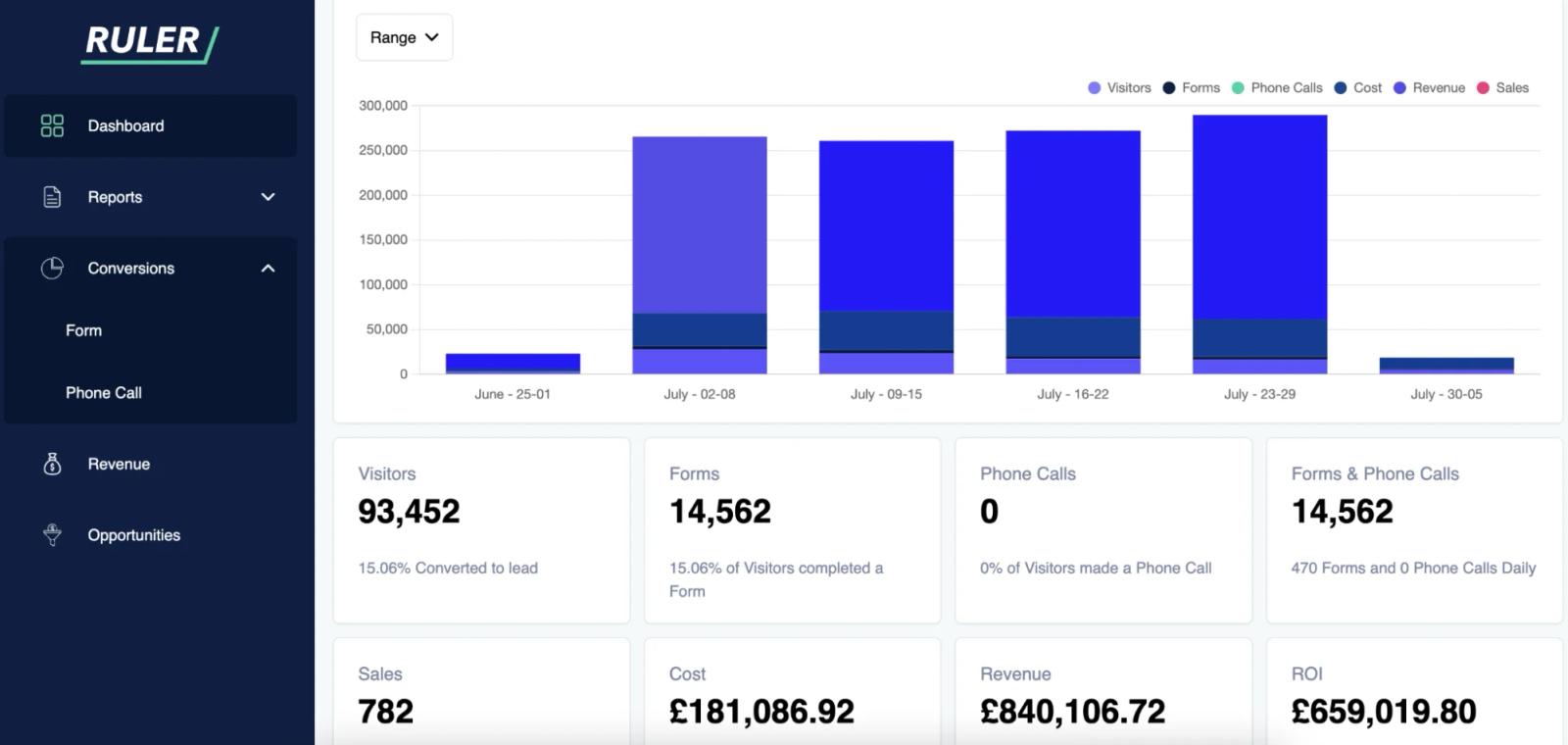
Ruler is the UK-built lead-gen attribution platform. It captures forms, calls, chats, and meetings, ties them back to source, and pushes attribution into your CRM with multi-touch models.
For Dreamdata users whose actual problem is "show me what's working" rather than "stitch anonymous traffic to target accounts," Ruler is a simpler and cheaper path.
Key capabilities
- Form, call, chat, and meeting tracking unified in one product (uncommon for tools at this price tier)
- Multi-touch attribution with first, last, linear, and weighted models
- CRM integrations including HubSpot, Salesforce, and Pipedrive with attribution attached at the contact and deal level
- Offline conversion sync to Google Ads, Meta CAPI, and LinkedIn Ads for closed-loop ad optimization
- UK and EU support with data residency options that matter for European customers
Watch-outs
Pricing starts at $199 a month and scales fast at higher lead volumes. The setup isn't a four-week project, but it isn't an hour either. Plan for a week.
The UI feels older than HockeyStack, Factors, or SourceLoop. Functional, not modern. After a week in the newer tools, the contrast is noticeable.
Pricing
From $199 / month. Enterprise custom.
Best for: UK and EU mid-market B2B and lead-gen teams that want forms-plus-calls in one product and prefer a UK-based vendor.
9. Heap
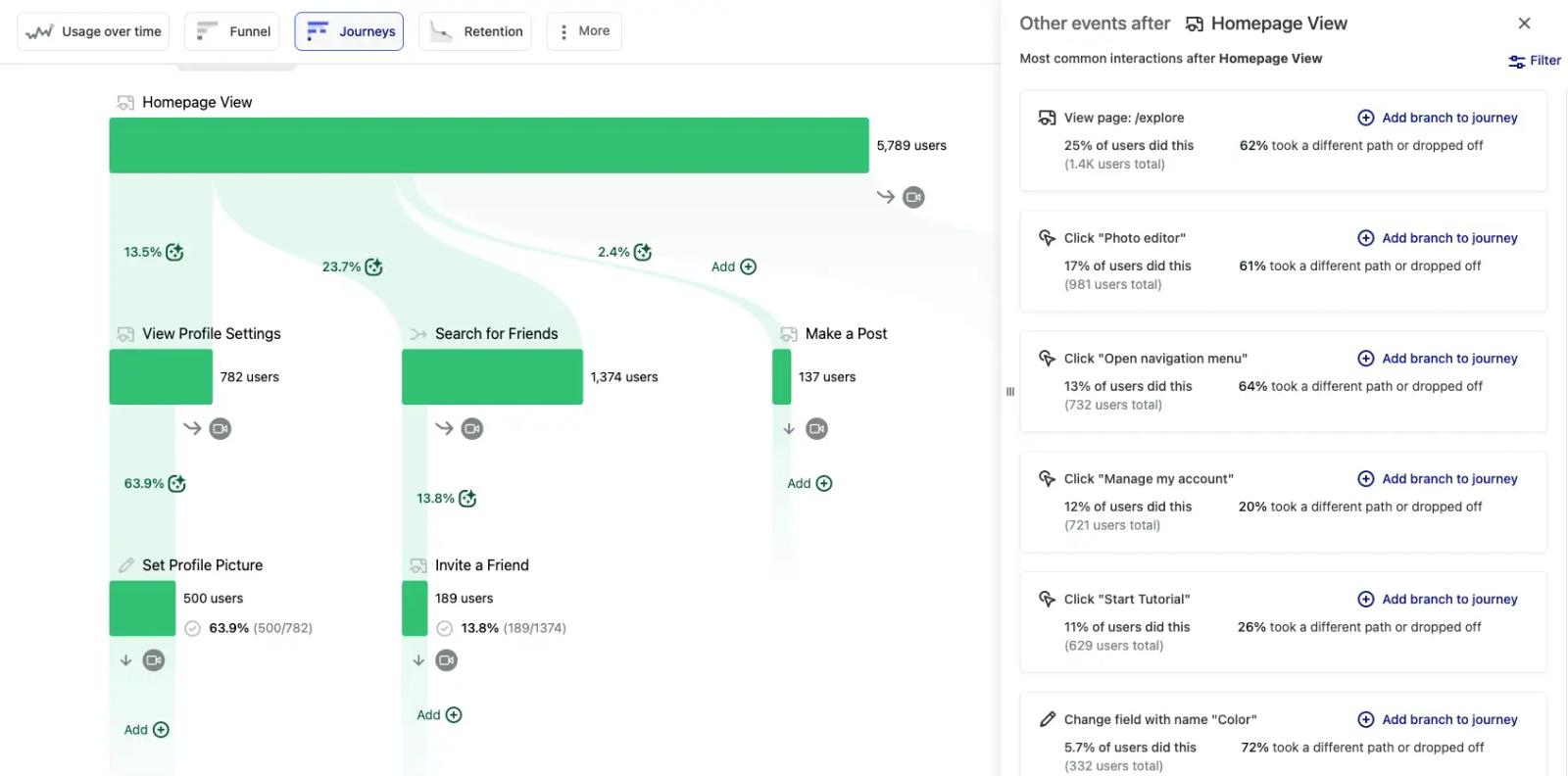
Heap is product analytics first, marketing analytics second. The differentiator is auto-capture: every click, page view, and form submission is captured automatically without explicit tagging, and you can build retroactive funnels and segments without writing tracking code.
For teams whose B2B funnel includes a meaningful product-led element (free trial, freemium, self-serve), the marketing-plus-product picture in one tool is a real win.
Key capabilities
- Auto-capture of every event without manual tagging, with retroactive funnel and cohort analysis
- Behavioral cohorts and journey reports that mix product behavior with marketing source
- Multi-touch attribution for marketing channels, with revenue tie-back at the user or account level
- Salesforce integration that connects product behavior to deals
- Free starter tier that's actually usable for early-stage product analytics
Watch-outs
Heap is a product analytics tool with attribution capabilities, not a pure attribution platform. If your problem is multi-channel revenue attribution at scale, dedicated tools (HockeyStack, Dreamdata) are more focused.
The pricing curve gets steep as event volume grows. Many teams that start on the free tier hit the upgrade wall faster than they expected.
Pricing
Free tier (up to 10k sessions). Paid plans from $3,600 per year. Enterprise custom.
Best for: Product-led B2B SaaS teams whose attribution question lives at the intersection of marketing source and product engagement.
10. Funnel
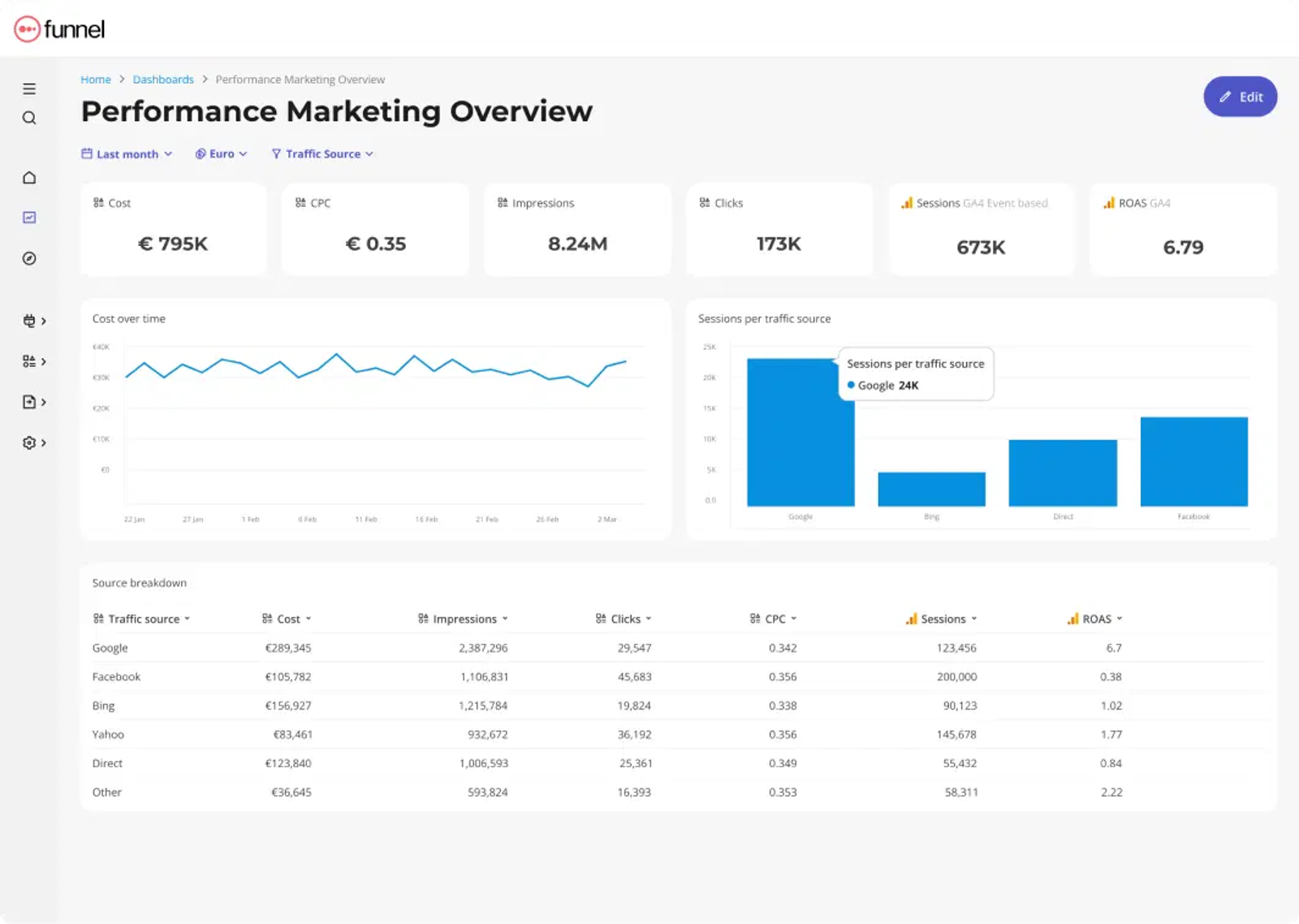
Funnel isn't an attribution platform. It's a marketing data pipeline that pulls from 500+ sources (ads, CRM, analytics, e-commerce, social) and sends them into a warehouse, BI tool, or marketing platform of your choice.
If you have a data team and you'd rather build attribution yourself with full control over modeling, Funnel is the foundation layer for that approach.
Key capabilities
- 500+ source connectors including Meta Ads, Google Ads, LinkedIn, TikTok, Salesforce, HubSpot, Shopify, Stripe, and dozens more
- Data normalization and reshaping with a custom rule engine, not just raw passthrough
- Destination flexibility: warehouse (BigQuery, Snowflake, Redshift), BI (Looker, Tableau, Power BI), reverse-ETL into ad platforms or CRM
- Custom dimensions and metrics that match your business model rather than the source platform's schema
- Schedule and orchestration for reliable daily or hourly data refreshes
Watch-outs
Funnel doesn't ship attribution dashboards. You're building those yourself in Looker, Tableau, or your custom internal tool. If you don't have analytics capacity, this is the wrong category for you.
The price is for the data pipeline, not for the attribution logic. Expect to add BI tooling, analyst time, and modeling effort on top.
Pricing
From ~$1,500 / month. Higher tiers scale with data volume and source count.
Best for: B2B teams with a data analyst or data team who want to build attribution and reporting on their own infrastructure.
11. Attribution (attribution.app)
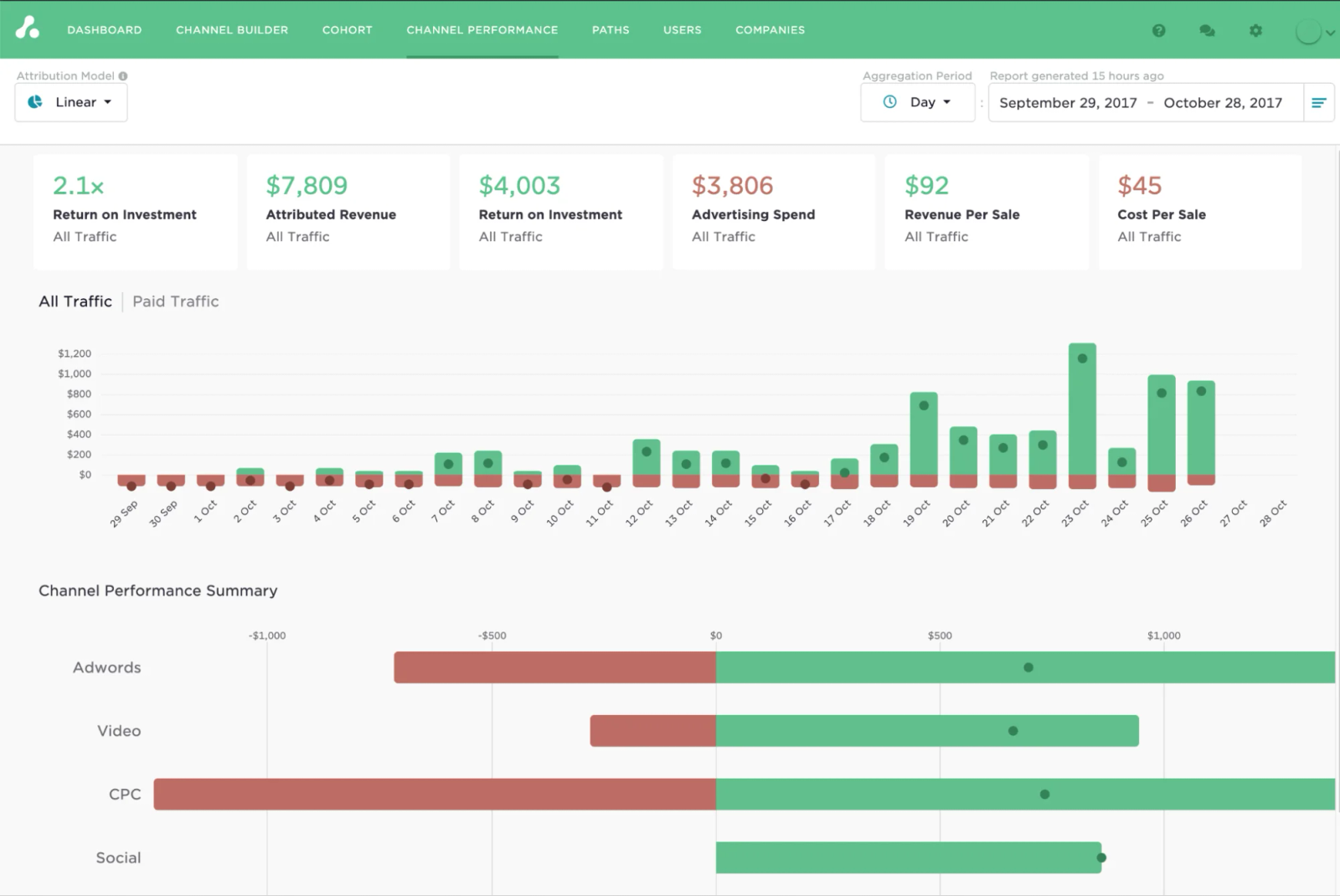
Attribution is the lightweight, low-cost option. It captures sources on forms, runs multi-touch models, and pushes data to HubSpot, Salesforce, or webhooks. The free tier is generous enough to actually pilot the product without hitting limits.
For Dreamdata users who realized their attribution problem doesn't justify the $999 floor, Attribution is the cheapest honest swap.
Key capabilities
- Free tier with reasonable limits for early-stage teams or pilots
- Multi-touch attribution out of the box, including custom models on paid tiers
- Form and event capture through a single snippet
- CRM sync to HubSpot, Salesforce, and arbitrary webhooks
- Lightweight by design, no enterprise pretensions, no implementation team required
Watch-outs
There's no account-level stitching, no native ABM features, no built-in CRM, no dark-social attribution. The action layer (offline conversion sync, journey orchestration) is light.
The product roadmap has been quieter than some competitors. Worth verifying current state before committing.
Pricing
Free tier. Paid plans from around $99 / month.
Best for: Lean B2B teams that want light multi-touch attribution at near-zero cost and don't need account-level ABM features.
How to pick the right one
Start with the question, not the feature list.
If your attribution problem is "show me which channels and content actually drive pipeline" and your sales cycle is under 6 months, SourceLoop covers it cleanly. $49 to $249 a month, set up in an hour, multi-touch attribution and offline ad sync without an implementation team. Create a free SourceLoop account. 7 days, no card.
If your attribution problem is genuinely account-based:
- Mid-market B2B SaaS, ABM-led: HockeyStack or Factors.ai. Both stitch anonymous traffic to accounts. HockeyStack has stronger dashboards. Factors has better LinkedIn intent.
- Enterprise ABM with outbound motion: 6sense or Demandbase. Real intent data, real orchestration, real price tag.
- Already on Adobe / Marketo / Salesforce: Marketo Measure, especially if your CFO needs auditable attribution.
- HubSpot-native: turn on HubSpot's built-in attribution before shopping anywhere else.
- Product-led growth: Heap, because the picture starts inside the product.
- You have analysts and prefer building your own: Funnel for the data pipeline, Looker or Tableau for the dashboards.
- Your problem is small and the budget is smaller: Attribution.
If none of those fit cleanly, SourceLoop is where I'd start.
Frequently asked questions
-
What is the cheapest Dreamdata alternative?
Attribution at $0 (free tier) and SourceLoop at $49 per month are the two lowest entry points. Attribution is light on dashboards, journey reporting, and ad-platform sync. SourceLoop ships full multi-touch dashboards and offline ad sync at the entry tier. For most B2B teams the SourceLoop $49 plan does more than Dreamdata's free tier and a meaningful chunk of what the $999 tier covers.
-
Does any of these tools include account-level ABM stitching?
HockeyStack, Factors.ai, 6sense, Demandbase, and Marketo Measure all do, in different forms. Dreamdata does it natively. SourceLoop, HubSpot Marketing Analytics, Ruler Analytics, Heap, Funnel, and Attribution don't (or do it weakly). If account-level stitching is a hard requirement, the first list is your shortlist.
-
Can I migrate from Dreamdata easily?
The technical migration is straightforward (snippet swap, CRM connector reconfiguration). The hard part is rebuilding the custom models and reports you set up over time inside Dreamdata. Most attribution tools don't import historical visitor sessions, so you'll have a 30-90 day window where the new tool's lookback fills up. Plan the migration around a quieter period and run both tools in parallel for the first 30 days.
-
Is Dreamdata's free tier actually useful?
Yes, for very small B2B teams. The limits are generous enough to run real attribution for early-stage SaaS companies. Most teams who outgrow the free tier do so within 6-9 months as deal volume picks up, at which point the $999 jump feels steep against the alternatives.
-
What about Bizible?
Bizible is now Adobe Marketo Measure. The Bizible product was acquired by Marketo in 2018 and rebranded after Adobe acquired Marketo. The roadmap has merged with Adobe's broader attribution and analytics suite.


 Paid Social


