
9 Best HockeyStack Alternatives I Tested for 2026
HockeyStack alternatives compared honestly. Nine attribution tools across price tiers, with the option that ships modern multi-touch at one-tenth the cost.
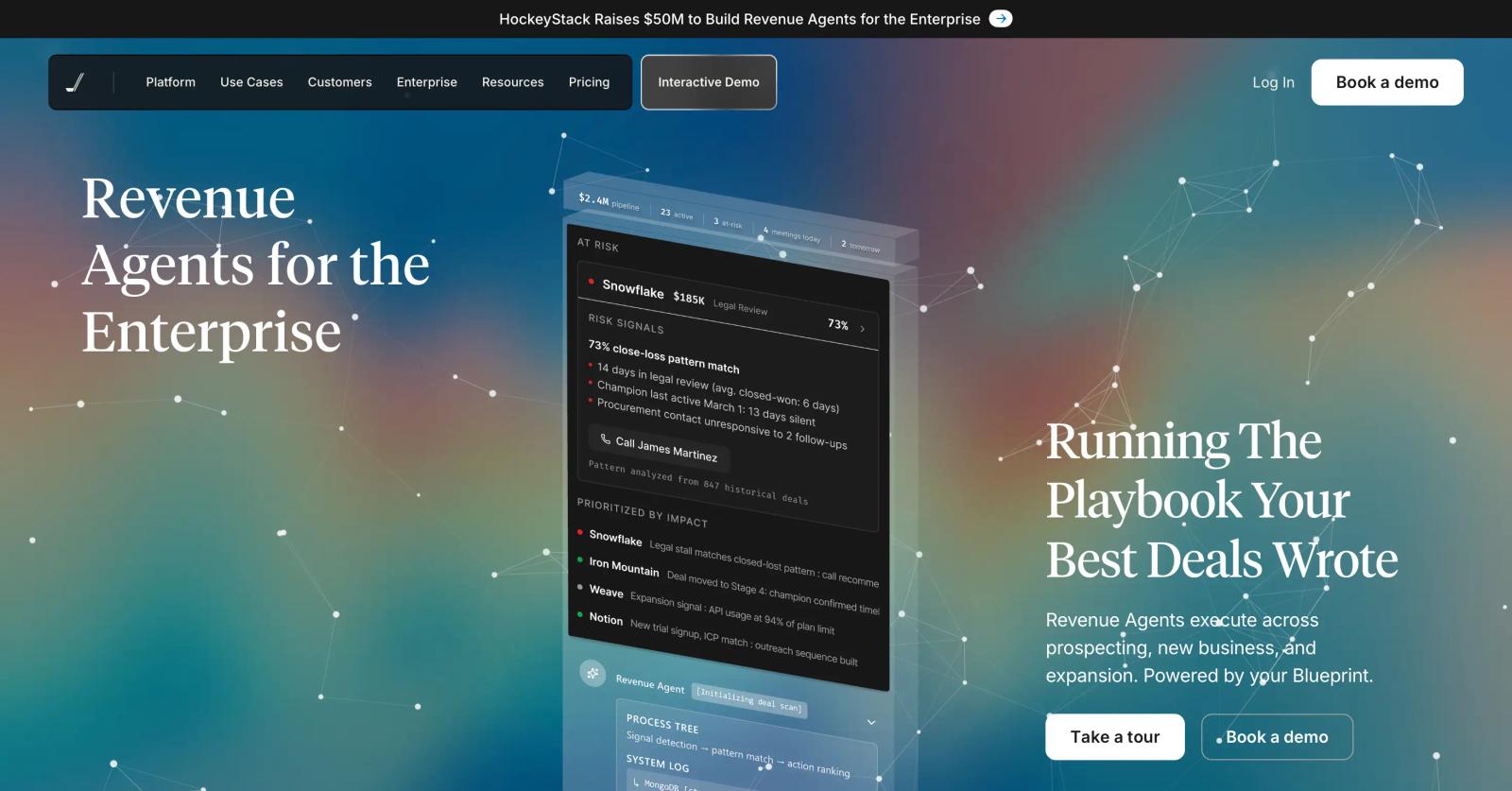
Table of contents
- Quick comparison of HockeyStack Alternatives
- 1. SourceLoop
- How the tracking install works
- The journey behind every lead and account
- Multi-touch attribution and reports
- CRM sync and pipeline reporting
- Sending conversions to ad platforms
- Querying it with an agent
- The honest gaps for a HockeyStack evaluator
- Pricing
- 2. Dreamdata
- Key capabilities
- Watch-outs
- Pricing
- 3. Factors.ai
- Key capabilities
- Watch-outs
- Pricing
- 4. 6sense
- Key capabilities
- Watch-outs
- Pricing
- 5. Demandbase
- Key capabilities
- Watch-outs
- Pricing
- 6. Adobe Marketo Measure
- Key capabilities
- Watch-outs
- Pricing
- 7. HubSpot Marketing Analytics
- Key capabilities
- Watch-outs
- Pricing
- 8. Heap
- Key capabilities
- Watch-outs
- Pricing
- 9. Attribution (attribution.app)
- Key capabilities
- Watch-outs
- Pricing
- How to pick the right one
HockeyStack started as an attribution and journey analytics tool. Solid product, fair price.
Then it grew up. The platform now positions itself as an enterprise Revenue Agents platform with AI agents, account scoring, intent data, and the rest of the GTM stack. Pricing moved with it. Most teams now end up in five-figure annual contracts, with starting plans well above $1,000 a month.
If you bought HockeyStack for the attribution and journey tracking, and you're feeling the pricing creep or the feature bloat, here are nine alternatives worth a look.
Quick comparison of HockeyStack Alternatives
| Tool | Best for | Starts at | Setup | Multi-touch | Account-level | AI insights |
|---|---|---|---|---|---|---|
 SourceLoop SourceLoop |
Most teams | $49 / mo | ~1 hour | Yes | No | No |
 Dreamdata Dreamdata |
Long-cycle B2B | Free / $999 / mo | ~1 week | Yes | Yes | Limited |
 Factors.ai Factors.ai |
LinkedIn-led ABM | ~$899 / mo | 1-2 weeks | Yes | Yes | Yes |
 6sense 6sense |
Enterprise ABM | ~$50k+ / year | 4-8 weeks | Yes | Predictive | Yes |
 Demandbase Demandbase |
Enterprise ABM + ads | ~$50k+ / year | 4-8 weeks | Yes | Yes | Yes |
 Adobe Marketo Measure Adobe Marketo Measure |
Enterprise revenue ops | ~$2,000+ / mo | 60-90 days | Yes | Limited | No |
 HubSpot Marketing HubSpot Marketing |
HubSpot-native | From $800 / mo | Bundled | Yes | Limited | Limited |
 Heap Heap |
Product-led B2B | Free / $3,600+ / yr | ~1 week | Yes | Limited | Limited |
 Attribution Attribution |
Cheap simple | Free / $99 / mo | ~1 hour | Yes | No | No |
1. SourceLoop
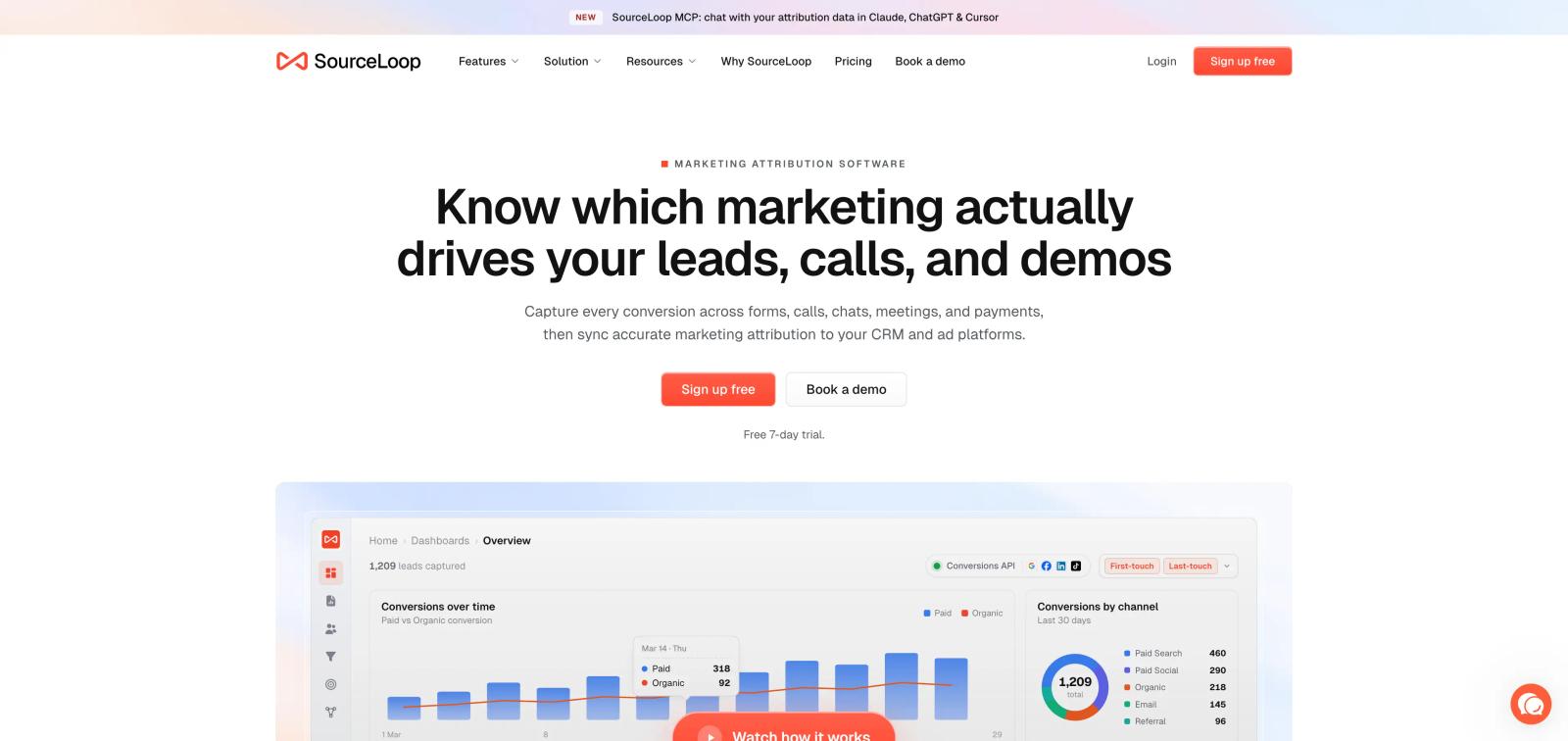
If what you wanted from HockeyStack was attribution, full customer journeys and a way to push conversions back to your ad platforms, SourceLoop is the more focused tool.
HockeyStack's Growth plan is $1,399/mo, and it has been moving from B2B attribution toward a broader GTM execution platform. That is a fine direction, and it changes what you are buying.
It also assumes someone owns it. The learning curve gets described as steep relative to the price, and teams without a dedicated analytics resource tend to under-use it.
How the tracking install works
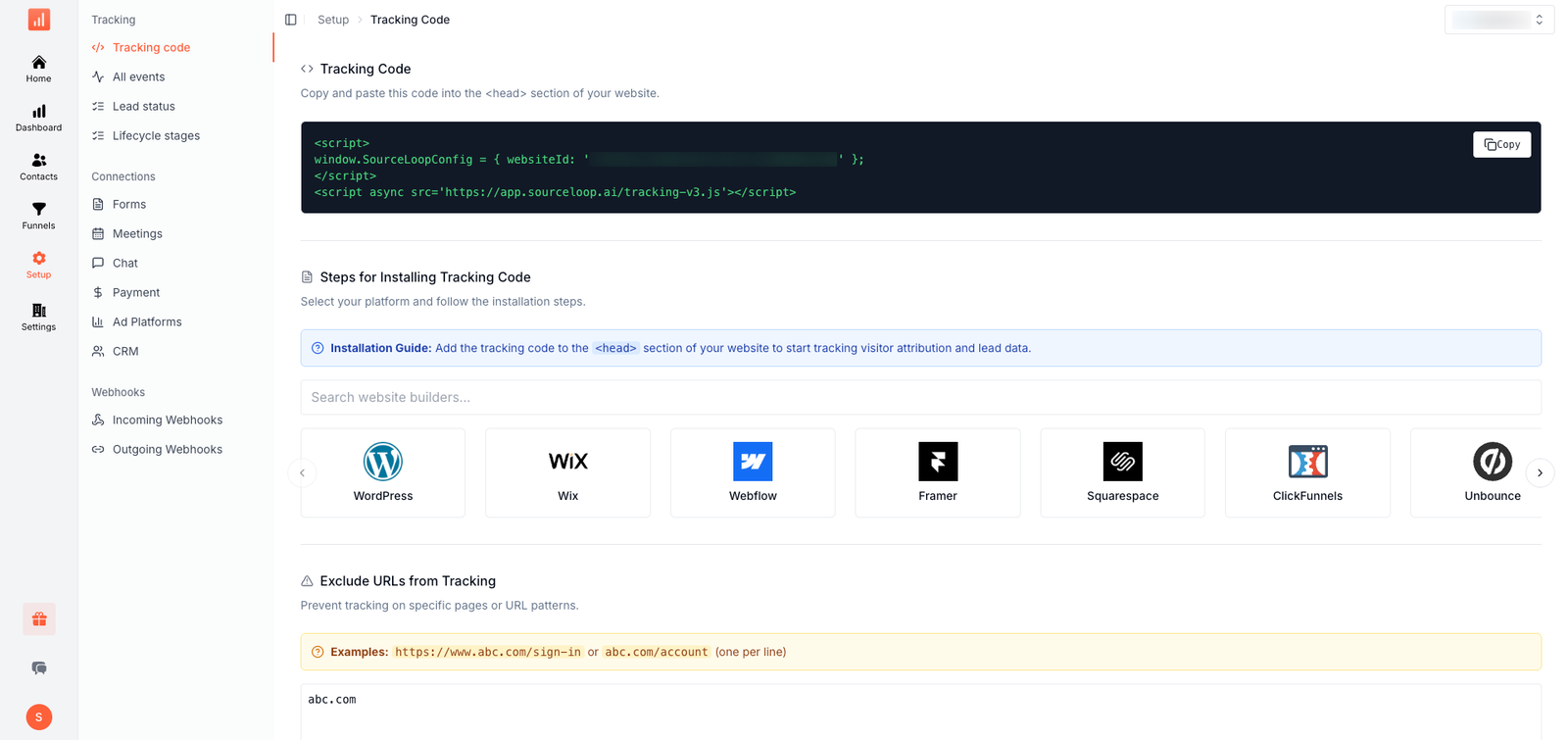
One script in the head of your site. No event taxonomy to design, no implementation project.
From the first pageview every visitor gets a first-party session with referrer, landing page, UTMs and the ad platform's click ID. Nine click IDs, read ahead of the referrer.
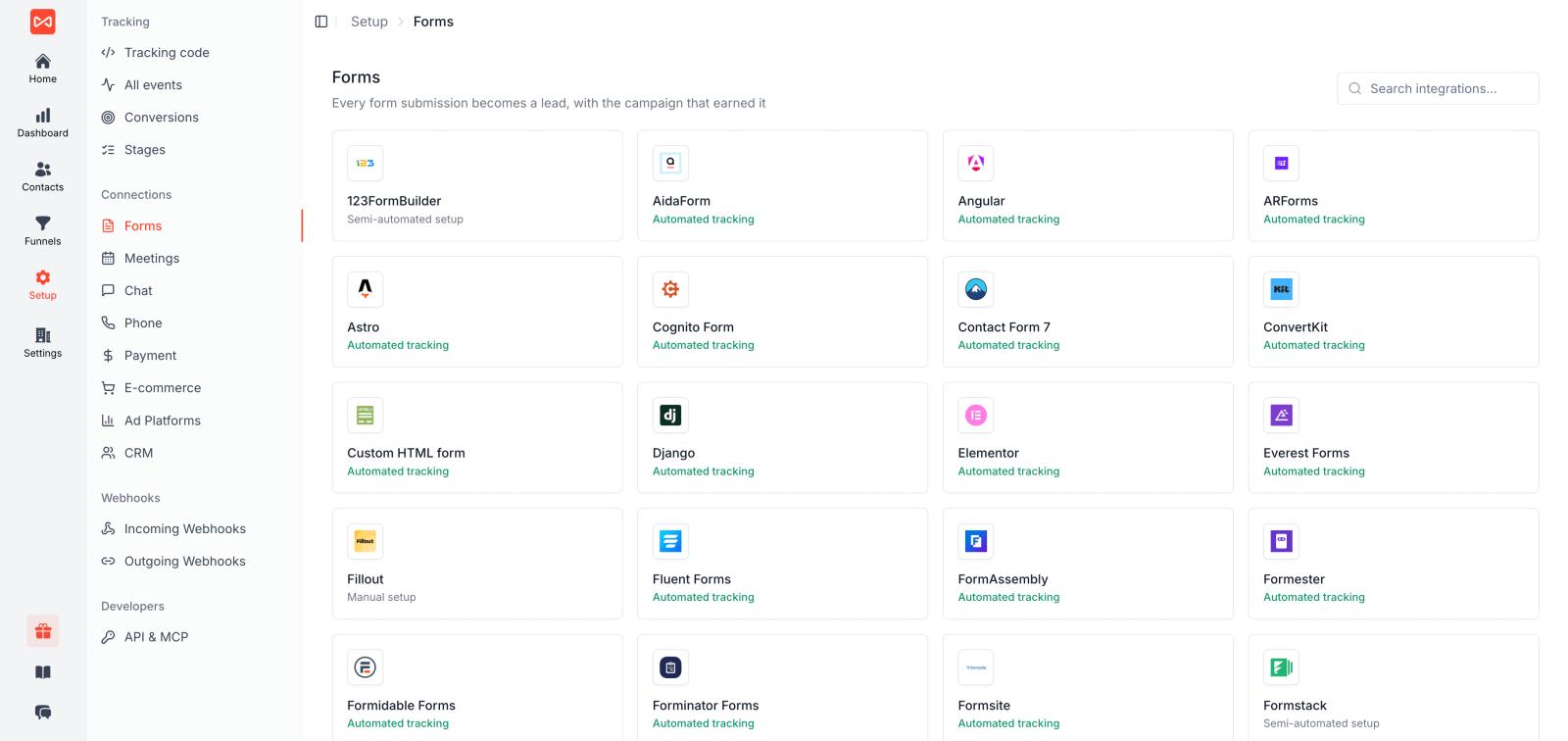
Around 70 lead tools are detected automatically. Calendly, Cal.com, HubSpot Meetings, Chili Piper, Gravity Forms, WPForms, Typeform, Jotform, Webflow, Intercom, Drift, Crisp, CallRail, CallTrackingMetrics, Invoca, Stripe, Paddle and Polar among them.
The journey behind every lead and account
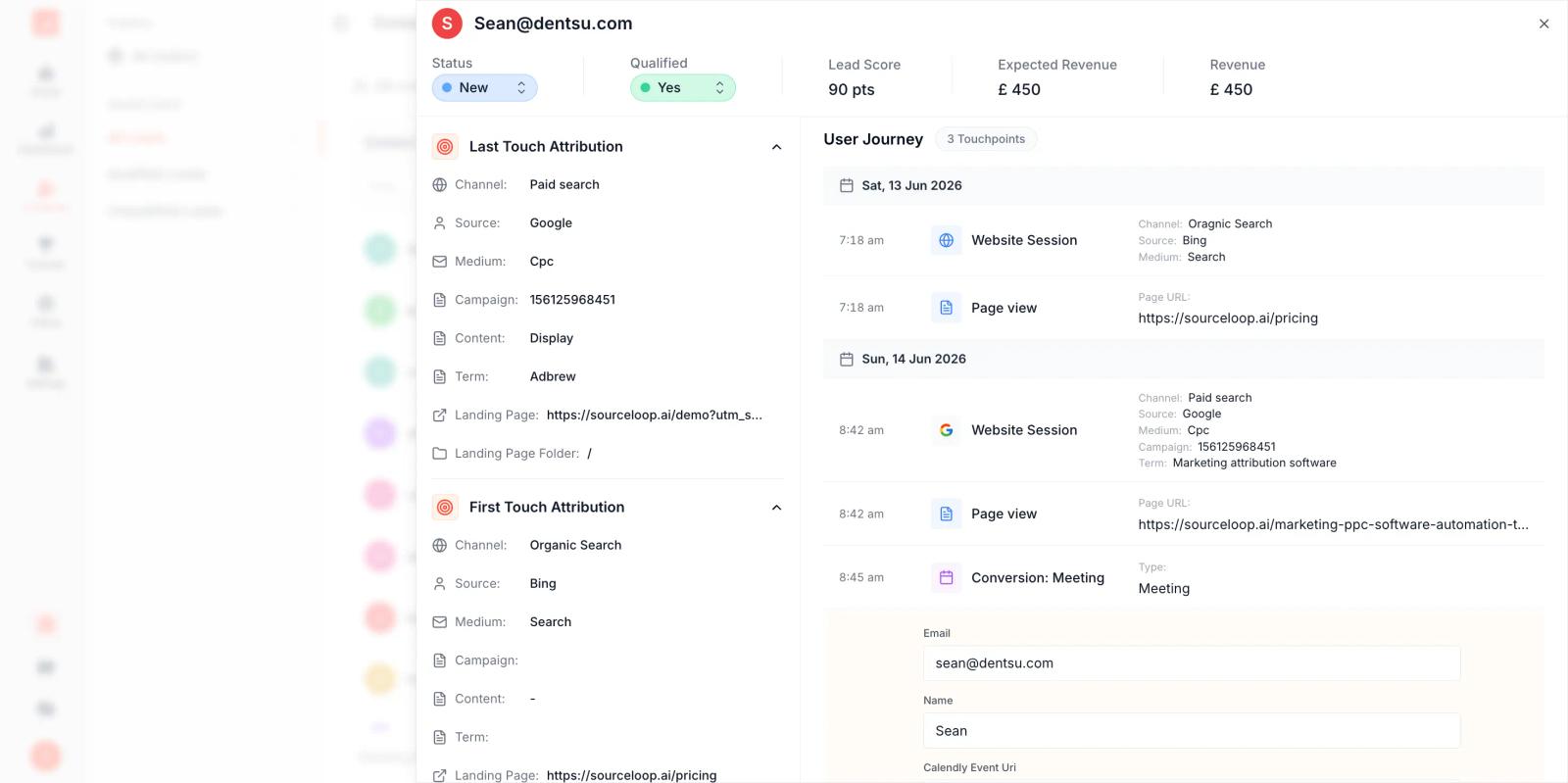
Every contact has a timeline. Each session in order, how they arrived, what they read, and the visit that converted.
Identity stitching merges devices and browsers when an email, phone or user ID connects them. Subdomains share identity automatically through a first-party cookie on your root domain; separate root domains need one config line.
Contacts roll up by company, resolved from the domain on a captured lead email, so every known person at an account shares one journey.
A Visitors view covers everyone who has not converted yet, with their own attribution attached. In a six-month cycle that is where most of next quarter's pipeline currently sits.
Multi-touch attribution and reports
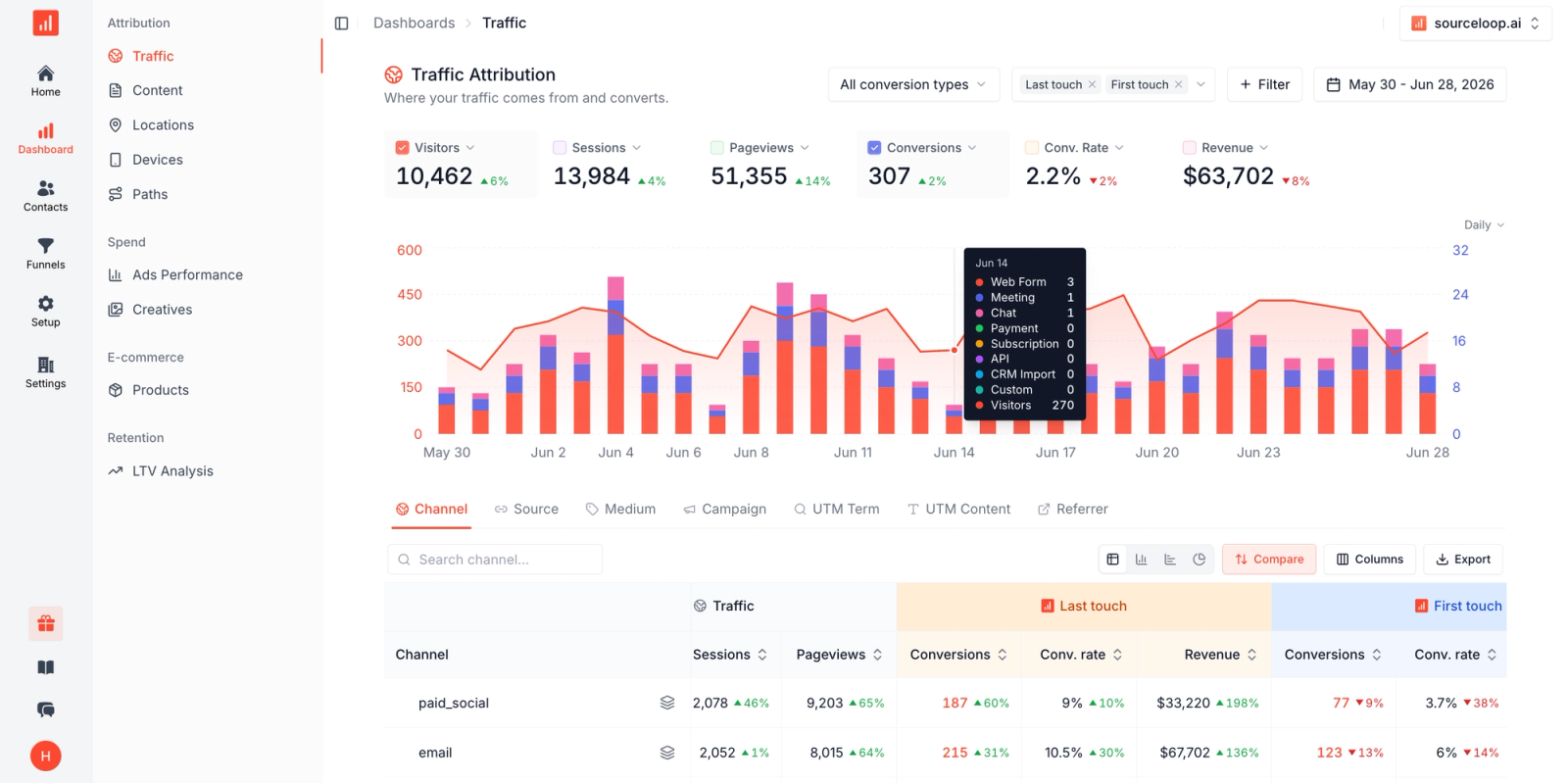
The conversion-path-by-channel report puts first touch, multi-touch and last touch on the same screen.
The data is captured once. The model is applied at read time. Changing from first touch to position-based does not trigger a config sprint.
The weightings are published rather than inferred: position-based is 40% first, 40% last, 20% across the middle, and time decay lands near 13/30/57 on a three-touch path. You can recompute any number by hand, which matters when someone asks why the figure moved.
Channel rollups answer the budget question: pipeline, revenue and CAC by channel. Content attribution runs at page level, and the Paths view shows the touch sequences that end in conversions.
CRM sync and pipeline reporting
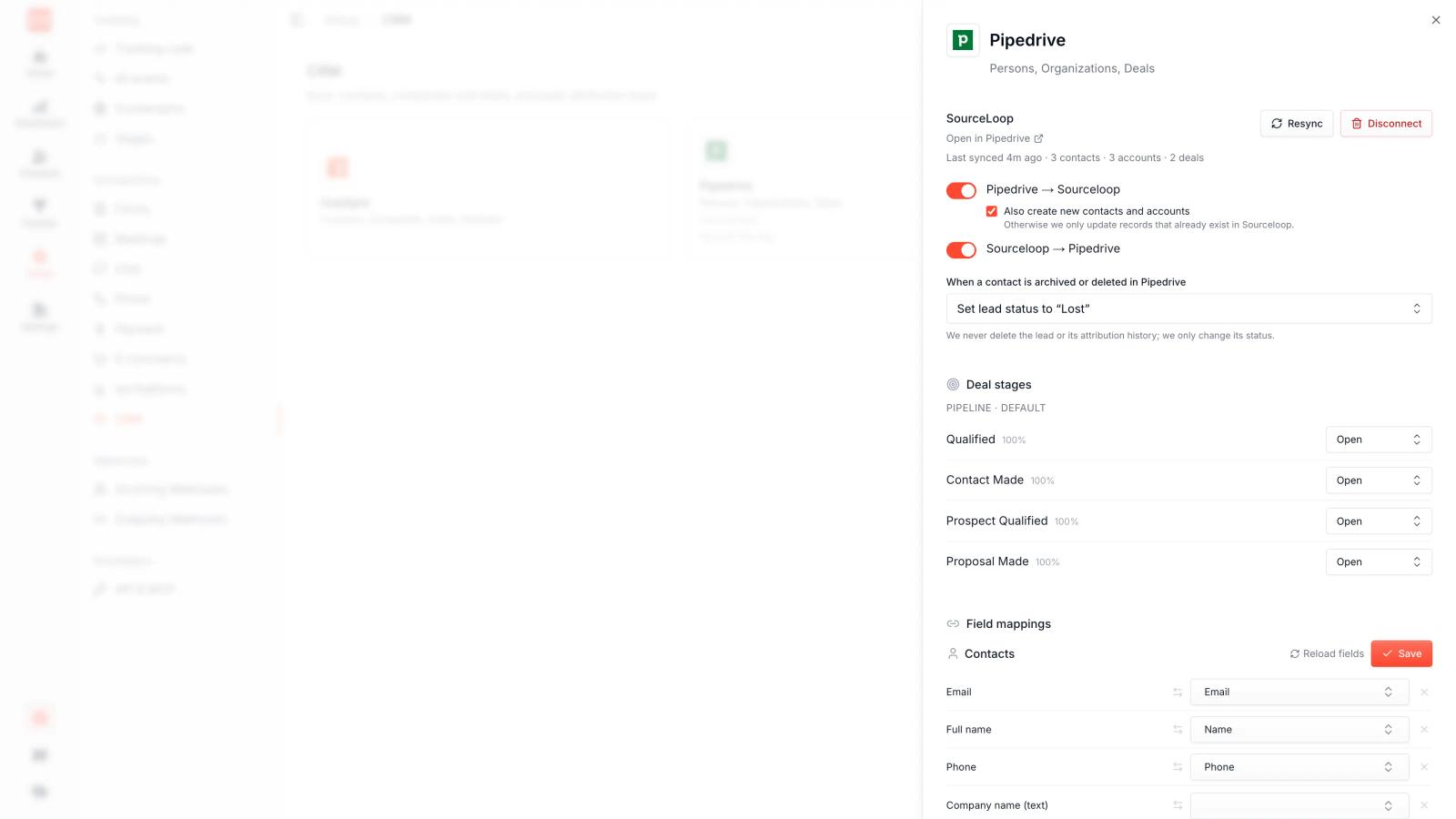
Native two-way sync with HubSpot, Salesforce, Pipedrive and Zoho.
Source, campaign, UTMs and click IDs are written onto the contact or lead record. The properties are created automatically on first write and remappable across contacts, companies and deals.
Deal stages and closed-won values come back the other way, with explicit mapping for Salesforce lead status, HubSpot lifecycle stages and Pipedrive labels.
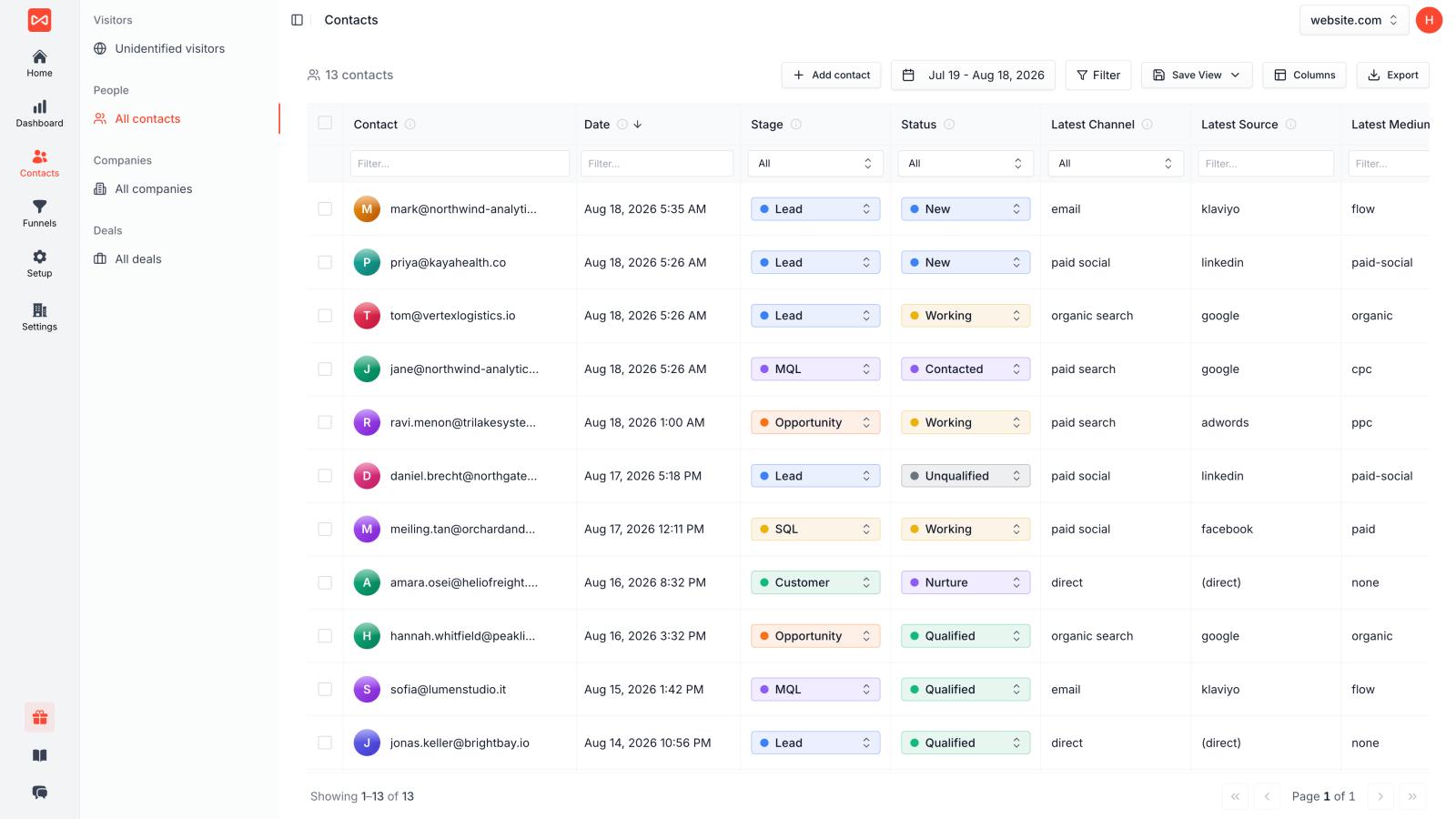
Deals inherit first-touch and last-touch attribution derived from the touchpoints of everyone linked to them. Revenue also arrives directly from Stripe, Paddle, Polar, Lemon Squeezy and Dodo Payments for self-serve motions.
Sending conversions to ad platforms
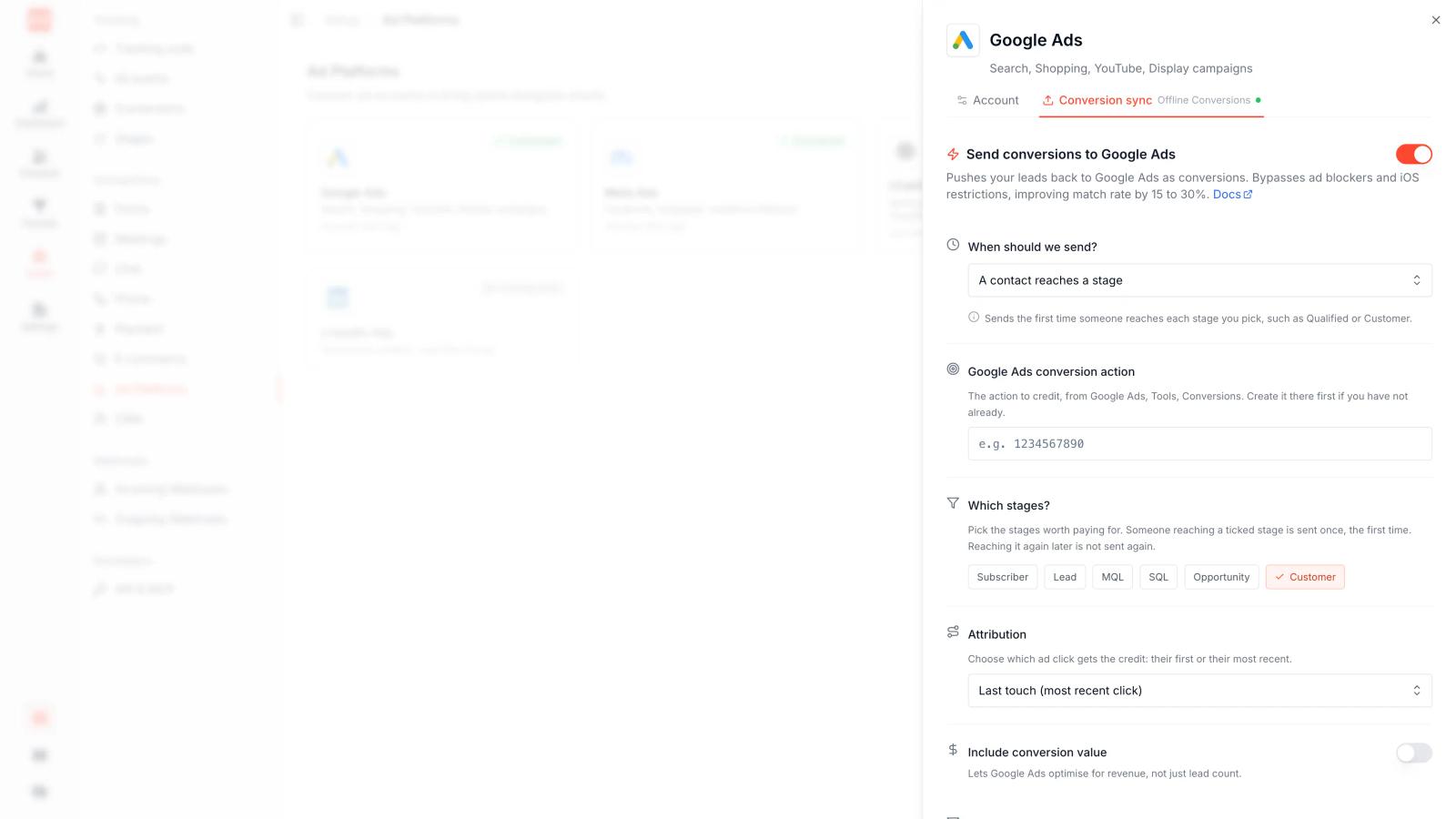
Connect the ad accounts and spend joins the journeys across Google, Meta, LinkedIn, TikTok and Microsoft.
Closed deals then push back server-side to seven platforms, filtered per event, with the attribution touch chosen per platform and the value taken from your CRM.
Querying it with an agent
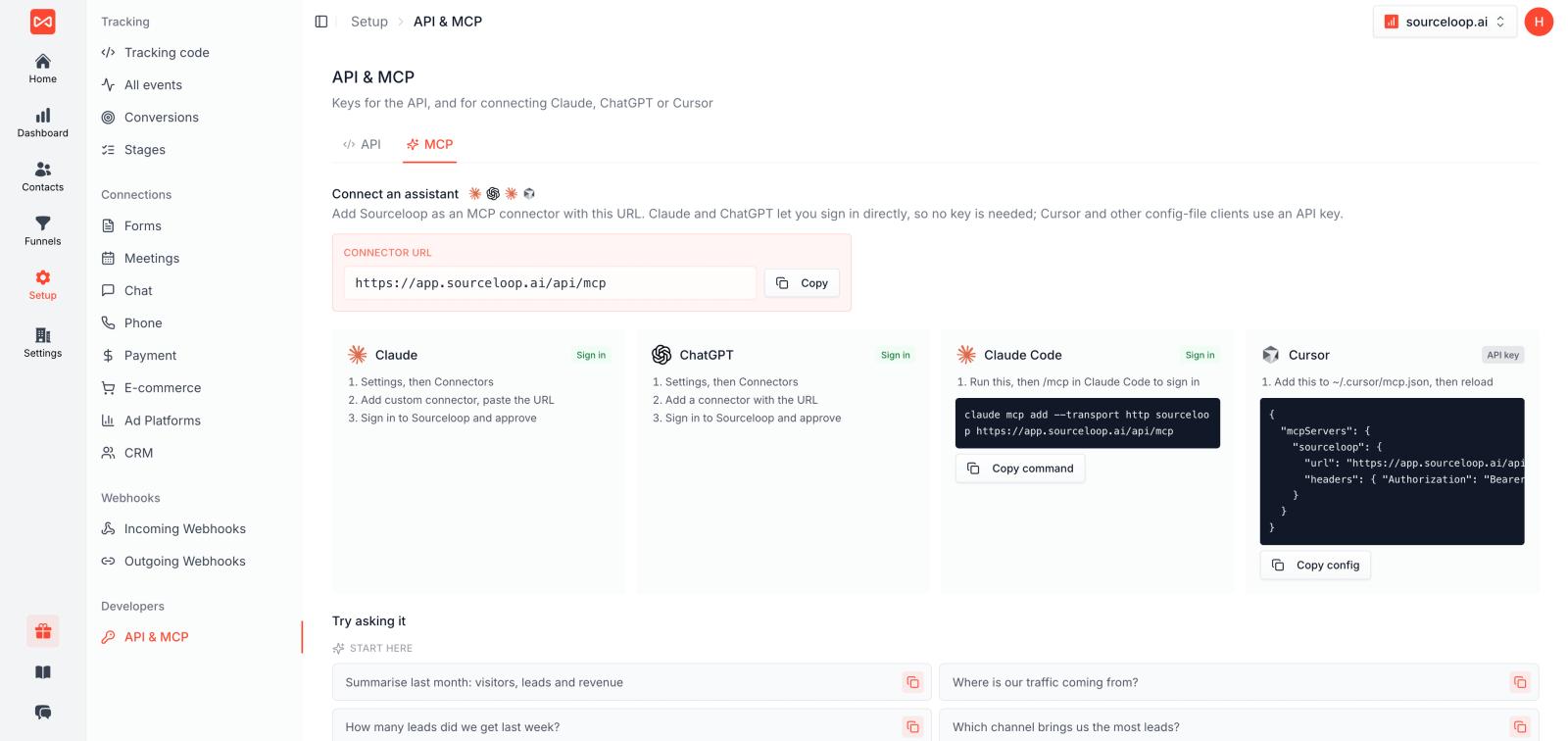
There is an MCP server and a REST API, so Claude, Cursor or any agent framework can ask for headline performance, channel breakdowns, contact lookups, deal attribution, funnel stages, LTV or the journey behind any conversion.
A /changes endpoint handles incremental pulls into a warehouse.
The honest gaps for a HockeyStack evaluator
No anonymous account identification. HockeyStack stitches anonymous traffic to target accounts. SourceLoop ties sessions to leads at conversion, then rolls known contacts up by company. If your team relies on weekly lists of companies that visited the pricing page without converting, that workflow stays on HockeyStack.
No packaged AI analyst. Odin is a finished product with its own interface. SourceLoop exposes the same data through MCP, so Claude or Cursor answers the questions instead. Cheaper and more flexible, but you bring your own agent.
No GTM execution. HockeyStack is adding sales workflow on top of analytics. SourceLoop is measurement only.
For most B2B teams below mid-market those gaps are theoretical. For ABM-led teams they are the reason HockeyStack exists.
Pricing
- Essential: $49 / month, 30k page views
- Professional: $99 / month, 100k page views
- Agency: $249 / month
7-day trial, no card.
Best for: B2B teams that want multi-touch attribution and ad-platform sync without enterprise pricing or an ABM-grade implementation. Create a free SourceLoop account.
2. Dreamdata
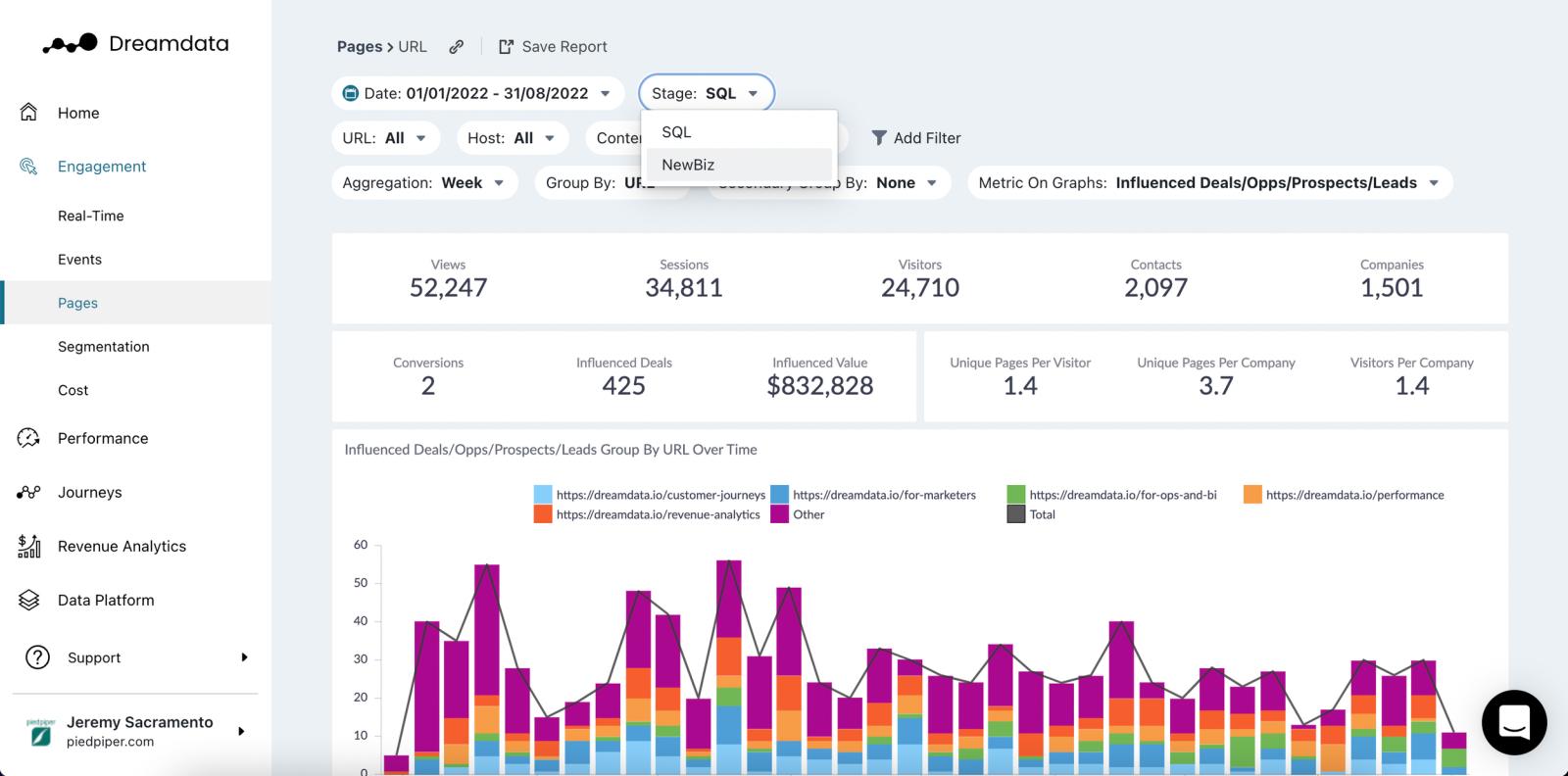
Dreamdata sits at a similar price point as HockeyStack with a different architectural bet: revenue, not conversions, as the source of truth.
Every contact, account, and deal gets tied back to the marketing touches that influenced it, with weighted models that respect deal size and pipeline stage. The Salesforce integration is the deepest in this list.
Key capabilities
- Bi-directional Salesforce integration that reads pipeline movement near real-time and writes attribution back as custom fields on deals
- Free tier that's actually usable for a pilot or small-team deployment, low monthly limits but no card
- Revenue-weighted multi-touch models respecting deal size, stage progression, and account age, not just touch count
- Reverse-ETL friendly for teams running modern data stacks (BigQuery, Snowflake, dbt)
- Account-level journey reports with full timelines including post-conversion expansion deals
Watch-outs
Setup needs a Salesforce admin. The data model is rich, which means a week of tuning what counts as an "influence" before dashboards reflect reality. Short cycles or messy CRMs slow value compounding.
Pricing
Free for low volumes. Team from ~$999/month. Business $2k+/month. Enterprise custom.
Best for: B2B teams with longer sales cycles where Salesforce is the system of record and pipeline-weighted attribution matters more than dashboard speed.
3. Factors.ai
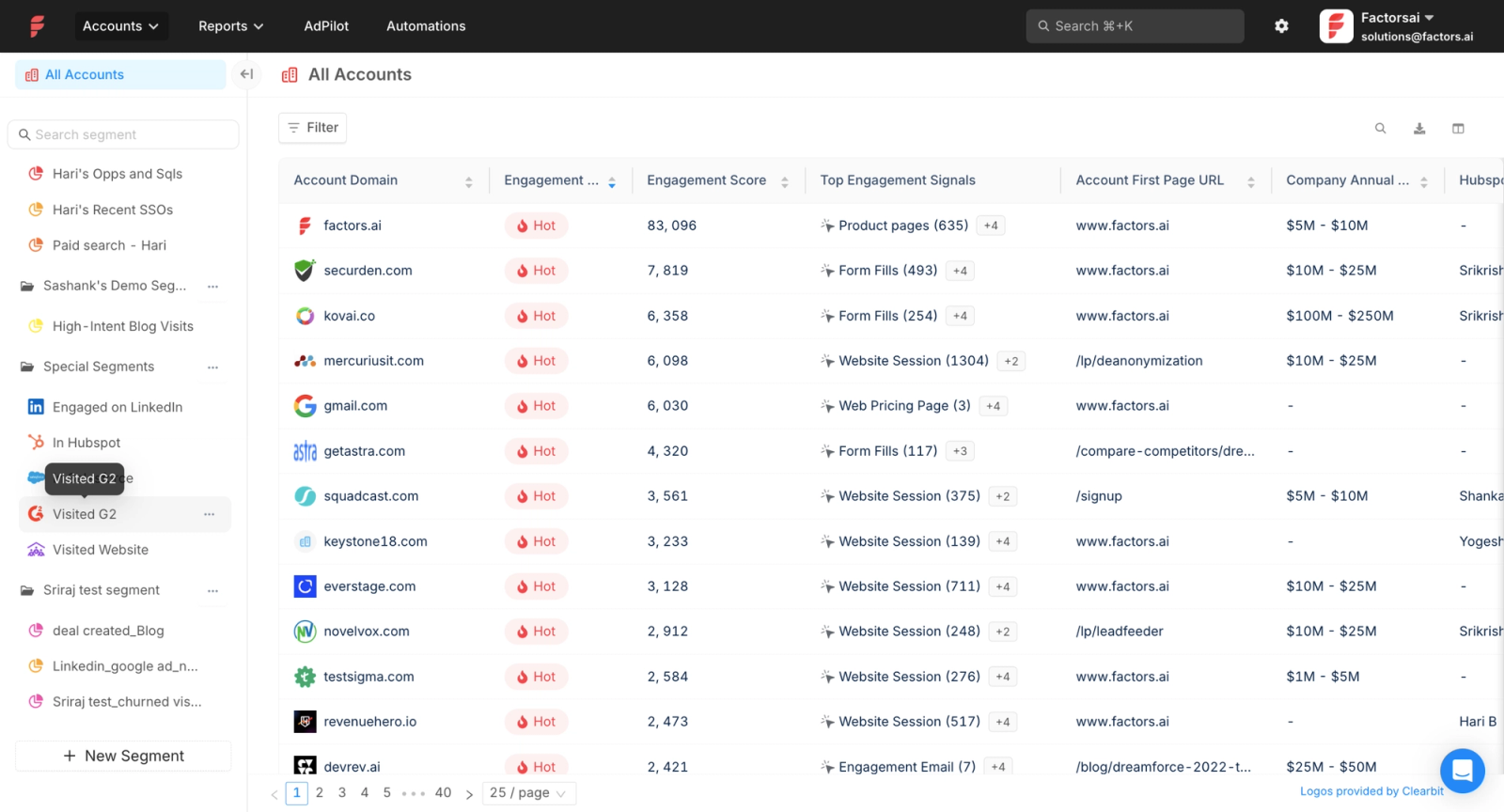
Factors sits between Dreamdata and HockeyStack on the architecture spectrum. Account-first, but with a specific edge: native LinkedIn intent integration that surfaces in-market accounts based on engagement across the LinkedIn network.
For teams whose ABM motion runs heavily on LinkedIn, that integration is the reason to look here.
Key capabilities
- Account identification via reverse-IP and de-anonymization (powered by ZoomInfo, Clearbit, and a proprietary signal layer)
- LinkedIn intent integration for surfacing in-market accounts and activating ad audiences
- B2B-weighted multi-touch models respecting deal size and stage progression
- Salesforce, HubSpot, Marketo native sync with bi-directional updates
- Workflow automation triggering Slack alerts, Salesforce tasks, or sequence enrollment when accounts hit defined intent thresholds
Watch-outs
Setup takes 1-2 weeks. The free trial is 15 days, not long enough to see real attribution data accumulate for accounts with longer cycles.
Pricing
Free tier with limits. Paid plans from ~$899/month.
Best for: B2B SaaS and services teams running ABM with LinkedIn as a core channel.
4. 6sense
6sense is the most-quoted name in enterprise ABM. Where HockeyStack reports on what your funnel did, 6sense predicts which accounts are entering a buying cycle based on third-party intent signals across the public web.
If your sales motion involves outbound to high-value accounts and your team has the headcount to act on intent, 6sense pays back fast. If you don't, it's an expensive intent-data subscription.
Key capabilities
- Predictive intent scoring based on third-party signal data captured across 6sense's research network
- Buying-stage classification (Awareness, Consideration, Decision, Purchase) with predicted transition timing
- ABM orchestration across web personalization, paid ads, sales prospecting, and email
- Anonymous account identification at higher fidelity than competitors, including accounts not in your CRM
- Salesforce, Marketo, HubSpot, Outreach native with deep CRM operations and custom workflow automation
Watch-outs
Pricing is enterprise-only. Plans typically run $50k-$120k per year. Implementation takes 4-8 weeks and a dedicated owner.
Pricing
Custom. Typically $50,000+ per year.
Best for: Mid-market and enterprise B2B running outbound-led growth where intent data drives sales action.
5. Demandbase
Demandbase is 6sense's longest-running competitor with one differentiator: a built-in advertising platform for serving display ads directly to identified accounts without going through Meta or LinkedIn.
For paid ABM at serious scale, that DSP changes the cost math.
Key capabilities
- Account intent and engagement scoring that combines first-party engagement with third-party signal data
- ABM orchestration across web, ads, outbound, and email
- Built-in DSP for serving display ads directly to identified accounts (no public ad-platform fees)
- Anonymous traffic-to-account stitching with strong match rates for North American B2B
- Salesforce + Marketo native with deep integration into pipeline reporting
Watch-outs
Pricing matches 6sense ($50k+ per year). Implementation similarly long. Strength is in advertising orchestration; if pure attribution is the goal, lighter tools fit better.
Pricing
Custom. Typically $50,000+ per year.
Best for: Enterprise B2B running paid ABM where having the ad-serving inside the attribution platform changes the math.
6. Adobe Marketo Measure
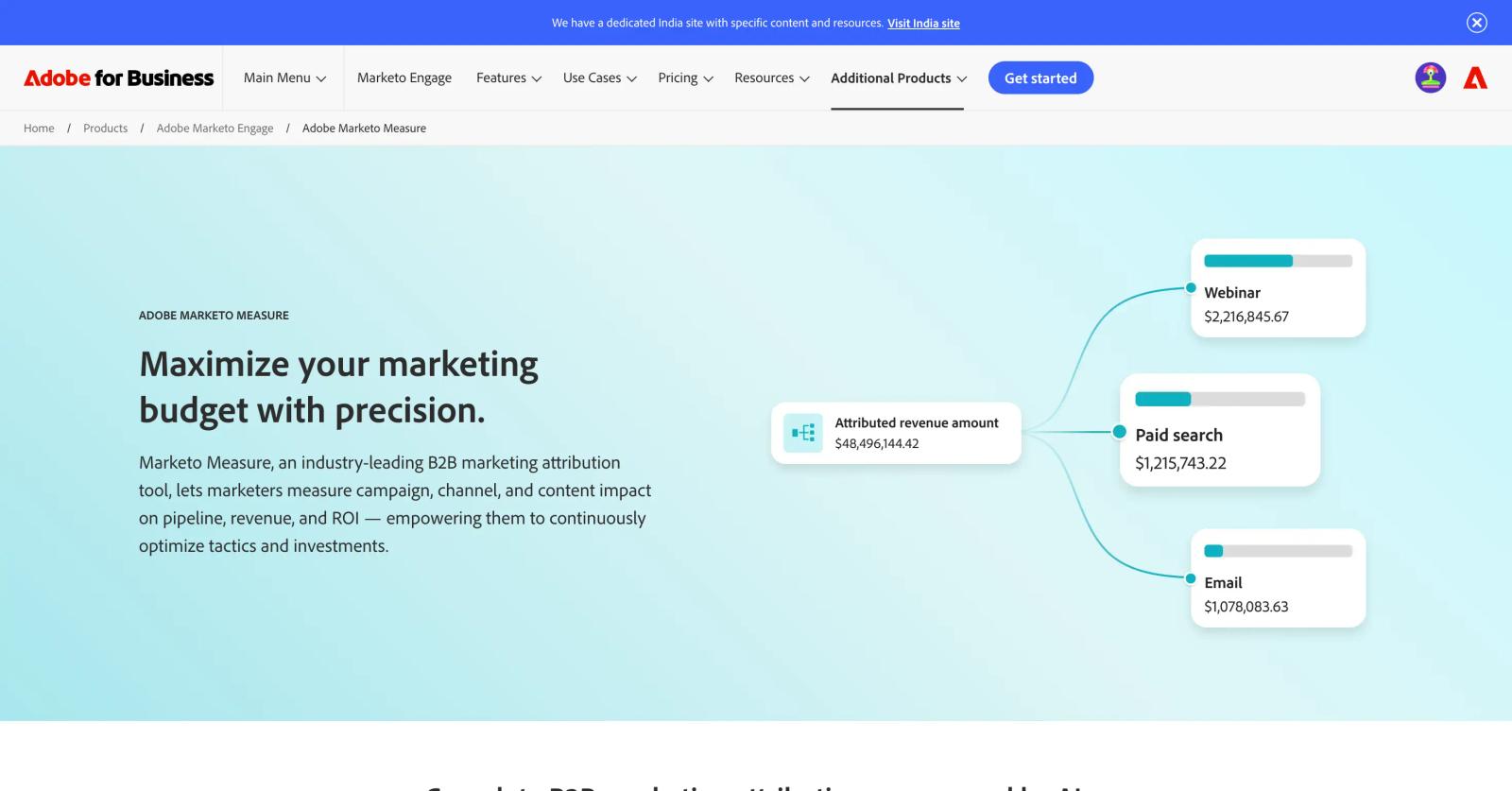
Marketo Measure is the enterprise B2B option, deeply tied to Adobe's stack and Salesforce. It's bought when "the right answer" matters more than time-to-value.
The trade-off: 60 to 90 days of implementation. Pricing custom and rarely below $2,000 per month.
Key capabilities
- Multi-touch revenue attribution at enterprise scale, with custom models defined and audited by finance
- Native Salesforce and Marketo integration including custom-object reads and writes
- Adobe Experience Cloud connectivity when Adobe Analytics or Adobe Target are already in the stack
- Pipeline-stage progression tracking with attribution applied across stages, not just first-touch
- Custom reporting dashboards integrated with Salesforce reports and Adobe-native business intelligence
Watch-outs
Locked into the Adobe stack to extract full value. Most companies budget 60-90 days, a Salesforce admin, and a Marketo admin.
Pricing
Custom. Typically $2,000+/month, often $40k+ annually for mid-market.
Best for: Enterprise B2B already on Marketo and Salesforce with mature ops teams.
7. HubSpot Marketing Analytics
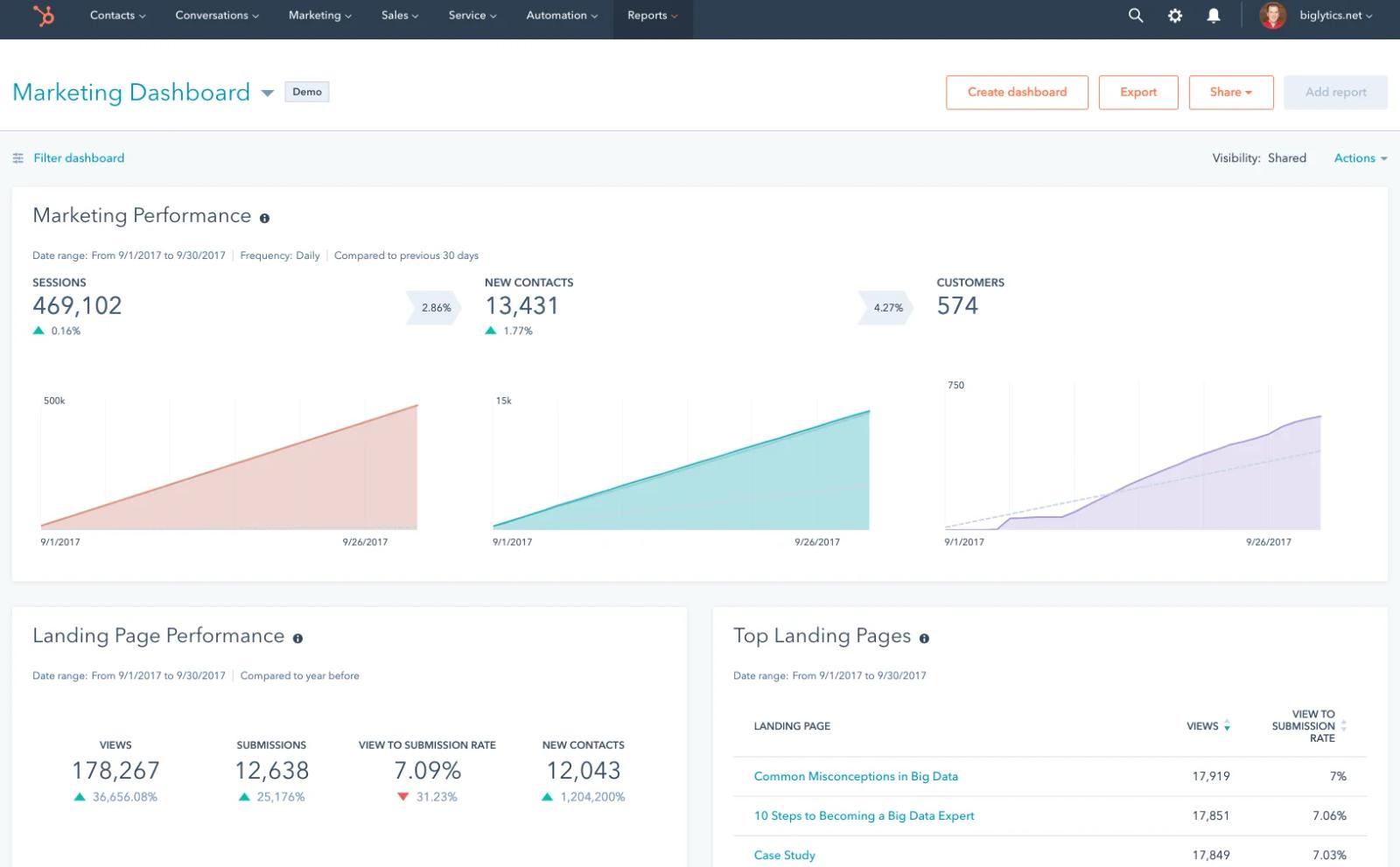
If you're already on HubSpot Marketing Hub Pro or Enterprise, the built-in attribution module is worth turning on before evaluating anything else. Same CRM. Same dashboard. No new vendor.
The depth is lighter than HockeyStack. The convenience is higher.
Key capabilities
- Native integration with everything HubSpot already tracks: forms, contacts, deals, lifecycle stages, custom properties
- Multi-touch attribution models: linear, U-shaped, W-shaped, time-decay, full-path
- Revenue attribution at the deal level with closed-won pipeline tied to source-of-influence
- Custom property-based reporting that fits the way your team thinks about data
- Closed-loop ad management for HubSpot's built-in Google and Facebook ad tools
Watch-outs
Marketing Hub Professional is $800/month, Enterprise is $3,600/month. Starter doesn't include attribution. Reporting works inside HubSpot's reporting paradigm, which is competent but more constrained than dedicated attribution dashboards.
Pricing
Marketing Hub Professional from $800/month. Enterprise from $3,600/month.
Best for: Teams already paying for Marketing Hub Pro or Enterprise who want attribution inside the existing platform.
8. Heap
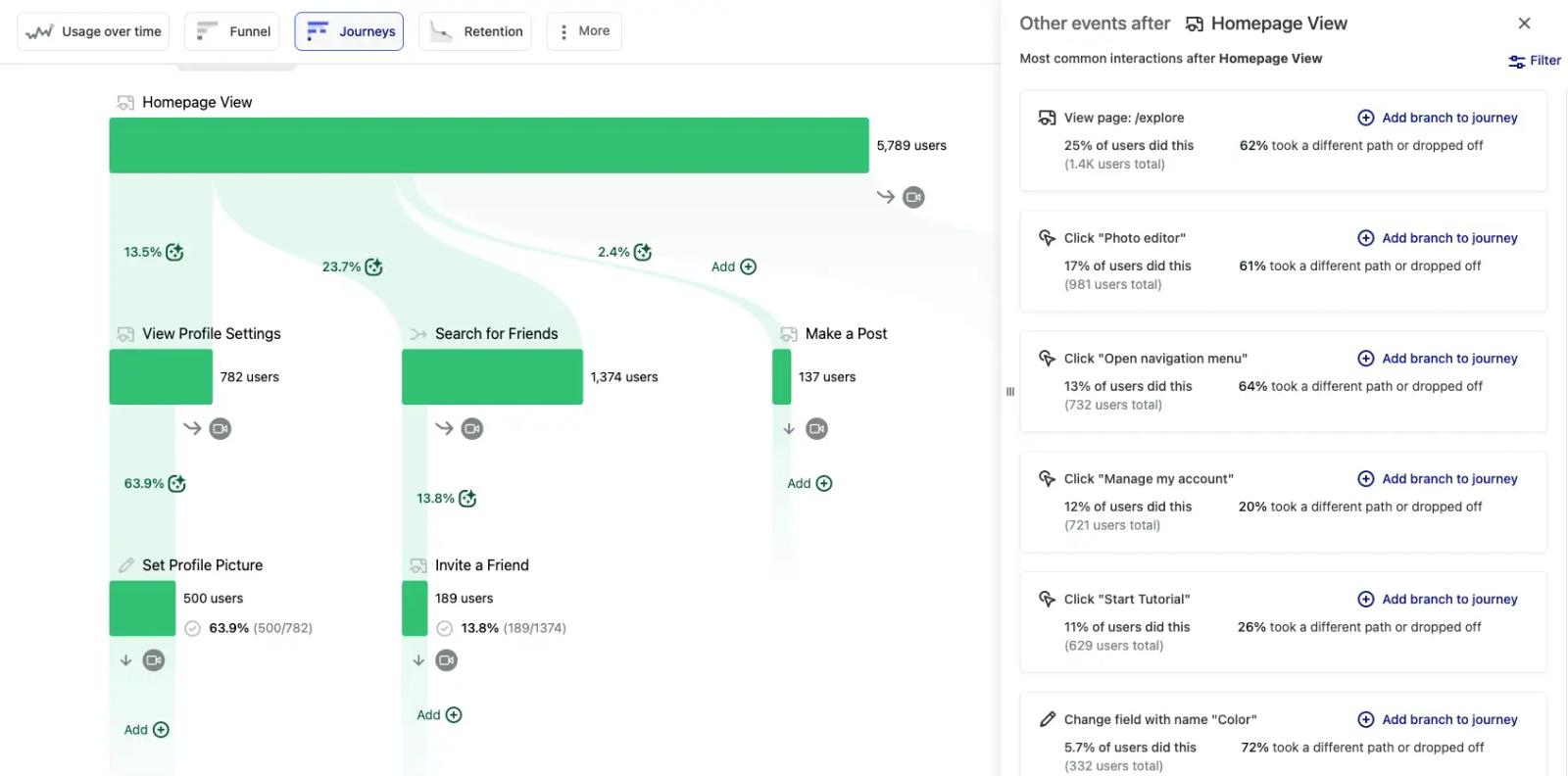
Heap puts product analytics and marketing attribution in one tool. For B2B SaaS teams whose funnel includes a real product-led element (free trial, freemium, self-serve), that combination is what HockeyStack doesn't ship.
Key capabilities
- Auto-capture of every event without manual tagging, with retroactive funnel and cohort analysis
- Behavioral cohorts that mix product behavior with marketing source data
- Multi-touch attribution for marketing channels with revenue tie-back at the user or account level
- Salesforce integration that connects product behavior to deals
- Free starter tier that's genuinely useful for early-stage teams (up to 10k monthly sessions)
Watch-outs
Heap is product analytics with attribution capabilities. Pure multi-channel revenue attribution at scale is sharper at dedicated tools.
The pricing curve gets steep as event volume grows.
Pricing
Free tier (up to 10k monthly sessions). Paid plans from $3,600/year. Enterprise custom.
Best for: Product-led B2B SaaS teams whose attribution question lives at the intersection of marketing source and in-product behavior.
9. Attribution (attribution.app)
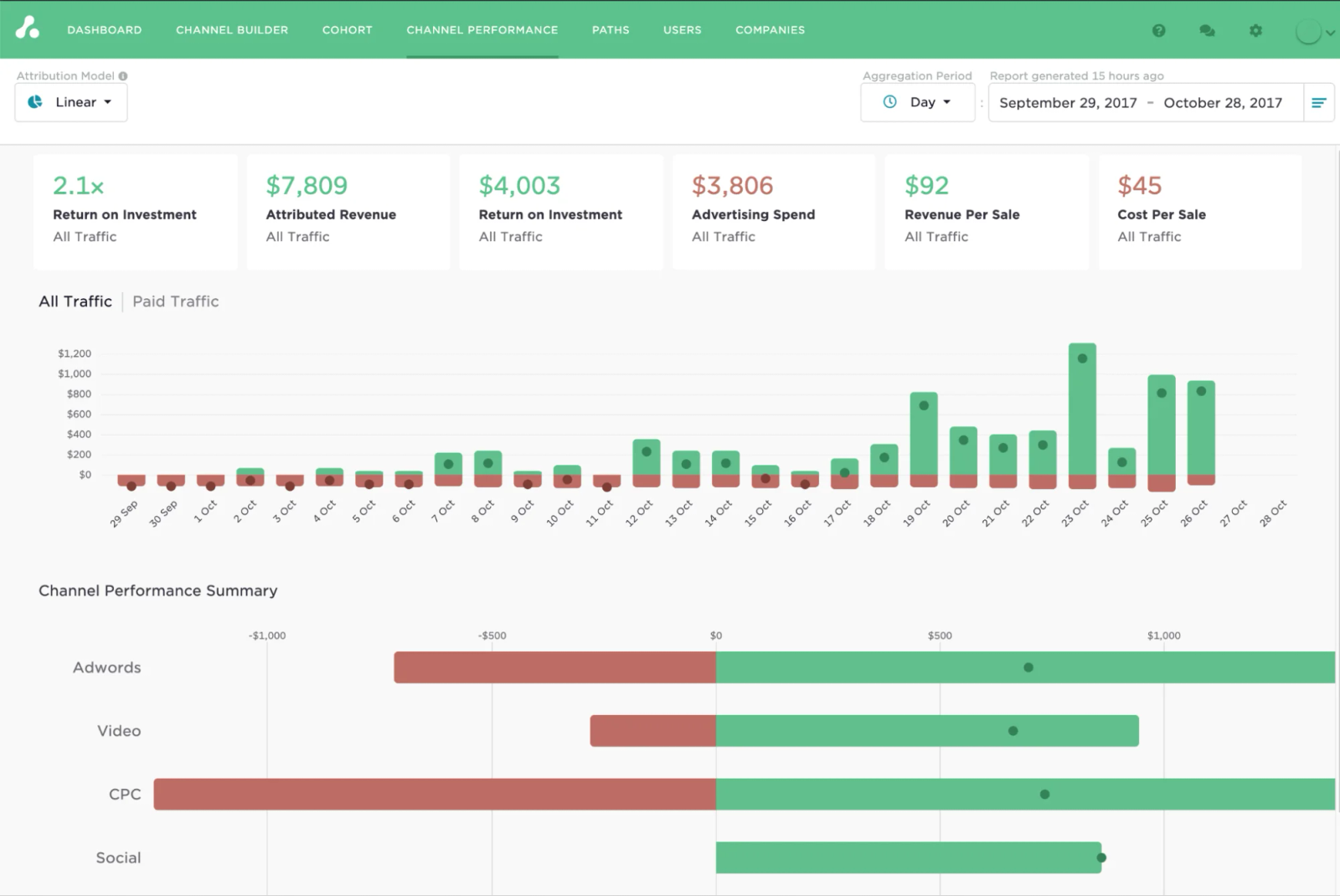
Attribution is the lowest-cost option. Free tier. Multi-touch out of the box. Snippet capture, an hour to install.
For teams whose HockeyStack evaluation revealed a smaller problem than the platform price tag implies, this is where the math lands.
Key capabilities
- Free tier with limits generous enough to evaluate the product
- Multi-touch attribution out of the box, with custom models on paid tiers
- Form and event capture through a single snippet
- CRM sync to HubSpot, Salesforce, and arbitrary webhooks
- Lightweight by design, no enterprise onboarding required
Watch-outs
No account-level identification, no built-in CRM, no dark-social attribution, light ad-platform sync.
Pricing
Free tier. Paid plans from around $99/month.
Best for: Small B2B teams that want light multi-touch at near-zero cost.
How to pick the right one
Three checks decide this list.
Check one: do you actually use account-level identification?
HockeyStack's account ID is one of its core differentiators. If your sales team isn't acting on "companies that visited but didn't convert" lists, you're paying for a feature that's not driving value. Drop to SourceLoop or Attribution.
Check two: is your sales cycle longer than three months?
If yes, revenue-weighted attribution matters more than touch-count attribution. Dreamdata pays back. So does Marketo Measure for enterprise teams. SourceLoop's multi-touch is competent but doesn't model deal-stage progression the way Dreamdata does.
Check three: how much of your spend goes to LinkedIn?
Heavy LinkedIn ABM motion: Factors.ai is a closer fit than HockeyStack. Their LinkedIn engagement layer surfaces accounts HockeyStack won't. Mid-mix LinkedIn presence: HockeyStack stays competitive.
If none of those checks pull you toward an enterprise tool, SourceLoop is the answer. Create a free SourceLoop account. Modern multi-touch, $49 a month, set up in an hour.
Frequently asked questions
-
What's the cheapest HockeyStack alternative?
Attribution at $0 (free tier) and SourceLoop at $49/month. SourceLoop ships full multi-touch dashboards, content attribution, and ad-platform sync at the entry tier. Attribution is lighter on dashboards and ad sync but stays free at low volumes.
-
Does SourceLoop replace HockeyStack for ABM?
For most teams, no. HockeyStack ships account-level journeys (anonymous traffic stitched to target companies). SourceLoop tracks visitor sessions and ties them to leads at conversion. If your ABM motion needs the "companies that visited but haven't converted" workflow, HockeyStack stays the better fit. If your B2B funnel is more inbound-led (forms, content, paid ads), SourceLoop covers it cleanly.
-
Is HockeyStack worth $1,000 a month?
For B2B SaaS teams running ABM with serious data volume and a team that uses the dashboards daily, yes. For teams whose attribution question is "show me what's working across our channels," it's expensive for what gets used. The honest test: open HockeyStack and ask your team which reports they actually pulled this week.
-
Can I migrate from HockeyStack easily?
The technical migration is straightforward. Snippet swap, CRM connector reconfiguration, ad-platform reconnection. The harder part is rebuilding any custom journeys, ABM dashboards, or Odin queries you set up over time. Plan for 2-4 weeks of overlap to validate the new tool's numbers match before cutting over.
-
What do I lose by leaving HockeyStack?
The AI assistant (Odin), account-level journey reports, and the warehouse-grade query speed are the three things teams notice first. Whether those three things are worth $12,000 a year is the right framing for the decision.



 Paid Social


