
7 Best WhatConverts Alternatives: I Tested for 2026
WhatConverts alternatives tested honestly. Seven tools across call tracking, multi-touch attribution, and lead-gen reporting, with the one I'd actually pay for.
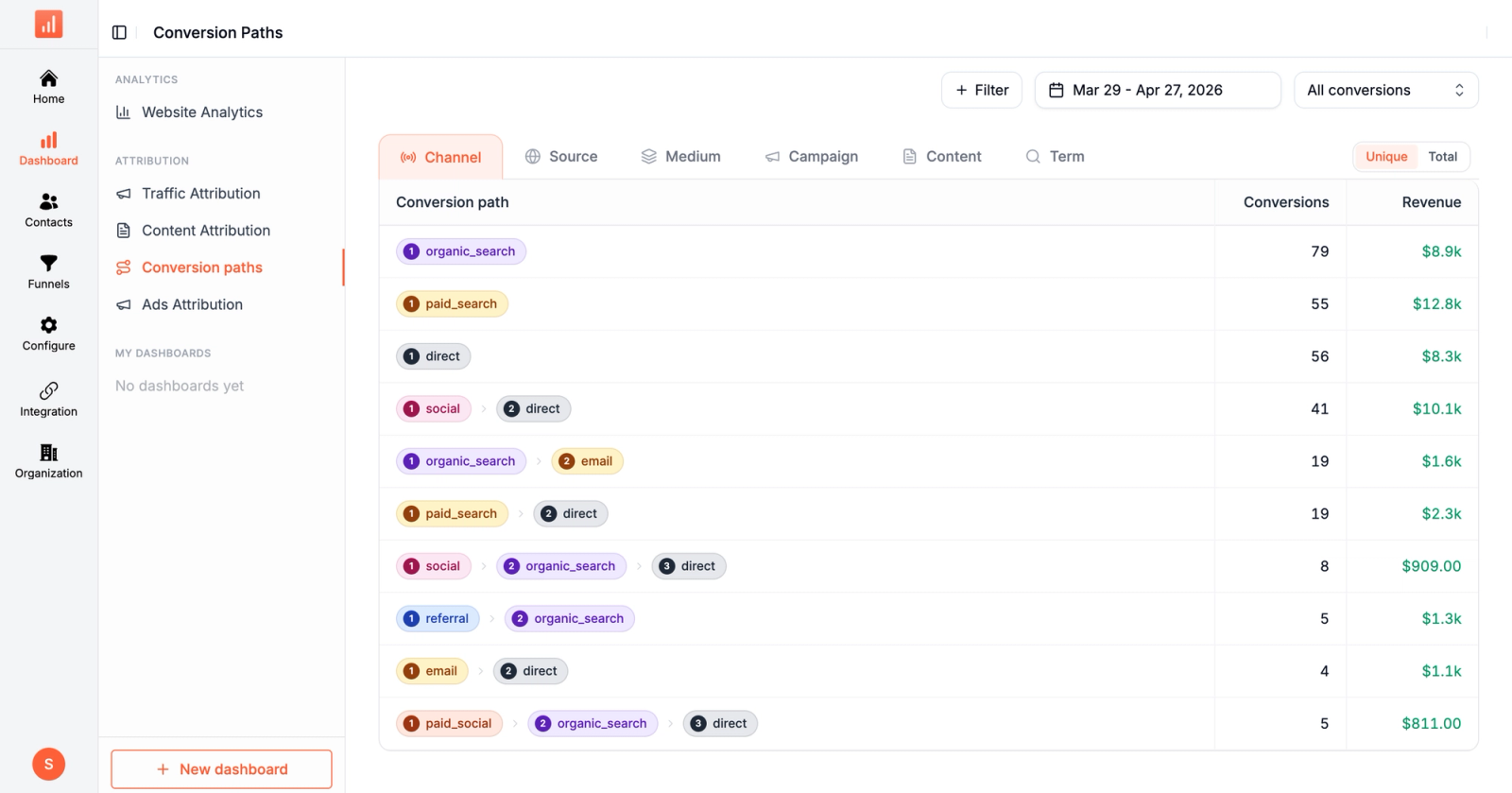
Table of contents
- Quick comparison
- 1. SourceLoop
- It does not replace your call tracking provider
- Attribution models and journeys
- CRM sync and pipeline reporting
- Sending conversions to ad platforms
- Key capabilities
- Watch-outs
- Pricing
- 2. CallRail
- Key capabilities
- Watch-outs
- Pricing
- 3. CallTrackingMetrics
- Key capabilities
- Watch-outs
- Pricing
- 4. Invoca
- Key capabilities
- Watch-outs
- Pricing
- 5. Ruler Analytics
- Key capabilities
- Watch-outs
- Pricing
- 6. HubSpot Marketing Analytics
- Key capabilities
- Watch-outs
- Pricing
- 7. Attribution (attribution.app)
- Key capabilities
- Watch-outs
- Pricing
- How to pick the right one
WhatConverts works.
Forms, calls, chats, all tied back to source, routed into your CRM, with per-client access if you run an agency. The reasons people shop around are usually one of three things.
The pricing climbs past comfortable once you grow past three or four agency clients. The dashboards feel light when you want real attribution analysis, not just "the lead came from Google." Or your funnel shifted toward something
WhatConverts wasn't built for: forms-heavy SaaS, paid-ads-driven DTC, modern attribution that matches what the algorithms actually need.
I spent the last quarter testing seven alternatives. Some are direct call-tracking peers. One is a different category entirely, and the one I'd recommend to most teams. Here's the honest take.
Quick comparison
| Tool | Best for | Starts at | Setup | Dashboards | Multi-touch | Calls |
|---|---|---|---|---|---|---|
 SourceLoop SourceLoop |
Most teams | $49 / mo | ~1 hour | Built-in | Yes | Via integration |
 CallRail CallRail |
Lead-gen with calls | $50 / mo | ~1 day | Built-in | Limited | Native |
 CallTrackingMetrics CallTrackingMetrics |
Call-heavy + agencies | $45 / mo | ~1 day | Built-in | Limited | Native |
 Invoca Invoca |
Enterprise calls | ~$1,000+ / mo | 2-4 weeks | Built-in | Yes | Native + AI |
 Ruler Analytics Ruler Analytics |
UK lead gen | $199 / mo | ~1 week | Built-in | Yes | Native |
 HubSpot Marketing HubSpot Marketing |
HubSpot-native shops | From $800 / mo | Bundled | Built-in | Yes | No |
 Attribution Attribution |
Cheap source-only | Free / $99 / mo | ~1 hour | Light | Yes | No |
1. SourceLoop
WhatConverts is good, and the ratings are earned. Keyword-level lead reporting for agencies is a job it does about as well as anyone.
The reason to look elsewhere is usually one of two things. Either the bill has become hard to predict, or you have outgrown lead tracking and want attribution.
SourceLoop is the second answer.
It does not replace your call tracking provider
SourceLoop does not sell tracking numbers. There is no dynamic number insertion, no call recording, no transcription.
It connects to CallRail, CallTrackingMetrics or Invoca instead, and matches the call back to the caller's browsing session so it inherits the full journey.
So if you are replacing WhatConverts purely as a call tracking provider, you still need one of those. If you are replacing it as your reporting layer, keep reading.
Attribution models and journeys
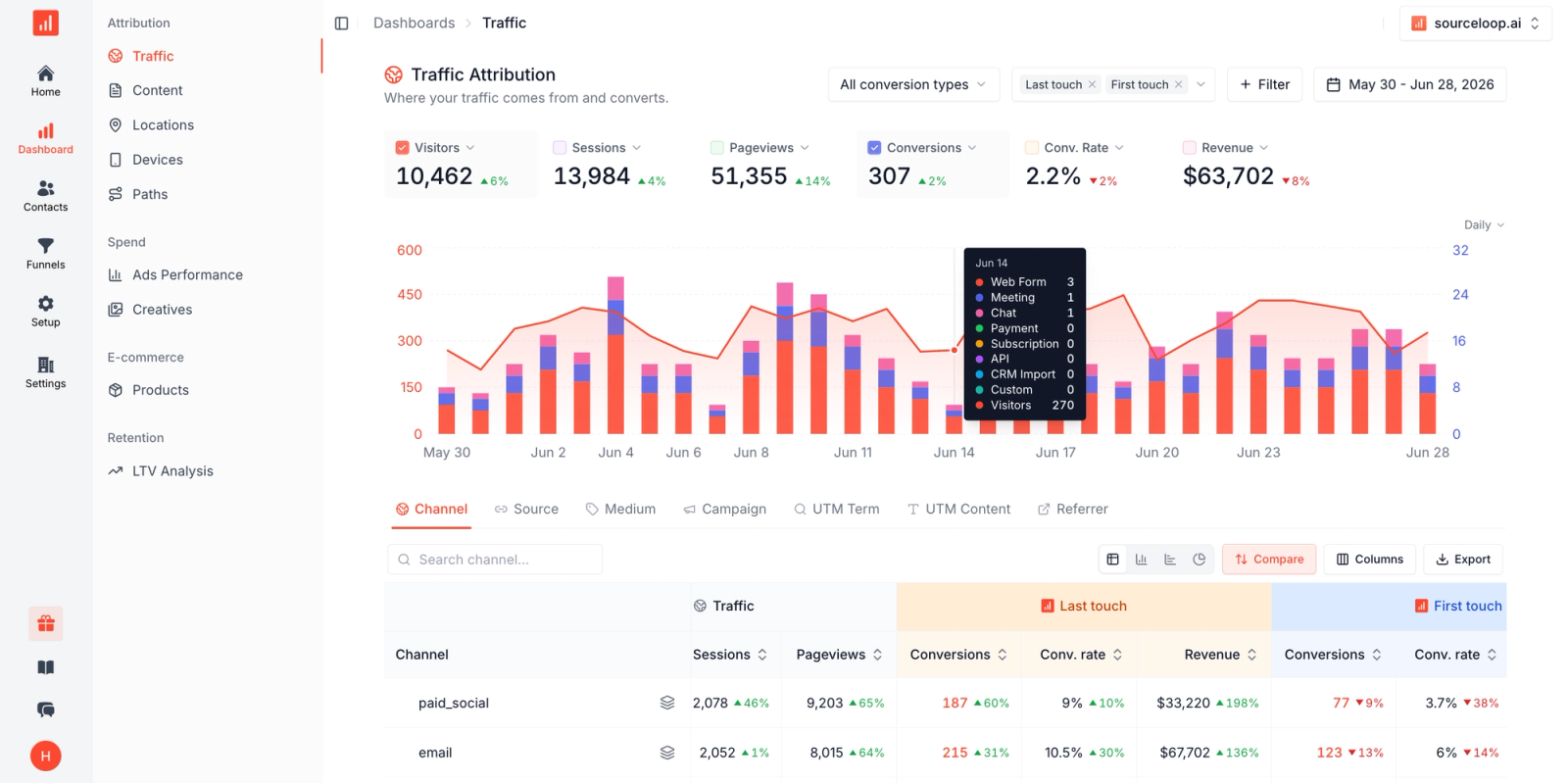
Seven attribution models on one stored journey: first touch, last touch, linear, position-based, time decay, first non-direct and last non-direct.
Lead tracking tools generally credit the source that produced the lead. That is last touch by another name, and it undervalues everything that opened the conversation.
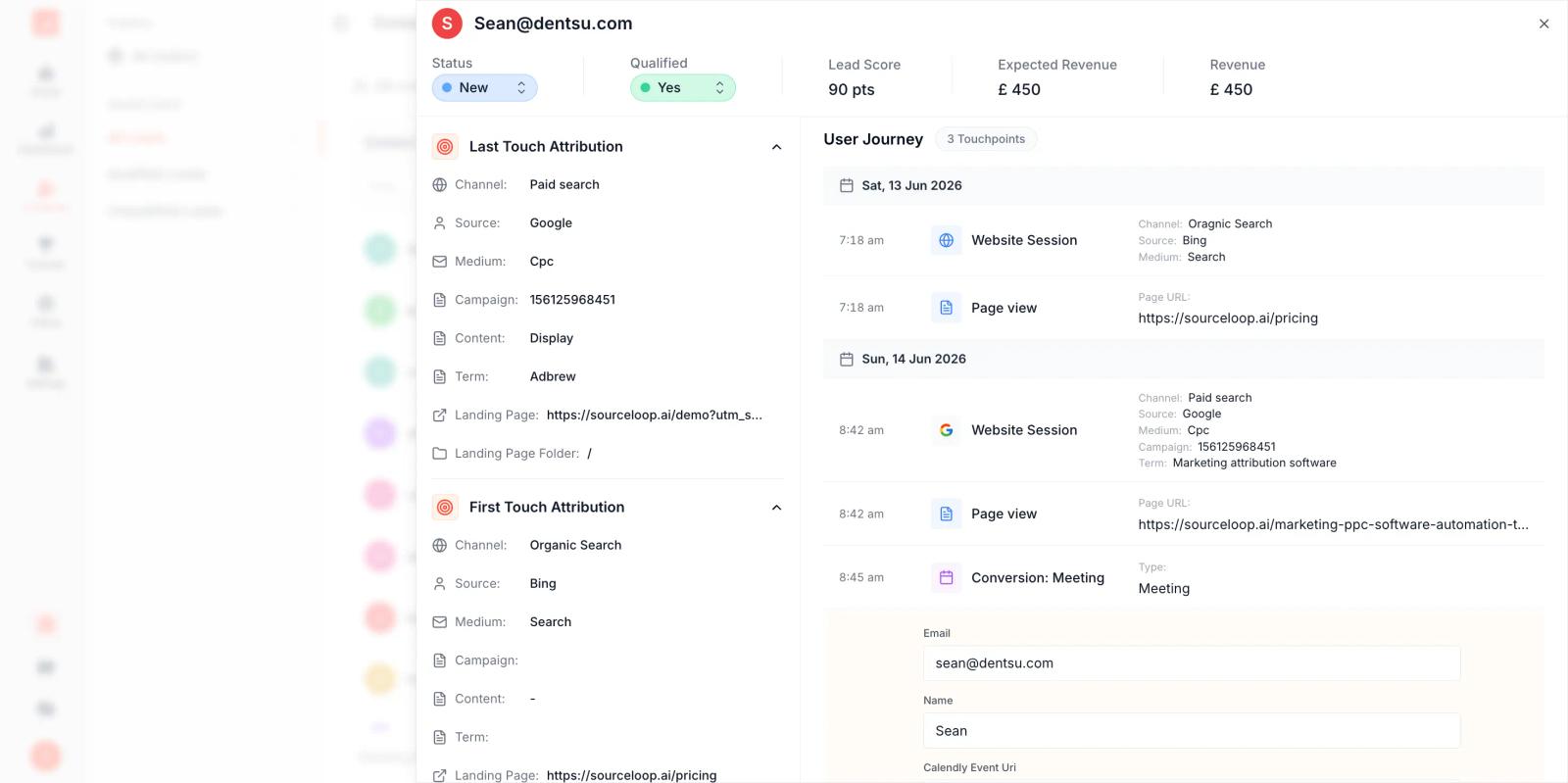
Every contact has a timeline behind it. Each session in order, how they arrived, what they read, and the visit that converted.
CRM sync and pipeline reporting
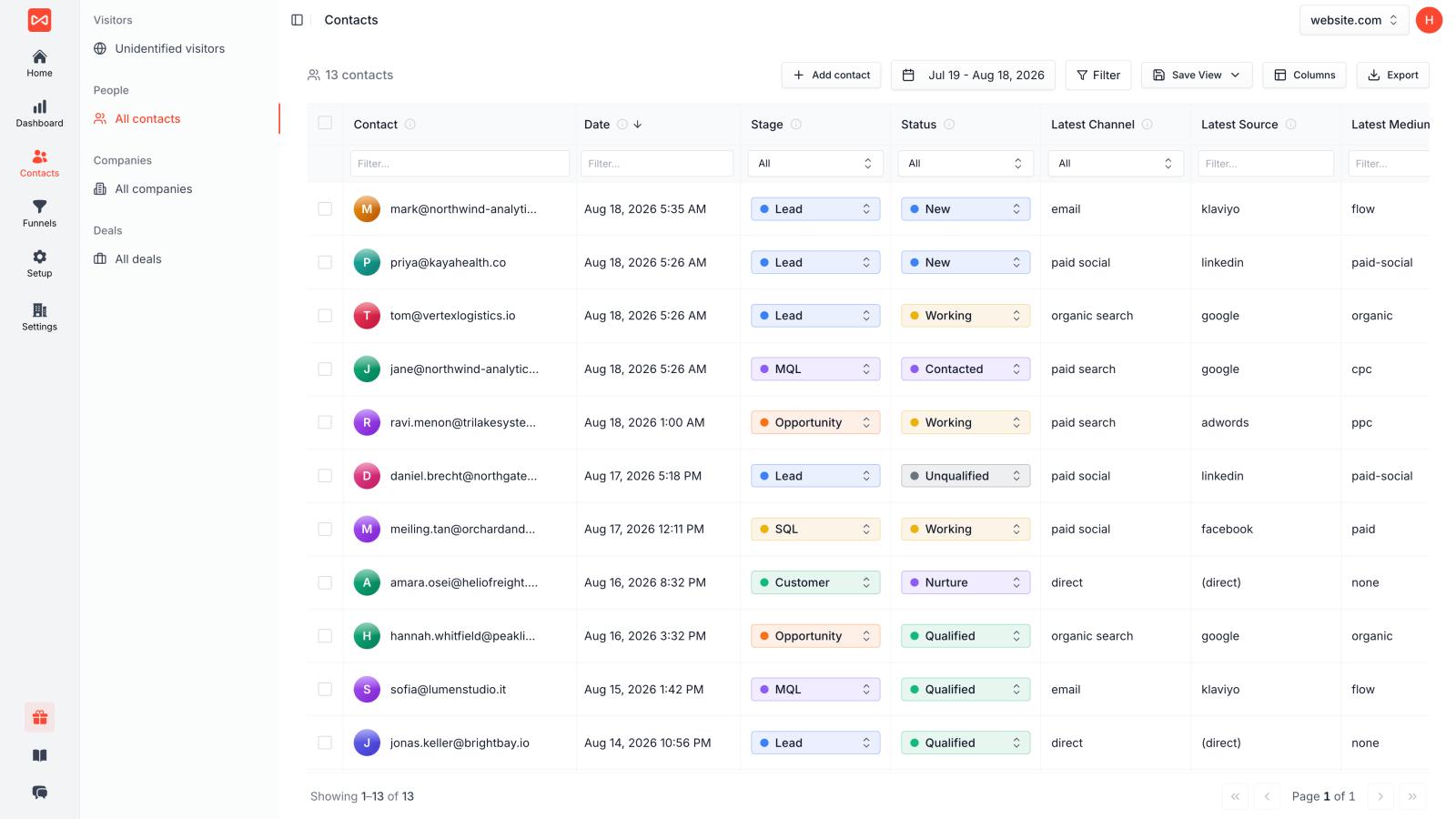
A common wish from lead tracking users is pipeline stages and follow-up, without bolting on another tool.
SourceLoop syncs both ways with HubSpot, Salesforce, Pipedrive and Zoho. Attribution fields go onto the record, and deal stage and closed-won value come back, so reporting moves from lead counts to revenue.
There is also a funnel builder for measuring drop-off between your own stages.
Sending conversions to ad platforms
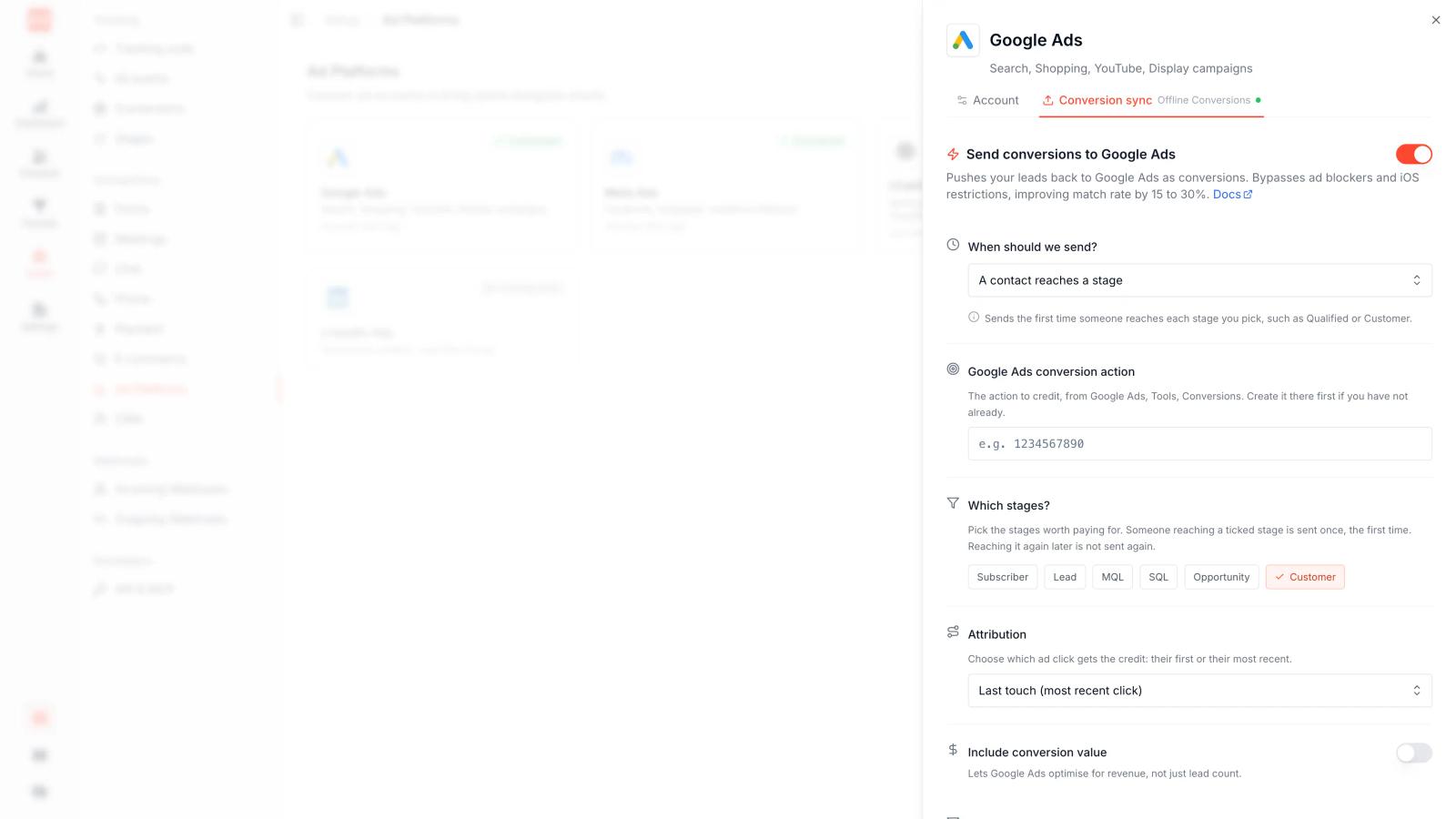
Qualified leads and closed deals push server-side to Google Ads, Meta, LinkedIn, Microsoft, TikTok, Pinterest and Reddit.
Each mapping picks its trigger, can filter to one source, chooses first or last touch, and sends your CRM's quote or realised value.
For an agency this is the difference between reporting on the client's spend and improving it.
Key capabilities
- Nine click IDs captured per session and per contact, read ahead of the referrer
- Around 70 form, meeting, chat, call and payment tools tracked with no event code
- Seven attribution models with published weightings
- Page-level content attribution and path sequence analysis
- White-label dashboards, plus unlimited websites and seats on the Business plan
- REST API, webhooks, Zapier, Make and an MCP server
Watch-outs
No tracking numbers, recording or transcription of its own.
No anonymous account identification.
Form tracking is automatic for around 70 tools, but anything custom needs a webhook.
Tracked conversions are unlimited on every plan, but the entry tier covers 30k page views a month, so a high-traffic site starts at Professional.
Pricing
- Essential: $49 / month, 30k page views
- Professional: $99 / month, 100k page views
- Agency: $249 / month, 3 websites, unlimited users
Flat monthly tiers with no per-minute, per-transcription or per-lead overage. That predictability is the main commercial difference for a high-volume agency.
Best for: Agencies and lead-gen teams that have the call tracking sorted and now want attribution, pipeline reporting and ad-platform sync on top. Create a free SourceLoop account.
2. CallRail
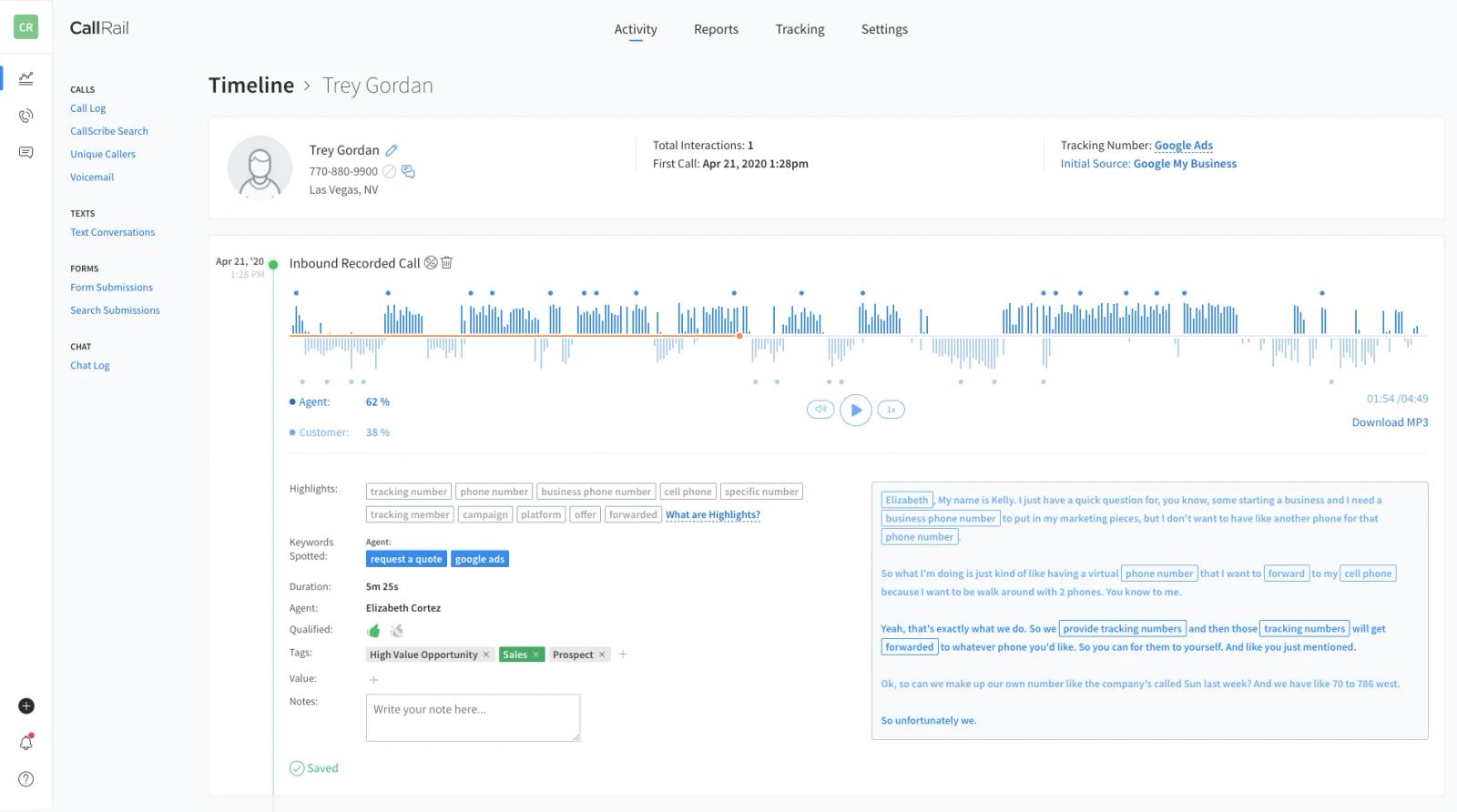
CallRail is the most-used call tracking platform in the US, and the closest direct peer to WhatConverts. If you came to WhatConverts because phone calls are real conversions in your business, CallRail is the alternative most agencies actually evaluate.
Key capabilities
- Dynamic number insertion by source, with mature attribution to keyword and campaign
- Call recording, transcription, and conversation intelligence
- Form Tracking add-on for full visibility across forms and calls
- HubSpot, Salesforce, and Google Ads integrations
- Multi-location and multi-account support for franchises and agencies
CallRail's strength is volume of customers. The product has been refined against thousands of agencies and home-services companies. Edge cases that would break other call trackers are usually solved.
Watch-outs
The pricing tiers stack quickly. Call tracking starts at $50 a month, but most agencies end up on the call-plus-forms plan at $95 or higher. Conversation Intelligence adds another tier. By the time you've turned on the features that matter, you're at $145 or $245 per month per account.
Multi-touch attribution is light compared to SourceLoop, Ruler, or HubSpot. CallRail will tell you what brought the call. It's less helpful for the question of what brought the customer over five visits and three channels.
Pricing
From $50 / month for call tracking. Realistic plans for agencies start at $95 (call + forms) or $145 (with conversation intelligence).
Best for: US lead-gen agencies and service businesses where calls are 50%+ of the funnel and the dashboards already shipped with the product are good enough.
3. CallTrackingMetrics
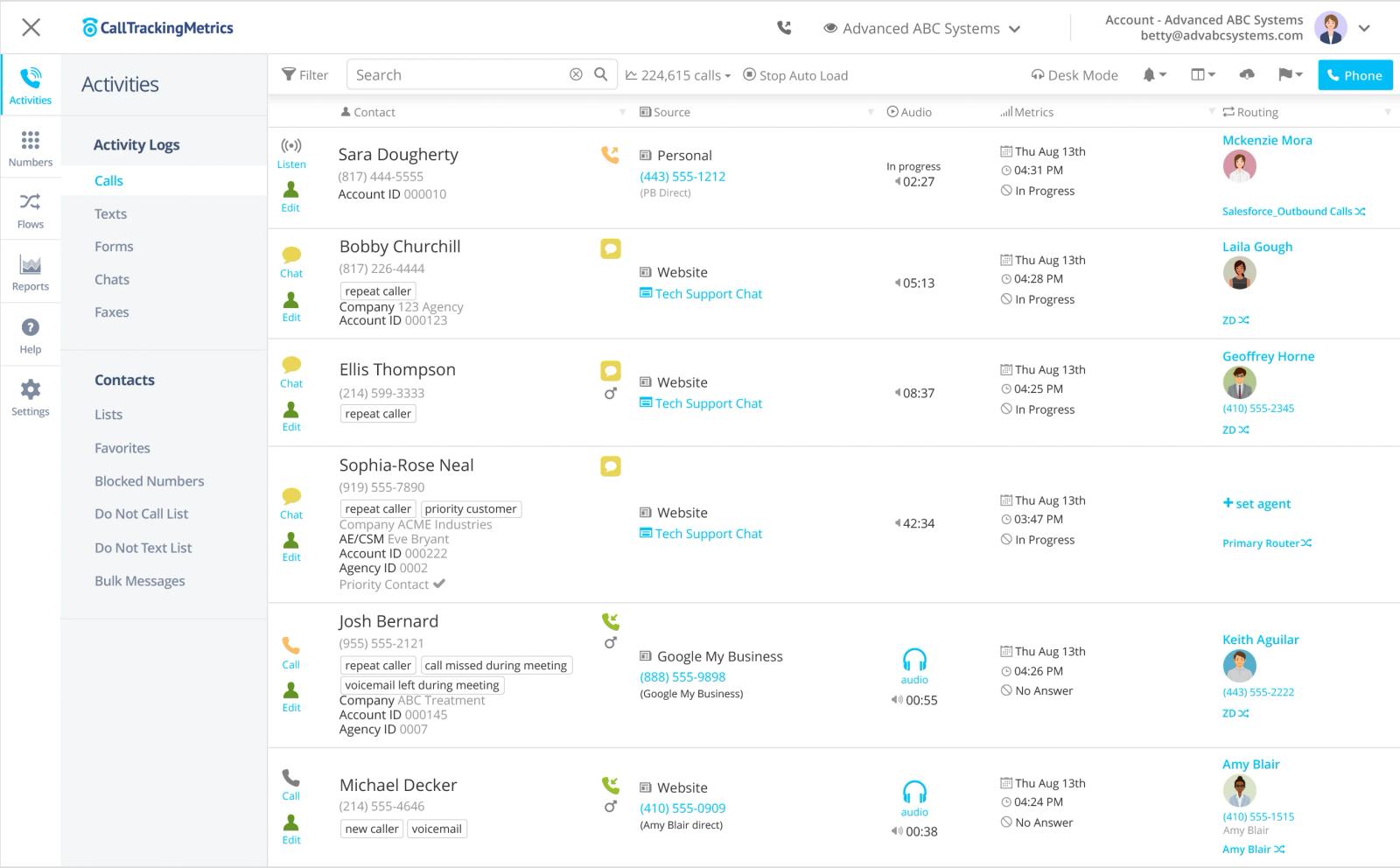
CallTrackingMetrics (CTM) is the other big name in agency-friendly call tracking. The pitch overlaps with CallRail: dynamic number insertion, recording, conversation analytics, and a real form-and-chat layer that complements calls.
Key capabilities
- DNI by source with deep tracking-pool support
- Call recording, transcription, and AI conversation scoring
- Form and chat layers that feed the same lead manager as calls
- HubSpot and Salesforce integrations with custom field mapping
- Multi-account architecture for agencies running several clients
CTM tends to be a touch cheaper than CallRail at equivalent feature levels. The agency tooling is more granular. AI scoring is good enough to use for routing decisions, not just reporting.
Watch-outs
If forms and meetings are most of your funnel, you're paying for call infrastructure you don't really need. Reporting on web-only conversions is thinner than what you'd get out of SourceLoop, HubSpot, or Ruler.
The UI feels older than CallRail and most of the rest of this list.
Pricing
From $45 / month, scaling to $300+ for higher call volumes. Enterprise quoted on usage.
Best for: Agencies running call-heavy clients who want better per-client controls than CallRail and slightly lower cost.
4. Invoca
Invoca is the enterprise call analytics tool. It's what large brands and agencies pick when call data needs to feed into bid strategies, real-time routing, and revenue dashboards that finance signs off on.
Key capabilities
- AI-driven conversation analytics with deal-stage classification, intent scoring, and outcome prediction
- Real-time call routing based on caller intent
- Native integrations with Google Ads, Meta, Adobe Experience Cloud, Salesforce
- Pre-call and post-call signal-to-bid loops for paid search optimization
- Audited reporting suitable for board-level review
If you're spending six figures a month on paid acquisition and a meaningful share of conversions are calls, Invoca pays for itself by improving how those ad platforms learn.
Watch-outs
It's enterprise-priced and enterprise-implemented. Plans start around $1,000 a month and routinely go higher. Setup is real, not snippet-and-go. You'll need a call-ops person involved.
If you're a 5-person agency with a few dozen clients, this is overkill.
Pricing
Custom. Typically $1,000+ / month, often much higher for full deployments.
Best for: Enterprise brands and agencies with serious paid spend where call quality directly drives ad-platform learning.
5. Ruler Analytics
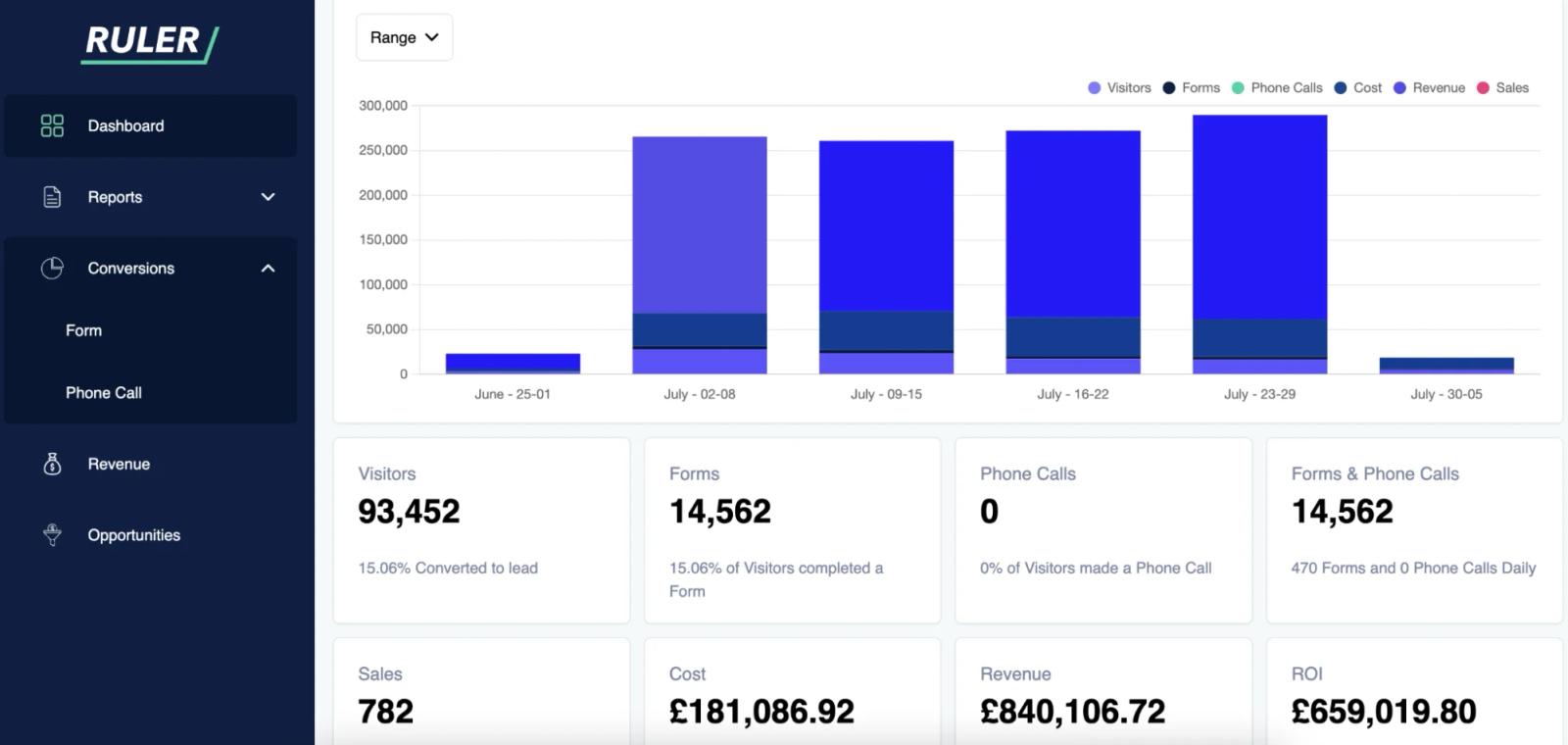
Ruler is the UK-built lead-gen attribution platform. It captures forms, calls, chats, and meetings, ties them back to source, and pushes attribution into your CRM with multi-touch models.
It does what it says. The reasons teams shop around are usually price, the rollout time, or the slightly older UI.
Key capabilities
- Form, call, chat, and meeting tracking in one product
- Multi-touch attribution with first, last, linear, and weighted models
- CRM integrations including HubSpot, Salesforce, Pipedrive
- Offline conversion sync to Google Ads, Meta CAPI, LinkedIn Ads
Watch-outs
Pricing starts at $199 a month and scales fast at higher lead volumes. The setup isn't a four-week project, but it isn't an hour either.
The UI is functional, not modern. After a week in SourceLoop and back into Ruler, the contrast is noticeable.
Pricing
From $199 / month. Enterprise custom.
Best for: Mid-market UK lead-gen teams that prefer a UK vendor and want forms-plus-calls in one product.
6. HubSpot Marketing Analytics
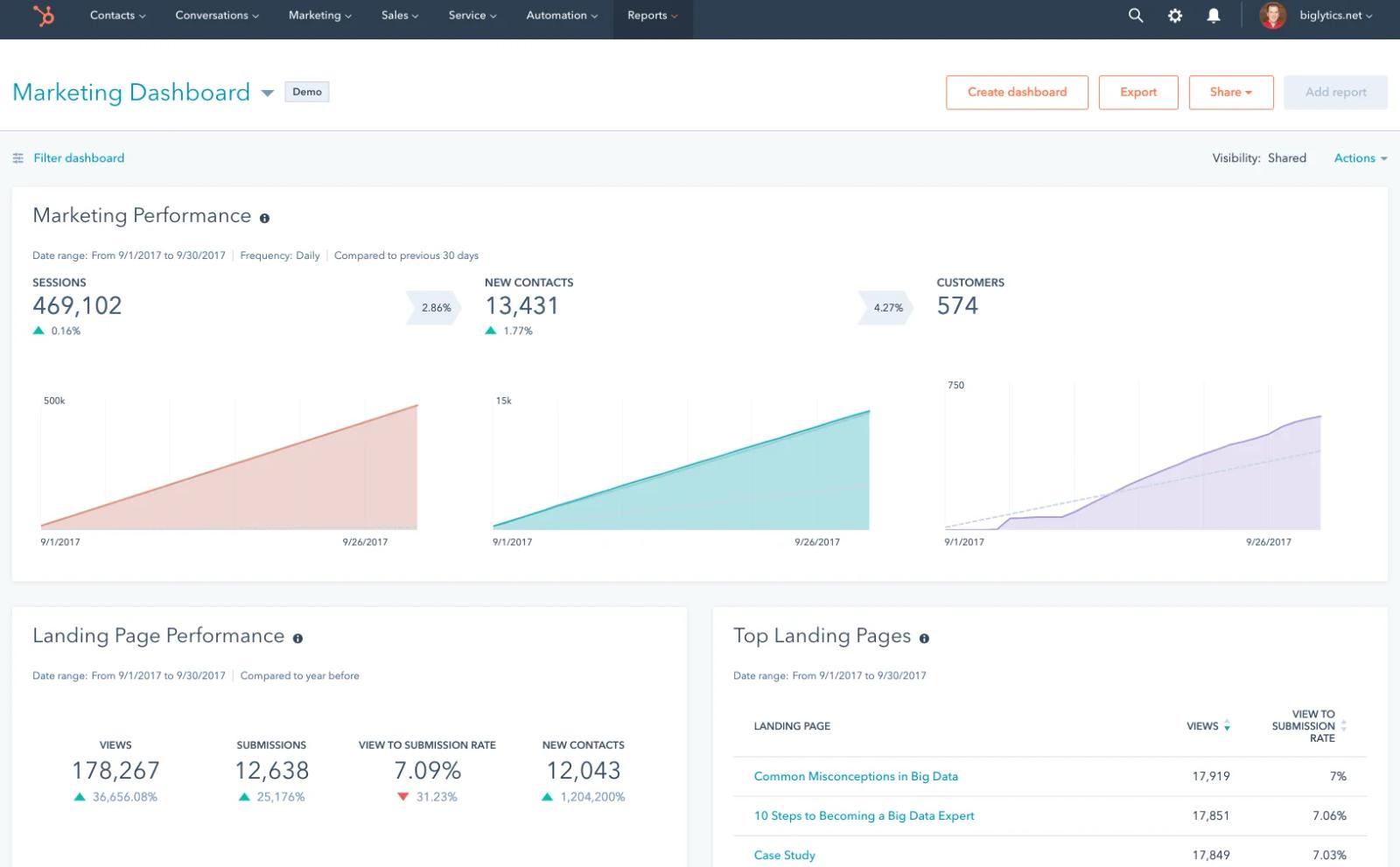
If you're already running HubSpot Marketing Hub Professional or Enterprise, the built-in attribution module is worth turning on before you shop anywhere else. It tracks first-touch, last-touch, and a few multi-touch models, and plugs into the contact-and-deal lifecycle natively.
Key capabilities
- Native integration with everything HubSpot already tracks: forms, contacts, deals, lifecycle stages, custom properties
- Multi-touch attribution models: linear, U-shaped, W-shaped, time-decay, full-path
- Revenue attribution at the deal level, with closed-won pipeline tied to source
- Contact-attribution reports that drop into existing dashboards
Watch-outs
You need Marketing Hub Professional ($800/month) or Enterprise ($3,600/month) to get attribution at all. The Starter tier doesn't include it.
There's no native call tracking. You'll forward calls in from CallRail, CTM, or another tool. The reporting is competent but rarely loved.
Pricing
Marketing Hub Professional from $800 / month (annual). Enterprise from $3,600 / month.
Best for: Teams already on Marketing Hub Pro or Enterprise who want one more reason to consolidate inside HubSpot.
7. Attribution (attribution.app)
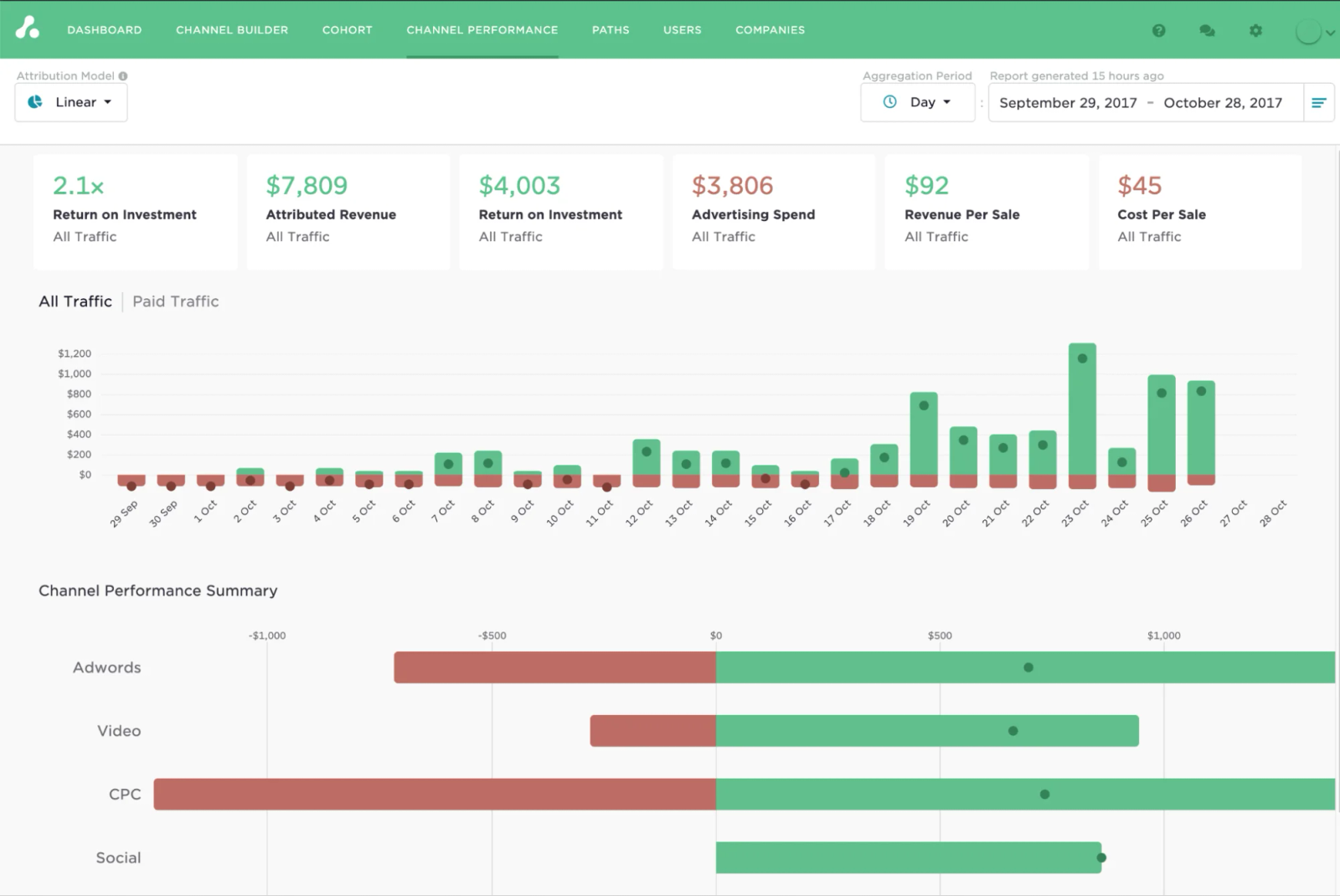
Attribution is the closest light-and-cheap swap from a tool like Attributer. It captures sources on forms, hands you a dashboard, and stays out of your way. The free tier is generous.
Key capabilities
- Free tier with reasonable limits
- Multi-touch attribution out of the box
- Form and event capture through a snippet
- CRM sync to HubSpot, Salesforce, and webhooks
Watch-outs
There's no call tracking, no built-in CRM, no dark-social attribution, and ad-platform sync is thinner than SourceLoop or Hyros. The action layer (offline conversion sync, journey orchestration) is light. It's an attribution tool. Not a marketing analytics platform.
The roadmap has been quieter than I'd want for a tool I'm trusting with attribution data.
Pricing
Free tier. Paid plans from around $99 / month.
Best for: Teams that liked WhatConverts' simplicity but want richer dashboards at a much lower price point, and don't need calls.
How to pick the right one
Start with the funnel.
For most teams, SourceLoop is the answer. Modern UI, multi-touch attribution, content and dark-social attribution, ad-platform sync, set up in an hour, $49 to $249 a month. If your funnel is forms, chats, and meetings (most lead gen and SaaS, plus a lot of agencies), it's the upgrade. Create a free SourceLoop account. 7 days, no card.
If calls are central to your business, the answer changes:
- 70%+ of conversions are inbound phone calls: pick a call-first tool. CallRail for US lead gen, CallTrackingMetrics for cost-conscious agencies, Invoca for enterprise.
- Calls are 30-50% of the funnel: SourceLoop for the dashboards and ad sync, paired with CallRail or CTM for the call tracking. Two tools, total cost still usually below WhatConverts at agency tiers.
- You're already paying for HubSpot Marketing Pro or Enterprise: turn on the built-in attribution before shopping.
- You run real ABM with named target accounts: Dreamdata or Factors.ai for the account-level stitching SourceLoop doesn't ship.
If none of those fit, SourceLoop is where I'd start.
Frequently asked questions
-
What is the cheapest WhatConverts alternative?
Attribution at $0 (free tier) and SourceLoop at $49 a month are the lowest-friction entry points. WhatConverts itself starts at $30/month for solo, but the agency tiers most users actually need start at $200+. SourceLoop's $49 entry plan covers more reporting and ad sync than WhatConverts at $200. The real comparison is on capability per dollar, not absolute floor.
-
Can I keep my phone numbers when migrating from WhatConverts?
Sometimes. CallRail and CallTrackingMetrics both support number porting, but the process takes 5-15 business days and may require a Letter of Authorization. If your numbers are critical to live ad campaigns, schedule the migration during a quieter period and run both tools in parallel for a few days.
-
Does SourceLoop replace WhatConverts entirely?
For form-and-meeting-driven funnels, yes. For call-heavy funnels, no, not on its own. SourceLoop doesn't ship native call tracking. The pattern that works is to pair SourceLoop with a dedicated call tracker like CallRail or CallTrackingMetrics, forward call events as webhooks, and let SourceLoop handle the multi-touch dashboards and ad-platform sync.
-
What's better for an agency: CallRail, CallTrackingMetrics, or WhatConverts?
CallRail has the largest install base and the most mature US support. CallTrackingMetrics tends to be slightly cheaper and has better per-client controls. WhatConverts has the cleanest agency multi-client architecture and lighter-weight reporting. The right pick depends on whether you weight reliability (CallRail), cost-per-feature (CTM), or per-client UX (WhatConverts) the most.
-
Do these alternatives push offline conversions back to Google and Meta?
SourceLoop, Invoca, and Ruler do this natively for forms and (where applicable) calls. CallRail and CallTrackingMetrics push call events to Google Ads natively but Meta is more limited. HubSpot has a Google Ads integration but Meta is partial. Attribution is light on this. If pushing closed-won deals back to ad platforms matters, SourceLoop or Invoca are the safer picks.



 Paid Social


