
9 Best Demandbase Alternatives I Tested for 2026
Demandbase alternatives compared honestly. Nine ABM and B2B attribution tools across price tiers, with the option that handles ad sync at one-fiftieth the cost.
Table of contents
- Quick comparison
- 1. SourceLoop
- What the tracking script captures
- The journey behind every lead and account
- Attribution models and reports
- CRM sync and pipeline reporting
- Sending conversions to ad platforms
- What you don't get
- Pricing
- 2. 6sense
- Key capabilities
- Watch-outs
- Pricing
- 3. Factors.ai
- Key capabilities
- Watch-outs
- Pricing
- 4. Dreamdata
- Key capabilities
- Watch-outs
- Pricing
- 5. HockeyStack
- Key capabilities
- Watch-outs
- Pricing
- 6. Adobe Marketo Measure
- Key capabilities
- Watch-outs
- Pricing
- 7. HubSpot Marketing Analytics
- Key capabilities
- Watch-outs
- Pricing
- 8. Salesforce Pardot (Marketing Cloud Account Engagement)
- Key capabilities
- Watch-outs
- Pricing
- 9. Attribution (attribution.app)
- Key capabilities
- Watch-outs
- Pricing
- How to pick the right one
Demandbase is an ABM platform with attribution baked in, not the other way around.
That distinction matters because the cost reflects it. The platform pays back when your team is running paid ABM with ad orchestration, account intent acting as routing fuel, and outbound coordinated against the dashboards. It doesn't pay back when those flywheels aren't spinning.
If yours aren't (or aren't yet), the question is what you actually need. Maybe it's still ABM, just with a tool that doesn't require six figures. Maybe it's pure attribution. Maybe it's ad sync at a fraction of the cost.
Quick comparison
| Tool | Best for | Starts at | Setup | Account ID | ABM ads | Conversion sync |
|---|---|---|---|---|---|---|
 SourceLoop SourceLoop |
Most teams (no ABM) | $49 / mo | ~1 hour | No | No | Yes |
 6sense 6sense |
Enterprise ABM + intent | ~$50k+ / year | 4-8 weeks | Predictive | Via integrations | Yes |
 Factors.ai Factors.ai |
LinkedIn-led ABM | ~$899 / mo | 1-2 weeks | Yes | No | Yes |
 Dreamdata Dreamdata |
Long-cycle B2B | Free / $999 / mo | ~1 week | Yes | No | Yes |
 HockeyStack HockeyStack |
B2B SaaS dashboards | ~$1,000 / mo | 1-2 weeks | Yes | No | Yes |
 Adobe Marketo Measure Adobe Marketo Measure |
Enterprise revenue ops | ~$2,000+ / mo | 60-90 days | Limited | No | Yes |
 HubSpot Marketing HubSpot Marketing |
HubSpot-native | From $800 / mo | Bundled | Limited | No | Limited |
 Salesforce Pardot Salesforce Pardot |
Salesforce-native MAP | From $1,250 / mo | 2-4 weeks | Limited | No | Limited |
 Attribution Attribution |
Cheap simple | Free / $99 / mo | ~1 hour | No | No | Limited |
1. SourceLoop
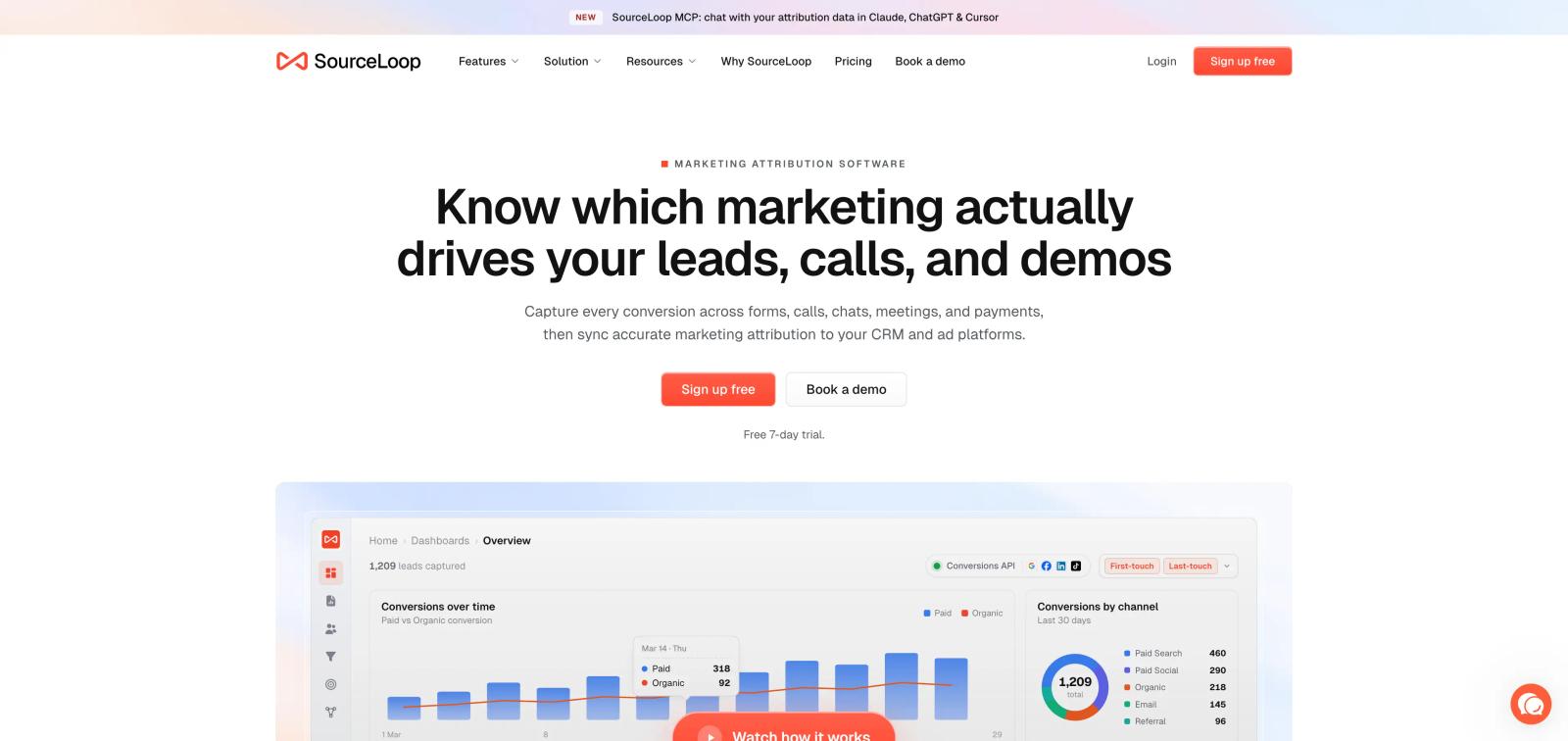
SourceLoop is the answer when "Demandbase" turned out to mean "I need ad-platform sync and revenue attribution," not "I need an ABM platform."
That is a common landing point, and the reason is structural.
Demandbase prices by module. Advertising, account intelligence, personalisation, orchestration and data each carry their own line item, so attribution arrives bundled with things you may not run.
Contracts are quote-only and typically start around $18,000 a year, with a median closer to $65,000. Getting to a number takes a sales cycle.
What the tracking script captures
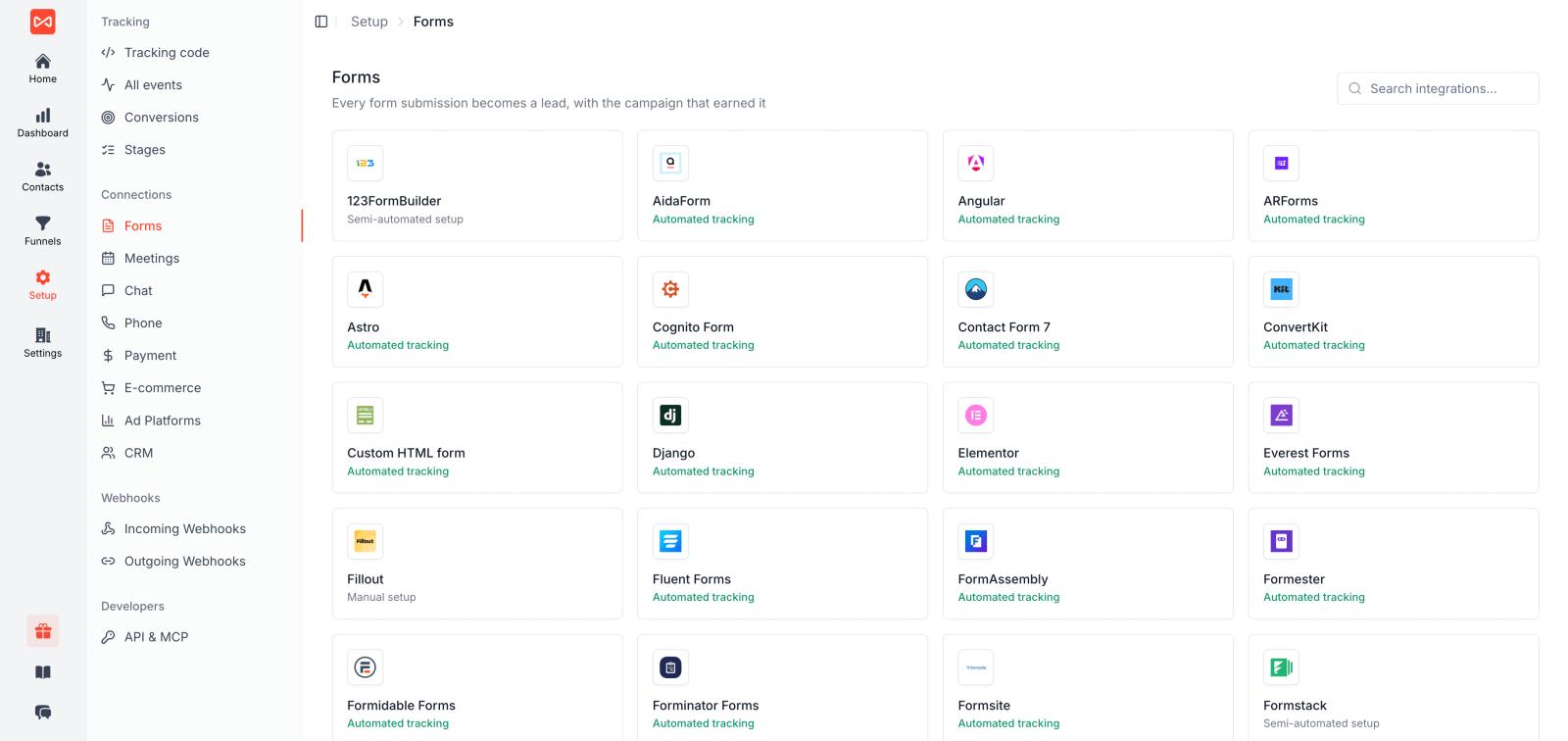
One script, and every visitor gets a first-party session with referrer, landing page, UTMs and the ad platform's click ID. Nine click IDs, read ahead of the referrer.
Conversions arrive from around 70 tools with no event code. Calendly, Cal.com, HubSpot Meetings, Chili Piper, Gravity Forms, WPForms, Typeform, Jotform, Webflow, Intercom, Drift, Crisp, CallRail, CallTrackingMetrics, Invoca and the major payment providers.
The journey behind every lead and account
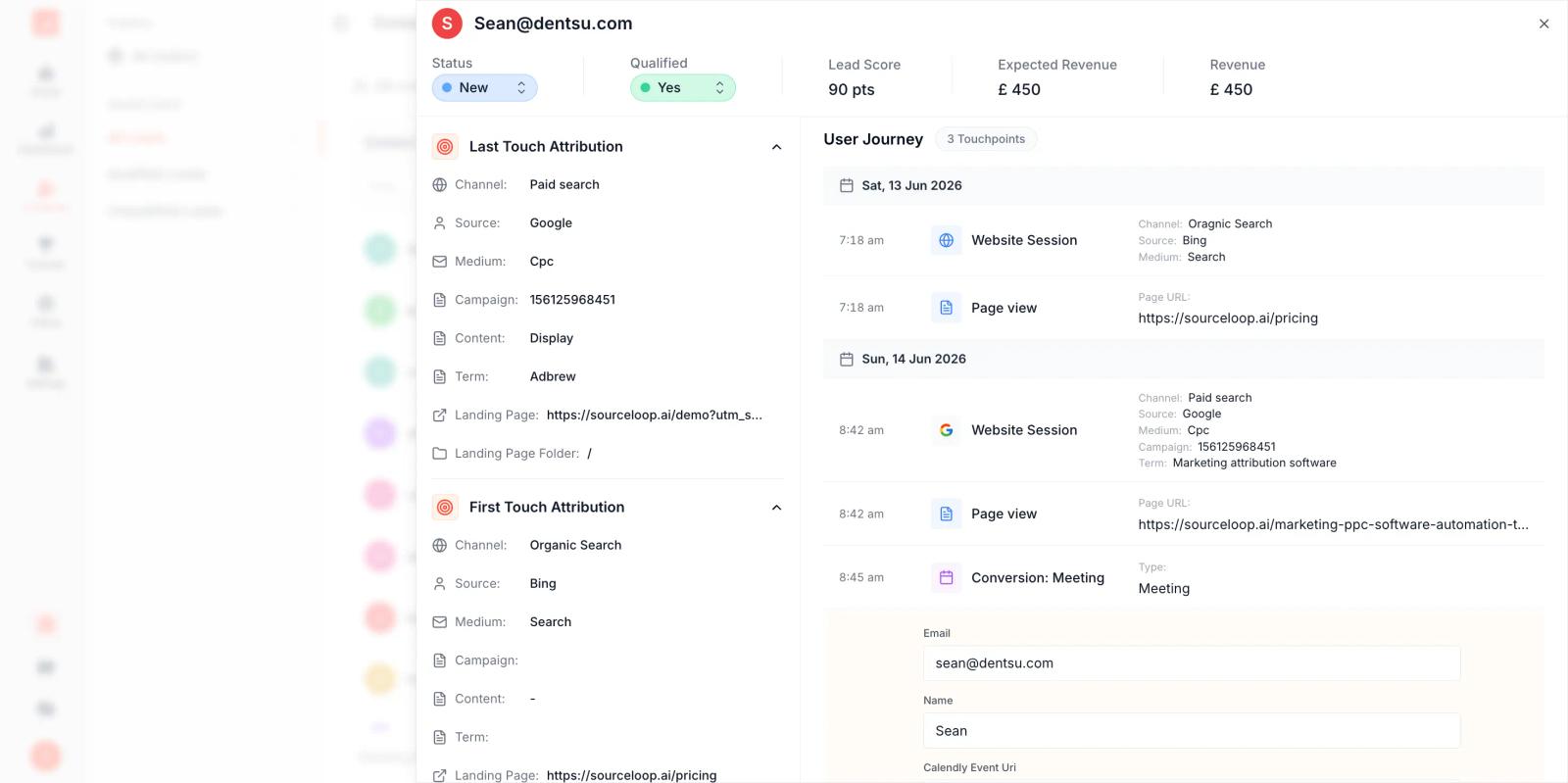
Every contact has a timeline. Each session in order, how they arrived, what they read, and the visit that converted.
Identity stitching merges devices and browsers when an email, phone or user ID connects them, which matters in a cycle measured in months.
Contacts roll up by company, resolved from the domain on a captured lead email, and every known person at that account shares one journey. In B2B the person who read the first blog post is rarely the person who signs.
A Visitors view covers people who have not converted yet, with their own first and last touch attribution attached.
Attribution models and reports
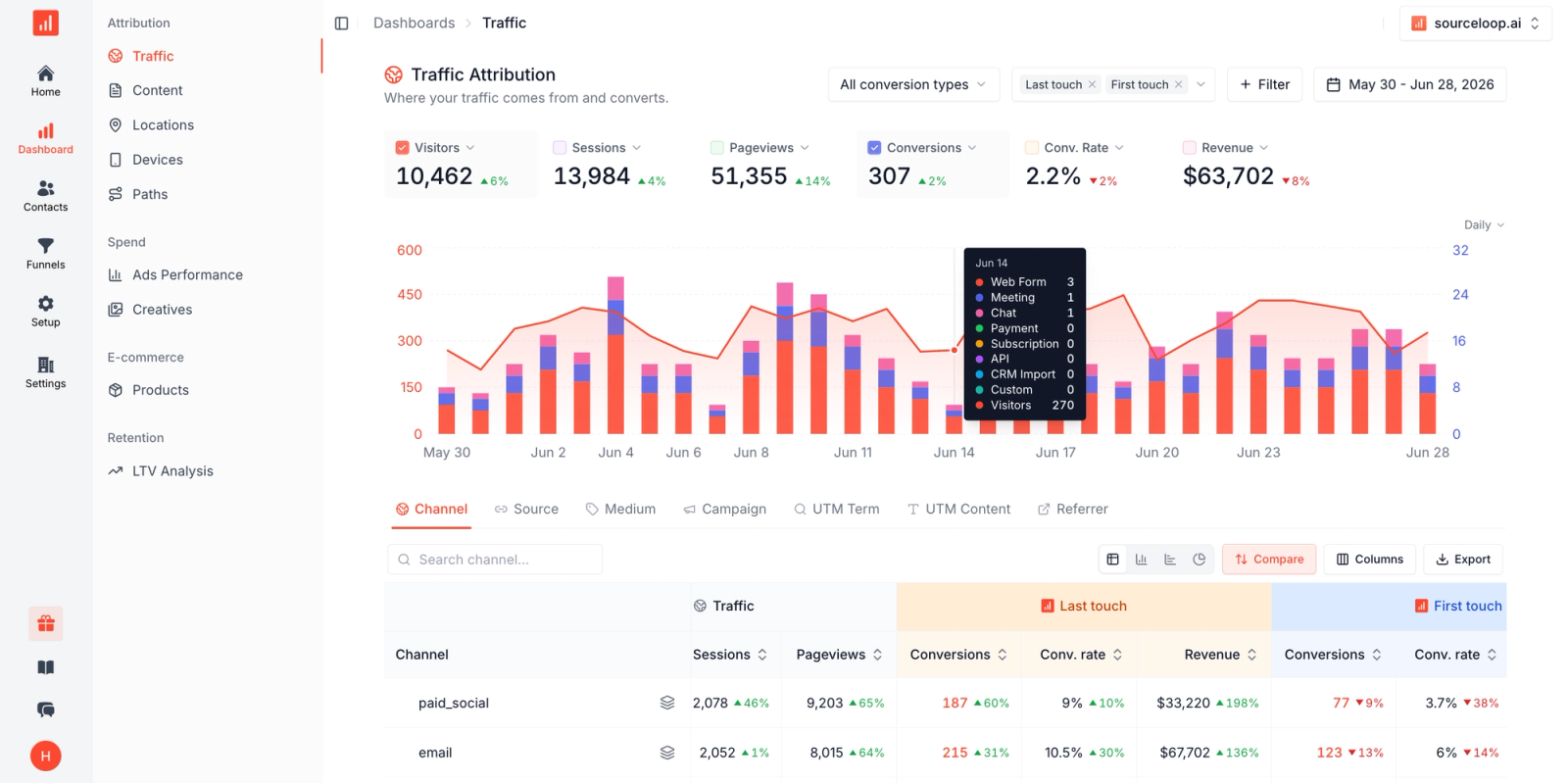
Seven models on one stored journey, switched from a dropdown: first touch, last touch, linear, position-based, time decay, first non-direct and last non-direct.
The conversion-path-by-channel report puts first touch, multi-touch and last touch side by side. Channel rollups show pipeline, revenue and CAC by source.
A recurring frustration with large ABM platforms is connecting platform activity back to actual pipeline. That connection is the only thing this layer does.
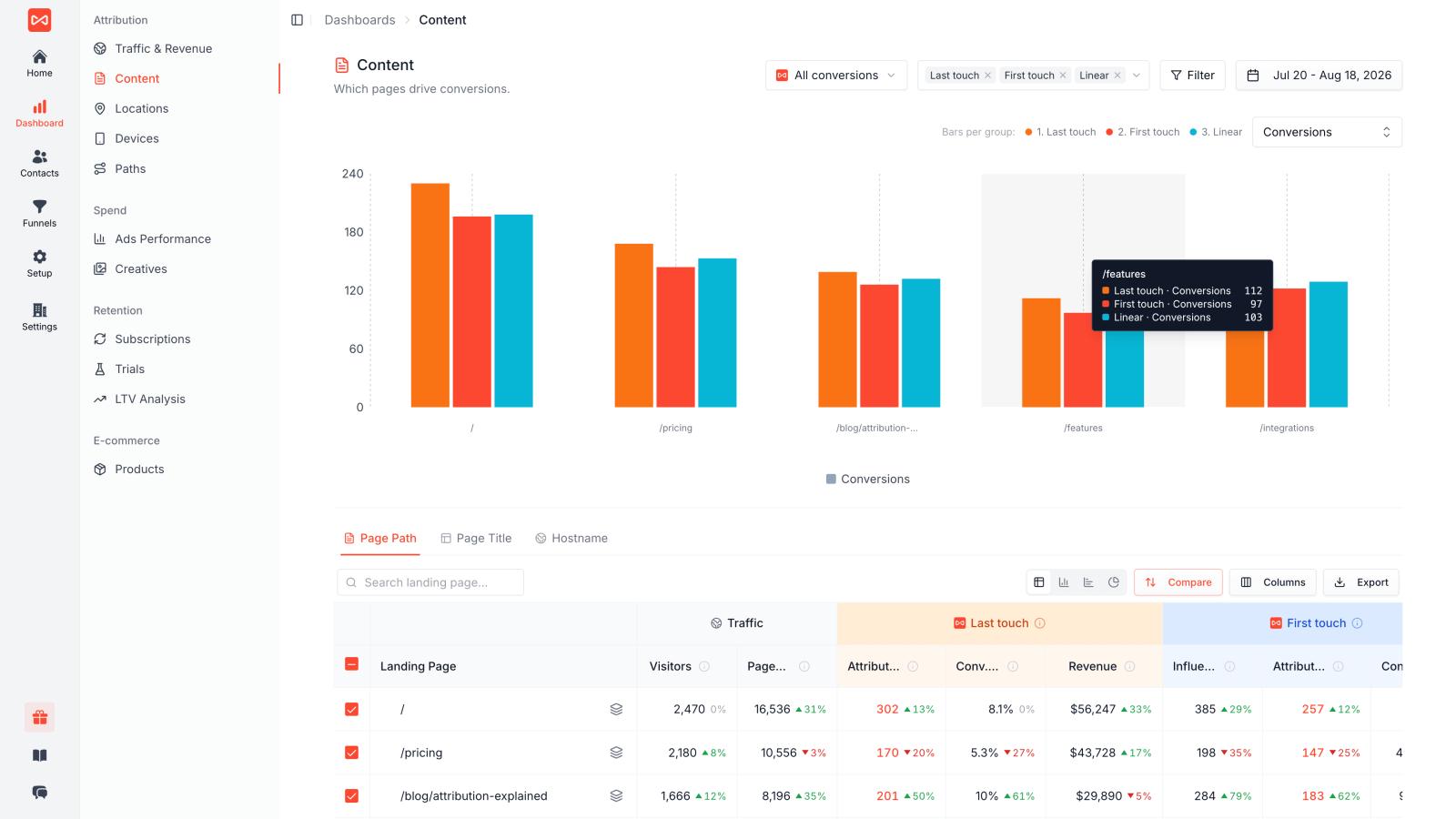
Content attribution runs at page level, crediting the blog posts that opened pipeline under first touch rather than only the page that closed it.
CRM sync and pipeline reporting
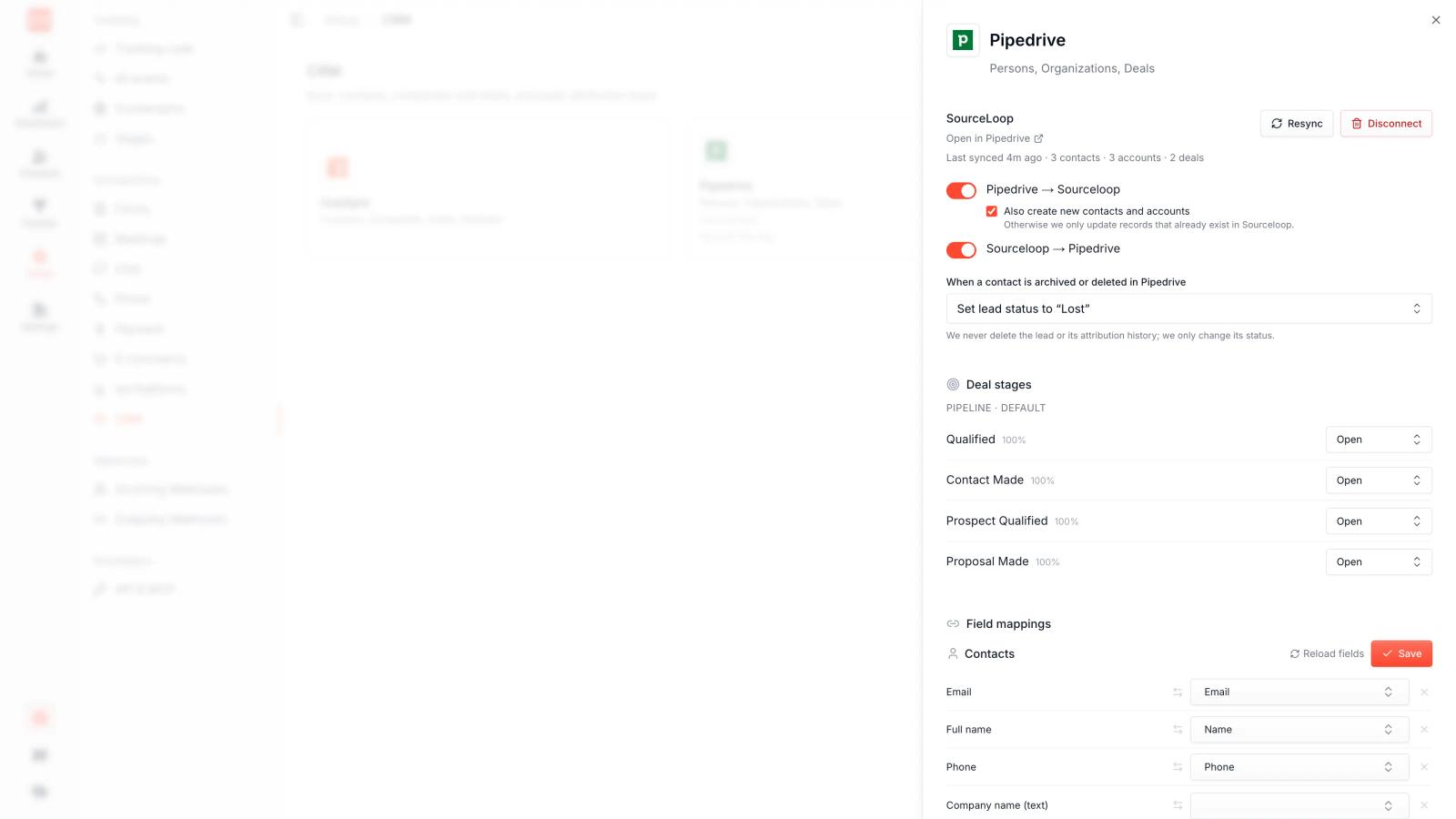
Native two-way sync with HubSpot, Salesforce, Pipedrive and Zoho.
Source, campaign, UTMs and click IDs are written onto the contact or lead record, with the properties created automatically on first write and remappable across contacts, companies and deals.
Deal stages and closed-won values flow back, with explicit mapping for Salesforce lead status, HubSpot lifecycle stages and Pipedrive labels.
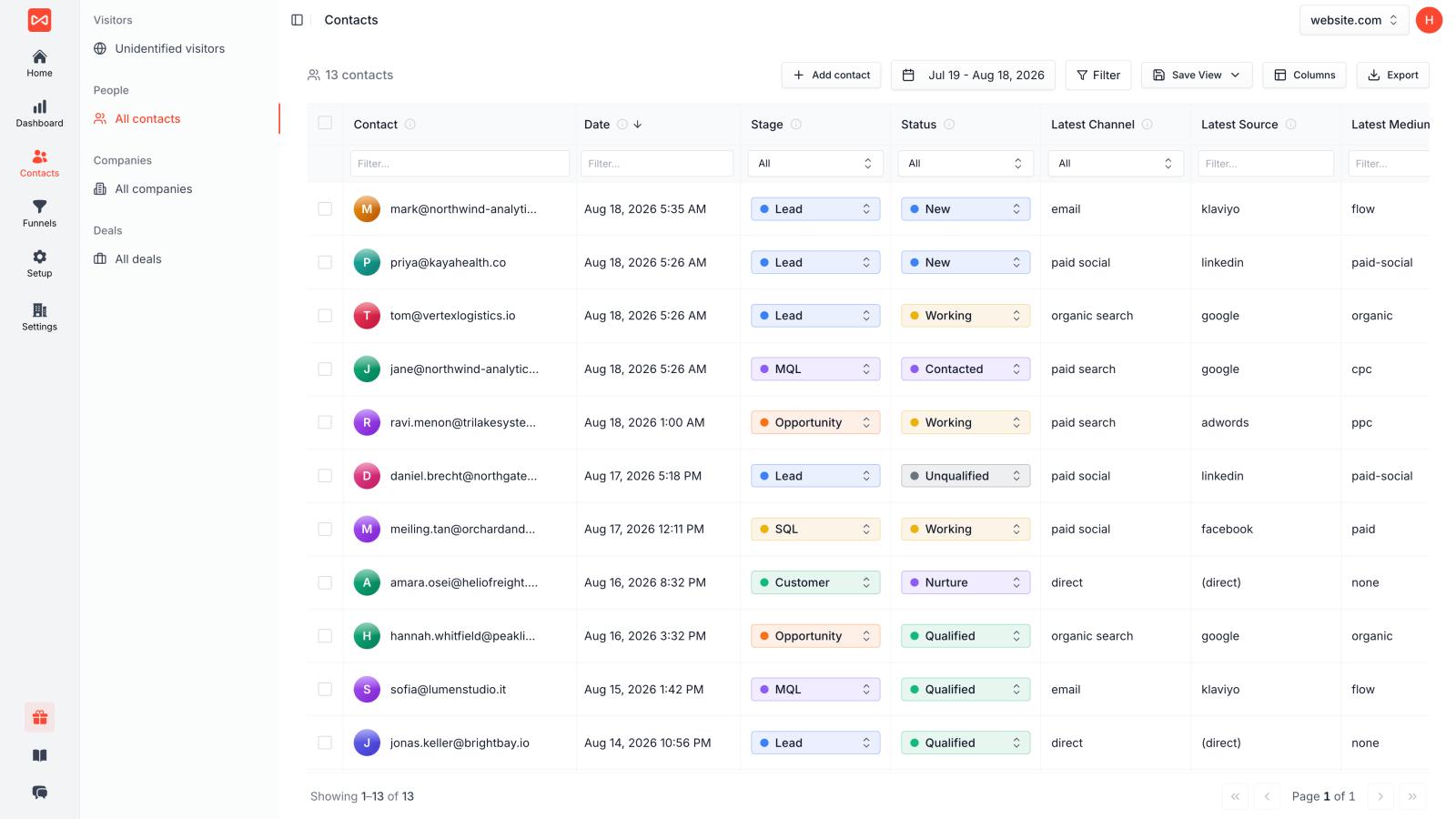
Deals inherit first-touch and last-touch attribution derived from the touchpoints of everyone linked to them. Your CRM does not compute that field.
Sending conversions to ad platforms
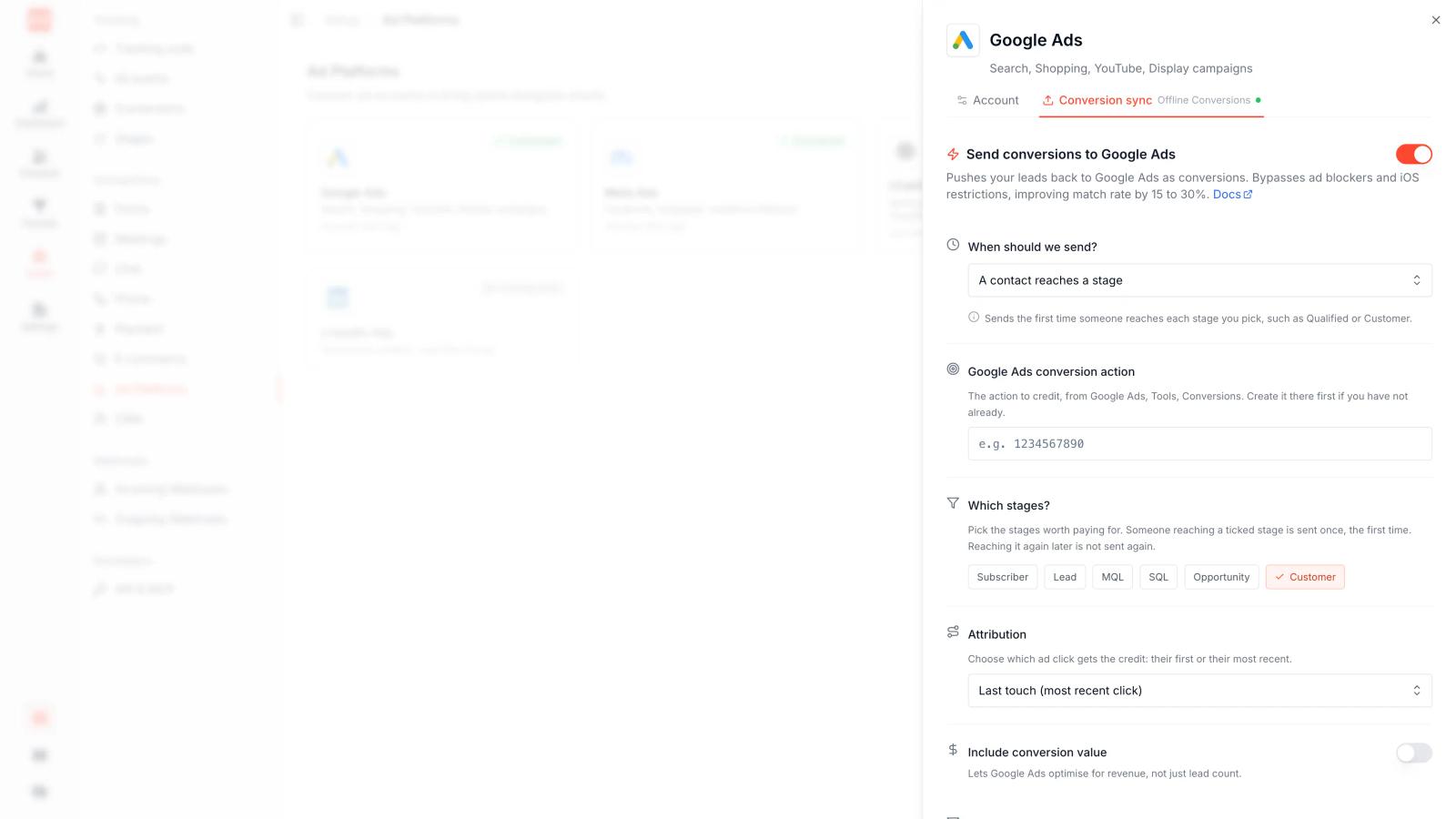
When a deal closes, that conversion goes back to the ad platforms as an offline event.
Google Ads shifts bid weighting toward the channels that produced revenue. Meta CAPI hardens the signal against ATT and Safari ITP. LinkedIn gets the conversion tied to the original campaign, which matters because LinkedIn is usually where the ABM budget went. Microsoft, TikTok, Pinterest and Reddit are covered too.
Each mapping is per event. Pick the trigger, filter to one source, choose first or last touch, and send your CRM's quote value or the realised amount.
What you don't get
This is a Demandbase alternatives article, so the gaps matter.
No anonymous account identification. No ABM ad orchestration. No built-in DSP. No predictive intent scoring across the public web.
Account rollup here needs a captured email first. It is domain resolution, not reverse IP.
If those features are why you are on Demandbase, SourceLoop is not the answer. The closest substitutes are 6sense and Factors.ai.
If they turned out to be more demo than daily driver, SourceLoop covers what is left.
Pricing
- Essential: $49 / month, 30k page views
- Professional: $99 / month, 100k page views
- Agency: $249 / month
Published, monthly, with a 7-day trial and no card.
Best for: B2B teams who joined Demandbase for the attribution and ad sync, not the ABM orchestration. Create a free SourceLoop account.
2. 6sense
6sense is Demandbase's longest-running competitor. The pitches overlap: predictive intent across the public web, anonymous account identification, ABM orchestration, deep CRM integrations.
The core differentiator is on the prediction side. 6sense leans harder into the "which accounts are entering a buying cycle" model, with stage-progression confidence scores and predicted timing.
Key capabilities
- Predictive intent scoring based on third-party signal data captured across 6sense's research network
- Buying-stage classification (Awareness, Consideration, Decision, Purchase) with predicted transition timing
- ABM orchestration across web personalization, paid ads, sales prospecting, and email
- Anonymous account identification at high fidelity, including accounts not in your CRM
- Salesforce, Marketo, HubSpot, Outreach native with deep CRM operations and custom workflows
Watch-outs
Pricing is enterprise-only. Plans typically run $50k-$120k per year. Implementation is 4-8 weeks. Most companies under-use what they buy without a dedicated owner.
The platform doesn't ship a built-in DSP the way Demandbase does. ABM advertising goes through public ad platforms with 6sense providing the audiences.
Pricing
Custom. Typically $50,000+ per year.
Best for: Mid-market and enterprise B2B running outbound-led growth where intent prediction drives sales workflow.
3. Factors.ai
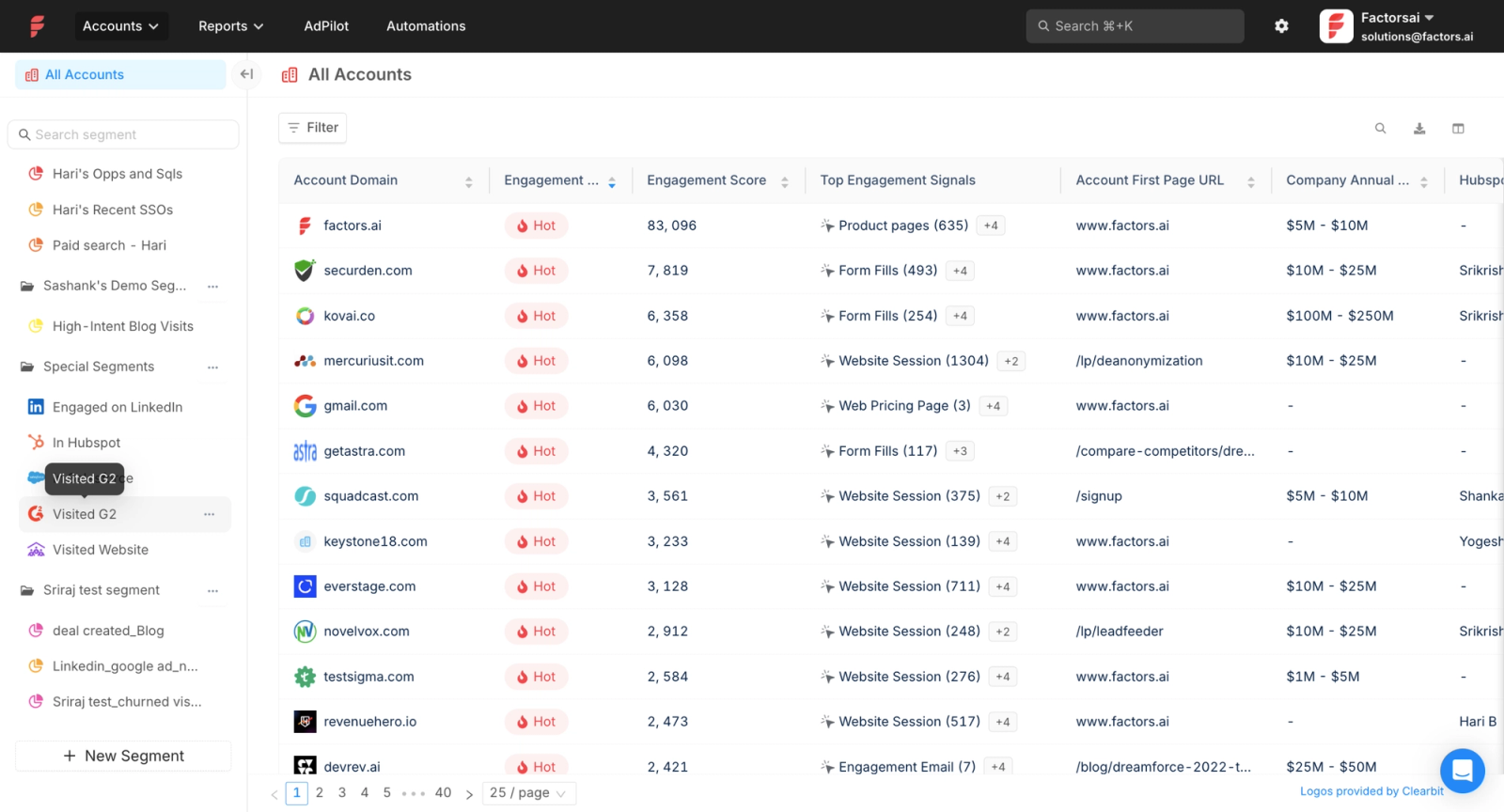
Factors sits at a different price tier than Demandbase ($899 vs $50k+) and a different audience: B2B SaaS teams running LinkedIn-led ABM where account ID matters but enterprise scale doesn't.
The differentiator is native LinkedIn intent integration. Engagement signals from your LinkedIn page, posts, and ads get layered on top of web behavior.
Key capabilities
- Account identification via reverse-IP and de-anonymization (powered by ZoomInfo, Clearbit, and a proprietary signal layer)
- LinkedIn intent integration for surfacing in-market accounts and activating ad audiences
- B2B-weighted multi-touch models that respect deal size, stage progression, and account age
- Salesforce, HubSpot, Marketo native sync with bi-directional updates
- Workflow automation triggering Slack alerts, Salesforce tasks, or sequence enrollment when accounts hit defined intent thresholds
Watch-outs
Setup takes 1-2 weeks. The 15-day free trial isn't long enough to see real attribution data accumulate for accounts with longer cycles.
Pricing
Free tier with limits. Paid plans from ~$899/month.
Best for: B2B SaaS and services teams running ABM with LinkedIn as a core channel and a budget under enterprise scale.
4. Dreamdata
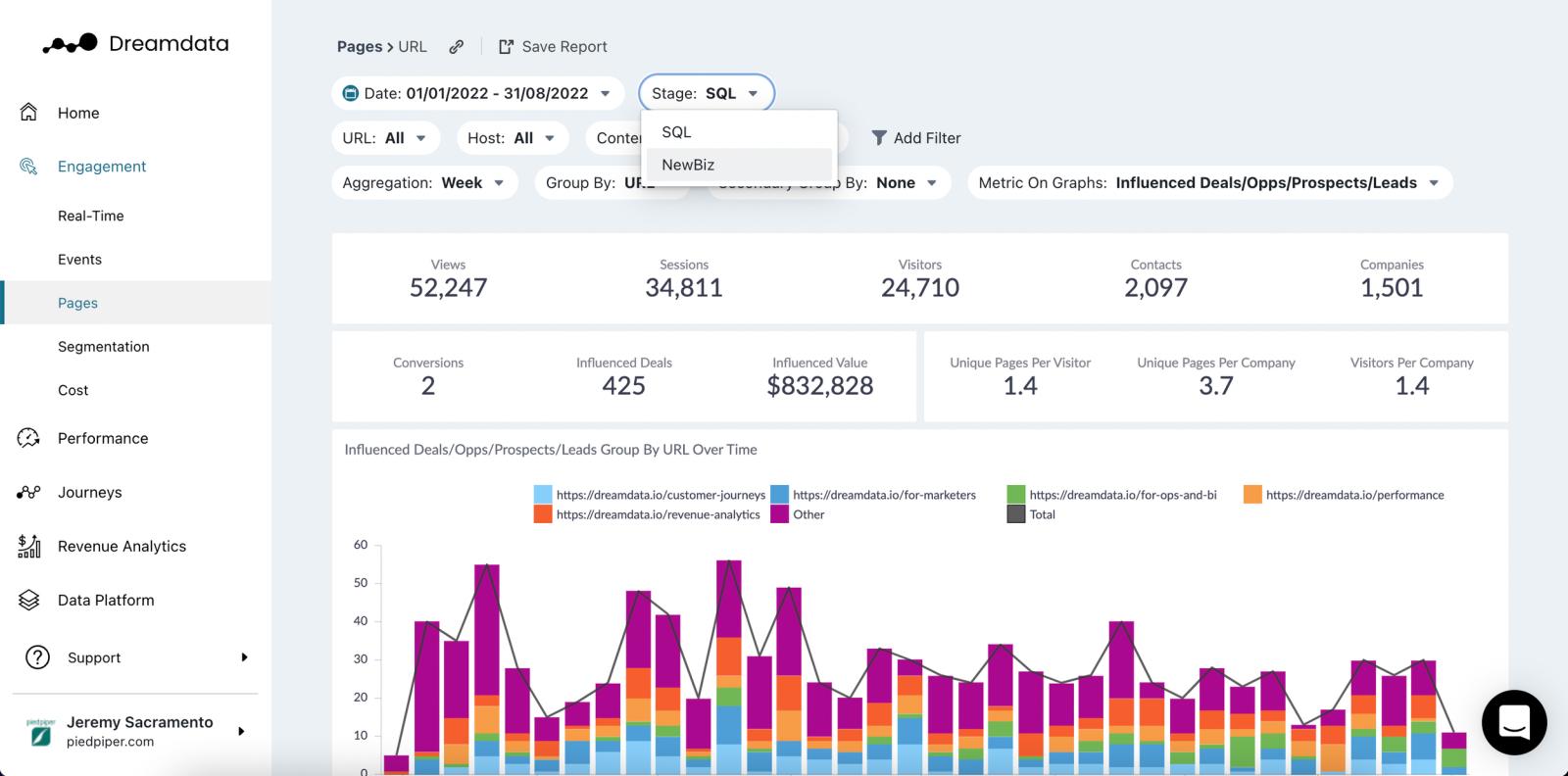
Dreamdata strips the ABM-orchestration layer off and focuses on revenue attribution. Salesforce-deep, weighted by deal size and stage, with strong handling of long sales cycles.
If you came to Demandbase for the attribution and the ABM was incidental, Dreamdata covers that swap at a tenth the price.
Key capabilities
- Bi-directional Salesforce integration that reads pipeline movement near real-time and writes attribution back as custom fields
- Free tier that's actually usable for a pilot or small-team deployment, low monthly limits but no card
- Revenue-weighted multi-touch models respecting deal size, stage progression, and account age
- Reverse-ETL friendly for teams running modern data stacks (BigQuery, Snowflake, dbt)
- Account-level journey reports with full timelines including post-conversion expansion deals
Watch-outs
Setup needs a Salesforce admin. Data model tuning takes a week before dashboards reflect reality. No ABM orchestration, no built-in DSP.
Pricing
Free for low volumes. Team from ~$999/month. Business $2k+/month. Enterprise custom.
Best for: B2B teams with longer sales cycles where Salesforce-deep attribution is the actual job and ABM orchestration was always optional.
5. HockeyStack
HockeyStack covers the attribution layer with stronger dashboards than Dreamdata, lighter Salesforce ties.
For B2B SaaS teams who valued Demandbase's reporting more than its ABM features, HockeyStack is the closest swap at a similar price tier.
Key capabilities
- Account-level journeys stitched from anonymous traffic via reverse-DNS and de-anonymization signals
- AI assistant ("Odin") that answers natural-language questions with charts and prose summaries
- Sub-second query performance on warehouse-grade data via pre-aggregation at ingest
- Native HubSpot, Marketo, Salesforce with bi-directional sync, including custom objects on enterprise
- Pre-built ABM dashboards for source-of-pipeline, content performance, and account engagement
Watch-outs
Pro starts at ~$1,000/month. No built-in advertising platform. Enterprise contracts run $25k-$60k per year for mid-market.
Pricing
Pro from ~$1,000/month. Enterprise custom.
Best for: B2B SaaS teams who need account-level attribution depth without ABM advertising orchestration.
6. Adobe Marketo Measure
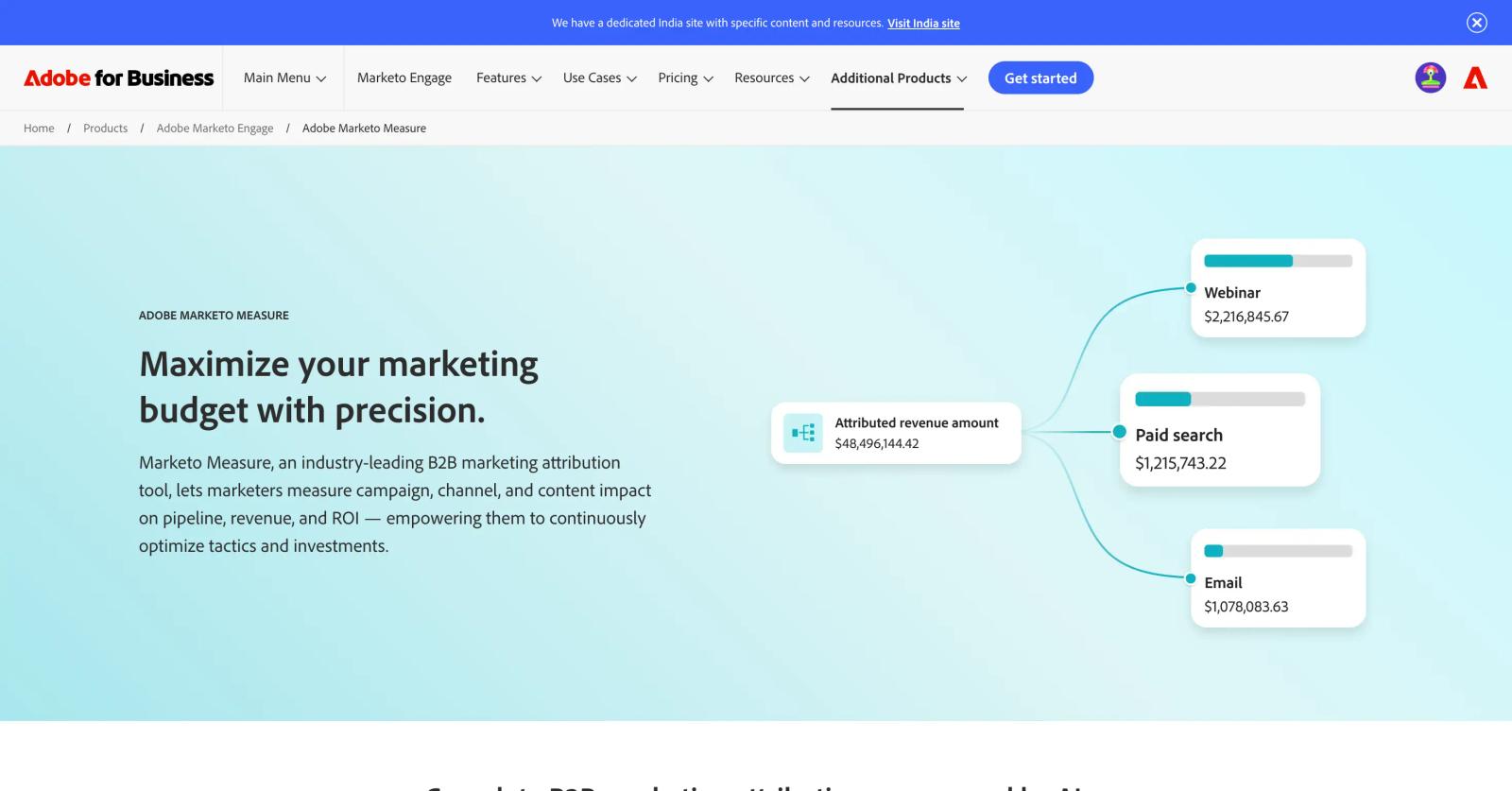
Marketo Measure is the enterprise B2B revenue attribution option. If you went to Demandbase because the ABM ad orchestration was the use case, Marketo Measure isn't a swap. If you went for the auditable revenue attribution at scale, it covers that piece deeply.
Key capabilities
- Multi-touch revenue attribution at enterprise scale, with custom models defined and audited by finance
- Native Salesforce and Marketo integration including custom-object reads and writes
- Adobe Experience Cloud connectivity when Adobe Analytics or Adobe Target are already in the stack
- Pipeline-stage progression tracking with attribution applied across stages, not just first-touch
- Custom reporting dashboards integrated with Salesforce reports and Adobe-native business intelligence
Watch-outs
Implementation 60-90 days. Requires Salesforce + Marketo admins. No ABM advertising orchestration.
Pricing
Custom. Typically $2,000+/month.
Best for: Enterprise B2B already on Marketo and Salesforce with mature ops teams.
7. HubSpot Marketing Analytics
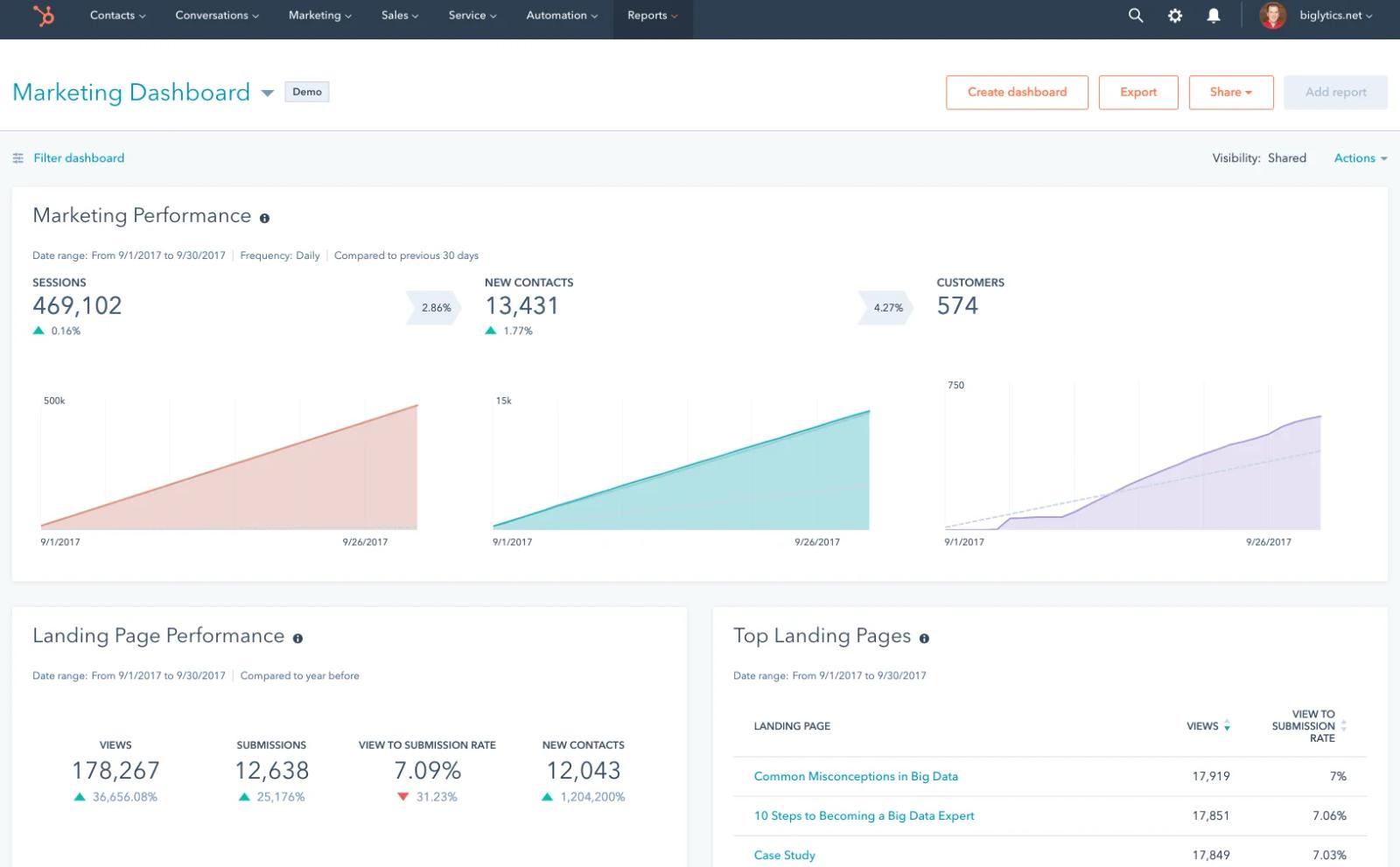
If your stack is already HubSpot Marketing Hub Pro or Enterprise, the built-in attribution module is a free add-on relative to Demandbase's $50k.
It's lighter on ABM. Lighter on intent. But it's already paid for.
Key capabilities
- Native integration with everything HubSpot already tracks: forms, contacts, deals, lifecycle stages, custom properties
- Multi-touch attribution models: linear, U-shaped, W-shaped, time-decay, full-path
- Revenue attribution at the deal level with closed-won pipeline tied to source
- Custom property-based reporting that fits the way your team already thinks about data
- Closed-loop ad management for HubSpot's built-in Google and Facebook ad tools
Watch-outs
You need Marketing Hub Pro ($800/month) or Enterprise ($3,600/month). Starter doesn't include attribution. No ABM orchestration. No anonymous account ID worth the name.
Pricing
Marketing Hub Professional from $800/month. Enterprise from $3,600/month.
Best for: Teams already paying for HubSpot Marketing Pro or Enterprise.
8. Salesforce Pardot (Marketing Cloud Account Engagement)
Pardot is the Salesforce-native marketing automation platform. The attribution layer is more lifecycle-stage-progression than full multi-touch, but the Salesforce tie is tight.
If you're a Salesforce shop without HubSpot, Pardot is the closest in-stack alternative to Demandbase's attribution layer (without the ABM advertising).
Key capabilities
- Native Salesforce integration as part of the Salesforce ecosystem, not a third-party connector
- Marketing automation alongside attribution (email, lead scoring, nurture campaigns)
- Engagement Studio for visual workflow building tied to lifecycle stages
- Account-based marketing add-ons (Pardot ABM) at higher tiers
- Reporting through Salesforce reports and dashboards
Watch-outs
Pricing starts at $1,250/month and climbs fast for ABM features. The UI feels older than HubSpot's. Multi-touch attribution depth is lighter than Marketo Measure or Dreamdata.
Pricing
From $1,250/month for Growth. Higher tiers ($2,500-$15,000/month) for ABM and advanced features.
Best for: Salesforce-native B2B teams who want marketing automation and attribution in the same platform.
9. Attribution (attribution.app)
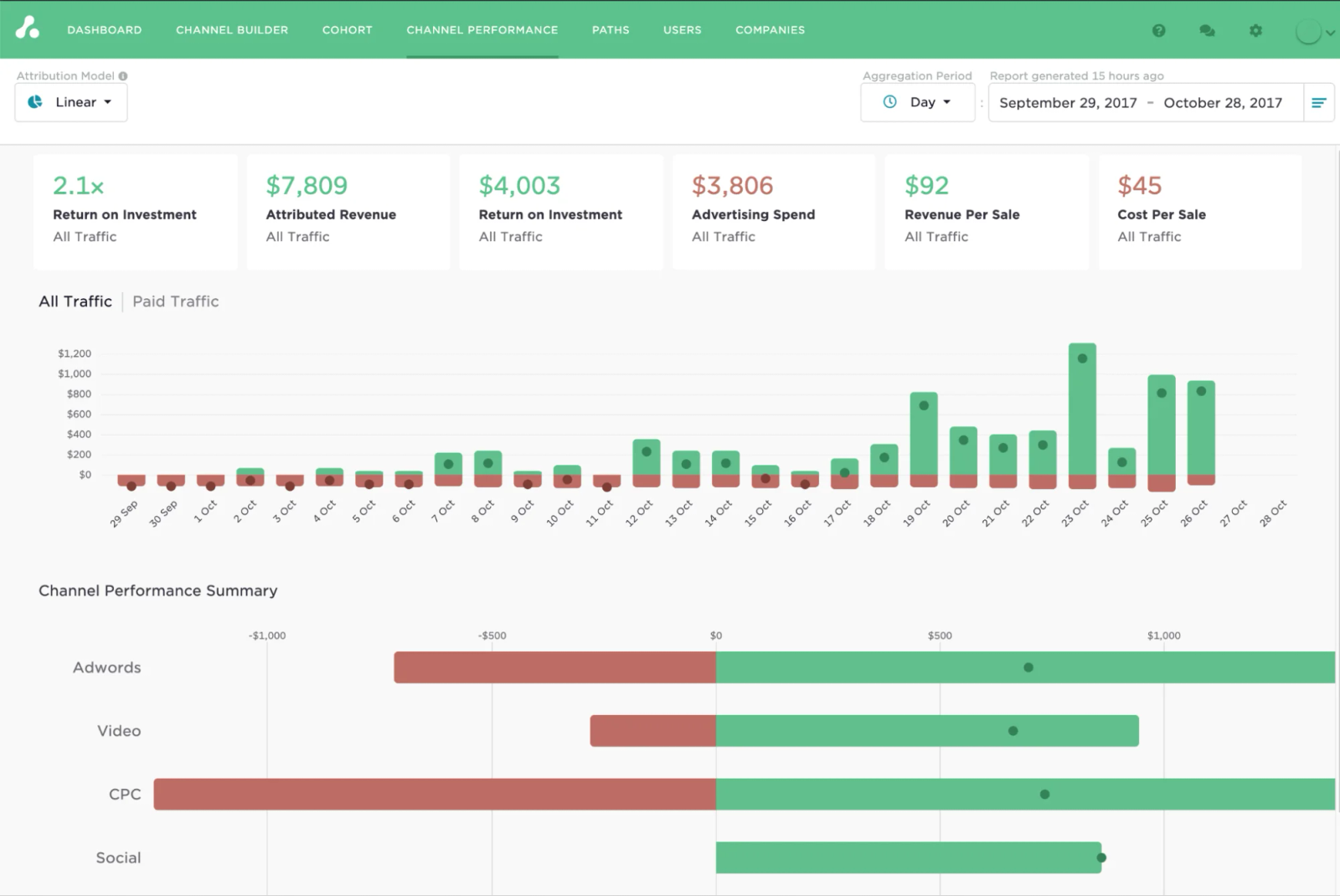
Attribution is the lowest-cost option. Free tier. Multi-touch out of the box. Snippet-based capture.
For Demandbase users whose evaluation revealed a much smaller problem than the platform price tag, this is where the math lands flat.
Key capabilities
- Free tier with limits generous enough to evaluate
- Multi-touch attribution out of the box, with custom models on paid tiers
- Form and event capture through a single snippet
- CRM sync to HubSpot, Salesforce, and arbitrary webhooks
- Lightweight by design, no enterprise onboarding
Watch-outs
No account-level identification, no ABM, no built-in CRM, light ad-platform sync.
Pricing
Free tier. Paid plans from around $99/month.
Best for: Lean teams whose Demandbase evaluation revealed a small, simple problem.
How to pick the right one
Sort by the actual job you're hiring the tool to do.
Job: closed-loop conversion sync to ad platforms. That's SourceLoop at $49/month. Same closed-loop revenue feedback the enterprise tools ship as one feature among twenty. Create a free SourceLoop account. 7 days, no card.
Job: anonymous account identification + ABM ad orchestration. That's 6sense or staying on Demandbase. Both are enterprise, both ship the orchestration layer.
Job: B2B revenue attribution at enterprise scale. Dreamdata for Salesforce-deep, HockeyStack for B2B SaaS dashboards, Marketo Measure for finance-audited attribution.
Job: LinkedIn-led ABM at mid-market price. Factors.ai. Different segment than Demandbase, same family of needs.
Job: marketing automation + attribution in one Salesforce-native tool. Pardot.
Job: cheap multi-touch on a tight budget. Attribution.
If you're not sure which job you're actually hiring for, that's an honest signal. Pick the tool that fits the smaller hypothesis (SourceLoop or Attribution) and work up from there. Going down from a six-figure ABM platform back to "we need attribution" is harder than going up.
Frequently asked questions
-
What's the cheapest Demandbase alternative?
Attribution at $0 (free tier) and SourceLoop at $49/month. SourceLoop covers closed-loop conversion sync to Google Ads, Meta CAPI, and LinkedIn Ads natively. Attribution is lighter on ad sync. Both skip the ABM orchestration layer entirely.
-
Does any alternative ship a built-in DSP like Demandbase?
Not really. 6sense, Factors, and HockeyStack handle ABM advertising through integrations with public ad platforms (Meta, LinkedIn, Google) rather than serving display ads directly. Demandbase's built-in DSP is a real differentiator. If that's why you're on Demandbase, no alternative is a clean swap.
-
Is Demandbase worth $50k a year?
For enterprise B2B teams running paid ABM with serious ad spend going through the built-in DSP, yes. The DSP economics often justify the platform fee. For teams who use Demandbase mostly for attribution and intent, the math gets harder. The honest test: what percentage of your Demandbase value comes from the ad-orchestration layer versus the dashboards?
-
Can I migrate from Demandbase easily?
The technical migration is straightforward. The hard part is the ABM workflows you've built (account scoring rules, intent-based plays, ad-orchestration flows). Most alternatives don't replicate the ABM orchestration layer 1:1, so plan for workflow redesign, not just data migration.
-
Will offline conversions still flow to Google and Meta after switching?
SourceLoop, Dreamdata, HockeyStack, Factors, 6sense, and Marketo Measure all support offline conversion sync to Google Ads and Meta CAPI. HubSpot has Google Ads sync but Meta is partial. Pardot is limited. Attribution is light. If conversion sync is the differentiator that keeps your ad algorithms learning from revenue, the first six are safer picks than Pardot or Attribution.


 Paid Social


