
Facebook Ad Optimization: The Revenue-First Playbook
Master Facebook ad optimization with our 2026 playbook. Learn to set up CAPI, test creative angles, and connect ad spend to real revenue with attribution.
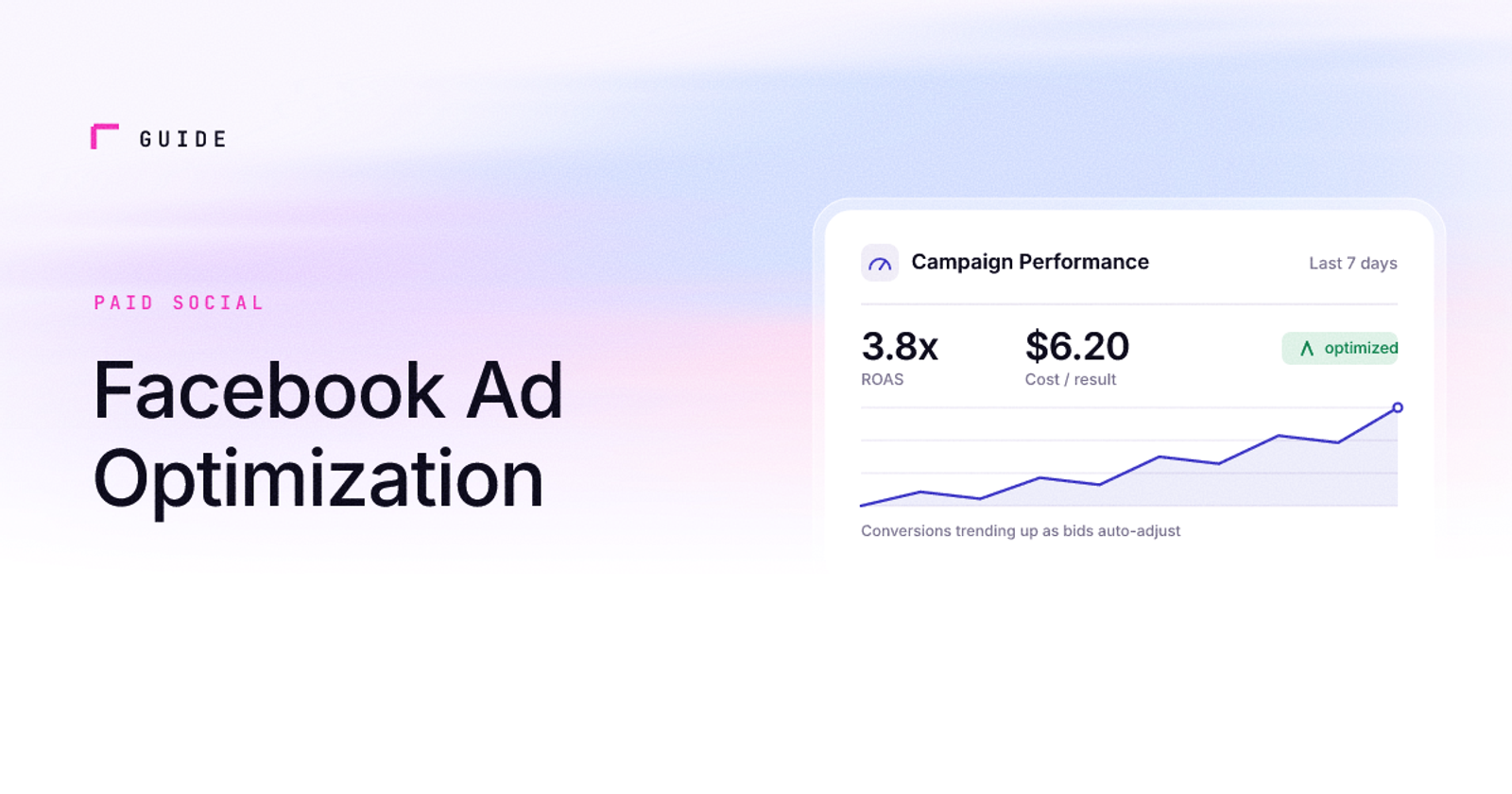
Your Facebook ads can look healthy inside Ads Manager and still be subtly losing money.
That's the trap a lot of teams are in right now. Cost per lead looks acceptable. CTR is fine. A few campaigns even show “winning” creatives. Then sales reviews the pipeline and says the leads are weak, close rates are uneven, and the customers who do buy aren't coming from the angles the media team thinks are working.
That disconnect is the primary Facebook ad optimization problem in 2026. Most guides still teach platform-level optimization. Fewer show how to optimize ad sets, angles, and creative around actual revenue signals. If you stop at form fills, you'll train Meta to find more form fills. If you send back qualified pipeline, booked meetings, subscriptions, and payments, you give the system a very different job.
The advertisers who win now usually aren't the ones making the most tweaks. They're the ones building a clean measurement layer, structuring campaigns around intent, testing angles instead of cosmetic edits, and feeding Meta the conversion signals that matter to finance, not just marketing.
Table of Contents
- Build a Bulletproof Measurement Foundation
- Master Audience and Campaign Structure
- Develop a High-Impact Creative Testing System
- Implement a Rigorous Experimentation Framework
- Connect Ad Optimization to Actual Business Revenue
- Advanced Optimization Levers and Common Pitfalls
Build a Bulletproof Measurement Foundation
Monday morning looks great in Ads Manager. CPL is down, lead volume is up, and the team wants to scale. Two weeks later, sales says the pipeline is thin and revenue did not move.
That gap usually starts with measurement.
A basic pixel setup is enough to launch campaigns. It is not enough to optimize a serious account in 2026. Browser tracking misses conversions because of privacy controls, blocked scripts, and attribution loss across devices. Once Meta loses that feedback, it starts optimizing toward the easiest visible action instead of the action that makes you money.
Why pixel-only tracking breaks optimization
Meta has been pushing advertisers toward a browser-plus-server setup for a reason. Conversions API helps recover event coverage that browser-only tracking misses, especially when the purchase or lead path is messy, delayed, or split across tools. Better event coverage improves delivery because the system has more complete conversion feedback to learn from.
The practical issue is bigger than attribution. If Meta only sees page views, form fills, and a fraction of purchases, it will bias toward cheap conversions. In lead gen accounts, that often means low-intent leads. In ecommerce, it can mean the platform chases discount-driven buyers who convert once and disappear.
A lot of guides stop at "install the pixel." That advice is incomplete. Revenue-first optimization starts by sending Meta enough signal to find buyers, not just clickers.

What a reliable measurement stack includes
The strongest setups use three sources of truth together:
- Browser events through the Meta Pixel for on-site actions like view content, add to cart, and form submission.
- Server-side events through Conversions API to pass back the same key actions when browser tracking drops or fails.
- First-party business data from your CRM, billing system, app backend, booking flow, or subscription platform.
That third layer is where a lot of advertisers fall short. Meta can optimize to whatever signal you feed it, but it cannot infer sales quality from a raw lead form. If your actual sales process happens in HubSpot, Salesforce, Stripe, or a call center, those downstream outcomes need to make it back into the ad account.
If you want a broader framework for tying channel reporting to business outcomes, this guide on measurement in marketing is worth reading.
Teams building more creative volume into this system can also look at this Facebook Ads use case for workflow ideas, but the measurement layer has to come first or the extra creative just scales noise faster.
The offline conversion piece many B2B SaaS teams skip
The common mistake is treating a lead as the finish line.
A form fill is an intent signal. It is not revenue. If SDRs disqualify half the leads, if booked calls no-show, or if deals close 45 days later, Meta needs some version of those outcomes back in the platform. Otherwise, you are training the algorithm on the wrong proxy.
For B2B SaaS, services, education, high-ticket coaching, and any sales-assisted funnel, useful events usually look more like this:
- Qualified lead
- Booked meeting
- Sales accepted opportunity
- Closed-won deal
- First payment or activated subscription
For ecommerce, the principle is the same, but the event chain is shorter. Clean purchase data matters most. If refunds, subscription renewals, or higher-value repeat orders are a major part of margin, those signals should shape how you evaluate campaigns even if Meta cannot optimize directly to every one of them.
A measurement checklist that holds up under spend
Use this before you scale budget:
- Map the funnel to real business milestones. Pick events that reflect value, not just curiosity.
- Send the same key conversion through browser and server. Use deduplication correctly so reporting stays clean.
- Standardize event definitions with sales and finance. "Qualified" needs one definition, not three.
- Audit match quality inputs. Email, phone, and other first-party identifiers improve event matching.
- Check lag time. If revenue shows up weeks after the click, do not judge campaigns only on day-one lead cost.
- Review CRM syncs weekly. Broken field mapping can subtly poison optimization for a month.
There is a trade-off here. Better measurement takes more setup time, tighter ops discipline, and closer alignment with sales. It also gives you a real optimization loop.
That loop is the whole point. If you cannot tie each ad set, angle, and creative back to pipeline and revenue, you are not really optimizing Facebook ads. You are just buying leads and hoping the back half of the funnel fixes the quality problem later.
Master Audience and Campaign Structure
Most underperforming accounts don't have an audience problem first. They have a structure problem.
Advertisers often pile cold audiences, retargeting pools, multiple offers, and unrelated creative concepts into the same campaign. That gives Meta noisy inputs and gives the team muddy outputs. When performance shifts, nobody can tell whether the cause was audience temperature, offer, angle, or placement.
Structure campaigns by temperature and intent
The cleanest account structures follow the funnel instead of fighting it. Prospecting, consideration, and retargeting shouldn't live in the same bucket because buyer intent isn't the same.

Meta campaign architecture gets much easier when you separate by audience temperature:
| Funnel stage | What the audience knows | Campaign job | Best message style |
|---|---|---|---|
| ToFu | They don't know you yet | Create interest and qualify attention | Problem-aware or curiosity-led |
| MoFu | They've engaged but haven't committed | Educate and build preference | Proof, objections, use cases |
| BoFu | They already know the brand or offer | Convert existing intent | Strong offer, urgency, trust |
That structure also lines up with Meta's own delivery needs. In a discussion summarized from practitioner insights, top-performing ad accounts consolidate ad sets around distinct angles and audience intents because Meta needs structured data to compound learnings, and each ad set needs approximately 50 optimized conversion events to exit the learning phase, as noted in this Facebook group post on angle and intent structure.
How to keep account structure clean
A practical operating model looks like this:
- One campaign per funnel stage or product line: Don't mix prospecting and retargeting if you want clear readouts.
- One ad set per angle or intent cluster: Keep the concept clean enough that performance means something.
- Multiple creatives inside the ad set: Let the ad set test execution within a clear message lane.
- Audience logic matched to stage: Interests, broad, or lookalikes for cold traffic. Website visitors, engagers, and lead lists for warmer stages.
If your team needs a visual reference for how creators and paid teams can align around production inputs, this Facebook Ads use case shows a practical workflow for generating ad-ready user-generated style assets.
For implementation details on piping Meta data into your wider stack, this guide to connect Meta Ads is useful.
Where most accounts go wrong
The most common mistakes are structural, not tactical:
- Audience overlap hidden inside messy campaigns: Teams think one segment is failing when the campaign setup is cannibalizing itself.
- Too many ad sets with too little signal: Data gets fragmented before any ad set can stabilize.
- Retargeting mixed with prospecting: The blended results look better, but they hide what creates demand.
- Angles lumped together: You can't learn which narrative works if three narratives share one ad set.
A tidy account doesn't just help reporting. It gives Meta cleaner patterns to learn from and gives operators cleaner decisions to make.
Good Facebook ad optimization is less about “finding hacks” and more about making sure each campaign has one job, each ad set has one clear idea, and each audience reflects a real stage of intent.
Develop a High-Impact Creative Testing System
A campaign can look healthy in Ads Manager while sales stays flat.
That usually happens when the account is optimizing for attention instead of buyer quality. CTR looks strong. CPC looks efficient. The sales team says the leads are weak, pipeline stalls, and revenue never catches up. Creative is often the break point, because creative decides who stops, who clicks, and who self-qualifies before the landing page does any work.
The practical job of creative testing is simple. Find the message that pulls in buyers who progress to pipeline and closed revenue, then find the execution that scales it.

Test the promise before the polish
Creative testing should start with angles, not production style.
Teams waste weeks debating UGC versus brand video, static versus motion, or short copy versus long copy before they answer the harder question. What claim is strong enough to make the right buyer care? Faster onboarding, lower total cost, fewer manual hours, better reporting, lower risk, or a sharper offer to a specific segment. Those are the tests that matter because they shape downstream lead quality.
A disciplined angle-testing system looks like this:
- One buyer problem per ad set: Keep price, speed, trust, and feature depth in separate tests.
- Several hooks for the same core claim: Change the opening, not the message, so results stay readable.
- Multiple executions inside the same angle: Test founder-style video, customer proof, static callout, or demo cut without changing the promise.
- Score winners by sales quality: Use pipeline creation, qualified meetings, or closed-won rate, not just cheap clicks.
If you want another operator-focused perspective on structuring Meta creative work, this Meta ad success playbook is worth reviewing.
Build for the placement the buyer actually sees
A strong idea still loses if the asset is awkward in the feed.
Reels and Stories need full-screen vertical creative that looks native to the placement. Feed ads need a clear thumbnail, readable framing, and enough visual hierarchy to communicate the offer without forcing the user to decode it. Meta's own creative asset recommendations are a useful baseline for placement specs and formatting.
Use a simple prep table before launch:
| Placement | Creative priority | Common mistake |
|---|---|---|
| Reels | Native-feeling vertical motion | Cropped feed creative |
| Stories | Fast opening frame and clear CTA | Overdesigned brand ad |
| Feed | Strong thumbnail and readable framing | Tiny text and cluttered layouts |
Production trade-offs are real here. A polished brand asset can improve perceived credibility but still lose to a rougher creator-style ad if it gets to the point faster. I see this often in higher-ticket B2B and considered-purchase accounts. The winner is rarely the ad the design team likes most. It is the ad that qualifies intent early and keeps the sales team out of bad conversations.
Kill angles, not just ads
Many teams keep editing a weak concept long after the market has rejected it.
A few bad metrics do not always mean the editor missed the mark. Sometimes the angle attracts the wrong person. Sometimes it creates curiosity with no buying intent. Sometimes it sells a benefit the business cannot support well enough to convert downstream.
Kill or rewrite creative when these patterns show up:
- High click volume with weak pipeline: The message gets attention from low-fit traffic.
- Strong engagement with poor sales feedback: The ad is interesting, but the promise is too broad or too soft.
- Fast fatigue across multiple versions: The audience understood the claim quickly and stopped responding.
- Repeated losses across different executions of the same angle: The problem is the message, not the format.
Good creative testing is a revenue filter.
That is the gap in many Facebook ad optimization guides. They stop at CTR, thumb-stop rate, CPL, or even on-platform conversion volume. In 2026, that is not enough. The useful creative system is the one that ties each angle and each asset back to qualified pipeline and revenue, so you stop scaling ads that look efficient in-platform but fail once the sales process starts.
Implement a Rigorous Experimentation Framework
A B2B team launches three new ad sets on Monday. By Wednesday, the account has six renamed duplicates, two budget changes, a new optimization event, and a Slack thread arguing over which creative "feels strongest." End result: spend went out, but nobody learned anything useful.
That is the primary reason experimentation breaks in Meta accounts. The problem is not a lack of tests. The problem is uncontrolled edits.
Set test conditions before spend starts
Serious advertisers decide the rules before launch.
Write down the hypothesis, the single variable being tested, the primary success metric, the downstream quality check, and the point at which the team will cut or scale. If that sounds rigid, good. Rigid is how you stop a sales-led business from making creative decisions off one good afternoon.
Meta delivery is noisy early. Auction pressure shifts. Day-of-week behavior shifts. Sales follow-up speed shifts. If you react to every wobble, you are not optimizing. You are resetting the test before it has a fair chance to mature.
I prefer a simple standard. One test gets one question. If the question is "Does angle A beat angle B with this audience?" then audience, offer, landing page, and conversion event stay fixed.
The rules that keep tests clean
Use a short operating checklist:
- Change one variable at a time. Creative angle, audience, bid approach, and offer should not all move together.
- Choose the optimization event before launch. Changing it mid-test creates a new test whether the team admits it or not.
- Limit early budget edits. Budget swings change delivery conditions and muddy the result.
- Set a review window in advance. Daily checks are fine. Daily interventions are not.
- Use sales feedback and CRM outcomes to break close calls. Cheap leads are not useful if they stall after the form fill.
That last point is where many Facebook ad optimization guides still come up short. They treat experimentation like a front-end media exercise. In 2026, the useful framework ties each test back to opportunity quality, pipeline creation, and closed revenue. That requires clean handoff into a B2B CRM system that preserves source and campaign context.
A simple decision table for live accounts
| Situation | Common reaction | Better move |
|---|---|---|
| Early CPL is higher than expected | Edit copy, audience, and budget on day one | Keep the test intact until the planned review point |
| One ad spikes for a day | Declare a winner and shift spend immediately | Check whether conversion quality holds across multiple days |
| Leadership wants more ideas in market | Launch many small tests at once | Run fewer tests with enough spend to produce a readable result |
| Sales says lead quality dipped | Kill the whole campaign | Isolate which ad set, angle, or placement is creating the problem |
Test less. Learn more.
Accounts with disciplined experimentation usually look boring from the outside. Fewer active tests. Fewer emergency edits. Cleaner naming. Better logs.
They also make better decisions because they can answer basic questions without guessing. What changed? When did it change? Did the result hold long enough to matter? Did it produce pipeline, not just conversions inside Ads Manager?
That trade-off matters in larger accounts. Running ten messy tests feels productive, but it often produces ten weak conclusions. Running three clean tests gives you something you can scale, cut, or port into the next campaign cycle.
A real experimentation framework is not about testing more often. It is about protecting signal quality long enough to find what drives revenue.
Connect Ad Optimization to Actual Business Revenue
Two marketers can run the same offer, get similar lead volume, and walk away with completely different business outcomes.
The first marketer optimizes for in-platform leads. They watch CPL, CTR, and landing page conversion rate. They rotate creatives when those metrics slip. Their reporting looks tidy. Sales still complains that half the leads never should've made it into the pipeline.
The second marketer tracks the same front-end metrics, but they also tie booked calls, qualified opportunities, subscriptions, or payments back to the original ad set and creative angle.

That second marketer has a much better chance of making the right optimization calls because they can see what happened after the click.
Two marketers with the same lead volume
The dangerous part of lead-gen reporting is that it can look efficient while hiding bad economics.
A practitioner discussion around angle testing highlighted a major blind spot: most optimization methods fail to tie creative angle testing to downstream revenue. Many teams still optimize for leads, while fewer track qualified pipeline or connect Stripe revenue back to the original angle. That's how campaigns become operationally efficient but commercially weak.
One marketer sees that Angle A produces cheaper leads and scales it.
The other marketer sees that Angle B produces fewer leads, but more of them become qualified pipeline and actual customers. They scale Angle B instead. Same ad account. Better business decision.
If your team wants a stronger foundation for connecting marketing data with sales workflow, this piece on B2B customer relationship management is relevant because the handoff between ad traffic and CRM stages is where a lot of attribution breaks.
How to send revenue signals back to Meta
Revenue-first optimization depends on a closed loop.
That loop usually includes these steps:
- Capture the original click and visit path: You need the first touch and subsequent touches tied to the contact record.
- Track real conversion moments across tools: Web forms, chat widgets, calendars, CRM stage changes, and payments all matter.
- Map those milestones to ad metadata: Campaign, ad set, ad, and angle should remain visible downstream.
- Sync qualified offline events back through Conversions API: This lets Meta optimize toward stronger customer patterns.
Here's a walkthrough that shows the principle in action:
Why angle-level revenue changes decisions
Optimization gets sharper at this point.
When revenue is tied back to the original angle, you stop asking shallow questions like “Which ad got the cheapest lead?” and start asking better ones:
- Which angle creates sales conversations that progress?
- Which audience responds to the message and then buys?
- Which creative attracts low-intent users who clutter the CRM?
- Which ad set deserves more budget because it drives revenue, not noise?
When ad reporting and sales outcomes live in separate systems, marketing usually overvalues volume and undervalues quality.
That's why the final stage of Facebook ad optimization isn't another platform trick. It's operational alignment. The ad account should learn from the same outcomes the business cares about.
Advanced Optimization Levers and Common Pitfalls
You launch a new creative, cost per lead drops for three days, and the team wants to scale. Then sales checks the CRM a week later and finds the extra volume barely moved pipeline. That is where advanced optimization gets real. The account can look healthy inside Ads Manager while revenue quality gets worse underneath it.
At this stage, good judgment matters more than extra reporting tabs. The point is not to chase cleaner platform metrics. The point is to protect signal quality while pushing spend into combinations of audience, angle, and creative that produce revenue.
Frequency is a pressure gauge
Many teams treat frequency as an afterthought until results soften. By then, the damage is already visible in CPMs, click-through rate, lead quality, or all three.
Frequency only matters in context. In prospecting, rising frequency usually means one of two things. The audience is too small for the spend level, or the creative pool is too narrow to hold attention. In retargeting, higher frequency can be fine because intent is already stronger. A seven-day site visitor audience should not be judged by the same standard as a broad cold audience.
Watch frequency alongside downstream signals, not in isolation.
- Prospecting campaigns: Rising frequency with weaker CTR and higher cost per qualified opportunity usually points to fatigue.
- Retargeting campaigns: Higher frequency can still be profitable if booked calls, SQLs, or purchases hold up.
- Narrow audiences: Performance can look stable for a short period even while fatigue is building underneath.
The mistake is treating frequency like a vanity metric or a universal rule. It is an early warning sign. If frequency climbs and pipeline efficiency stays strong, leave it alone. If frequency climbs and lead quality falls, fix the audience or the message before you add budget.
Breaking best practices on purpose
Automatic placements are still a strong default. Broad targeting is still a strong default. Neither one deserves blind loyalty.
If one placement consistently produces better sales outcomes, isolate it and read the result at the pipeline level. If broad targeting works, keep it. If broad fills the CRM with weak leads, the problem is not that the audience is broad. The problem is that Meta is optimizing on a shallow signal, or the creative is attracting the wrong click.
That trade-off gets missed in a lot of surface-level optimization advice. Platform efficiency and business efficiency are not always the same thing.
For a useful comparison on reporting workflows and agency Facebook ad strategies, this breakdown is worth reviewing.
A few mistakes deserve blunt language:
- Premature scaling: A common mistake is raising budgets on a new winner before the team understands whether the result came from the angle, the audience, the offer, or short-lived auction conditions.
- Budget fragmentation: Too many small ad sets starve delivery and make it hard to get a clean read.
- Secondary KPI obsession: Cheap clicks and low-cost leads can hide expensive pipeline.
- Creative refresh without message refresh: New formats do not fix a weak angle.
Scaling without corrupting the read
The cleanest way to scale a winner is to keep the winning variable clear. If the angle is working, preserve it. Test new audiences around it. Test fresh executions that keep the same core message. Do not throw a winning ad into a crowded campaign structure where three other changes happen at once.
Some ad sets should not be scaled aggressively. They work because they sit in a tight pocket of demand. Push too much budget into them and efficiency falls fast. I see this constantly in high-intent retargeting and niche B2B segments. The lesson is simple. Spend more where the account can still find profitable conversions, not where the dashboard makes growth look easy.
That is the gap in a lot of Facebook ad optimization advice. It stops at leads, CTR, and CPA. Real optimization in 2026 ties every scaling decision back to pipeline progression, closed revenue, and payback. If those numbers are disconnected from campaign decisions, you are not optimizing the business. You are optimizing the ad account's version of reality.

 Paid Social


