








Attribution
Why SourceLoop
Every marketing channel gets your budget. Only a few ever get the credit
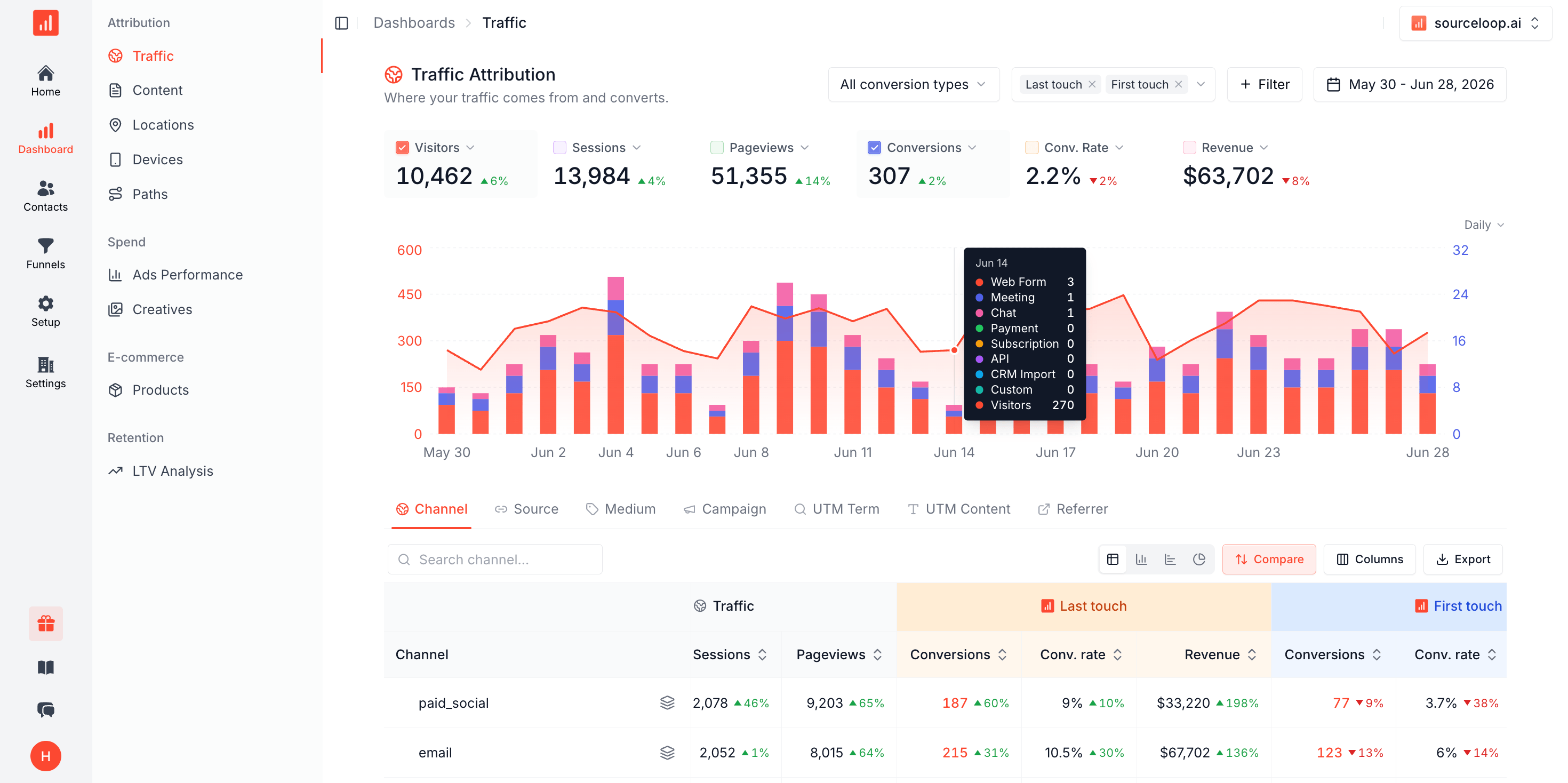
Ad platforms only report themselves, so organic, email, referral and calls land in "direct". SourceLoop measures every channel from your own site data, then writes it into your CRM and back to your ad accounts.
- First-party attribution One snippet on your site. Your CRM, billing and ad accounts connected over OAuth. Nothing to rebuild.
- Built for a five-person marketing team Not a three-month enterprise rollout with a data engineer attached to keep it running.
- Live the same afternoon New visitors are attributed the day you install it. Free 7-day trial, no call required.
Used by 750+ marketing teams, agencies, and SaaS companies
01 · The math
The marketing channel report doesn't add up. It was never going to
Every ad platform reports the conversions it can claim, inside its own window, using its own model. Meta counts a view. Google counts a click. Both can count the same lead. None of them check their totals against the leads you actually received.
Conversions claimed vs. verified · March
Claimed by the platform Verified against your own data
ChannelClaimedVerifiedGap
 Meta Ads 640 402 −238
  Google Ads 581 470 −111
  TikTok Ads 193 88 −105
  LinkedIn Ads 116 104 −12
 1,530claimed by platforms 1,124leads actually received
406 conversions were claimed more than once
The platform totals add up to more conversions than you actually had, so the channel mix you plan against is wrong before you start. And that is only the paid half of it. See how the re-count works
02 · Where it lands
The missing credit isn't spread evenly. It comes off the channels with no tracking of their own
Ad platforms report their own conversions, so paid keeps most of its credit. Organic search, email, referral, partnerships, community, live chat, booked meetings and the inbound phone line have nothing reporting for them, so they end up in direct and unassigned.
Share of conversions that keep their original source
Paid, self-reported Everything else Lost to "direct"
Google Ads 94% Self-reported in full
Meta Ads 91% Self-reported in full
Organic search 59% 41% lands in direct
Email 52% 48% lands in direct
Referral & partners 44% 56% lands in direct
Chat & booked meetings 31% 69% lands in direct
Inbound calls 8% Almost never attributed
- Double counted 406 paid conversions claimed by more than one platform
- Re-credited $147K revenue that moves back to organic, email and referral
- Newly visible 312 conversions that began on a call or a booked meeting
- Extra spend $0 moving budget between channels costs nothing
The channels that lose the most credit are usually the cheapest ones you have, so budget moves away from them and toward whichever platform reports best. Figures shown are from an example account.
03 · The analytics gap
And your Google Analytics can't settle it. It was never built to
GA4 counts sessions, not people, and it stops at the form submit. It has no idea which of those leads your sales team closed, what the deal was worth, or which ones are still open.
The questions a budget meeting actually asks
 GA4 SourceLoop
 | Question | GA4 | SourceLoop |
|---|---|---|
| Which channel brought this visit? | Yes | Yes |
| Did the visit turn into a lead? | Only if you built the event | Automatic on any form |
| Did that lead become a customer? | No | From your CRM |
| What was the deal worth? | No revenue data | From CRM and payments |
| Which campaign won a deal that closed 90 days later? | Retention caps at 14 months | Full history kept |
| Which named contact was it? | Aggregated and thresholded | Named on the record |
| Did the phone call and the booked meeting count? | No | Tracked and attributed |
Nothing here is a knock on GA4. It is a good behavioural analytics tool and most teams should keep it. It just cannot tell you which channel paid for itself, because it never sees the money. Compare it properly
04 · The objection
"We already know what's working." You know what got reported, not what caused the sale
"The dashboards are green, the sales closed, the money came in. Nobody in this company is asking me for more reporting."
Knowing which campaigns are performing is not the same as knowing which ones caused the sale. The point isn't to re-count revenue you already have. It's to decide where next quarter's budget goes, and last quarter is the only evidence you have for that.
Splitting the same budget on your own numbers instead of on platform reports costs nothing to do. No new headcount, no new channel, no new creative. The same money, spent where it actually works.
Today, on platform-reported numbers
On evidence from your own data
- Paid social
- Paid search
- Organic
- Referral
Same total spend. Different split.
05 · Getting connected
Three steps, one afternoon no data engineer involved
There is no warehouse to stand up and no schema to design. You add one snippet, authorise the accounts you already pay for, and the first attributed visitors show up while you are still in the tab.
-
<script src="https://cdn.sourceloop.ai/sl.js" defer></script>
01Add the snippet
One line in your head tag, or a tag in GTM. Every visit is recorded with the source that brought it, including the ones that arrive with no campaign tag at all.
-

 02
02Connect your accounts
Your CRM, your billing, and the ad accounts you spend on, all over OAuth. SourceLoop reads the outcomes and writes the source back, so nothing gets exported by hand.
- K
Kayden Floyd
- Source Google / CPC
- Campaign free_demo
- First touch Organic search
03Watch it fill in
New visitors are attributed immediately. Forms, chats, calls and booked meetings arrive with a source attached, and multi-touch journeys complete as your sales cycle plays out.
06 · What changes
Five things change once SourceLoop is connected
You install a snippet and connect the accounts you already pay for. Every channel then gets measured the same way. No three month implementation, no data engineer to keep it running.
 Organic · blog
 Email · nurture
 One number
One revenue figure every channel has to reconcile against.
Paid audit
Ad platforms get audited against data they don't own.
Everything else
Organic, email and referral appear on the same chart as paid.
Feedback loop
Verified conversions go back to the ad platforms, server-side, in real time.
 Microsoft Ads
07 · Into your CRM
The source follows the lead all the way into your CRM
Source, medium, campaign, content, landing page and the full touch history are written onto the contact the moment it is created. When the deal closes, the revenue comes back the other way and lands on the channel that started it.
Field sync


SourceLoop field Your CRM property
first_touch_source Original SourceContact last_touch_source Last Touch SourceContact campaign · content · term Campaign, Content, TermContact landing_page · referrer Landing Page, ReferrerContact touch_history[] Every touch, in orderTimeline closed_revenue Amount, Close dateDeal Written onto the record when the lead is created Comes back when the deal closes
08 · Measure it legally
Measure every channel. Without collecting more personal data
Measuring more channels normally means storing more about people. Tracking here is first-party, respects consent, and never sends raw personal data to an ad platform.
First-party by default
Data is collected on your own domain and stays in your workspace. There is no third-party cookie to lose, no identity graph shared between customers, and nothing sold on to anyone else.
Consent-aware, cookieless mode
Respects your consent banner and works with the major consent frameworks. Where consent is withheld, cookieless measurement keeps channel-level reporting intact without identifying anyone.
Hashed on the way out
Conversions pushed back to ad platforms carry hashed identifiers and click IDs, never raw personal data. DPA, subprocessor list and regional hosting available.
Read the DPA, the subprocessor list, and our security practices.
09 · The fourth option
Serious attribution. Without the serious price tag
Free analytics stop at page views. Form trackers see only the last touch. Big platforms cost as much as a hire. SourceLoop is the fourth option.
| Free analytics GA4, Plausible   | Form trackers Attributer, Leadsource.io   | Mid-market & enterprise Ruler, Cometly, Heeet, Northbeam     | SourceLoop Enterprise-grade, without the price tag  | |
|---|---|---|---|---|
| Lead source on every form, chat & meeting | ||||
| Full multi-touch journey | ||||
| Funnel & cohort analysis | Limited | |||
| Revenue attribution | ||||
| CRM sync | Limited | |||
| Offline conversions to ad platforms | ||||
| Setup in minutes | ||||
| Starting price | Free | $29 / mo | $400+ / mo | $49 / mo |
09 · AI access
Ask it in plain English, in the AI you already pay for
The SourceLoop MCP server connects your attribution data to Claude, ChatGPT and Cursor. Access is read-only and limited to the workspace you connect, and nothing is used to train a model.
 Claude
  ChatGPT
  Cursor + any MCP client SourceLoop connected
 Which channel actually drove closed revenue last month, and what changed vs February?
Organic search drove the most closed revenue at $104K, ahead of paid social at $87K.
- Organic search$104,000+18%
- Paid social$87,000−9%
- Email$57,000+31%
Paid social fell after the retargeting audience ran out of new people. Email grew on the March nurture sequence, which now returns more per dollar than any other channel you run.
Ask about a campaign, a cohort or a channel
No SQL, no export, no waiting on an analyst. See the MCP server
FAQ
The questions that come up first
Is SourceLoop only for paid ads?
No. Paid usually has the largest reporting gap, so more of the product is aimed at it, but every channel is measured the same way: organic search, email, referral, partnerships, social, direct, phone calls, and offline events all land in the same dataset with the same definition of a conversion. Any channel that can send someone to your site gets measured.
Why don't the ad platforms and my dashboard agree?
They cannot. Each ad platform reports the conversions it can claim, inside its own attribution window, using its own model. Two platforms can claim the same sale, and neither one sees the organic search that started it. SourceLoop counts each conversion once, from your own data, so every channel is measured against the same revenue.
Do I have to rip out GA4 or my CRM?
No. SourceLoop runs alongside them. Most teams keep GA4 for behavioural reporting and use SourceLoop for revenue and source, with the source fields written back into the CRM so sales and finance read the same values.
How long before the data is usable?
Install the snippet, connect your CRM, billing, and ad accounts over OAuth, and attribution starts the same day. New visitors are attributed immediately. Multi-touch journeys fill in as your sales cycle plays out.
Is this legal under GDPR?
It is built to be. Tracking is first-party and consent-aware, there is a cookieless mode, personal data can be hashed before anything is sent to an ad platform, and you can host data in the region you need. We publish a DPA and a subprocessor list.
What makes this different from an enterprise attribution platform?
Mostly the price and the setup time. The enterprise tools usually mean a three month implementation and a data engineer to keep it running. SourceLoop is self-serve, live in an afternoon, and priced for a five person marketing team.