
Multi Touch Attribution vs Marketing Mix Modeling
Multi touch attribution vs marketing mix modeling - Considering multi-touch attribution vs marketing mix modeling? Compare MTA & MMM on data, speed, & use
Multi-touch attribution (MTA) tracks individual customer touchpoints across digital channels, while marketing mix modeling (MMM) analyzes aggregate historical data to measure overall marketing impact. MTA suits businesses needing granular campaign optimization; MMM fits those requiring strategic budget allocation across all channels, including offline.
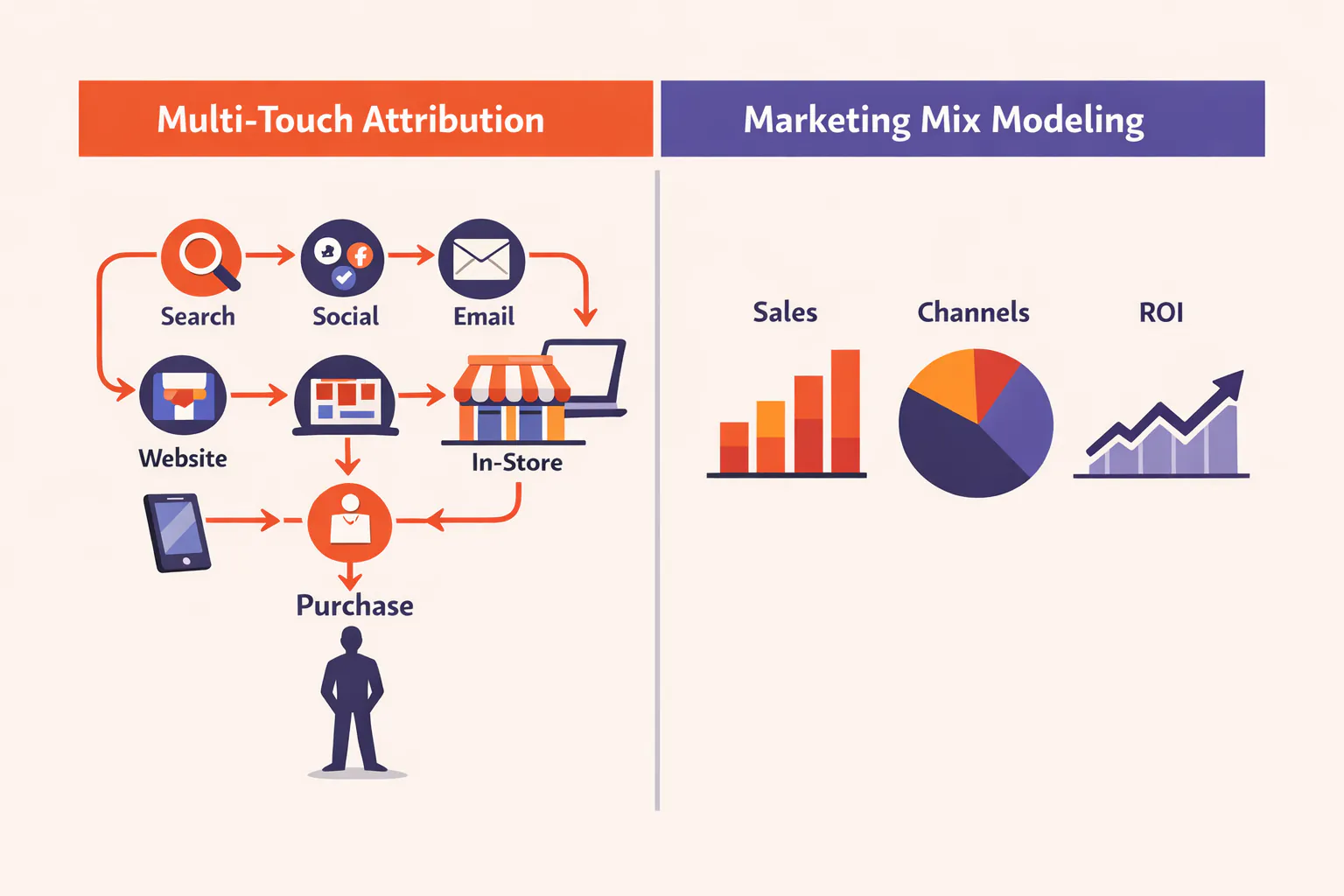
## What is Multi-Touch Attribution?
Multi-touch attribution examines every touchpoint in the customer journey to determine which marketing channels drive conversions. It assigns percentage credit to each interaction, helping marketers understand the path customers take before purchasing.
For example, a customer sees a Facebook ad (35% credit), clicks an email campaign (55% credit), and converts after a display ad (10% credit). This granular view helps optimize digital campaigns by revealing which touchpoints deserve more budget.
"MTA is strongest for day-to-day digital optimization, while MMM is better suited for strategic budget allocation decisions."
Common MTA models include:
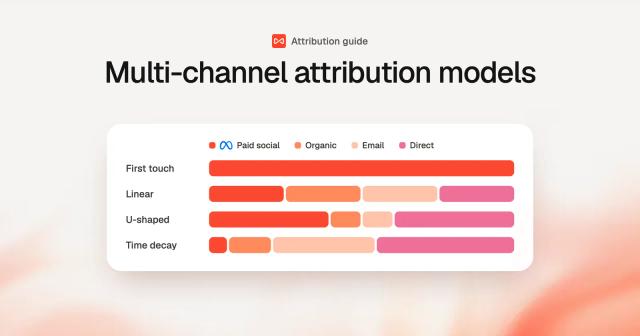
Linear attribution: Equal credit to all touchpoints. Simple but assumes every interaction has identical impact.
Time-decay: More weight to recent interactions. Reflects that touchpoints closer to conversion often matter more.
Data-driven: Machine learning assigns credit based on actual impact, analyzing thousands of customer journeys.
First-touch: All credit to the first interaction (not multi-touch, but commonly used).
Last-touch: Full credit to the final touchpoint before conversion.
How MTA Works in Practice
MTA relies on tracking technologies like cookies, pixels, and UTM parameters to follow users across devices and platforms. When someone converts, the system looks back at their journey and distributes credit according to the chosen model.
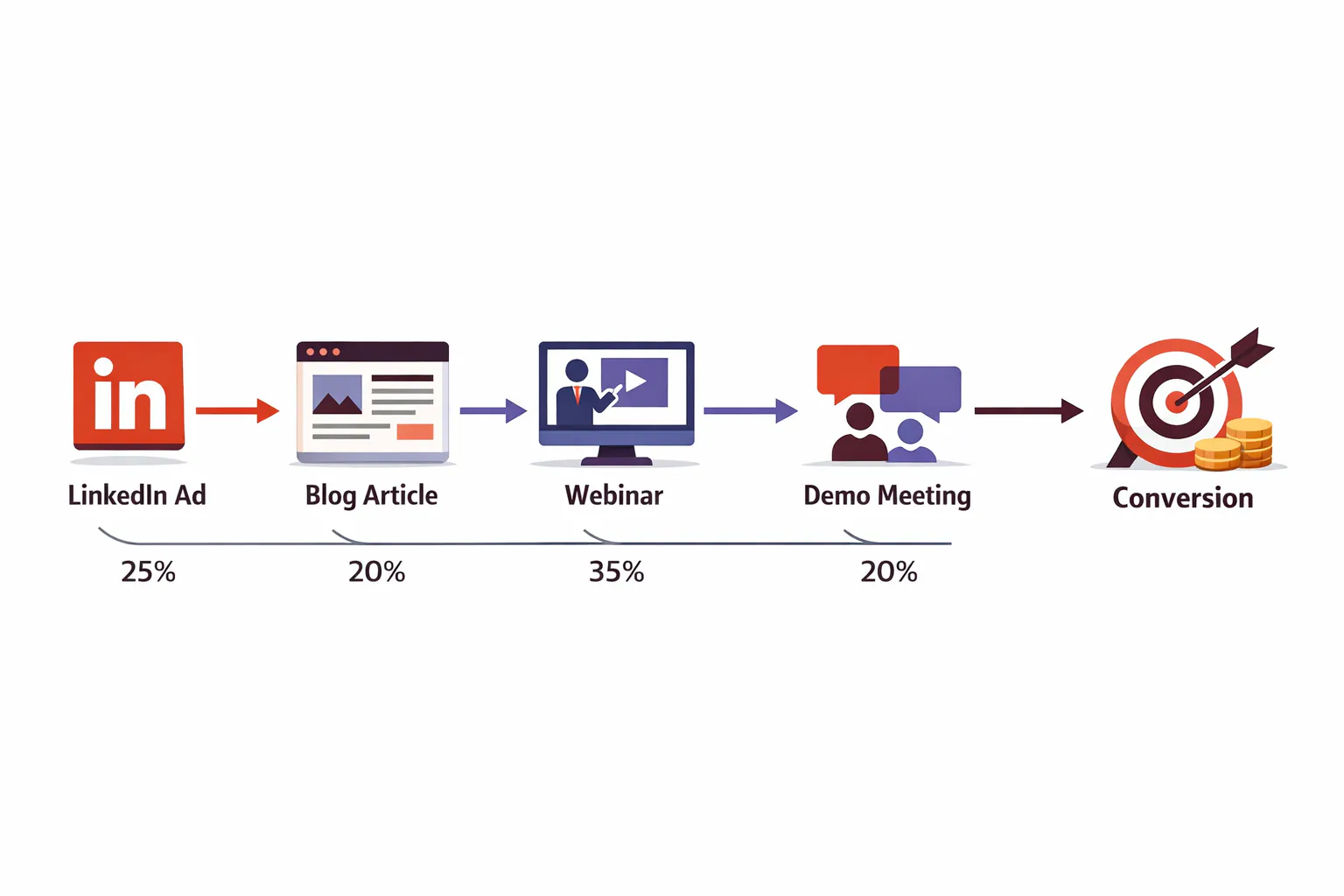
A B2B SaaS company might track this journey: LinkedIn ad click → blog post visit → webinar registration → demo request → closed deal. With time-decay attribution, the demo request gets the most credit, followed by the webinar, then the blog post, with the LinkedIn ad receiving the least.
This approach works well for digital-first businesses running campaigns across Google Ads, Meta, LinkedIn, and email. It answers tactical questions like "Should we shift budget from display to search?" or "Which email sequence drives the most conversions?"
Advantages of MTA
MTA provides several benefits for digital marketers:
Granular insights: See exactly which campaigns, ads, and keywords drive conversions
Quick optimization: Make tactical adjustments within days based on performance data
Personalization opportunities: Understand different customer segments and their preferred paths
Campaign-level detail: Evaluate specific creative, messaging, and targeting choices
Limitations of MTA
Despite its strengths, MTA has significant drawbacks:
Digital-only focus: Misses offline touchpoints like trade shows, TV ads, or word-of-mouth
Privacy challenges: GDPR, CCPA, and cookie deprecation limit user-level tracking
Attribution bias: Models make assumptions about credit distribution that may not reflect reality
Ignores external factors: Doesn't account for seasonality, economic conditions, or competitor actions
Implementation complexity: Requires robust tracking infrastructure across all platforms
According to Supermetrics, MTA's promise of 100% trackability was always flawed. We've never been able to track every impression and click, especially across devices and platforms.
What is Marketing Mix Modeling?
Marketing mix modeling uses statistical analysis to measure how marketing activities, external factors, and business variables influence sales. It analyzes aggregate data rather than individual journeys, providing a holistic view of marketing effectiveness.
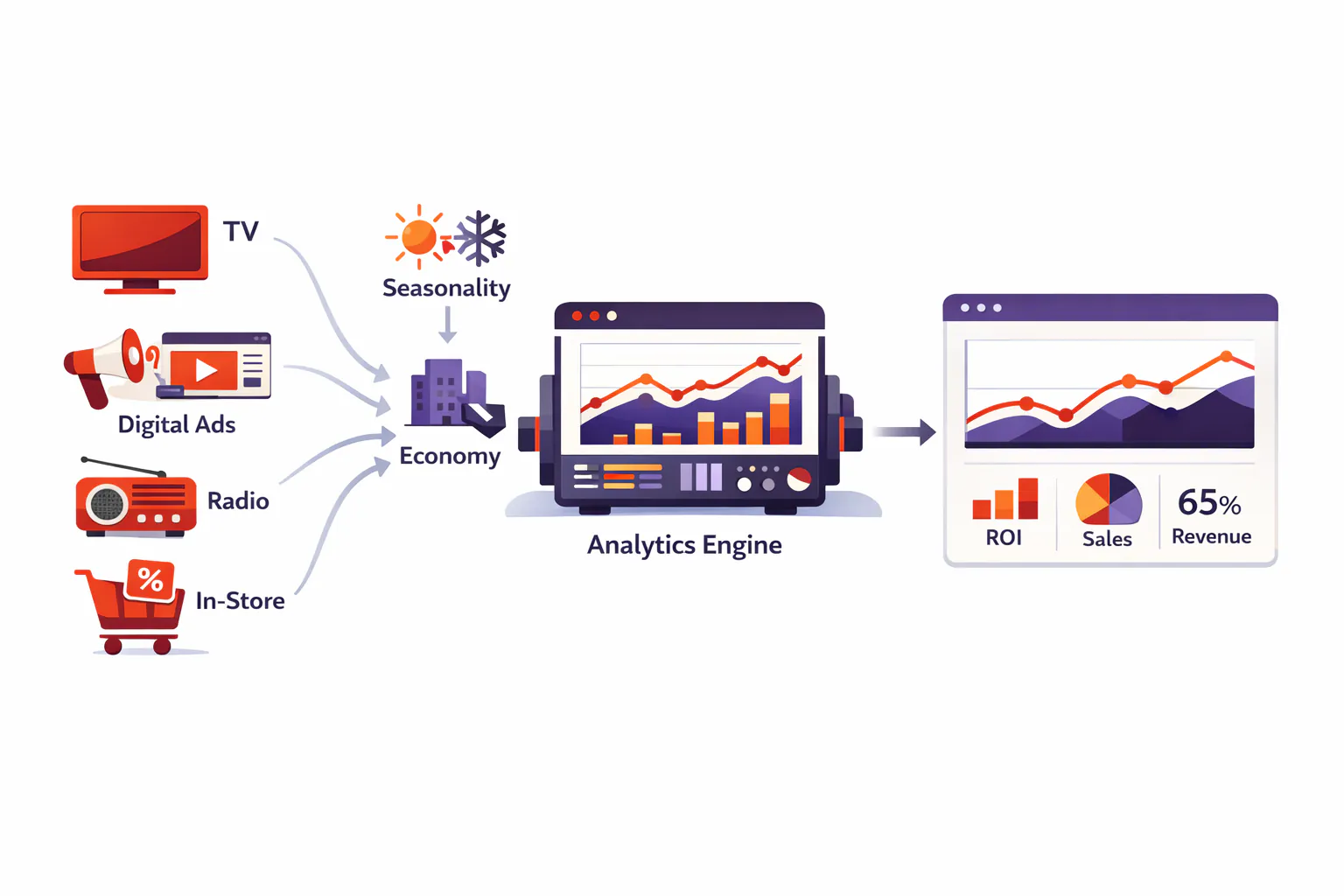
MMM considers multiple variable categories:
Media activities: TV, radio, print, digital ads, social media, email campaigns
External factors: Seasonality, economic conditions, weather, competitor actions
Internal variables: Pricing changes, product launches, distribution expansion
Calendar effects: Holidays, day-of-week patterns, promotional periods
How MMM Works
MMM follows a structured process:
Data collection: Gather historical sales data, marketing spend by channel, external variables, and business metrics (typically 18-24 months minimum)
Statistical analysis: Use regression analysis, machine learning, and causal inference to identify relationships between inputs and outputs
Model building: Create a customized model that represents your specific business context and marketing mix
Validation: Test the model against holdout data and run what-if simulations
Optimization: Identify optimal budget allocation and forecast future performance
Ongoing refinement: Continuously update the model with new data
For example, an MMM analysis might reveal that TV advertising has diminishing returns after $500K monthly spend, while podcast sponsorships show consistent ROI up to $200K. It might also show that your marketing performs 15% better in Q4 due to seasonal buying patterns.
Real-World MMM Example
A multi-channel retailer running TV, radio, digital ads, and in-store promotions uses MMM to understand total marketing impact. The analysis reveals:
TV drives 40% of incremental sales but has reached saturation
Digital ads contribute 25% and still have room to scale
Radio provides 15% contribution with strong efficiency
In-store promotions deliver 20% but cannibalize margin
Armed with these insights, they shift $200K from TV to digital and optimize promotion timing, resulting in 12% higher ROI.
Advantages of MMM
MMM offers strategic benefits:
Holistic view: Measures all channels, including offline and non-trackable media
Privacy-friendly: Uses aggregate data, unaffected by cookie deprecation or privacy laws
External factor inclusion: Accounts for seasonality, economy, and competitive landscape
Strategic planning: Supports long-term budget allocation and forecasting
Incrementality focus: Measures true lift, not just correlation
Limitations of MMM
MMM also has constraints:
Data requirements: Needs 18-24 months of historical data for reliable results
Expertise needed: Requires statistical knowledge and specialized tools
Time lag: Results take weeks to generate, not suitable for real-time optimization
Less granular: Doesn't show campaign or keyword-level performance
Cost: Traditional MMM can be expensive, though modern platforms are more accessible
Key Differences Between MTA and MMM
Aspect | Multi-Touch Attribution | Marketing Mix Modeling |
|---|---|---|
Data level | Individual user interactions | Aggregated channel data |
Timeframe | Short-term, real-time | Long-term historical trends |
Scope | Digital touchpoints only | All channels (online + offline) |
Privacy | Requires user tracking | Privacy-friendly aggregate data |
Best for | Campaign optimization | Strategic budget allocation |
External factors | Limited consideration | Incorporates market dynamics |
Implementation | Weeks to set up tracking | Months to build initial model |
Granularity | Campaign/keyword level | Channel/medium level |
The fundamental difference is perspective. MTA asks "Which touchpoints led to this specific conversion?" while MMM asks "How effective is my overall marketing mix at driving business outcomes?"
When to Use Each Model
Choose MTA When You:
Run primarily digital campaigns across paid search, social, display, and email
Need tactical, campaign-level insights for quick optimization
Want to understand specific customer journey patterns
Have robust tracking infrastructure in place
Operate in a privacy-permissive environment
Require real-time or near-real-time insights
A DTC ecommerce brand running only Facebook and Google Ads benefits most from MTA. They can quickly test creative variations, adjust bidding strategies, and optimize landing pages based on granular conversion data.
Choose MMM When You:
Invest in both online and offline channels (TV, radio, print, events)
Need strategic, long-term planning and budget allocation
Face privacy restrictions on user tracking
Have 2+ years of historical data
Want to measure incrementality and true marketing lift
Operate in regulated industries with strict data policies
A B2B SaaS company running Google Ads, LinkedIn campaigns, trade shows, and podcast sponsorships benefits from MMM. It captures the full marketing mix impact, including offline events that MTA can't track.
When to Use Both
Many sophisticated marketing teams now use both approaches. Harvard Business Review reports that MMM calibrated with experimental data can be up to 15% more accurate than traditional attribution.
This hybrid approach, called unified marketing measurement (UMM), combines:
MTA's granular digital insights for tactical optimization
MMM's strategic view for budget allocation
Incrementality testing to validate both approaches
For example, use MTA to optimize your Google Ads campaigns daily while using MMM quarterly to decide how much total budget should go to paid search versus other channels.
The Role of Sourceloop in Attribution
Sourceloop bridges the gap between MTA and MMM.
Our lead source tracking software captures the complete customer journey from first click to closed deal, connecting every touchpoint to revenue in your CRM.
Unlike traditional MTA tools limited to digital clicks, Sourceloop tracks:
Forms, calls, and meetings
Offline conversions and events
Multi-session journeys over weeks or months
Revenue outcomes, not just form fills

The attribution data writes directly into HubSpot, Pipedrive, or Salesforce, showing which campaigns drive qualified leads and closed deals, not just website sessions. This gives you MTA-style granularity with MMM-style business outcome focus.
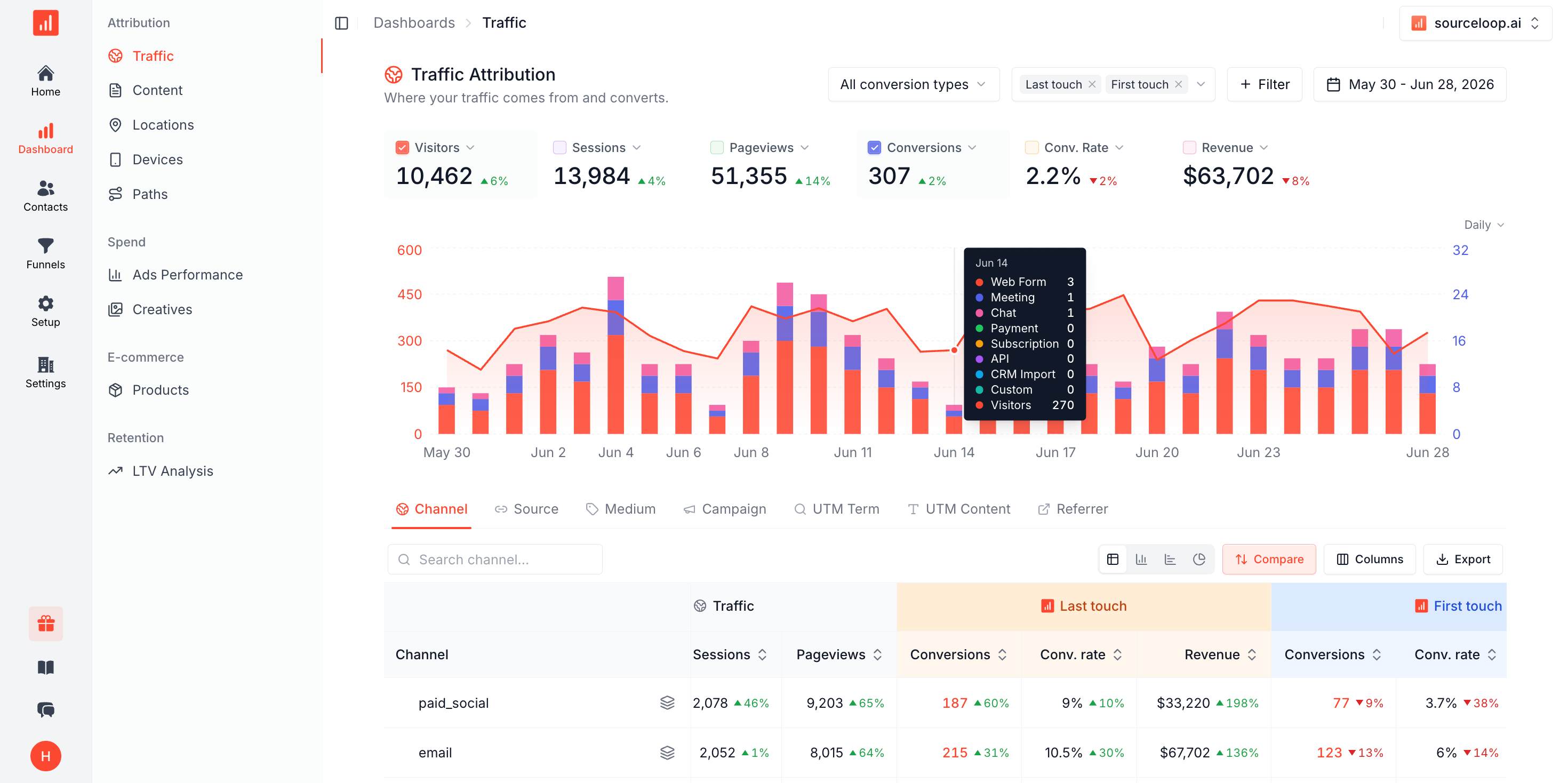
For B2B businesses where the path to purchase spans multiple touchpoints and weeks, Sourceloop provides the attribution foundation that makes both tactical and strategic decisions possible.
FAQ
What is the main difference between MTA and MMM?
MTA tracks individual customer touchpoints across digital channels, while MMM analyzes aggregate historical data to measure overall marketing effectiveness across all channels, including offline.
Which is more accurate: MTA or MMM?
Neither is universally more accurate. MTA provides precise digital touchpoint data but misses offline impact. MMM offers holistic measurement but lacks granular detail. Accuracy depends on your marketing mix and data quality.
Can small businesses use marketing mix modeling?
Traditionally, MMM required large datasets and budgets. However, modern platforms now make MMM accessible to smaller businesses with as little as 18-24 months of historical data.
How does privacy regulation affect these models?
Privacy laws like GDPR and the deprecation of third-party cookies significantly limit MTA's user-level tracking. MMM's aggregate approach remains unaffected, making it increasingly attractive.
Should I use both MTA and MMM?
If budget allows, yes. Using both provides tactical optimization (MTA) and strategic planning (MMM), giving you a complete view of marketing performance.
What data do I need for each model?
MTA requires user-level tracking data (clicks, impressions, conversions). MMM needs historical sales data, marketing spend by channel, and external factors like seasonality, typically 2+ years of data.
How does Sourceloop help with attribution?
Sourceloop tracks the complete customer journey from first touch to revenue, capturing forms, calls, meetings, and CRM data. It writes attribution directly into HubSpot, Pipedrive, or Salesforce, showing which campaigns drive qualified leads and closed deals, not just clicks.



 Paid Social


