
10 Best Multi-Touch Attribution Tools: Compared in 2026
A practical comparison of 10 multi-touch attribution tools across rules-based, data-driven, and ML-powered models, who they're built for, and what you'll actually pay.
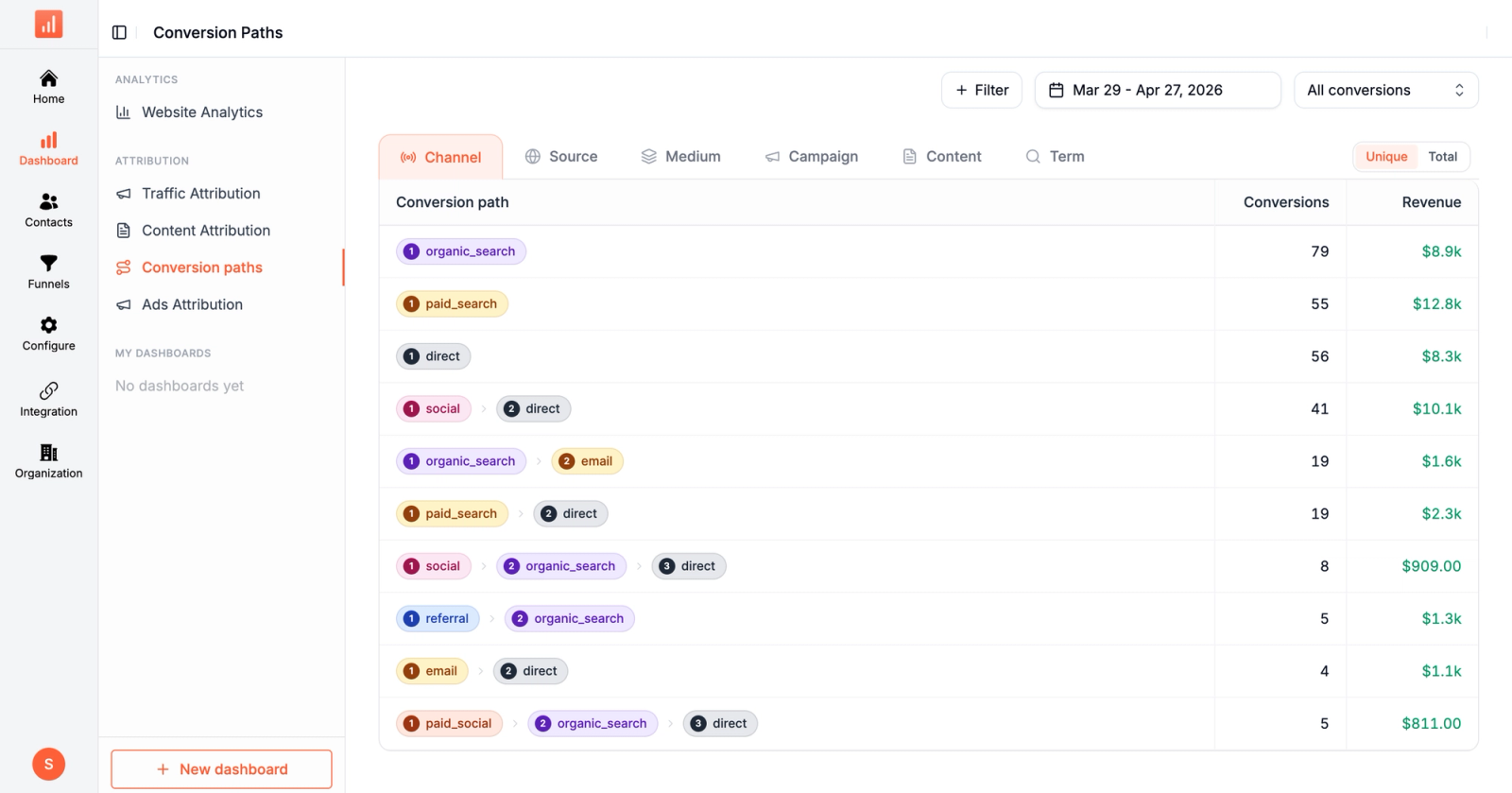
Table of contents
Multi-touch attribution distributes conversion credit across every touchpoint in a customer journey instead of giving 100% credit to the last click (or first click).
The methodology has matured significantly: where 2018-era MTA used fixed-formula models like position-based or time-decay, modern platforms use machine learning to weight touchpoints based on actual behavioral signals.
According to Improvado's 2026 industry research, MTA adoption has grown to 75% of companies, up from 58% in 2024, and teams report 14-36% CPA improvement and 19% revenue lift in the first year.
Below are 10 Best Multi-Touch Attribution Tools that handle MTA differently in 2026.
Quick Comparison of Best Multi-Touch Attribution Software
| Tool | Attribution model | Starts at |
|---|---|---|
 SourceLoop SourceLoop |
All 7 models, rules-based | $49/mo |
 HockeyStack HockeyStack |
9 models, ML-powered | $1,399/mo |
 Dreamdata Dreamdata |
Multi-model, B2B account-level | $999/mo |
 Northbeam Northbeam |
ML attribution + MMM | $1,500/mo |
 Triple Whale Triple Whale |
Multi-model + Triple Pixel | $129/mo |
 Rockerbox Rockerbox |
MTA + MMM + incrementality | $2,000/mo |
 Ruler Analytics Ruler Analytics |
Multi-model, B2B + calls | £199/mo |
 Cometly Cometly |
Multi-model + AI optimization | Custom |
 Google Analytics 4 Google Analytics 4 |
Data-driven + 5 rules-based | Free |
 Adobe Analytics Attribution IQ Adobe Analytics Attribution IQ |
10+ models, algorithmic | Custom |
1. SourceLoop
Best for: SaaS, agency, B2B and lead-gen teams that want the full model suite with transparent weightings, without an enterprise contract
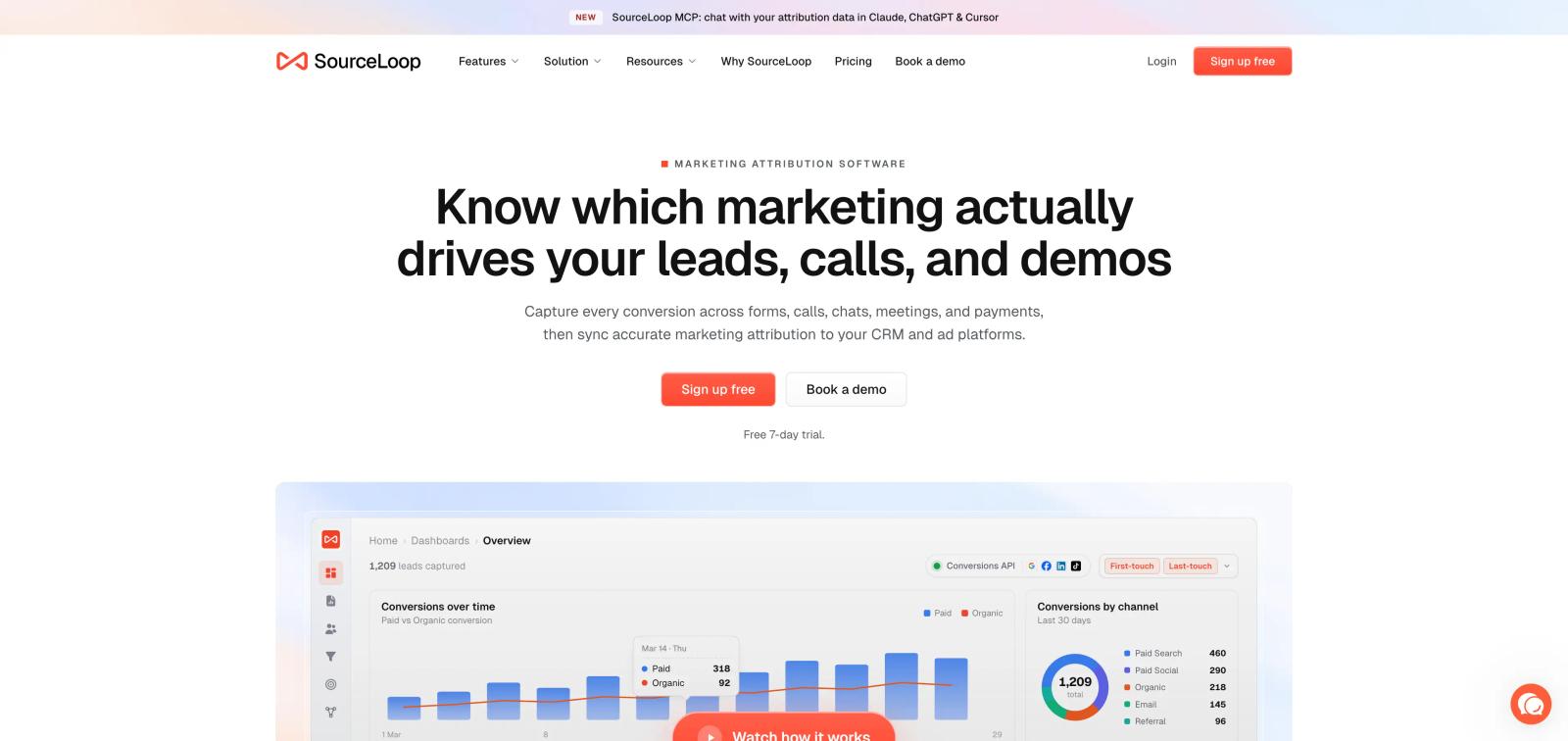
SourceLoop ships every standard attribution model on the entry plan: last touch, first touch, last non-direct, first non-direct, linear, position-based and time decay. No upgrade tier to compare models, no data science work to configure them.
That matters given what the rest of the market does. Heeet puts multi-touch on a $1,490/mo plan and sells first-and-last-click below it. GA4 removed first click, linear, time decay and position-based in September 2023, leaving data-driven and last click, so the free baseline most teams assume they can fall back on is no longer a multi-touch tool.
Why SourceLoop works well as an MTA tool
1. Seven models on one journey, with published weightings
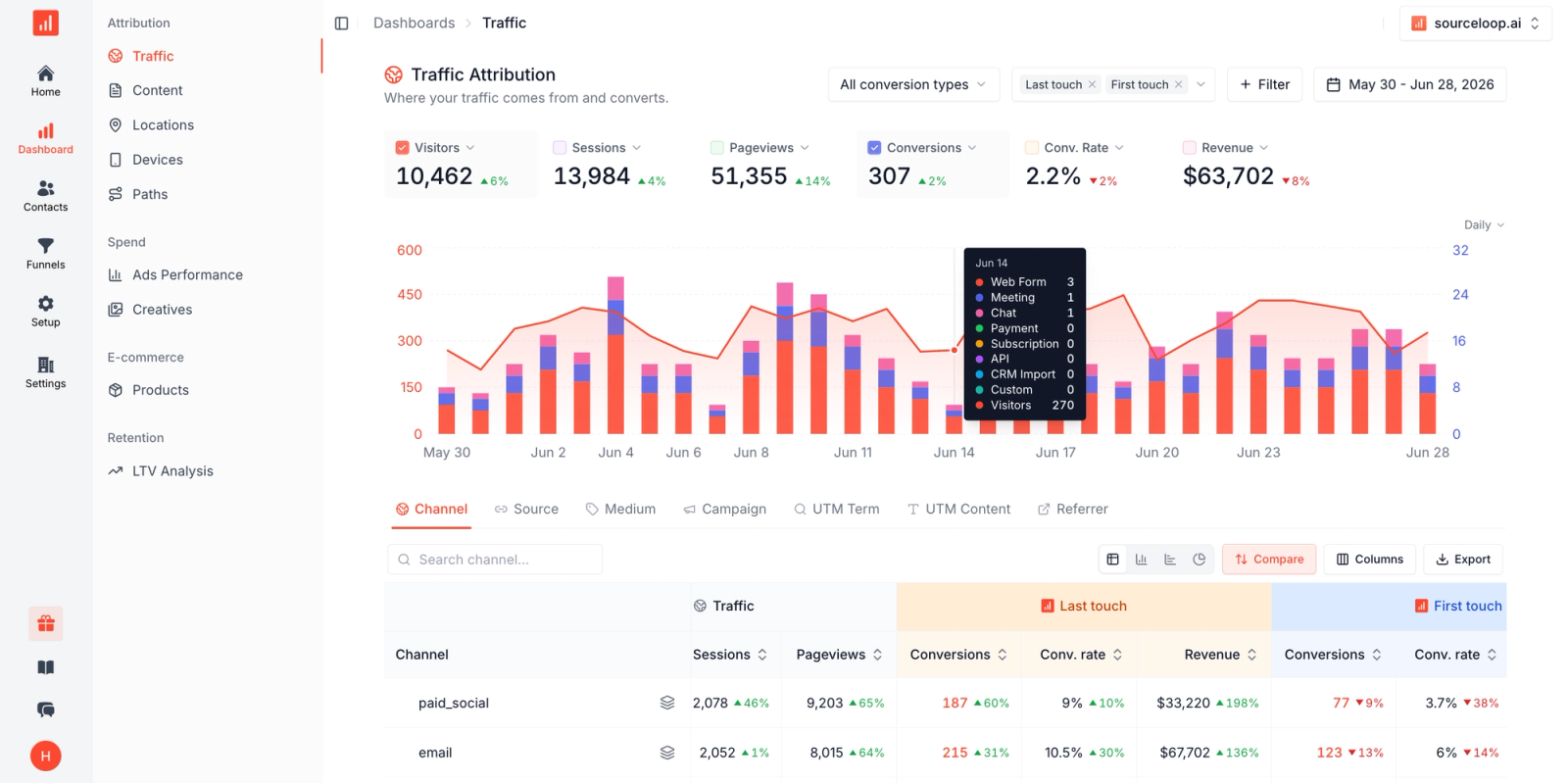
The numbers are worth knowing before you argue about them in a meeting:
- Last touch and first touch give 100% to the closing and sourcing session
- Last non-direct and first non-direct do the same but skip Direct sessions. These are the two most people ignore and should not: in an established brand a returning visitor's technical first touch is often Direct, which quietly buries the channel that brought them back
- Linear splits credit evenly, roughly 33/33/33 on a three-touch journey
- Position-based (U-shaped) gives 40% to first touch, 40% to last touch, 20% across the middle
- Time decay weights recency, landing near 13/30/57 across three touches
All seven run against one stored journey rather than a tagging configuration, so switching is a dropdown.
2. Rules-based, and that is a deliberate trade
This is the honest limitation, so it goes up front. SourceLoop's models are rules-based, not machine-learned like Northbeam's or HockeyStack's, and there is no incrementality testing or media mix modelling.
The counterargument: data-driven attribution needs conversion volume to mean anything, and a B2B team running 80 demos a month is nowhere near it. What they get from an ML model at that volume is a number that shifts between report pulls and that nobody can explain.
A rules-based model you can recompute by hand is one you can defend when the CFO asks why the content budget went up. Above seven figures a year of paid media, the ML platforms genuinely earn their price.
3. The touchpoint data underneath decides accuracy
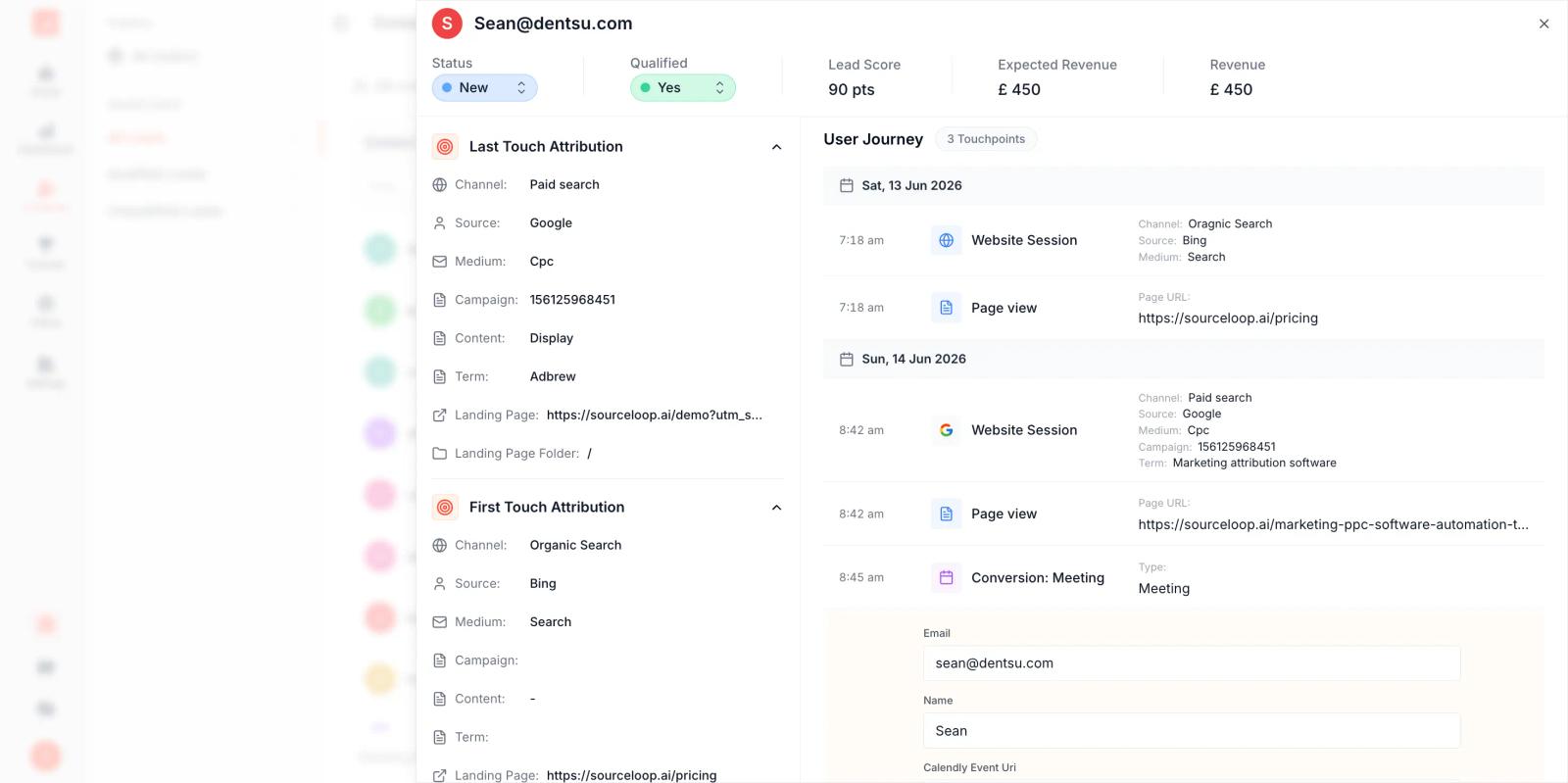
An MTA model is arithmetic. It is only as good as the touch list it runs on, which is where most implementations quietly fail.
SourceLoop reads nine click IDs on every landing URL (gclid, gbraid, wbraid, msclkid, fbclid, li_fat_id, ttclid, epik, rdt_cid) before the referrer and before UTMs. That stops a paid click becoming a Direct touch when iOS Safari strips the referrer. Every Direct touch that should have been Paid Social is credit handed to the wrong channel.
Identity stitching merges devices when an email, phone or user ID connects them, so mobile research and a desktop conversion are two touches on one person rather than two people with one touch each.
4. Conversions the model can actually see
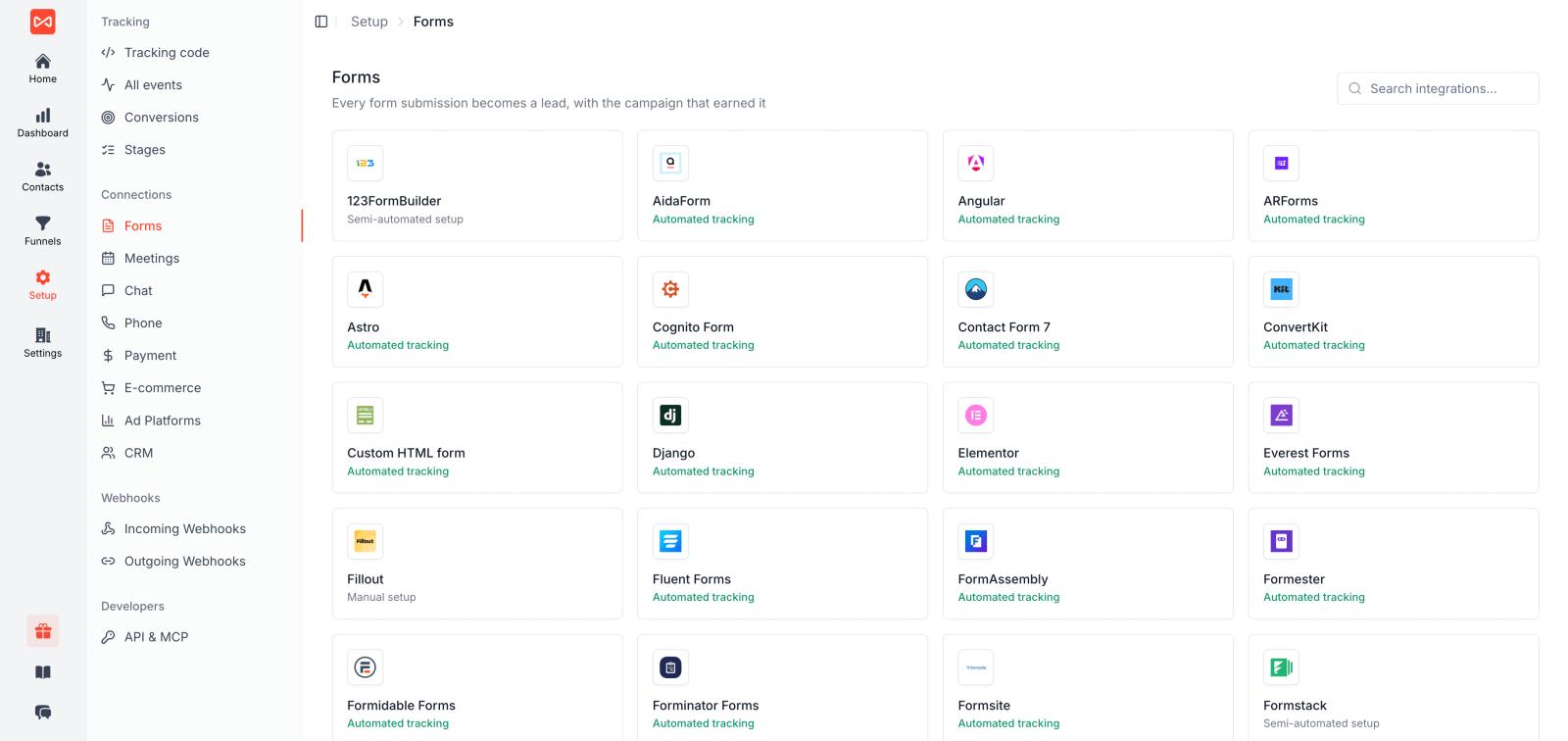
Around 70 form, meeting, chat, call and payment tools captured with no event code, including Calendly, Cal.com, HubSpot Meetings, Chili Piper, Gravity Forms, WPForms, Contact Form 7, Typeform, Tally, Jotform, Webflow, Framer, Intercom, Drift, Crisp, LiveChat, CallRail, CallTrackingMetrics, Invoca, Stripe, Paddle, Polar and Lemon Squeezy.
A booking widget that redirects to a confirmation page and drops your parameters is the most common way a multi-touch journey ends up with one touch labelled Direct.
5. Revenue in the model, not just conversions
Models that stop at "form fill" miss the thing you are optimising. Stripe, Paddle, Polar, Lemon Squeezy and Dodo Payments webhooks match each purchase back to the original visitor, and two-way CRM sync with HubSpot, Salesforce, Pipedrive and Zoho brings deal stages and closed-won values back.
Credit then distributes over money rather than form submissions. A channel producing many cheap leads and a channel producing a few large deals look identical under conversion-weighted MTA and nothing alike under revenue-weighted MTA.
6. The model output goes back to the ad platforms
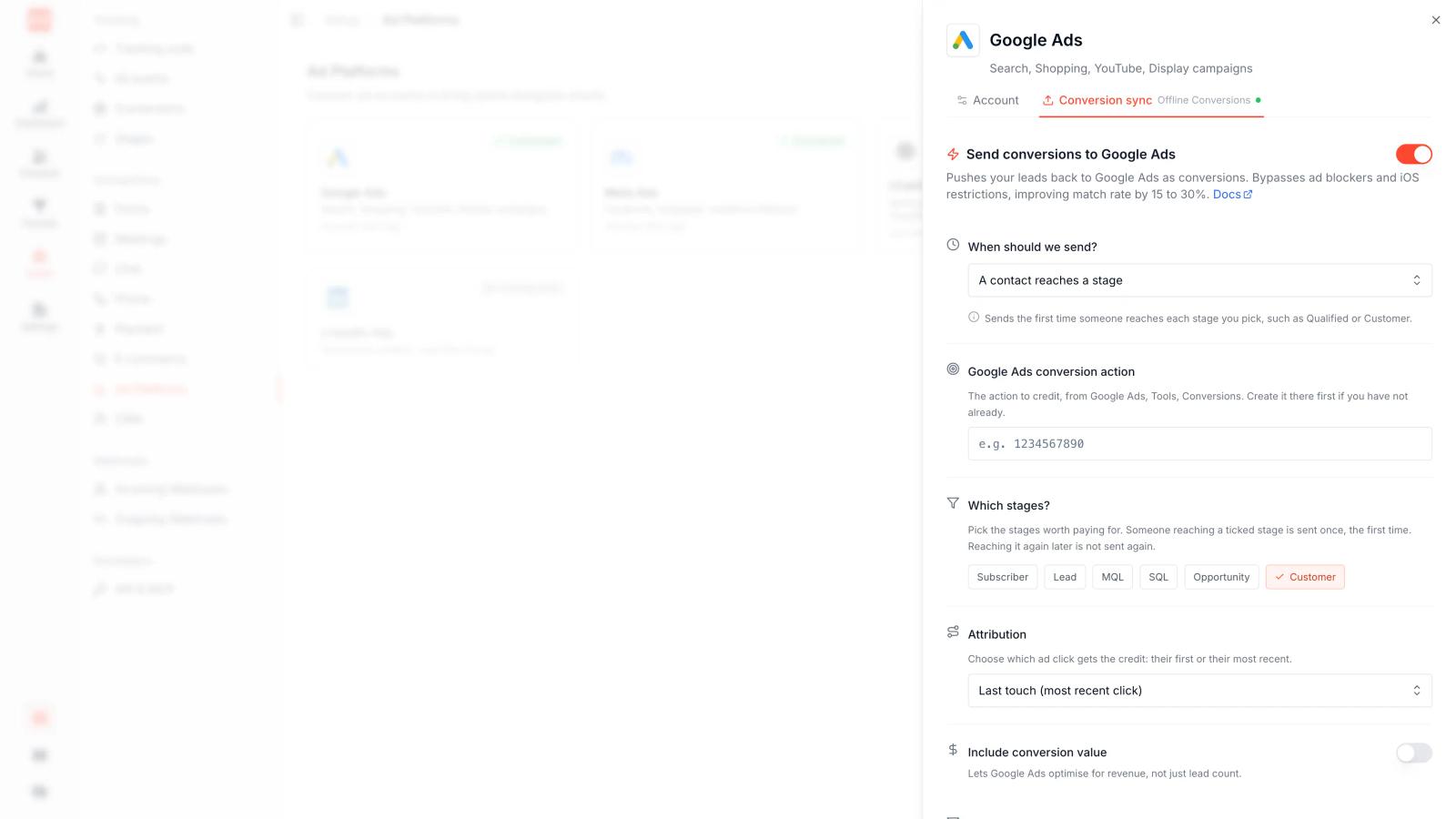
Server-side sync to Google Ads Enhanced Conversions, Meta CAPI, LinkedIn CAPI, Microsoft Ads, TikTok, Pinterest and Reddit, with the attribution touch chosen per platform. Train Google on first touch and Meta on last touch, filter each mapping to a source, and send the CRM's quote value or realised revenue rather than a flat number.
Most MTA tools compute a model for your dashboard and stop there.
7. Paths behind the model
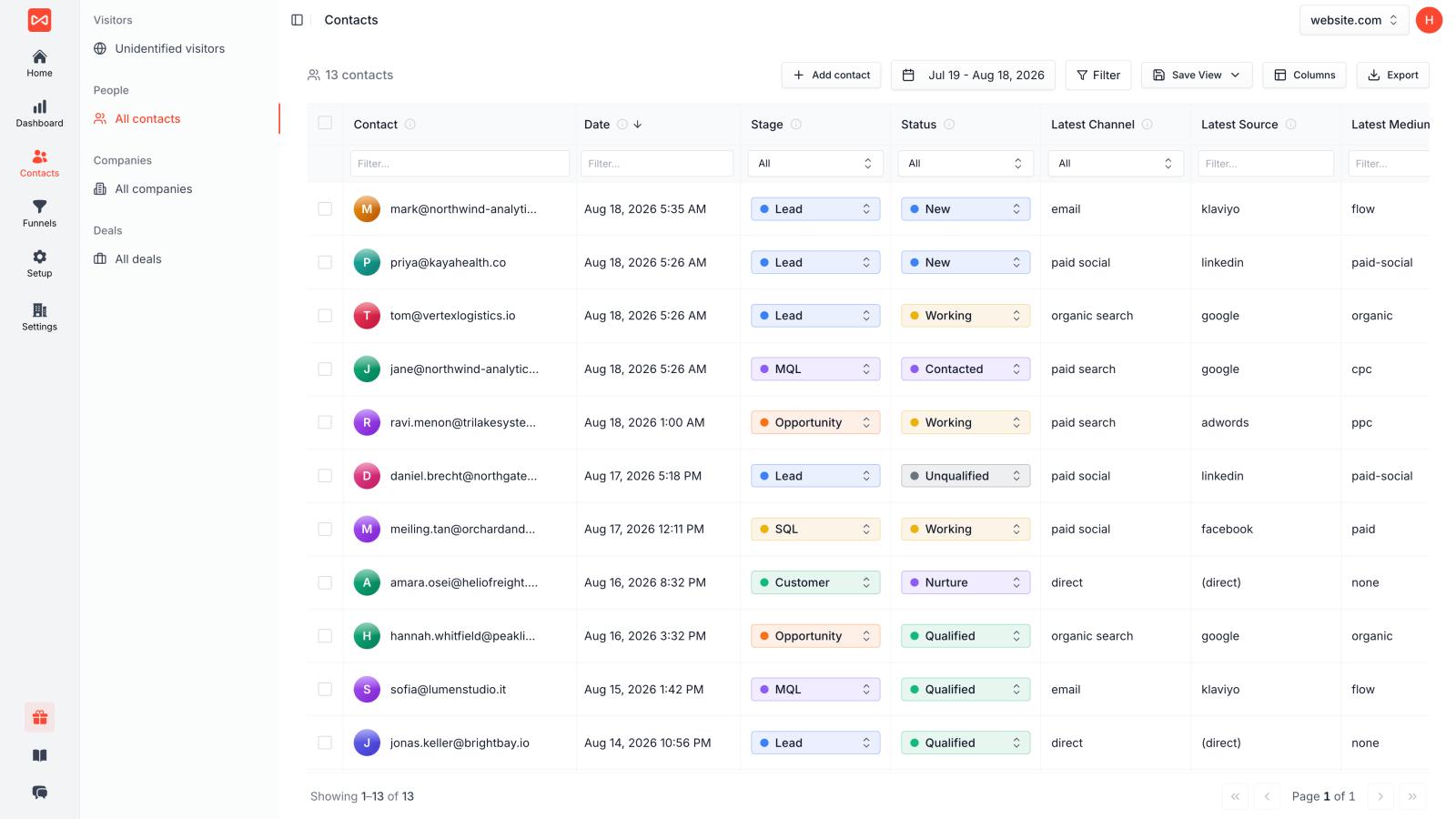
The Paths view shows the touch sequences that end in conversions, with visitors, conversions and revenue against each, plus a toggle to collapse repeat touches. Expanded, it shows how many exposures a channel needs before it converts.
Under it sits the Contacts Hub, so any number in the model drills down to the actual people it describes.
Pros:
- All seven models on the entry plan, with published weightings rather than a black box
- Nine click IDs read ahead of the referrer, which keeps paid touches out of the Direct bucket
- Identity stitching across devices, automatic subdomain and one-line cross-domain handoff
- Around 70 lead tools captured with no event code
- Revenue-weighted attribution from five payment providers, plus two-way CRM sync
- Per-platform choice of which attribution touch each ad network learns from
- Path sequence analysis and contact-level drill-down behind every number
- MCP server and REST API for querying models, journeys and paths programmatically
Cons:
- Rules-based models only. No machine-learned attribution, no incrementality testing and no media mix modelling, which is where Northbeam, Rockerbox and HockeyStack earn their pricing at high spend.
- No reverse-IP company identification, so account-level rollup needs a captured email first.
- Web and server-side only, with no native mobile SDK.
- Tracked conversions are unlimited on every plan, but the entry tier covers 30k page views a month, so a high-traffic site starts at Professional.
Pricing: Essential $49/mo covers 1 site, 1 user and 30k page views a month. Professional $99/mo adds 3 users and 100k page views. Agency $249/mo covers 3 sites, unlimited users and 2.5M page views. Tracked conversions are unlimited on every plan, annual billing takes 25% off, and there is a 7-day trial with no card.
2. HockeyStack
Best for: Mid-market and enterprise B2B running complex multi-channel motions
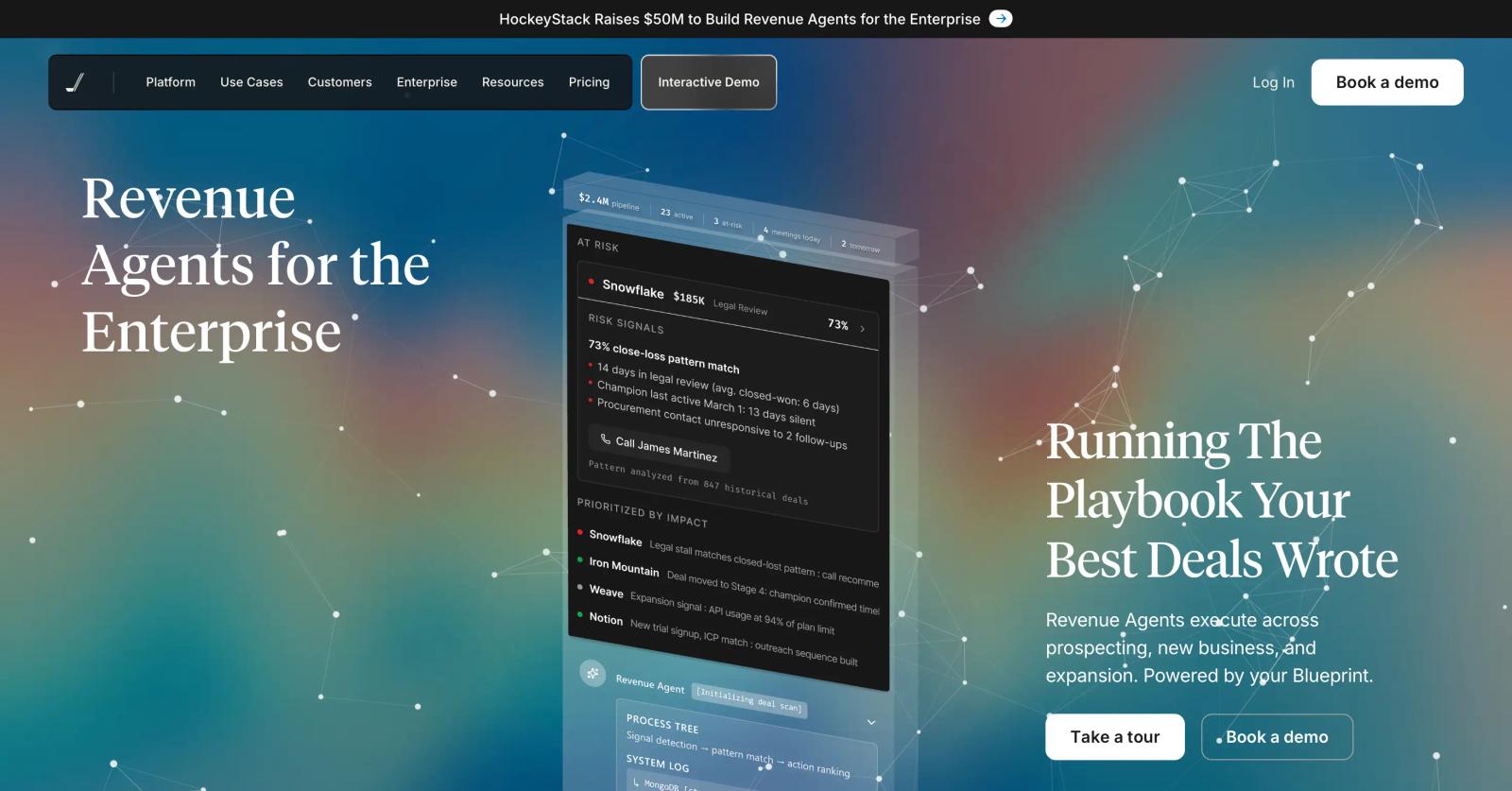
HockeyStack ships 9 attribution models including W-shaped and full-path, with cookieless tracking built into the architecture.
Where rules-based MTA assigns credit by position, HockeyStack's Atlas data foundation lets teams build custom models around their actual sales cycle.
The Odin AI agent answers GTM questions in natural language, which lowers the barrier from "data team builds dashboards" to "marketer asks a question."
HockeyStack tracks pipeline across customers including 8x8, DataRobot, RingCentral, and MasterCard. The most-cited negative on G2 is the learning curve, with 11 explicit mentions and 8 calling it "steep", and some former customers reporting attribution numbers that change between report pulls.
Pros:
- 9 attribution models including custom B2B-specific options
- Cookieless tracking built into the core architecture
- Odin AI agent for natural-language MTA queries
Cons:
- 2-6 weeks to operationalize, no public pricing
- Attribution methodology has been called a black box
- Annual contracts only
Pricing: Growth plan starts around $1,399/month per Docket's research. Some sources put the entry point closer to $2,200/month for 30K visitors. Enterprise custom.
3. Dreamdata
Best for: B2B SaaS teams that want account-level multi-touch attribution tied to CRM revenue
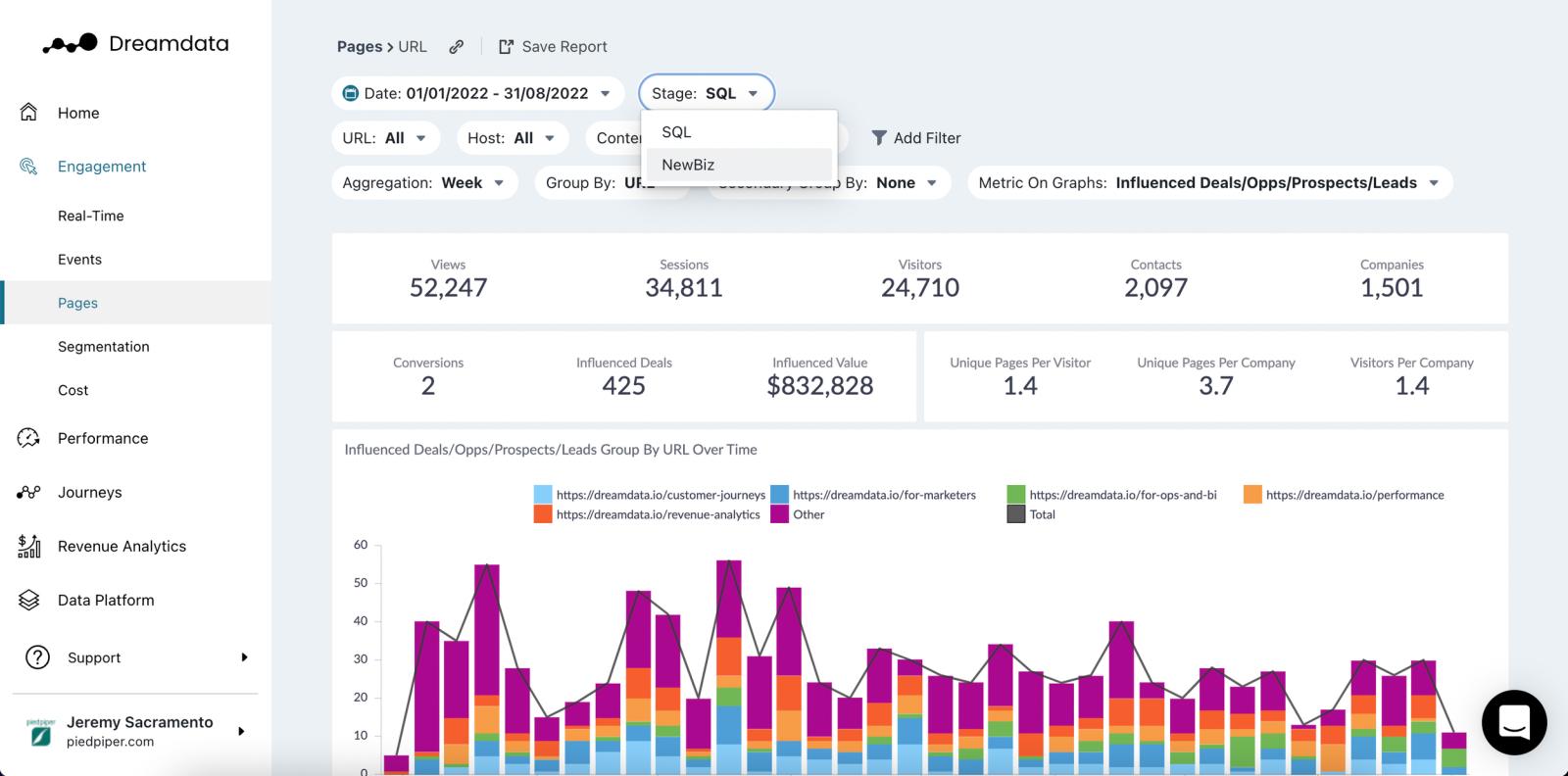
Dreamdata is a B2B revenue attribution platform built specifically for long sales cycles and multi-stakeholder buying journeys.
Where most MTA tools attribute at the contact level, Dreamdata aggregates touchpoints at the account level, which is critical for B2B where the demo booker, decision maker, and budget holder are often different people.
The IP-to-company resolution engine identifies up to 80% of companies visiting your site even when they don't fill out a form.
Dreamdata is rated number one in G2's B2B Attribution category with 230+ reviews.
The trade-off is that implementation typically takes 4-8 weeks, and reports are warehouse-locked with batch processing rather than real-time updates.
Pros:
- Account-level MTA tied to CRM opportunity data
- Up to 80% company identification rate from anonymous traffic
- BigQuery and Snowflake access on higher tiers
Cons:
- 4-8 week implementation
- Warehouse-locked reports with batch processing
- Pricing scales sharply with contact volume
Pricing: Free tier available. Activation Starter at $999/month. Annual contracts typical with contract values often $9,000-$30,000.
4. Northbeam
Best for: DTC brands at $1M+ ARR that want ML-powered MTA at scale
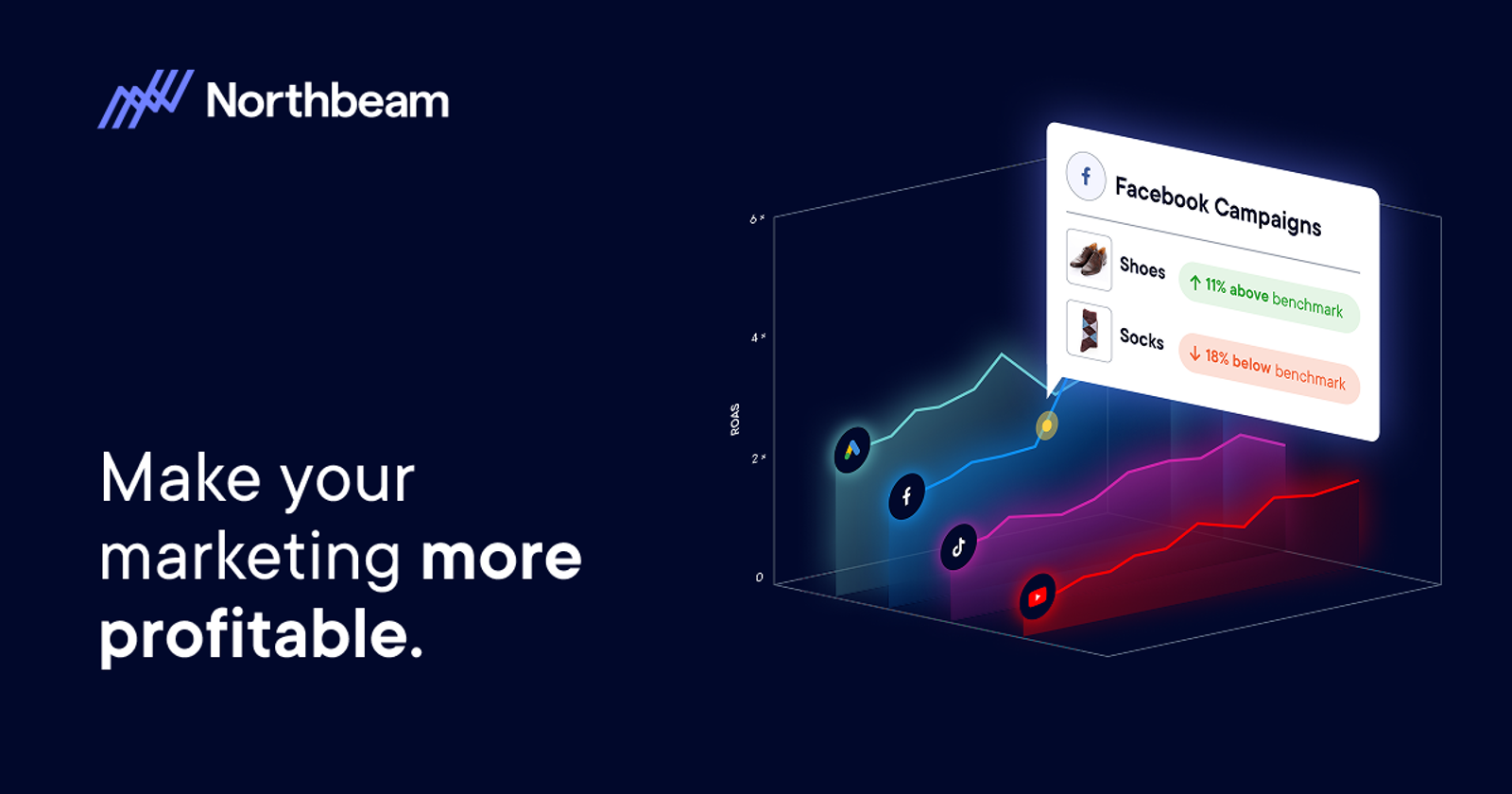
Northbeam ships first-party multi-touch attribution combined with deterministic view-through measurement and weekly-retraining MMM+.
The attribution methodology uses machine learning to weight touchpoints based on actual conversion patterns rather than fixed formulas.
The Apex integration feeds Northbeam's MTA data back into Meta and other ad platforms, which in Northbeam's own study drove an average 34% improvement in conversion rates for Apex users.
Northbeam is the most technically sophisticated MTA platform for DTC, but it requires a 2-4 week calibration period and isn't viable below $20-50K/month in spend.
Pros:
- ML-powered MTA, not rules-based
- Apex CAPI integration drives measurable lift
- Weekly-retraining models for offline channels
Cons:
- Steep price floor, not viable below $20-50K/month in spend
- 2-4 week calibration before reliable data
- Onboarding has gotten thinner for sub-$1K/month accounts
Pricing: Starter from $1,500/month for brands spending under $250K/month. Professional at $2,500/month. Enterprise custom.
5. Triple Whale
Best for: Shopify DTC brands that want native MTA without enterprise complexity
Triple Whale is the analytics OS for Shopify. The Triple Pixel does first-party multi-touch attribution and server-side conversion tracking back to Meta, Google, and TikTok.
Multiple attribution models are included (last-click, first-click, linear, position-based, plus Triple Whale's own algorithmic model), and you can compare them side by side in the dashboard.
Sonar Send, which enriches Klaviyo flows with Triple Whale attribution data, has driven average Klaviyo revenue lifts of 14.2%. Above $5M GMV, pricing becomes GMV-based and climbs steeply.
Pros:
- One-click Shopify integration, fast time-to-value
- Multiple MTA models including Triple Whale's algorithmic option
- Sonar Send drives measurable Klaviyo lift
Cons:
- Shopify-first, non-Shopify support is newer
- Above $5M GMV, pricing climbs quickly
- Some users report attribution discrepancies on imported orders
Pricing: Free Founders Dash. Starter at $129/month (annual). Advanced at $259/month. Above $5M GMV, pricing is GMV-based.
6. Rockerbox
Best for: Brands that want MTA, MMM, and incrementality testing in one platform
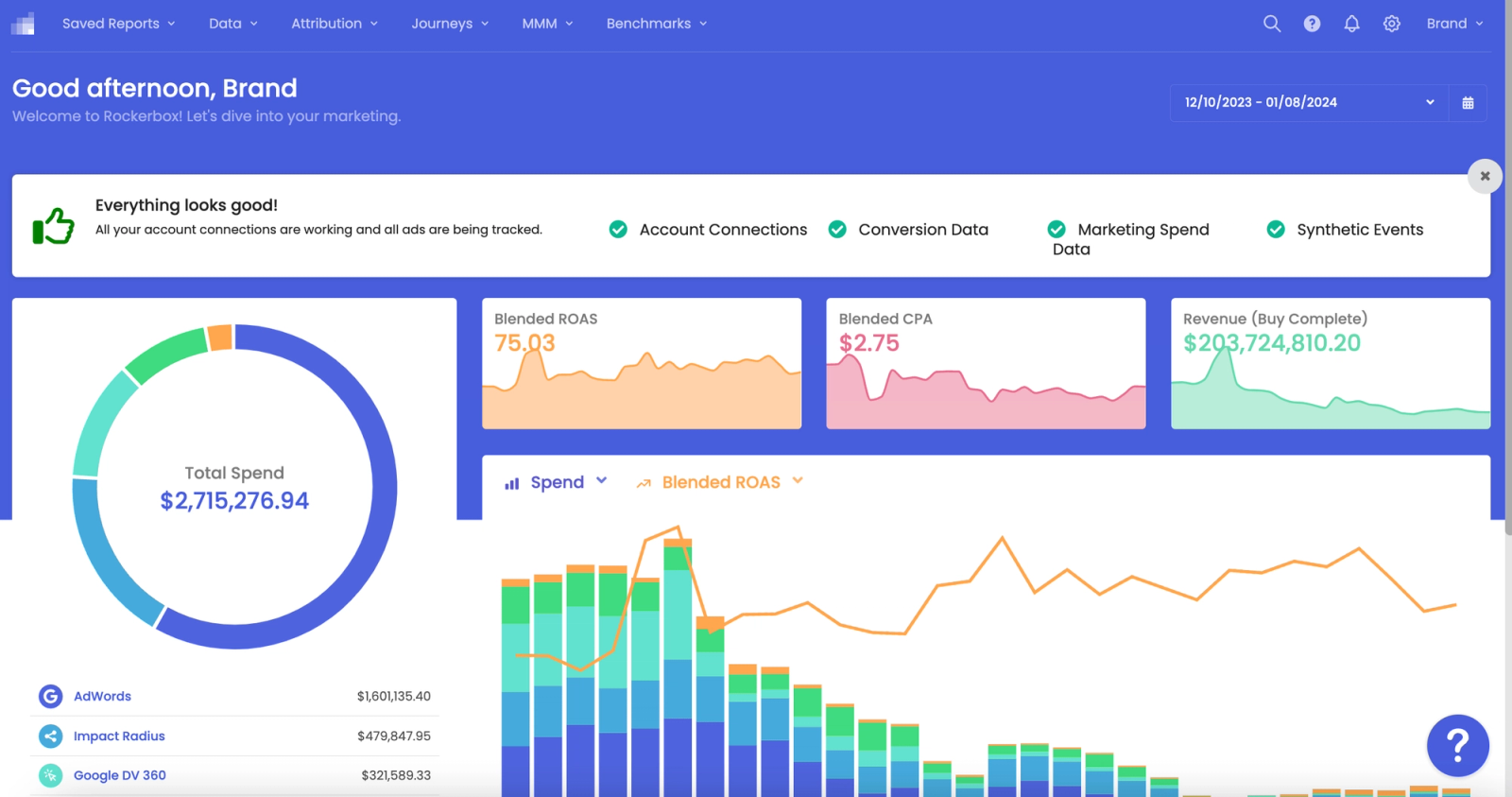
Rockerbox is the most comprehensive unified measurement platform on the market. It combines multi-touch attribution (with multiple selectable models), marketing mix modeling, and built-in holdout incrementality testing in a single interface.
You can switch between attribution models and immediately see how credit shifts, which is genuinely useful when presenting attribution scenarios to leadership.
Where Rockerbox stands out is the side-by-side comparison: instead of just running MTA, you can validate the model output against incrementality test results to see which model best reflects measured causal lift. The trade-off is enterprise pricing starting at $2,000/month and a 4-6 week implementation.
Pros:
- MTA + MMM + incrementality in one platform
- Multiple selectable models with side-by-side comparison
- Validates MTA against measured causal lift
Cons:
- Custom enterprise pricing, no public tiers below $2,000
- 4-6 week implementation
- MTA methodology stays at the rule-based level
Pricing: Custom enterprise pricing. Starts at $2,000/month.
7. Ruler Analytics
Best for: B2B and lead-gen businesses where phone calls and forms drive pipeline
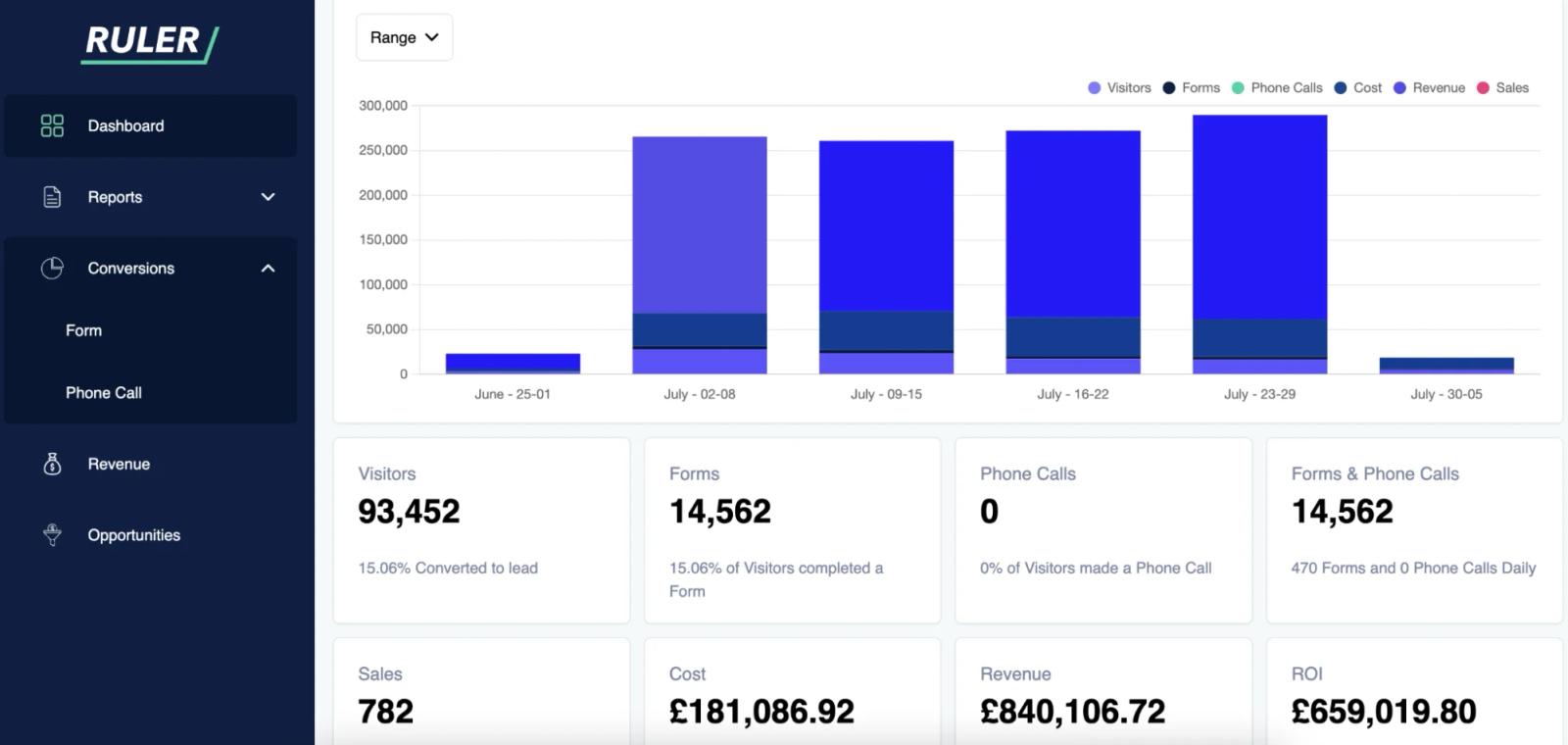
Ruler Analytics is a UK-built attribution platform with strong call tracking and form attribution.
It captures every visitor's source, attributes form, call, and live chat conversions back to the original marketing source through multiple MTA models, and pushes the data back into HubSpot, Salesforce, and Microsoft Dynamics for closed-loop reporting.
The most common complaint, repeated on Capterra, is the 12-month minimum contract being inflexible if the fit isn't right.
Setup can run up to three weeks. For mid-market B2B with phone calls and forms as primary lead types, Ruler is a solid pick. For ecommerce or self-serve SaaS, it's overkill.
Pros:
- Strong call tracking and form attribution
- Closed-loop CRM revenue reporting
- Multiple MTA models with re-provided keywords matched to calls
Cons:
- 12-month minimum contract, hard to exit early
- Setup can take 2-3 weeks
- Pricing scales by traffic volume rather than leads captured
Pricing: Small Business at £199/month. Medium Business at £649/month. Large Business at £1,149/month.
8. Cometly
Best for: Paid media teams that want multi-touch attribution plus AI optimization
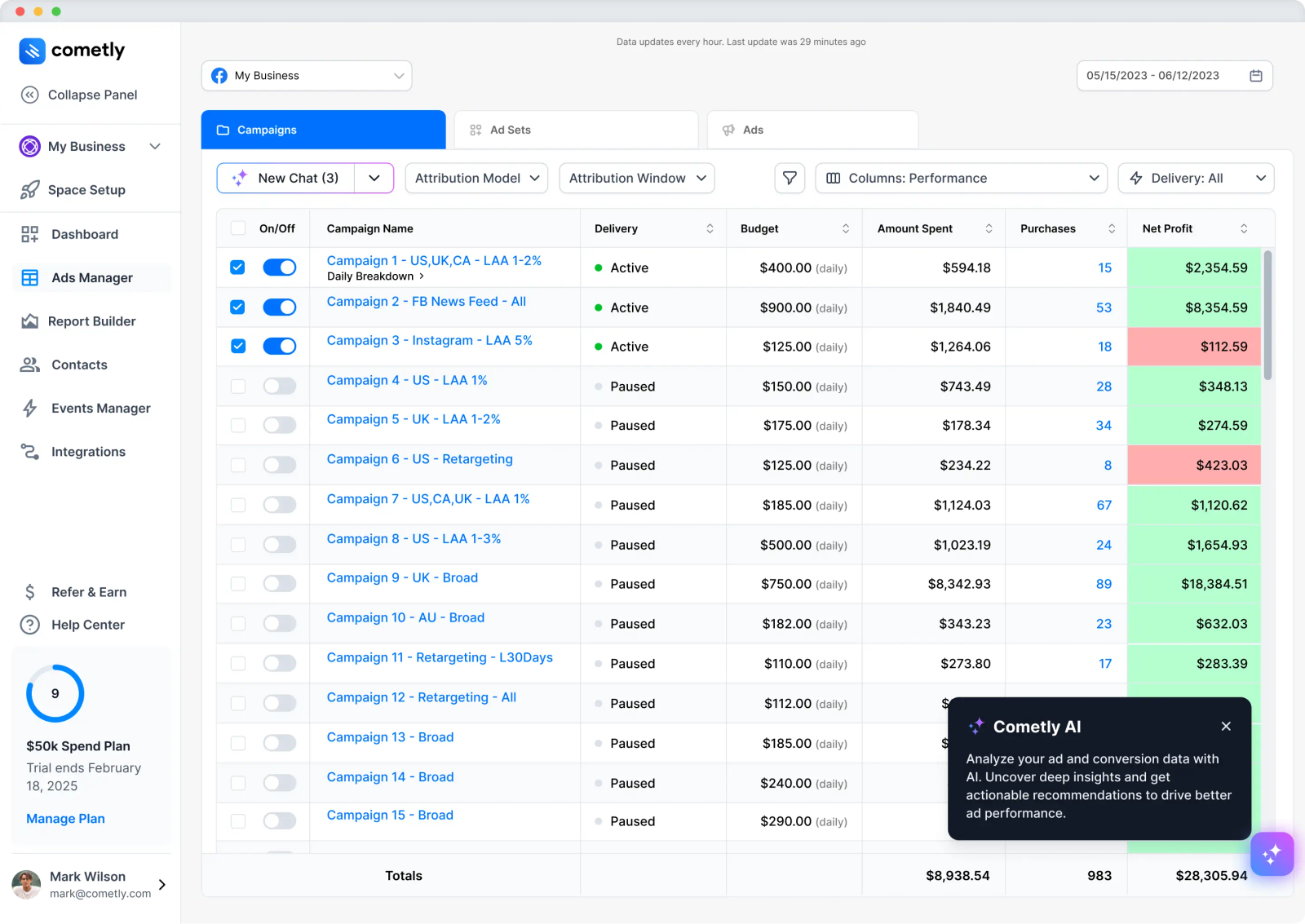
Cometly combines multi-model MTA with server-side tracking and an AI Ad Manager that recommends which ads and campaigns to scale or pause based on actual conversion data.
The platform tracks the full customer journey from ad click through CRM conversion, supports first-click, last-click, linear, time-decay, and data-driven attribution, and feeds enriched conversion data back to Meta, Google, TikTok via their server-side APIs.
Cometly is strongest for teams running paid media at scale across multiple platforms. Setup is straightforward for a typical Meta + Google + TikTok stack, though documentation can be thin.
Pros:
- Multi-model MTA with AI optimization layer
- Server-side tracking that survives iOS and ad blockers
- Conversion sync feeds enriched events back to ad platforms
Cons:
- No public pricing
- Steeper setup for complex tech stacks
- Documentation has been called less complete than expected
Pricing: Quote-based, ad-spend-tiered. Professional and Enterprise tiers.
9. Google Analytics 4
Best for: Google-centric campaigns under $50K/month that need free baseline MTA
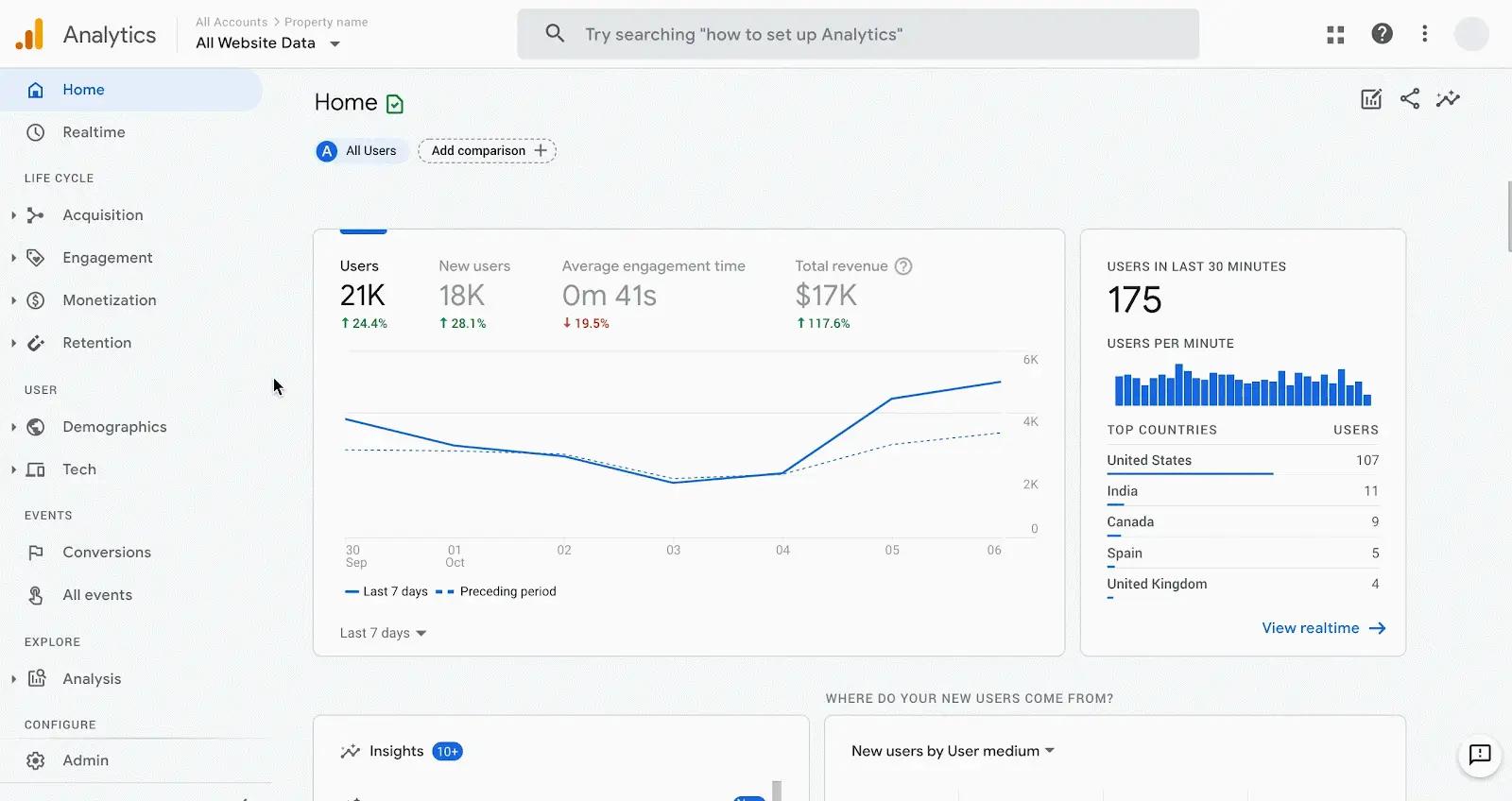
Google Analytics 4 ships data-driven attribution as the default model, plus first-click, last-click, linear, time-decay, and position-based as alternatives.
The data-driven model uses machine learning to assign credit based on actual conversion paths in your data, which is genuinely useful for free.
The catch is that GA4's MTA is biased toward the Google ecosystem. Google Ads conversions feed cleanly into the model. Meta, TikTok, and LinkedIn conversions don't, because GA4 doesn't natively send conversions to non-Google ad platforms via Conversions API.
For multi-platform advertisers, GA4 is fine as a baseline but typically needs a paid tool layered on top.
Pros:
- Free, including data-driven attribution
- Native Google Ads integration with conversion import
- BigQuery export for advanced analysis
Cons:
- Biased toward Google ecosystem
- 14-month default data retention
- Doesn't send conversions to non-Google ad platforms
Pricing: Free for standard GA4. GA4 360 enterprise version available with custom pricing for high-traffic sites.
10. Adobe Analytics Attribution IQ
Best for: Enterprise organizations already invested in Adobe Experience Cloud
Adobe Analytics with Attribution IQ is the enterprise standard for MTA at scale. It ships 10+ attribution models including first-touch, last-touch, linear, time-decay, position-based, J-shaped, U-shaped, inverse-J, and a data-driven algorithmic model that uses machine learning.
The Analysis Workspace lets analysts compare models side by side without predefined reports.
For Fortune 500 brands and large enterprises, Attribution IQ within Adobe Analytics is the safe choice.
The trade-offs are familiar Adobe trade-offs: implementation typically takes 3-6 months, requires dedicated analytics resources, and pricing scales sharply with data volume. Annual costs typically run $50,000+ for mid-market deployments and well into six figures for enterprise.
Pros:
- 10+ attribution models including algorithmic data-driven
- Mature enterprise integrations (Marketo, Salesforce, Adobe Experience Cloud)
- Analysis Workspace for flexible model comparison
Cons:
- 3-6 month implementation typical
- Enterprise pricing only
- Steep learning curve for non-experts
Pricing: Custom enterprise pricing, typically starting at $10,000+ annually based on data volume.
How to choose
For most teams, the question isn't "which MTA tool" but "which methodology and how much do I want to pay for it." Here's how the layers stack up.
The lean approach: rules-based MTA with all 7 models for $49/month. If you want to compare last-touch, first-touch, linear, position-based, and time-decay attribution side by side without committing to a $1,500+ enterprise platform, SourceLoop ships all 7 standard models on the entry plan plus server-side CAPI, click ID capture, and Stripe webhook revenue stitching.
For SaaS, agency, and DTC teams under enterprise scale, this delivers the actual decision-making capability of MTA without the enterprise sticker price.
The traditional stack: if you've outgrown rules-based MTA and need ML-powered attribution, the right pick depends on your business model. For B2B with multi-stakeholder cycles, Dreamdata or HockeyStack.
For DTC at $1M+ ARR, Northbeam or Rockerbox. For Shopify, Triple Whale. For Adobe-stack enterprises, Attribution IQ. For multi-channel paid media optimization, Cometly. Total cost easily clears $25,000-$100,000/year at mid-market scale.
Frequently asked questions
-
What is multi-touch attribution?
Multi-touch attribution (MTA) is a methodology that distributes conversion credit across every touchpoint in a customer journey instead of giving 100% credit to the last click. A typical B2B journey might include a podcast ad, an organic blog visit, a LinkedIn ad click, three nurture email opens, a webinar attendance, a competitor comparison page, and finally a demo form fill. MTA models distribute credit across all of those touchpoints based on the model you choose.
-
What are the standard attribution models?
The seven standard MTA models are: last-touch (100% to the last touchpoint), first-touch (100% to the first), last non-direct (last touchpoint excluding direct), first non-direct, linear (equal credit to all), position-based or U-shaped (40% first, 40% last, 20% middle), and time-decay (recent touches weighted more heavily). Some platforms add W-shaped, J-shaped, and full-path variants. Modern platforms also offer data-driven or algorithmic models that use machine learning instead of fixed formulas.
-
What's the difference between rules-based and ML-powered attribution?
Rules-based attribution uses fixed formulas (like 40/40/20 for position-based) to distribute credit. The math is transparent and auditable. ML-powered attribution uses machine learning to weight touchpoints based on actual conversion patterns in your data, which can be more accurate but harder to audit. Most modern platforms support both: rules-based for simpler use cases and a data-driven model for sophisticated analysis.
-
How many monthly conversions do I need for MTA?
Rules-based MTA works at any volume because the math doesn't depend on training data. ML-powered MTA typically needs 300-400 monthly conversions minimum to produce stable results, and ideally 1,000+ for high-confidence model output. Below that threshold, ML-driven attribution introduces noise rather than insight, and rules-based models are usually the better choice.
-
Do I need MTA if I have Google Analytics 4?
GA4 ships data-driven attribution for free, which is genuinely useful for Google-centric campaigns. The catch is that GA4 doesn't send conversions to Meta, TikTok, or LinkedIn natively via Conversions API. If you spend on multiple ad platforms, GA4-only attribution underrepresents non-Google channels because the conversion signal feeding back to those platforms is broken. Most teams keep GA4 as a baseline and add a dedicated MTA tool on top.
-
Which MTA model should I use?
There's no single right answer. For top-of-funnel demand gen, first-touch shows you which channels source new audiences. For bottom-of-funnel optimization, last-touch shows which channels close. For balanced reporting, position-based (U-shaped) is the most common starting point. For B2B with long cycles, time-decay or W-shaped tend to fit better. The most useful approach is comparing two or three models side by side to see how credit shifts and using the model that aligns with how your business actually operates.
-
How much should I budget for MTA?
Below $1M ARR or $20K/month ad spend, free tools (GA4 data-driven attribution) plus a $49/month layer like SourceLoop cover the basics. Between $1M-$10M ARR, paid MTA tools at $129-$1,500/month make sense (Triple Whale, Ruler Analytics, Northbeam Starter, HockeyStack Growth). Above $10M ARR, enterprise platforms (Northbeam Enterprise, Rockerbox, Adobe Attribution IQ) at $25K+/year are justified.
-
Is MTA still useful in a cookieless world?
Yes, but only if the data feeding it is durable. Cookieless MTA depends on first-party tracking, server-side Conversions API, click ID capture, and identity stitching from email or login. Tools that rely purely on third-party browser cookies are increasingly broken. The MTA platforms on this list that consistently work in 2026 share one thing: they capture conversion data server-side, not just through browser pixels.



 Paid Social


