
7 Best Calibermind Alternatives: Compared for 2026
Compare 7 Calibermind alternatives for B2B attribution, HockeyStack, Dreamdata, SourceLoop, and more. Real pricing, features, and which fits your team.
Table of contents
- Why Teams Look for Calibermind Alternatives
- Custom-only pricing creates budget uncertainty
- Implementation requires significant resources
- Enterprise focus limits self-service capabilities
- Data warehouse dependency increases cost
- Calibermind Alternatives Comparision
- 1. SourceLoop: Best for Full-Funnel Marketing Attribution
- Key Features
- SourceLoop vs. Calibermind
- Pricing
- Best For
- 2. HockeyStack
- 3. Dreamdata
- Best for
- Pricing
- Key features
- vs Calibermind
- 4. Ruler Analytics
- Best for
- Pricing
- Key features
- vs Calibermind
- 5. Adobe Marketo Measure (formerly Bizible)
- Best for
- Pricing
- Key features
- vs Calibermind
- 6. Demandbase One
- Best for
- Pricing
- Key features
- vs Calibermind
- 7. LeanData
- Best for
- Pricing
- Key features
- vs Calibermind
The best Calibermind alternatives include SourceLoop for first-party tracking, multi-touch attribution, and CRM sync, HockeyStack for GTM intelligence, Dreamdata for revenue attribution, and Ruler Analytics for attribution with call tracking.
SourceLoop is a strong option for teams that want accessible attribution without the complexity of enterprise platforms.
Why Teams Look for Calibermind Alternatives
Calibermind is a sophisticated GTM intelligence platform built for large enterprises with complex data environments. However, several common constraints drive teams to evaluate alternatives:
Custom-only pricing creates budget uncertainty
Calibermind does not publish pricing tiers. Based on market data from procurement platforms, enterprise deployments typically start around $75,000 annually and scale to $150,000+ depending on data volume and requirements. Mid-market teams often find this prohibitive compared to transparent, tier-based alternatives.
Implementation requires significant resources
Calibermind's flexibility comes with complexity. Onboarding typically takes 8-12 weeks and requires dedicated data engineering support to configure custom data models, attribution logic, and reporting structures. Teams without technical resources struggle to extract value.
Enterprise focus limits self-service capabilities
While Calibermind offers deep customization for RevOps teams, marketing users report needing vendor support for report modifications and funnel adjustments that competing platforms handle through no-code interfaces.
Data warehouse dependency increases cost
Calibermind runs on BigQuery, creating an additional infrastructure cost and maintenance requirement that some teams prefer to avoid. For comparison, other marketing attribution software options offer hosted solutions without warehouse dependencies.
Teams evaluating alternatives typically prioritize one of three needs: transparent pricing for budget predictability, faster time-to-value with lighter implementation, or more self-service flexibility for non-technical users.
Calibermind Alternatives Comparision
| # | Platform | Best For | Pricing (Annual) | Implementation Time | Key Strength |
|---|---|---|---|---|---|
| 1 | SourceLoop | Mid-market B2B needing accessible entry | $49/mo - $99/mo | 10-15 min | CRM-native & transparent pricing |
| 2 | HockeyStack | Complex B2B buyer journeys | $12,000-$150,000+ | 2 weeks | Real-time data & incrementality testing |
| 3 | Dreamdata | Account-based attribution | $15,000-$160,000+ | 4-6 weeks | Buying committee analysis |
| 4 | Ruler Analytics | Call tracking + attribution | $3,000-$15,000+ | 2-3 weeks | Online-to-offline conversion tracking |
| 5 | Adobe Marketo Measure | Adobe/Salesforce ecosystems | $18,000+ | 4-8 weeks | Native Salesforce integration |
| 6 | Demandbase One | Full ABM orchestration | $100,000+ (est.) | 8-12 weeks | ABM advertising + attribution |
| 7 | LeanData | Lead routing + attribution | $50,000+ (est.) | 6-10 weeks | Revenue orchestration |
1. SourceLoop: Best for Full-Funnel Marketing Attribution
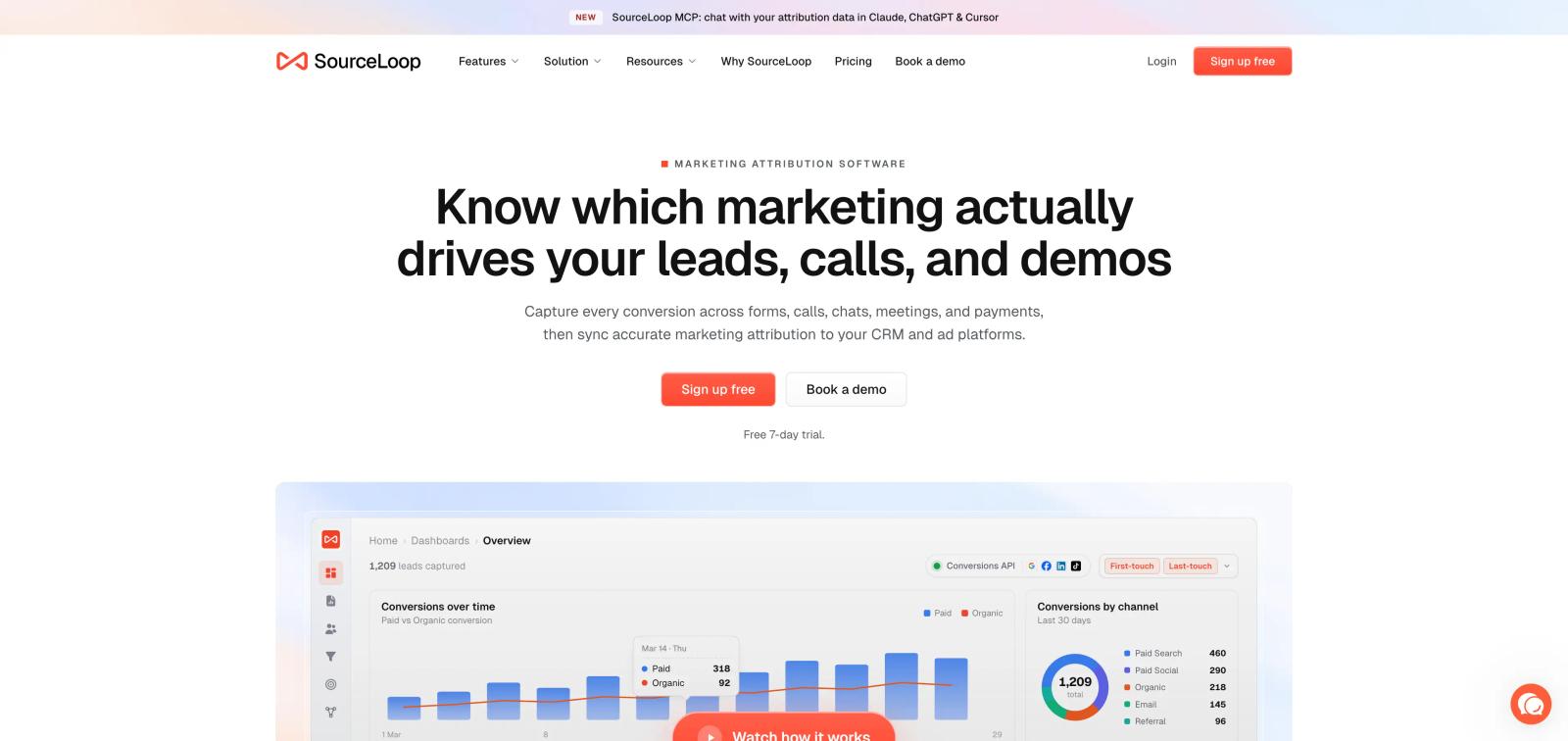
SourceLoop is a first-party marketing attribution and conversion tracking platform that connects the entire journey from a visitor's first marketing touch to leads, calls, meetings, opportunities, customers, and revenue.
It combines multi-touch attribution, conversion tracking, CRM sync, dashboards, and server-side conversion tracking in one platform.
Where Calibermind is geared toward complex enterprise GTM intelligence and customized data environments, SourceLoop focuses on giving marketing teams a ready-to-use attribution layer without requiring a data engineering project.
Key Features
- First-party tracking: Capture visitor journeys and marketing touchpoints using your own first-party data rather than relying on third-party cookies.
- Multi-touch attribution: Compare first-touch, last-touch, linear, U-shaped, W-shaped, and other attribution models using the same underlying dataset.
- Full-funnel attribution: Connect ad clicks and website visits to forms, calls, chats, meetings, CRM stages, deals, and revenue.
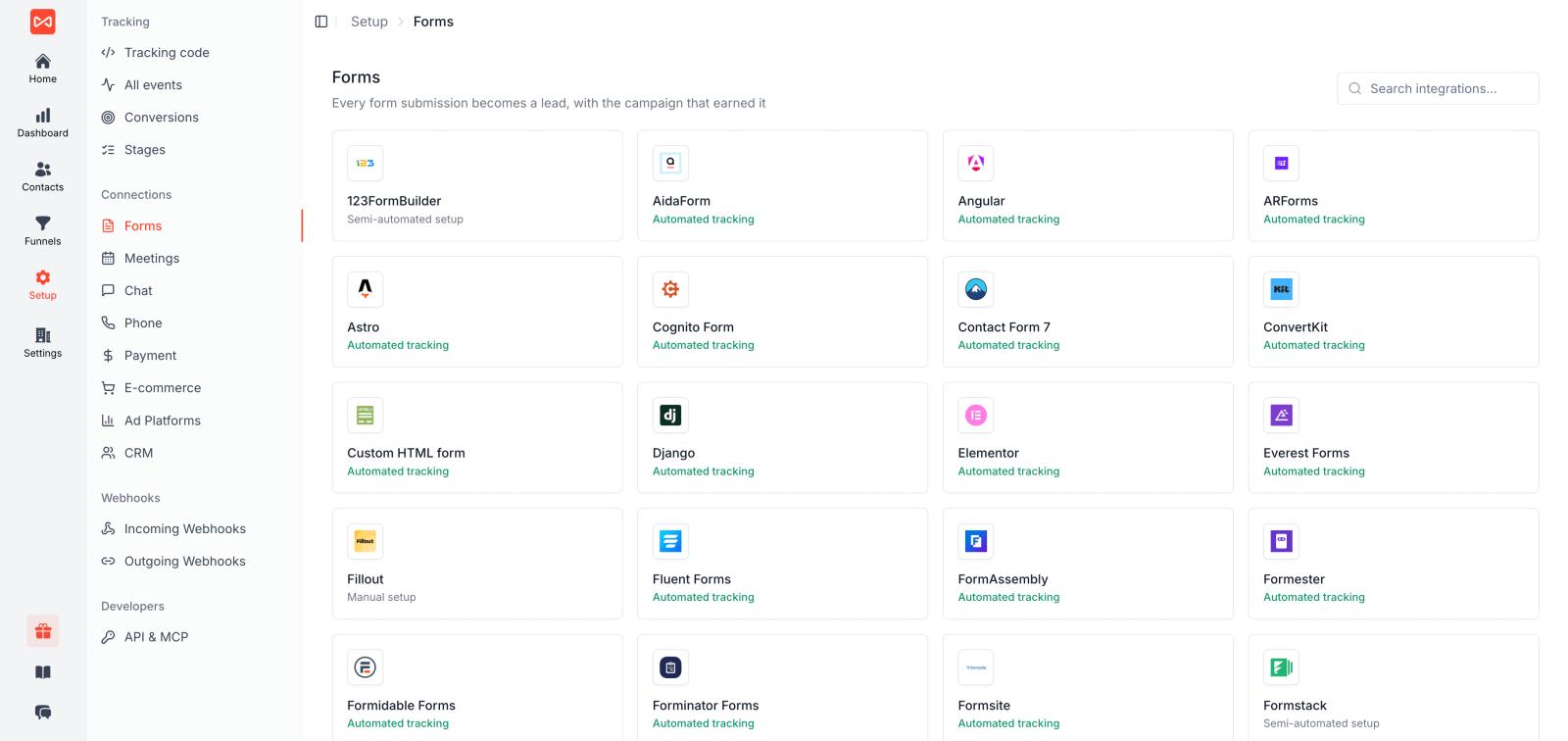
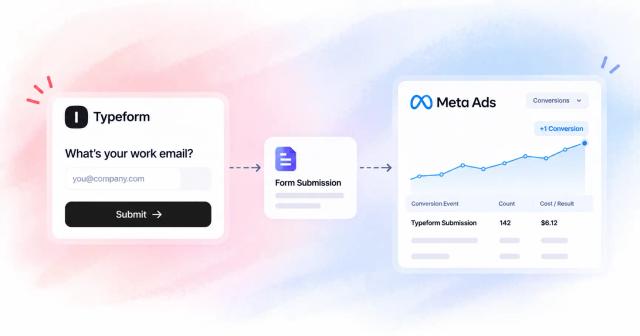
- Lead and conversion tracking: Automatically capture conversions from forms, calls, chats, meetings, and payments, with integrations across common tools.
- CRM integration: Sync source, journey, attribution, and revenue data with Salesforce, HubSpot, Pipedrive, and other CRM systems.
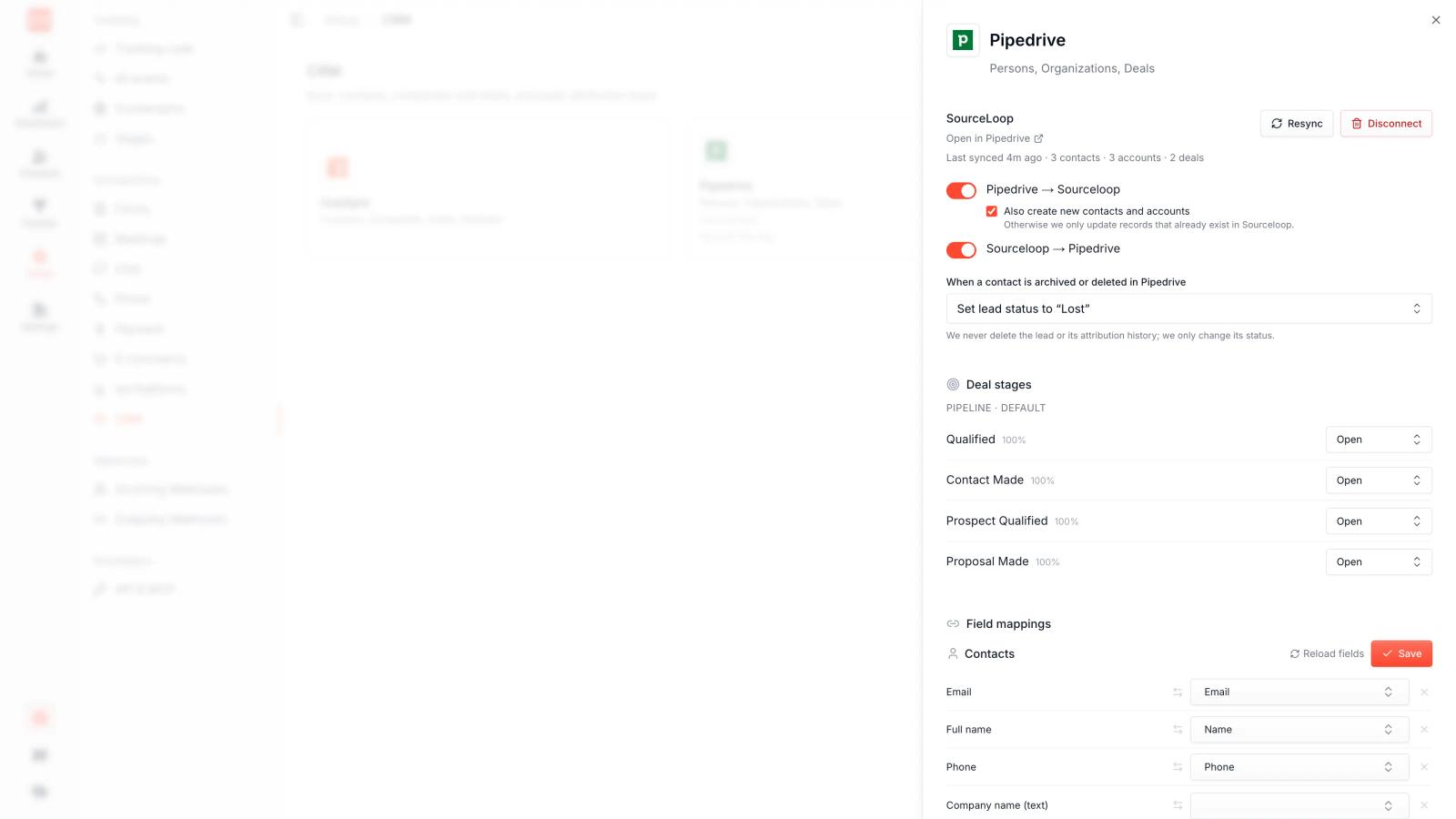
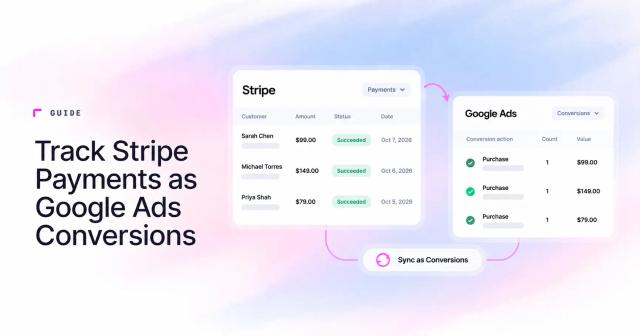
- Revenue attribution: Connect CRM opportunities, closed-won revenue, Stripe payments, subscriptions, and renewals back to their original marketing sources.
- Ad platform conversion sync: Send qualified leads, opportunities, and revenue back to Google Ads, Meta, and LinkedIn through server-side conversion APIs, helping ad platforms optimize toward business outcomes rather than just form fills.
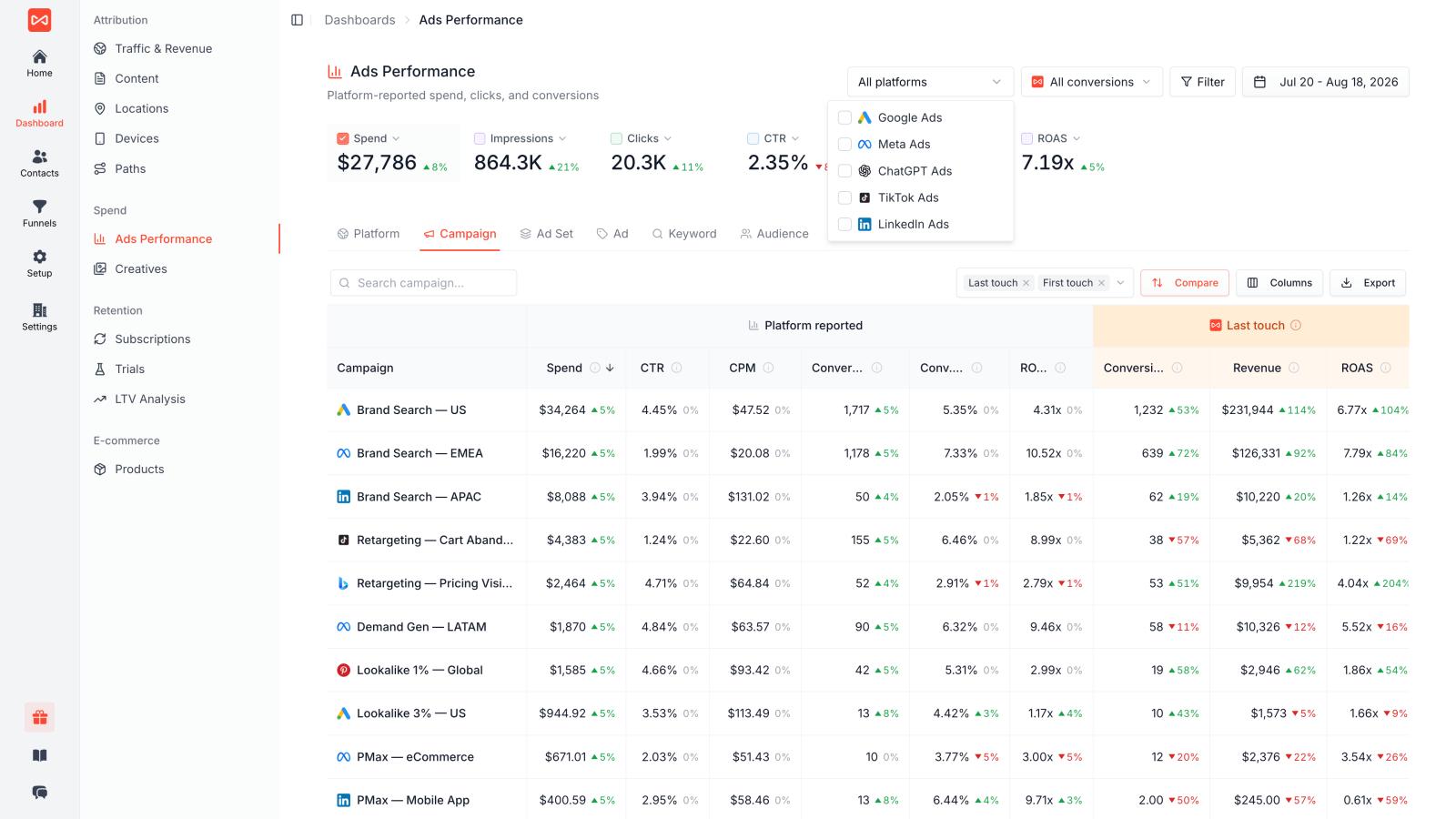
- Dashboards and funnels: Analyze ROAS, CAC, pipeline, conversion paths, and revenue by channel, campaign, and other dimensions without building reports from scratch.
SourceLoop vs. Calibermind
The biggest difference is how much infrastructure and customization you need to get to usable attribution.
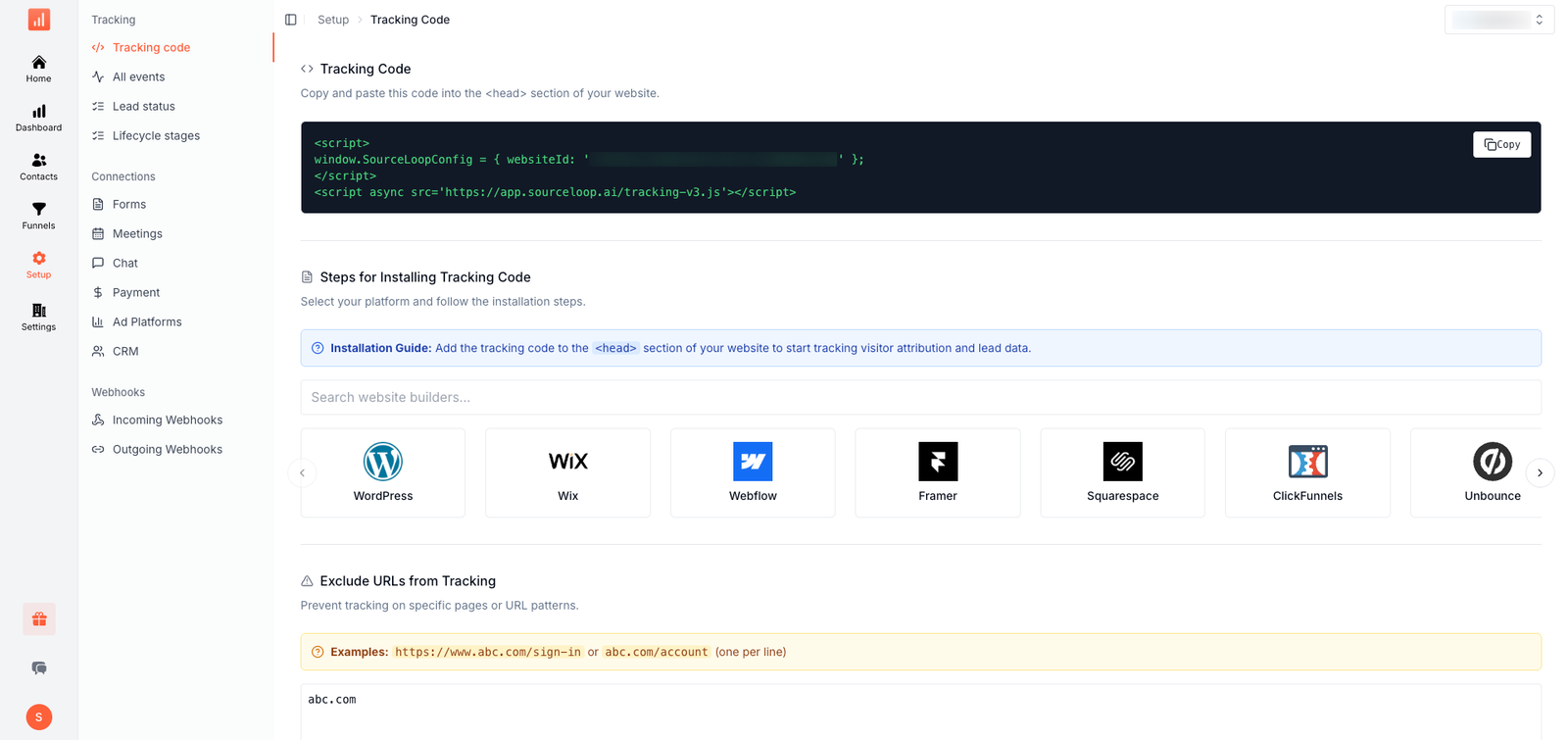
Calibermind makes sense for large organizations with complex GTM data requirements and the resources to support a highly customized implementation. SourceLoop takes a more productized approach: install the tracking snippet, connect your CRM and other sources, and start analyzing attribution from a unified first-party dataset. SourceLoop says the basic setup can be completed in about 15 minutes without a developer or data engineer.
SourceLoop | Calibermind
Primary focus | Full-funnel marketing attribution | Enterprise GTM intelligence
Tracking | First-party website and conversion tracking | Multi-source enterprise data
Attribution | First-touch, last-touch, multi-touch | Advanced customizable attribution
CRM & revenue | CRM, deals, payments, subscriptions | Enterprise GTM data
Ad activation | Google, Meta, LinkedIn conversion sync | Enterprise activation
Implementation | Productized, self-service setup | More involved enterprise implementation
Data infrastructure | Managed platform | More customized enterprise environment
Pricing
SourceLoop has transparent monthly pricing rather than requiring a custom enterprise quote. Plans currently start at $49/month, with Professional at $99/month and Agency at $249/month.
All plans include the core attribution stack, including multi-touch attribution, funnels, and dashboards, while higher tiers add greater usage, CRM connections, ad-platform sync, and team features. There is also a 7-day free trial with no credit card required.
Best For
SourceLoop is a good fit for marketing teams, agencies, lead-generation businesses, ecommerce companies, SaaS companies, and other businesses that need to connect marketing activity to actual conversions and revenue.
It is particularly useful when basic analytics or last-touch attribution isn't enough, but building and maintaining a custom enterprise attribution stack would be excessive.
2. HockeyStack
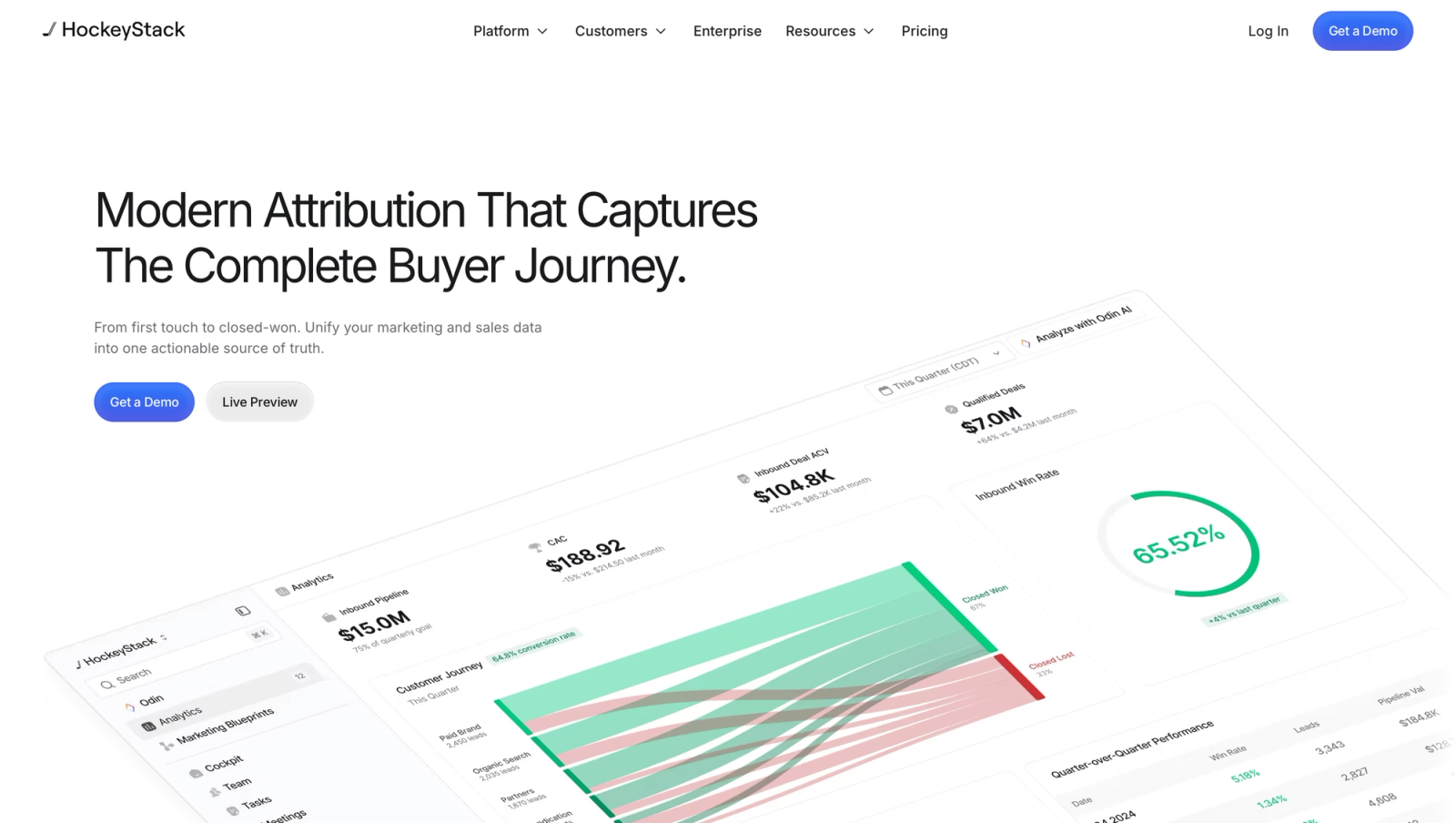
HockeyStack is a GTM intelligence platform that unifies marketing, sales, CRM, website, and revenue data for B2B teams. It combines multi-touch attribution with pipeline analytics, buyer journey tracking, and incrementality testing.
Best for: Mid-market to enterprise B2B companies with complex, multi-touch buyer journeys who need real-time customer insights and no-code flexibility across product and marketing teams.
Pricing: Custom, sales-led pricing. Based on market data from Vendr, small teams (10,000-25,000 tracked contacts) typically see $12,000-$24,000 annually; mid-market (50,000-100,000 contacts) ranges $30,000-$60,000; enterprise (100,000+ contacts) starts around $75,000.
Key features:
- Real-time data processing, conversions and customer touchpoints appear instantly rather than in batch updates
- No-code funnel builder and custom report creation
- Nine attribution models plus cohort-based lift testing to prove incremental campaign impact
- Multi-device cookieless tracking option using fingerprinting, delivering 40% more accurate user-to-opportunity matching across the customer journey
- AI-assisted analysis and automated workflows
- Two-week implementation timeline
vs Calibermind: HockeyStack offers faster time-to-value and more self-service flexibility for marketing teams. Where Calibermind requires data engineering resources to modify reports and attribution logic, HockeyStack provides a no-code interface that marketing ops can use directly. Both serve enterprise buyers, but HockeyStack prioritizes speed and usability while Calibermind emphasizes deep customization for complex data environments. Customer reviews highlight that HockeyStack makes it easier to measure marketing's impact on pipeline without technical support.
3. Dreamdata
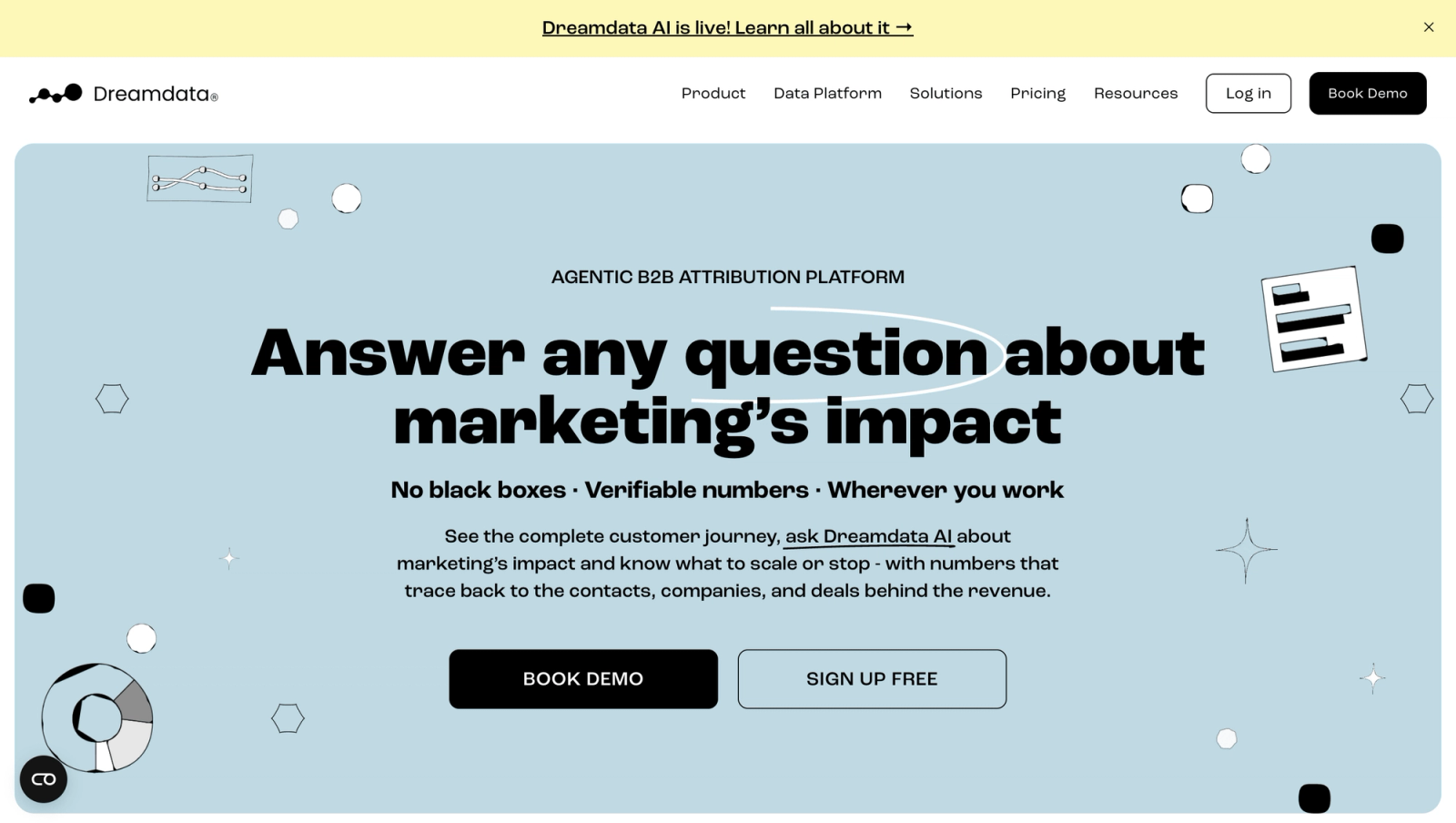
Dreamdata is a B2B revenue attribution platform focused on account-based marketing and buying committee analysis. It tracks account-level journeys, connects touchpoints to revenue, and provides predictive analytics for pipeline forecasting.
Best for
B2B companies running account-based marketing motions who need to understand buying committee behavior and account-level influence.
Pricing
Custom enterprise pricing. Market data suggests $15,000-$30,000 annually for entry-level deployments (similar contact volumes to HockeyStack's $12,000-$24,000 range); $35,000-$70,000 for mid-market; $80,000-$160,000+ for enterprise.
Key features
- Account-level journey tracking showing all touchpoints across buying committee members
- Predictive analytics for lead conversion and revenue forecasting
- ABM dashboard with account engagement scores
- Multi-touch attribution models (first-touch, last-touch, linear, time-decay, U-shaped, W-shaped)
- Batch data processing with warehouse-level control for custom SQL analysis
- Integrations with major CRMs, marketing automation, and ad platforms
vs Calibermind
Dreamdata focuses specifically on account-based attribution where Calibermind offers broader GTM intelligence. Dreamdata's ABM specialization makes it stronger for buying-committee analysis, but Calibermind provides more flexibility for custom data models and non-ABM use cases.
Both target enterprise buyers with similar pricing, but Dreamdata's batch processing creates reporting delays that Calibermind's architecture avoids. Explore each platform's data processing approach when real-time customer insights matter for your team.
4. Ruler Analytics
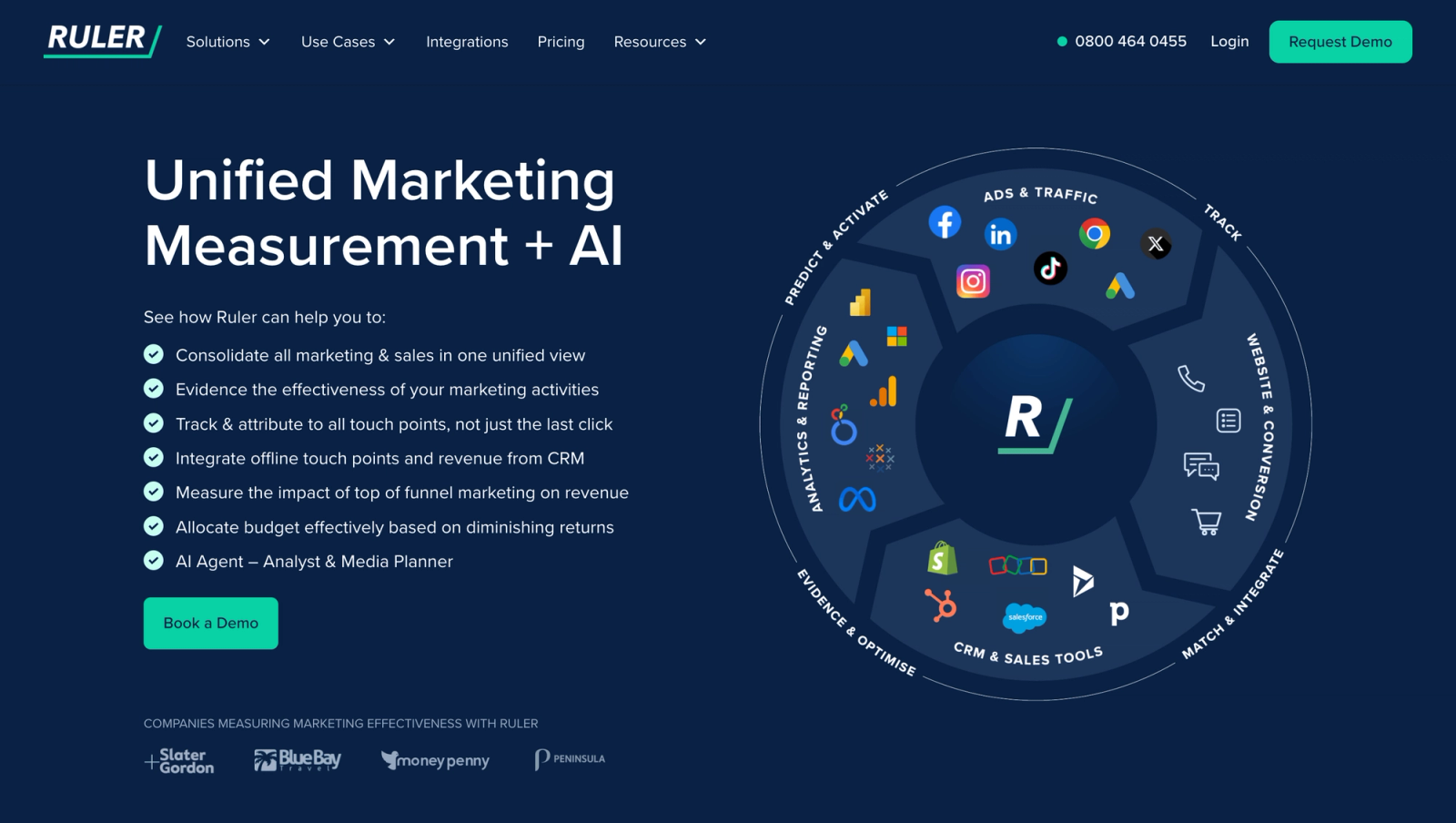
Ruler Analytics connects web activity with forms, phone calls, live chat, CRM stages, and offline conversions. It specializes in bridging online marketing to offline revenue, particularly for businesses where phone calls represent critical conversion points.
Best for
B2B service businesses (agencies, legal, healthcare, home services) where phone calls and offline conversions are primary lead sources.
Pricing
Starts at £199/month ($250) for small businesses with up to 10,000 monthly visits, scaling to £584/month ($730) for medium businesses and £999/month ($1,250) for large businesses. Custom pricing for advanced enterprise needs.
Key features
- Call tracking with keyword-level attribution, connects phone calls to specific search terms and campaigns
- Form, phone, chat, and ecommerce conversion capture
- First-party web tracking with multi-touch, data-driven, and impression attribution models
- CRM opportunity and closed revenue attribution
- Marketing mix modeling capabilities
- AI Agent for analysis and media planning
vs Calibermind
Ruler Analytics serves a different use case. Where Calibermind focuses on complex enterprise data unification, Ruler specializes in online-to-offline conversion tracking, particularly phone calls. Ruler's pricing is transparent and accessible, starting at a fraction of Calibermind's cost. Customer reviews highlight Ruler as the solution for B2B call tracking and marketing attribution. Choose Ruler when call tracking is essential; choose Calibermind when you need enterprise-scale data modeling without call tracking specialization.
5. Adobe Marketo Measure (formerly Bizible)
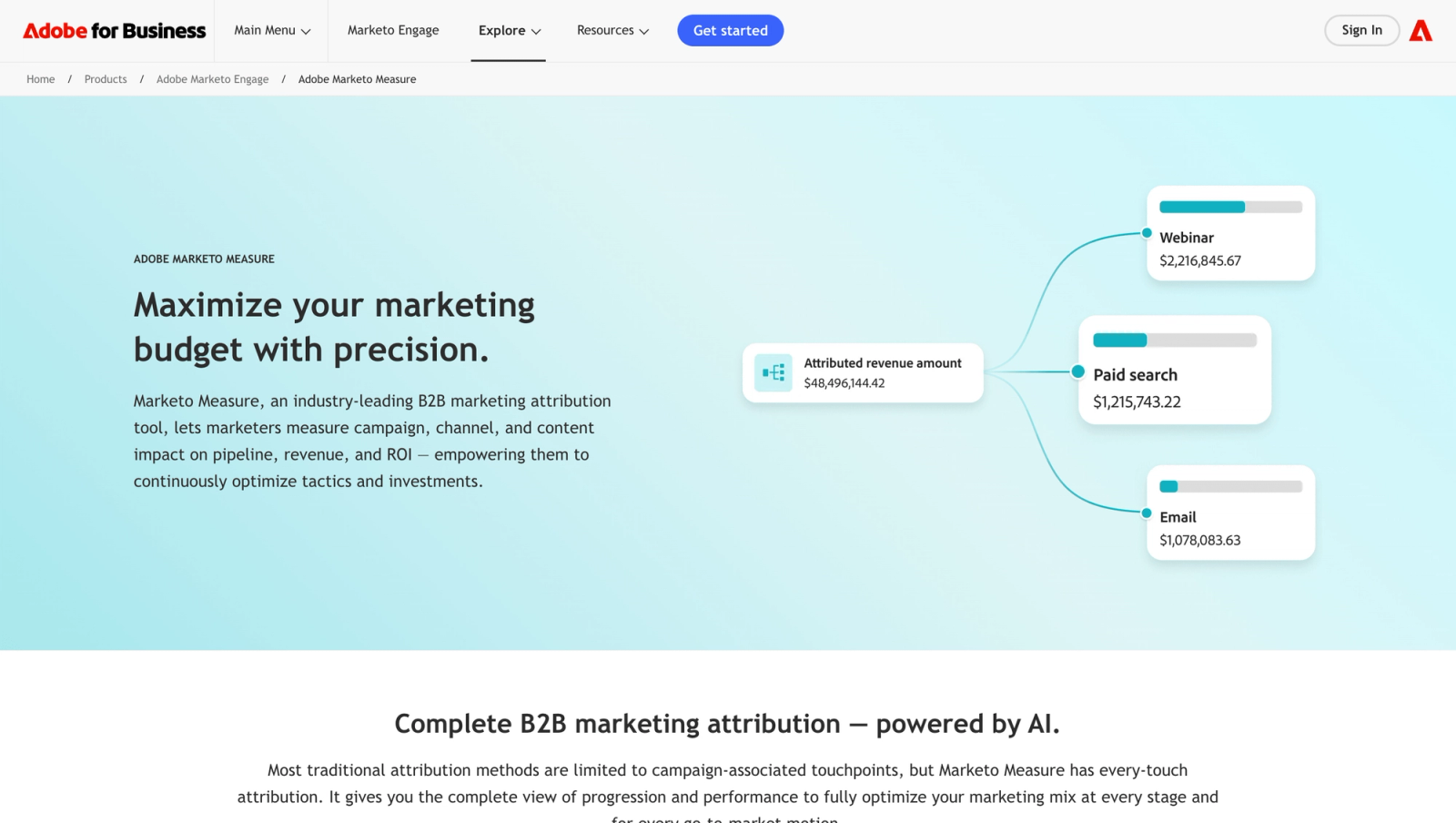
Adobe Marketo Measure provides B2B marketing attribution for Salesforce and Adobe Marketing Cloud environments. It connects marketing touchpoints to opportunities and revenue with pre-built attribution models.
Best for
Enterprise teams heavily invested in Adobe Marketing Cloud and Salesforce who need native integration within that ecosystem.
Pricing
Custom enterprise pricing, typically starting around $1,500/month ($18,000 annually) and scaling based on company size and requirements.
Key features
- Native Salesforce integration with bi-directional data sync
- Pre-built multi-touch attribution models (first-touch, lead creation, U-shaped, W-shaped, full-path, custom)
- Touchpoint tracking across web, email, events, and paid media
- Revenue attribution reporting inside Salesforce
- Integration with Adobe Marketing Cloud tools
- Mobile app for on-the-go reporting
vs Calibermind
Adobe Marketo Measure offers tighter Adobe/Salesforce integration but less flexibility. Calibermind provides customizable attribution logic and data models; Marketo Measure locks you into predefined models. Marketo Measure suits teams wanting turnkey solutions within the Adobe ecosystem, while Calibermind serves teams needing to adapt the platform to unique business logic.
6. Demandbase One
Demandbase One is an account-based marketing platform that combines account identification, engagement, advertising, and attribution. It goes beyond pure attribution to provide ABM orchestration tools.
Best for
Enterprise B2B companies running full account-based go-to-market motions who need ABM advertising, account engagement, and attribution in one platform.
Pricing
Custom enterprise pricing not publicly disclosed. Market positioning suggests pricing competitive with or above Calibermind for full-platform access.
Key features
- Account identification and visitor de-anonymization
- ABM advertising with account-based targeting and retargeting
- Account engagement scoring and intent data
- Multi-touch attribution at the account level
- Sales intelligence and account insights for outbound teams
- Native integrations with Salesforce, HubSpot, and major marketing tools
vs Calibermind
Demandbase is a broader ABM platform; Calibermind focuses specifically on attribution and analytics. Choose Demandbase if you need ABM advertising and orchestration alongside attribution. Choose Calibermind if you want deeper attribution customization without paying for ABM tools you won't use.
7. LeanData
LeanData is a revenue orchestration platform that includes lead-to-account matching, routing, and attribution alongside broader RevOps capabilities.
Best for
Enterprise B2B teams that need lead routing, account matching, and attribution in one platform, particularly those with complex lead assignment workflows.
Pricing
Custom enterprise pricing not publicly disclosed. Positioned as an enterprise platform with pricing likely comparable to Calibermind.
Key features
- Lead-to-account matching and account hierarchy management
- Automated lead routing and assignment workflows
- Multi-touch attribution with pre-built models
- Opportunity influence reporting
- Native Salesforce integration
- Revenue operations automation beyond attribution
vs Calibermind
LeanData bundles attribution with lead routing and matching, which some teams need and others don't. Calibermind focuses entirely on attribution and analytics with deeper customization in that domain. Choose LeanData if broken lead routing is your primary pain; choose Calibermind if attribution depth matters more than routing automation.
Frequently asked questions
-
Frequently Asked Questions
-
What is Calibermind used for?
Calibermind is a GTM intelligence and multi-touch attribution platform that connects marketing and sales data to pipeline and revenue. It is primarily designed for complex enterprise data environments.
-
Why look for a Calibermind alternative?
Teams often look for alternatives because of enterprise pricing, longer implementation timelines, technical requirements, and data infrastructure needs. Platforms like SourceLoop offer a faster, more productized approach to marketing attribution.
-
How much does Calibermind cost?
Calibermind uses custom enterprise pricing and does not publicly list standard plans. Costs vary based on data volume, integrations, and implementation requirements.
-
What's the difference between single-touch and multi-touch attribution?
Single-touch attribution gives credit to one touchpoint, such as the first or last interaction. Multi-touch attribution distributes credit across multiple interactions in the customer journey, giving a broader view of how marketing contributes to conversions and revenue.
-
Can Google Analytics 4 replace Calibermind?
GA4 is useful for website and conversion analytics, but it does not provide the same depth of CRM, pipeline, and revenue attribution. Tools like SourceLoop connect website activity with leads, conversions, CRM data, and revenue.
-
How long does attribution software take to implement?
Implementation depends on the platform. SourceLoop is designed for a fast, self-service setup, while enterprise platforms such as Calibermind can require significantly more technical configuration and implementation resources.
-
Do I need a data warehouse for attribution?
No. Platforms such as SourceLoop provide a managed attribution infrastructure, so you don't need to build and maintain a separate data warehouse just to track marketing attribution.
-
What integrations do I need?
A typical setup includes your website, advertising platforms, forms or conversion sources, and CRM. SourceLoop connects with platforms such as Salesforce, HubSpot, Google Ads, Meta, and LinkedIn, while additional integrations can be used to capture forms, meetings, calls, chats, and other conversion events.


 Paid Social


