
Cometly Pricing Plans and Real Cost in 2026
Cometly pricing in 2026 broken down by plan, ad-spend tier, and hidden costs. See what you'll actually pay before you buy.
Cometly starts at $199 per month on Lite and rises to $499 per month on Standard, with usage tiers scaling into Enterprise territory once ad spend passes roughly $150,000 per month. The headline price is only the entry point, because your tracked spend, usage limits, onboarding terms, and renewal language determine the bill you'll approve.
The popular advice is to treat Cometly as a simple two-plan purchase. That's incomplete. Current listings show a public pricing floor, but independent sources also describe different plan names, pricing structures, usage measurements, and onboarding terms. The right question isn't “How much does Cometly cost?” It's “Which inputs make Cometly cost more, and are those inputs connected to value for my business?”
I've compared Cometly with five other attribution tools, and my view is direct: Cometly makes the most sense for growth teams in the middle of the spend curve. Smaller advertisers may pay for more capacity than they need, while larger cross-channel organizations should demand a custom quote and compare the full contract, not just the subscription line.
Table of Contents
- What Cometly Pricing Actually Looks Like in 2026
- Cometly Plan Tiers and Included Ad Spend
- Lite vs Standard Side by Side
- How Ad-Spend Thresholds Drive Usage Pricing
- Why Third-Party Sources Disagree on Cometly Pricing
- Hidden Costs Beyond the Sticker Price
- Cometly vs the Broader Attribution Pricing Market
- Matching Cometly Plans to Real Buyer Profiles
- When Cometly Is Not the Cheapest Option
- Cometly Pricing Buying Checklist Before You Sign
What Cometly Pricing Actually Looks Like in 2026
The headline subscription is only the starting point. Cometly pricing is better understood as a usage-based subscription tied to advertising scale, where tracked spend, onboarding terms, and renewal language can shape the final bill. The public entry points are Lite at $199 per month and Standard at $499 per month, with Enterprise priced by quote, according to Cometly's pricing page.
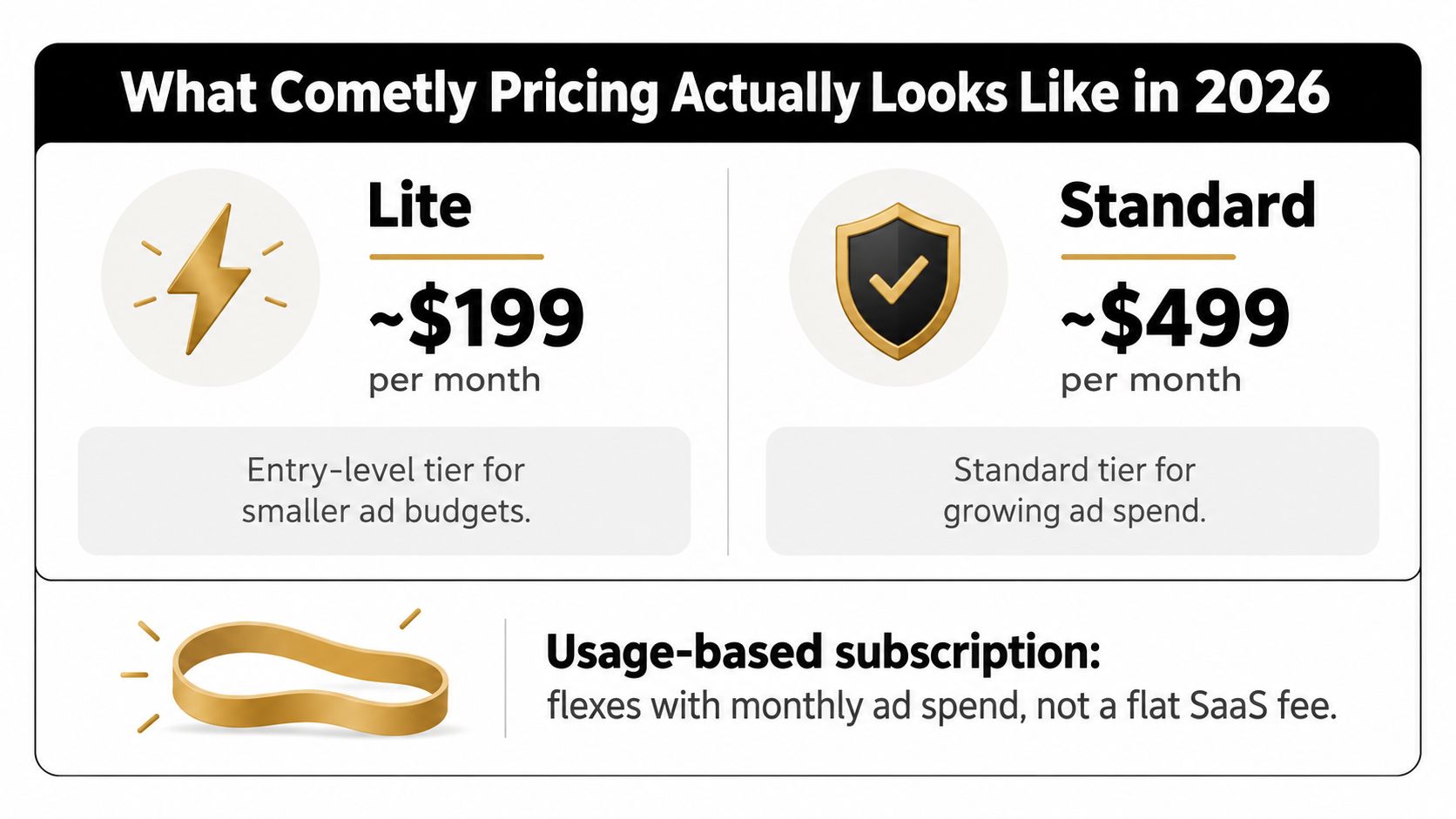
Those figures establish a public floor, not a guaranteed all-in cost. The plans are tied to included usage and ad-spend limits. If your account exceeds those limits, the next charge may come through overage fees, a higher subscription tier, or a sales-led Enterprise arrangement. Confirm which rule applies before approving the contract.
The public floor is not the real budget
The gap between the visible plans is substantial. An upgrade from $199 to $499 per month must deliver more than cosmetic reporting changes. It should address the additional channel coverage, attribution depth, data volume, or collaboration requirements that made the upgrade necessary. Use the Cometly pricing listings cited above as a starting reference, then validate the exact inclusions in your quote.
The public positioning places Cometly toward businesses spending under $500,000 per month on digital ads, while Enterprise is associated with accounts spending more than $5 million per year on digital ads. These thresholds clarify the intended customer range, but they do not function as a transparent quote calculator.
Practical rule: Treat the public starting price as the cost of entry, not the guaranteed cost of ownership.
Before signing, get three answers in writing: how much spend is included, what happens after the threshold, and which onboarding or renewal terms can change the recurring bill. That review matters more than comparing headline prices alone.
Cometly Plan Tiers and Included Ad Spend
Cometly's headline tiers are easy to list. Their actual cost depends on the ad-spend allowance attached to each tier, how overages are handled, and whether the account requires sales-led implementation. Current listings show Lite at $199 per month, Standard at $499 per month, and Enterprise with custom pricing, but treat those figures as starting points rather than complete contract terms.
Independent pricing research describes published allowances of up to $10,000 in ad spend on Lite, $50,000 on Standard, and $150,000 on Advanced, priced at $199, $499, and $999 per month respectively (2026 Cometly pricing research). Since public references do not present one perfectly consistent plan table, use these figures to test a quote, not to approve one blindly.
Published tiers at a glance
| Plan | Starting Monthly Price | Included Ad Spend | Key Features |
|---|---|---|---|
| Lite | $199 | One independent listing reports up to $10,000 | Core tracking and dashboard reporting |
| Standard | $499 | One independent listing reports up to $50,000 | Broader capacity for growing paid acquisition |
| Advanced | $999 | One independent listing reports up to $150,000 | Higher usage allowance and advanced account needs |
| Enterprise | Custom | Custom | Sales-led scope for larger spend and implementation requirements |
The table exposes the first buying risk. “Included ad spend” may refer to total platform spend, selected channels, tracked spend, or another usage measure. Ask Cometly to define the metric and state the threshold in the quote. Also confirm whether crossing it triggers an overage fee, a mandatory upgrade, or a sales conversation.
What the tiers should mean operationally
Lite fits a smaller paid acquisition team that needs centralized performance reporting and can stay within the stated allowance. Standard earns its higher price when channel coverage expands, attribution requirements become more complex, or usage approaches Lite's limit. Advanced is a capacity decision, not a feature upgrade, so require a clear explanation of the added allowance and account support.
Do not rely on comparison tables for the final scope. Confirm connected ad accounts, attribution models, lookback windows, data retention, integrations, user seats, API access, onboarding, and support in writing. A feature marked “included” can still depend on usage or a specific contract package. Also ask what changes at renewal, because the recurring bill may reflect revised limits or commercial terms rather than the original starting price.
Lite vs Standard Side by Side
The $300 monthly difference between Lite and Standard is the main Cometly pricing decision for smaller or self-serve buyers. Across a year, that becomes $3,600 before taxes, onboarding, usage adjustments, or add-ons. Pay the difference only when Standard removes a reporting or attribution constraint that is already affecting decisions.
Lite is associated with a lower included ad-spend allowance, while Standard provides a higher one. As noted earlier, one independent 2026 listing places those allowances at up to $10,000 for Lite and up to $50,000 for Standard. Treat those figures as planning references, not final contract terms.
| Dimension | Lite ($199/mo) | Standard ($499/mo) |
|---|---|---|
| Core price | $199 monthly | $499 monthly |
| Included ad-spend reference | Up to $10,000 in one independent listing | Up to $50,000 in one independent listing |
| Best fit | Smaller paid acquisition programs | Growing teams with broader spend |
| Reporting | Core dashboards and tracking | Higher-capacity reporting and usage |
| Attribution scope | Confirm the exact models in the quote | Confirm multi-touch and advanced model access |
| Integrations | Confirm channel availability | Confirm native connectors and add-on status |
| Support | Standard support should be documented | Ask whether enhanced support is included |
| Upgrade trigger | Usage approaches the allowance | Usage or complexity approaches custom scope |
When the upgrade earns its place
Standard earns its price when several paid channels influence the same conversion path and the team must compare those interactions instead of relying on a single last-click view. It also fits when reporting volume creates manual work, analysts are exporting data, or the account is nearing Lite's usage ceiling.
Lite remains the better choice when one or two channels drive most demand, the reporting team is small, and current activity sits comfortably below the stated allowance. A more advanced plan name does not justify a larger recurring bill.
Decision rule: Choose Lite for contained acquisition. Choose Standard when channel complexity or spend growth creates a measurable reporting requirement. Request Enterprise pricing when the quote depends on custom integrations, support, or usage terms.
The headline tiers still leave several buying questions unanswered. Ask Cometly to map each required capability to the contract, including TikTok, LinkedIn, Pinterest, CRM data, offline conversions, retention, and user permissions. Confirm whether onboarding is included, whether add-ons change the monthly bill, and what happens when spend crosses the allowance.
Renewal deserves the same scrutiny as the initial quote. Get the included usage, overage treatment, support level, and renewal terms in writing. That is how you prevent a Standard plan that looks affordable at signing from becoming materially more expensive after the first contract period.
How Ad-Spend Thresholds Drive Usage Pricing
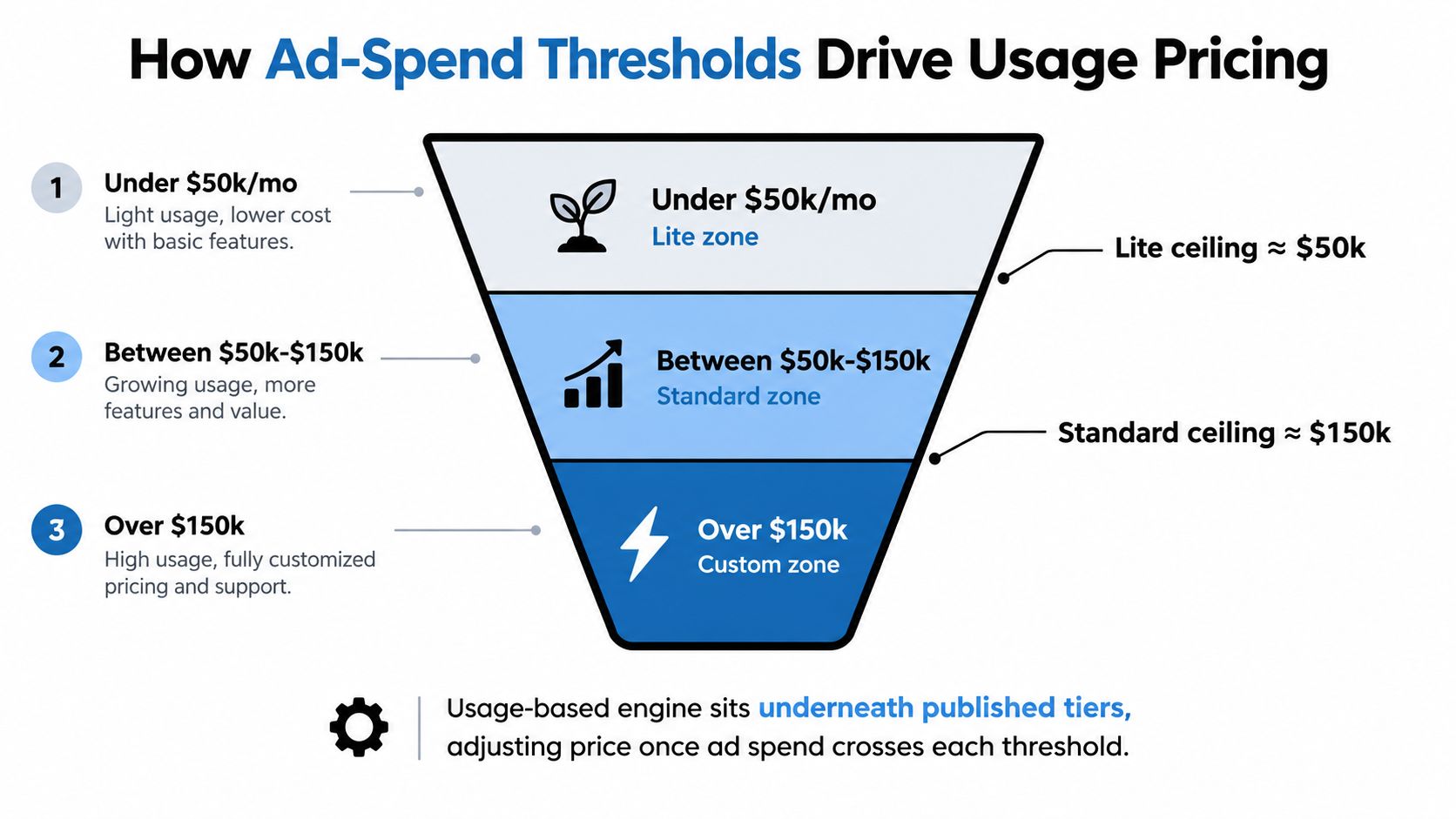
The headline plan price is only the starting point. Cometly's cost changes as monthly advertising spend approaches the allowance attached to each tier. Independent pricing research describes usage thresholds of $10,000, $50,000, and $150,000 across different plans (Cometly pricing research).
The buyer's real task is defining what Cometly counts toward that allowance. Ask whether usage means total ad spend, spend from connected accounts, tracked campaigns, conversion events, sessions, or another unit. A plan can look affordable until a broader definition captures channels or data that the team did not include in its initial forecast.
Three inputs deserve scrutiny
- Tracked ad spend: Confirm whether the allowance covers spending across Meta, Google, TikTok, YouTube, and other connected channels, or only spend Cometly successfully attributes.
- Data volume: Ask whether conversion paths, events, sessions, or revenue records affect the tier. Reporting load can increase while media spend stays flat.
- Integration scope: Establish whether CRM, ecommerce, API, offline conversion, and warehouse connections are included. Custom data movement may carry a separate cost.
A brand spending $90,000 per month should not assume an automatic move to a higher tier. Cometly may keep it on Standard with an adjustment, or issue a custom quote. An advertiser spending $200,000 per month should expect a sales discussion rather than rely on the Standard headline price. The available sources do not provide one definitive overage schedule, so the contract must state the outcome.
Forecast the next invoice before approval
Build a forecast using recent monthly spend, planned channel additions, conversion-event volume, and integration changes. Have Cometly price the current month, the expected quarter, and the high-spend scenario in writing.
The forecast must identify the trigger that moves the account from included usage to overage or a new tier. Without that rule, finance cannot tell whether a higher renewal bill reflects genuine growth, a contract condition, or an unplanned change in measurement scope. Ask for the same treatment at renewal, not only during the initial quote.
Why Third-Party Sources Disagree on Cometly Pricing
Third-party Cometly pricing claims conflict because the product has appeared under different commercial structures. Current references list Lite at $199, Standard at $499, and Enterprise with custom pricing. Other market references describe usage-based tiers with different allowances and plan names (Cometly's current pricing reference; independent 2026 pricing listing).
A separate review cites prices beginning at $199 per month, $500 per month, or $750 per month plus a $1,500 onboarding fee (Cometly pricing review). These figures may reflect different dates, packages, or sales quotes. They do not establish a universal rate. Before comparing offers, confirm the plan name, billing basis, included ad spend, onboarding terms, and renewal treatment.
| Source | Quoted Price | Plan Referenced | Likely Accuracy |
|---|---|---|---|
| Current Cometly pricing listings | $199 and $499 monthly, Enterprise custom | Lite and Standard | Strongest starting reference, subject to usage terms |
| Independent 2026 listing | $199, $499, and $999 monthly | Usage-based tiers | Useful for allowance questions, verify with sales |
| Pricing review | $199, $500, or $750 plus onboarding claims | Varying structures | Treat as historical or market context until confirmed |
Plan renaming, outdated screenshots, annual packaging, and implementation bundled into a quote can all create mismatches. Review content may also reduce a usage-based product to a “starting at” figure, leaving ad-spend thresholds and renewal conditions unstated.
Use public listings to build a verification checklist, not to set the budget. The written quote should show the included allowance, the cost after that allowance, onboarding, and the renewal rule. If those terms are missing, the headline price is not decision-ready.
Hidden Costs Beyond the Sticker Price
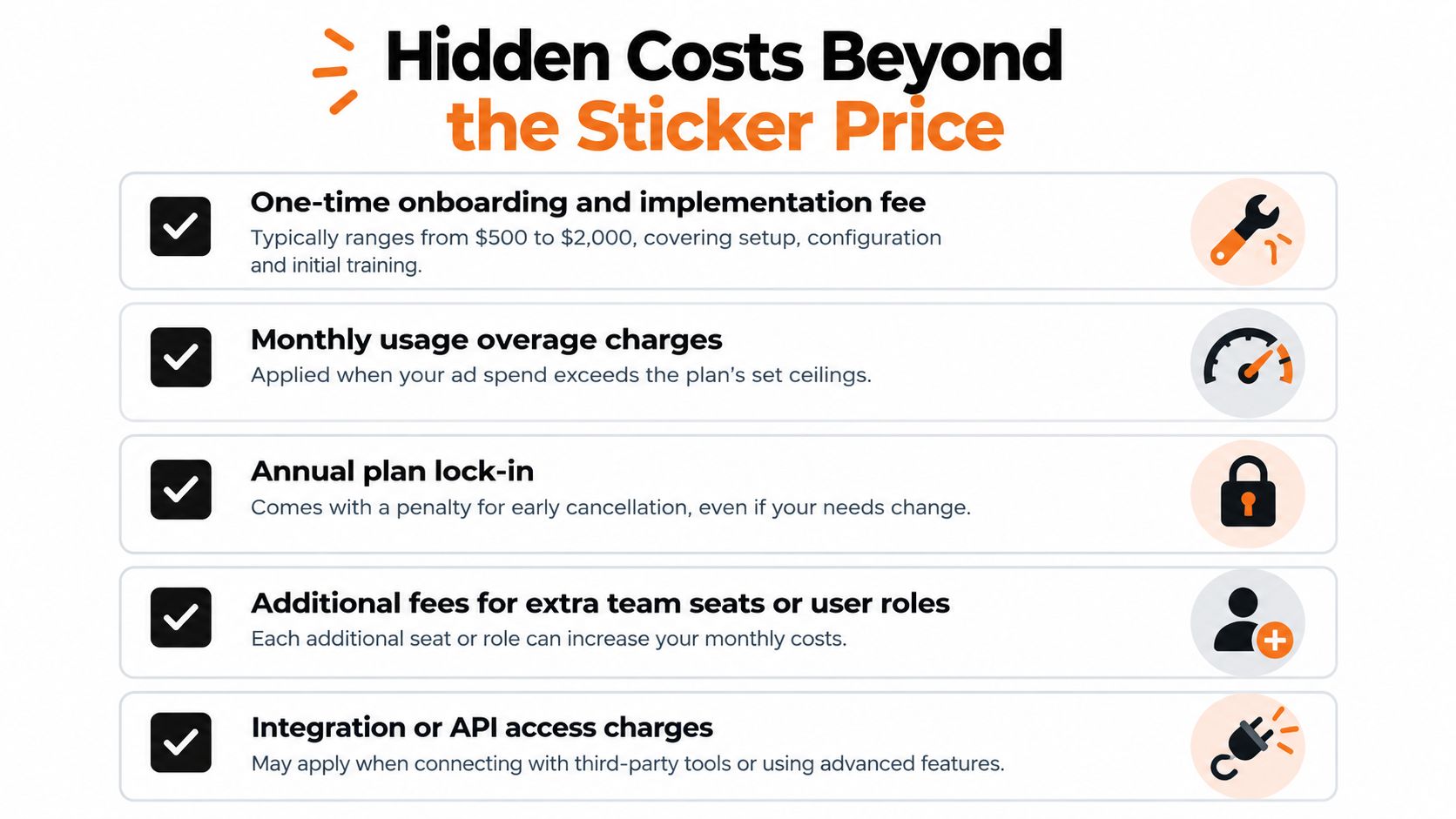
The subscription figure is only the entry point. Implementation, higher ad spend, added access, and renewal terms can raise the cost. One documented Cometly structure includes a $1,500 one-time onboarding fee, while another review cites onboarding claims from $500 to $2,000. Treat these figures as terms to verify, not as a standard fee.
Separate mandatory fees from internal effort
Request a line-item estimate before approving the purchase. It should cover:
- Onboarding and migration: Confirm whether historical data import, naming cleanup, dashboard setup, and validation are included.
- Usage overages: Get the rate and trigger for ad spend or event volume above the plan allowance.
- Additional seats and workspaces: Check charges for extra users, roles, brands, or client workspaces.
- Integrations and API access: Confirm whether CRM, ecommerce, offline conversion, and API connections belong to the selected plan.
- Tracking implementation: Budget developer time for pixel installation, server-side tracking, consent settings, and event validation.
Internal work can exceed the invoice. Your team may need training, connector maintenance, dashboard governance, and a process for reconciling differences among Cometly, ad platforms, GA4, and the CRM. Assign an owner for each task before launch. Otherwise, implementation effort becomes an unplanned part of the subscription decision.
Renewal language can change the economics
Ask how Cometly measures usage during the contract and calculates renewal pricing. A larger ad budget can push the account into a different commercial tier, even if the initial subscription fit the budget.
Get the measurement window, notice period, renewal floor, cancellation terms, and overage treatment in writing. Do not approve a quote that only says pricing scales with growth. A reliable first-year total cannot be calculated from the available public information because onboarding, usage, add-ons, and contract terms vary. That uncertainty is a direct budgeting risk.
Cometly vs the Broader Attribution Pricing Market
Attribution tools occupy distinct pricing bands, but the headline subscription is only the starting point. A market benchmark places free or self-serve tools around $0 to $200 per month, specialist mid-market tools around $200 to $1,000 per month, and enterprise platforms starting near $1,250 per month (B2B attribution software pricing benchmark).
Cometly's visible $199 Lite tier sits at the boundary between self-serve and specialist software. Its $499 Standard tier falls within the specialist range. Those prices become less comparable once vendors bill by seats, events, revenue, sessions, or tracked spend. Independent research reports flat-fee attribution products ranging from $0 to $2,000 per month, while seat-based products can range from $25 to $20,000 per user per month (attribution software pricing research).
| Platform | Starting Price | Billing Model | Typical Spend Ceiling |
|---|---|---|---|
| Cometly | $199 monthly | Usage and ad-spend based | Public tiers, then custom Enterprise |
| Triple Whale | Verify current quote | Product-specific plan structure | Confirm with sales |
| Northbeam | Verify current quote | Ask whether spend or revenue affects billing | Confirm with sales |
| Hyros | Verify current quote | Confirm hybrid or usage inputs | Confirm with sales |
| Rockerbox | Verify current quote | Quote and scope dependent | Confirm with sales |
| SourceLoop | Verify current quote | Plan and usage limits | Confirm with vendor |
Cometly gives smaller growth teams a clearer public entry point than enterprise-first platforms. That advantage holds only while ad spend, data volume, integrations, and reporting needs remain inside the selected tier. Once those limits change, the buyer may face a new commercial discussion rather than a predictable upgrade.
Use this guide to track ROI with ViralRef when judging whether attribution connects campaigns to revenue in a useful way. For a competing option, review the Northbeam pricing guide and compare its billing inputs with Cometly's.
Compare the billing basis first, then compare the monthly number. Cometly is competitive for teams whose spend and data requirements fit its public tiers. It is not automatically the cheaper choice after onboarding work, expanded usage, custom requirements, or complex offline journeys enter the purchase.
Matching Cometly Plans to Real Buyer Profiles
Choose a Cometly plan based on acquisition complexity, ad-spend thresholds, and reporting workload, not the company's revenue target. A solo operator running one paid channel has a different measurement need from an ecommerce team connecting several channels to post-purchase behavior.
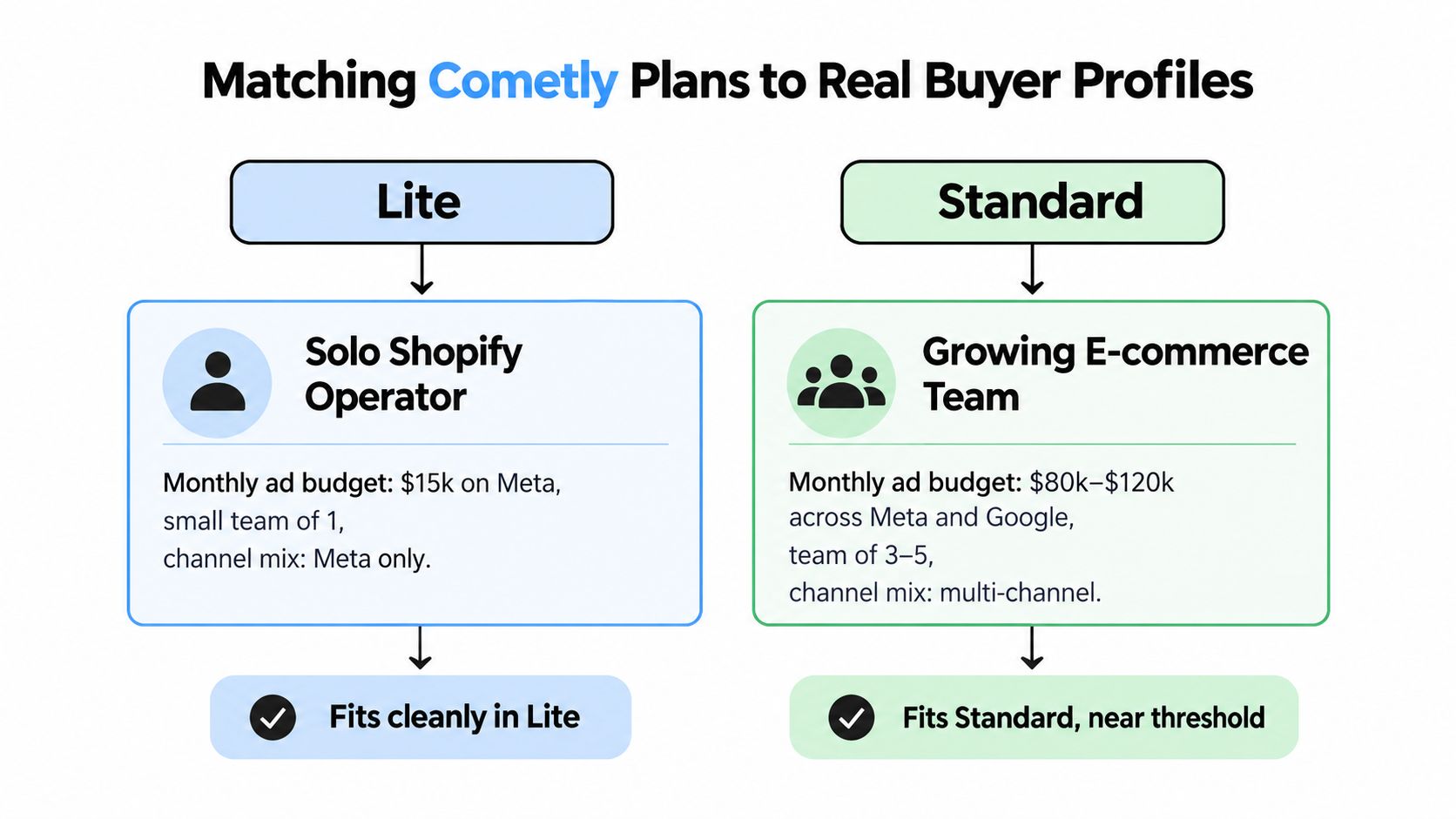
Earlier pricing research outlines two practical profiles: a solo Shopify operator spending $15,000 monthly on Meta, and a growing ecommerce team spending $80,000 to $120,000 across Meta and Google (independent Cometly pricing research). Treat these examples as planning references, then confirm the current allowance, onboarding scope, and renewal terms before signing.
The practical fit
| Buyer profile | Acquisition pattern | Recommended starting point |
|---|---|---|
| Solo Shopify operator | One main paid channel and a small reporting workload | Lite, after confirming the usage allowance |
| Growing ecommerce team | Multiple paid channels and broader attribution needs | Standard, after confirming included integrations |
| Larger cross-channel organization | Spend and data flows require custom controls | Enterprise quote |
The solo operator should start with Lite rather than pay for Standard based on possible future growth. Lite fits a business that mainly needs pixel tracking, campaign reporting, and a clear view of paid performance. Confirm what happens when ad spend reaches the tier ceiling, since that threshold can change the economics.
Standard suits the growing ecommerce team more closely. Multiple channels create overlapping customer journeys, and the team may need more than a source report to decide where to place the next budget increase. Get written confirmation that the required connectors, attribution models, surveys, and retention features are included. Also ask whether onboarding carries a separate charge and whether renewal changes follow higher usage.
The larger organization should begin the Enterprise discussion before spend exceeds the published upper allowance. Secure a custom quote while the team can still compare implementation work, data volume, integrations, support, and renewal terms across vendors. A Cometly alternatives comparison gives buyers a practical fallback before that sales conversation.
When Cometly Is Not the Cheapest Option
Cometly is not the budget choice for every advertiser. The $199 monthly Lite floor, noted earlier, can be significant for a small business with modest paid spend, a narrow channel mix, and basic tracking needs that UTMs and GA4 may already cover.
A single-channel advertiser may also get limited value from the subscription. A Facebook-only brand can pay within the same plan category as a team managing several channels, despite having simpler attribution paths. Compare Cometly with a focused tracking tool or a stronger analytics workflow before committing.
The economics change as ad spend, data volume, and implementation demands rise. Enterprise pricing is custom, so larger advertisers should compare a written Cometly quote with equivalent event volume, integrations, support, retention, and attribution requirements. Include onboarding and renewal terms in that comparison. A platform with a higher starting price can still cost less overall if its billing model handles scale more predictably.
Cometly makes the strongest case for businesses whose paid acquisition is too complex for basic analytics but not yet dominated by custom enterprise requirements. Buyers should judge the full contract, not the entry tier alone.
Review Ruler Analytics pricing before signing. Ruler Analytics is another attribution option to evaluate for lead, signup, booking, payment, and multi-touch source tracking under a published plan structure. Compare its included capabilities, implementation requirements, and renewal terms with the Cometly quote.
Cometly Pricing Buying Checklist Before You Sign
Before signing, require Cometly to document the commercial rules, including the costs that appear after your ad spend crosses an included threshold. Ask these questions:
- Usage definition: Is billing based on total ad spend, tracked spend, events, sessions, or another unit?
- Threshold treatment: What happens after you exceed the allowance, and when does the new rate apply?
- Billing term: Do monthly, quarterly, and annual commitments carry different prices?
- Implementation: Are onboarding, migration, tracking setup, and validation charged separately?
- Workspace scope: Do extra brands, users, seats, roles, or workspaces cost more?
- Integration access: Are CRM, API, offline conversion, ecommerce, and native ad connectors included?
- Renewal protection: What reassessment, notice, cancellation, and renewal-price terms apply?
- Data limits: What limits cover trigger events, identity resolution, retention, and replay?
Prepare a 30-day spend forecast for Meta, Google, TikTok, and YouTube. Ask Cometly to quote both current usage and the growth scenario, including onboarding and renewal terms. Get at least one competitor quote, then compare total contract cost, not the starter tier.
Cometly fits paid acquisition that needs deeper attribution than basic analytics. Sign only after the quote makes threshold pricing, implementation, integrations, and renewal exposure explicit. Compare the written offer with Ruler Analytics pricing before committing.


 Paid Social


