
B2B Attribution Models: A Practical Guide
A practical guide to b2b attribution models covering single-touch, multi-touch, data-driven, and account-based options, with pros, cons, and selection criteria.
Your last-touch report says the demo request created the deal. Sales remembers a different story: months of email nurture, an analyst briefing, a partner introduction, several content downloads, and repeated conversations with multiple people at the account. Yet the budget recommendation still credits one final interaction and cuts the channels that created the buying conditions.
That situation is common because B2B attribution models are often treated as reporting settings instead of operating decisions. Multi-touch attribution is now widely used, with one 2026 industry summary reporting 76% adoption among B2B marketers, up from 56% in 2020, while another benchmark reports 47% adoption across more than 1,200 B2B teams. The adoption gap between those estimates matters less than the underlying lesson. Teams want a fuller view of revenue influence, but many still feed unreliable data into increasingly advanced models. (Industry attribution benchmarks)
Table of Contents
- Why Your Attribution Model Is Only Half the Problem
- The Six B2B Attribution Models Explained
- Comparing B2B Attribution Models Side by Side
- What Attribution Requires Before You Pick a Model
- Metrics That Tell You Attribution Is Actually Working
- Choosing the Best Fit for Your Sales Cycle
- Beyond Attribution Models and the Hybrid Stack
Why Your Attribution Model Is Only Half the Problem
The model isn't where most attribution failures begin. They begin when the data describes three disconnected people instead of one buying committee, when CRM stages don't reflect the actual sales process, or when offline activity disappears between marketing automation and the opportunity record.
A prospect may read an article anonymously, return through a paid campaign, download a guide with a work email, and later join a webinar. A colleague from the same company may speak with an SDR, attend an event, and request a proposal. If your systems don't connect those interactions to the same person and account, a linear model won't create a balanced view. It'll distribute incomplete data evenly.
Practical rule: A sophisticated model applied to incomplete journeys produces precise-looking fiction.
Start with identity, not weighting
Your first requirement is stitched identity across anonymous and known touchpoints. That means preserving a stable relationship between website activity, form submissions, marketing automation records, sales engagement, and CRM accounts. Account-level identity matters because B2B deals rarely follow one person's browser from discovery to signature.
The second requirement is a CRM structure that matches reality. Define what lead creation, sales acceptance, opportunity creation, progression, and closed-won mean in operational terms. If one sales team creates opportunities early and another waits until procurement, the same model will interpret comparable deals differently.
The third requirement is consent-respecting event capture. Collect relevant events from the website, advertising platforms, email, events, sales activity, product usage, and partner channels where permitted. Don't pretend that a missing event means a prospect wasn't influenced. It means your measurement system didn't observe the interaction.
Treat model selection as a sequence
A trustworthy decision follows this order:
- Audit coverage. Identify which touchpoints are captured, which are anonymous, and which sit outside your marketing systems.
- Reconcile stages. Match marketing events to CRM milestones and revenue outcomes.
- Define the unit of analysis. Decide whether you're measuring people, opportunities, or accounts.
- Choose a model that fits the sales cycle. The weighting scheme comes last.
- Validate against sales reality. Compare model output with accepted pipeline, opportunity progression, and closed-won records.
The business risk is substantial. One benchmark reports that only 24% of B2B marketers trust the data produced by their attribution model, while 63% identify data integration as the biggest barrier. The same benchmark reports mature attribution programs with 15% to 30% higher marketing ROI than last-touch peers, but that comparison only becomes useful after you establish whether the underlying paths are complete. (B2B multi-touch attribution benchmarks)
The Six B2B Attribution Models Explained
Each model answers a different question. The mistake is asking one model to answer every question about awareness, pipeline creation, acceleration, and revenue.
Last-touch attribution
Mental model: The final measurable interaction gets all the credit.
A prospect spends months reading your content and attending webinars, then submits a demo form after visiting a pricing page. Last-touch attribution credits the demo request or pricing-page interaction. It's easy to explain and useful for analysing the immediate conversion mechanism, but it tells you little about what created demand.
Use it for narrow conversion optimisation, not as the sole basis for channel budgets in a complex sales process.
First-touch attribution
Mental model: The first recorded interaction gets all the credit.
A buyer scans your badge at an industry event, then returns through organic search, joins an email sequence, and speaks with sales. First-touch assigns the relationship to the event or the first tracked campaign. That makes it useful for evaluating awareness and demand creation, especially when you're testing a new market or acquisition channel.
It can't tell you whether the initial interaction had enough influence to move the opportunity forward.
Linear attribution
Mental model: Every recorded touchpoint receives equal credit.
A journey includes a webinar, a product comparison page, two emails, an SDR call, and a proposal review. Linear attribution divides the credit across all of them. This gives teams a neutral baseline and prevents one interaction from swallowing the entire story.
The weakness is obvious. A passive ad impression and a substantive sales conversation may receive the same weight even though their roles differ. Linear attribution rewards the number of recorded interactions, not necessarily their influence.
For teams comparing approaches, this overview of attribution models for marketing teams provides useful context on how credit can be assigned across different interaction types.
Position-based attribution
Mental model: Give greater weight to strategically important positions, usually the start and end of the journey, then distribute the remainder across the middle.
A first interaction creates awareness, a mid-funnel workshop develops understanding, and a sales interaction precedes conversion. Position-based attribution protects both the demand-creation and conversion stages while still acknowledging the middle of the journey.
The weights are assumptions, not discovered truths. That makes this model practical and transparent, but teams must document why those positions matter and test whether the resulting budget decisions make sense.
Time-decay attribution
Mental model: Recent interactions receive more credit because they occur closer to the conversion event.
A prospect engages with content over several weeks, then attends a product session and requests a proposal. Time-decay gives more influence to the later session and proposal-stage activity. It fits situations where recent engagement is a credible signal of active intent.
It can overvalue retargeting, branded search, or late-stage email if those channels appear frequently near conversion. It also risks discounting early content that shaped the problem definition long before the buyer became identifiable.
Data-driven algorithmic attribution
Mental model: Estimate each touchpoint's contribution from historical conversion paths rather than assigning fixed weights.
Methods such as Shapley value compare conversion paths and estimate the marginal contribution associated with interactions. In theory, this is more responsive to observed behaviour than a fixed rule. In practice, the model needs broad, consistent journey coverage and enough conversion volume to avoid unstable credit assignment.
One benchmark says data-driven algorithmic models generally require more than 10,000 conversions per month plus dedicated data-science resources, while rule-based models remain sufficient at lower scale. (Cross-channel marketing analytics guidance)
Account-based attribution as a B2B lens
Account-based attribution isn't just another way to split individual sessions. It rolls engagement up to the account, allowing the model to reflect activity from several stakeholders. That makes it valuable when one person consumes content, another attends an event, and an executive joins a sales meeting.
The trade-off is reduced individual-channel precision. Account-level engagement can show that a company became more active, but it may not cleanly identify which interaction changed the buying decision. Use it alongside opportunity and revenue analysis rather than treating account engagement as proof of causality.
Comparing B2B Attribution Models Side by Side
The right comparison isn't “which model is most advanced?” Ask which model can represent your cycle, stakeholders, offline activity, and available evidence without creating false confidence.
| Model | Best Cycle Fit | Stakeholder Handling | Offline Touches | Data Requirement | Key Weakness |
|---|---|---|---|---|---|
| Last-touch | Short, conversion-led journeys | Weak | Only if manually captured | Low | Starves awareness and nurture |
| First-touch | Awareness and demand creation | Weak | Only if captured as the first event | Low | Ignores progression and closing influence |
| Linear | Simple journeys needing a baseline | Moderate if all touches are captured | Possible, with consistent logging | Low to moderate | Rewards activity volume equally |
| Position-based | B2B SaaS journeys with roughly 4 to 8 touchpoints and 30 to 90 day cycles | Moderate | Moderate | Moderate | Fixed weights are subjective |
| Time-decay | Faster-moving journeys where recent intent matters | Moderate | Moderate | Moderate | Can over-credit late-stage retargeting |
| Data-driven algorithmic | High-volume journeys with deep historical paths | Strong when identity is reliable | Only when offline data enters the dataset | High | Unstable with sparse or inconsistent data |
| Account-based | Committee-led B2B buying | Strong at account level | Strong if sales and partner activity are logged | Moderate to high | Sacrifices some individual-channel detail |
For longer B2B cycles, independent guidance recommends W-shaped logic because it emphasises first touch, lead creation, and opportunity creation milestones. A fixed model becomes less credible when the journey includes long periods of research and irregular stakeholder involvement. (Multi-touch attribution solution guidance)
What the table means for budget calls
Last-touch usually protects channels closest to conversion. First-touch protects channels that introduce the brand. Linear protects everything equally, which sounds fair until high-volume channels benefit because they generate more trackable activity.
Position-based and time-decay models are useful compromises, but neither discovers truth automatically. Algorithmic models can estimate marginal contribution more flexibly, yet they demand stronger data than many B2B teams possess. Account-based attribution handles committee behaviour better than person-level models, but it won't replace channel analysis.
Attribution and marketing mix modeling also answer different questions. This guide on how to compare multi-touch attribution and MMM is useful when your team is deciding whether it needs touch-level optimisation, aggregate budget analysis, or both. Teams working through that distinction can also review this comparison of multi-touch attribution and marketing mix modeling.
What Attribution Requires Before You Pick a Model
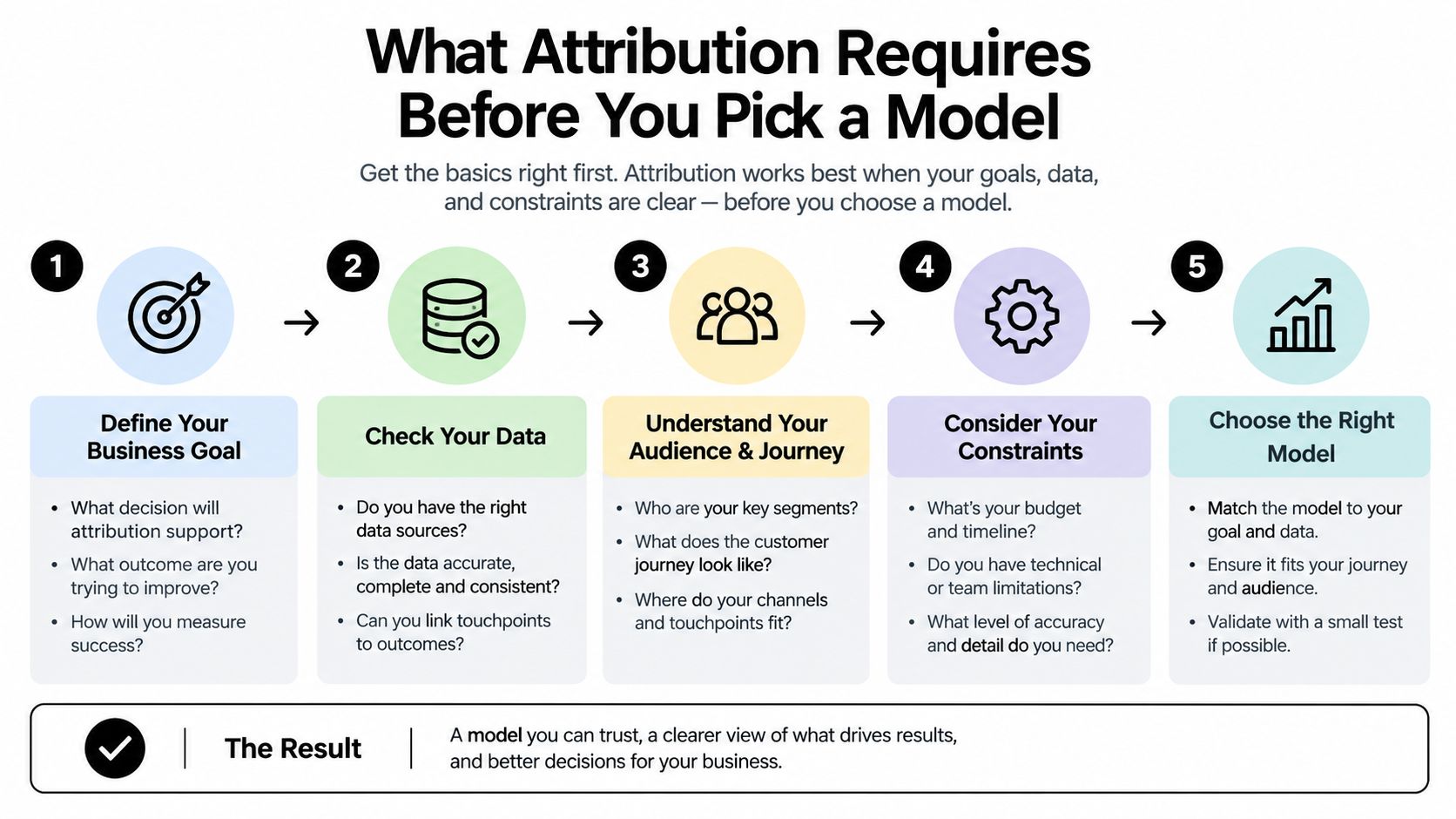
Every model inherits the weaknesses of its input data. Before you debate first-touch versus time-decay, build a measurement layer that can tell one campaign from another, one person from another, and one opportunity stage from another.
Create one event vocabulary
Document the names and properties used across advertising platforms, marketing automation, analytics, and CRM. Campaign, channel, content type, form submission, event attendance, intent signal, sales call, and opportunity milestone should have consistent definitions.
Without a shared taxonomy, “webinar,” “webinar registration,” and “event lead” may appear as separate activities even when they represent one campaign. Your dashboard can be technically correct and operationally misleading.
Resolve identity across the journey
Choose a shared key, such as a CRM account ID, a consented hashed email, or a controlled data join. Use it to connect an anonymous visit with a later form submission and then with the sales conversation recorded in the CRM.
Don't force every anonymous session into an identity. Preserve uncertainty rather than assigning activity to the wrong person or account. A smaller, reliable dataset beats a larger dataset built on aggressive matching.
Connect revenue and offline activity
Sync opportunity stages, amounts, owners, and closed-won dates between the CRM and analytics environment. Define which offline activities count, including trade shows, partner introductions, BDR calls, executive meetings, and intent-data events.
Sales must have a practical logging process. If recording an event takes too much effort, the data will be incomplete and the model will implicitly prefer digital channels because they're easier to capture.
Deduplicate before calculating credit
Write explicit rules for duplicate form submissions, repeated imports, shared buying committee logins, internal traffic, and multiple campaign records for the same interaction. Decide whether a repeated visit is a new touch, a continuation of an existing touch, or noise.
Teams needing a practical implementation reference can use this guide to implement multi-touch attribution. The tool matters less than the governance. Assign an owner for taxonomy changes, identity rules, stage definitions, and model versioning.
Attribution doesn't become credible because the dashboard has more dimensions. It becomes credible when marketing, sales, and finance agree on what each event means.
Metrics That Tell You Attribution Is Actually Working
A polished dashboard isn't evidence of measurement quality. The model is working when its output remains stable, aligns with pipeline reality, and helps the business make better forecasts and budget decisions.
Quality signals
| Metric Category | Quality Signal | Vanity Trap |
|---|---|---|
| Model stability | Credit shares remain explainable across reporting periods | A dramatic shift after every retraining |
| Pipeline alignment | Modeled contribution broadly reconciles with sales-accepted pipeline | Influenced pipeline with no CRM confirmation |
| Time consistency | Touch-to-opportunity timing resembles the known sales process | A fixed attribution window applied to every segment |
| Path coverage | Closed-won opportunities have traceable, reviewable journeys | High conversion totals with large journey gaps |
| Forecast usefulness | Model outputs improve planning conversations and revenue forecasts | A dashboard that only reports historical credit |
| Channel diagnosis | The model exposes over-credited and under-credited sources | Credit that simply follows media spend |
Test the model against reality
Compare modeled channel contribution with sales-accepted pipeline, opportunity creation, stage progression, and closed-won revenue. Investigate large differences instead of averaging them away. A channel that receives substantial influenced credit but rarely appears in verified pipeline may be over-credited, poorly tagged, or associated with the wrong object.
Watch how credit changes when the model is retrained or when a campaign taxonomy changes. Stable output doesn't prove causality, but unexplained volatility is a warning that the dataset or calculation isn't ready for budget allocation.
LinkedIn reporting needs the same discipline. A practical guide to cómo medir LinkedIn B2B con KPIs can help teams define channel metrics, but channel metrics still need reconciliation with CRM outcomes.
Choosing the Best Fit for Your Sales Cycle
Model selection should start with the shape of the sale, not the feature list in an analytics platform. A short, self-serve journey doesn't need the same measurement system as a committee-led enterprise purchase.
For a transactional B2B offer with a short cycle and one primary decision-maker, last-touch or first-touch can be defensible for a narrow question. First-touch tells you what creates awareness. Last-touch tells you what triggers the conversion. Keep both if the team understands that neither represents total revenue influence.
A sales-assisted SaaS journey with several months of consideration needs a more balanced rule. Position-based attribution can protect the opening demand-generation interaction and the conversion-stage interaction, while time-decay can help when recent intent is more predictive. Independent guidance places position-based and time-decay approaches in the strongest fit for B2B SaaS journeys with roughly 4 to 8 touchpoints and 30 to 90 day cycles. (Model selection guidance)
Use a simple decision matrix
Score your business across four questions:
- Cycle complexity: Does the journey move quickly, or does it include long periods of education and procurement?
- Stakeholder complexity: Does one person decide, or do several people influence the opportunity?
- Touchpoint coverage: Can you capture web, email, advertising, sales, events, partners, and product activity?
- Data readiness: Can you connect identities, stages, opportunities, and revenue without major gaps?
Then apply these recommendations:
- Low complexity and low data readiness: Use first-touch and last-touch as diagnostic views, not a single “truth” metric.
- Moderate complexity and consistent tracking: Use position-based or time-decay as the operational default.
- Long cycles with clear stage milestones: Test W-shaped logic around first touch, lead creation, and opportunity creation.
- High complexity with strong journey data: Evaluate algorithmic attribution and account-level reporting together.
- High complexity with weak coverage: Fix governance first. Don't hide missing evidence behind a more advanced model.
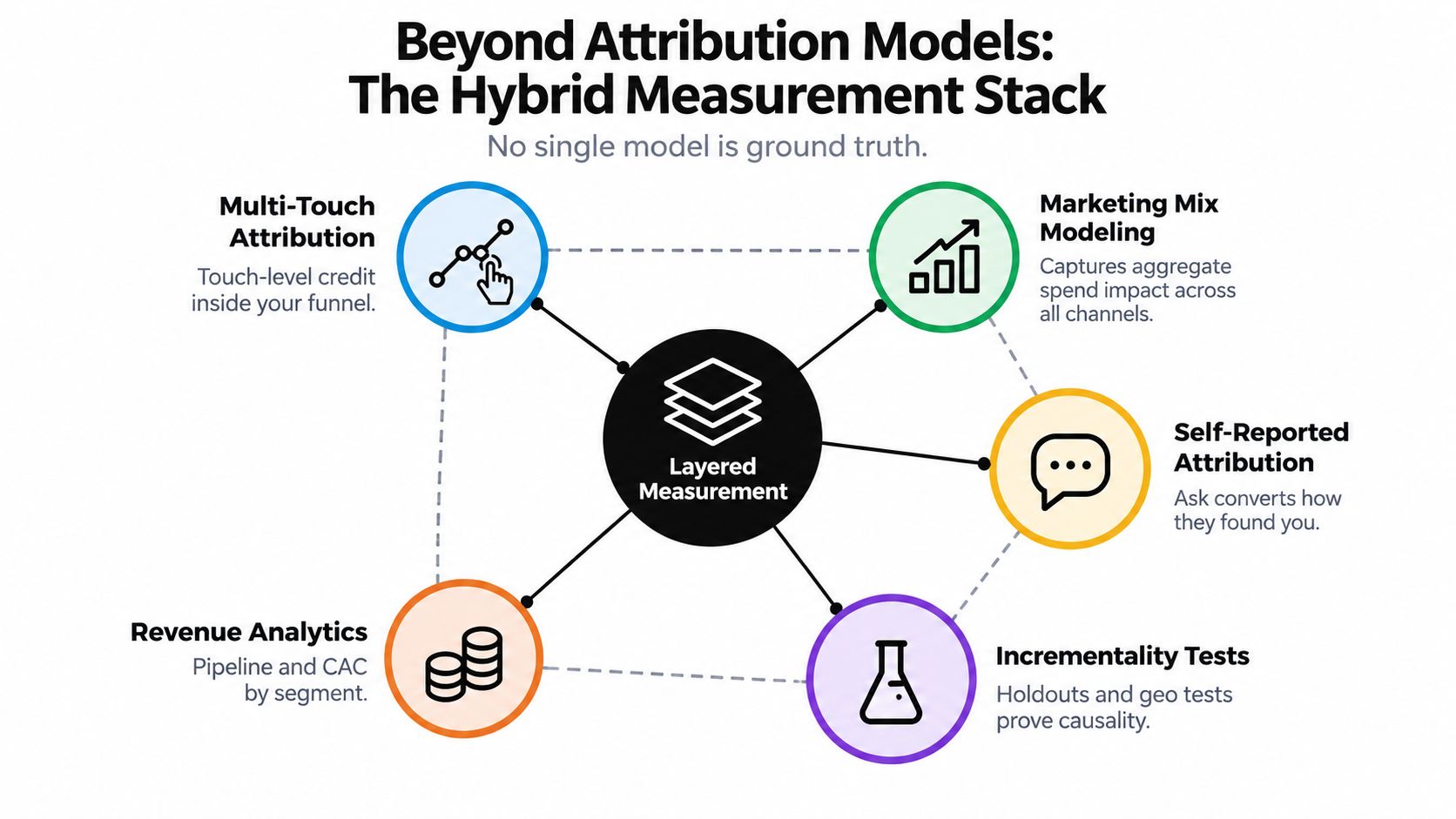
A hybrid stack should support the default model rather than replace the decision framework. Use it to compare touch-level credit with aggregate channel impact, self-reported discovery, experiments, and revenue by segment.
Beyond Attribution Models and the Hybrid Stack
No single attribution model is ground truth. Touchpoint models are useful for operational questions, such as which campaign assisted opportunity creation or which interaction preceded a booking. They struggle with interactions that leave no click, no cookie, no form field, and no clean contact record.
Marketing mix modeling addresses a different level of analysis. It examines aggregate spend and outcomes across channels, helping leadership assess the combined effect of activity that individual-level tracking can't reliably connect. It won't tell a campaign manager which person read which asset, but it can challenge a channel report that claims more impact than the overall business pattern supports.
Incrementality testing asks a harder question: would the outcome have happened without the activity? Geo holdouts, audience holdouts, and conversion-lift tests can separate correlation from causal impact. These tests take planning and may be difficult for small segments, but they're more useful than arguing over whether a final click “deserves” the credit.
Fill the dark-funnel gaps
Buyers discuss vendors in places deterministic tracking can't see. Those discussions can happen in Slack, private communities, direct messages, podcasts, customer groups, sales calls, and offline meetings. Self-reported attribution, structured sales notes, partner feedback, and intent signals won't provide perfect measurement, but they reveal influence that click-based systems omit.
One recent industry estimate places dark-funnel sources at roughly 38% of B2B pipeline, while a 2026 source reports 47% multi-touch adoption. Those figures point to a measurement problem, not a reason to assign dark-funnel credit automatically. (B2B attribution and hybrid measurement guidance)
Senior analyst view: Use attribution to operate the funnel, incrementality to test causality, and MMM to guide aggregate investment. Don't ask one method to perform all three jobs.
Match each layer to its job
A lean team with limited conversion volume should start with a transparent rule-based model, CRM reconciliation, and a required self-reported source field. A more mature team can add controlled experiments for important channels and segments. An organisation planning broad channel investment should use MMM when it has sufficient historical spend and outcome data to support aggregate analysis.
The rollout can stay practical:
- Choose one operational default. Use the model that your teams can explain and maintain.
- Run one focused incrementality test each quarter. Select a channel where the budget decision is meaningful and the audience can support a holdout.
- Use self-reported attribution consistently. Ask every qualified buyer how they first heard about the company and what influenced the evaluation.
- Reserve MMM for annual or major planning cycles. Use it to challenge channel-level assumptions, not to replace CRM pipeline reporting.
- Review governance with the model. Revisit identity, event definitions, offline capture, and stage mapping whenever the sales process changes.
Teams that need a lightweight way to connect web visits, conversions, CRM records, and revenue can evaluate SourceLoop's multi-touch attribution platform. Treat it as an implementation option, not a substitute for agreed definitions and validation.
The point isn't to abandon multi-touch attribution. It's to stop overloading it with answers it can't provide. Your model should explain observed journeys, while experiments, aggregate analysis, and buyer feedback test the parts of the journey your tracking can't see.
Audit your current B2B attribution model before approving another channel-budget change. Map every marketing and sales touchpoint, reconcile it with CRM opportunity stages, measure path coverage, and run your current model alongside a simple position-based or time-decay view. Then bring marketing, sales, RevOps, and finance into one review and agree on the model that reflects your actual sales cycle, not the most impressive option in your analytics platform.



 Paid Social


