
Best HubSpot Marketing Attribution Alternatives in 2026
Compare the best HubSpot marketing attribution alternatives for 2026. See which tools unify CRM revenue, multi-touch journeys, and ad platform sync.
Your paid media manager says campaigns are driving pipeline. Sales says the serious deals came from outbound and referrals. HubSpot's attribution dashboard says organic search and direct own most of the credit. Then finance asks the only question that matters: which number should we trust?
That's usually the moment teams start shopping for a HubSpot attribution alternative.
I've seen this enough times to be blunt about it. The problem usually isn't that HubSpot is broken. It's that HubSpot works best when the journey stays neat, form-based, and mostly inside its own system. Real buying journeys don't behave that way anymore. Buyers bounce across devices, ask AI tools for vendor recommendations, click nothing, come back later, talk to sales offline, and finally convert through a route that makes the original source look invisible.
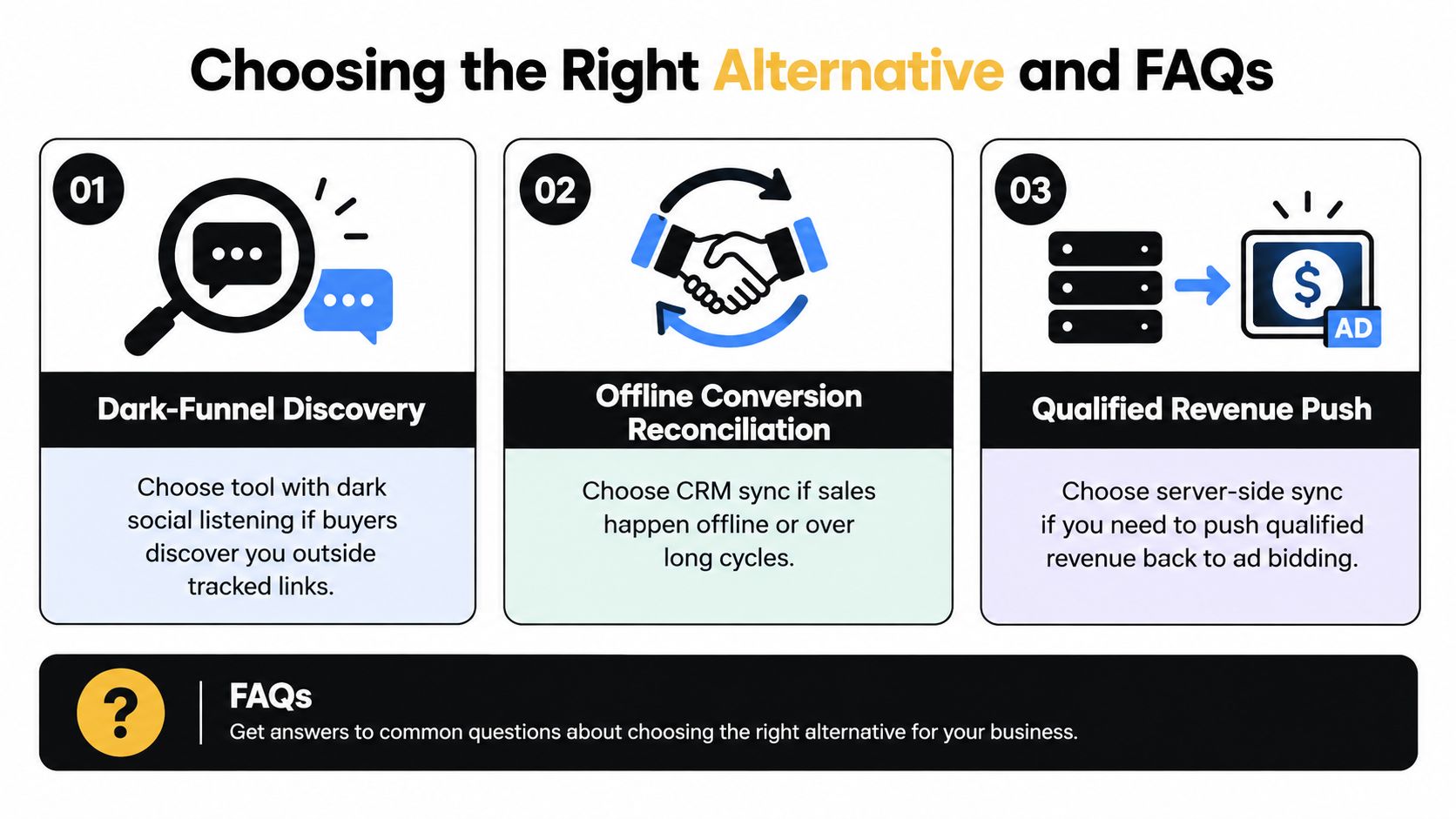
If you're evaluating the best HubSpot marketing attribution alternatives, stop comparing feature grids first. Start with the three hard problems that force a replacement decision: AI-driven dark-funnel discovery, offline conversion reconciliation, and sending qualified revenue back to ad platforms so bidding optimizes for real business outcomes.
Table of Contents
- Why Teams Start Looking Beyond HubSpot Attribution
- What HubSpot Attribution Does Well and Where It Falls Short
- From Last-Touch to Multi-Touch and Incrementality
- Why Data Quality Matters More Than Model Choice
- How to Compare HubSpot Attribution Alternatives
- Closing the Loop With Server-Side Conversion Sync
- Best HubSpot Alternatives by Team Type
- Choosing the Right Alternative and FAQs
Why Teams Start Looking Beyond HubSpot Attribution
The quarterly review issue is familiar. Google Ads reports healthy conversion activity. LinkedIn claims it assisted a meaningful share of pipeline. HubSpot still gives a lot of the visible credit to direct traffic, branded search, or the final session before form fill. Leadership looks at three dashboards and assumes someone is wrong.
Usually, all three are incomplete.
The budget meeting problem
HubSpot's native attribution can tell a useful story when source capture is clean and the funnel is simple. But once buying behavior gets messy, last-touch thinking starts to distort budget decisions. If you need a sharp refresher on why that happens, this breakdown of why last touch attribution misleads is worth reading before you choose any replacement.
The tension isn't philosophical. It's operational. Teams need a system that can answer questions like:
- Where did this demand start? AI search, dark social, peer communities, review sites, and untagged shares often don't show up cleanly.
- Did the pipeline turn into revenue? Marketing wants attribution tied to closed business, not just contacts and deals created.
- Can ad platforms learn from real outcomes? If Meta, Google, and LinkedIn only receive form-fill events, they'll optimize for cheap leads instead of qualified customers.
The three structural gaps
Independent 2026 reporting says 48% of agencies now see tracking AI-driven discovery from ChatGPT or AI Overviews as their hardest attribution problem (AgencyAnalytics benchmark summary). That's a big shift. It means the old buying question, which tool gives me nicer attribution dashboards, is no longer the important one.
The important question is whether your stack can hold onto source truth when the first meaningful touchpoint isn't a normal click.
Practical rule: If your attribution tool can't connect anonymous discovery, CRM progression, and ad-platform feedback, it's a reporting layer, not a revenue measurement system.
That's why teams move beyond HubSpot. Not because they need more reports, but because they need an attribution system built for how people buy now.
What HubSpot Attribution Does Well and Where It Falls Short
HubSpot attribution isn't useless. For a lot of teams, it's the first system that gets them out of spreadsheet theater and into something actionable. If your forms, emails, lifecycle stages, and deals all live in HubSpot, the native reporting is good enough to answer basic source and conversion questions.
It handles first-party web capture, source reporting, CRM-connected deal attribution, and standard touchpoint views reasonably well. That matters, especially for lean teams that don't have a data engineer waiting around to stitch event streams together.
Where HubSpot earns its keep
HubSpot is strongest in setups with disciplined UTM usage and a single CRM source of truth. It can show first touch, last touch, and revenue-linked attribution views that help marketers compare channels without building a full warehouse project.
It also benefits from being embedded in the workflow your team already uses. Sales sees the same records. Marketing sees the same contacts. RevOps doesn't need to train everyone on another UI on day one.
If you're early in your journey, it's fair to start there. It's also fair to outgrow it.
Where it breaks in practice
The cracks show up when attribution has to survive outside the browser session. A peer-reviewed paper on multi-touch attribution points out that model accuracy depends heavily on data quality, offline touchpoint integration remains challenging, and cross-device tracking still affects completeness (peer-reviewed MTA paper). That's exactly where native HubSpot setups struggle.
HubSpot doesn't give you a strong native answer for several common operating realities:
| Capability Area | HubSpot Native Performance | Common Gap |
|---|---|---|
| Web and form source tracking | Strong for first-party form capture and standard source reporting | Weak when journeys start in dark social, AI discovery, or untagged shares |
| CRM-linked attribution | Good when deals and contacts are cleanly associated inside HubSpot | Revenue truth gets messy when offline steps or external systems sit in the middle |
| Multi-touch visibility | Useful for basic touchpoint reports | Limited once identity stitching across devices and anonymous sessions matters |
| Paid media optimization | Can inform reporting decisions | Doesn't natively close the loop back into ad platforms with qualified offline conversion sync |
| Cross-system governance | Convenient inside one stack | Less reliable when BI, ecommerce, call tracking, or app events need unified attribution |
The bigger point is this: HubSpot is a CRM with attribution features. It isn't a full attribution operating system.
If you're still comparing broad martech options, it can help to browse HubSpot competitors and separate CRM replacement decisions from attribution replacement decisions. Those are not the same project.
For teams trying to extend HubSpot rather than rip it out, this guide on tracking marketing attribution in HubSpot is the more realistic path. Most companies don't need to replace HubSpot. They need to replace what they expect HubSpot attribution to do.
From Last-Touch to Multi-Touch and Incrementality
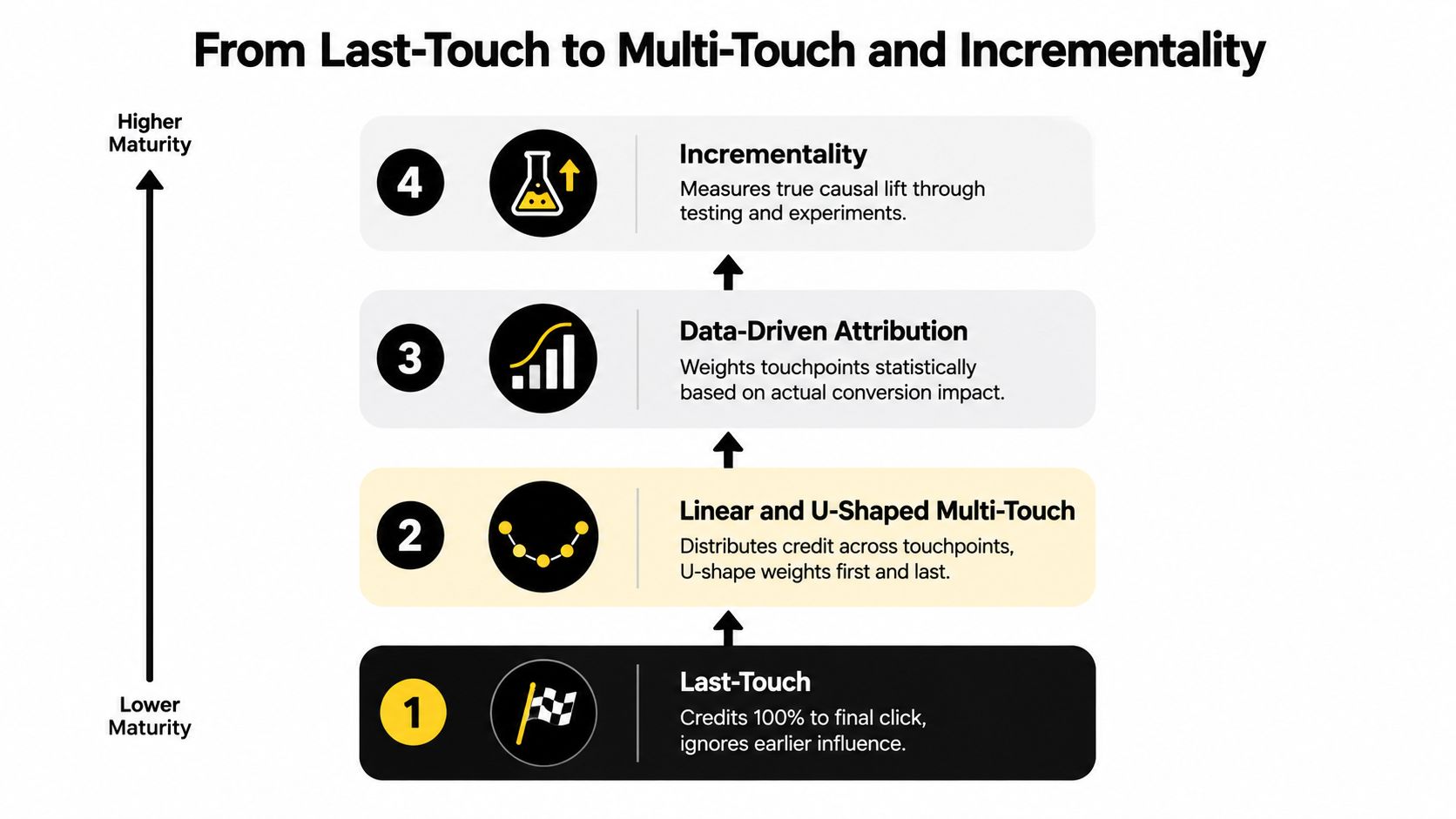
Most attribution discussions get stuck arguing about models. That's too narrow. Still, you need to understand the maturity ladder, because a lot of teams are making six-figure decisions with a model that only credits the final click.
What each step really changes
Last-touch attribution gives all credit to the final interaction before conversion. In B2B, that often means a branded search click or direct visit steals credit from the campaign that first got the account interested.
Linear and U-shaped multi-touch spread credit across the journey. They're better because they at least acknowledge that multiple interactions mattered. They're still rules-based, so they can flatten very different touchpoint quality into a tidy but misleading split.
Data-driven attribution tries to weight touchpoints statistically. In theory, that's more advanced. In practice, it's only as good as the identity, event quality, and conversion truth underneath it.
Why incrementality matters more than most teams admit
By 2025, attribution measurement had already moved well beyond simple last-touch reporting. BCG and Google reported that 81% of organizations run attribution, 79% run marketing mix modeling, and 86% run incrementality testing, yet only 46% use all three together and just 40% completely trust their measurement (attribution measurement summary). That same reporting also noted that Google Ads retired first-click, linear, time-decay, and position-based attribution models in 2023, leaving last-click and data-driven attribution as native options.
That should tell you where the market is heading. Teams aren't replacing HubSpot because they want another flavor of touchpoint report. They're replacing it because they need a broader measurement stack.
Incrementality testing is the strongest counterweight to observational attribution because it asks a causal question: what changed because the campaign ran? A technical summary notes that test and control design isolates conversions that wouldn't have happened otherwise, and cites a Meta campaign study where observational models produced estimated ad-effect errors ranging from 488% to 948% (incrementality and observational error summary).
Attribution tells you where conversion paths appeared. Incrementality tells you whether the campaign created lift at all.
For a practical framework on cross-channel measurement design, this piece on cross-channel attribution is worth reviewing before you commit to any single model.
Why Data Quality Matters More Than Model Choice
Your team pulls a beautiful attribution report. Paid social gets credit for pipeline. Search looks efficient. Then sales closes deals that never showed up in the journey, finance disputes the revenue totals, and Google Ads keeps optimizing toward leads your reps would never accept. That is the point where HubSpot attribution stops being a reporting issue and becomes a data issue.
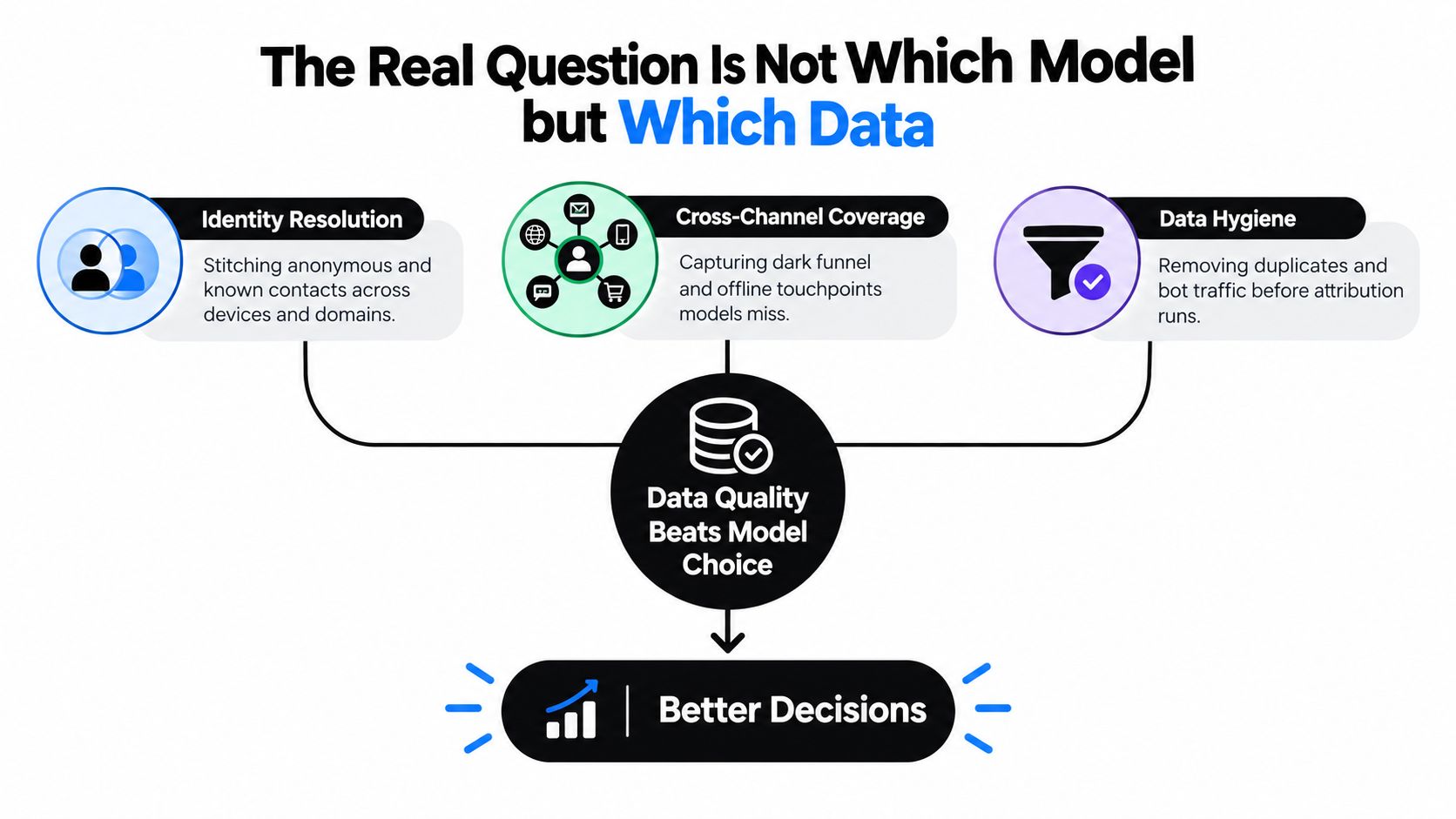
Model debates distract buyers from the harder question. Can the system see the journey that produced revenue? If identity is fragmented, offline events never land in the attribution layer, and CRM records do not map cleanly back to ad traffic, the model barely matters. You are just assigning credit inside a broken dataset.
Identity resolution matters more than model choice
HubSpot struggles when one buying journey spans mobile research, desktop revisits, a booked demo, sales calls, and a closed-won record in the CRM. If those actions do not resolve to one person or one account, your reporting is scoring fragments.
Privacy changes made that worse. Independent coverage from Braze explains that attribution accuracy drops when journeys break across devices, observable signals shrink, and platform totals no longer line up cleanly with backend systems (attribution challenges summary). That is why so many teams stop trusting the numbers long before they stop paying for the tool.
Offline revenue and dark-funnel signals decide whether attribution is useful
HubSpot is fine at web-touch reporting. It is much weaker at the three problems buyers need to solve next.
First, dark-funnel discovery. If a prospect hears about you in a Slack group, watches a founder interview, gets mentioned by a customer, then later converts through branded search, HubSpot mostly sees the last visible click. It does not do much to surface the hidden influence that shaped demand before the session started.
Second, offline conversion reconciliation. B2B revenue often gets decided in calls, meetings, demos, procurement reviews, and handoffs between SDRs and AEs. If those milestones stay trapped in the CRM, your attribution report overstates channels that generate form fills and understates the touches that produce qualified pipeline and closed revenue.
Third, ad-platform feedback. Reporting alone does not improve performance. The winning setup sends qualified pipeline, offline conversions, and closed revenue back to Google Ads, Meta, and LinkedIn so their algorithms optimize for customers, not just cheap lead volume.
Use a simple standard when you compare alternatives:
- Identity first. The tool should stitch anonymous, known, online, and offline activity into a usable person or account history.
- Revenue second. It should tie CRM stages, opportunity values, payments, or closed-won outcomes back to acquisition sources.
- Feedback third. It should send qualified conversion events back to ad platforms, not stop at dashboards.
- Dark-funnel coverage fourth. It should help you capture self-reported attribution, sales-input signals, and other non-click influence HubSpot misses.
A cleaner data layer with simpler modeling beats a complex model fed by partial journeys. That is the buying question behind any serious HubSpot attribution replacement.
How to Compare HubSpot Attribution Alternatives
Most comparison posts rank tools like they're buying laptops. That's lazy. Attribution tools solve different jobs, and if you compare them without a shared evaluation framework, you'll buy the wrong category.
Start with the operating reality of your team. Are you trying to fix source capture? Reconcile revenue? Push offline conversions into ad platforms? Those are different needs, and different products win in each case.
The criteria that matter
I'd judge every alternative against five questions:
Pricing transparency
If pricing is hidden behind sales calls and add-ons, expect implementation surprises. Attribution projects already create enough internal friction without procurement guesswork.Identity stitching
Ask how the tool handles web, CRM, app, offline, and cross-device identity. If the answer is vague, move on.Modeling depth
Rules-based models are fine if the underlying data is trustworthy. Don't overpay for algorithmic modeling you can't validate.Ad platform loop-back
This is the big one. Can the system send qualified events back to Google Ads, Meta, and LinkedIn, or does it stop at reporting?Time to value
A lean marketing ops team needs something they can stand up and govern without turning attribution into a six-month data program.
Compare categories, not just brands
| Category | Pricing Transparency | Identity Stitching | Modeling Depth | Ad Platform Loop-Back | Time to Value |
|---|---|---|---|---|---|
| Lightweight first-party trackers | Usually simpler | Good for web and CRM when configured well | Basic to moderate | Often strong if built for conversion sync | Fast |
| B2B MTA platforms | Often sales-led | Stronger across long journeys and account views | Moderate to deep | Mixed by vendor | Medium |
| DTC MTA platforms | Usually clearer for ecommerce buyers | Strong for store and paid media data | Moderate to deep | Often strong for ad optimization | Medium |
| Incrementality tools | Varies | Less about stitching every touch | High on causal measurement | Usually indirect | Medium to slow |
| Call-tracking hybrids | Usually straightforward | Strong where phone leads matter | Narrow but useful | Sometimes supported | Fast |
One practical shortcut is to look at how a vendor talks about integration, not just attribution. If you want a clean checklist for evaluating data handoff approaches, these PlotStudio AI integration methods are a useful lens. Attribution fails more often in the pipes than in the dashboard.
Deal-breaker questions to ask in demos
Don't ask vendors to “show reporting.” Ask this instead:
- How do you map HubSpot deal stages to attribution events?
- How do you handle offline revenue and sales-qualified outcomes?
- Can you deliver server-side conversions to Google, Meta, and LinkedIn?
- What happens when identity breaks across devices or anonymous visits?
- Can marketing and finance reconcile to the same revenue record?
If a vendor can't answer those clearly, it's not a serious alternative.
Closing the Loop With Server-Side Conversion Sync
Attribution only earns its keep when it changes campaign optimization. If your reporting says one channel drives better customers but your ad platforms still optimize toward form fills, you haven't fixed the problem. You've just documented it.
That's why server-side conversion sync matters.
Why browser pixels are no longer enough
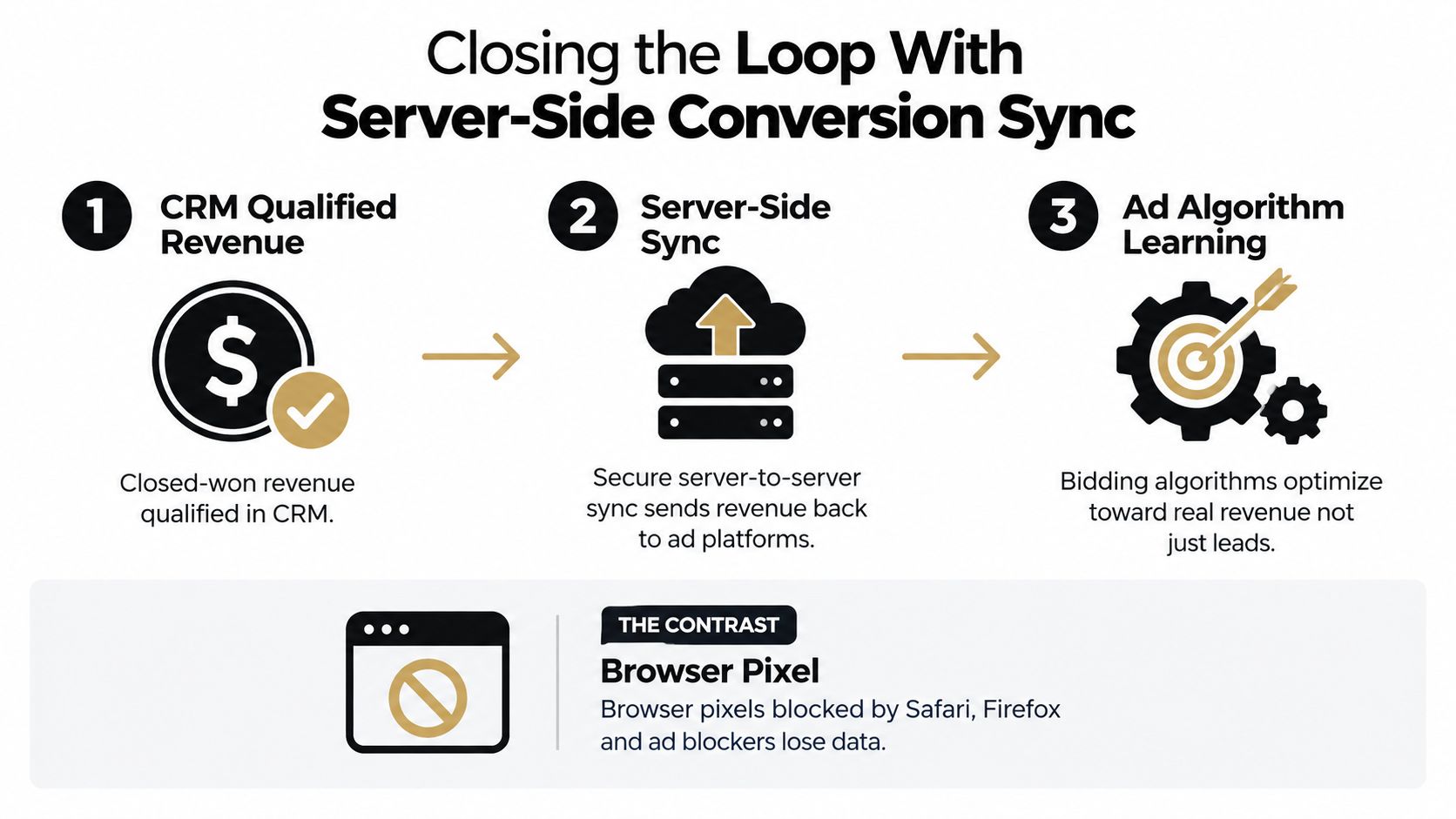
Browser-based tracking misses too much. Consent choices, ad blockers, Safari behavior, and identity fragmentation all chip away at signal quality. That leaves paid media teams optimizing on a partial view of reality.
Server-side sync changes the flow. Instead of relying only on the browser pixel to tell Meta or Google what happened, your CRM or attribution layer sends qualified conversion data directly to the ad platform. That can include lead qualification, booked meetings, opportunity creation, and closed revenue events, depending on your setup and policy constraints.
What good loop-back looks like
The cleanest setup usually follows this pattern:
- Capture the original source context when the lead first appears.
- Carry that context into the CRM so it stays attached to the person, company, or deal.
- Wait for a qualified milestone such as sales acceptance, opportunity creation, or closed-won.
- Send a server-side event back to Google Ads, Meta, or LinkedIn using approved identifiers and consent-aware handling.
That's the difference between attribution for reporting and attribution for bidding.
Here's a useful overview of conversion API tracking tools if you're building this layer out.
A short explainer helps if your team still thinks pixels are enough:
Operational advice: If the ad platform only receives low-intent conversions, it will find you more low-intent conversions.
Privacy still matters. The right implementation uses hashed identifiers where appropriate, respects consent requirements, and treats first-party customer data as governed infrastructure, not a growth hack.
Best HubSpot Alternatives by Team Type
You usually hit this section after the same meeting. Marketing says HubSpot attribution misses too much. Sales says the numbers do not match pipeline reality. Paid media says ad platforms keep finding junk leads because nobody sends qualified revenue back. At that point, stop shopping by feature grid. Choose the replacement based on the failure mode.
Best fits for B2B revenue teams
| Tool | Best for Team Type | Primary Use Case | Core Strength |
|---|---|---|---|
| Dreamdata | RevOps-heavy B2B teams with long sales cycles | Multi-touch revenue attribution across complex account journeys | Strong CRM stitching and account journey reporting |
| HockeyStack | GTM teams that want attribution plus broader revenue intelligence | Connecting marketing, sales, and product signals | Better visibility into account activity across the funnel |
| Ruler Analytics | Teams that want pragmatic revenue attribution without rebuilding everything | Feeding attribution and revenue outcomes into CRM and BI | Practical offline attribution and reporting |
| CallRail or Invoca | Teams where phone calls create or qualify pipeline | Call attribution tied to lead quality | Clear visibility into call-driven conversions |
If your biggest HubSpot problem is dark-funnel discovery, start with Dreamdata or HockeyStack.
Both are better suited to B2B buying reality where the journey starts long before a form fill. They do a better job connecting anonymous visits, account research, CRM activity, and campaign influence across a long sales cycle. HubSpot can report touches. It struggles more when the question is which accounts were already in motion before conversion showed up in the CRM.
Ruler Analytics is the practical choice for teams whose main problem is offline conversion reconciliation. If your funnel runs through calls, meetings, handoffs, and closed revenue events that need to map back to source with less manual cleanup, Ruler usually gets you there faster than a larger re-platforming project.
CallRail and Invoca belong in a separate bucket. If phone calls create pipeline, generic web attribution will miss qualified demand. Use a call-focused platform.
B2B teams also underestimate implementation difficulty. A recent benchmark summary noted that multi-touch adoption is common, but confidence in attribution accuracy still trails adoption rates (B2B attribution benchmark summary). That matches what I see in rollouts. Pretty dashboards are easy to buy. Trusted revenue reporting is harder.
Best fits for paid media and ecommerce teams
| Tool | Best for Team Type | Primary Use Case | Core Strength |
|---|---|---|---|
| Triple Whale | DTC and Shopify-focused teams | Ecommerce attribution and paid media reporting | Strong store and paid media visibility |
| Northbeam | Performance teams focused on media mix and post-pixel attribution | Channel and creative decision support | Better support for budget allocation under tracking loss |
| Hyros | High-ticket info-product and ecommerce advertisers | Ad-to-cash tracking | Revenue-focused ad performance reporting |
These tools fit teams with a different job to do.
If your priority is media buying, creative decisions, and getting cleaner signal after pixel loss, HubSpot is usually the wrong center of gravity. Triple Whale and Northbeam are better choices when you need channel and campaign reads that help buyers shift budget fast. Hyros fits advertisers who care less about long CRM opportunity stages and more about tying ad spend to revenue outcomes.
One more category matters for mid-market teams that stay on HubSpot for CRM. SourceLoop fits teams that need first-party attribution connected to forms, bookings, payments, and qualified offline conversion sync back to Google Ads, Meta, and LinkedIn. That is a narrower job than broad journey analytics. It is often the more urgent one because it fixes optimization, not just reporting.
Choosing the Right Alternative and FAQs
A typical buying mistake looks like this: the team spends weeks comparing attribution models, signs the tool with the prettiest dashboards, and still cannot answer the question the CFO cares about. Which campaigns created qualified pipeline, which deals closed offline, and which ad platforms should get that revenue signal back.
Choose the replacement based on the break in your measurement system.
If buyers first discover you through AI answers, private communities, forwarded docs, branded search, or direct traffic that tells you nothing, HubSpot is not enough. You need a tool built to reconstruct account journeys and recover dark-funnel influence. Start with HockeyStack or Dreamdata.
If your reporting falls apart after the form fill, focus on offline conversion reconciliation. That means CRM stage mapping, revenue-event matching, and clean handoffs between marketing, sales, and finance. Ruler Analytics is a practical option here. So is a first-party attribution layer that stays tied to forms, meetings, opportunities, and closed revenue.
If ad platforms keep chasing cheap leads instead of real customers, fix the feedback loop first. Server-side conversion sync matters more than another attribution model because bidding systems improve only when they receive qualified outcomes. For that problem, look at Northbeam, Triple Whale, or a HubSpot-connected layer such as SourceLoop that can send qualified revenue events back to Google Ads, Meta, and LinkedIn.
FAQs
How long does migration usually take
Longer than teams expect.
Lightweight first-party attribution and call-tracking setups are usually faster. Tools that require warehouse work, identity stitching, custom CRM mapping, and ad-platform sync take longer. As noted earlier, mid-market B2B rollouts often stretch across multiple months, especially when sales ops and paid media teams need different outputs from the same data.
Do these tools replace HubSpot entirely
Usually no. HubSpot should remain the CRM, automation, and lifecycle system unless you are replacing much more than attribution.
The better approach is to let HubSpot do contact and deal management, then add a tool that fixes the gap HubSpot cannot handle well. That gap is usually dark-funnel discovery, offline reconciliation, or qualified revenue sync to ad platforms.
What happens to historical attribution data
Keep it for reference. Do not burn time trying to recreate every old touchpoint inside the new platform.
Set a clean go-live date. Use the new tool as the reporting system for new opportunities and closed revenue from that point on. Historical comparisons will never be perfect across different tracking methods, and forcing that project usually delays the work that improves decision-making.
Can you still use HubSpot reporting
Yes, and you should.
Use HubSpot for pipeline, lifecycle stages, conversion rates, and CRM reporting. Use the attribution alternative for the job HubSpot struggles with: identifying hidden demand, reconciling offline outcomes, or sending qualified revenue back to ad platforms.
The right alternative is the one that fixes your current blind spot. Start with the problem, not the model.

 Paid Social


