
Cookieless Marketing Attribution That Still Converts
Learn cookieless marketing attribution that works without third-party cookies. Explore methods, accuracy tradeoffs, and how to recover conversions.
Your dashboard says paid search drove the lead. LinkedIn says it influenced the same person. Meta says it assisted. Your CRM shows the deal came in through a demo form, but analytics lost the original source somewhere between the first visit and the sales call.
That's where a lot of growth teams are right now.
The old habit was simple: drop pixels everywhere, rely on third-party cookies, and let your reports stitch the journey together. That habit doesn't hold up cleanly anymore. Some browsers restrict tracking. Some users deny consent. Some identifiers disappear before the conversion happens. And Chrome didn't give the market the clean cutoff many teams expected. Google tested blocking third-party cookies for 1% of Chrome Stable users on January 4, 2024, then changed direction on July 22, 2024, and later confirmed on April 22, 2025 that it would not proceed with a full phaseout or a standalone opt-out prompt, so third-party cookies still remain available in Chrome as of 2026 according to this Chrome deprecation timeline summary.
That hybrid reality is why cookieless marketing attribution is confusing. It's not a switch you flip after cookies disappear. It's a measurement problem with three moving parts at once: accuracy, consent, and coverage.
Table of Contents
- Introduction Why Attribution Feels Broken Without Cookies
- What Cookieless Marketing Attribution Really Means
- How Cookieless Attribution Works Behind the Scenes
- Choosing Your Cookieless Methods and Accuracy Tradeoffs
- Implementing Cookieless Attribution Without Losing Signal
- Common Pitfalls That Quietly Break Cookieless Attribution
- Real World Examples and Your Next Steps Forward
Introduction Why Attribution Feels Broken Without Cookies
Marketers don't wake up asking for cookieless attribution. They wake up because reporting stopped making sense.
A paid social manager sees strong in-platform conversion numbers. A search lead sees branded search lifting at the same time. RevOps pulls closed-won records and notices that neither platform lines up neatly with pipeline. Then the team argues about which dashboard is “right,” when the core issue is that each system sees only part of the journey.
The frustration isn't just technical
What feels broken usually comes from a few overlapping problems:
- Platforms overclaim: Each ad platform measures from its own point of view.
- Browsers restrict visibility: Some journeys lose cross-site tracking before the conversion happens.
- Consent changes the dataset: When people deny consent, you don't just lose a cookie. You lose a chunk of the path.
- Offline steps break the chain: Sales calls, CRM stage changes, and revenue events often sit outside web analytics.
That's why cookieless marketing attribution matters even if cookies haven't vanished everywhere. Teams need a way to measure what they can observe directly, recover what they can through privacy-safe systems, and validate the rest with broader methods.
Attribution feels broken because marketers are trying to solve a consent and signal-loss problem with tools built for full user-level visibility.
Why this changed faster than many teams expected
Even before Chrome's plan shifted, teams had already started moving away from third-party-cookie dependence. One industry summary reports a 2024 Adobe finding that 49% of marketing strategies still relied on third-party cookies, down from 75% two years earlier, showing how quickly teams were adapting toward first-party data and modeled attribution, as summarized in this cookieless measurement analysis.
That adaptation happened because waiting for a perfect replacement doesn't work. There isn't one.
Some teams still have cookie-based signal in parts of their stack. Others operate with browser restrictions, denied consent, and fragmented identity from the first touch. Most sit in the middle. They need hybrid reporting today, not a theoretical future-state diagram.
If you run growth, paid media, lifecycle, analytics, or RevOps, the practical question isn't “What replaces cookies?” It's “How do we recover enough trustworthy signal to keep making budget decisions with confidence?”
What Cookieless Marketing Attribution Really Means
Cookieless marketing attribution doesn't mean tracking disappears. It means the way you connect touchpoints to outcomes changes.
With third-party cookies, attribution often worked like a loyalty card used across many stores. A person browsed one site, clicked an ad on another, returned later, and platforms could often recognize that browser across sites. That made user-level stitching easier, even when the person never identified themselves.
Without that kind of cross-site cookie access, the system looks more like a mix of receipts, membership accounts, and store traffic estimates. If someone logs in or fills out a form, you can connect activity more confidently. If they stay anonymous, you rely more on browser-generated reports, session data, and modeling.
The old model versus the new one
Here's the simplest way to think about the shift:
- Cookie-based attribution: “I know this browser moved from ad click to conversion.”
- Cookieless attribution: “I know this person if they identified themselves, I know this browser reported a privacy-safe event, or I can estimate contribution from aggregate patterns.”
That's why the phrase “cookieless” can mislead people. It sounds like a replacement technology. It's really a stack of methods.
The new building blocks
Most cookieless setups use some combination of these ingredients:
First-party data When someone submits a form, books a meeting, logs in, or purchases, your own systems capture the relationship directly.
Browser-based reporting Google's Attribution Reporting API documentation describes a privacy-preserving way to match ad interactions to conversions in the browser without third-party cookies or cross-site user tracking. In practice, that means browser-generated event and aggregatable reports replace a lot of old user-level tracking.
Modeled attribution When direct observation is incomplete, teams estimate likely channel contribution from patterns in the available data.
Where readers usually get confused
The biggest misunderstanding is thinking cookieless means identifier-free. It doesn't.
It means consent-based where possible, first-party where available, browser-mediated where needed, and aggregated more often than before. You may still use identifiers, but they need to come from relationships you own and can justify, such as CRM records, authenticated users, or consented form submissions.
Key concept: Cookieless marketing attribution is not the absence of identity. It's the move from default cross-site identity to a layered system of first-party data, browser signals, and modeled measurement.
How Cookieless Attribution Works Behind the Scenes
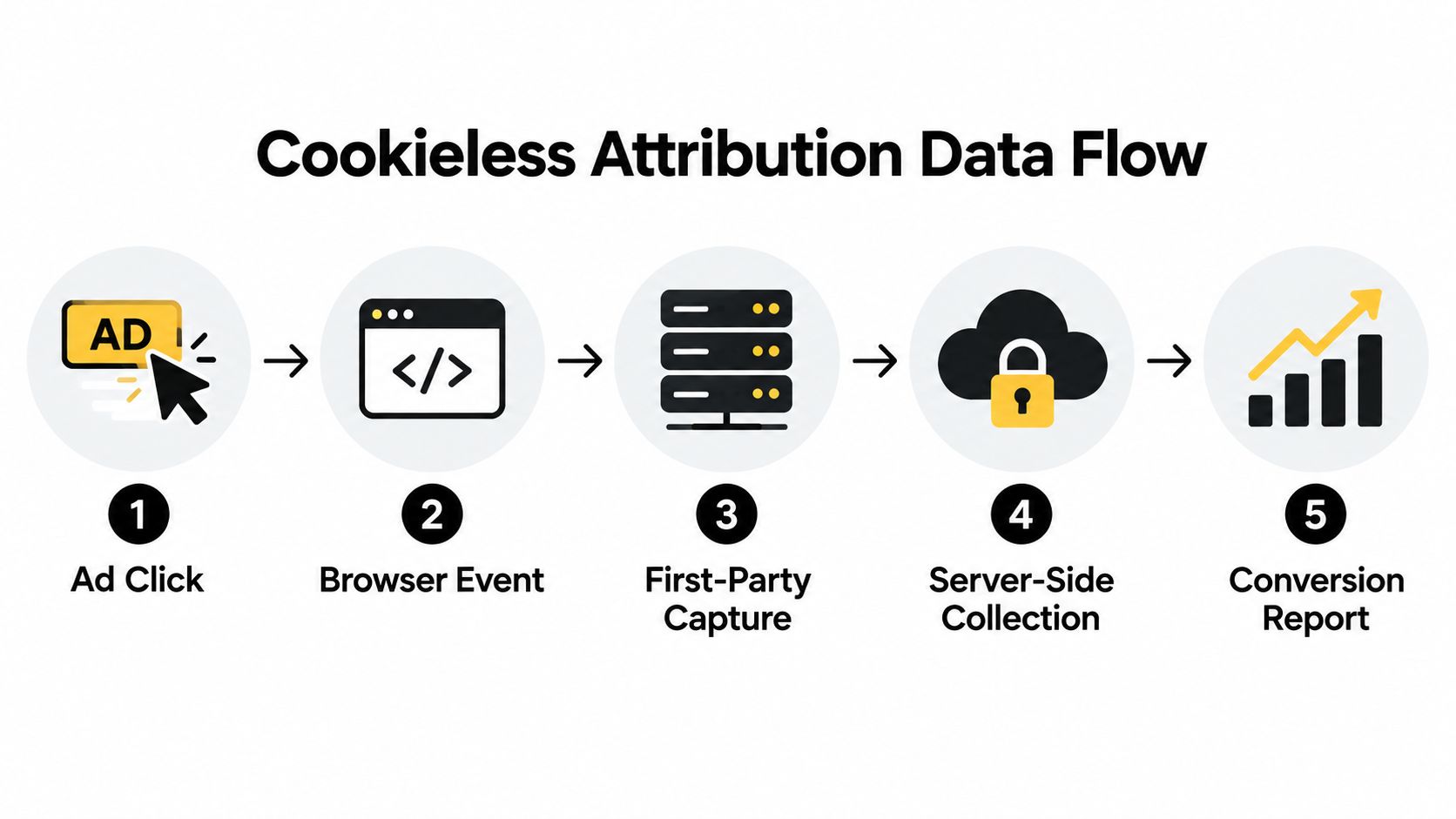
A cookieless setup starts the same way most journeys do. Someone clicks an ad, lands on your site, browses, and eventually converts. What changes is how that path gets recorded and stitched together.
From click to report
At a high level, the flow works like this:
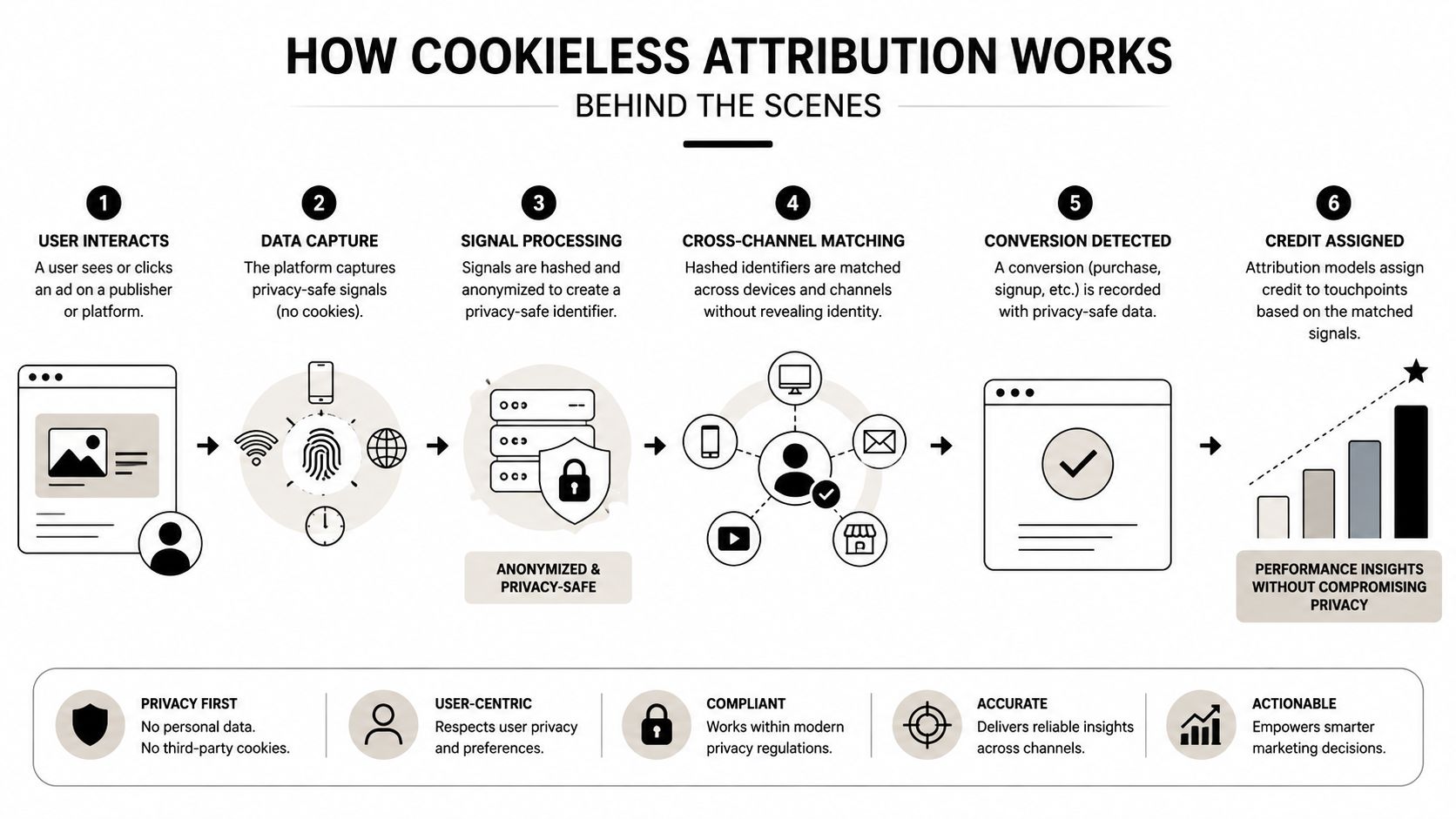
- Ad interaction happens: A user clicks or views a campaign.
- The browser records an eligible signal: In some environments, the browser stores limited attribution data.
- Your site captures first-party context: Landing page, referrer, form activity, and consented identifiers get recorded on your domain.
- Server-side systems collect events: Your backend logs conversions and other key actions more reliably than browser-only pixels.
- Platforms receive privacy-safe conversion inputs: That may happen through browser APIs, conversion APIs, or offline conversion syncs.
- Reports aggregate the result: Instead of a perfect person-level path, you get a partial but useful picture.
Why the output feels worse, even when the setup is better
Marketers often expect the same style of reporting they had before. That's where disappointment starts.
Cookieless systems often produce data that is:
- Delayed: Reports may not appear instantly.
- Aggregated: You may get grouped results instead of user-level trails.
- Thresholded: Some outputs are limited to protect privacy.
- Incomplete by design: Not every journey can be reconstructed exactly.
That's not a bug in the system. It's the tradeoff. Privacy-preserving measurement keeps some visibility while reducing the granularity marketers were used to.
A helpful benchmark comes from a published Privacy Sandbox case study. Testers using the Attribution Reporting API observed 85% of the same unique converters as third-party cookies, plus an additional 3.7% that third-party cookies did not capture, according to this MIQ case study. That result matters because it shows browser-based attribution can recover meaningful coverage, but not in the same event-by-event format teams expect.
Where tooling fits
If you're evaluating platforms that help collect, route, or reconcile these signals, it helps to compare implementation styles rather than just feature lists. This review of signal tracking platforms from Yalc is useful because it frames the problem around signal capture and operational fit, not just dashboard polish.
For a more practical breakdown of platform patterns, this guide to cookieless tracking solutions is a good reference for how server-side collection, first-party tracking, and attribution workflows fit together.
The browser now acts less like an all-seeing tracker and more like a limited witness. You still get testimony, but not the full surveillance tape.
Choosing Your Cookieless Methods and Accuracy Tradeoffs
A growth team sees paid search, paid social, organic, and partner traffic all driving conversions in the same week. Then Safari traffic looks thin, CRM matches arrive late, and ad platforms each claim more credit than total revenue allows. The question is no longer which cookie replacement to install. The question is how much certainty you can recover, with user consent, from different kinds of signals.
That framing helps because cookieless attribution is a hybrid accuracy and consent problem. Each method gives you a different mix of coverage, precision, speed, and privacy risk. Choosing well means deciding which signal should answer which business question.
Start with the methods that earn the most trust
Deterministic attribution sits at the top of the confidence ladder. If a known email, login, lead ID, or CRM record connects an ad interaction to a later conversion, you have a direct join. It works like matching a checked coat ticket to the right coat. The match is narrow, but clear.
Browser-based APIs sit in the middle. They preserve some campaign visibility without exposing the same user-level detail marketers had with third-party cookies. Google's Privacy Sandbox documentation explains that the Attribution Reporting API is designed to support conversion measurement while limiting cross-site tracking, which makes it useful for platform reporting and directional optimization, not full-funnel person-level reconstruction, as described in the Attribution Reporting API overview.
Probabilistic methods sit lower on the confidence ladder. They infer likely matches from patterns such as device, browser, time, or geography. That can help with directional channel analysis, but the certainty drops fast, and the privacy case gets weaker. Browser fingerprinting carries even more risk because it tries to recreate identity from technical signals that users did not explicitly provide. The UK Information Commissioner's Office has warned that fingerprinting for advertising and measurement raises consent and fairness concerns under privacy law, as explained in its guidance on fingerprinting and privacy risks.
Cookieless Attribution Methods Compared by Confidence and Use Case
| Method | Confidence level | Best use case |
|---|---|---|
| Deterministic matching through CRM, login, or consented identifiers | Higher | Lead gen, subscriptions, logged-in products, revenue attribution |
| Browser APIs such as Attribution Reporting | Medium | Campaign measurement where user-level tracking is restricted |
| Probabilistic matching | Lower | Directional channel trends and short-term gap filling |
| Fingerprinting | Lower, with higher privacy risk | Temporary fallback only, if legal review allows it |
| Incrementality testing | High for channel impact, low for user path detail | Budget allocation, lift measurement, validating reported attribution |
The table above is an illustrative planning aid, not a published benchmark. The point is to show relative confidence, not claim fixed accuracy percentages across every stack.
The practical choice is usually a layered model
B2B teams with strong form fills and CRM discipline should bias toward deterministic joins. Ecommerce brands with weaker logged-in coverage often need browser-reported conversions plus modeled reporting from ad platforms. Teams making large budget shifts should add incrementality tests, because a method can be good at assigning credit inside a system and still be weak at answering whether the spend changed outcomes.
A simple way to choose is to sort methods by the question you need answered.
- Who converted, and what became pipeline or revenue? Use deterministic joins first.
- Which campaigns appear to be driving reported conversions this week? Use browser APIs and platform conversion reporting.
- Which channels caused lift? Use geo tests, holdouts, or other incrementality methods.
- Where do you have gaps you can tolerate directionally? Use probabilistic modeling carefully, and label it as estimated.
If your team is still deciding how to structure that mix, this guide to a cookie deprecation strategy for measurement and tracking is a helpful reference for comparing implementation paths.
A useful rule for tradeoffs
Use the strongest signal available before adding a weaker one. Start with consented identifiers. Add browser-supported reporting where identity stops. Validate major budget decisions with incrementality. That sequence recovers more signal without pretending every conversion path can still be observed end to end.
The mistake is not using an imperfect method. The mistake is asking one method to do the job of three.
Implementing Cookieless Attribution Without Losing Signal
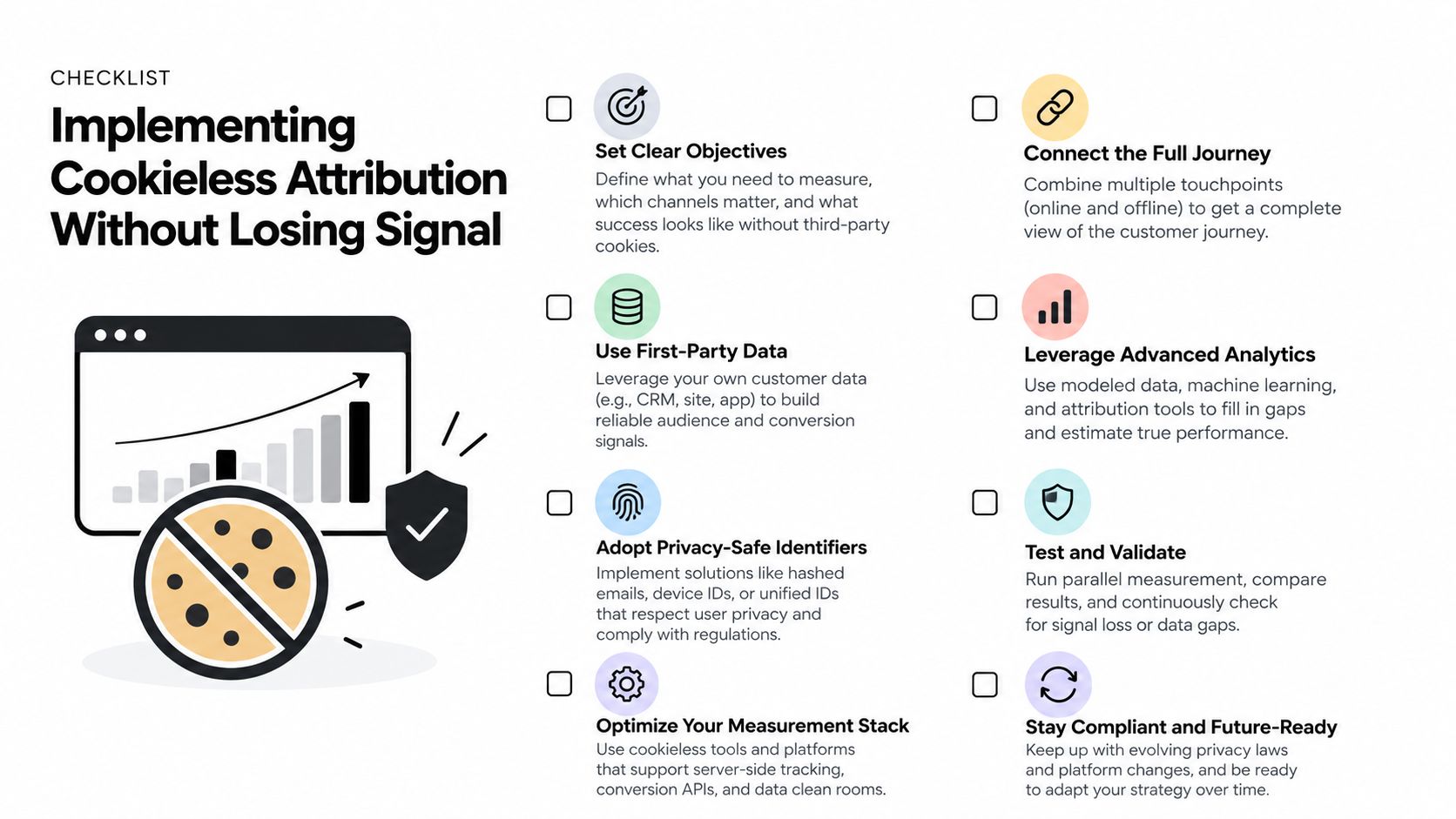
Teams often lose signal during implementation because they treat attribution as a tagging project. It's bigger than that. You're building a measurement chain that has to survive consent choices, browser restrictions, CRM delays, and ad platform matching rules.
The fix is a layered setup.
Start with the signal you own
Before adding more tools, make sure your site reliably captures what it can on your own domain.
That usually means preserving landing-page data, UTMs, click IDs where available, referrers, forms, booking events, and purchase or lead-submission events. If a visitor becomes known later, you want that first-touch context ready to attach.
Three practical priorities matter most:
- Capture consented identifiers early: Email addresses, lead forms, account signups, and meeting bookings create the anchor points deterministic attribution needs.
- Send events server-side: Browser-only pixels miss too much in restricted environments.
- Keep the journey tied to business outcomes: Don't stop at form fill if your real KPI is qualified pipeline or revenue.
A lightweight first-party layer can help here. For example, SourceLoop captures visits and conversion events on your domain, ties journeys to forms, chat, and bookings, syncs with CRM systems, and sends qualified offline conversions back to ad platforms. If you're comparing options for this part of the stack, this roundup of conversion API tracking tools is a practical place to start.
Reconcile before you optimize
A lot of teams push server-side events into ad platforms and assume the problem is solved. It isn't.
Independent guidance on cookieless attribution stresses that no single method recovers the full measurement loss. Teams need to reconcile backend records with analytics, then separate consent loss, deduplication gaps, and modeling gaps before trusting channel-level credit, as explained in this cookieless attribution guidance.
That reconciliation step usually looks like this:
Match web conversions to CRM records Make sure the lead, signup, booking, or purchase exists downstream.
Classify what was observable Identify which conversions had deterministic identity, which had browser-level reporting, and which were only modeled.
Deduplicate across systems One demo booked by one person shouldn't count as three conversions just because three platforms touched it.
Here's a practical explainer that frames the mindset well:
Use two layers of measurement, not one
The most reliable implementations separate tactical optimization from strategic validation.
For daily decisions, server-side collection and first-party attribution help you decide which campaigns, audiences, or creatives deserve attention. For bigger budget calls, use incrementality tests or marketing mix modeling to validate whether the pattern in your attributed data reflects real business lift.
Practical rule: Use attribution to steer. Use incrementality or MMM to verify.
That layered approach is what keeps teams from overreacting to partial data. You don't need a perfect mirror of every journey. You need a system that captures enough signal for action and enough validation for trust.
Common Pitfalls That Quietly Break Cookieless Attribution
Cookieless attribution usually doesn't fail because the code never fired. It fails because teams trust the wrong parts of the output.

Overusing probabilistic identity
Fingerprinting and similar methods can look attractive because they recover some anonymous traffic. The problem is that they can create false confidence. A stitched path that looks complete but isn't defensible is worse than an acknowledged gap.
Fix it by treating probabilistic identity as a fallback for directional insight, not your source of truth.
Ignoring consent-denied traffic
Some teams report only on the users they can identify and forget that this group may behave differently from the users they can't. That creates channel bias fast.
Fix it by separating observed conversions from modeled or inferred ones, then validating channel conclusions against broader business outcomes.
Failing to deduplicate platform claims
Paid search, paid social, analytics, and CRM reports can all point to the same conversion from different angles. If nobody normalizes that, attributed totals will exceed reality.
Fix it by using one conversion record as the final source of truth, then mapping touchpoints onto it.
Trusting modeled data as if it were logged truth
Modeled attribution is useful. It's also easy to misuse. If your team treats estimates like exact person-level trails, you'll optimize around noise.
Fix it by labeling modeled views clearly and testing big spending decisions outside the attribution platform.
Narrower, cleaner data often beats wider, shakier data when you're making real budget decisions.
Real World Examples and Your Next Steps Forward
A growth team cuts third party cookies from its reporting setup and wakes up to a familiar mess. Paid social still claims conversions. Search still claims conversions. CRM revenue still exists. The path between those points is what disappeared.
That is why the useful real world lesson is not about finding a one-for-one cookie substitute. Cookieless attribution works better when you treat it as two problems at once: how to recover enough measurement accuracy to make budget decisions, and how to do it inside the consent limits each channel now imposes.
In practice, the teams that hold up best layer methods. They use deterministic data where they have a known user or lead. They use browser and platform reporting where user-level tracking is restricted. They use incrementality to answer the question attribution cannot answer cleanly on its own: would this conversion have happened anyway? That stack will not recreate the old path report, but it can recover enough signal to guide spend with more honesty.
A simple example helps. A B2B team might capture UTM and landing page data on form fill, match that lead to pipeline stages in the CRM, pass qualified opportunities back to ad platforms, and then run holdout tests on paid social. The deterministic layer covers known leads. Platform feedback improves bidding. The experiment checks whether the channel is creating lift or just showing up near conversions that would have closed regardless.
That is a stronger operating model than chasing one number across every channel.
A practical action plan
- Start with one conversion that matters: Pick a revenue-linked event such as qualified demo, opportunity created, or closed-won, not just a top-of-funnel lead.
- Protect first-party source capture: Preserve UTMs, referrers, landing pages, and timestamps at the point of signup, form fill, or purchase.
- Reconcile web data with CRM outcomes: Use one conversion record as the final truth, then map marketing touches onto it.
- Feed platforms better outcomes: Send qualified conversions back to Google Ads, Meta, and LinkedIn so optimization is based on business value, not volume alone.
- Test the gaps attribution cannot see: Use holdouts, geo tests, or MMM to check whether channel winners are producing real incremental lift.
The next move is narrower than expected.
Run one pilot. Choose one channel, one conversion, and one validation method. Get that loop working end to end, then expand. Teams that approach cookieless attribution this way usually stop asking how to replace cookies and start building a measurement system that balances consent, coverage, and decision quality.



 Paid Social


