
Best Marketing Attribution Tools for Agencies That Prove ROI
Compare the best marketing attribution tools for agencies and learn how to integrate Google Analytics with Salesforce for pipeline reporting.

A client's Google Ads dashboard says the campaigns generated 42 conversions. Meta reports another set of conversions from the same period, LinkedIn has its own number, and Salesforce shows far fewer leads that progressed into pipeline. The account team still has to explain performance on the monthly call, even though each platform is using a different definition, attribution window, and identity system.
That situation is why choosing among the best marketing attribution tools for agencies isn't mainly a question of which dashboard has the most models. The practical question is whether your system can connect anonymous web behavior to known Salesforce records, reconcile advertising claims with pipeline truth, and expose journeys that include multiple sessions, content influence, and AI-assisted discovery.
Agencies are moving beyond last-click reporting. One 2026 industry compilation reports multi-touch attribution adoption at 47%, up from 31% in 2023, while another 2026 summary places enterprise usage at 41% and last-click reliance at 37%. Yet only 18% of MTA implementations are rated highly accurate by their own teams, and the average cross-device attribution accuracy gap is 34%, according to the same compilation of 2026 attribution data. (Digital Applied's 2026 marketing attribution statistics)
Table of Contents
- Why Agencies Cannot Trust Platform Numbers Alone
- How to Choose the Right Attribution Tool for Agency Work
- Mapping Web Behavior to Salesforce Contacts and Leads
- Turning Integrated Data Into Attribution and Pipeline Reports
- Troubleshooting Common GA4 and Salesforce Sync Issues
- Final Checklist for Rolling Out Attribution Across Clients
Why Agencies Cannot Trust Platform Numbers Alone
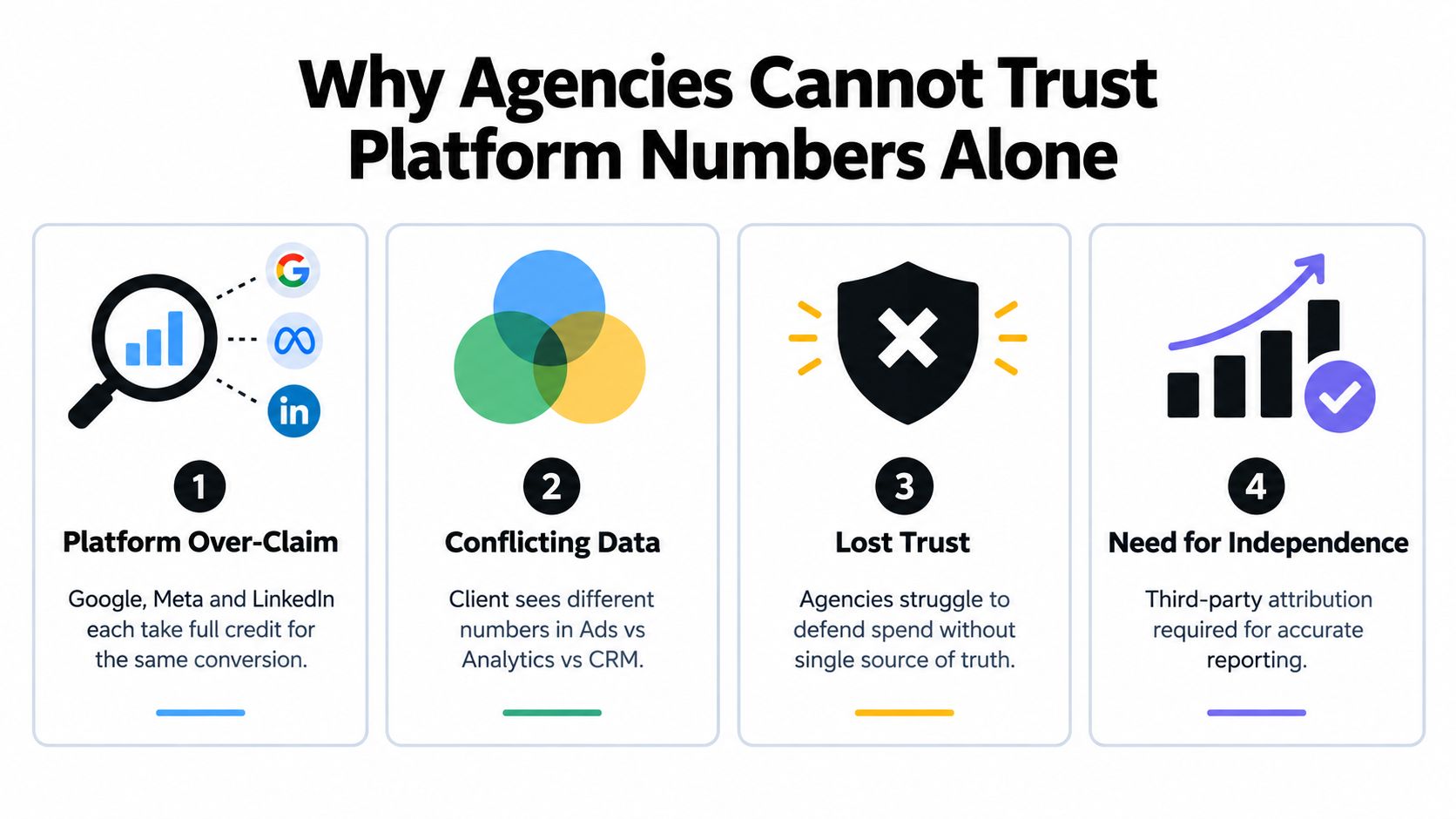
A paid search manager sees a conversion in Google Ads, a paid social specialist sees one in Meta, and Salesforce shows a contact that never became a qualified opportunity. The monthly client report must explain all three records, even though each system uses its own attribution window, identity rules, and conversion definition.
Platform reporting describes the interactions an advertising network can associate with an ad. Salesforce records whether a person became a qualified lead, entered an opportunity, advanced through the sales process, or generated revenue. Those events answer different business questions. Presenting platform totals as ROI can leave an agency defending media activity that produced clicks but no pipeline.
Platform credit is not business truth
A 2026 cross-market study reported that Google Ads over-claimed conversions by 18%, Meta by 24%, and LinkedIn by 31% compared with backend reconciliation. It also reported average cross-platform conversion double-counting of 34%. (Visionary Marketing's 2026 attribution statistics)
The figures will vary by account, tracking setup, and sales process. They still show why agencies need an independent reconciliation layer. When several platforms claim the same person, compare those claims with a deduplicated conversion record, then check the related Salesforce stage and revenue outcome.
Practical rule: Treat ad-platform conversions as optimization signals, not as the final definition of client ROI.
Last-click reporting creates another blind spot. It rewards the final measurable interaction, often branded search, retargeting, direct traffic, or a sales email, while obscuring earlier discovery and education. Multi-touch attribution can distribute credit across the journey, but only if the agency has reliable touchpoints and a usable identity key.
AI discovery makes the journey harder to see
Classic channel reports also miss newer discovery paths. In a 2026 agency benchmark, 48% of agencies said tracking AI-driven discovery from tools such as ChatGPT or AI Overviews was their hardest attribution problem. The same benchmark reported that 45% lacked visibility into which content influenced conversions, while 47% couldn't attribute conversions across multi-session journeys. (AgencyAnalytics' 2026 agency benchmarks)
The tool brief must therefore include landing pages, available referral context, campaign parameters, content interactions, and later CRM outcomes. Agencies also need a reporting convention for AI-assisted discovery, because the initial interaction may not be observable with the precision of a tracked ad click.
A workable setup uses GA4 for behavioral events, Salesforce for pipeline truth, and an attribution layer that joins the two. Tool selection and the GA4-to-Salesforce workflow belong together. A model dashboard without CRM reconciliation is polished reporting, not dependable ROI measurement.
How to Choose the Right Attribution Tool for Agency Work
Start with the client's operating reality, not the vendor's feature list. A local service business with one form and a short buying cycle may need consistent UTMs, hidden fields, call tracking, and a clean Salesforce connector. A B2B client with long sales cycles, repeated visits, several stakeholders, offline sales activity, and paid media across platforms needs identity resolution, historical touchpoint storage, opportunity mapping, and revenue feedback.
The market has expanded quickly. One 2026 estimate values multi-touch attribution software at USD 2.76 billion, up from USD 2.43 billion in 2025, and projects USD 5.17 billion by 2031 at a 13.41% CAGR. Another estimate places the market at USD 2.3 billion in 2026, rising to USD 6.2 billion by 2033 at a 15.2% CAGR. (Mordor Intelligence's multi-touch attribution market analysis) The figures are estimates, but the direction is clear. Agencies increasingly need infrastructure that connects spend to pipeline and revenue.
Compare the main tool categories
| Tool Category | Best For | Salesforce Integration | Attribution Depth |
|---|---|---|---|
| UTM and hidden-field capture | Clients with straightforward forms and disciplined campaign tagging | Manual field mapping or light connector | First-touch, last-touch, and basic source reporting |
| Form and call tracking connectors | Lead-generation accounts with important phone and form conversions | Usually maps lead fields and conversion metadata | Lead-source and conversion-path reporting |
| Server-side tracking tools | Accounts affected by browser restrictions, ad blockers, or fragile client-side scripts | Requires custom mapping or middleware | More complete event capture, still dependent on CRM joins |
| Marketing data connectors | Agencies consolidating GA4, ad platforms, spreadsheets, and CRM exports | Often supports scheduled syncs or warehouse workflows | Cross-channel reporting, model depth varies |
| Dedicated multi-touch attribution platforms | Complex B2B, SaaS, and performance accounts tied to opportunity value | Native or managed CRM sync, identity resolution, offline feedback | Multi-touch, revenue attribution, cohort and path analysis |
A lightweight connector works when the conversion action is clear and the client's CRM data is clean. It won't solve duplicate records, anonymous-to-known identity stitching, offline events, or conflicting platform claims by itself. A full platform costs more in implementation effort, but it becomes easier to manage when multiple clients need repeatable workspaces, field mapping, white-label reports, and standardized governance.
Before you compare vendors, review a clear explanation of how attribution models differ in the referral program attribution guide. For agency budgeting, also separate software cost from implementation cost, which is the focus of this marketing attribution software cost guide.
Use a buying scorecard
Ask every vendor to demonstrate a real workflow using your fields, not a generic demo account.
- CRM depth: Can it map anonymous IDs, email addresses, lead IDs, contact IDs, account IDs, opportunity IDs, stages, and closed revenue?
- Conversion coverage: Does it capture forms, calls, chat interactions, calendar bookings, imports, and offline outcomes?
- Reconciliation: Can you compare platform-reported conversions with deduplicated conversions and Salesforce outcomes?
- Journey visibility: Can the system handle multi-session paths, returning visitors, content influence, and AI-assisted discovery notes?
- Agency operations: Does it support client separation, permissions, white-label reporting, reusable templates, and audit trails?
- Data controls: Can the team inspect timestamps, source values, identity matches, consent status, failed syncs, and field changes?
The right tool is the one your delivery team can operate consistently across accounts. A model that nobody audits will produce less value than a simpler system with reliable data capture and clear CRM ownership.
Mapping Web Behavior to Salesforce Contacts and Leads
GA4 and Salesforce don't become useful together just because both are connected to a reporting dashboard. The integration has to preserve campaign context, identify the person when possible, and attach marketing behavior to the correct CRM record without creating a second lead.
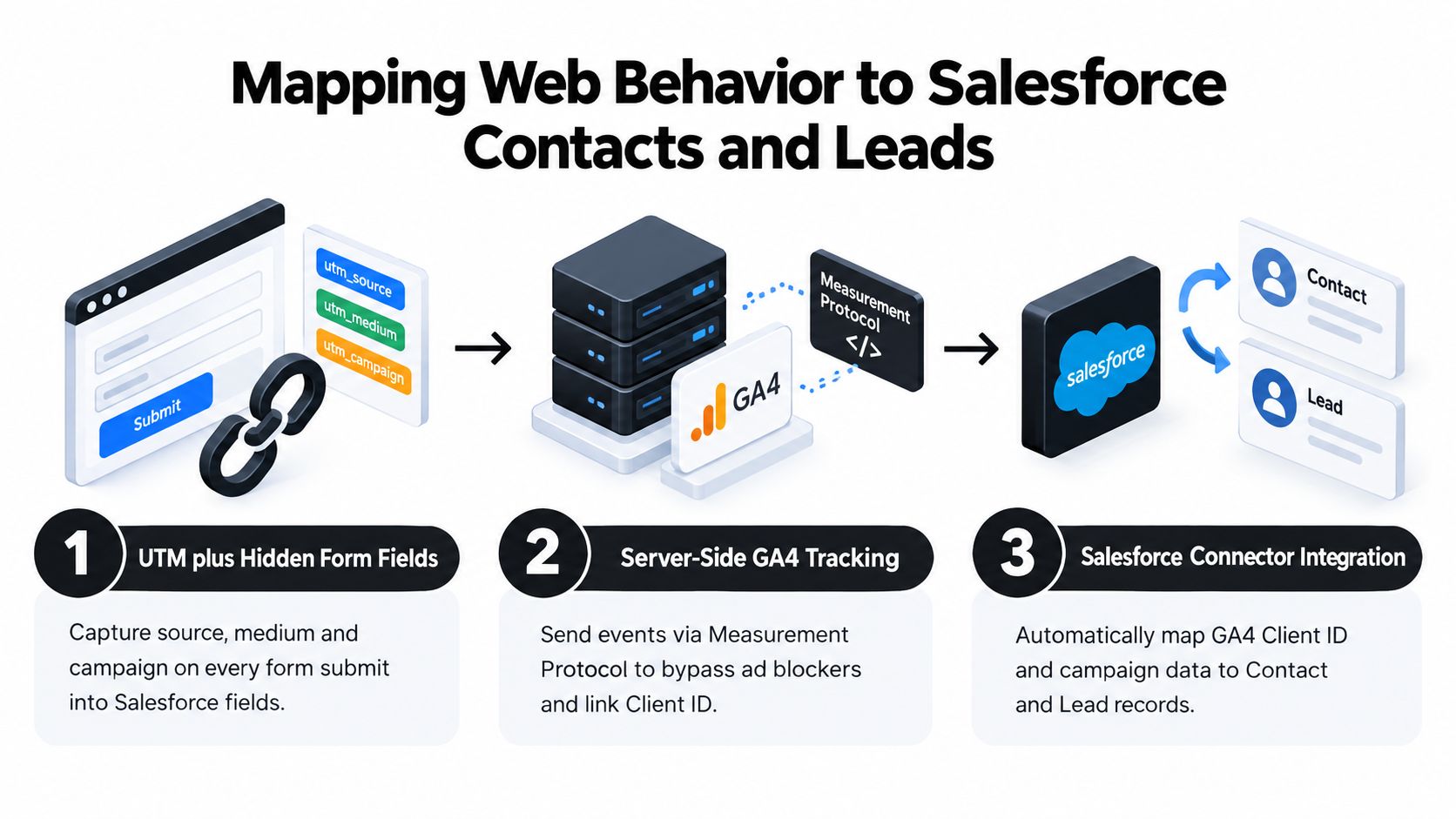
Use the least complex path that meets the client's needs. Most agency implementations fit one of three patterns, moving from browser-level capture to server-side collection and then to managed connector workflows.
Start with UTMs and hidden form fields
For a client with conventional lead forms, begin with a strict campaign taxonomy. Define allowed values for source, medium, campaign, content, and term. Store the original values separately from the latest values so Salesforce can answer both “what first introduced this person?” and “what brought them back before conversion?”
A typical form implementation works like this:
- Persist campaign parameters: Save UTM values in first-party storage during the visit, subject to the client's consent and privacy requirements.
- Populate hidden fields: Copy the stored values into the form before submission. Test standard forms, embedded forms, single-page applications, and forms loaded after the page.
- Map CRM fields: Send original source, latest source, landing page, first-touch timestamp, latest-touch timestamp, GA4 client identifier where permitted, and form name into Salesforce.
- Match before creating: Search for an existing lead or contact using the client's approved matching rules. Don't create a new record because the same person submitted another form.
This method is affordable and transparent. It also breaks easily when redirects strip parameters, JavaScript fails, consent blocks storage, or an iframe prevents the parent page from passing values into the form.
For privacy-conscious implementation decisions, use this privacy-smart visitor tracking guide alongside the client's legal and consent requirements.
Add server-side GA4 for fragile client-side capture
Client-side tracking is convenient, but browsers, extensions, consent settings, and script errors can interrupt collection. Server-side GA4 tracking lets the implementation send selected events through the Measurement Protocol, with the agency controlling which fields are transmitted and how they're validated.
The important design choice is the identity handoff. Preserve the GA4 client identifier for anonymous activity, then connect it to a Salesforce lead or contact when the visitor submits a form, books a meeting, or otherwise provides an approved identifier. Store the relationship in a durable mapping table or equivalent system rather than trying to infer it from pageviews later.
Map behavior to business objects deliberately:
- Lead or contact: email, CRM record ID, GA4 client ID, consent state, original source, latest source.
- Opportunity: opportunity ID, account ID, stage changes, amount, created date, close status.
- Marketing events: page view, content engagement, form submission, booking, campaign parameters, event timestamp.
Server-side tracking improves control and resilience, but it adds engineering responsibility. The agency must manage event schemas, retries, consent enforcement, duplicate prevention, and monitoring. It won't repair inconsistent campaign naming or a Salesforce process that overwrites source fields without preserving history.
Use connectors when repeatability matters
No-code and managed connectors are useful when the agency needs to deploy a similar pattern across clients without building a custom pipeline each time. Tools such as Zapier, native GA4 connectors, warehouse integrations, and dedicated attribution platforms can move lead events, campaign metadata, and CRM updates between systems.
The workflow should remain explicit:
- Capture the anonymous session: Store the client ID, landing page, source parameters, and key events.
- Resolve the person: Match the new submission to an existing Salesforce record using approved identifiers.
- Write the relationship: Attach the marketing touchpoint or journey reference to the lead, contact, or opportunity.
- Sync outcomes back: Send qualified stages and revenue states into the attribution system, then use reconciled outcomes for analysis and permitted ad-platform feedback.
A platform such as SourceLoop can capture first-party journeys, connect conversions and revenue to touchpoints, sync with Salesforce and other CRMs, and send qualified offline conversion signals back to advertising platforms. It's one option for agencies that need a managed multi-client attribution workflow rather than assembling each connection independently.
For a field-by-field implementation pattern, see this guide to tracking marketing attribution in Salesforce CRM.
The cleanest rollout starts with one client and one conversion path. Prove that an anonymous session can become a deduplicated Salesforce record, then expand to opportunities, calls, bookings, and offline outcomes.
Here's a short visual walkthrough you can use to explain the tracking handoff to a client or developer:
Turning Integrated Data Into Attribution and Pipeline Reports
Once GA4 behavior and Salesforce outcomes share a reliable key, reporting must answer the client's commercial questions. Which sources influenced qualified pipeline? Which journeys preceded opportunity movement? Where should the agency change investment? A session table cannot answer those questions on its own.
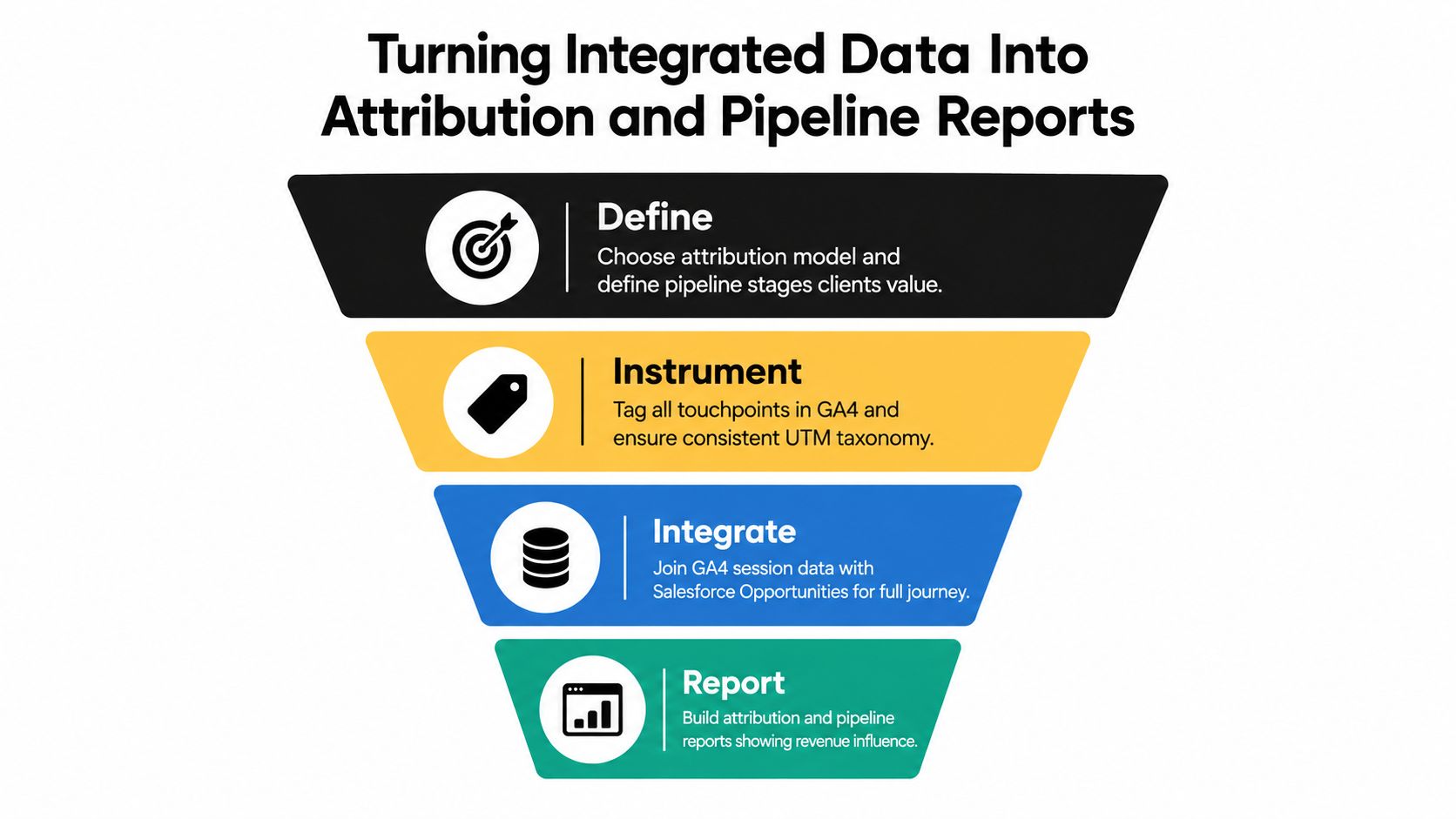
Use the workflow Define → Instrument → Integrate → Model → Analyze → Optimize → Communicate. Agency attribution guidance recommends defining meaningful outcomes before choosing a model, which prevents teams from selecting a dashboard first and forcing the data to fit it. (Pedowitz Group's campaign attribution guidance for agencies)
Define the outcome before selecting the model
Agree with the client on the stages that matter. A form fill can diagnose demand volume, while pipeline creation, qualified opportunity, stage progression, and closed revenue support stronger budget decisions. Document definitions, inclusion and exclusion rules, ownership, and refresh timing in a shared measurement plan.
Select one primary model the account team can explain, such as W-shaped or position-based attribution. Compare it with a secondary model each month. The purpose is not to crown one permanently correct model. It is to identify channels that remain valuable across reasonable views and channels whose credit changes enough to warrant investigation.
A Salesforce report should connect marketing activity to the CRM lifecycle:
| Report Layer | Useful Fields | Agency Question |
|---|---|---|
| Acquisition | Original source, campaign, landing page, first-touch date | How did the relationship begin? |
| Engagement | Sessions, content events, return visits, assisted touches | What helped the prospect evaluate? |
| Pipeline | Lead status, opportunity stage, source history | Which activity influenced sales progress? |
| Revenue | Opportunity amount, closed status, close date | Where did commercial value appear? |
Optimize for pipeline per dollar
Cost per lead can reward inexpensive, unqualified volume. Compare spend with pipeline created or advanced, using the client's agreed stage definitions. That keeps the report relevant to marketing and sales because it follows the outcome the business funds.
Validate the pattern with cohort and path analysis before reallocating budget. A channel may look strong because it captures branded demand late in the journey. Another may perform poorly in last-click reporting while repeatedly appearing in paths that later produce qualified opportunities.
The guide to measuring marketing performance and connecting metrics to decisions offers useful context for turning measurement choices into operating decisions. Keep the report practical: show the current model, comparison model, pipeline value, stage movement, data coverage, and the agency's recommended action.
Add validation instead of presenting attribution as causality
MTA describes observed journeys. It does not prove that every credited touchpoint caused the outcome. Add experiments, holdouts, or marketing mix analysis for mature accounts, then compare those findings with user-level attribution.
Report three ideas separately: platform-reported credit, observed influence across the journey, and validated incremental impact. That distinction matters when platform conversions disagree with Salesforce pipeline truth. It also helps agencies assess AI-driven discovery, where prospects may encounter a brand through generated answers or other intermediary experiences before arriving through a measurable channel. Clients can then see what the tools recorded, what the CRM confirms, and which conclusions still require testing.
Troubleshooting Common GA4 and Salesforce Sync Issues
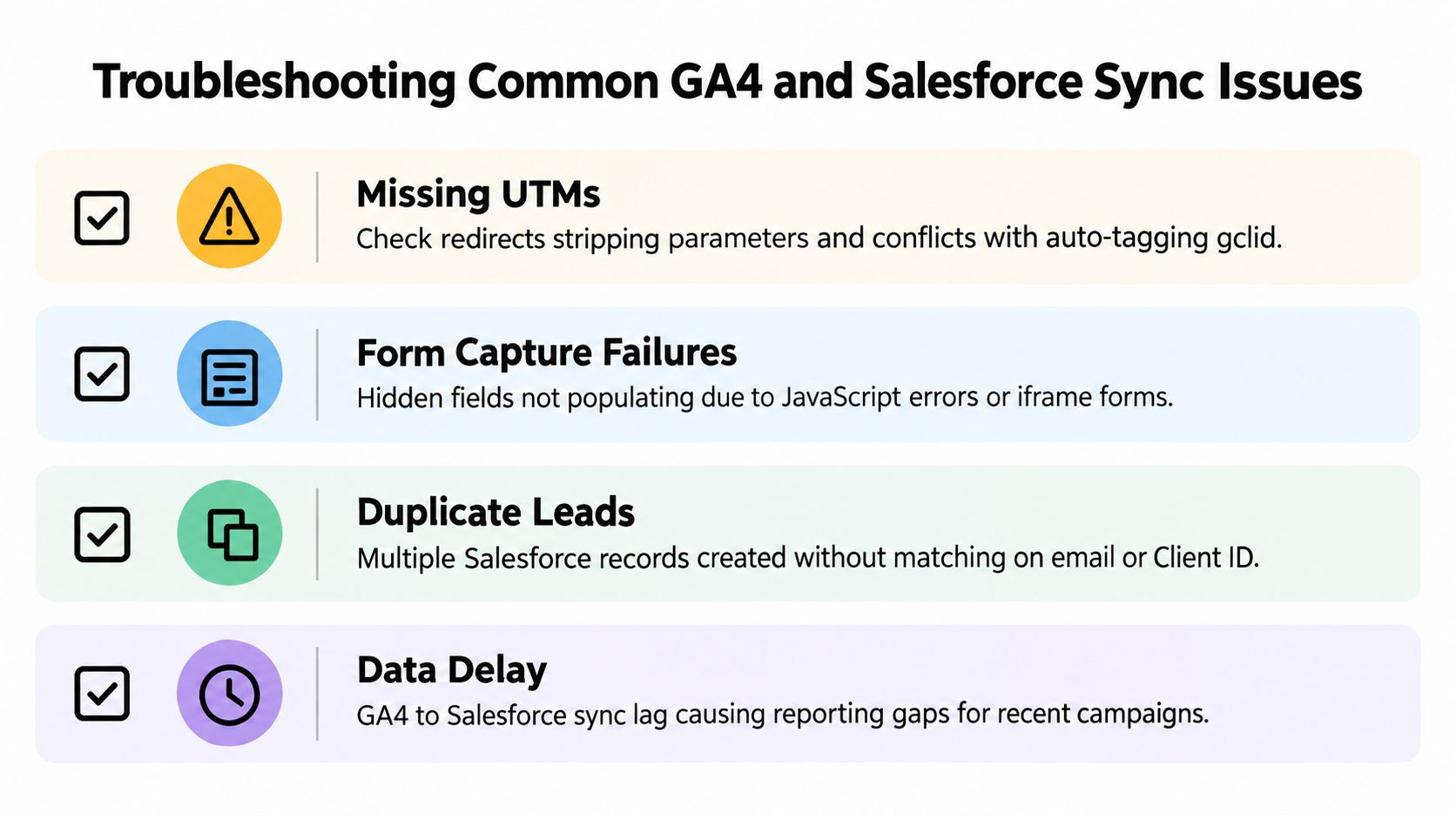
A connected stack can still produce a wrong report. Most failures aren't caused by an exotic modeling error. They come from ordinary implementation problems that remove campaign context, split identities, or place events on different timelines.
Missing UTMs after a redirect
Symptom: Paid traffic appears as direct, referral, or an unclassified source.
Likely cause: A redirect, link shortener, consent flow, or intermediate landing page removes query parameters. Auto-tagging can also create a conflict if the implementation expects manual UTMs but relies on a platform identifier such as gclid.
Quick fix: Test the complete click path from the live ad, not from a copied URL. Inspect the destination after every redirect, preserve the original campaign values, and define precedence rules for manual and automatic tagging. Keep original and latest source fields separate in Salesforce so a later direct visit doesn't erase acquisition context.
Form submissions don't carry the session
Symptom: Salesforce receives a lead, but source, landing page, or GA4 client ID is blank.
Likely cause: A JavaScript error prevents hidden fields from populating, the form sits inside an iframe, or the submission happens through an external form handler.
Quick fix: Submit test records from multiple browsers and devices, inspect the payload before it leaves the page, and verify the Salesforce field mapping. For iframes, use the vendor's supported parent-child communication method or capture the parameters at the form provider before sending them to Salesforce.
Debugging habit: Test the browser event, the connector payload, the Salesforce record, and the final report as four separate checkpoints.
Duplicate leads distort conversion counts
Symptom: One person appears as several leads, each with a different source or campaign.
Likely cause: The integration creates a record on every submission and doesn't match against existing email, phone, contact ID, or client ID. Imports and sales-created records can create another version of the same problem.
Quick fix: Agree on matching rules with the Salesforce owner, then configure deduplication before expanding the campaign. Preserve multiple touchpoints on one person or opportunity instead of creating multiple people to represent those touches.
Recent campaigns look incomplete
Symptom: GA4 shows activity, but Salesforce reports don't yet include the corresponding stage or opportunity updates.
Likely cause: Sync latency, failed API jobs, timezone differences, or a report filter that excludes recently created records.
Quick fix: Display ingestion time and source-system timestamps separately. Check connector logs, retry failed jobs, normalize timestamps, and label recent data as provisional until the expected sync window has passed. Don't reallocate spend based on a partial cohort.
Independent market data reinforces why these checks matter. Data integration is cited as the top attribution barrier by 65.7% of marketers, while 42% cite lack of expertise and 41% cite difficulty tracking customer touchpoints. (Flint's attribution accuracy statistics) The same source reports tracking gaps among 62% of marketers using phone calls and 36% using form submissions, so call capture, form validation, CRM deduplication, and identity resolution deserve explicit test cases.
Final Checklist for Rolling Out Attribution Across Clients
A reusable agency rollout should produce the same core controls for every client, even when the tools differ.
- Document the business outcome: Define qualified lead, opportunity, stage progression, and revenue rules with the client's sales team.
- Standardize campaign data: Publish UTM naming rules, allowed values, source precedence, and ownership for campaign creation.
- Choose the lightest viable stack: Use hidden fields and connectors for simple lead flows. Add server-side tracking, call capture, identity resolution, and revenue sync when the client's journey demands them.
- Map Salesforce carefully: Preserve original and latest touchpoints, match existing records before creation, and attach activity to opportunities where the sales process requires it.
- Validate before launch: Test ads, redirects, forms, calls, bookings, consent states, duplicate submissions, failed syncs, timestamps, and dashboard filters.
- Report the commercial outcome: Show pipeline per dollar, opportunity progression, revenue influence, coverage gaps, and the recommended action.
- Reconcile every month: Compare platform-reported conversions with deduplicated conversions and Salesforce outcomes. Use a secondary model and path or cohort analysis to challenge the primary view.
- Record AI discovery separately: Capture known referral context and content influence where possible, and label unobservable or self-reported AI-assisted discovery rather than forcing it into an inaccurate channel.
Email and CRM attribution also depend on dependable operational data. If email is part of the client journey, pair campaign tracking with a practical resource such as this email deliverability guide, because an untracked or poorly delivered message can't be evaluated fairly.
The best marketing attribution tools for agencies aren't the ones with the longest feature pages. They're the ones that let your team repeat a trustworthy process across accounts, from first visit to Salesforce pipeline and revenue. Pilot the full workflow with one client, reconcile it against backend records, document what broke, and turn the corrected setup into your agency template. Then scale only the controls that survived that test.

 Paid Social


