
First Touch Attribution: When It Works & When It Fails (2026)
Master first touch attribution: uncover its pros, cons, pitfalls, and best practices. See how SourceLoop helps streamline your marketing strategy.
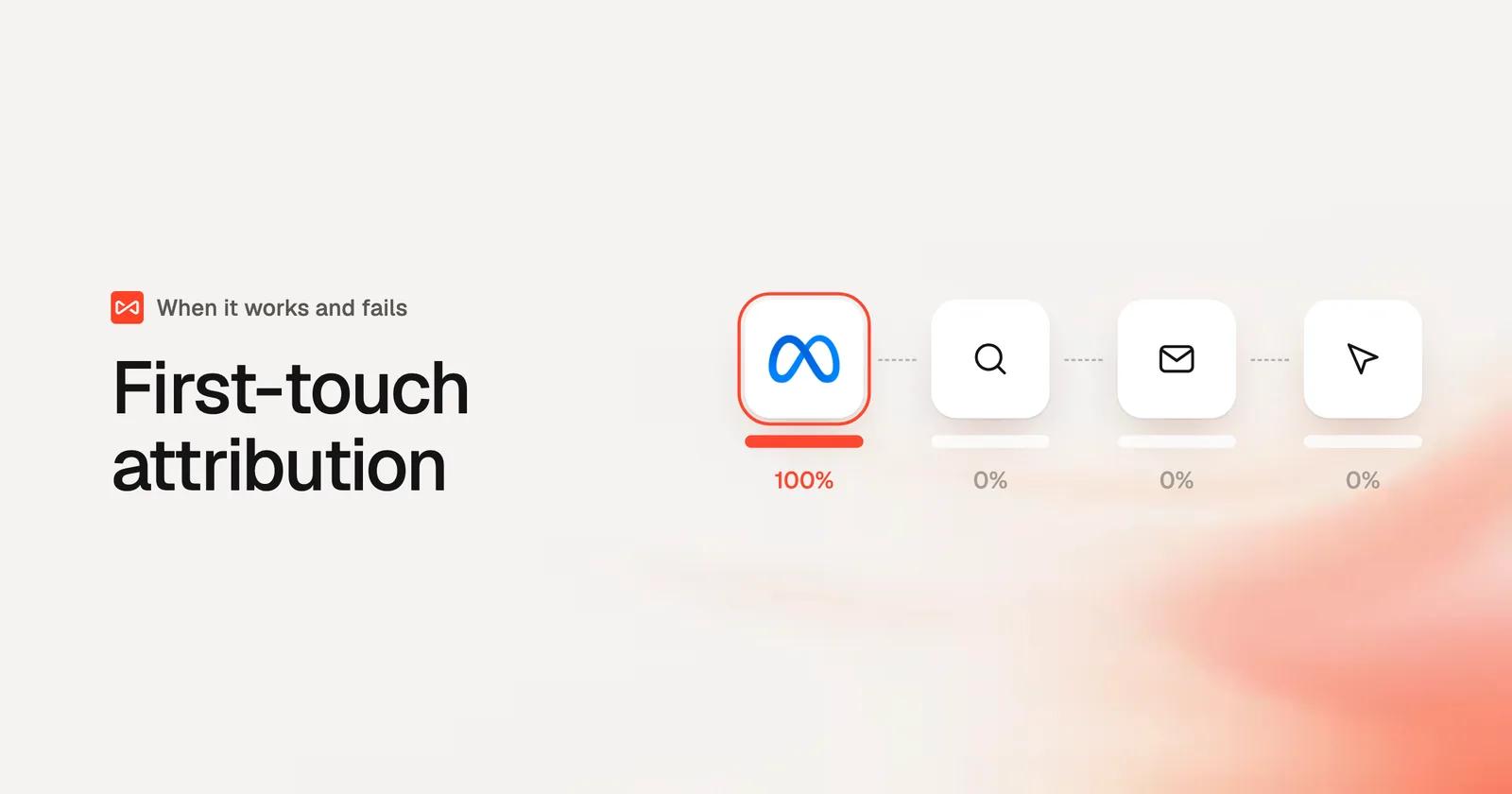
First-touch attribution is a marketing attribution model that assigns 100% of conversion credit to the very first interaction a prospect has with your brand. When someone clicks your Facebook ad today and converts three weeks later after six more touchpoints, the Facebook ad gets full credit.
What Is First-Touch Attribution?
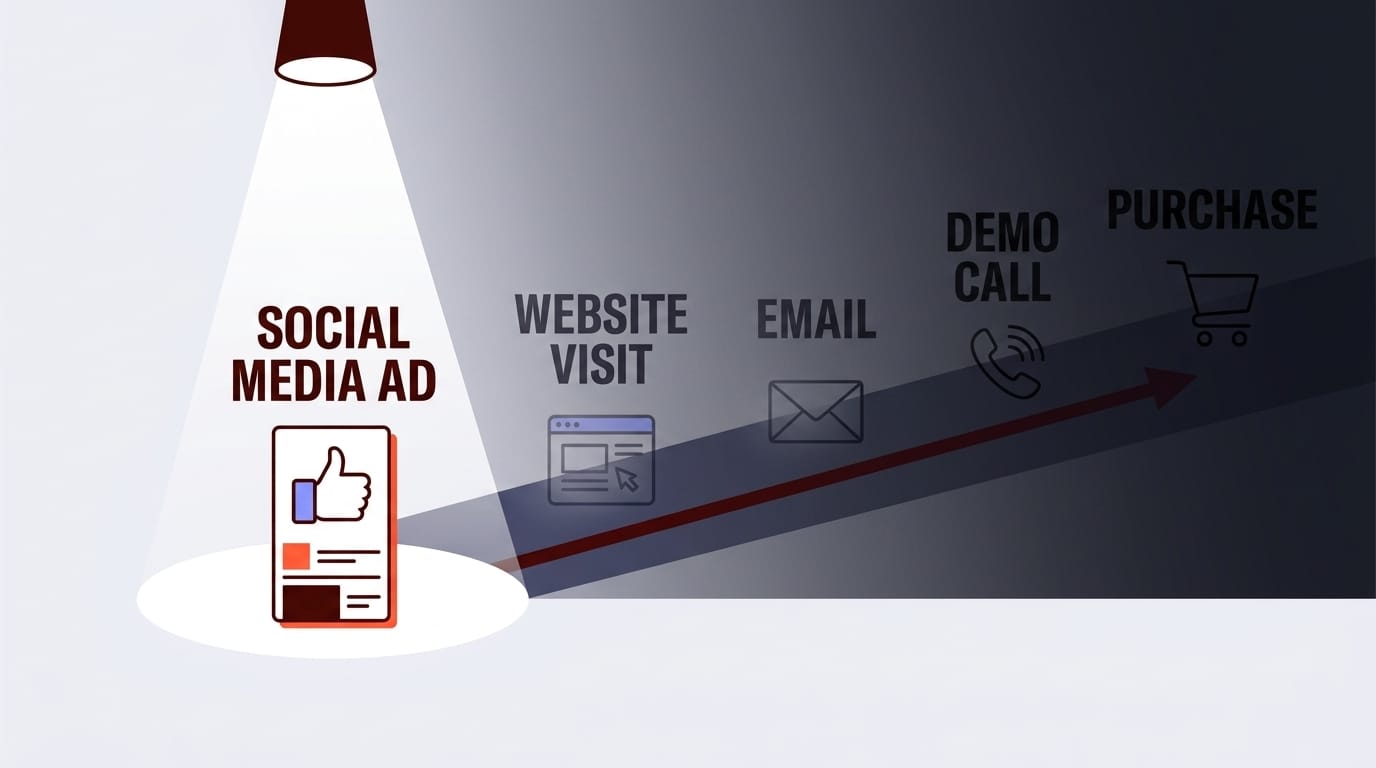
First-touch attribution is a single-touch attribution model that gives complete credit for a conversion to the initial touchpoint in the customer journey. Unlike multi-touch attribution models that distribute credit across multiple interactions, first touch focuses exclusively on the channel or campaign that introduced a prospect to your brand.
Here's how it works in practice.
Sarah discovers your SaaS product through a LinkedIn ad on Monday.
She visits your website via organic search on Wednesday, downloads a whitepaper on Friday, attends a webinar the following week, and finally books a demo after receiving a nurture email.
Under first-touch attribution, the LinkedIn ad receives 100% of the credit for Sarah's demo booking. The organic search, whitepaper, webinar, and email receive zero credit.
The model operates on a straightforward premise: the first interaction sparked the entire journey. Without that initial touchpoint, the prospect would never have entered your funnel. This makes first touch particularly valuable for measuring brand awareness campaigns and top-of-funnel marketing efforts.
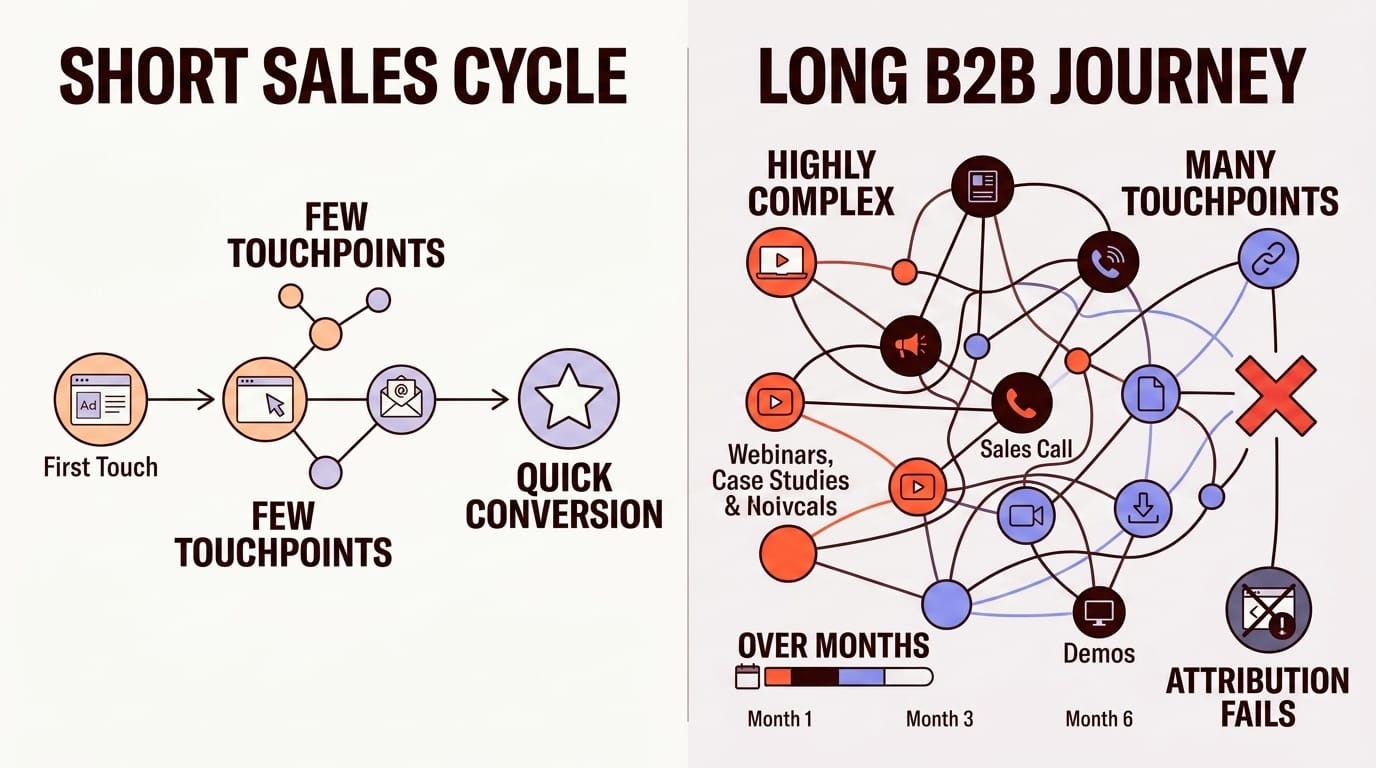
According to Dreamdata's 2022 B2B benchmarks, the average B2B buyer interacts with a brand across 100+ touchpoints over 192 days before converting. In these scenarios, crediting only the first interaction oversimplifies a complex buying process.
How First-Touch Attribution Works
The mechanics of first-touch attribution depend on three core components: tracking identifiers, source tagging, and data persistence.
Tracking identifiers establish a persistent record of each prospect. Most implementations use browser cookies that timestamp the first session. When someone visits your site for the first time, the system writes a cookie containing the traffic source, campaign details, and timestamp. This identifier persists across future visits.
Source tagging distinguishes where traffic originates. UTM parameters on paid and organic links provide channel, campaign, and creative-level detail. A properly tagged LinkedIn ad URL might look like: yoursite.com?utm_source=linkedin&utm_medium=paid-social&utm_campaign=q1-demand-gen&utm_content=video-ad-v2
Data persistence ensures the first-touch value never changes. When a prospect fills out a form, the system writes the first-touch source to a CRM field like "Lead Source" or "Original Source." Even if the prospect returns through different channels, that original value remains locked.
The process breaks down in predictable ways. Cookies expire or get deleted. Prospects switch devices. Links get shared without UTM parameters. According to Improvado's attribution research, marketing teams should expect 15-25% of conversions to attribute to "direct" or "unknown" sources due to these tracking gaps.
The Real Cost of Getting First-Touch Attribution Wrong
Most articles tell you first-touch attribution "oversimplifies" the customer journey.
That's true, but vague. Here's what actually happens when you optimize marketing spend based solely on first-touch data.
Scenario 1: The content marketing trap
A B2B SaaS company runs first-touch attribution and discovers that 60% of their pipeline originates from organic blog traffic. They triple their content budget and cut retargeting spend by 50%. Three months later, pipeline drops 35%. Why? Those blog posts generated awareness, but retargeting ads and nurture emails actually closed deals. First-touch attribution made the blog posts look like revenue drivers when they were really just introduction points.
Scenario 2: The paid social illusion
An agency sees that LinkedIn ads generate 400 first-touch conversions per month while Google Ads generates only 80. They shift 70% of paid budget to LinkedIn. Six months later, revenue per lead drops 40%. The LinkedIn ads brought in early-stage prospects who needed extensive nurturing. The Google Ads captured high-intent searchers ready to buy. First touch couldn't distinguish between awareness and intent.
Scenario 3: The partner program disaster
A company credits 100% of conversions to partner referral links using first-touch attribution. They pay partners based on these numbers. Sales complains that "partner leads" never close. Investigation reveals that partners share links broadly, generating clicks from unqualified prospects.
The actual sales come from prospects who clicked a partner link months ago but converted after engaging with direct sales outreach. First touch credited the wrong channel and paid partners for leads they didn't actually influence.
According to SaaSHero's 2026 attribution analysis, organizations relying exclusively on first-touch attribution misallocate up to 60% of marketing spend in long sales cycles. The error compounds over time as you continue investing in channels that generate awareness but not revenue.
When First-Touch Attribution Actually Works
First-touch attribution isn't inherently bad. It's a tool that works brilliantly in specific contexts. Here's when to use it.
### Short Sales Cycles (Under 14 Days)
E-commerce stores, small-ticket B2B SaaS, and consumer subscription services often see prospects convert within hours or days of first contact. When the journey contains three or fewer touchpoints, first touch approximates actual influence.
A Shopify store selling fitness equipment might see this journey: prospect clicks Instagram ad → browses product pages → purchases same day. The Instagram ad genuinely drove that sale. First-touch attribution accurately reflects reality.
New Market Entry and Brand Building
When launching in a market where your brand has zero recognition, first-touch data reveals which channels introduce prospects to your category. A cybersecurity vendor expanding into healthcare might discover that 70% of first touches come from trade publication ads and conference sponsorships, while only 15% come from paid search.
This insight is actionable. It tells you where your target audience discovers new solutions. You can't optimize for conversions until you generate awareness. First touch measures awareness effectively.
Demand Generation Program Evaluation
Marketing teams launching new content programs, paid media campaigns, or event sponsorships use first-touch data to measure how many prospects each initiative brings into the pipeline. A webinar series that generates 400 first-touch conversions but only 50 last-touch conversions is effective at awareness but weak at closing. Pair it with nurture sequences or retargeting to move prospects through the funnel.
Partner and Affiliate Attribution
Organizations running partner referral programs or affiliate networks use first-touch attribution to credit the originating partner. If a prospect clicks an affiliate link, browses for three weeks, and converts via direct traffic, first touch ensures the affiliate receives credit and commission. Last-touch attribution would incorrectly credit direct traffic and deny the affiliate payment.
The Decision Framework: Should You Use First-Touch Attribution?
Use this framework to determine whether first-touch attribution fits your business model.
Factor | First-Touch Works | First-Touch Fails |
|---|---|---|
Sales cycle length | Under 14 days | Over 30 days |
Touchpoints before conversion | Fewer than 5 | More than 10 |
Business model | Transactional, self-serve | Enterprise, committee-based buying |
Primary goal | Measure awareness and demand generation | Optimize full-funnel ROI |
Marketing sophistication | Early-stage, limited analytics resources | Mature, data-driven teams |
Channel mix | Primarily top-of-funnel (content, paid social, SEO) | Mix of awareness, nurture, and conversion tactics |
Attribution infrastructure | Basic tracking, single CRM | Multi-platform, complex tech stack |
If your business falls into the left column for most factors, first-touch attribution provides valuable insights. If you're in the right column, you need multi-touch attribution models that credit multiple interactions along the customer journey.
How to Implement First-Touch Attribution Correctly
Implementing first-touch attribution requires careful setup across your tracking infrastructure, CRM, and analytics platforms. Here's the step-by-step process.
Step 1: Audit Your Current Tracking
Document every traffic source, form, and conversion point. Identify which sources already carry UTM parameters and which arrive untagged. Check whether your CRM captures lead source data and whether that field persists or gets overwritten.
Most organizations discover that 30-50% of inbound traffic lacks source tagging. Common gaps include:
Email signatures and internal links
Social media posts from employees
Links shared in Slack or private messages
PDF downloads and shared documents
Offline sources like business cards and events
Step 2: Standardize UTM Tagging
Create a tagging taxonomy that distinguishes channel, campaign, and creative. Use consistent values across all paid and owned channels. Here's a recommended structure:
utm_source: The platform or publisher (linkedin, google, facebook, newsletter)
utm_medium: The marketing medium (paid-social, organic-search, email, referral)
utm_campaign: The specific campaign name (q1-demand-gen, product-launch-2026, webinar-series)
utm_content: The creative variant (video-ad-v2, carousel-ad, text-link)
utm_term: The keyword (for paid search campaigns)
Implement a URL builder to prevent manual tagging errors. Train any team member who creates links on the tagging standard. This includes marketers, sales, customer success, and product teams.
Step 4: Implement First-Touch Tracking with SourceLoop
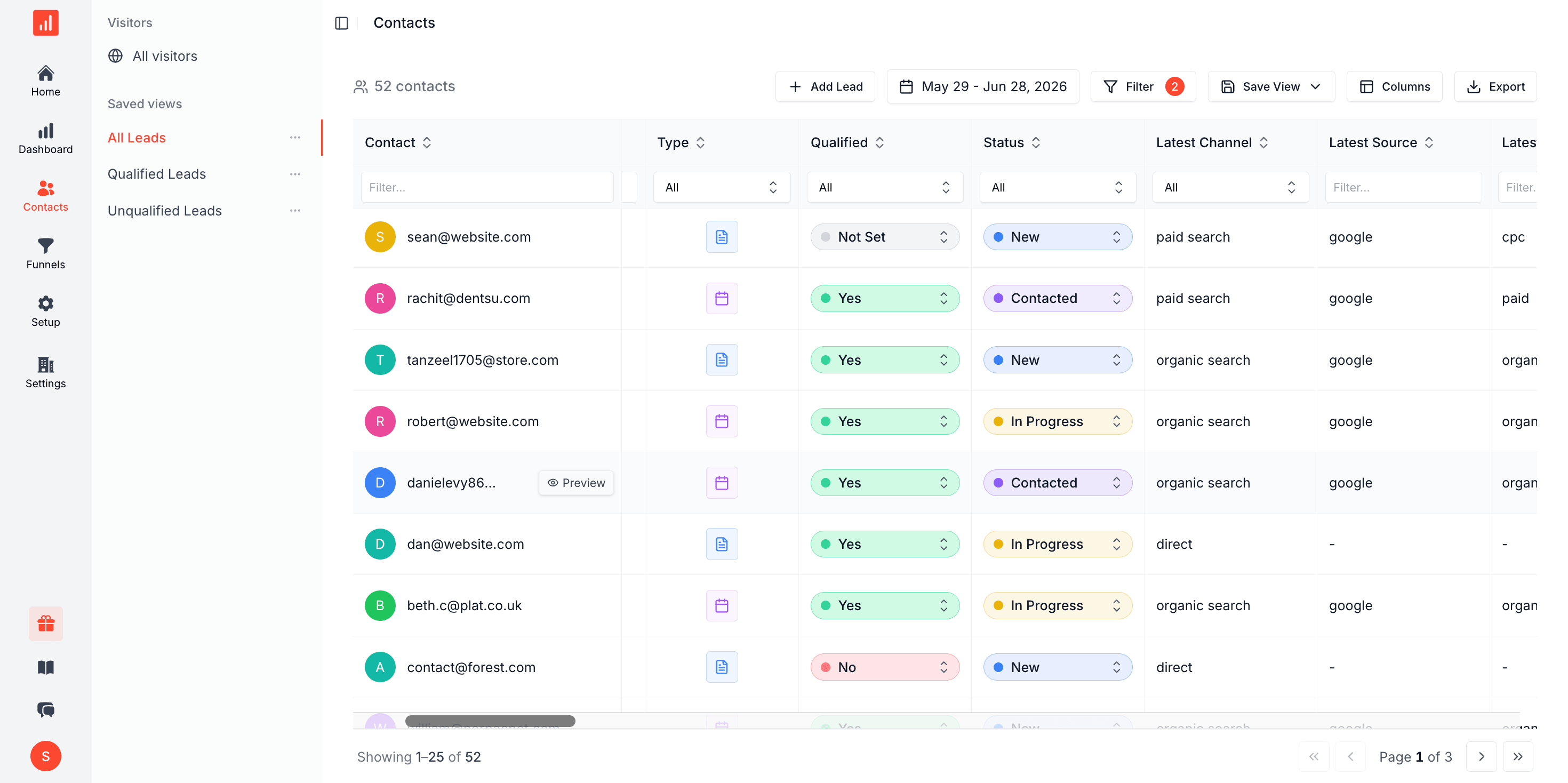
SourceLoop captures first-touch attribution across every marketing channel and syncs it directly to your CRM. Here's how it works:
Automatic UTM capture: SourceLoop's tracking script captures UTM parameters, referrer data, and landing pages from the first visit. The data persists in a first-party cookie on your domain, surviving cookie blockers and privacy restrictions.
CRM integration: When a prospect fills out a form, books a meeting, or converts through any channel, SourceLoop writes the first-touch source to your CRM's lead source field. The integration works with HubSpot, Salesforce, and Pipedrive.
Full journey visibility: While first touch shows where prospects originate, SourceLoop also tracks every subsequent touchpoint. You can see the complete path from first click to closed deal, enabling you to run first-touch and multi-touch attribution models side by side.
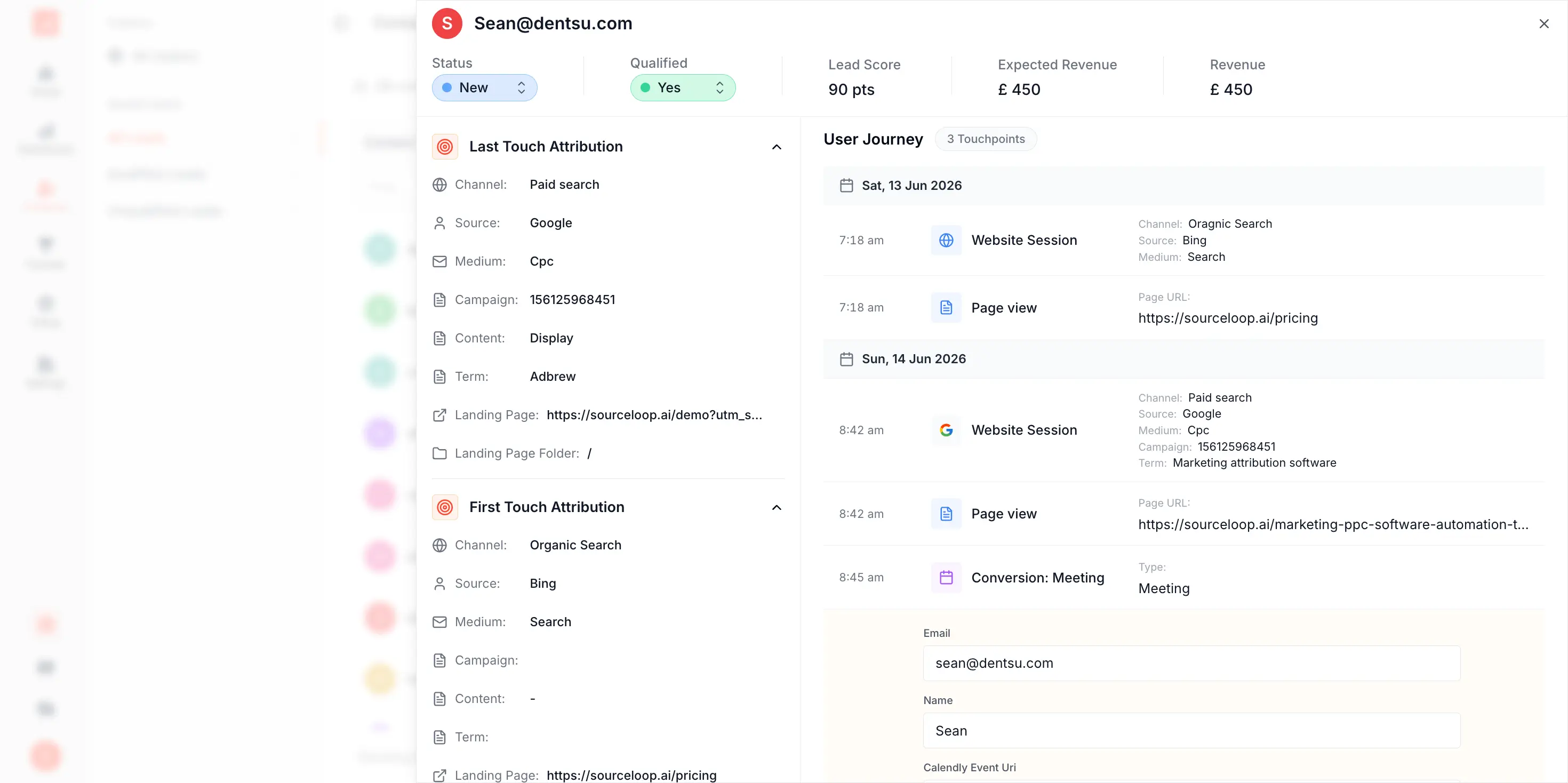
Revenue attribution: SourceLoop syncs deal values and won/lost status from your CRM, so you can measure first-touch attribution not just on lead volume but on actual revenue. This reveals which first-touch channels generate high-value customers versus low-value leads.
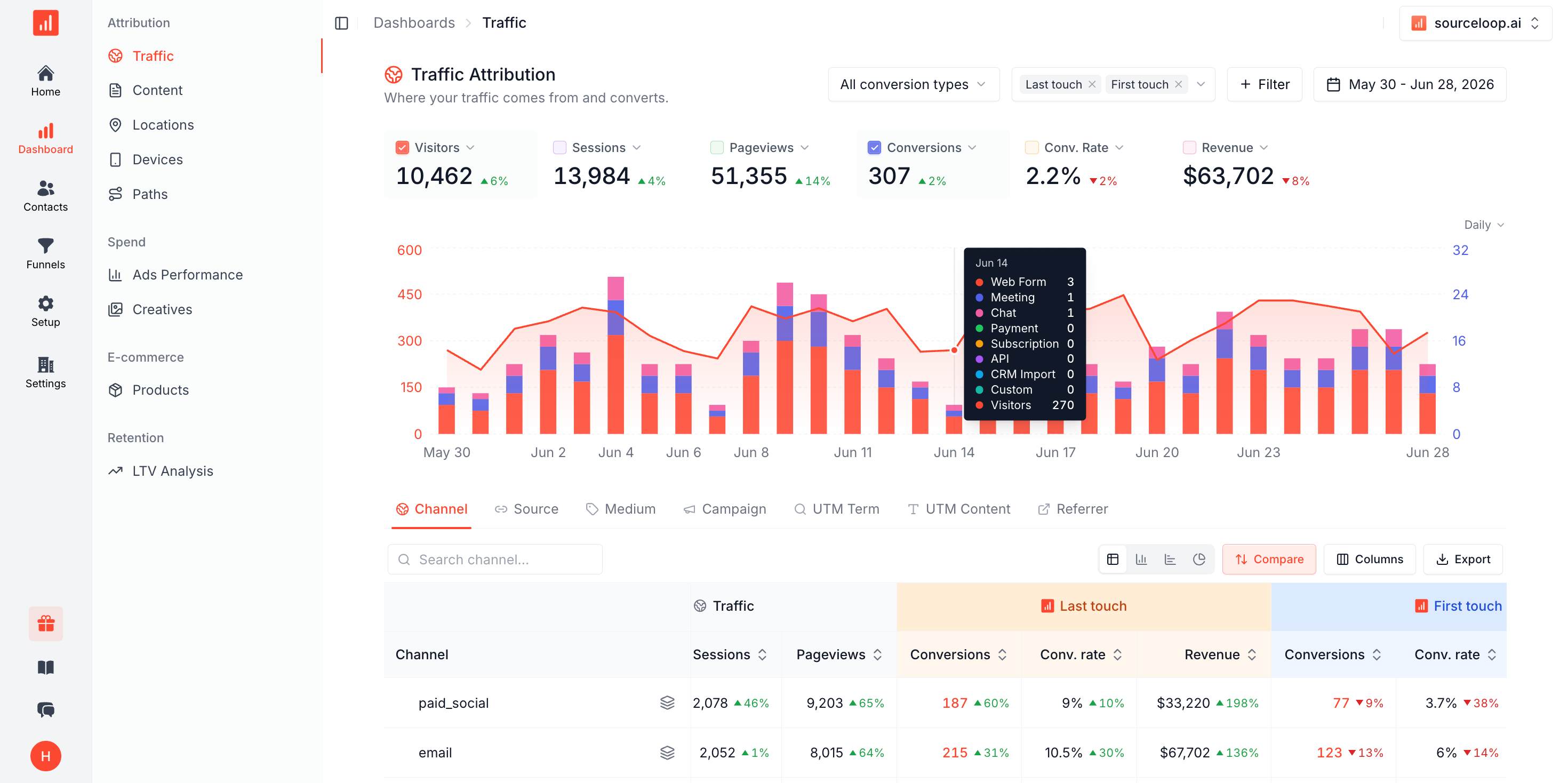
Implementation takes under 30 minutes. Add the SourceLoop tracking script to your website, connect your CRM, and define your conversion events. The platform handles UTM capture, identity stitching, and attribution logic automatically.
Step 5: Build Validation Reports
Create a dashboard that shows first-touch distribution across all conversions. Look for red flags:
More than 30% attributed to "direct" or "unknown"
Sudden channel shifts without corresponding campaign changes
Zero attribution for channels you know are active
Discrepancies between GA4 and CRM lead source data exceeding 15%
These signals indicate tracking gaps or configuration errors. Schedule monthly audits to identify new untagged sources, CRM sync failures, and attribution drift.
Step 6: Run Parallel Attribution Models
Don't rely exclusively on first-touch data. Run last-touch, linear multi-touch, and time-decay models in parallel. Compare how different models allocate credit across channels.
Channels that perform well in first touch but poorly in last touch are strong at generating awareness but weak at driving conversions.
They need supporting tactics to move prospects through the funnel. Channels that rank low in first touch but high in multi-touch are conversion drivers that depend on other channels to generate pipeline.
First-Touch Attribution vs. Other Attribution Models
Understanding how first-touch attribution compares to other models helps you choose the right approach for your business.
First-Touch vs. Last-Touch Attribution
Last-touch attribution assigns 100% credit to the final interaction before conversion. It's the opposite of first touch.
Dimension | First-Touch Attribution | Last-Touch Attribution |
|---|---|---|
What it measures | Top-of-funnel awareness and demand generation | Bottom-of-funnel conversion and closing tactics |
Optimization focus | Content marketing, paid social, SEO, brand campaigns | Retargeting, sales calls, email nurture, demo requests |
Ideal for | New market entry, brand building, awareness measurement | Lead capture optimization, direct-response campaigns |
Blind spot | Ignores nurture, remarketing, and sales touchpoints | Ignores how prospects discovered you initially |
Budget risk | Over-invests in awareness while under-funding conversion | Over-invests in retargeting while starving new audience acquisition |
First touch tells you which channels bring new names into the pipeline. Last touch tells you which channels close them. Neither tells you what happened in between.
First-Touch vs. Multi-Touch Attribution
Multi-touch attribution spreads credit across multiple touchpoints, recognizing the contribution of each interaction. Common multi-touch models include:
Linear attribution: Distributes credit equally across all touchpoints. If a prospect had five interactions before converting, each receives 20% credit.
Time-decay attribution: Gives more credit to interactions closer to the conversion. The most recent touchpoint might receive 40% credit, while the first touchpoint receives 10%.
Position-based attribution (U-shaped): Assigns the most credit to the first and last touchpoints (typically 40% each), with the remaining 20% spread among middle interactions.
Data-driven attribution: Uses machine learning to weight each touchpoint based on observed conversion patterns. GA4's data-driven model increases accuracy by 25-40% for B2B organizations compared to rules-based models.
Multi-touch models provide a more complete view of the customer journey but require sophisticated tracking infrastructure and more complex analysis. For organizations with sales cycles exceeding 30 days or more than five touchpoints before conversion, multi-touch attribution delivers more accurate ROI calculations than first touch alone.
Common First-Touch Attribution Mistakes (And How to Avoid Them)
Even teams that implement first-touch attribution correctly often make strategic errors that undermine its value. Here are the most common mistakes.
Mistake 1: Using First-Touch as Your Only Attribution Model
First touch measures one thing: where prospects discover your brand. It cannot measure full-funnel influence. Teams that optimize solely for first-touch metrics risk cutting budgets from high-performing conversion channels because those channels appear to generate no pipeline.
Solution: Run first-touch alongside multi-touch models. Compare the two reports monthly. Use first touch to inform demand generation strategy and multi-touch to allocate budgets across the full funnel.
Mistake 2: Ignoring Attribution Gaps
When 30-50% of conversions attribute to "direct" or "unknown," your first-touch data is unreliable. These gaps typically stem from missing UTM parameters, cookie deletion, cross-device journeys, or dark social sharing.
Solution: Implement strict UTM tagging standards, add hidden form fields that capture UTM parameters even when cookies are blocked, and use a customer data platform for cross-device identity resolution. Tools like SourceLoop reduce attribution gaps by capturing first-party data on your own domain, bypassing cookie blockers and privacy restrictions.
Mistake 3: Treating All First Touches Equally
A prospect who clicks a paid ad and converts within 24 hours is fundamentally different from a prospect who reads a blog post and converts six months later. First-touch attribution treats both scenarios identically, assigning 100% credit to the initial interaction.
Solution: Segment first-touch data by time to conversion. Track how prospects from each first-touch channel convert over 7, 30, 60, and 90 days. Channels that bring in high volume but convert slowly need stronger mid-funnel nurture. Channels that convert quickly deserve higher budget allocation.
Mistake 4: Failing to Connect Attribution to Revenue
Measuring first-touch attribution on lead volume alone creates a dangerous blind spot. A channel might generate 500 leads per month but convert at 0.5% to customers. Another channel generates 100 leads converting at 8%. The first channel looks better in lead-volume reports but delivers less revenue.
Solution: Connect first-touch attribution to closed deals and revenue. SourceLoop syncs deal values and won/lost status from your CRM, enabling you to measure first-touch attribution on actual revenue rather than just lead counts. This reveals which first-touch channels generate high-value customers versus low-value leads.
Mistake 5: Not Accounting for Offline Touchpoints
First-touch attribution focuses on digital interactions, overlooking offline touchpoints like in-person events, phone calls, direct mail, or trade show conversations. A prospect might discover your brand at a conference, research online, and convert via a web form. First-touch attribution credits the web form or the first digital session, ignoring the conference that actually introduced them.
Solution: Add a "How did you hear about us?" field to high-value conversion forms. Include options for offline sources like events, referrals, and direct outreach. Use this data to supplement digital first-touch attribution and identify offline channels that drive awareness.
When to Transition from First-Touch to Multi-Touch Attribution
Your business will eventually outgrow first-touch attribution. Here are the signals that indicate it's time to adopt multi-touch models.
Signal 1: Sales cycle exceeds 30 days. When prospects take more than a month to convert, the first touchpoint has minimal influence on the final decision compared to mid-funnel and bottom-funnel interactions.
Signal 2: Average touchpoints before conversion exceed 10. If prospects engage with your brand across ten or more interactions before converting, first touch captures less than 10% of the actual influence.
Signal 3: Marketing team exceeds five people. Larger teams run multiple campaigns across awareness, consideration, and decision stages. First-touch attribution cannot measure the performance of mid-funnel and bottom-funnel tactics, creating blind spots in team performance evaluation.
Signal 4: You're running retargeting and nurture campaigns. If you invest in remarketing ads, email sequences, or sales development, first-touch attribution makes these channels invisible. You'll systematically under-fund the tactics that actually close deals.
Signal 5: Sales complains about lead quality. When sales reports that "marketing leads never close," it often indicates a mismatch between awareness-focused first-touch optimization and the actual channels that drive qualified pipeline.
Signal 6: Budget exceeds $50,000 per month. At this spend level, attribution accuracy directly impacts ROI. A 10% improvement in attribution accuracy can shift $5,000 per month from low-performing to high-performing channels.
The transition from first-touch to multi-touch attribution doesn't require abandoning first-touch data. Keep running first-touch reports to measure awareness and demand generation. Add multi-touch models to measure full-funnel influence and optimize budget allocation across all stages of the customer journey.
Real-World First-Touch Attribution Examples
Here's how different types of businesses implement first-touch attribution in practice.
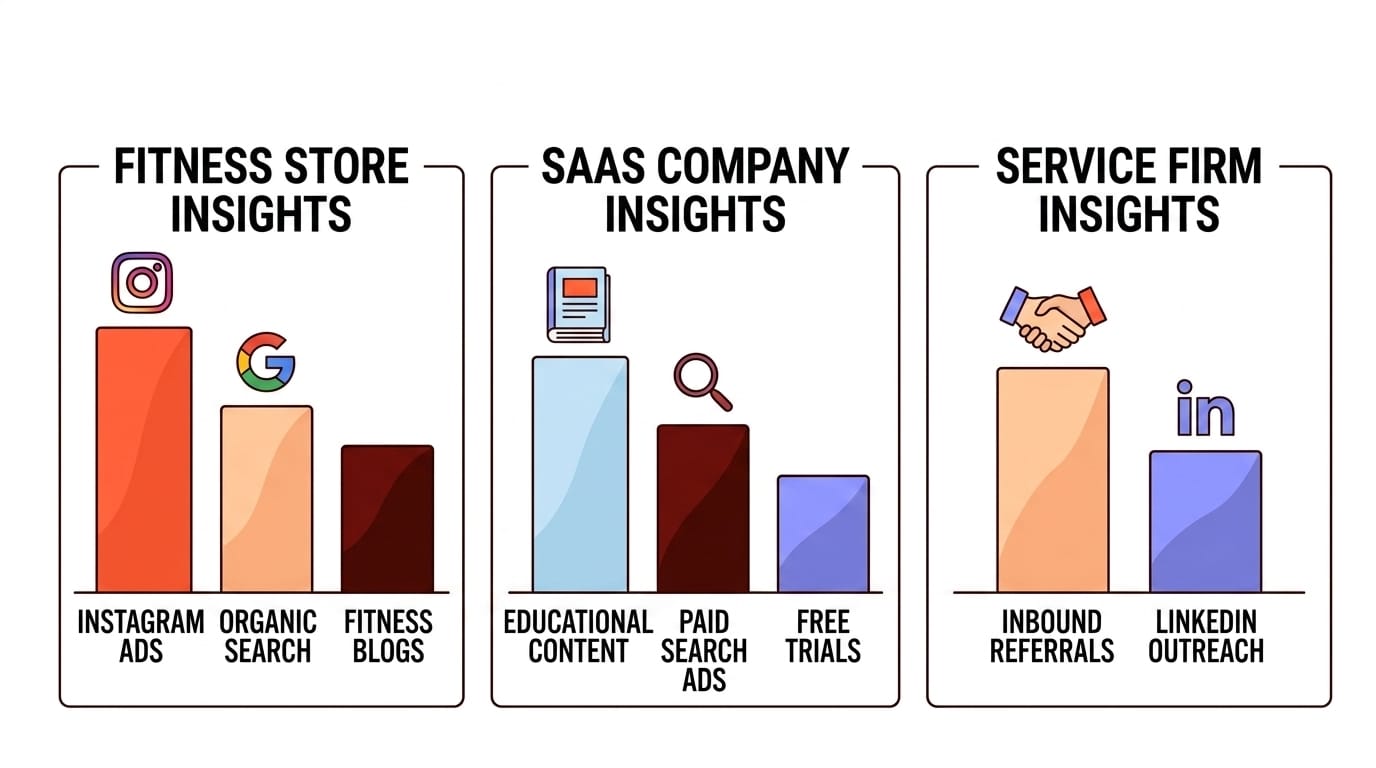
### Example 1: E-Commerce Store (Fitness Equipment)
Business model: Direct-to-consumer e-commerce selling fitness equipment, average order value $300, sales cycle 3-7 days.
First-touch implementation: Google Analytics 4 first user source/medium, integrated with Shopify for revenue attribution.
Key insight: 45% of first touches come from Instagram ads, 30% from organic search, 15% from YouTube, 10% from email. Instagram drives high volume but lower average order value ($250). Organic search drives lower volume but higher order value ($380).
Action taken: Maintained Instagram spend for volume but shifted creative strategy to promote higher-ticket products. Increased SEO investment to capture more high-value organic traffic.
Result: Overall revenue increased 22% while maintaining the same total ad spend.
Example 2: B2B SaaS (Project Management Tool)
Business model: Self-serve B2B SaaS, $49/month starting price, sales cycle 14-21 days, 6-8 touchpoints before conversion.
First-touch implementation: SourceLoop tracking integrated with HubSpot CRM, running first-touch and multi-touch attribution in parallel.
Key insight: First-touch data showed 60% of trials originated from organic blog content. Multi-touch data revealed that only 12% of paid customers had blog content as their first touch. Most paid conversions came from prospects who started with paid search or comparison pages.
Action taken: Continued investing in blog content for awareness but recognized it as a top-of-funnel channel. Increased budget for paid search and comparison content that drove actual conversions.
Result: Trial-to-paid conversion rate increased from 8% to 14% by optimizing for full-funnel attribution rather than first-touch alone.
Example 3: Professional Services (Marketing Agency)
Business model: B2B marketing agency, average deal size $50,000, sales cycle 60-90 days, 15-20 touchpoints before conversion.
First-touch implementation: Salesforce lead source field populated via form integrations, supplemented with "How did you hear about us?" field for offline sources.
Key insight: First-touch data showed 40% of leads originated from referrals, 25% from LinkedIn content, 20% from webinars, 15% from paid ads. However, closed-won analysis revealed that referral leads closed at 35% while LinkedIn leads closed at only 8%.
Action taken: Implemented a formal referral program with incentives for existing clients. Shifted LinkedIn strategy from broad awareness content to targeted account-based campaigns.
Result: Pipeline quality improved significantly. While total lead volume decreased 15%, closed-won revenue increased 40% due to higher-quality referral pipeline.
Frequently Asked Questions
What is first-touch attribution?
First-touch attribution is a marketing measurement model that assigns 100% of conversion credit to the first interaction a prospect has with your brand. If someone clicks your ad today and converts three weeks later after multiple touchpoints, the ad receives full credit for the conversion.
How does first-touch attribution differ from last-touch attribution?
First-touch attribution credits the initial interaction that introduced a prospect to your brand, focusing on top-of-funnel awareness and demand generation. Last-touch attribution credits the final interaction before conversion, focusing on bottom-of-funnel conversion tactics. First touch answers "where do prospects come from?" while last touch answers "what closes deals?"
When should I use first-touch attribution instead of multi-touch models?
Use first-touch attribution when your sales cycle is under 14 days with fewer than five touchpoints before conversion, when your primary goal is measuring brand awareness and demand generation channel performance, or when you're a new company building initial market awareness. For sales cycles exceeding 30 days or complex B2B buying journeys, use multi-touch attribution models that credit multiple interactions.
What tools can I use to implement first-touch attribution?
Google Analytics 4 tracks first-touch attribution natively through "first user source" dimensions. For CRM integration and revenue attribution, use SourceLoop, which captures first-touch data across all channels and syncs it directly to HubSpot, Salesforce, or Pipedrive. Other options include AppsFlyer for mobile app attribution and Improvado for enterprise marketing data pipelines.
Why do so many conversions show as "direct" or "unknown" in first-touch reports?
Attribution gaps occur due to cookie deletion, cross-device journeys, missing UTM parameters, dark social sharing (links shared in Slack or private messages), and privacy restrictions. Marketing teams should expect 15-25% of conversions to attribute to "direct" or "unknown" even with strong tracking infrastructure. Reduce gaps by implementing first-party tracking, standardizing UTM tagging, and using tools like SourceLoop that capture attribution data on your own domain.
Can I use first-touch attribution for B2B companies with long sales cycles?
You can, but you shouldn't rely on it exclusively. B2B companies average 192 days and 100+ touchpoints between first contact and closed deal. First-touch attribution provides valuable data on which channels generate awareness, but it cannot measure the mid-funnel nurture and bottom-funnel conversion tactics that actually close deals. Run first-touch alongside multi-touch attribution models to understand both awareness generation and full-funnel influence.
How do I connect first-touch attribution to actual revenue?
Integrate your attribution tracking with your CRM and sync deal values and won/lost status. SourceLoop automatically syncs closed deal data from HubSpot, Salesforce, and Pipedrive, enabling you to measure first-touch attribution on actual revenue rather than just lead counts. This reveals which first-touch channels generate high-value customers versus low-value leads.
What's the biggest mistake companies make with first-touch attribution?
The biggest mistake is using first-touch as your only attribution model and optimizing marketing spend solely based on first-touch data. This leads to over-investing in awareness channels while under-funding the conversion tactics that actually close deals. According to research, organizations relying exclusively on first-touch attribution misallocate up to 60% of marketing spend in long sales cycles. Always run first-touch alongside multi-touch models to measure full-funnel performance.
Conclusion: Use First-Touch Attribution as One Input, Not the Only Answer
First-touch attribution excels at one specific job: measuring which channels introduce prospects to your brand. For businesses with short sales cycles, transactional purchases, or early-stage awareness programs, this data drives smart channel allocation decisions.
But first-touch attribution cannot measure full-funnel influence. It ignores the content, emails, webinars, remarketing, and sales touchpoints that move prospects from consideration to decision. Marketing teams optimizing solely for first touch risk cutting budgets from high-performing conversion channels because those channels appear to generate no pipeline.
The solution isn't to abandon first-touch attribution. It's to use it as one input in a broader attribution strategy. Run first-touch alongside multi-touch models. Compare how different frameworks allocate credit. Identify channels that excel at awareness versus conversion. Build marketing strategies that optimize across the full customer journey, not just the first interaction.
For implementation, tools like SourceLoop make it simple to track first-touch attribution across all channels, sync the data to your CRM, and run multiple attribution models in parallel. You get the awareness insights from first touch plus the full-funnel visibility from multi-touch attribution, all in one platform.
Start with first touch to understand where prospects discover your brand. Add multi-touch models to understand what actually drives revenue. That combination gives you the complete picture you need to allocate marketing spend effectively.


 Paid Social


