
Multi Touch Attribution Google Analytics: What Works in 2026
GA4's data-driven attribution distributes credit across touchpoints, but only sees Google channels. Learn what works, what doesn't, and when you need more.
Table of contents
- What Is Multi-Touch Attribution?
- How GA4 Attribution Models Work in 2026
- 1. Data-driven attribution (default):
- 2. Paid and organic last click:
- 3. Google paid channels last click:
- Data-Driven Attribution Explained
- How Data-Driven Attribution Works
- Requirements and Limitations
- Limitations of GA4 for Multi-Touch Attribution
- 1. Google-Ecosystem Visibility Only
- 2. No Connection to Revenue or CRM Data
- 3. Session-Based Tracking in a Multi-Device World
- 4. Black-Box Methodology
- 5. Privacy Changes Reduce Data Quality
- Alternative Multi-Touch Attribution Approaches
- First-Party Attribution Platforms
- Marketing Mix Modeling (MMM)
- Incrementality Testing
Multi Touch Attribution Google Analytics implementation relies on GA4's data-driven attribution model, which became the default in November 2023.
This machine learning model distributes conversion credit across multiple touchpoints based on their measured contribution to conversions, replacing the old rule-based models like linear and position-based attribution that Google sunset in September 2023.
However, GA4's data-driven attribution only tracks touchpoints it can see within Google's ecosystem and requires at least 400 conversions per month to function reliably, making it useful for Google Ads optimization but insufficient for B2B businesses that need to connect marketing touchpoints to CRM pipeline and closed revenue.
What Is Multi-Touch Attribution?
Multi-touch attribution (MTA) is the practice of assigning credit for conversions across multiple marketing touchpoints in a customer's journey, rather than attributing 100% of the credit to a single interaction.
The challenge of assigning credit fairly across touchpoints has driven significant innovation in multi-touch attribution technology over the past decade.
According to Salesforce's research, 75% of enterprise marketing teams now use some form of multi-touch attribution model to understand their customer acquisition costs and optimize channel spend.
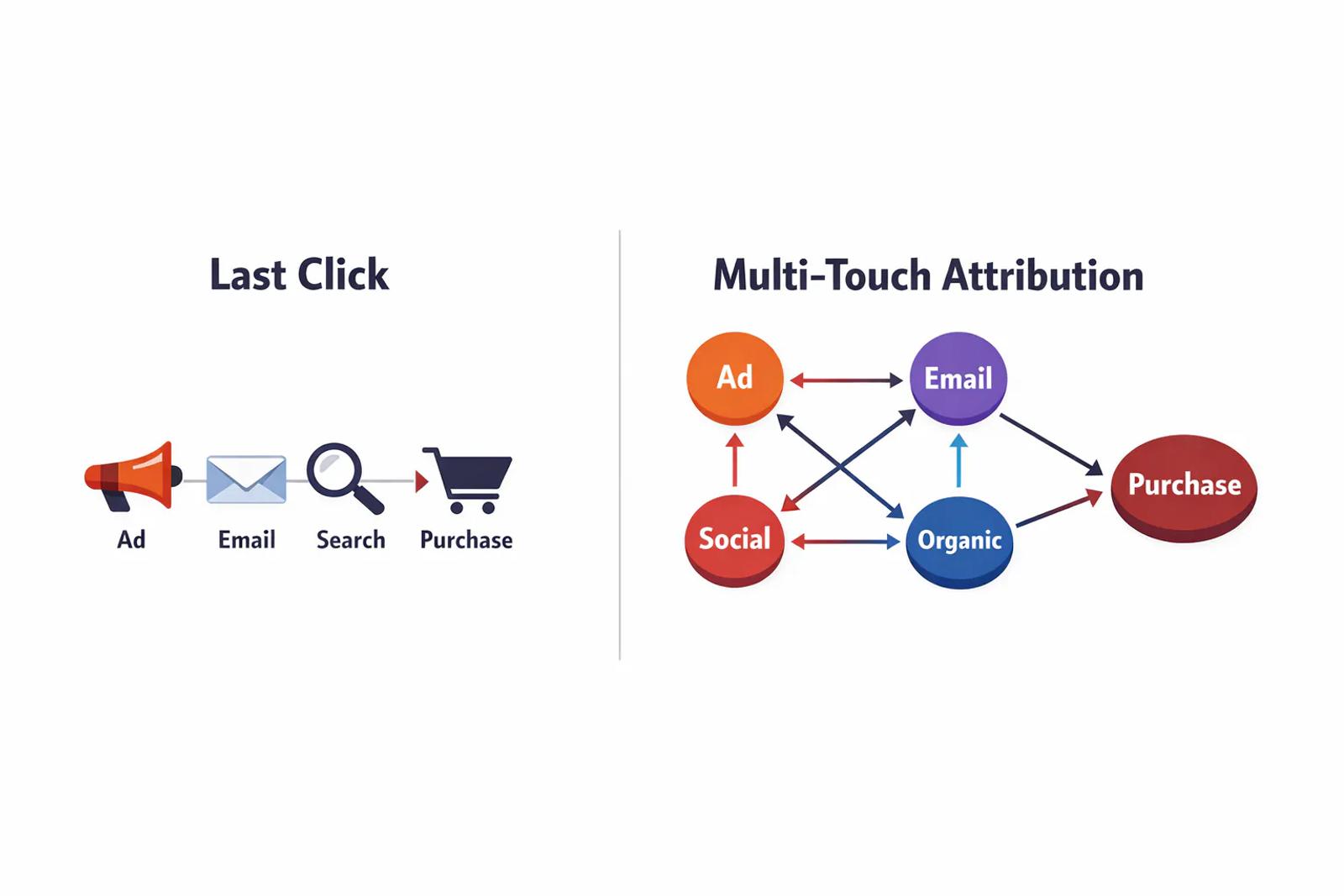
Multi-touch attribution tools help marketers see which combinations of channels work together to drive conversions. Nielsen's marketing research confirms that companies using multi-touch attribution models report 15-30% better ROI visibility compared to single-touch approaches.
In a multi-touch attribution model, if a customer discovers your product through organic search content, engages with a LinkedIn ad, clicks a Google Ad, and then converts through an email campaign, all four touchpoints receive proportional credit based on their contribution to the final conversion.
This approach to assigning credit reveals which channels work together in your marketing mix.
This contrasts with single-touch attribution models like last-click (which gives 100% credit to the final interaction) or first-click (which credits only the initial touchpoint). Multi-touch attribution recognizes that modern customer journeys involve multiple interactions across channels before a purchase decision.
The core challenge is determining how much credit each touchpoint deserves. Rule-based attribution models like linear attribution split credit evenly across conversion paths, while algorithmic multi-touch attribution approaches like data-driven models use statistical analysis to weight each touchpoint's actual impact on conversion probability. The method of assigning credit you choose fundamentally shapes your understanding of marketing performance.
How GA4 Attribution Models Work in 2026
Google Analytics 4 dramatically simplified its attribution options in 2023, reducing from seven models to just three:
1. Data-driven attribution (default):
Uses machine learning to distribute credit across touchpoints based on their measured contribution.
This multi-touch attribution model analyzes both converting and non-converting conversion paths to estimate how much each interaction influenced the conversion outcome. Unlike first-click or last-click models, it evaluates the full customer journey.
Credit is assigned fractionally, you might see 0.4 conversions attributed to organic search and 0.6 to paid search for the same order. This is the most sophisticated attribution model available in GA4.
2. Paid and organic last click:
Assigns 100% credit to the last click before conversion, whether it came from a paid search ad, display campaign, Facebook ad, organic search result, or another channel. Direct traffic is excluded from receiving credit unless the entire path consists only of direct visits.
3. Google paid channels last click:
Similar to paid and organic last click, but only considers Google's own paid channels (Google Ads, Shopping, Display, YouTube ads). This model is designed specifically for Google Ads optimization.
All three models exclude direct visits from receiving attribution credit unless the conversion path consists entirely of direct traffic. According to Google's official documentation, this exclusion assumes direct visits often represent customers who already know your brand rather than discovery moments.
The removal of linear, first-click, time-decay, and position-based attribution models in September 2023 means marketers can no longer apply those traditional multi-touch attribution approaches within GA4.
Data-Driven Attribution Explained
Data-driven attribution (DDA) is Google's machine learning model that algorithmically assigns fractional credit to marketing touchpoints based on statistical analysis of conversion paths. Unlike rule-based models that apply the same formula to every conversion, DDA adapts to your specific data patterns.
How Data-Driven Attribution Works
The methodology involves two main components, according to Google's technical documentation:
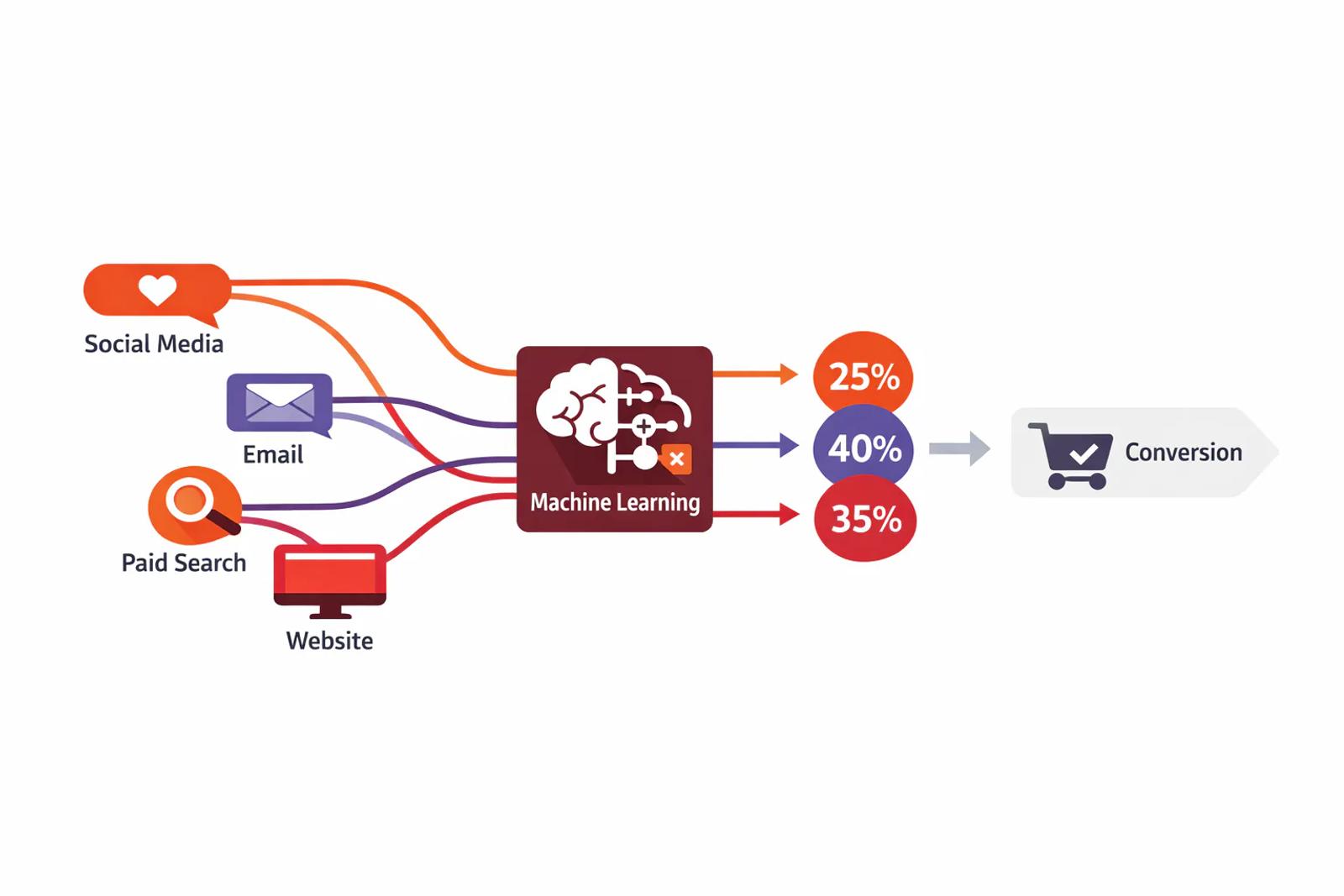
1. Key event probability modeling: The model analyzes path data from both converting and non-converting users to calculate how specific touchpoints change conversion probability. It compares users exposed to particular ad interactions against similar users in a holdback group who weren't exposed.
2. Fractional credit assignment: The algorithm assigns credit based on how much each touchpoint increases the estimated conversion probability. If adding "Ad Exposure #4" to a path increases conversion probability from 2% to 3%, that touchpoint receives credit proportional to that 50% lift in likelihood. Each key event type gets its own model that learns from your specific conversion data.
The model incorporates multiple factors including time between interaction and conversion, device type, number of ad interactions, order of exposure, and creative format. Using a counterfactual approach, it contrasts what happened with what could have occurred to isolate each touchpoint's true contribution.
This is fundamentally different from traditional multi-touch attribution models like position-based (U-shaped) or time-decay, which apply preset weights regardless of your actual data. Data-driven attribution adapts to your users' actual behavior patterns.
Requirements and Limitations
Google recommends at least 400 conversions per conversion action per month for data-driven attribution to function reliably. Below that volume, the model lacks sufficient data points to distinguish genuine patterns from noise, and fractional credit assignments become unreliable.
For a B2B SaaS company generating 50 demo requests per month, data-driven attribution is technically active but statistically unstable. The model may still run, but the credit distribution won't accurately reflect touchpoint contributions across your conversion paths. In these cases, paid and organic last click may provide more consistent, if less nuanced, attribution reports.
Additionally, conversions can be reattributed for up to 7 days after the initial conversion as the model refines its calculations with new data. This means attribution reports may shift slightly as the model learns.
Limitations of GA4 for Multi-Touch Attribution
While GA4's data-driven attribution represents a meaningful improvement over single-touch last-click models, it faces structural limitations that prevent it from delivering complete multi-touch attribution for most businesses. Understanding these limitations helps you determine when you need additional attribution tools beyond Google Analytics:
1. Google-Ecosystem Visibility Only
GA4 can only attribute credit to touchpoints it directly tracks. The platform has no visibility into:
- Offline interactions: Trade shows, sales calls, direct mail, billboards
- Phone calls: Inbound calls triggered by marketing campaigns (a critical gap for service businesses where phone calls are the primary conversion event)
- Dark social: Messaging apps, private communities, Slack shares
- Other platforms' walled gardens: LinkedIn's true view-through impact, TikTok's organic reach
- AI search: Citations in ChatGPT, Perplexity, or Gemini responses
According to privacy-focused analytics provider Piwik PRO, five years into GDPR enforcement, EU companies face a particularly acute version of this visibility gap, as strict compliance requirements further limit cross-site tracking. Gartner's 2026 report found that 68% of marketing leaders cite data privacy restrictions as the primary challenge in implementing effective multi-touch attribution.
If a customer discovers your product through a LinkedIn post, discusses it in a Slack community, searches for your brand, and converts via a Google Ad, GA4 will see only the Google Ad and the branded search, missing the actual discovery and consideration touchpoints. WhatConverts notes this is one of the primary reasons businesses seek dedicated attribution platforms.
2. No Connection to Revenue or CRM Data
GA4 tracks conversions (form submissions, button clicks, page views), not revenue outcomes. The platform doesn't know:
- Which leads became qualified opportunities
- Which deals closed and at what value
- How long the sales cycle took
- Which initial touchpoints produced the highest-value customers
For B2B businesses where the gap between form submission and closed revenue spans weeks or months, GA4's attribution ends at the form fill. A campaign might generate 50 leads in GA4 but produce zero pipeline value in your CRM, and GA4 has no way to surface that disconnect.
This disconnect becomes especially problematic when optimizing paid search campaigns or content marketing efforts where lead quality varies dramatically by source. You might be scaling a campaign that drives high-volume, low-value leads while cutting budget from a low-volume, high-conversion channel. HubSpot's State of Marketing report found that 54% of B2B marketers struggle to connect their first-touch awareness campaigns to final revenue outcomes without dedicated multi-touch attribution platforms.
3. Session-Based Tracking in a Multi-Device World
GA4's attribution is built on sessions and cookies, which struggle to track users across devices and browsers. A customer might research on mobile during their commute, compare options on their work laptop, and convert on a personal tablet, appearing as three separate users in GA4 unless they sign in or can be probabilistically linked.
While GA4 attempts cross-device tracking through User-ID and Google Signals, these require user authentication or Google account sign-in, which most anonymous website visitors never complete.
4. Black-Box Methodology
Data-driven attribution's machine learning model is proprietary and opaque. Google doesn't publish the specific algorithm, weighting factors, or how it handles edge cases. Marketing teams can see the credit distribution but can't audit why a particular touchpoint received its credit allocation.
This lack of transparency makes it impossible to validate the model's accuracy or understand when it might be systematically over- or under-valuing specific channels. A 2026 survey by Haus found that only 37% of marketers trust in-platform attribution models like GA4's DDA, citing this opacity as a primary concern.
5. Privacy Changes Reduce Data Quality
iOS tracking prevention, cookie deprecation, and consent requirements have eroded GA4's ability to build complete conversion paths. According to Piwik PRO's analysis, attribution models now miss significant portions of the actual customer journey due to blocked tracking scripts and declined consent.
The result: data-driven attribution bases its credit calculations on incomplete path data, systematically under-representing channels that rely on third-party cookies or cross-site tracking.
Alternative Multi-Touch Attribution Approaches
When GA4's built-in attribution doesn't provide the visibility your business needs, particularly for B2B companies with long sales cycles and multiple revenue stages, several alternative approaches fill the gap:
First-Party Attribution Platforms
Dedicated attribution software like SourceLoop captures the full customer journey from first anonymous visit through closed revenue by combining:
- First-party tracking on your own domain, capturing every session, referrer, ad click, and page view
- CRM integration that writes attribution data directly into HubSpot, Salesforce, or Pipedrive records, showing reps exactly which campaign produced each lead
- Revenue tracking that syncs deal values and won/lost status back from the CRM, enabling attribution based on pipeline and closed revenue rather than just form fills
- Offline conversion sync that pushes qualified leads and revenue back to Google Ads and Meta so automated bidding optimizes toward actual outcomes
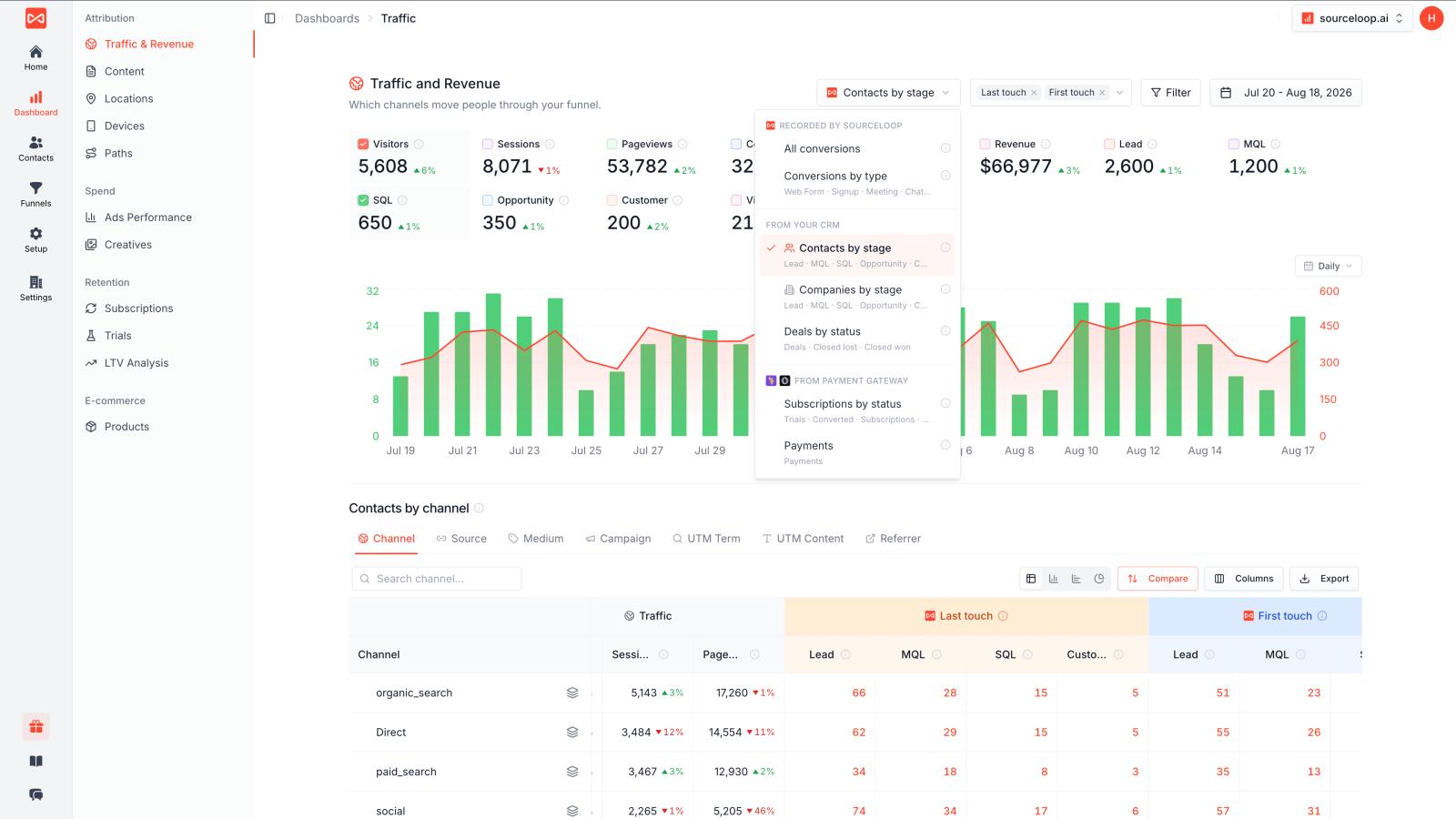
This architecture solves the "GA4 ends at the form fill" problem by tracking the complete journey from initial touchpoint to closed deal.
When a $50,000 deal closes, SourceLoop can show you it started with a LinkedIn ad, progressed through three blog visits and two paid search clicks, converted via a demo request form, and took 45 days to close, multi-touch attribution that connects marketing data directly to revenue and attribution reports that GA4 simply cannot provide.
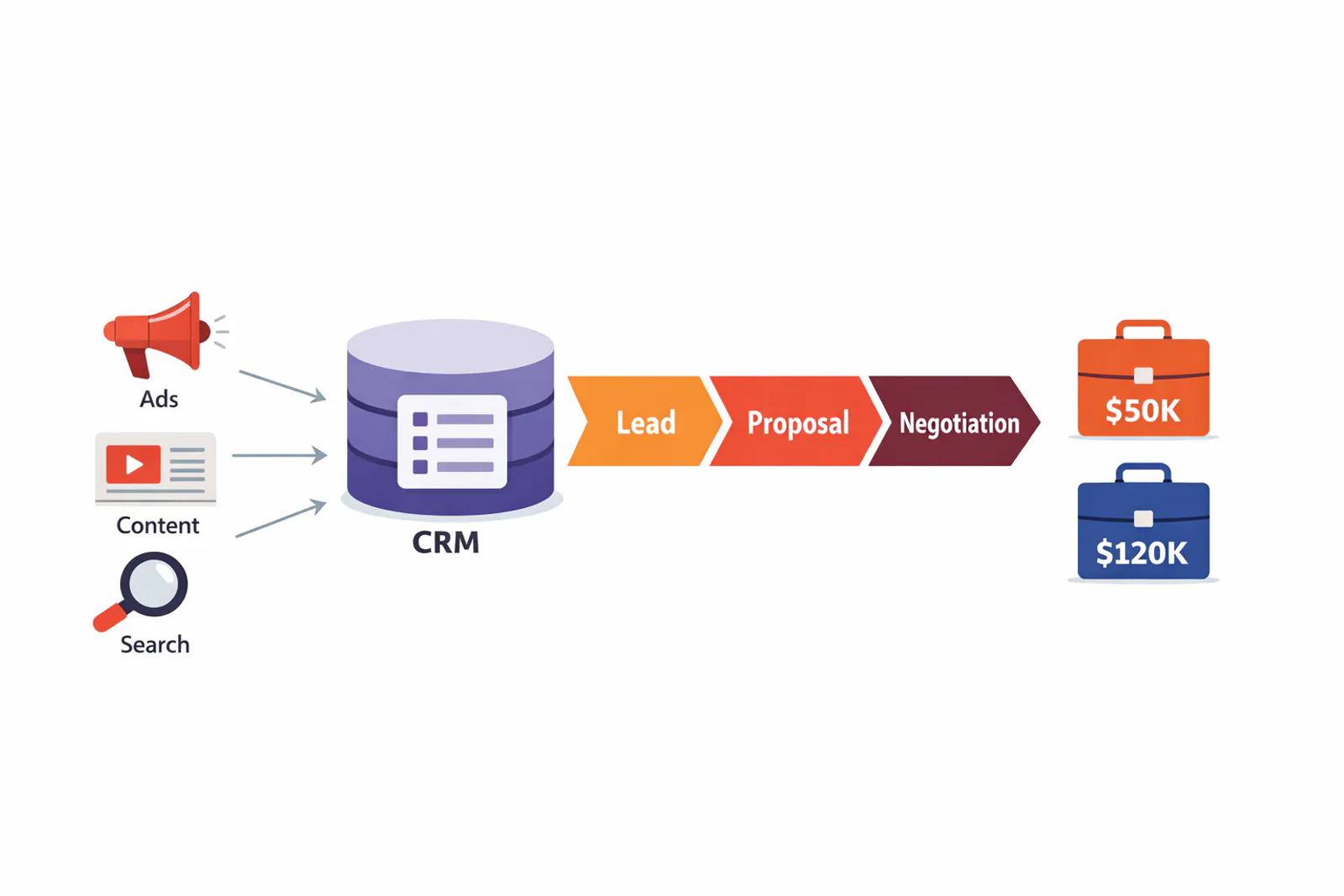
For B2B teams, this connection between marketing spend and actual revenue is the difference between optimizing for leads (which may or may not convert) and optimizing for customers. Multi-touch attribution platforms enable marketers to see which first-touch content pieces initiate high-value customer journeys and which last-touch campaigns close deals.
Marketing Mix Modeling (MMM)
Marketing mix modeling takes a top-down statistical approach, analyzing the relationship between marketing spend across channels and business outcomes (revenue, sign-ups, orders) at an aggregate level. Rather than tracking individual user journeys, MMM uses regression analysis to estimate each channel's incremental contribution.
According to measurement specialists at Measured, MMM has seen renewed adoption in 2026 as privacy changes have degraded individual-level multi-touch attribution tracking. Forrester research recommends combining MMM with multi-touch attribution for comprehensive measurement.
Improvado's 2026 analysis found that 42% of marketing teams with budgets over $1M now use some form of marketing mix modeling alongside their attribution tools. The trade-off: MMM provides channel-level directional guidance but can't attribute specific conversions to specific campaigns or keywords, and it requires months of spend data to produce statistically significant results.
Incrementality Testing
Incrementality testing (also called lift testing or holdout testing) measures multi-touch attribution by running controlled experiments that isolate the true impact of marketing touchpoints. A portion of your audience is excluded from seeing a specific campaign, and conversion rates are compared between the exposed and holdout groups. The difference represents the campaign's true incremental impact.
This approach bypasses tracking limitations entirely, you don't need to follow individual users, but it requires significant traffic volume and only works for ongoing campaigns, not retrospective analysis.
Frequently asked questions
-
Frequently Asked Questions
-
What is the difference between multi-touch and last-touch attribution?
Last-touch attribution credits 100% of a conversion to the final interaction, while multi-touch attribution distributes credit across all touchpoints in the customer journey. Last-touch overvalues bottom-of-funnel channels like branded search, whereas multi-touch reveals how top-of-funnel channels (like content and social) work together to drive conversions.
-
Does GA4 support multi-touch attribution?
Yes, GA4 supports multi-touch attribution through its default Data-Driven Attribution (DDA) model. However, GA4 only credits channels within Google's ecosystem. It cannot track offline touchpoints, phone calls, or CRM pipeline stages, making it insufficient for complete B2B journey mapping.
-
How many conversions do you need for GA4 data-driven attribution to work?
Google recommends at least 400 conversions per conversion action per month for data-driven attribution to function reliably. Below this threshold, GA4's machine learning model lacks the statistical volume to accurately distribute fractional credit, leading to unstable or noisy attribution reports.
-
Can GA4 track attribution to closed revenue?
No, GA4 cannot track attribution to closed CRM revenue or deal values. GA4's tracking ends at the initial conversion (like a form fill). It cannot connect touchpoints to offline sales stages, pipeline value, or closed-won deals in CRMs like HubSpot or Salesforce.
-
What replaced the removed GA4 attribution models?
Google replaced its traditional rule-based models (linear, first-click, time-decay, and position-based) with algorithmic Data-Driven Attribution. GA4 now offers only three attribution options:
- Data-driven attribution (default)
- Paid and organic last click
- Google paid channels last click
-
How do you set up multi-touch attribution in Google Analytics 4?
Multi-touch (data-driven) attribution is enabled by default in GA4. To verify or adjust settings, navigate to Admin > Attribution Settings and select your reporting attribution model. You can view paths and credit distribution under Advertising > Attribution > Attribution Paths.
-
Why is first-party attribution better than GA4 for B2B?
First-party attribution platforms like Sourceloop track the entire B2B customer journey from the first anonymous visit to closed CRM revenue. Unlike GA4, which stops at the form fill, first-party tools:
- Sync directly with CRMs (HubSpot, Salesforce) to attribute actual deal value.
- Track offline touchpoints, phone calls, and sales meetings.
- Bypass cookie restrictions using secure, first-party domain tracking.


 Paid Social


