
Multi Channel Attribution Models: Practical Guide for 2026
Master multi channel attribution models with clear comparisons, implementation checklists, and SourceLoop guidance for accurate marketing measurement.

Your paid media dashboard says one thing. The CRM says another. Google Ads claims the final conversion, organic search appears at the beginning of the journey, and sales says the prospect only became serious after a webinar and several follow-up emails. Nobody necessarily made a tracking mistake. Each system is answering a different attribution question.
That conflict is why multi channel attribution models matter. They don't reveal a single objective truth about who caused a conversion. They provide structured ways to compare how different touchpoints may have contributed, then help teams decide where to investigate, test, and invest.
Table of Contents
- The Attribution Problem Every Marketing Team Faces
- How Attribution Models Evolved From Rules to Algorithms
- Comparing Multi-Channel Attribution Model Types
- When Data-Driven Attribution Actually Works
- Implementation Checklist for Multi-Channel Attribution
- Using SourceLoop to Operationalize Attribution Models
- Beyond Attribution and the Calibration Layer
- Building Your Attribution Operating Rhythm
The Attribution Problem Every Marketing Team Faces
Consider a SaaS company with a long buying journey. A prospect first discovers the brand through an organic search result, returns through a paid search ad, downloads a guide after seeing a social post, attends a webinar, visits the pricing page directly, and finally submits a demo request after an email reminder. The advertising platform credits paid search. The marketing automation system gives importance to email. The CRM may record the original organic source.
A last-click report can make the final email or direct visit look like the decisive channel. A first-touch report can make organic search appear responsible for the entire outcome. Both reports are internally consistent, but neither captures the full sequence. Google defines attribution models as rules, rule sets, or data-driven algorithms that assign credit to touchpoints before a key event such as a purchase or lead submission (Google's attribution model documentation).
The practical risk is budget allocation based on an incomplete story. If the company cuts content because organic search rarely closes the deal, it may weaken the discovery layer that feeds later branded searches. If it cuts email because email receives little first-touch credit, it may remove a useful conversion prompt. Attribution doesn't eliminate these judgment calls. It makes the assumptions visible.

What attribution can and cannot tell you
A model can show which channels and touchpoints appear in converting journeys, how credit changes under different allocation rules, and where data disappears between marketing and revenue. It can't prove that a credited interaction caused the conversion. A prospect may have clicked a retargeting ad and converted because the prospect had already decided to buy.
Practical rule: Treat attribution as a measurement framework for comparing assumptions, not as a machine that discovers one unquestionable answer.
That distinction changes how teams use the output. Attribution is useful for journey diagnostics, lead-source reporting, channel coordination, and prioritizing experiments. It becomes unreliable when marketers use fractional credit alone to claim incremental revenue, especially where identity links are weak, exposure is correlated, or offline activity is missing.
How Attribution Models Evolved From Rules to Algorithms
Rules-based attribution caught on because teams could explain it in one sentence and put it into a dashboard the same day. First-click gave all credit to the first recorded interaction. Last-click gave it to the final one. Linear spread credit evenly across touchpoints, time-decay weighted later interactions more heavily, and position-based models favored selected moments in the path, usually the beginning and the end.
That clarity made reporting easier. It did not make the model true.
The limitation was always calibration. A rules-based model starts with a human belief about how credit should be split, then applies that belief to every journey. In practice, that means a pricing-page visit, a webinar attendance, and a passive display impression can receive similar treatment under the wrong setup, even when nobody on the team believes those touches influenced the outcome equally.
Adoption patterns show why many organizations still run mixed approaches. In the attribution statistics summary, a Forrester Consulting study published through Think with Google found that 53% of marketers saw measurement as a high or top organizational priority, while 40% of enterprises still used first-touch or last-touch approaches, 35% used algorithm-based attribution, and 30% used advanced statistics-based methods. That split reflects operating constraints. Advanced models depend on identity resolution, event consistency, CRM integration, and agreement on which conversion points matter.
The move toward data-driven attribution
Google's timeline captures the product shift clearly. Rules-based models became available on June 14, 2021, and Google introduced data-driven attribution for paid and organic channels on November 1, 2021 in Google's historical model overview. The underlying idea was straightforward. Instead of assigning fixed weights up front, the system estimates contribution from observed patterns across converting and non-converting paths.
That sounds more nuanced, and sometimes it is. It also changes the failure mode. With rules-based attribution, the assumption is visible. With algorithmic attribution, weak identity stitching, inconsistent UTM governance, missing offline touchpoints, and broken CRM stage mapping get buried inside the output. Teams often mistake that opacity for precision.
Google later removed first-click, linear, time-decay, and position-based models from Analytics in November 2023, leaving data-driven attribution and last-click as the main comparison views. The practical takeaway is not that one model won. It is that teams still need a baseline they can audit, plus a modeled view they can challenge.
That is the part many model comparisons skip. Attribution works best as a hypothesis engine for incrementality testing, not as a final statement of causality. If the model increases credit for branded search after paid social launches, that is a prompt to test whether social is creating demand upstream. If cross-device matching is weak or consent coverage is patchy, treat the result as directional and fix governance before making budget calls.
The timeline below captures the conceptual shift from fixed rules to learned allocation.
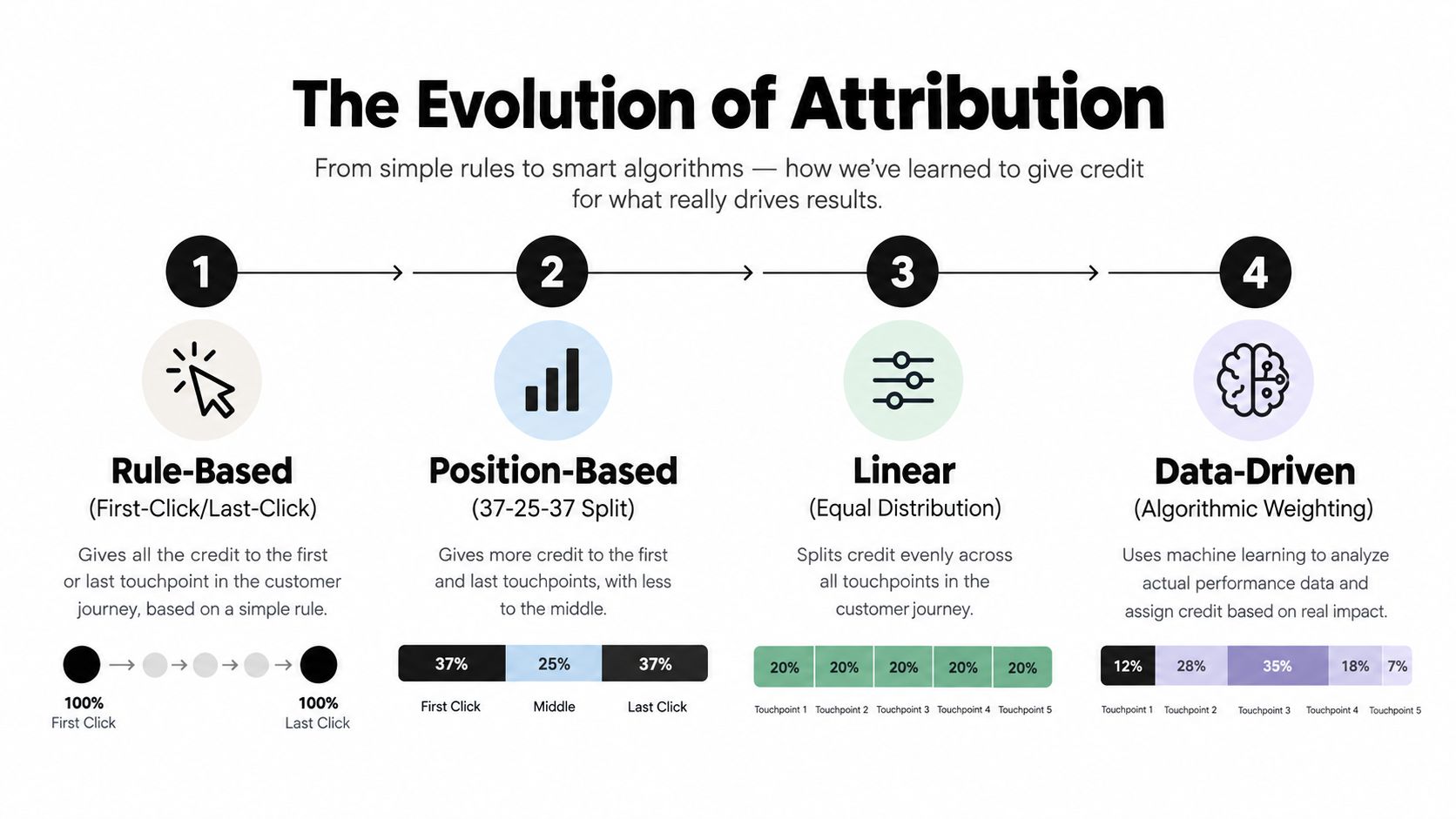
A concise visual explanation can help non-technical stakeholders see why changing the model changes the story, and why neither story should go untested.
Comparing Multi-Channel Attribution Model Types
A team reports that paid search closed the quarter, while paid social claims it created the pipeline. Both dashboards look reasonable because each model answers a different question. Choosing a model starts with the decision you need to make, the length of the buying cycle, and whether your identity stitching is good enough to trust the path.
| Model Type | Credit Distribution | Best For | Key Limitation |
|---|---|---|---|
| First-click | All credit goes to the first recorded touchpoint | Assessing discovery and demand creation | Ignores the interactions that move a prospect toward conversion |
| Last-click | All credit goes to the final recorded touchpoint | Simple conversion reporting and operational baselines | Overvalues closing interactions and undervalues earlier influence |
| Linear | Credit is divided evenly across recorded touches | Establishing a balanced view during a measurement transition | Assumes every touch has equal importance |
| Time-decay | Later interactions receive more credit | Journeys where recent intent matters strongly | Can erase the contribution of early awareness activity |
| Position-based | Greater credit goes to selected positions, commonly first and last | Journeys with meaningful acquisition and conversion milestones | The chosen split still reflects an assumption |
| Data-driven | Credit reflects modeled differences across converting and non-converting paths | Complex journeys with sufficient, reliable data | Requires strong identity resolution, event coverage, and validation |
Rules-based models are easier to explain in a budget meeting. They are also easier to audit when channel owners challenge the numbers. First-click is useful for measuring how prospects enter the funnel, but it can overcredit channels that start curiosity and undercredit the touches that turn interest into action. Last-click stays useful longer than many teams admit because it gives you a stable baseline, especially when cross-device coverage, CRM syncing, or consent rates are uneven.
Linear, time-decay, and position-based models sit in the middle. They spread or weight credit in ways that match a theory of how journeys work, not proof that the theory is correct. That is why I treat them as structured hypotheses. If a position-based model shifts value toward early education content, the next step is not immediate reallocation. The next step is testing whether that content changes downstream conversion rates or pipeline quality.
For a detailed grounding in how touchpoints are distributed, understanding multi-touch attribution is a useful companion resource. Teams with longer sales cycles should also compare model choice against opportunity stages, lead source rules, and offline touch capture. This matters most in B2B, where B2B attribution models often need to reflect CRM progression, not just a web form completion.
A practical decision rule helps. If your sales cycle is long and CRM stages are consistently maintained, start by testing position-based attribution against last-click. If path data is thin, anonymous traffic dominates, or identity resolution breaks across devices and systems, keep last-click as the auditable baseline and use broader models only as directional views.
The hidden layer is governance. Before comparing models, define conversion events the same way across ad platforms, analytics, and CRM. Set rules for UTM hygiene, channel grouping, bot filtering, and person-level deduplication where consent permits. Without that calibration work, model comparisons create debate, not clarity.
When Data-Driven Attribution Actually Works
Data-driven attribution is not a weighted rule with a more impressive name. It works as a counterfactual probability model, using both converting and non-converting paths to estimate how the likelihood of a key event changes under different touchpoint conditions (Google's explanation of data-driven attribution).
That distinction matters. A channel can appear frequently in converting journeys because high-intent users seek it out, not because the channel created demand. A useful model tries to compare otherwise similar paths and estimate the change associated with a particular interaction. Relevant signals can include the order and timing of interactions, device type, ad exposure patterns, creative format, and other query information.
The data foundation
Before choosing an algorithm, preserve the journey in a form the model can use. At minimum, teams need ordered event sequences, campaign metadata, timestamps, device identifiers where consent permits, conversion outcomes, and non-converting journeys. Removing non-converting paths leaves the system unable to distinguish influence from simple exposure frequency.
Identity resolution is often the limiting factor. A prospect may browse anonymously on a phone, return on a laptop, submit a form, enter a CRM, speak with sales, and pay through a separate system. If those records can't be linked reliably, the model sees fragments and may assign credit to whichever fragment happens to contain the conversion.
For SaaS, the key outcome might be qualified pipeline or closed revenue rather than a form submission. For DTC, a purchase event may be easier to capture, but consent loss and cross-device behavior can still create gaps. Agencies need a repeatable taxonomy across clients, because changing channel definitions from account to account makes comparisons unstable.
Data-driven attribution works when the data describes journeys. It doesn't repair missing journeys, ambiguous outcomes, or inconsistent identifiers.
Validation remains necessary even with clean inputs. Geo experiments, audience holdouts, and platform lift tests can challenge observational results. If a high-spend channel receives substantial modeled credit but loses its effect in a controlled test, the team should revise the allocation hypothesis rather than defend the dashboard.
Implementation Checklist for Multi-Channel Attribution
A workable implementation starts with data discipline, not model selection. Teams that skip the foundation often spend time debating fractional credit while their campaign names, conversion definitions, and offline records remain inconsistent.
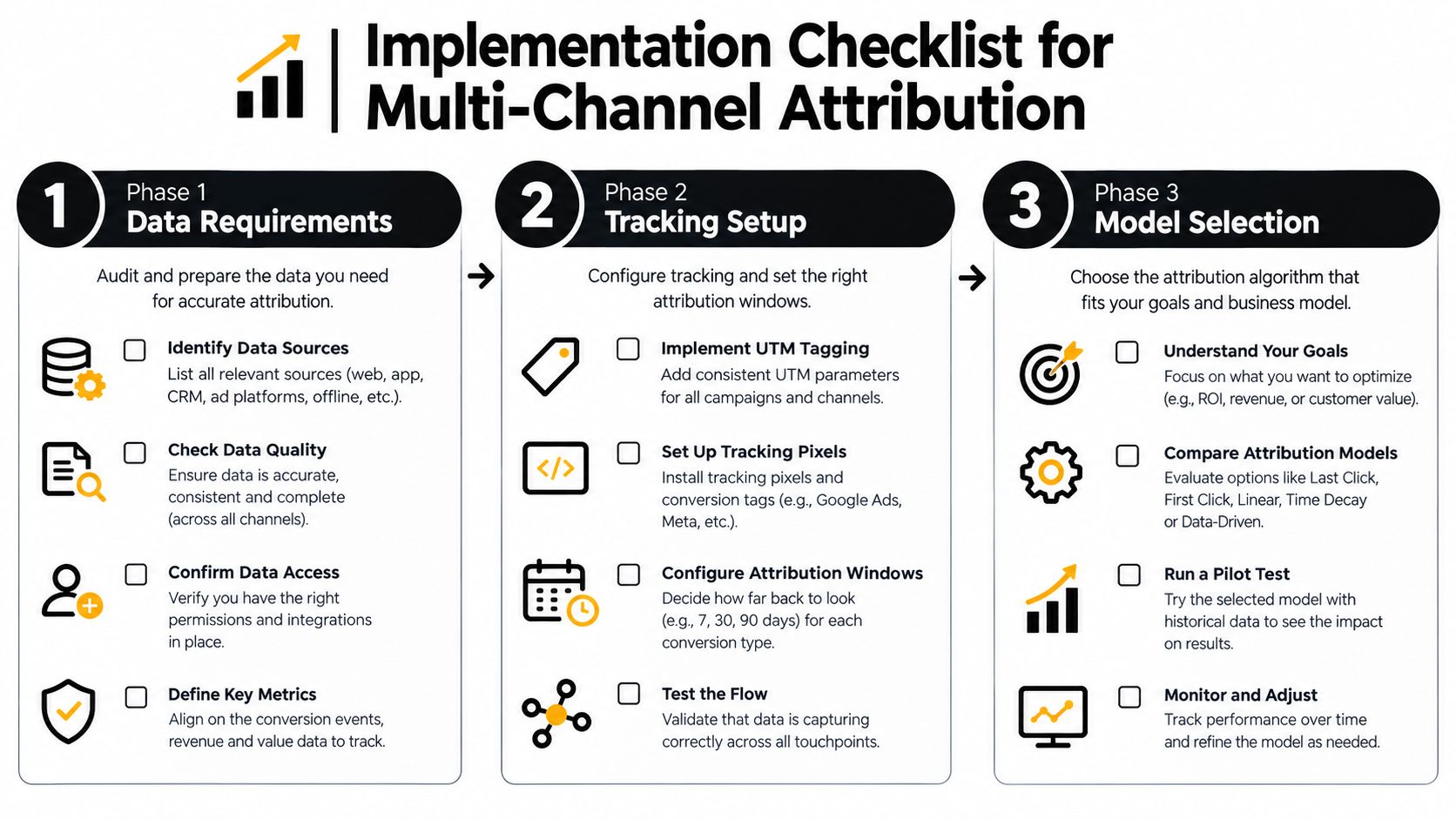
Phase one covers the data requirements
Define the outcomes before collecting more events. Separate a marketing-qualified lead, a sales-qualified opportunity, a booked meeting, a payment, and a closed-won deal. If every conversion is treated as equal, the model may optimize toward easy form fills instead of valuable customers.
Then audit the source systems:
- Campaign taxonomy: Standardize UTM naming, channel grouping, campaign IDs, and landing-page conventions.
- Event coverage: Confirm that forms, chat interactions, calendar bookings, purchases, and important funnel stages are captured.
- Identity links: Document how anonymous visitors become known contacts and how online records connect to CRM and payment data.
- Offline outcomes: Import sales activity and revenue where consent and business processes allow it.
- Data quality: Record missing values, duplicate contacts, unattributed sessions, and match rates instead of hiding them.
Phase two covers tracking setup
Install the smallest tracking layer that can capture the required events, then test it across browsers, devices, consent states, and conversion paths. Preserve timestamps and campaign metadata. A source value without timing or event context isn't enough for ordered journey analysis.
Connect the systems that hold different parts of the customer record. A web form may contain the original campaign, the CRM may contain qualification, and the payment processor may contain revenue. The attribution output becomes more useful only when those records can be reconciled without overwriting uncertainty.
Teams evaluating tools can browse attribution software to compare integration patterns, reporting, and operational requirements. The choice should follow the data architecture, not replace it. For a practical implementation sequence, use this guide to implement multi-touch attribution.
Phase three covers validation
Start with a transparent baseline such as last-click, then compare it with a multi-touch or data-driven view. Investigate large discrepancies instead of celebrating them. Check whether a change comes from real channel influence, a lookback-window difference, an identity match problem, or a revised channel definition.
Create a calibration backlog. Rank hypotheses by spend, strategic importance, and uncertainty. Test the channels where attribution could materially change budget decisions, using holdouts, geo experiments, or other controlled designs where feasible.
Using SourceLoop to Operationalize Attribution Models
Model selection is only useful when the output reaches the people who make budget, sales, and pipeline decisions. Many teams can build a dashboard that reports form submissions. Fewer can connect the original visit to a qualified CRM stage and then to revenue without manual spreadsheet work.
SourceLoop is one option for teams that want a first-party attribution layer across those systems. According to the platform description, a lightweight snippet captures visits and connects multi-touch journeys with web forms, chat widgets, and calendar bookings. It also connects Stripe revenue to the original channel, which lets teams analyze payments rather than stopping at lead creation.

The operational pieces that matter
The useful distinction isn't whether a platform has a multi-touch label. It's whether the system keeps the evidence connected after a lead enters the funnel.
- CRM synchronization: Two-way connections with systems such as HubSpot, Salesforce, and Pipedrive can bring deal stages back into channel reporting.
- Revenue connection: Linking payment data to the originating journey makes it possible to compare attributed activity with actual commercial outcomes.
- Qualified conversion feedback: Sending offline conversions to Google Ads, Meta through CAPI, or LinkedIn gives ad systems signals closer to business value than raw form fills.
- Alerts and reporting: Triggers, custom reports, dashboards, APIs, and webhooks help teams move from retrospective analysis to routine monitoring.
- Query access: An MCP Server can make attribution data available through tools such as Claude, ChatGPT, or Cursor, subject to the team's access controls and governance.
The platform is described as GDPR-compliant, with flat monthly tiers and a free trial. Those commercial details may change, so teams should verify current terms directly before evaluating it. The more important implementation question is whether its integrations preserve consent states, identity uncertainty, and the distinction between observed and inferred touchpoints.
For a lean agency, SaaS team, or DTC operator, operational simplicity can be more valuable than a highly customized model nobody maintains. A tool should reduce manual reconciliation while leaving assumptions visible enough for marketing, sales, and finance to challenge.
Beyond Attribution and the Calibration Layer
Attribution becomes dangerous when a team mistakes credit for causation. A prospect may have converted without the touchpoint that receives modeled credit. Observed journeys reveal associations in the data, but they don't automatically reveal the incremental effect of removing a channel.
That boundary determines the right question for the measurement method. Attribution can help answer which sources appear in qualified journeys, which sequences deserve investigation, and where lead-source reporting breaks down. It can't, by itself, establish whether retargeting generated net-new demand or merely reached people who were already likely to buy.
Research on attribution measurement recommends combining multi-touch analysis with marketing-mix modeling and incrementality experiments, while identifying randomized control tests as the strongest approach for estimating causal impact (the research on attribution and causal measurement).
How to run the calibration layer
Use person-level or account-level journeys to generate a specific hypothesis. For example, if a retargeting audience receives unusually high modeled credit, don't immediately increase spend. Ask whether suppressing those ads for a comparable holdout changes qualified pipeline or revenue.
A practical calibration sequence looks like this:
- Find the signal: Use attribution to identify a channel, audience, creative, or sequence with meaningful credit or unusual movement.
- State the counterfactual: Define what should happen if the channel is absent or materially reduced.
- Choose the design: Use an audience holdout, geo experiment, matched market, or another controlled comparison suited to the channel.
- Compare business outcomes: Evaluate qualified pipeline, revenue, or another agreed outcome, not only clicks and form submissions.
- Update the operating model: Keep, reduce, expand, or investigate the channel based on the test result.
Privacy and identity gaps make this calibration layer more important, not less. Teams should separate observed touchpoints from inferred links, report match rates, preserve consent states, and show uncertainty rather than presenting every fractional credit as precise.
A cookie-loss response should therefore address measurement design as well as tagging. Teams working through this issue can use a cookie deprecation strategy that prioritizes first-party data, consent-aware identity resolution, and tests that don't depend entirely on a continuous digital trail.
Building Your Attribution Operating Rhythm
Attribution isn't a one-time configuration. Establish a recurring rhythm that keeps data quality, model behavior, and commercial outcomes in the same conversation.
Each week, review tracking failures, unattributed conversions, identity match rates, and sudden shifts in channel definitions. Each month, compare model outputs with qualified pipeline and revenue, then investigate changes across lookback windows. Each quarter, select important channel hypotheses for holdouts or geo tests. Review the wider data architecture annually, including CRM mappings, consent handling, offline imports, and reporting ownership.
Document every assumption: what counts as a touchpoint, which outcomes qualify, how direct traffic is handled, and where identity is inferred. Share the results with sales and finance, because marketing attribution that stops at a lead rarely explains business performance.
The operating principle is simple. Choose the simplest model that answers the current question, use stronger data before adding complexity, and calibrate high-stakes decisions with controlled tests. That approach won't produce perfect attribution. It will produce better decisions with a clearer understanding of uncertainty.
If your reports disagree today, start by auditing the conversion definitions, campaign taxonomy, identity links, and revenue connections behind them. Then compare a transparent baseline with a multi-touch view, document the differences, and choose one high-impact channel hypothesis to test. Visit SourceLoop to evaluate a first-party attribution workflow, or begin with your existing analytics and CRM data before committing to a more advanced platform.



 Paid Social


