
Rockerbox Pricing 2026: Costs, Fees & Alternatives
Rockerbox doesn't publish prices. Here's what buyers report paying in 2026, what drives the quote, hidden costs, and how SourceLoop compares.
Table of contents
- What Rockerbox Costs in 2026
- How Rockerbox Pricing Works
- What the DoubleVerify acquisition means for buyers
- What You Get for the Money
- Multi-touch attribution
- Marketing mix modeling
- Incrementality testing
- Offline and hard-to-track channels
- The Hidden Costs Behind a Rockerbox Contract
- Reported Rockerbox Pricing at a Glance
- Is Rockerbox Worth the Price?
- Rockerbox makes sense if you
- Rockerbox is probably overkill if you
- SourceLoop as a Rockerbox alternative
- What SourceLoop includes
- SourceLoop pricing
- Rockerbox vs SourceLoop pricing
If you went to the Rockerbox website looking for a price, you probably noticed there isn't one. The plans page sends you to a demo form, and the number you finally get depends on a sales conversation.
That's normal for enterprise measurement software. It's also frustrating when you just want to know whether the tool fits your budget before spending weeks on calls.
This guide pulls together every public data point on Rockerbox pricing in 2026. You'll see what buyers report paying, what drives the quote, the costs that hide outside the license, and how SourceLoop compares for teams that mainly need attribution.
What Rockerbox Costs in 2026
Rockerbox does not publish list prices. Still, enough buyers and review sites have shared numbers to sketch a realistic range.
- Listed starting price: Capterra shows a Basic plan at $2,000 per feature, per month.
- Mid-market contracts: buyer data summarized by WeTracked puts typical deals at $40,000 to $90,000 a year for brands spending $100,000 to $500,000 a month on marketing.
- Median contract: buyer-disclosed data cited by EightX puts the median annual contract at roughly $83,000.
- Implementation: onboarding fees are reported between $5,000 and $20,000, charged once.
Rockerbox hasn't confirmed any of these figures. Use them as a budgeting ballpark, not as a quote.
Quick math: a $40,000 annual contract works out to about $3,300 a month before onboarding. That's a big line item for any team spending under $1M a year on ads.
How Rockerbox Pricing Works
Rockerbox prices against the size and complexity of your marketing program, not against seats or pageviews. According to Vendr's Rockerbox pricing data, these are the main drivers:
- Marketing spend under management. The more you spend, the higher the quote.
- Number of channels. Each ad platform, offline source, and data feed adds setup work.
- Measurement products. Multi-touch attribution, marketing mix modeling, and incrementality testing can be bundled or priced separately.
- Data volume. Bigger event and order volumes raise the cost.
- Service level. Managed services and analyst support add to the contract.
Multi-year deals reportedly come with discounts of 10% to 20%. That lowers the yearly number, but it also locks you in for longer.
What the DoubleVerify acquisition means for buyers
In 2025, DoubleVerify agreed to buy Rockerbox in an $85 million cash deal. DoubleVerify said the move expands its reach into mid-market and direct response advertisers.
Rockerbox is now part of a much larger ad verification company. Before you sign, ask your rep whether pricing, renewal terms, or the product roadmap are tied to other DoubleVerify products.
What You Get for the Money
Rockerbox is broad, and that breadth is the main reason it costs what it does.
Multi-touch attribution
The Rockerbox platform collects touchpoints across paid, organic, and offline channels. You can compare attribution models and see how customers move between channels before they buy.
Marketing mix modeling
MMM uses aggregated spend and outcome data to estimate each channel's contribution, including channels you can't track user by user. Not sure which approach you need? Our guide to multi-touch attribution vs marketing mix modeling explains the difference.
Incrementality testing
Lift tests check whether a channel actually caused sales or simply took credit for them. This is useful once your budget is big enough that a 10% misallocation costs real money.
Offline and hard-to-track channels
Podcasts, linear TV, CTV, direct mail, and influencer campaigns are where Rockerbox stands out. Most lighter tools can't model these well.
The Hidden Costs Behind a Rockerbox Contract
The license is only part of the bill. Budget for these as well:
- Onboarding fees. Reported at $5,000 to $20,000.
- Analyst time. MMM and lift results need someone who can read them. Reviewers flag that the platform needs analytics resources to get value from it.
- Ramp time. Connecting data, mapping channels, and calibrating models takes weeks.
- Long commitments. Plan for the full annual or multi-year total, not the monthly equivalent.
- Learning curve. Some users find the platform's terminology confusing at first.
For a wider view of what attribution tools cost across the market, see our breakdown of marketing attribution software cost.
Reported Rockerbox Pricing at a Glance
| Data point | Reported figure | Notes |
|---|---|---|
| Listed starting price | $2,000 per feature, per month | Capterra and Software Advice |
| Mid-market contract | $40,000 to $90,000 per year | Brands spending $100k to $500k a month on marketing |
| Median contract | About $83,000 per year | Buyer-disclosed, all company sizes |
| Implementation | $5,000 to $20,000 one time | Not confirmed by Rockerbox |
| Multi-year discount | 10% to 20% | Reported on Vendr |
| Free trial | No | Plans page routes to a demo request |
Your quote can land above or below these ranges. Give every vendor the same channel list, data history, and support needs so the numbers are comparable.
Is Rockerbox Worth the Price?
It comes down to the size and shape of your media mix.
Rockerbox makes sense if you
- Spend $1M or more a year across many channels.
- Put serious budget into TV, podcasts, direct mail, or other offline media.
- Want MTA, MMM, and incrementality testing from one vendor.
- Have an analyst or data team to act on the models.
Rockerbox is probably overkill if you
- Spend most of your budget on Google, Meta, and LinkedIn.
- Sell through leads, demos, calls, or trials rather than only ecommerce checkout.
- Need answers this week, not after a multi-week rollout.
- Have an attribution budget measured in hundreds per month, not thousands.
If you're in the second group, SourceLoop, covered below, is the lighter option.
SourceLoop as a Rockerbox alternative
SourceLoop is a first-party marketing attribution and measurement tool for lead generation businesses, agencies and SaaS teams. It covers the attribution work most teams bought Rockerbox for, without an enterprise contract.
It isn't a measurement suite. There's no media mix modeling, no incrementality testing and no TV, podcast or direct mail modeling, and it isn't built for Shopify stores. If offline media is a big share of your spend, Rockerbox is still the better pick.
What SourceLoop includes
These are the parts of Rockerbox's attribution product that SourceLoop covers, and the lead and CRM pieces it adds.
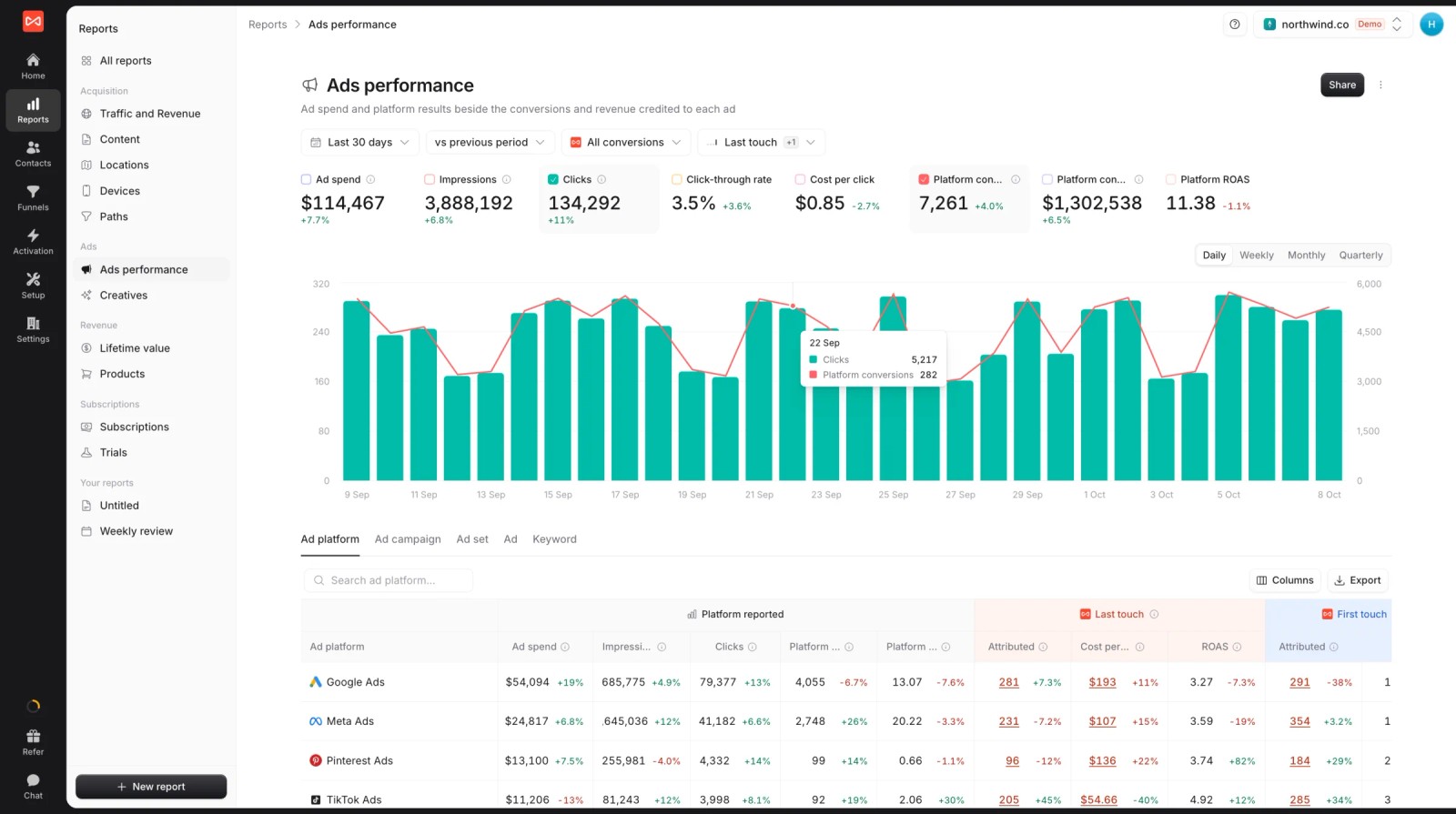
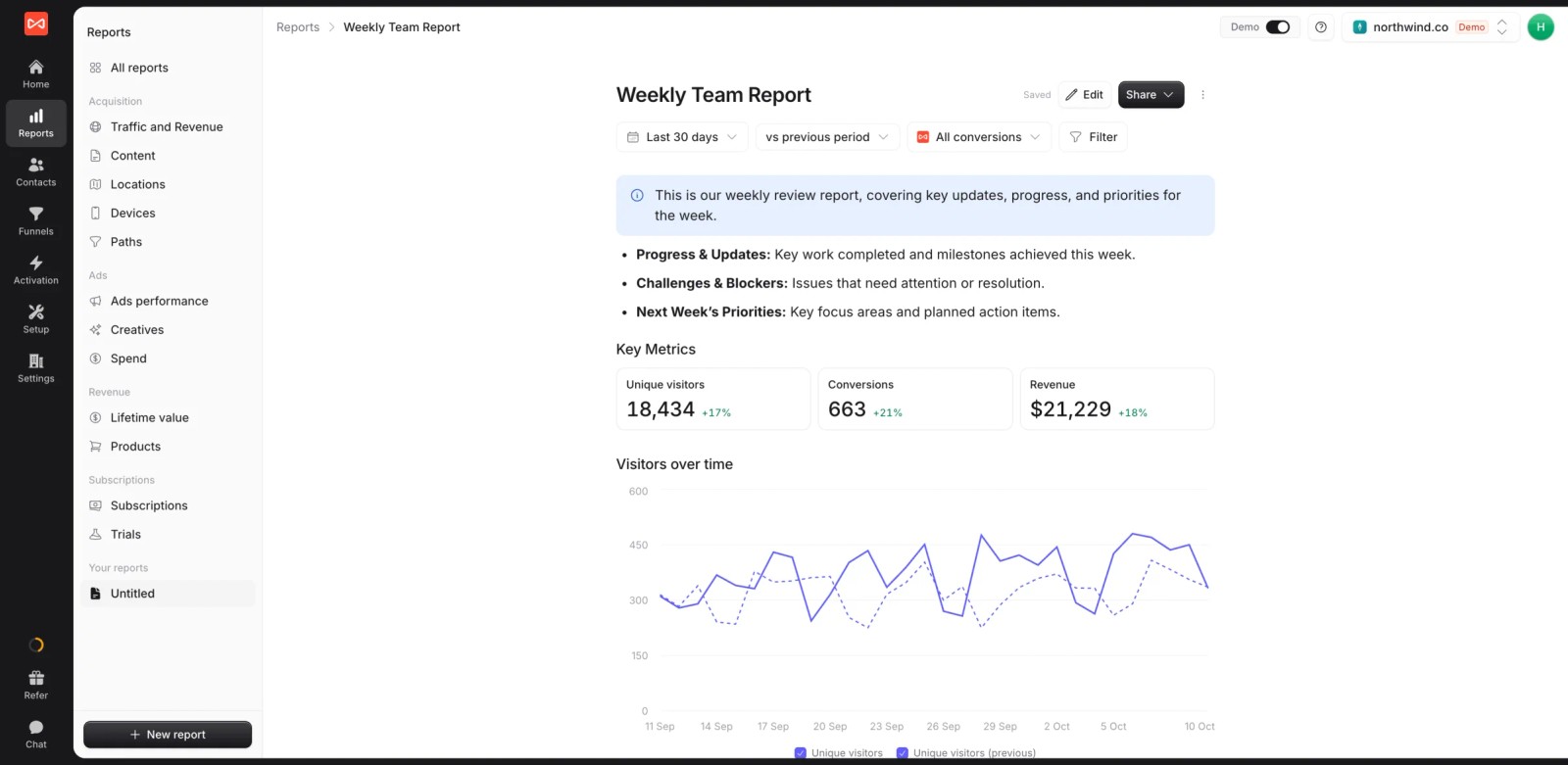
- Platform claims vs credited results: spend and platform-reported conversions sit beside what SourceLoop credits each ad platform under first and last touch.
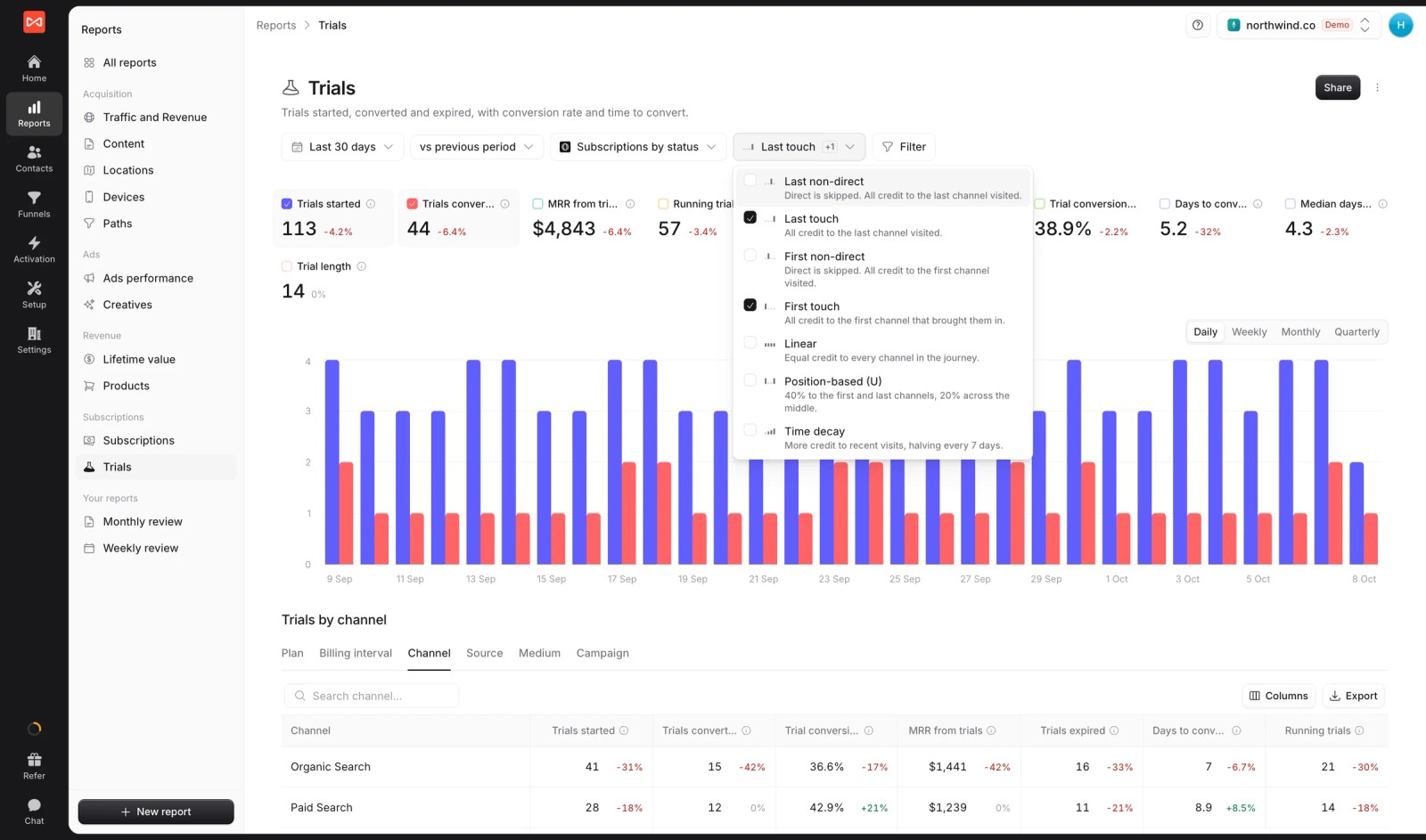
- Seven rule-based models: first and last touch, first and last non-direct, linear, U-shaped and time decay, with documented rules you can explain to finance.
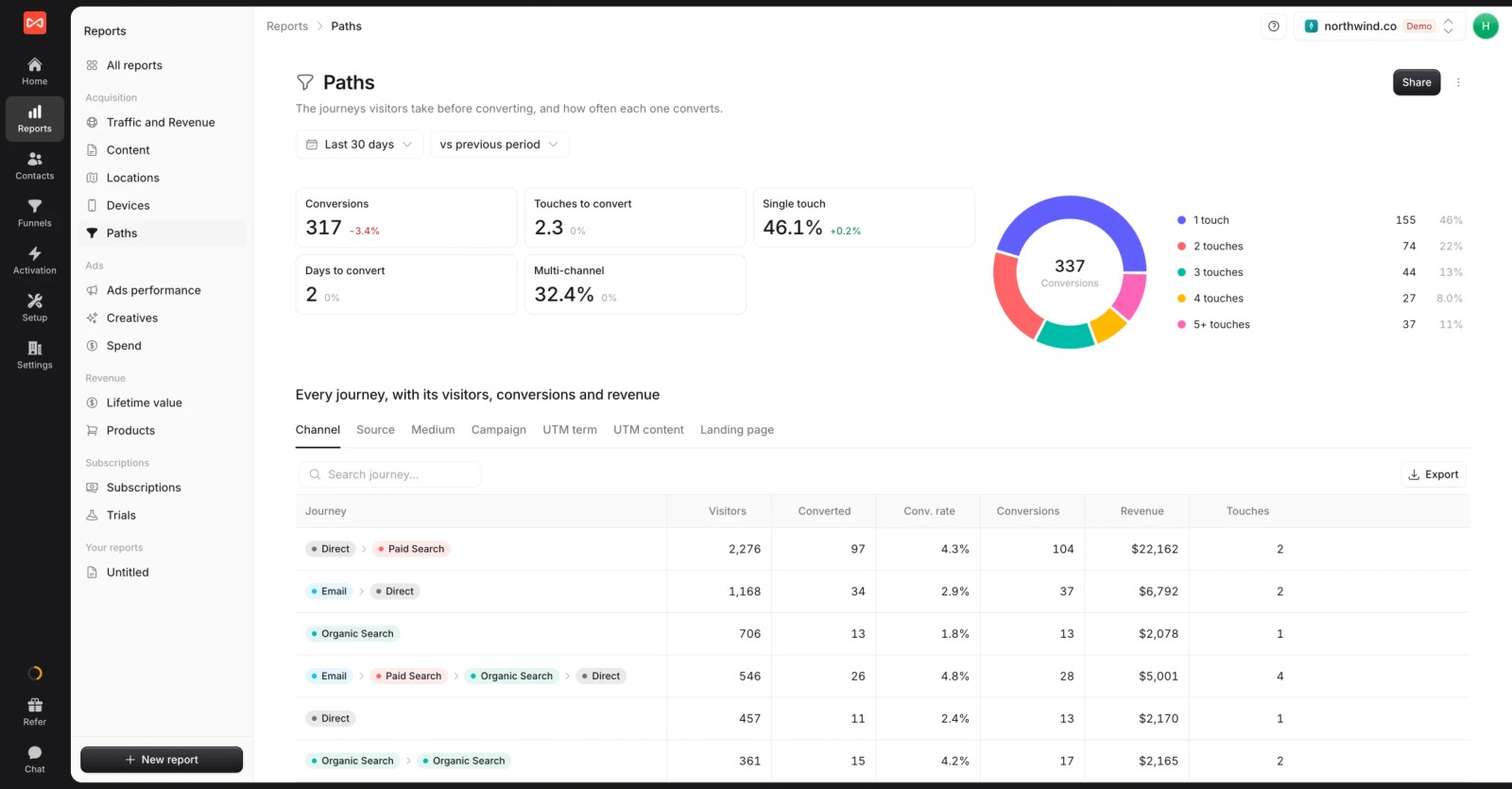
- Conversion paths: the channel sequences behind conversions, with touches and days to convert, which shows which channels start journeys and which finish them.
- Person-level journeys: every visit and ad click before a lead, call, signup or deal, kept on the contact.
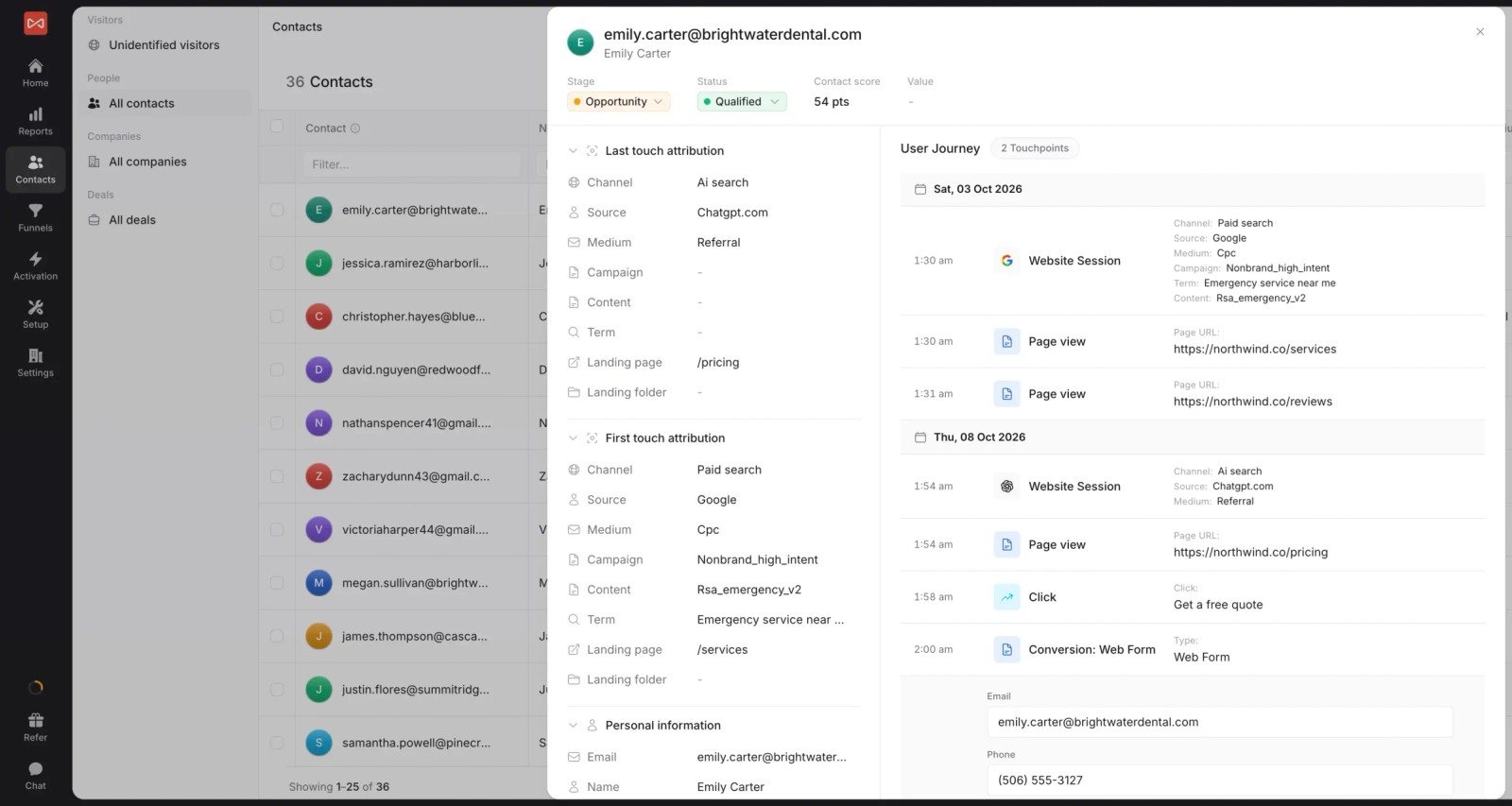
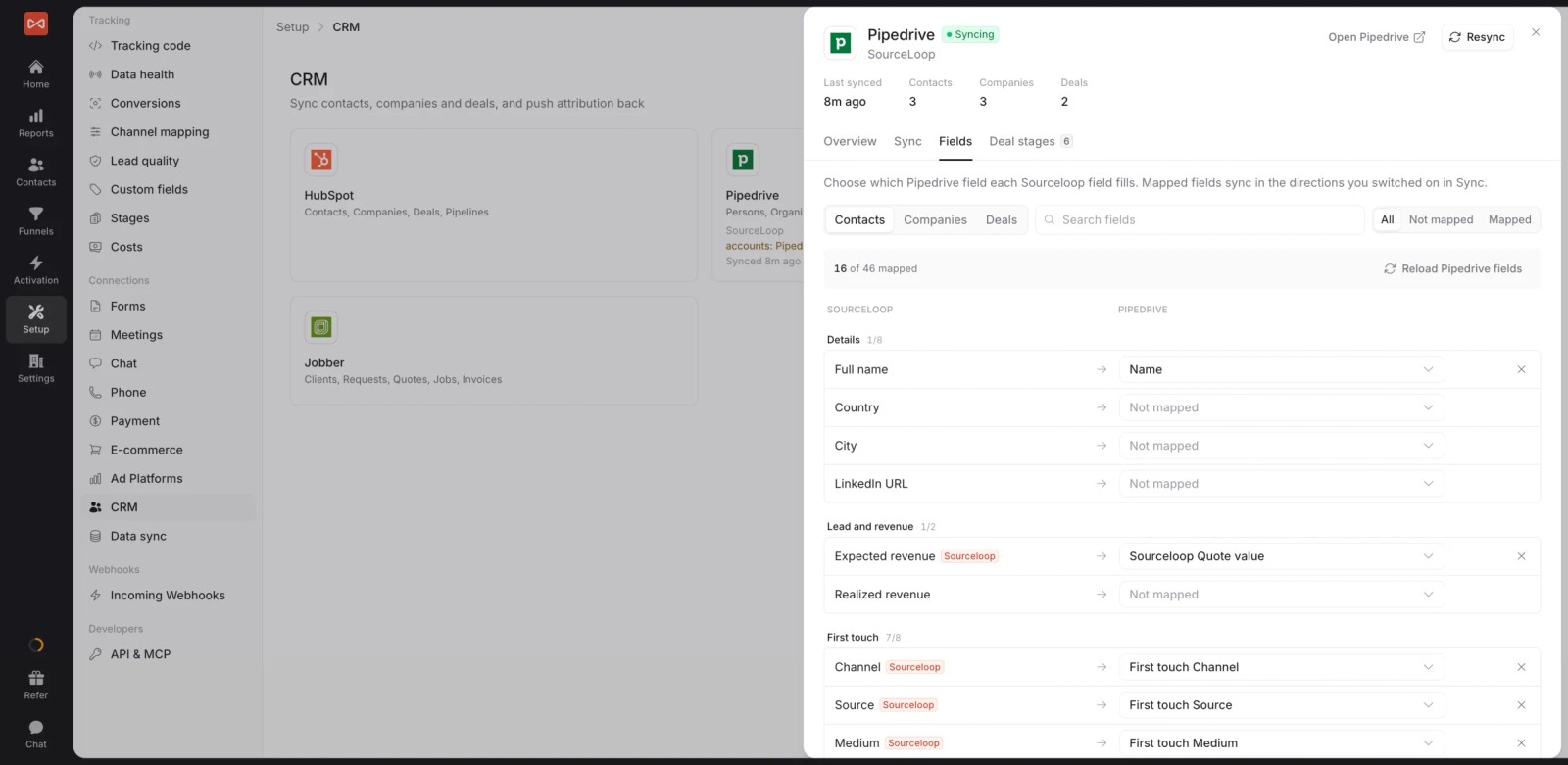
- CRM sync on Professional: HubSpot, Salesforce, Pipedrive and Jobber get attribution fields on each record, and stages and won deals come back for revenue reporting.
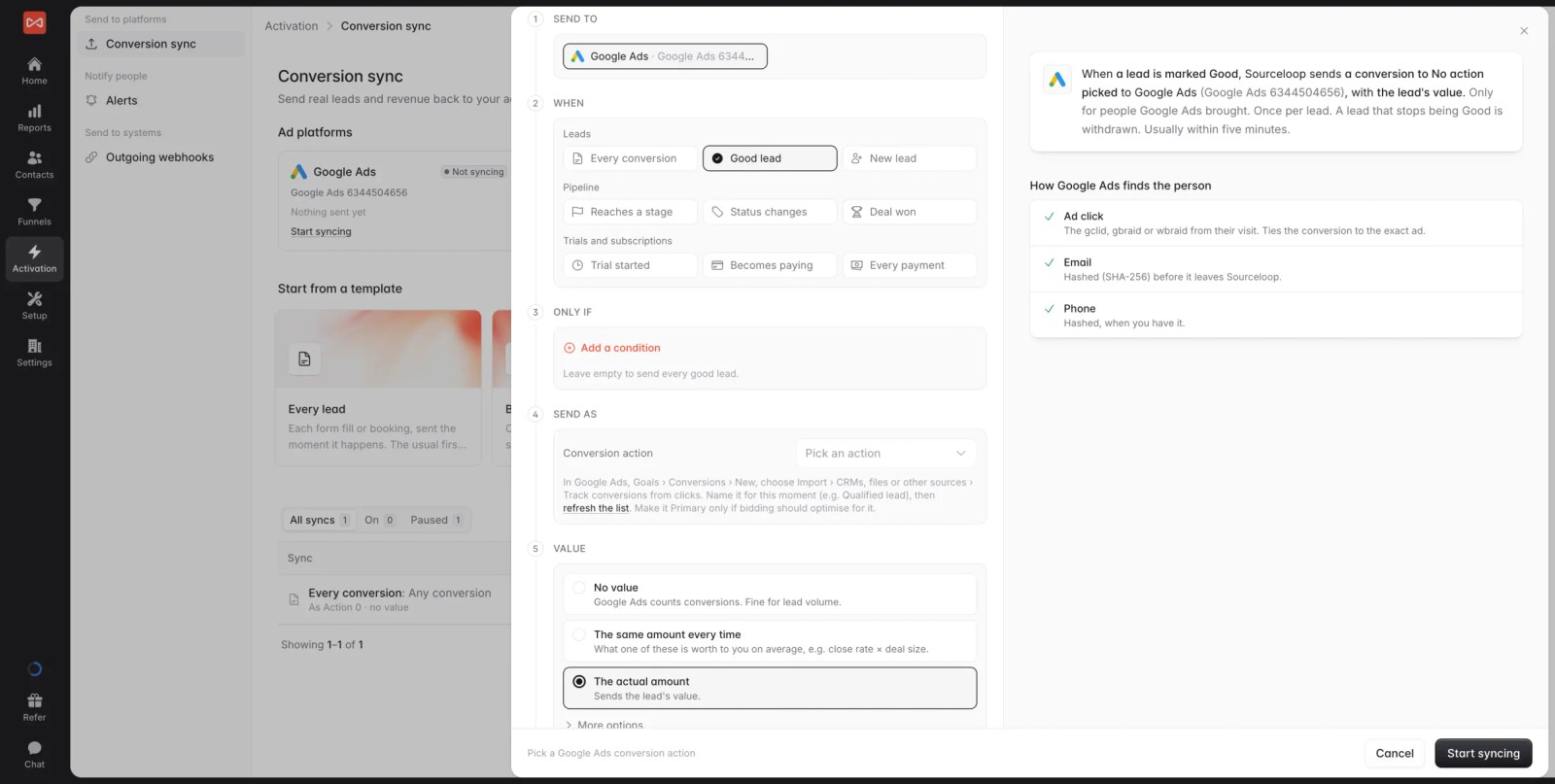
- Conversion sync: good leads, won deals and payments go to Google Ads, Meta, Microsoft Ads and ChatGPT Ads with their value. LinkedIn and TikTok are coming soon.
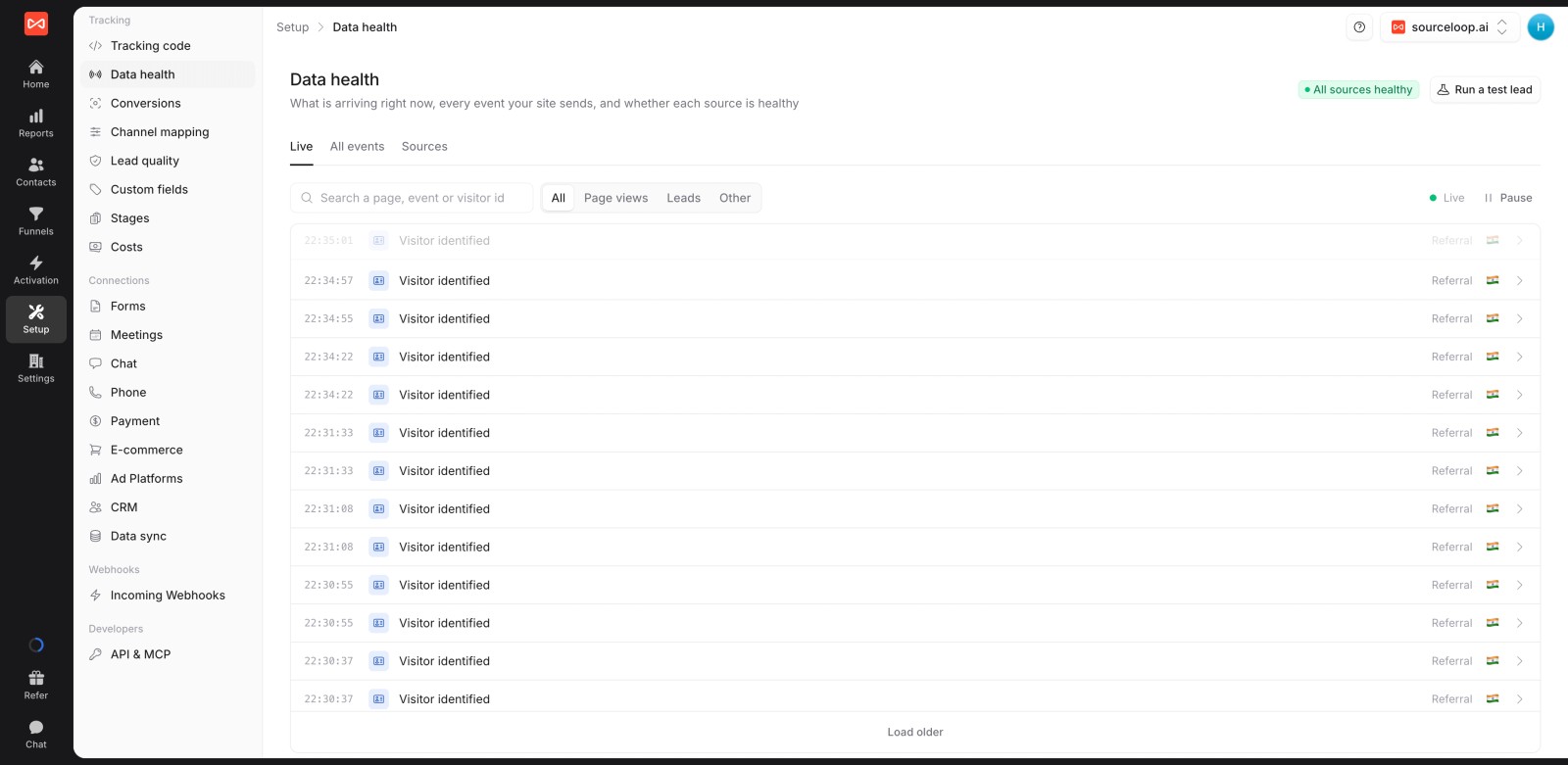
- Data health checks: a live event stream and a test-lead button show that tracking is working before you trust a report.
- Custom reports: build a live attribution report for leadership, share it as a link, or export it.
SourceLoop pricing
Unlike Rockerbox, every SourceLoop plan is published. The meter is page views, and conversions are unlimited.
| Plan detail | Essential | Professional | Agency |
|---|---|---|---|
| Monthly price | $49 | $99 | $249 |
| Billed yearly | $37/mo | $74/mo | $187/mo |
| Websites | 1 | 1 | 3 |
| Users | 1 | Unlimited | Unlimited |
| Page views a month | 30,000 | 100,000 | 1.5 million |
| Conversions | Unlimited | Unlimited | Unlimited |
| What it unlocks | Tracking, attribution reports, lead quality rules, alerts | Everything in Essential, plus CRM sync, conversion sync to ad platforms, API and MCP | Everything in Professional, plus white label reporting |
Extra websites are $19 a month, there's no onboarding fee or contract, and every plan has a 7-day trial.
Rockerbox vs SourceLoop pricing
Rockerbox doesn't publish prices, so its column uses the reported figures from earlier in this guide.
| Pricing detail | Rockerbox | SourceLoop |
|---|---|---|
| Pricing model | Custom quote by spend, channels and products | Three published tiers, metered on page views |
| Typical yearly cost | $40,000 to $90,000 (reported) | $588 to $2,988 at list price |
| Onboarding fee | $5,000 to $20,000 (reported) | None |
| Contract | Annual or multi-year (reported) | Monthly, or yearly at 25% off |
| Trial | None listed, demo first | 7 days, self-serve |
| Setup | Several weeks | Self-serve, same day |
| MMM and incrementality | Included as products | Not offered |
| CRM and lead attribution | Built mainly for ecommerce orders | Forms, calls, chats, CRM deals and payments |
A full year of SourceLoop Professional is $1,188, under 3% of the low end of Rockerbox's reported range. The comparison only holds if you used Rockerbox mainly for attribution; if MMM and lift tests were the point, SourceLoop doesn't replace them.
Frequently asked questions
-
How much does Rockerbox cost per month?
Rockerbox doesn't publish a price. Review sites list a starting point of $2,000 per feature, per month, and buyer data puts mid-market contracts at $40,000 to $90,000 a year. That's roughly $3,300 to $7,500 a month before onboarding.
-
Does Rockerbox offer a free trial?
Capterra lists no free trial, and the Rockerbox plans page routes to a demo request. Some older listings mention a free tier, so confirm current options with sales.
-
What affects the Rockerbox price?
Marketing spend under management, the number of channels, which measurement products you buy (MTA, MMM, incrementality), data volume, and the level of managed support.
-
Who owns Rockerbox now?
DoubleVerify acquired Rockerbox in 2025 in an $85 million cash deal. Rockerbox now operates as part of DoubleVerify's measurement suite.
-
What is the cheapest alternative to Rockerbox?
For teams that mainly need attribution, SourceLoop starts at $49 a month with unlimited conversions and a 7-day trial, and adds CRM sync and conversion sync on its $99 Professional plan. It doesn't include MMM or incrementality testing.
-
Is Rockerbox good for B2B or lead generation?
Rockerbox is built mainly for DTC and omnichannel brands. Lead-gen and B2B teams usually need form, call, and CRM attribution first. Our guide to B2B attribution models covers what matters there.

 Paid Social


