
Last Touch Attribution: When It Works and Fails
Discover how last touch attribution credits conversions and where it falls short. Learn when to use it in your marketing strategy.
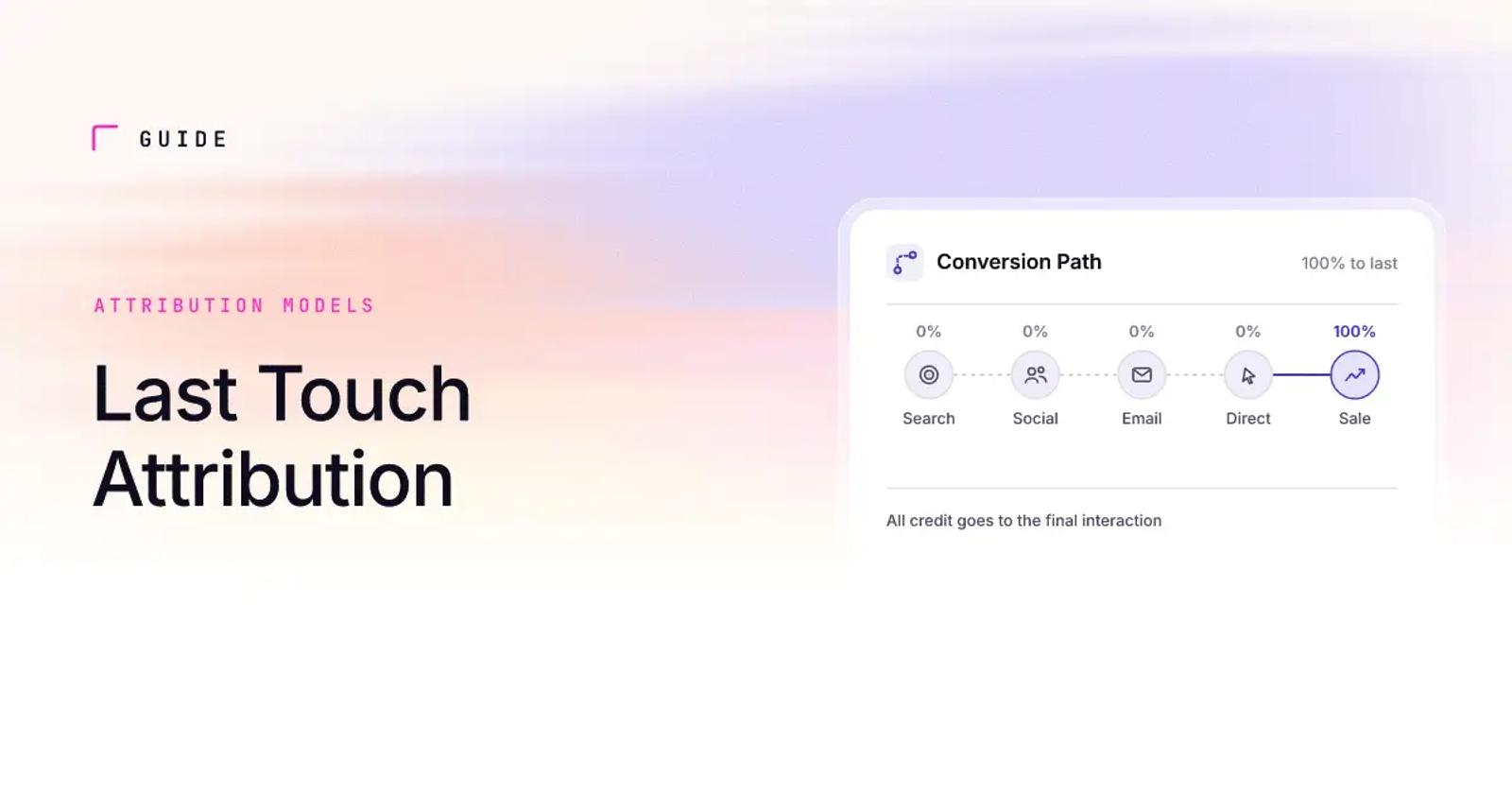
Your dashboards are probably telling three different stories. Google Ads says it did the heavy lifting, Meta points to its own assisted influence, and the CRM insists the deal came from somewhere else entirely. In that mess, last touch attribution feels comforting because it hands you one clean answer, even if that answer leaves out most of the journey.
That's why the model stuck around. It's easy to implement, easy to explain to sales, and already built into many reporting stacks. If you want a simple primer on what a lead is before you start arguing about credit, Refport's lead generation guide is a useful companion.
Table of Contents
- Why Last Touch Attribution Still Dominates Dashboards
- How Last Touch Attribution Works
- The Hidden Cost of Last Touch Bias
- Comparing Last Touch to Other Attribution Models
- When Last Touch Attribution Is Still the Right Choice
- Migrating to Multi-Touch Attribution
- Choosing the Right Attribution Model for Your Business
Why Last Touch Attribution Still Dominates Dashboards
A marketer opens three tabs and gets three different truths. Paid search says it drove the most conversions, Meta says its retargeting ads are pulling their weight, and the CRM shows the final form fill came from a branded click that happened after weeks of earlier research. Last-touch attribution became the default logic because it makes that chaos look orderly, even when the underlying journey isn't.
Why the default survived for so long
The model stuck because it's blunt in a useful way. It answers one narrow question, what was the last recorded interaction before the conversion, and it does that without demanding a complex data stack. That made it the historical starting point in many CRM and ad-platform reports, and it still shows up often because teams can explain it in one sentence.
That simplicity still has real appeal in day-to-day reporting. A marketer who needs to defend a budget line can point to the channel that closed the lead and move on. In a fast-moving team, that kind of clarity can feel like a feature, not a flaw.
Practical rule: if your team can't reliably capture the whole journey yet, a simple model is often better than pretending you have precision you don't.
The reason last-touch still hangs around is also visible in broader adoption patterns. One 2026 attribution summary reported that 41% of marketers still use last-touch for online channels, even while multi-touch approaches reached 47% adoption, according to Haus on last-touch attribution. Another 2026 industry roundup reported 34% usage among 6,200 practitioners across 28 countries, which shows the model is still common even as teams shift away from relying on it alone, according to Digital Applied's marketing attribution statistics.
What it really gives you
Last-touch gives you a clean operational story, not a full causal one. It's useful when the question is narrow, especially when teams want to know what directly closed the deal rather than everything that influenced it.
That's why it often becomes the first reporting layer, then lingers as the most familiar one. The problem starts when that familiarity gets mistaken for completeness.
How Last Touch Attribution Works
A buyer can interact with your brand across search, social, email, webinars, and retargeting, then convert on a final click that looks tidy in the report. Last touch attribution gives all conversion credit to that final tracked interaction. Every earlier touchpoint gets 0% credit. The model does not change whether the last interaction was a paid click, an email, a social ad, or a direct visit.
A real multi-touch journey
Take a prospect who first sees your brand in a LinkedIn ad, then finds a blog post through organic search, later joins a webinar, and finally clicks a retargeting ad before booking a demo. Under last-touch attribution, only that final retargeting click gets credit. The earlier LinkedIn ad, the organic content, and the webinar all disappear from the report.
That is why the model feels intuitive to sales teams and frustrating to growth teams. Sales sees the final nudge that turned interest into action. Growth sees the longer path that made the final nudge possible.
The model does not measure influence. It measures the last recorded stop before conversion.
Why the technical setup matters
This is not just a matter of chronology. Adobe notes that the Last Touch Channel reflects the most recent marketing channel a visitor qualifies for during the engagement window, and the value persists until that window expires if no new qualifying channel appears, according to Adobe Experience League. Tracking rules, cookie lifetime, and the definition of a qualifying visit can all change which channel gets the win.
For marketers, that matters more than people usually admit. A short window tends to favor recent, high-frequency channels. A longer window gives earlier touches more time to remain eligible as the final credited source. Cross-device behavior and long gaps between visits can shift credit again, especially when a buyer researches on mobile and converts later on desktop.

What to check before you trust the report
- Conversion event definition: Make sure the platform is measuring the same action your team cares about.
- Engagement window rules: Confirm how long a touchpoint stays eligible for final credit.
- Cross-device continuity: Check whether the system can connect visits across browsers and devices.
- Qualifying channel logic: Verify which interactions the platform recognizes as a channel.
If those pieces are loose, the model can still be useful, but the output becomes a reflection of tracking policy as much as buyer behavior.
The Hidden Cost of Last Touch Bias
The biggest problem with last-touch attribution isn't that it's simple. It's that simplicity can hide the value of the channels that do the quiet work before a conversion. Brand search and direct traffic often look stronger than they really are because they tend to appear at the end of the journey, while awareness and consideration channels get pushed out of the frame.
Where the budget gets misread
That bias changes how teams allocate spend. When a channel is repeatedly the last recorded touch, it looks like the best channel, even if it mainly catches demand created elsewhere. The result is a budget story that can favor the channel closest to the checkout moment and starve the channels that made the conversion possible.
A 2026 industry report estimated that businesses relying exclusively on last-touch misattribute an average of $240,000 in annual media spend by ignoring upper-funnel channels, according to Digital Applied's 2026 attribution roundup. That number matters because attribution isn't a reporting exercise. It shapes what gets funded, what gets paused, and what gets defended in planning meetings.
Why the blind spot grows in fragmented journeys
This gets worse in privacy-constrained, cross-device, and offline-heavy journeys. Improvado says attribution models that can't connect fragmented interactions create a 35% visibility blind spot where awareness and consideration touches disappear, according to Improvado's cross-channel marketing analytics guide. When a buyer researches on one device, talks to sales on another, and closes offline, last-touch only sees the fragment that happens to be recorded at the end.
That's why the model often overvalues the easiest-to-track channels. It isn't necessarily lying. It's just incomplete in a way that consistently favors the final digital click over the longer path that built the pipeline.
Budget rule: if a channel mainly appears at the end of the journey, don't assume it created the journey.
The practical danger is subtle. Teams start optimizing for a report pattern instead of a revenue pattern. If you keep rewarding the final click, you can end up buying more closure and less demand.
Comparing Last Touch to Other Attribution Models
A last-touch report can look decisive until the channel mix gets more complex. Then the model starts answering a narrow question well and a broader planning question poorly. The right comparison is not about which model is superior in theory. It is about which model matches the decision you need to make, and which one shifts credit away from the channels that created the pipeline in the first place.
Model fit matters more than model ideology
First-touch helps you see what starts demand. Linear attribution spreads credit across the journey, which is useful when you want to respect every interaction without forcing every touch to carry the same weight in the same way. Time-decay gives more credit to recent touches while still acknowledging earlier ones, and position-based models try to preserve both the entry point and the close.
For a more direct contrast with first-touch, SourceLoop's first-touch attribution overview is a useful reference. If you are working inside ad platforms, the Facebook attribution window guide is worth reading because window settings can change what any model can see, especially when paid activity gets filtered through platform-specific rules.
Attribution Model Comparison
| Model | Best For | Main Bias | Data Requirements |
|---|---|---|---|
| Last-touch | Understanding what closes deals | Over-credits the final interaction | Needs reliable final-touch tracking |
| First-touch | Seeing what starts demand | Over-credits the first interaction | Needs reliable first-contact tracking |
| Linear | Respecting the full journey evenly | Can flatten meaningful differences between touches | Needs consistent tracking across all touches |
| Time-decay | Balancing recency with journey context | Still leans toward the end of the funnel | Needs timestamped touchpoints |
| Position-based | Highlighting entry and close together | Can underweight middle-stage influence | Needs enough journey data to place touches properly |
Modern attribution platforms make this comparison more practical, not less. A recent industry roundup from Digital Applied's marketing attribution statistics points to broad multi-touch adoption while last-touch still remains in active use for online attribution. That mix says something useful. Last-touch has not disappeared, but it works better as one lens in a larger measurement stack than as the only operating model.
What each model is really good at
- Last-touch: Best for closure analysis and short-cycle optimization.
- First-touch: Better for demand creation analysis.
- Linear: Better for journey visibility.
- Time-decay: Better when recency clearly matters.
- Position-based: Better when both the opener and closer deserve explicit attention.
The practical test is simple. If you are trying to understand which channel deserves credit for opening the door, last-touch will mislead you. If you are trying to understand which interaction most often precedes the final conversion event, it can still be useful. Teams that migrate to multi-touch attribution usually keep last-touch in the stack for exactly that reason. It gives them a baseline to compare against first-touch, assisted conversions, and path-level reporting without forcing every question into the same model.
When Last Touch Attribution Is Still the Right Choice
Last-touch still earns its keep when the business question is narrow and the journey is short. If your team mainly wants to know what directly closes deals, the model can be a clean fit. If the buyer path is simple enough, the extra sophistication of multi-touch can add complexity without adding much decision value.
Where it works well
Quantummetric says last-touch is best when the business question is “what closes deals,” according to Quantummetric's attribution models explainer. Improvado narrows its best-use case further to short sales cycles and paths with fewer than three touchpoints for most conversions, also in the same decision context.
That lines up with what many lean teams need. A sales-led business with a straightforward funnel may care more about the final interaction that triggered the demo, purchase, or booking than the earlier touches that built awareness. In that setting, last-touch is a practical operational lens, not a strategic theory.
Where it belongs in the stack
The better move for many teams is not to delete last-touch. It's to keep it as a baseline. That lets you compare what closes deals against what creates demand, without forcing every stakeholder to learn the same report in the same way.
Use last-touch as a control group, not as the whole experiment.
That approach is especially useful when teams are transitioning to more complete measurement. The old report still gives sales and finance a familiar benchmark, while the newer model starts showing where earlier touches contribute to pipeline creation. If the two reports diverge sharply, that's a signal to investigate tracking, journey length, and channel mix before changing budgets.
The practical test is simple. If your funnel is short, your touchpoints are few, and your primary decision is about immediate closure, last-touch can still be the right answer. If those conditions don't hold, it should be treated as a reference point, not the final word.
Migrating to Multi-Touch Attribution
Moving off last-touch doesn't start with software. It starts with deciding what you need to measure. If your team can't see every meaningful touchpoint, then any fancy model will just produce more precise-looking blind spots. The migration has to begin with data quality, not dashboard aesthetics.
Start with the journey you already have
Map the actual conversion path before you choose the platform. That means listing the touchpoints that matter in your business, from paid clicks and organic visits to web forms, chat widgets, sales calls, meetings, and offline conversions. If a touchpoint affects revenue but never gets recorded, the model can't credit it.
A platform like SourceLoop can help here because it captures visits, ties multi-touch journeys to conversions from web forms and chat widgets, and syncs qualified offline conversions back to ad platforms. That kind of setup matters because it connects the front of the funnel to revenue instead of stopping at the last digital click.
Validate before you switch the whole team
The cleanest migration is usually a parallel run. Keep last-touch in place while you test the new model against known outcomes, then compare the two side by side. If the new model suddenly erases obvious channels or inflates a source that never shows up in CRM, the implementation needs review.
- Audit current tracking: Identify which touchpoints are tracked, missing, or duplicated.
- Choose the model stack: Pick multi-touch logic that matches your funnel shape, not just the default in the tool.
- Test against real conversions: Compare modeled credit with CRM stage movement, closed revenue, and offline sources.
Durable IDs and first-party tracking matter more now because so many journeys are fragmented across devices and channels. Teams that want more complete truth need systems that can preserve identity across those handoffs and import offline conversions back into the same reporting layer.
If you're comparing tools, SourceLoop's multi-touch attribution tools overview is one place to start because it frames tool choice around the tracking problem, not just the UI.

Choosing the Right Attribution Model for Your Business
The right model depends on what you sell, how people buy, and how much of the journey you can see. If conversions happen quickly and the final interaction is the main decision point, last-touch may still be enough. If buyers research across channels, switch devices, or involve sales before converting, you need a model that sees more than the final click.
The best decision rule is practical. Use last-touch attribution when the funnel is short, the channel mix is simple, and you want a clean view of what closes deals. Move toward multi-touch when earlier interactions clearly shape pipeline, when offline revenue matters, or when platform reports keep over-crediting the same end-of-funnel source.
For teams building a broader measurement stack, SourceLoop's types of attribution models can help anchor the vocabulary before you redesign reporting. And if your budgets depend on social performance, PostPulse's guide to automate social goal tracking is useful for keeping campaign objectives tied to measurable outcomes instead of vanity metrics.
Attribution is never a one-time decision. Start with the model that matches your current visibility, compare it against a second view, then revisit the setup whenever your sales cycle, channel mix, or tracking coverage changes. The goal isn't perfect attribution. It's better budget decisions, made with enough truth to improve revenue.
If your team is still making spend decisions from a single last-click report, it's time to audit the journey, compare it against a multi-touch view, and see where credit is getting stuck at the end. Start by mapping your real touchpoints, then test a model that can connect web, CRM, and offline conversions in one place.



 Paid Social


