
What Does Last Click Attribution Mean? Definition & Examples
Last click attribution gives 100% credit to the final touchpoint before conversion. Learn how it works, pros and cons, and when to use this attribution model.
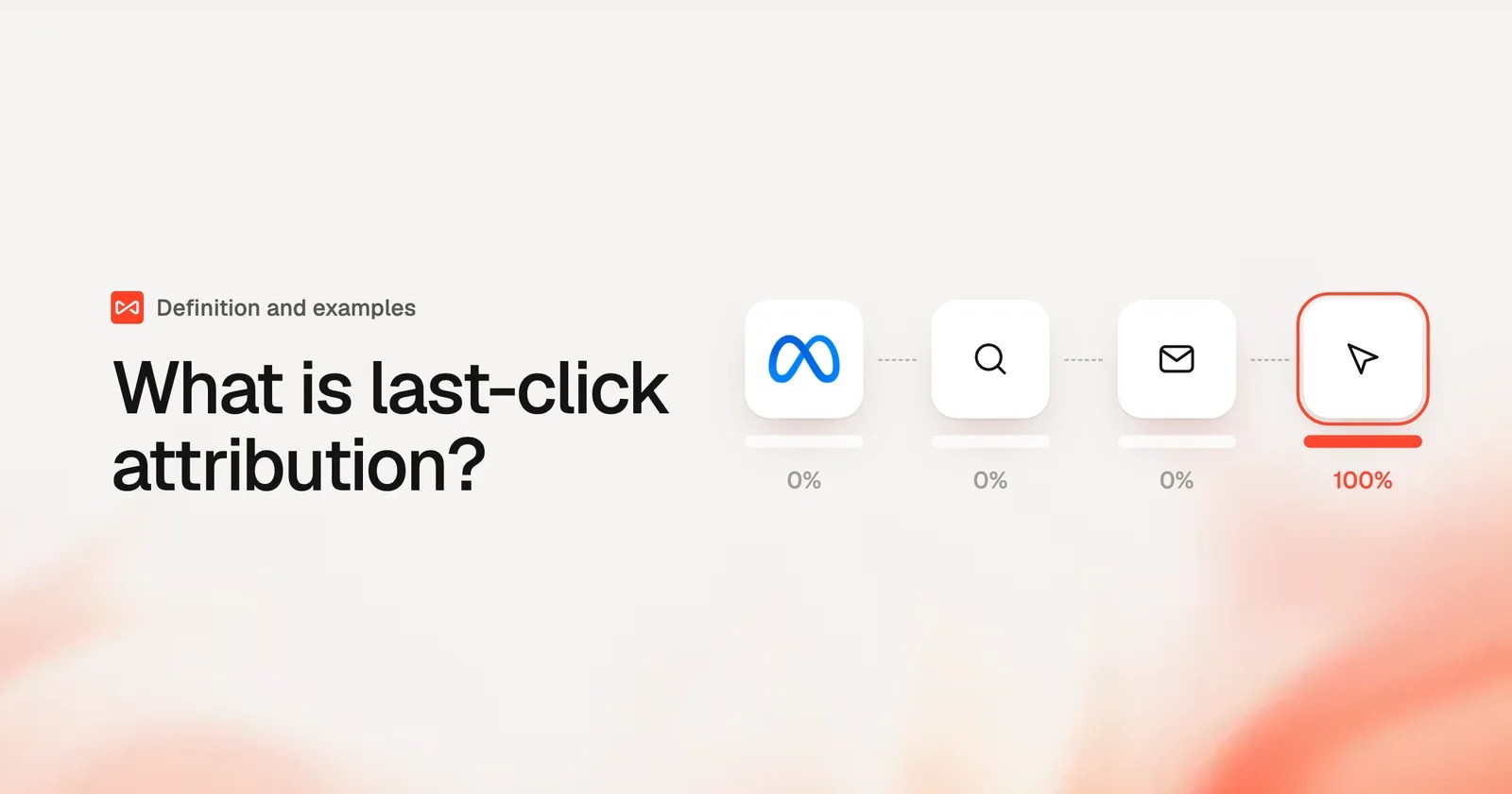
Table of contents
- How Last Click Attribution Works
- Why Marketers Use Last Click Attribution
- The Limitations of Last Click Attribution
- Last Click vs. Other Attribution Models
- Last Click vs. First Click Attribution
- Last Click vs. Linear Attribution
- Last Click vs. Time Decay Attribution
- Last Click vs. Multi-Touch Attribution
- When to Use Last Click Attribution
- How to Implement Last Click Attribution
- In Google Analytics
- In Your CRM
- With Attribution Software
- Moving Beyond Last Click Attribution
- Common Last Click Attribution Mistakes
- FAQ
- What is the difference between last click and last touch attribution?
- Why is last click attribution considered flawed?
- What attribution model is better than last click?
- Does Google Analytics use last click attribution?
- When should you use last click attribution?
- How do you capture last click data in your CRM?
- Can last click attribution track offline conversions?
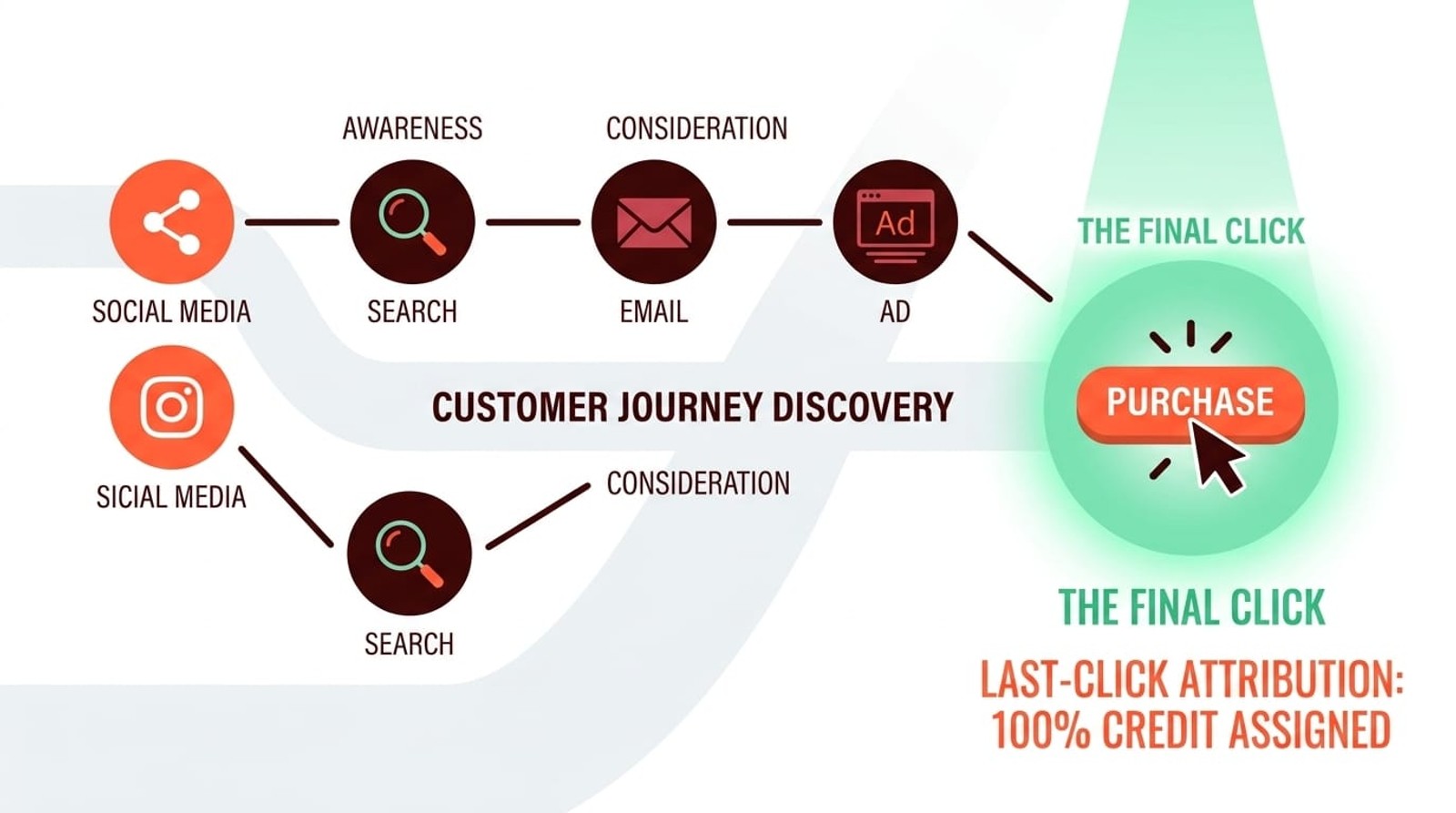
Last click attribution is a marketing attribution model that assigns 100% of the credit for a conversion to the final touchpoint a customer interacts with before completing a desired action. If someone clicks a paid search ad and immediately converts, that ad receives all the credit, regardless of how many other marketing channels influenced the decision beforehand.
How Last Click Attribution Works
Last click attribution operates on a straightforward principle: whichever marketing channel the customer interacted with immediately before converting gets 100% of the credit.
Here's how it plays out in practice. A potential customer discovers your brand through several touchpoints:
- Monday: Sees your LinkedIn ad
- Tuesday: Clicks a Facebook retargeting ad but doesn't convert
- Wednesday: Receives your email newsletter and clicks through
- Thursday: Searches "\[your brand name\]" on Google, clicks the ad, and converts
Under last click attribution, Google Ads receives full credit for the conversion. The LinkedIn ad, Facebook retargeting, and email campaign that contributed to the journey? They receive zero credit, even though they all influenced the final decision.
This single-touch approach makes reporting clean and simple but masks the complexity of actual customer behavior. Most B2B buyers interact with 10 or more touchpoints before making a purchase decision, yet last click only acknowledges one.
Why Marketers Use Last Click Attribution
Despite its limitations, last click attribution remains popular for several practical reasons.
Simplicity and clarity. Last click requires minimal setup and doesn't demand sophisticated tracking infrastructure. Every analytics platform from Google Analytics to Facebook Ads Manager defaults to last-click reporting. Teams can generate reports without debating weighting formulas or cross-channel data integration challenges.
Direct correlation to revenue. When you need to show executives which campaigns directly led to closed deals, last click provides a clean answer. The channel that "closed" the deal gets credit, which aligns with how many sales teams think about attribution, who brought in the customer?
Quick decision-making. For businesses testing multiple campaigns simultaneously, last click offers immediate feedback on what's driving conversions right now. You don't need weeks of data to see patterns; conversions map directly to specific channels.
Budget allocation baseline. While not the full picture, last click gives you a starting point for budget decisions. If branded search consistently shows up as the last click, you know that channel requires protection even if it's not doing the heavy lifting earlier in the funnel.
Google Analytics used last click as its default attribution model for years, cementing it as the industry standard for many marketing teams. That widespread adoption created organizational inertia, switching attribution models requires convincing stakeholders to change how they've measured success for years.
The Limitations of Last Click Attribution
Last click attribution creates a distorted view of marketing performance that can lead to misguided decisions.
It ignores the awareness and consideration stages. Top-of-funnel channels like content marketing, display advertising, and social media rarely show up as the last click. A prospect might discover you through a blog post, engage with your content for weeks, then finally convert after clicking a branded search ad. Last click credits search while the content that built trust receives nothing.
Bottom-funnel channels get inflated credit. Branded search, retargeting ads, and direct traffic almost always appear as the last click because they're closest to the conversion moment. These channels look incredibly efficient under last click attribution, which can lead to over-investment in tactics that capture existing demand rather than generate new awareness.
It penalizes long sales cycles. B2B companies with 3-6 month sales cycles see prospects touch dozens of marketing assets. The whitepaper that sparked initial interest, the webinar that educated the buying committee, the case study that overcame objections, none of these receive credit if the final click came from an email.
Budget decisions become myopic. When you optimize spending based on last click data, you naturally shift budget toward bottom-funnel channels. This can starve your pipeline of new prospects, creating a short-term win that damages long-term growth. According to Gartner's research, 63% of CMOs report that last-click attribution led them to undervalue brand-building initiatives.
Last Click vs. Other Attribution Models
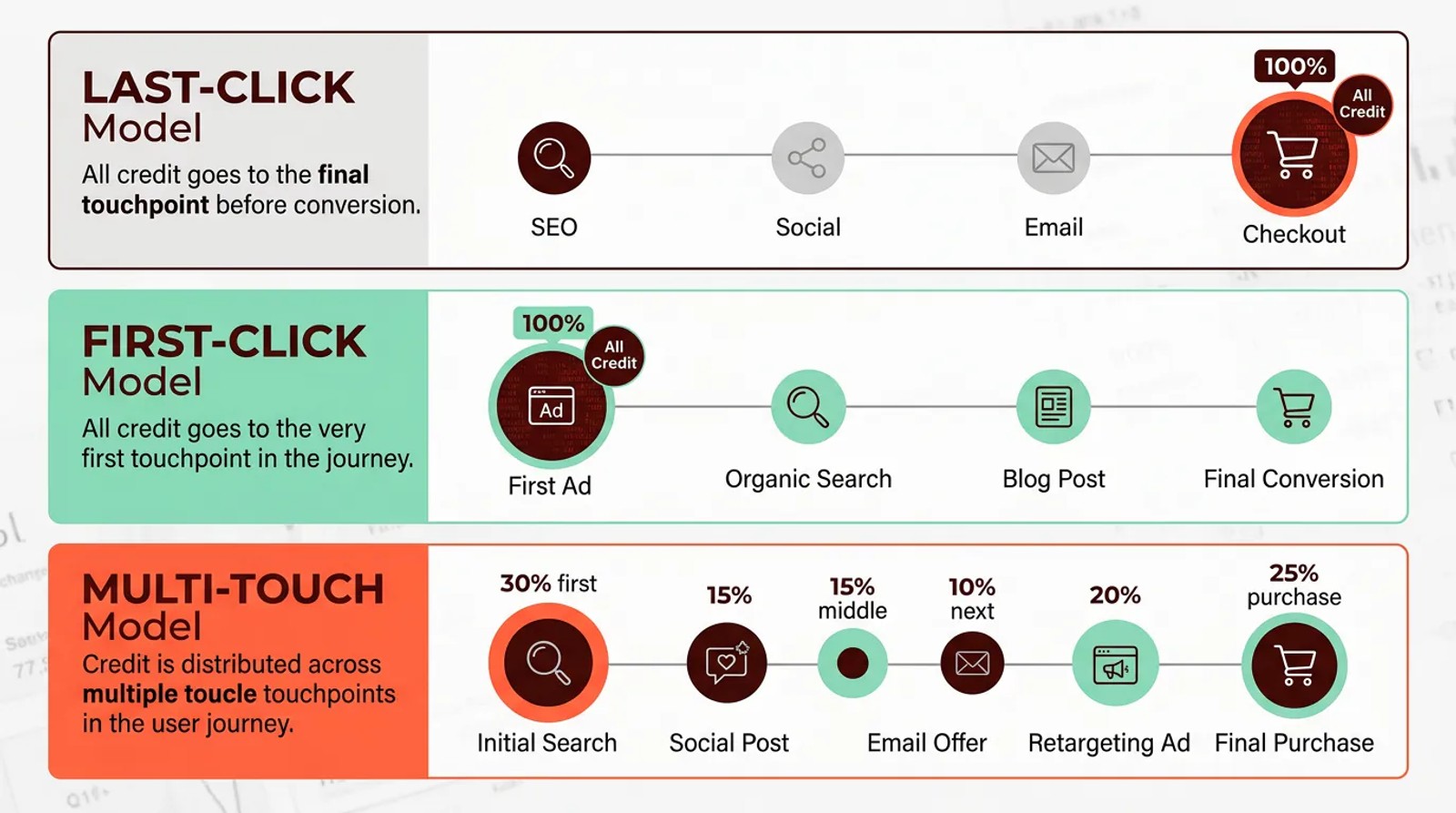
Attribution models differ in how they distribute credit across the customer journey. Understanding these differences helps you choose the right approach for your business.
Last Click vs. First Click Attribution
First click attribution is last click's mirror image, it assigns 100% credit to the channel that started the journey. Where last click favors bottom-funnel tactics, first click emphasizes top-of-funnel awareness channels.
If a customer first discovered you through a Facebook ad, later engaged with your email campaign, then converted via branded search, first click gives all credit to Facebook. This model suits businesses focused on understanding which channels drive new prospect acquisition rather than closing behavior.
Last Click vs. Linear Attribution
Linear attribution distributes credit equally across all touchpoints. A journey with five interactions gives each channel 20% credit. This model prevents any single channel from dominating the narrative but can dilute the importance of truly influential moments.
Linear works well when you want a balanced view but lacks sophistication, it treats a casual blog read the same as a demo request that indicated buying intent.
Last Click vs. Time Decay Attribution
Time decay attribution gives more credit to touchpoints closer to conversion while still acknowledging earlier interactions. A touchpoint one day before purchase receives more credit than one 30 days earlier.
This model recognizes that recent interactions often matter more while avoiding last click's blind spot. It's particularly effective for businesses with clear buying signals that intensify as prospects approach a decision.
Last Click vs. Multi-Touch Attribution
Multi-touch attribution uses data-driven or algorithmic models to assign credit based on actual conversion patterns. Rather than applying a fixed rule, multi-touch systems analyze thousands of customer journeys to determine which touchpoints statistically correlate with conversions.
Multi-touch models require more sophisticated tracking and larger data sets but provide the most accurate picture of channel performance. They're essential for businesses with complex funnels, multiple product lines, or long sales cycles where dozens of interactions precede a purchase.
When to Use Last Click Attribution
Last click attribution isn't always wrong, it fits specific business contexts where its simplicity outweighs its limitations.
Short sales cycles with immediate conversions. E-commerce businesses selling low-consideration products see customers who research briefly and convert quickly. When most buyers convert within 1-2 sessions, the "last click" often is the journey. A customer searching "buy noise-canceling headphones" and converting immediately didn't need months of nurturing.
Limited marketing channels. If you're only running Google Ads and email campaigns, attribution complexity matters less. With two channels, you can manually assess their relationship without sophisticated modeling. Last click provides a clean baseline, and you can supplement it with basic channel overlap reports.
Branded search campaigns. When you're specifically measuring branded search performance, last click makes sense. People searching for your brand name already have awareness and intent, they're not in a complex discovery journey. Last click accurately reflects branded search's role as a conversion capture mechanism.
Quick testing and iteration. Early-stage companies testing channel viability benefit from last click's immediacy. You launch Facebook ads, see conversions, and can decide whether to invest more. The question isn't "how did Facebook contribute to journeys?" but "did this channel drive any conversions at all?"
Organizational constraints. Sometimes you're working within systems that only support last click attribution. Rather than delay all measurement while building a multi-touch system, use last click as your starting point. Document its limitations and plan the eventual migration, but don't let perfect attribution prevent good-enough measurement.
However, most B2B companies, businesses with 30+ day sales cycles, and organizations running comprehensive marketing programs should move beyond last click as quickly as possible. SourceLoop's lead source tracking captures the full customer journey, not just the final click.
How to Implement Last Click Attribution
Setting up last click attribution requires capturing and crediting the final interaction before each conversion.
In Google Analytics
Google Analytics 4 (GA4) uses data-driven attribution as its default model, but you can view last click data through conversion path reports.
Navigate to Advertising → Attribution → Conversion paths to see the sequence of channels leading to conversions. While GA4 emphasizes cross-channel journeys, you can isolate the final touchpoint by filtering reports or using the "Last click" attribution comparison option in exploration reports.
For Universal Analytics (sunset in July 2023), last click was the default. You found it under Conversions → Attribution → Model Comparison Tool.
In Your CRM
CRM systems like HubSpot, Salesforce, and Pipedrive typically use last-touch attribution for their standard reporting. When a contact converts to a deal, the CRM assigns the source based on the most recent campaign, form submission, or interaction.
To ensure accurate last click attribution in your CRM:
- Capture UTM parameters at every touchpoint. Use UTM tracking on all campaigns to record channel and campaign details with each interaction.
- Configure lifecycle stage automation. Set up workflows that update contact properties when key actions occur, ensuring the latest interaction is captured.
- Create custom fields for conversion attribution. Build fields like "Last Marketing Source" or "Conversion Campaign" that lock in values at the conversion moment, preventing overrides from post-sale touches.
- Map offline conversions back to online sources. When phone calls, in-person meetings, or manual deal entry happen, ensure your team logs the source that triggered the interaction.
With Attribution Software
Dedicated marketing attribution software offers more control and flexibility than built-in platform tools.
SourceLoop automatically tracks the complete customer journey from first anonymous visit through conversion and revenue. While we support multiple attribution models, you can isolate last-click data for specific reports:
- Install the tracking pixel on your website to capture all visitor interactions
- Connect your CRM (HubSpot, Salesforce, Pipedrive) to unify web behavior with conversion data
- Link your ad platforms (Google Ads, Meta, LinkedIn) to see the full picture from click to customer
- View last-click reports in the dashboard while maintaining access to multi-touch attribution for deeper analysis
The advantage of using attribution software rather than relying on GA4 or your CRM alone is that you can switch between attribution models without rebuilding your tracking. Start with last click as a baseline, then layer in multi-touch analysis as your marketing sophistication grows.
Moving Beyond Last Click Attribution
Most marketing teams eventually recognize last click's limitations and seek more complete attribution.
Start by auditing your customer journey. Map the typical path from awareness to conversion. How many touchpoints do prospects engage with? Which channels appear early, middle, and late in the funnel? This visibility immediately reveals whether last click is hiding significant channel contributions.
Compare attribution models side by side. Run reports showing the same time period under last click, first click, linear, and multi-touch models. You'll see dramatic differences in channel performance. Channels that look weak under last click often show strong early-funnel contribution under first click or multi-touch analysis.
Identify your high-value first-touch channels. While you're still using last click for primary reporting, create supplementary reports on first-touch sources. You'll discover which channels are building your pipeline even if they rarely close deals. These channels deserve continued investment despite weak last-click metrics.
Test incrementality. Turn off a channel that performs poorly under last click but appears frequently in customer journeys. If conversions drop significantly, last click was undervaluing that channel. Incrementality testing validates whether attribution models reflect reality.
Implement proper lead source tracking. The barrier to better attribution is usually data, not strategy. You need systems that capture every touchpoint, maintain user identity across devices and sessions, and connect web behavior to CRM records. SourceLoop solves this by capturing the full journey from first anonymous visit through closed revenue.
According to a 2024 survey by Marketing Evolution, 71% of enterprises have moved beyond last-click attribution, adopting algorithmic or multi-touch models. The holdouts are primarily small businesses with limited resources or simple go-to-market motions.
Common Last Click Attribution Mistakes
Even within last click's limitations, teams make errors that compound its weaknesses.
Not tracking dark social. Links shared in Slack, WhatsApp, or text messages often appear as direct traffic in analytics. If your last click is "direct," you're crediting an unknown source. Use link shorteners with UTM parameters for shareable content to capture these hidden referrers.
Ignoring offline conversions. Phone calls, in-person demos, and trade show leads need to be mapped back to their digital sources. If a prospect fills out a form from your email campaign then calls to close the deal, the phone call shouldn't overwrite the email as the last click.
Over-rotating to bottom-funnel channels. When last click shows branded search and retargeting as your top performers, it's tempting to shift budget away from awareness campaigns. This creates a pipeline crisis 3-6 months later when you've stopped generating new demand.
Not documenting data quality issues. Last click attribution is only as good as your tracking. Missing UTM parameters, broken CRM integrations, or cookie consent blockers create attribution gaps. If 30% of conversions show "unknown source," your last-click data is unreliable, but many teams still make budget decisions as if it were accurate.
Using different attribution windows across platforms. Google Ads might use a 30-day click window while Facebook uses 7 days. If you compare these platforms' last-click numbers directly, you're not measuring the same thing. Standardize attribution windows across channels for fair comparison.
FAQ
What is the difference between last click and last touch attribution?
Last click and last touch attribution are functionally the same, both assign 100% credit to the final interaction before conversion. "Last click" is more commonly used in digital marketing contexts while "last touch" appears more often in CRM and sales attribution discussions, but they describe identical methodologies.
Why is last click attribution considered flawed?
Last click attribution is considered flawed because it ignores all touchpoints except the final one, creating an incomplete picture of the customer journey. It systematically undervalues awareness and consideration channels while over-crediting bottom-funnel tactics like branded search and retargeting. This leads to misguided budget decisions that can damage long-term growth.
What attribution model is better than last click?
Multi-touch attribution models that distribute credit across the entire customer journey provide a more accurate view than last click. Data-driven attribution uses machine learning to assign credit based on actual conversion patterns, while rules-based approaches like time decay or position-based (U-shaped) offer more balanced credit distribution. The "best" model depends on your sales cycle, channel mix, and analytical capabilities.
Does Google Analytics use last click attribution?
Google Analytics 4 (GA4) uses data-driven attribution as its default model rather than last click. However, you can view last-click data through conversion path reports and attribution comparisons. The older Universal Analytics (deprecated in 2023) used last non-direct click as its default, which credits the last channel that wasn't direct traffic.
When should you use last click attribution?
Last click attribution works best for businesses with short sales cycles (1-2 sessions), limited marketing channels, low-consideration products, or when you need a quick baseline for channel performance. It's also appropriate when specifically measuring branded search or other bottom-funnel conversion-capture tactics where the "last click" genuinely represents the customer's decision point.
How do you capture last click data in your CRM?
To capture accurate last click data in your CRM, use UTM parameters on all marketing campaigns, configure lifecycle stage automation to update contact properties at conversion, create custom fields that lock in conversion source values, and implement proper tracking tools like SourceLoop that automatically capture and sync attribution data from first touch through revenue.
Can last click attribution track offline conversions?
Last click attribution can track offline conversions if you properly map them back to their digital sources. When prospects convert via phone, in-person demos, or other offline channels, your team needs to document which marketing source triggered the interaction. Tools like call tracking software and CRM workflows help maintain accurate attribution through offline touchpoints.

 Paid Social


