
Closed Loop Attribution Explained from Click to Revenue
Learn what closed loop attribution is, how it connects ad clicks to CRM revenue, and the steps to implement it without losing data across channels.
Your CMO is pointing to a campaign dashboard full of conversions. Your CRO is looking at the CRM and asking why the qualified pipeline is thin. Both may be reading accurate reports, yet neither report answers the question the business cares about: which marketing touchpoints contributed to revenue?
Closed loop attribution connects those systems. It follows a buyer from the original campaign interaction through website behavior, lead creation, sales progression, and a recorded transaction. The difficult part isn't drawing the journey on a dashboard. It's defining the data contract that lets every system recognize the same person, event, and outcome.
Table of Contents
- Why Marketing Reports and Sales Reality Rarely Match
- What Closed Loop Attribution Means
- How Closed Loop Differs From Other Attribution Models
- Building Blocks of a Working Closed Loop System
- Implementing Closed Loop Attribution Step by Step
- Pitfalls That Break the Loop
- Privacy, Consent and a First-Party Data Contract
Why Marketing Reports and Sales Reality Rarely Match
A paid media platform may report a conversion when someone submits a form. The CRM may later classify that contact as unqualified, duplicate, or lost. Finance may record no transaction at all. Without a connection between those records, marketing optimizes for the form submission while sales evaluates the quality of the resulting pipeline.
That separation grew out of how web analytics developed. Google acquired Urchin Software Corporation in April 2005 and relaunched the technology as Google Analytics on November 14, 2005. Urchin's campaign-tagging system helped establish UTM codes, which connect campaign links with subsequent website sessions, making source-level measurement broadly accessible through a free product (history of Google Analytics and campaign tracking).
The early model was useful, but it stopped near the browser. It could tell you which referrer preceded a visit or form submission, but it couldn't reliably follow the buyer into a phone call, sales conversation, payment process, or offline transaction. That is why a lead report and a revenue report can both look internally consistent while telling different stories.
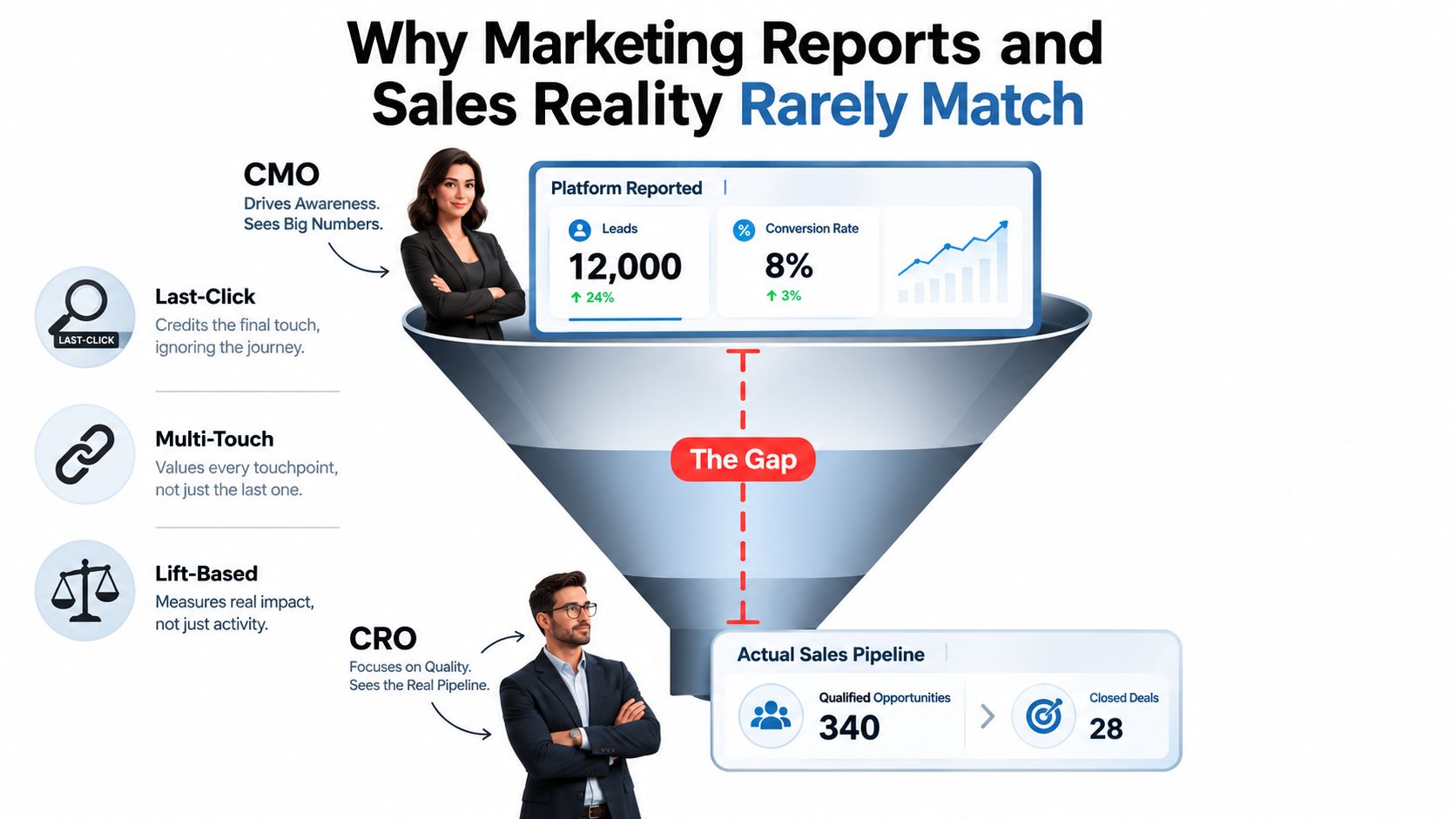
A buyer's journey through the loop
Consider a buyer who clicks a paid search ad, reads several pages, returns through an email link, books a sales call, becomes a qualified opportunity, and later pays an invoice. A closed loop preserves the relationship between those events instead of treating them as unrelated records.
The system needs four connected capabilities:
- Data collection: Capture campaign parameters, landing pages, sessions, forms, calls, bookings, and other meaningful touchpoints.
- Identity resolution: Associate anonymous visits and known contacts without creating a new person for every device, browser, or form submission.
- CRM and offline backfill: Bring opportunity stages, closed deals, payments, cancellations, and other downstream outcomes into the attribution record.
- Ad-platform feedback: Send qualified conversion signals back to platforms so optimization isn't based only on shallow actions.
A reporting framework can help teams communicate the difference between activity and business outcomes. For a practical perspective on campaign reporting, see this guide for marketing teams on reporting. For broader context on connecting measurement to business decisions, the marketing measurement guide provides a useful companion.
Practical rule: A lead is an event in the journey. Revenue is an outcome at the end of the journey.
The loop closes only when the original source remains attached to the contact as the contact moves through the business. If the campaign source disappears when the record enters the CRM, or if the CRM outcome never returns to the attribution system, the organization still has open-loop reporting.
What Closed Loop Attribution Means
A paid search click becomes a form submission, the submission becomes a CRM contact, and that contact later becomes a closed deal. Closed loop attribution connects those events so the original marketing activity can be compared with a verified business outcome. Credit allocation is one layer. The defining feature is the data connection from a marketing touchpoint to a business record, then back into reporting and campaign optimization.
Last-click attribution asks which interaction came immediately before conversion. Multi-touch attribution distributes credit across several observed interactions. Lift-based measurement compares an exposed group with a comparable unexposed group. A closed loop system can support any of these methods. Its distinguishing requirement is that the journey remains connected to records such as an opportunity, closed deal, payment, renewal, or cancellation.
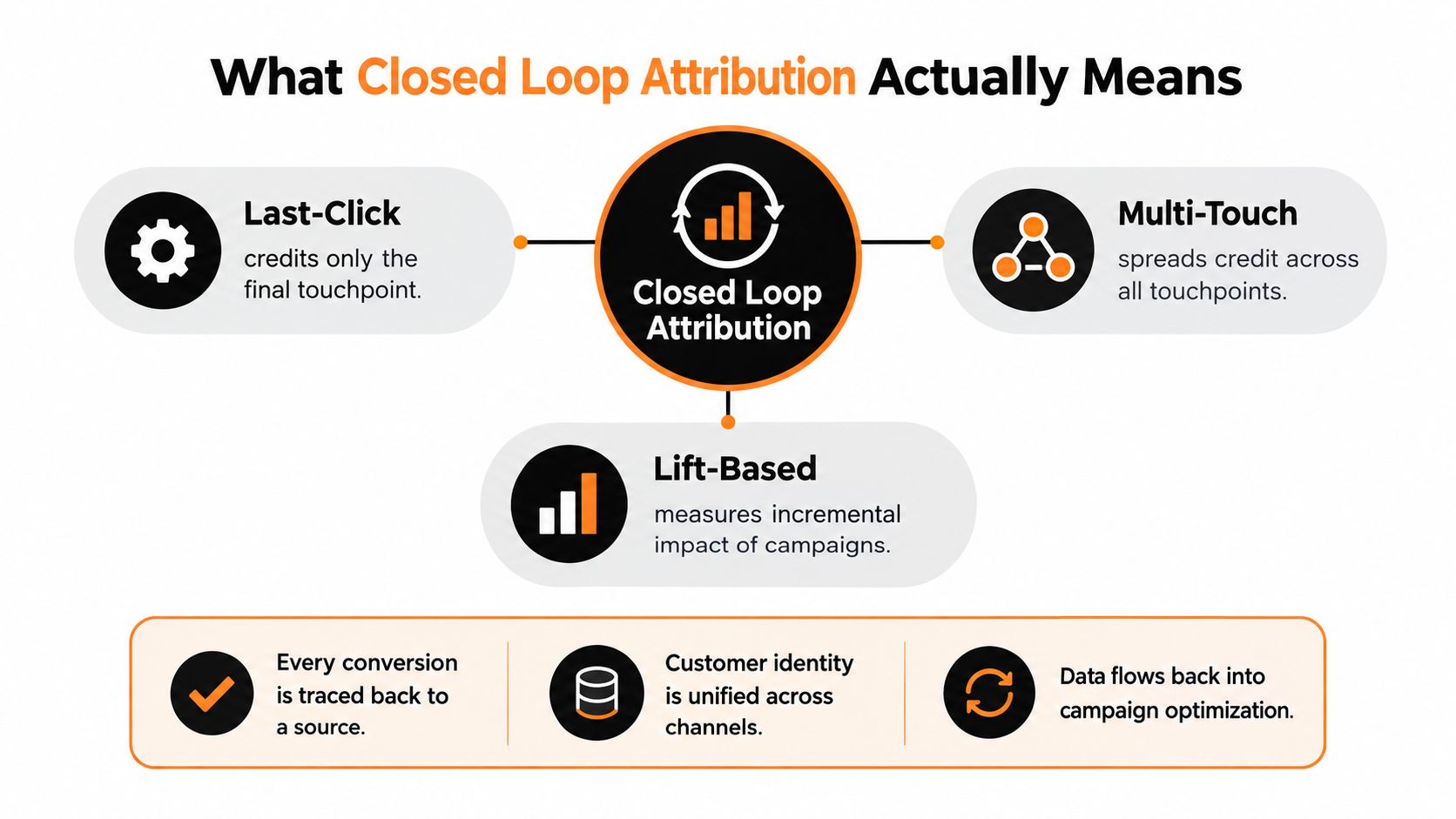
Three conditions must hold
A useful analogy is a letter with a reply slip. The address identifies the recipient, the recipient can recognize the sender, and the reply returns with the original request. If one link breaks, the response cannot be confidently tied to the letter.
A working loop requires three conditions:
- The touchpoint is captured. The system records the source, campaign, medium, landing page, ad interaction, or another agreed event.
- The contact is identifiable across interactions. The website, forms, CRM, and conversion systems associate activity with the same person or account.
- The outcome is joined back to the contact. A sales stage, payment, renewal, cancellation, or other business event connects to the journey and becomes available for analysis.
Identity resolution connects the chain. A carefully tagged campaign remains disconnected if a form creates a duplicate CRM record or a booked call cannot be matched to the earlier session.
Lead attribution and revenue attribution answer different questions
Lead attribution asks, “Where did this inquiry originate?” Revenue attribution asks, “Which sources are associated with customers and financial outcomes?” The answers can rank channels differently.
One channel may generate many inquiries that never become qualified opportunities. Another may produce fewer inquiries but contribute to serious sales conversations. A system that stops at form submission cannot distinguish these patterns. CRM and transaction data let analysts compare sources with later outcomes, while observed association still does not prove causation. The historical shift from browser sessions toward CRM-linked outcomes is documented in the development of Google Analytics.
How Closed Loop Differs From Other Attribution Models
The useful question isn't which model is universally correct. It's which model answers the decision in front of you.
A last-click model is fast and easy to inspect, but it gives the final interaction disproportionate influence. A position-based or multi-touch model recognizes more of the journey, though its weights still reflect a chosen rule. A data-driven model may estimate credit from observed patterns, but it remains dependent on the events and identities entering the dataset.
Incrementality is different from all three. It uses an experiment, such as a randomized holdout, geo test, or matched-market design, to estimate what would have happened without the campaign. Closed loop attribution can tell you that a campaign touchpoint appeared before a sale. Incrementality helps estimate whether the campaign caused additional sales.
Match the model to the decision
| Decision Type | Closed Loop | Multi-Touch | Incrementality |
|---|---|---|---|
| Creative testing | Connects creative exposure to later lead, opportunity, or revenue events when identifiers are available | Shows how credit is distributed across observed journeys | Tests whether a creative or campaign produces additional outcomes |
| Budget allocation | Compares channels against CRM stages and recorded revenue | Compares modeled contribution across touchpoints | Estimates causal lift before shifting substantial spend |
| Bidding optimization | Sends qualified or revenue-linked signals to ad platforms | Usually optimizes toward the conversion event defined in the platform | Rarely provides the fast feedback loop required for everyday bidding |
| Board reporting | Provides a business-outcome view when definitions and joins are reliable | Offers a journey-level view, but may stop at observed conversions | Supplies evidence about incremental impact, usually at a broader test level |
A team can use all three without confusing their roles. Use closed loop reporting for operational visibility, multi-touch analysis for journey context, and experiments when the decision depends on causality.
The central distinction is the conversion definition, identity layer, and feedback signal. A browser-based report may optimize for clicks. A CRM-connected system can optimize toward qualified pipeline. An experiment evaluates lift. Those are different questions, not competing labels for the same measurement.
More detailed attribution can produce more precise-looking answers without making them more causal.
Building Blocks of a Working Closed Loop System
A closed loop is best designed as a sequence of dependencies. Capture must work before identity can be resolved. Identity must work before records can be joined. The join must work before feedback is safe.
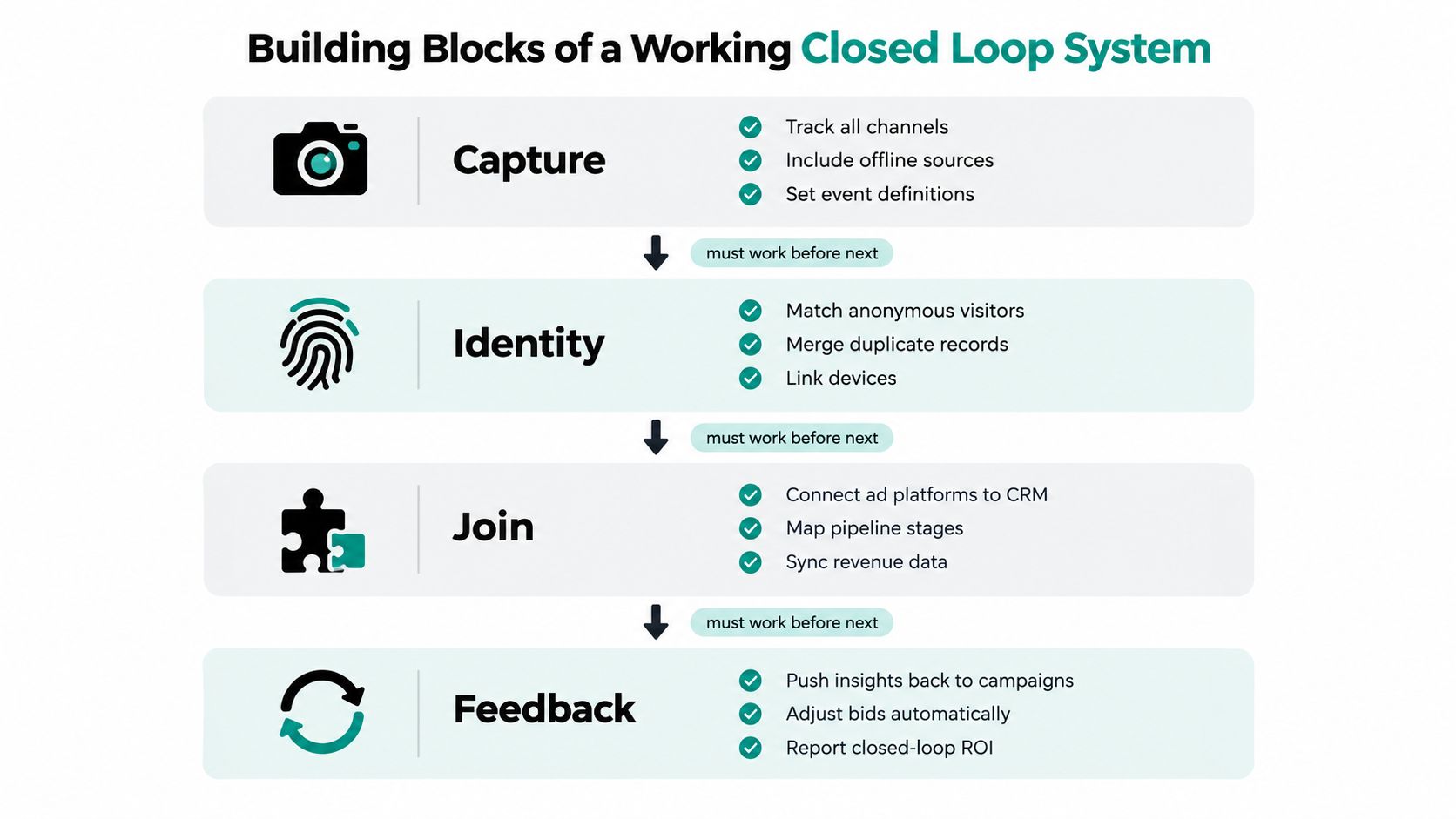
Capture
Start with a source inventory, not a tracking snippet. Record paid search, paid social, organic search, email, affiliates, referrals, direct traffic, calls, chat, calendar bookings, and any offline sources that influence the buying process.
Define the events that matter. A page view may be useful for diagnostics, while a qualified booking, sales acceptance, opportunity creation, closed-won record, payment, cancellation, or refund may be important for attribution. Use consistent naming and preserve campaign parameters as the contact moves from the website into the CRM.
Identity
The identity layer connects anonymous activity to a known record. It must handle duplicate contacts, changing email addresses, multiple devices, and people who return through a different channel.
Don't treat every identifier as equally reliable. A first-party form submission, CRM contact ID, booking record, and payment customer ID may provide stronger joins than a temporary browser identifier. Your rules should state which identifiers can merge records and which require review.
Join
The join maps marketing records to CRM stages and financial outcomes. A HubSpot or Salesforce integration can make opportunity status, owner, qualification, close state, and deal value available to the attribution system. The same principle applies to other CRMs, billing systems, commerce platforms, and call systems.
The Pipeline On attribution guide is useful when your team needs to think through model selection alongside implementation. For the mechanics of preserving original source data in a CRM, see this guide on sending lead source to your CRM.
Feedback
Feedback sends selected outcomes back to advertising platforms. The payload might represent a qualified opportunity rather than every form fill, or a paid transaction rather than an initial signup. The team must decide which event is trustworthy enough to influence bidding and how amended outcomes, duplicates, and reversals are handled.
Deal stages matter because they add business meaning to lead counts. A contact that reaches a defined sales milestone carries a different signal from an unreviewed inquiry. A payment record adds another layer, but only if the amount, customer identity, currency, refunds, and status are reconciled with the source system.
Implementing Closed Loop Attribution Step by Step
Implementation works best when the team earns the right to send each signal. Start with definitions and data quality, then activate feedback after the CRM can support it.
Begin with an audit
List every tag, UTM convention, form, booking tool, call source, CRM field, ad conversion, and revenue event. Compare what marketing records with what sales and finance recognize. Look for missing source fields, overwritten original values, duplicate contacts, and stage names that mean different things to different teams.
Next, instrument capture across the agreed channels. Preserve campaign data through redirects, forms, scheduling flows, and CRM creation. Test the path with controlled submissions and verify that the contact, source, event time, and identifier survive each handoff.
Wire stages before uploading conversions
Map lead statuses to operational milestones. Define what qualifies as a marketing-qualified lead, sales-qualified opportunity, closed-won record, paid transaction, cancellation, and refund. The definitions need an owner, a source of truth, and a rule for updates.
Don't turn on server-side uploads or conversion APIs while those stages are still unstable. Ad algorithms learn from the events you send. If the system sends duplicate, unqualified, or prematurely marked conversions, optimization will follow those errors.
A simple decision path helps:
- Use platform tags first when the event is web-based, consented, immediate, and reliably deduplicated.
- Use server-side or API feedback when the outcome occurs in a CRM, call system, billing platform, or other backend source.
- Use both when browser events provide context and the backend provides the authoritative status, with an event ID to prevent duplicates.
Roll out in phases
During the first phase, audit and standardize definitions. In the next phase, connect website events, CRM stages, and offline outcomes in a test environment. In the final phase, validate reconciliation, activate feedback, and monitor whether platform totals and CRM totals remain explainable.
SourceLoop is one example of a platform that captures web journeys, connects conversions to CRM and payment data, and syncs selected offline conversion signals to advertising platforms. Teams should compare any tool against their required fields, identity rules, integrations, consent controls, and reconciliation process.
The following video provides a visual introduction to the implementation flow:
Pitfalls That Break the Loop
A dashboard can look complete while its underlying joins are wrong. Attribution remains plausible even when contacts, lifecycle stages, and revenue records fail to line up, so the first check should follow the data from the website through the CRM and back to the reporting destination.
Duplicate contacts are a common failure point. A buyer might use a personal email, work email, and calendar booking address, creating separate records for one person. If the CRM does not merge or relate those records, the journey fragments and the originating source receives incomplete credit. A durable contact or account key helps preserve the relationship across systems.
Late-binding outcomes create a second break. Sales may update an opportunity long after the original campaign interaction, after the attribution system has evaluated the lead within a shorter event window. Refresh downstream status when the CRM changes, and retain the key that connects the later outcome to the original journey.
Audit the outcome, not only the event
Refunds, cancellations, and amended deal values need explicit treatment. Otherwise, a report can associate a campaign with gross bookings while finance recognizes a different net result. Define whether the primary metric is booked revenue, paid revenue, retained revenue, or another stated business outcome.
Consent gaps can also stop the return path. An offline conversion should not reach an advertising destination when the required permission was never collected or has since been withdrawn. Deletion and suppression requests must propagate through connected systems, with each handoff recorded in the data contract.
Separate attribution from incrementality
Branded search, retargeting, and high-intent email can appear especially strong because they often reach people who were already close to taking action. Their observed credit may therefore exceed the additional demand they created.
Use holdouts, geo experiments, or matched-market tests when a decision requires causal evidence. Keep experiment results separate from attributed results. A campaign can receive substantial observed credit and produce limited incremental lift, or receive modest observed credit while influencing demand another model misses.
Read the dashboard as an operating instrument; reserve causality judgments for experiments.
Privacy, Consent and a First-Party Data Contract
Privacy-safe measurement starts with a field-level agreement between the website, CRM, billing system, and advertising destinations. The team should be able to answer what is collected, why it is needed, which consent applies, how long it is retained, how deletion works, and which system owns the final value.
Google's measurement guidance emphasizes first-party conversion data, hashed identifiers, enhanced conversions, server-side or first-party tagging, consent-aware measurement, and on-device approaches. The shift isn't an attempt to recreate older third-party tracking. It is a move toward using information the business collected directly, with clearer controls around matching and transmission. A plain-language explanation of what counts as first-party data can help align marketing, RevOps, and privacy stakeholders.
Define the contract in fields
| Field | CRM Source | Sync Rule | Ad Platform Destination |
|---|---|---|---|
| Contact or account identifier | CRM record | Send only the approved pseudonymous or hashed representation, with consent status | Conversion matching or audience system |
| Original source and campaign | Contact and opportunity fields | Preserve original values and record later touches separately | Reporting dimensions and conversion context |
| Lifecycle stage | CRM opportunity or contact status | Send only defined, validated milestones | Qualified lead or opportunity event |
| Transaction status | Billing or commerce system | Send paid, canceled, refunded, and amended states according to agreed rules | Revenue conversion or correction event |
| Event timestamp and ID | CRM, booking, or billing event | Keep timestamps consistent and deduplicate by stable event ID | Conversion upload and deduplication |
| Consent and deletion status | Consent management or CRM | Propagate changes before future activation and honor deletion requests | Suppression, restricted processing, or removal workflow |
The table is a contract, not merely an integration checklist. If a billing system changes a payment from paid to refunded, that state change needs a defined path into reporting. If a person withdraws consent, downstream teams need to know whether to stop syncing, delete a record, or retain only permitted aggregate information.
Reconciliation should compare attribution records with CRM stages and finance records. Investigate mismatches rather than averaging them away. For a broader treatment of privacy-conscious measurement, see this guide to cookieless marketing attribution.
A durable first-party system improves signal quality because the business controls the definitions, identifiers, and correction process. Privacy isn't a layer added after tracking. It is part of the data contract that determines whether the loop can remain trustworthy.
If your marketing and sales reports disagree, start with one journey and trace every handoff from campaign parameter to CRM record to verified outcome. Document the fields, identity rules, stage definitions, consent requirements, and feedback events before evaluating dashboards or changing budgets. Then run a controlled pilot with your highest-value conversion, reconcile it against CRM and finance, and use the findings to build a closed loop your growth team can trust.




 Paid Social


