
Closed Loop Measurement: What It Is and How to Set It Up
Closed loop measurement links ad clicks to CRM deals and revenue. Learn how it works, its benefits, common pitfalls and how to set it up.

Your ad dashboard shows a healthy stream of leads. Sales says most aren't worth calling, finance wants to know which campaigns produced revenue, and you're exporting spreadsheets to reconcile answers that should already agree.
Closed loop measurement connects those conversations. It carries outcomes from your CRM or billing system back to the people and platforms controlling spend. But connecting an ad click to a sale doesn't prove the ad caused it. For better budget decisions, you need both a working feedback loop and a way to test what would've happened without the advertising.
Table of Contents
- What Closed Loop Measurement Means for Marketers
- How Data Moves From Click to Closed Revenue
- Closed Loop Versus Last-Click and Multi-Touch Attribution
- What Closed Loop Data Changes in Your Budget
- How to Build a Closed Loop in Six Steps
- Common Closed Loop Pitfalls and How to Fix Them
- How to Prove Lift With Holdout Tests
- Confirm Your Loop Before You Scale Spend
What Closed Loop Measurement Means for Marketers
A thermostat reads the room temperature, compares it with the setpoint, and switches the heating on or off. The reading changes the next action. A thermometer hanging beside a heater doesn't do that, even if someone puts its readings in a dashboard.
Marketing works the same way. Qualified leads, signed deals, and revenue must travel back into decisions about bids, audiences, creative, and budget. Otherwise, you're collecting results without using them to control the process.
Feedback control has more than 2,000 years of practical history, with James Watt's centrifugal governor in 1789 among its classic milestones, according to a review in Cell Systems00159-9).
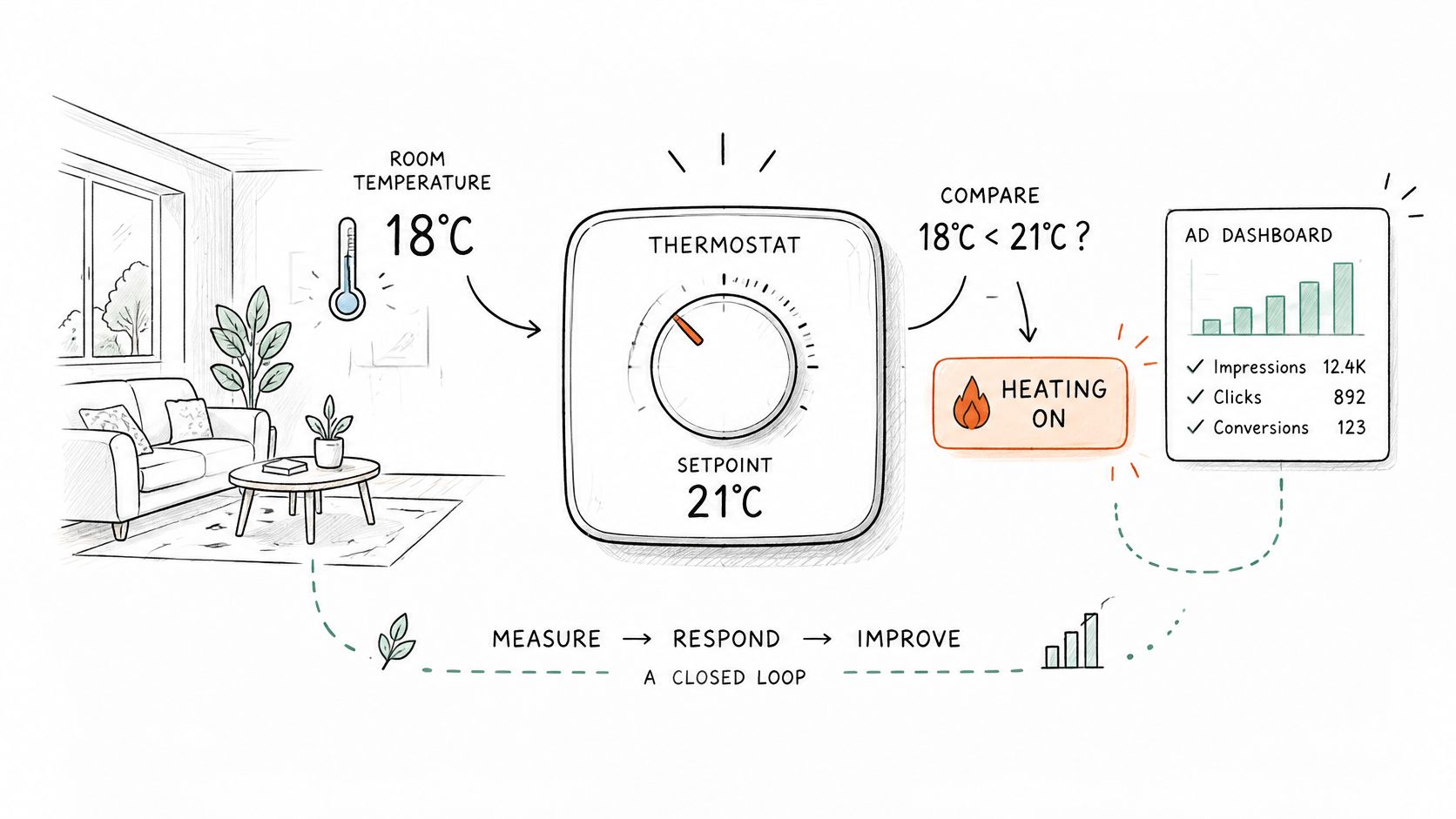
The engineering components have practical marketing equivalents:
- Process: Your campaign and sales process, from acquisition through qualification and purchase.
- Sensors: Tracking tags, click identifiers, CRM fields, and payment records that capture outcomes.
- Controller: The logic, person, or bidding system interpreting performance against your business objective.
- Actuators: The bid changes, exclusions, creative updates, and budget adjustments that follow.
The important distinction isn't whether you have attribution software. It's whether someone has defined the action that follows a result. A report showing poor qualification rates achieves little if nobody owns the campaign change.
Practical rule: Measurement becomes closed loop when an outcome can change the next marketing decision through a repeatable process.
That process can include human judgment. Automation isn't a prerequisite, and automatically sending bad data doesn't make a system useful. Ask whether a CRM result can change next week's spend without rebuilding the analysis manually. If the result only appears in a monthly presentation, your reporting is still operationally open.
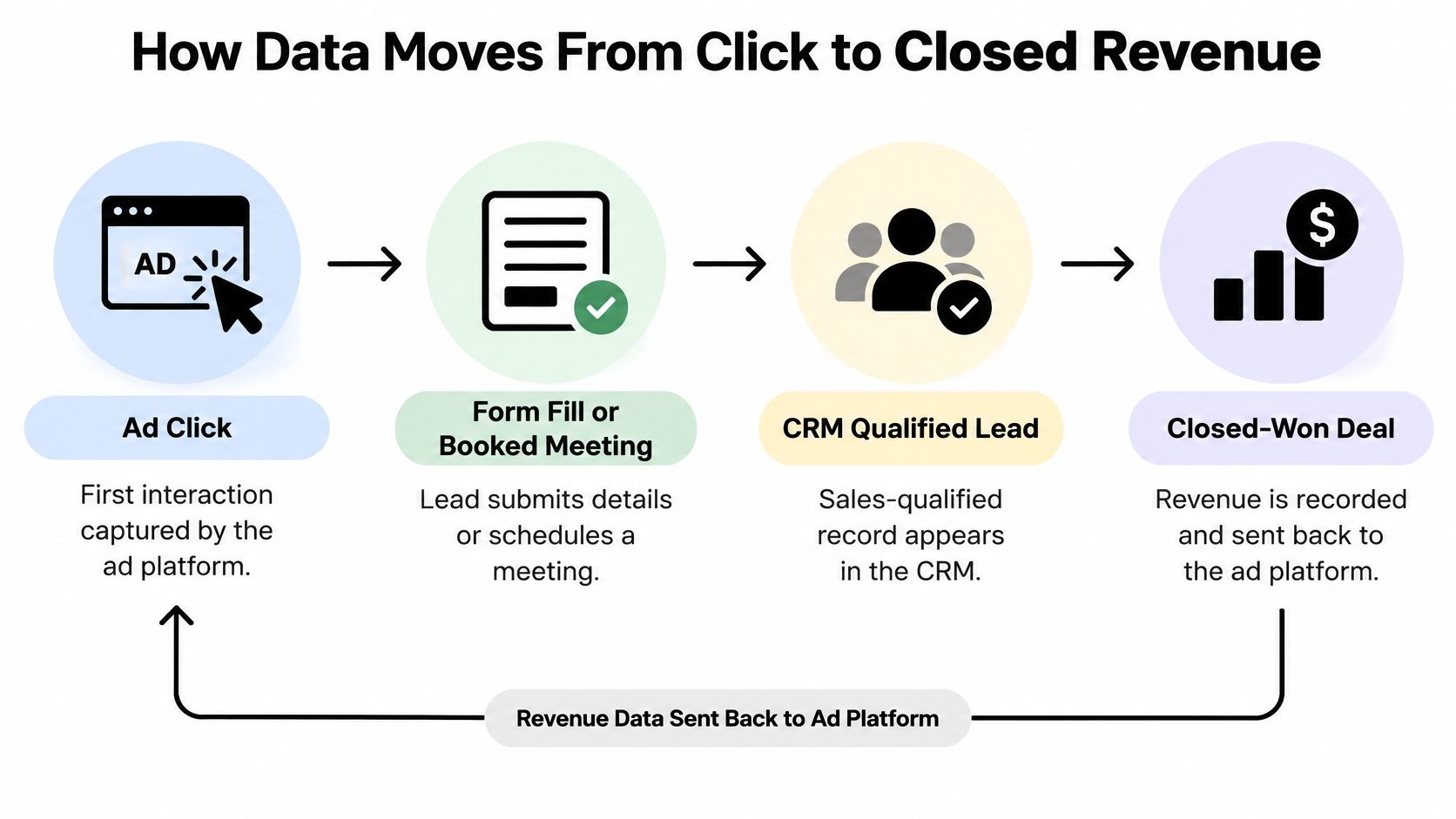
How Data Moves From Click to Closed Revenue
What each stage of the loop captures and sends back
| Stage | Data to capture | Sent back to ad platform |
|---|---|---|
| Ad click | Click ID, such as gclid or fbclid, UTM parameters, landing page | Stored with the visitor, no upload yet |
| Form fill or booked meeting | Email, phone, hashed for supported uploads, lead source, timestamp | Lead conversion, an early signal |
| CRM qualified lead | Lifecycle stage change, deal owner, deal value | Qualified lead conversion |
| Closed-won deal | Revenue, currency, product, close date | Sales or revenue conversion with value |
Preserve the original click identifier, attach it to the lead record, and retain that association as the customer progresses. UTMs explain campaign context; click identifiers support platform matching. Don't treat them as interchangeable.
Google Ads' offline conversion upload documentation describes submitting downstream events with click identifiers and supported first-party identifiers, normalized and hashed as required. It also recommends uploading available offline events, including those originating elsewhere, and warns that late uploads can miss reporting windows. Uploading an event doesn't guarantee attribution to an ad.
The feedback path should look like this:
Build a usable event record
Each downstream event needs the original click ID, event timestamp, conversion name, monetary value, currency, lifecycle stage, and deduplication key. Keep the event's actual occurrence time separate from the upload time.
Say a prospect clicks an ad, books a call later, and eventually signs a deal. The upload must describe that downstream outcome, not recreate the original form submission with a new label. Missing identifiers prevent matching; delayed CRM updates withhold the quality signal your bidding system needs.
Sales and marketing must also agree on what qualifies as progress. H2's guidance on shared metrics for sales and marketing is useful when teams assign different meanings to qualified, booked, and won.
Verify the handoff
- Identifiers: Check forms, scheduling tools, and chat flows, not just landing pages.
- Latency: Set a daily sync target and monitor failed uploads.
- Currency: Use an explicit reporting currency and conversion policy.
- Duplicates: Replaying an upload mustn't create another sale.
For the analytics side of the implementation, use our guide to tracking offline conversions in Google Analytics. Keep analytics collection and ad-platform uploads as separate tasks with separate acceptance checks.
Closed Loop Versus Last-Click and Multi-Touch Attribution
Attribution methods compared on the questions marketers ask
| Method | What it counts | Sees offline sales | Shows incremental lift |
|---|---|---|---|
| Last-click | Credit to the final touch before conversion | Rarely without an offline integration | No |
| Multi-touch attribution | Splits credit across touches on the path | Only if offline events are imported | No |
| Closed loop measurement | Links each lead to its CRM outcome and revenue | Yes, when connected | No, unless paired with a test |
| Incrementality test | Compares exposed and holdout groups | Yes, if outcomes are tracked | Yes, with a valid design |
These aren't mutually exclusive choices. Attribution determines how you assign credit; closing the loop determines whether downstream outcomes return to marketing. You can apply last-click or multi-touch rules within a closed-loop system.
Snipp's marketing attribution overview traces the shift from mass-media reach and delayed sales reporting before the 2000s, through click-based measurement in the 2000s and multi-touch attribution in the 2010s, toward purchase-linked measurement under privacy constraints in the 2020s. The practical progression is from observing activity to verifying commercial outcomes.
Choose the method for the decision
Last-click is quick to interpret. It helps with daily checks of which final interactions precede conversions, but it hides earlier discovery and evaluation. Don't confuse the ease of assigning credit with evidence that the final interaction created demand.
Multi-touch attribution makes recorded paths visible. It can help diagnose whether email, paid social, and search appear together before a purchase. However, missing devices, untracked interactions, and absent offline records still leave gaps, and changing the weighting formula doesn't repair them.
Closed loop measurement reaches the business record. For lead generation, that means qualification, opportunities, and revenue. For retail, it can mean verified purchases connected through first-party transaction records rather than a website action alone.
A more complete customer path improves diagnosis. It doesn't create a counterfactual.
Use last-click for straightforward operational checks, multi-touch for journey analysis, and closed-loop outcomes for revenue accountability. Use an experiment when you're deciding whether removing or increasing an advertising investment would change business results. Each answers a different question, so forcing them into a single winner creates unnecessary arguments.
What Closed Loop Data Changes in Your Budget
Budget decisions get sharper once outcomes flow back from the CRM. A working loop changes what marketers can act on:
- Better optimization signals: Bidding systems receive qualified outcomes instead of treating every form submission as equally valuable.
- Less wasted spend: Campaigns producing contacts that never progress become easier to identify.
- Shared accountability: Sales and marketing review the same revenue definitions.
- Faster intervention: Teams can adjust after trustworthy stage updates rather than waiting for a quarterly review.
- Clearer routing: Lead source stays attached to the record sales uses.
Doubt about last-click reporting is widespread among marketing teams. A closed loop gives that doubt somewhere useful to go: revenue outcomes in place of proxy metrics.
An illustrative campaign decision
Suppose an agency runs paid search campaigns at equal cost per lead. In this hypothetical example, Campaign A generates 200 leads and closes four deals; Campaign B generates 120 leads and closes 12.
Illustrative campaign comparison at equal cost per lead
| Campaign | Closed deals | Deals per 100 leads |
|---|---|---|
| Campaign A | 4 | 2 |
| Campaign B | 12 | 10 |
A lead-volume dashboard makes Campaign A look stronger. The revenue connection shows Campaign B closing five times the share of its leads.
Equal cost per lead doesn't mean equal spend. Campaign A cost more in total because it generated more leads, and each of its four deals carried far more acquisition spend behind it. Before reallocating, compare cost per closed deal, deal value, gross margin, and the maturity of each campaign's lead cohort.
Move a controlled portion of budget toward the stronger economics, then let the new cohort complete its sales cycle. Don't compare recently acquired leads with older leads that have had longer to close.
AdCrunch's explanation of budget management for ad teams provides useful context for turning that decision into spending controls rather than an informal recommendation. Set an owner, a spending boundary, and a review date.
The remaining uncertainty is demand creation. Campaign B may close efficiently because it reaches buyers who were already ready to purchase, not because increasing its budget will produce proportionally more business. Closed loop data shows which leads became revenue; it can't show whether the ads caused those sales. Treat the reallocation as a measured bet, and confirm it with a holdout test before scaling further.
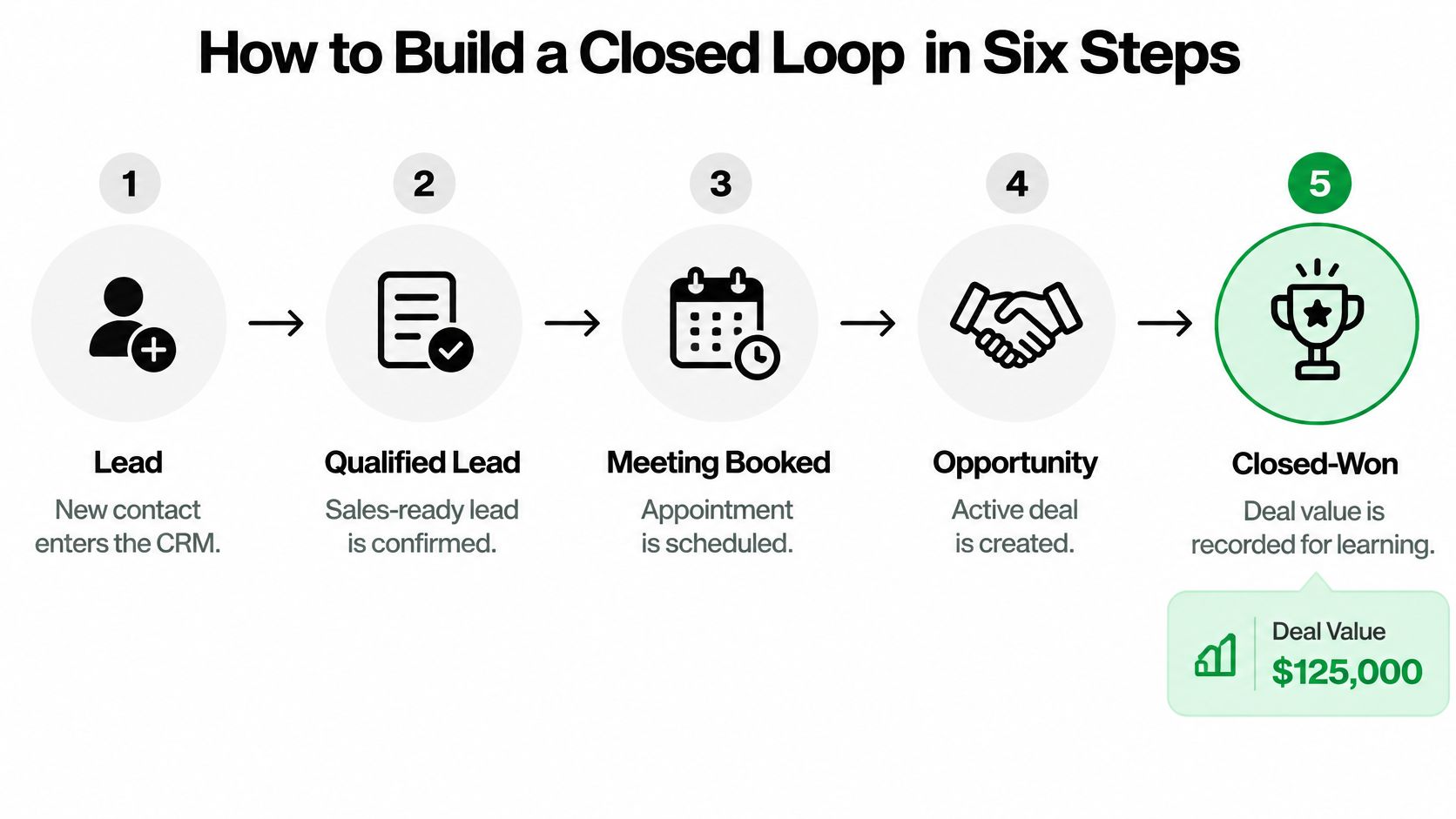
How to Build a Closed Loop in Six Steps
Start with a narrow implementation you can reconcile. Connecting every channel before validating the event definitions makes failures harder to locate.
Establish the collection and CRM rules
Define outcome stages. Document lead, qualified lead, meeting booked, opportunity, and closed-won in the CRM. Give each stage an entry rule and an owner; require a deal value at close. Otherwise, sales reps can apply the same label to commercially different outcomes.
Carry acquisition identifiers into the record. Capture click IDs and UTMs across forms, booking widgets, and chat, then preserve them when leads become contacts or opportunities. Test redirects and embedded calendars. Our guide to sending lead source to your CRM covers this handoff. Capturing a parameter on arrival isn't enough if it disappears before submission.
Collect on your own domain. Use a first-party tracking implementation and test the entire conversion path with consent settings applied. First-party collection can reduce reliance on third-party cookies, but it doesn't remove consent requirements or guarantee every visitor can be identified. At SourceLoop, our setup uses a single snippet that captures source on the customer's own domain.
These CRM stages provide the commercial backbone:
Connect delivery and reconciliation
Map fields to conversion events. Maintain a mapping document covering identifiers, timestamps, names, values, currencies, stages, and deduplication keys. Specify time zones and what revenue means, such as signed contract value versus collected payment. Mixing those definitions produces discrepancies even when every integration runs successfully.
Schedule uploads and select the optimization event. Use a supported API integration, webhook workflow, Zapier, Make, or a controlled CSV process. Google Ads, Meta, and LinkedIn have different identifier and event requirements, so build platform-specific payloads. Prefer a dependable qualified outcome over a sparse, delayed revenue signal when the latter can't support useful optimization. Keep diagnostic events separate from events selected for bidding.
Reconcile against the CRM. Review accepted events, rejected events, unmatched records, and attributed conversions separately. Compare equivalent date ranges and definitions. A CRM total and an ad-platform total shouldn't be expected to match if one includes all sales and the other only eligible attributed sales.
For example, moving a deal to closed-won should trigger an event containing its stored identifier, close timestamp, value, currency, and unique event key. Log the upload response and retry failures without changing that key.
Acceptance check: Trace a test record from landing page to CRM to upload response before enabling a new event for bidding.
When discrepancies appear, investigate the earliest broken handoff rather than changing attribution settings at random.
Common Closed Loop Pitfalls and How to Fix Them
Closed loop symptoms, causes and fixes
| Symptom | Likely cause | Fix |
|---|---|---|
| Ad platform reports many conversions, CRM shows few deals | Platform counts early leads; downstream events are missing or lack identifiers | Separate funnel stages and send closed-won events with click ID and value |
| Algorithm buys cheap, low-quality leads | Optimizing on form fills instead of qualified stages | Switch the optimization event to qualified lead or revenue |
| Totals differ between CRM and ad platform | Duplicate events, mismatched time zones or currencies | Set a deduplication key, align time zones, and use one reporting currency |
| Revenue appears after the conversion window | Long sales cycle and unsuitable lookback window | Align supported conversion windows with the sales cycle; retain late revenue internally |
| Channel looks profitable but sales would happen anyway | Attribution credits high-intent buyers already searching for you | Run a holdout or geo test before scaling spend |
Some fixes are mechanical. Duplicate suppression, consistent timestamps, and clearer stage mappings can resolve discrepancies without changing your measurement strategy. Investigate these before concluding that an attribution model is wrong.
The harder failure is treating a matched sale as a caused sale. A buyer may already know your product, search your brand, click an ad, and purchase. The record can be completely accurate while the budget interpretation is wrong.
Keep sourced revenue separate from incremental revenue
A sponsored practitioner article in Retail Dive reports that only 25% of surveyed marketers use a clear model to measure incremental revenue, while 37% cannot isolate lift at all. Those are survey findings, not a benchmark for your account, but they highlight an important measurement gap.
Maintain separate outputs:
- Observed sourced revenue: Revenue linked to recorded acquisition activity under your chosen attribution rules. Use it to investigate journeys, lead quality, and operational performance.
- Estimated incremental revenue: Additional revenue attributed to the intervention through a valid experiment or calibrated causal estimate. Use it to inform spending decisions.
Don't subtract an arbitrary discount from attributed revenue and call the result incremental. Without a defensible comparison, you're replacing one assumption with another.
Likewise, don't erase journey reporting because it isn't causal. Sales still needs source context, and marketers still need to identify broken landing pages or poor-quality audiences. Operational attribution and causal evaluation are complementary tools.
When a channel looks exceptionally strong, inspect who it reaches. Existing customers, returning visitors, and branded searches deserve particular scrutiny before you interpret attributed efficiency as an opportunity to scale.
How to Prove Lift With Holdout Tests
Choose a channel whose contribution is uncertain, then compare business outcomes where that channel runs with outcomes where it's withheld or reduced. For a geo test, use randomized regions where feasible, or carefully matched regions with comparable pre-test behavior.
The treatment and control arrangement looks like this:
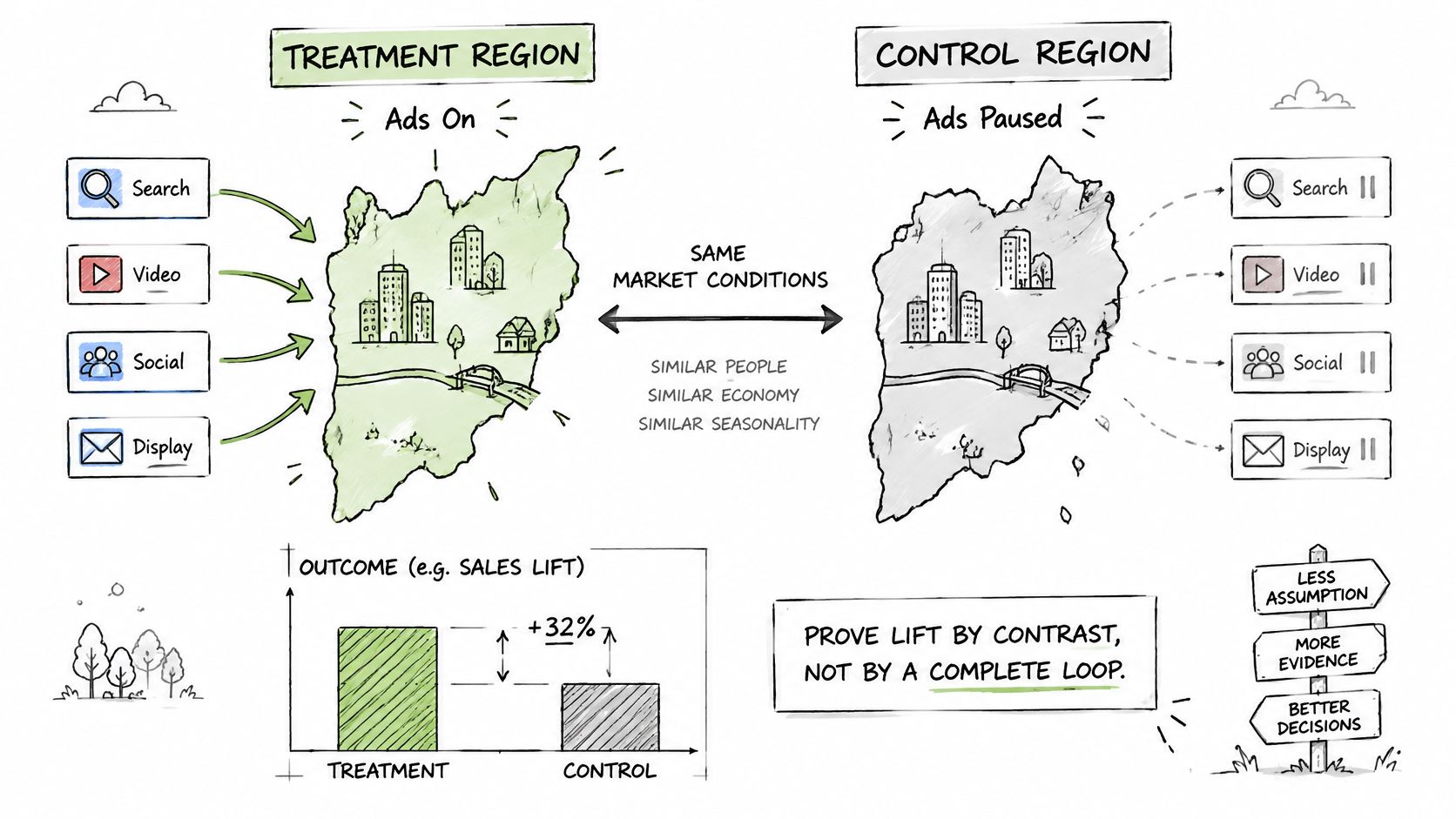
LiftLab's measurement playbook describes using geo experiments to calibrate modeled channel contribution. The useful operating principle is to test uncertain assumptions, update the budget model, and direct the next experiment toward the remaining uncertainty.
Define the decision before launch
- Specify the outcome: Choose qualified pipeline, closed-won revenue, or gross margin rather than clicks.
- Pre-register the design: Record regions, treatment, test window, expected conversion lag, minimum detectable effect, and analysis method.
- Protect the comparison: Account for seasonality, promotions, concurrent campaigns, and spillover between regions.
- Allow outcomes to mature: Include the sales-cycle lag rather than stopping when early lead counts look convincing.
Estimate what treatment-region outcomes would've been without the intervention, using the control and pre-test relationship. The difference is estimated incremental impact, not the raw difference between differently sized regions. If uncertainty is too wide to support a decision, report the result as inconclusive.
For implementation context, Rapid Ads' incrementality testing guide can help frame the experiment. Lean teams can consider regional channel suppression; randomized lead routing tests a follow-up intervention, not the acquisition ad itself.
Use this video as a supplementary explanation of the testing approach:
Feed measured lift and its uncertainty into your spending assumptions. Our guide to measuring marketing ROI helps connect that estimate to financial evaluation. A channel can deserve operational credit for closing buyers while warranting less budget than its attributed revenue suggests.
Confirm Your Loop Before You Scale Spend
Start with a single channel and ad platform. A narrow, auditable connection is more useful than a broad rollout nobody can reconcile.
Run this checklist before approving more spend:
- Identifier coverage: Inspect closed-won records and explain missing identifiers rather than excluding them.
- Delivery speed: Confirm CRM changes meet your daily sync target and that someone receives failure alerts.
- Financial consistency: Use a documented revenue definition, reporting currency, and treatment of refunds.
- Event integrity: Verify retries don't create duplicate outcomes.
- Experiment readiness: Put a dated holdout plan against the largest budget decision you can't currently justify.
Keep a short exception log. Distinguish missing collection, failed delivery, platform ineligibility, and attribution differences so each problem reaches the person who can fix it. Don't make the campaign manager responsible for a CRM mapping error they can't access.
Also record the decision each measurement will support. If nobody can say what they'd change after seeing a result, refine the question before adding more tracking.
Connect your CRM's closed-won stage to an ad platform, validate the event end to end, and schedule a holdout for the channel whose contribution matters most to your budget. Compare observed sourced revenue with estimated incremental revenue before reallocating spend. That gives you a revenue feedback loop and evidence for deciding how much to trust it.



 Paid Social


