
Multi Touchpoint Attribution: Models, Data and Setup
Learn how multi touchpoint attribution credits channels, stitches customer journeys and shows which touchpoints deserve more budget.
Your dashboard says branded search is your best channel. Your sales team says buyers arrive already familiar with the product. Meanwhile, you're being asked to cut the campaigns that introduced those buyers because they don't appear beside the final conversion.
That's the problem multi touchpoint attribution tries to solve. The useful question isn't just who gets credit. It's whether the way you assign credit gives you a defensible reason to move budget.
Table of Contents
- Why Last-Click Credit Misleads Your Budget
- How Journeys Are Stitched Across Touchpoints
- The Data You Need Before Attribution Works
- Multi-Touch Attribution Models Compared by Credit Rule
- One Lead's Journey Across Five Touchpoints
- Attribution Versus Incrementality and What to Trust
- Choose a Model and Roll Out Attribution
Why Last-Click Credit Misleads Your Budget
Say a B2B buyer sees your LinkedIn ad on Monday, reads a couple of blog posts, encounters a retargeting impression, and clicks a nurture email. Later, they search your brand name and book a demo.
In a hypothetical annual contract worth $12,000, last-touch reporting assigns the entire amount to branded search. LinkedIn gets nothing. If you use that report alone, you might increase search spend while cutting the campaign that introduced the buyer.
Multi touchpoint attribution splits conversion credit across the interactions in a journey instead of giving all of it to a single interaction. Think of a relay race: the runner crossing the finish line completes the race, but the earlier runners helped make the finish possible.
Credit isn't proof of contribution
The distinction matters when interpreting last-touch attribution. It identifies the final recorded interaction, not necessarily the interaction that persuaded the buyer.
A systematic review summarized by Omnibound retained 62 original empirical MTA studies published from 2011 through 2024. That breadth supports treating attribution as a measurement discipline, not a universal formula.
Budget rule: A channel receiving credit is a reason to investigate its contribution, not automatic permission to increase spending.
The same discipline applies in ecommerce. Online Brand Growth's profit-focused Amazon PPC strategies provide useful channel-specific context when you're translating advertising reports into profitability decisions.
Before acting, answer these questions:
- Credit rule: Which assumptions fit your buying process?
- Journey connection: How do separate interactions become one record?
- Trust: Which inputs and tests support the result?
How Journeys Are Stitched Across Touchpoints
Before a model can distribute credit, your systems need to establish which events belong together. A website visit, calendar booking, sales call, and payment often live in different tools.
The workflow below shows how those events become an ordered path.
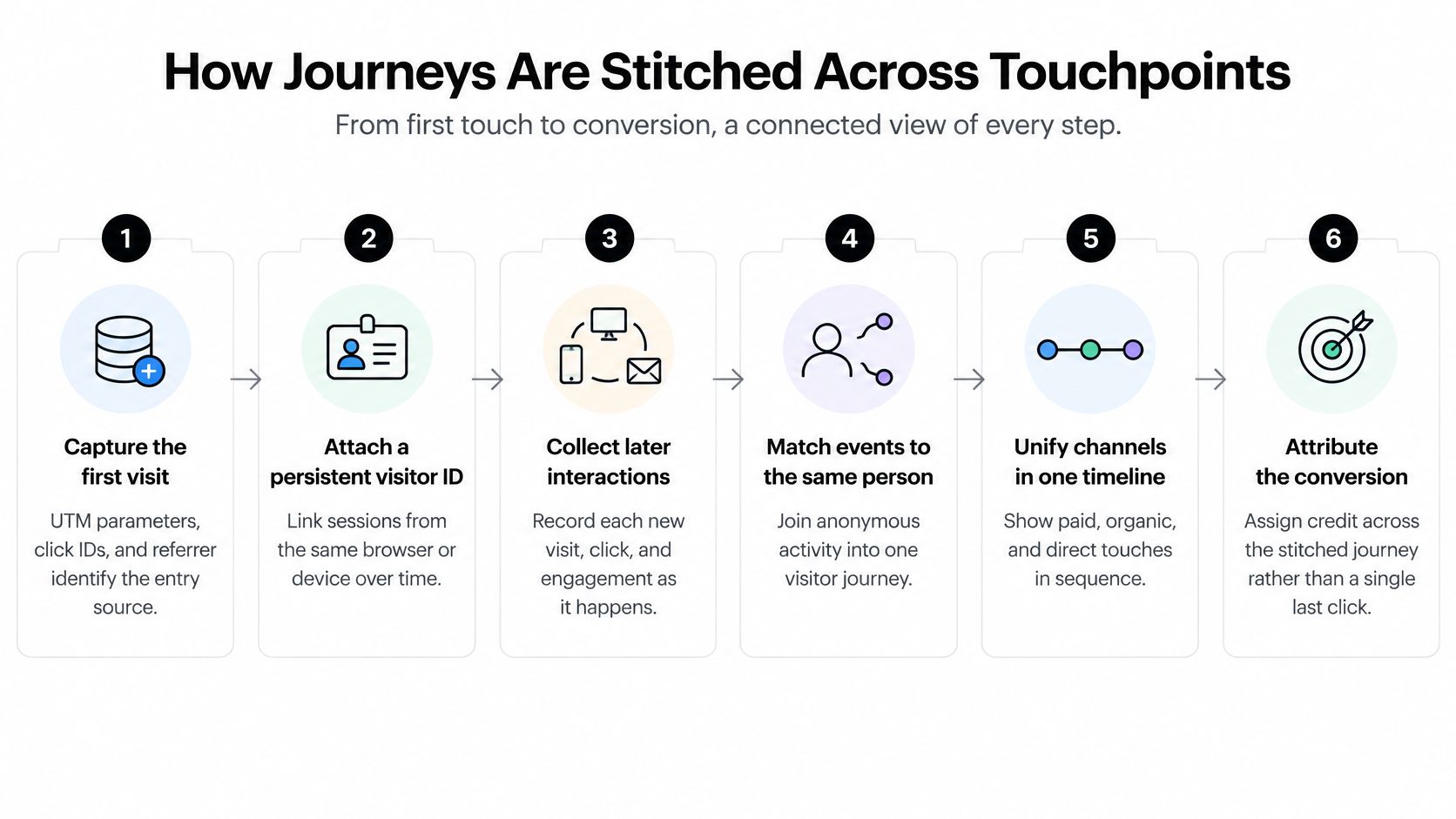
- Capture the entry source. Save UTM parameters, advertising click IDs, the landing page, and referrer when the visit occurs. Later redirects can remove information you can't reconstruct reliably.
- Attach a persistent visitor identifier. Where permitted, use a first-party browser identifier to connect subsequent visits. Record later events with timestamps rather than overwriting the original source.
- Connect anonymous history to a lead. When someone submits a form, starts a chat, or books a meeting, associate the known contact with the stored visit history. At SourceLoop, we attach all 8+ attribution data points when a lead converts through any form, chat, or booking and push them to the CRM.
- Resolve duplicate contacts. Use normalized email addresses and phone numbers as matching inputs, with safeguards for shared details. Our identity stitching and deduplication guide explains the connection between matching records and preserving journeys.
- Bring in offline outcomes. Append call events, attended meetings, and timestamped CRM stage changes. A booked meeting and an accepted opportunity shouldn't be interchangeable.
- Join payments to the same record. Link the transaction to the deal and contact, retaining the acquisition history rather than replacing it with the payment-page referrer.
Preserve gaps instead of inventing certainty
For leads without UTM tags, we use referrer data, landing-page heuristics, and direct-traffic detection. Keep inferred source labels distinguishable from explicitly captured campaign parameters.
A visitor who declines persistent tracking may return without an identifier connecting their earlier activity. Blocking third-party cookies alone doesn't necessarily prevent first-party identification. If no permitted identifier exists, keep the earlier interaction unlinked; hashed email matching can only connect records with a compatible identifier and appropriate permission.
Cross-device switching and walled gardens create similar gaps. Hashing an email doesn't recover an anonymous impression by itself.
A study summarized by Contentmation examined 45,694 journeys over nine years and found that rolling attribution updates improved accuracy compared with alternative approaches. Preserve event history so you can reassess results as journeys change.
Finally, define a canonical conversion, such as a qualified opportunity. Every channel comparison needs to count the same outcome.
The Data You Need Before Attribution Works
| Outcome stage | Fields to store | What the model uses it for | Common gap |
|---|---|---|---|
| Exposure | Timestamp, channel, campaign ID, creative | Builds the path before any click | Impressions missing from pixel data |
| Visit | Timestamp, landing page, UTM, click ID, referrer | Orders touches into a path | Stripped parameters and blocked cookies |
| Lead | Form or chat ID, contact ID, touch history | Marks the first conversion event | Duplicate contacts split one path into two |
| Opportunity | CRM stage, deal ID, owner, stage timestamp | Links marketing to pipeline | Stage changes not timestamped |
| Revenue | Amount, currency, payment date, source link | Shows which paths produce money | Renewals and refunds not linked |
| Non-converting paths | Full ordered sequence without a conversion | Estimates upstream influence in Markov and data-driven models | Discarded during conversion-only exports |
A conversion-only dataset leaves out the comparison a fitted model needs. If you only retain buyers, you can't examine how their paths differ from the paths of people who didn't buy.
Li and Kannan's framework, described by the American Marketing Association, separates channel influence into consideration, visits, and purchases across six online channels: display, email, referral, direct, organic search, and paid search. It uses converting and non-converting journeys rather than treating the purchase as an isolated event.
A prospect might read educational content and leave without submitting a form. That path still helps establish whether similar interactions appear among eventual customers, unsuccessful journeys, or both. It doesn't prove that reading the content caused a purchase, but it provides information a conversion-only export excludes.
Storage rules that protect interpretation
- Keep the event order. Store timestamps consistently and retain the original event identifiers. Otherwise, ingestion delays can make a follow-up interaction appear to precede the visit that generated it.
- Retain unsuccessful sequences. Define when a journey is considered non-converting, and revisit that status when delayed outcomes arrive. Apply retention and deletion policies to these records too.
- Separate outcomes. Exposure, visit, lead, opportunity, and revenue should remain distinct event types. A form submission isn't pipeline, and a signed contract isn't necessarily collected revenue.
Set a minimum-volume reporting rule before publishing fitted channel weights. When a channel lacks enough observations for a stable estimate, show insufficient evidence rather than a precise-looking score.
If you can't name the field that connects a payment to its acquisition history, you don't yet have the join needed for revenue attribution.
For example, document the chain from payment customer ID to CRM contact ID to visitor ID. Test that chain using an actual transaction record, including how refunds and recurring payments are handled.
Multi-Touch Attribution Models Compared by Credit Rule
| Model | How credit is assigned | Best fit | Main weakness |
|---|---|---|---|
| Last touch | All credit to the final eligible touch | Short, direct-response purchases | Hides earlier demand creation |
| First touch | All credit to the first recorded touch | Understanding recorded discovery sources | Ignores nurturing and closing |
| Linear | Equal share to every eligible touch | A transparent view of long journeys | Treats minor and substantial interactions equally |
| Time decay | More credit near conversion, using a chosen half-life | Evaluating late-stage nurture | Discounts early awareness by design |
| Position based | A fixed allocation to the first, last, and middle touches | Examining discovery and closing together | The allocation is a convention, not evidence |
| Markov chain | Credit based on the modeled drop in conversion probability when a channel is removed | Large volumes of consistent path data | Sensitive to path quality and modeling choices |
| Data-driven model | Credit derived from a fitted model using converting and non-converting paths | Teams with sufficient historical observations | Harder to explain and requires validation |
The main divide is between rules you impose and relationships you estimate. Linear attribution doesn't discover equal influence. You instruct it to distribute credit equally.
Time decay similarly assumes recency deserves more weight. Its half-life controls how quickly earlier interactions lose weight, so changing that setting can change channel rankings without any change in customer behavior.
Sophistication doesn't remove assumptions
A Markov model estimates how people move between states, such as channels and conversion. Its removal calculation asks what happens to modeled conversion probability when a channel is excluded. That simulated removal isn't the same as withholding advertising from real prospects.
Research published through the ACM Digital Library found that bagged logistic regression could produce more stable channel-contribution estimates while maintaining classification accuracy comparable to standard logistic regression. Stability matters because you don't want small changes in the input sample triggering large budget changes.
Prediction and attribution also answer different questions. A model may predict likely buyers accurately while relying on signals that marketers can't meaningfully influence.
For another explanation of the terminology, Headline Marketing Agency's guide helps teams compare marketing attribution models. Use the comparison to make assumptions explicit, not to select the most complicated option.
Choose a useful comparison
- Short buying process: Keep last touch as a transparent baseline and compare it with a simple multi-touch rule.
- Longer consideration: Use linear or position-based reporting to inspect the role of earlier interactions.
- Substantial path history: Consider fitted models only when you can evaluate stability, missingness, and sensitivity.
Run the baseline and alternative over the same conversion cohort, eligibility rules, and observation window. Otherwise, you're comparing different datasets rather than different credit rules.
The most useful output is often the disagreement between models. Investigate channels whose rankings change sharply before deciding which deserves additional spend.
One Lead's Journey Across Five Touchpoints
Consider an entirely illustrative SaaS deal worth $12,000. The prospect clicks a LinkedIn ad on day 1, finds a blog through organic search on day 8, clicks a retargeting ad on day 15, follows a webinar email on day 22, and books a demo through branded search on day 29.
This diagram shows the kind of sequence being modeled.
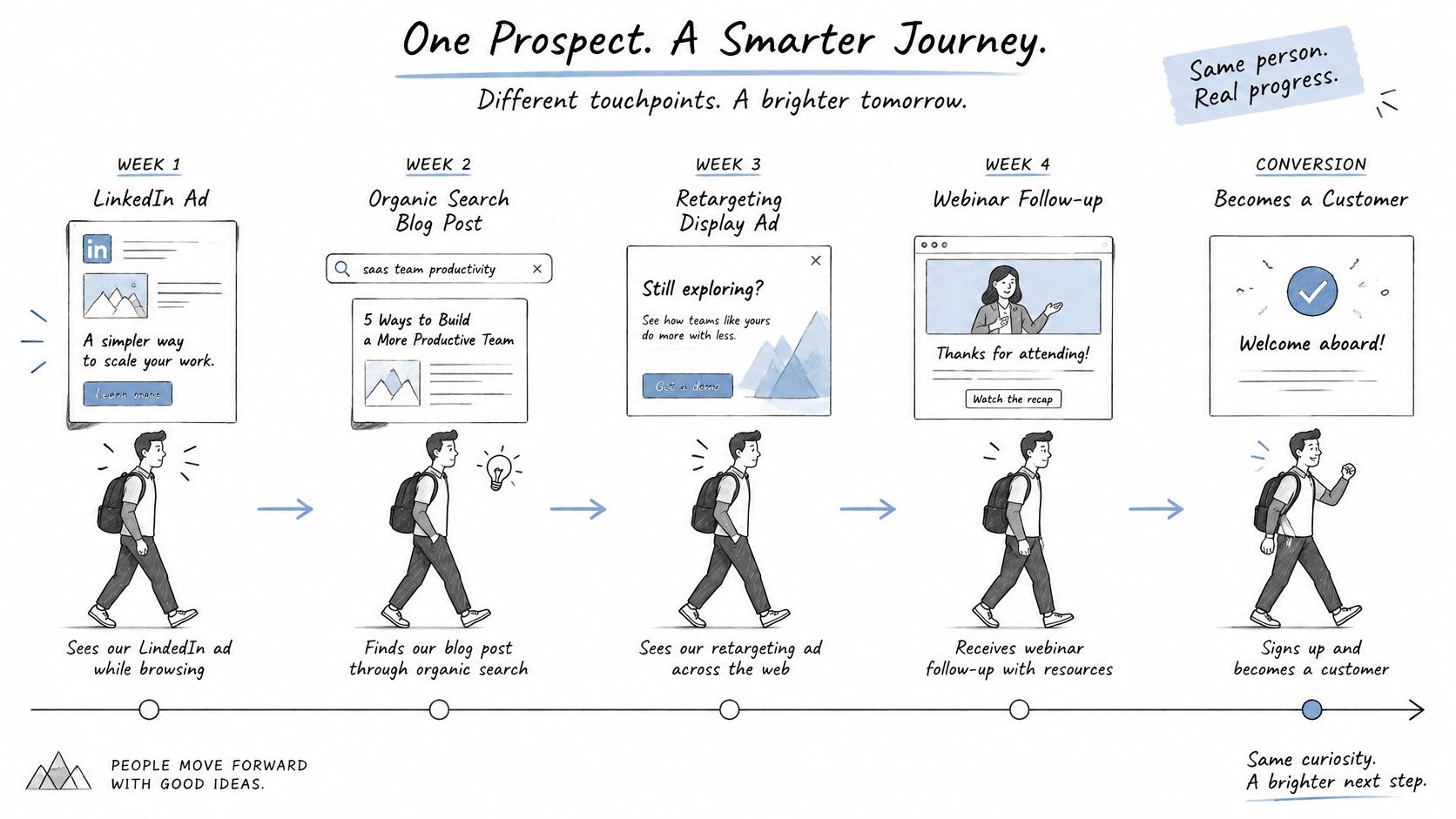
For this illustration, assume those are the eligible marketing touches and that the eventual contract revenue is assigned to the pre-demo journey. Sales activity after the demo is outside this deliberately simplified example.
Last touch assigns the full $12,000 to branded search. First touch assigns it all to LinkedIn. Linear assigns $2,400 to each interaction.
For an illustrative position-based allocation of 40% first, 40% last, and 20% across the middle, LinkedIn and branded search each receive $4,800. Each middle interaction receives $800.
Credit for one illustrative deal
The table isolates the middle interactions. All amounts are illustrative dollar credits, not measured incremental revenue.
| Model | Blog post | Retargeting ad | Webinar email |
|---|---|---|---|
| Last touch | $0 | $0 | $0 |
| First touch | $0 | $0 | $0 |
| Linear | $2,400 | $2,400 | $2,400 |
| Position based | $800 | $800 | $800 |
| Time decay with an illustrative 7-day half-life | $774.19 | $1,548.39 | $3,096.77 |
For the time-decay calculation, give each touch a raw weight of one-half raised to its age divided by the half-life, then normalize the weights to the deal total. With the illustrative timing above, LinkedIn receives $387.10 and branded search receives $6,193.55, rounded to cents.
The video offers another way to visualize attribution before interpreting the budget implications.
The company collected the same revenue under every model. Only the accounting story changed.
Under last touch, the search campaign looks indispensable. Under first touch, LinkedIn appears responsible for everything. Neither conclusion follows from the allocation alone.
Also, first touch means first recorded touch. Cleared cookies, unobserved impressions, or a different device can change where the recorded journey begins.
If linear reporting repeatedly assigns LinkedIn a meaningful share of revenue, that isn't sufficient evidence to preserve or cut its budget. It identifies a useful candidate for a LinkedIn holdout test.
Attribution Versus Incrementality and What to Trust
Suppose attribution gives branded search most of the credit. A well-designed holdout then finds that showing those ads added little revenue. Buyers in the control group still purchased through other routes.
For that budget decision, prioritize the experiment if it had adequate precision and the groups stayed comparable. Attribution reconstructs observed paths after the fact. Incrementality estimates what changed because advertising was available.
Digital Applied's measurement overview reports that 60% of US marketers ranked incrementality testing most trusted, compared with 40% for media mix modeling and 37% for in-platform reporting. Those figures describe opinions about trust, not accuracy benchmarks. A poorly executed experiment does not become reliable because respondents prefer the method.
Measurement methods and their limits
The table separates what each method can reveal from what it can only infer.
| Method | What it can show | What it cannot show alone |
|---|---|---|
| Incrementality testing | Causal lift within the experiment's scope | Detailed individual journeys |
| Media mix modeling | Aggregate channel contribution under model assumptions | Individual journey paths |
| In-platform reporting | Conversions the platform records or attributes | A reconciled cross-platform total |
| Multi-touch attribution | Journeys associated with conversions | Causal lift without calibration |
Design a decision-ready holdout
- Define the decision and outcome. Specify the channel, audience, qualified conversion, and budget change you're considering.
- Create a credible control. Randomly assign eligible users where possible. For geographic tests, select comparable regions and account for existing differences.
- Withhold the advertising being tested. Keep other conditions comparable and monitor exposure leakage into the control.
- Measure incremental outcomes. Compare conversion rates for randomized groups, account for uncertainty, and divide relevant advertising cost by estimated additional conversions.
A guide to advertising effectiveness measurement provides context for choosing outcomes beyond platform-reported conversions.
For low-volume B2B funnels, extend observation to capture delayed opportunities and revenue. An inconclusive result is not evidence of no effect.
Keep attribution for operational diagnosis. Use experiments to validate expensive or disputed channel decisions, then record the tested audience, conditions, and uncertainty alongside the resulting budget recommendation.
Choose a Model and Roll Out Attribution
A team switches from last-touch to position-based attribution and the same quarter of revenue now points more budget toward paid social. Nothing in the bank account changed. The credit rule changed which touchpoints got paid. That is why model selection works better as a hypothesis than a permanent settings choice: pick a baseline, compare it with a challenger, and treat expensive budget calls as inference problems to validate with holdouts.
Start with a written measurement specification, not a dashboard configuration. Name the outcome, eligible interactions, identity rules, revenue treatment, and the person responsible for resolving discrepancies.
Use this checklist to organize the rollout.
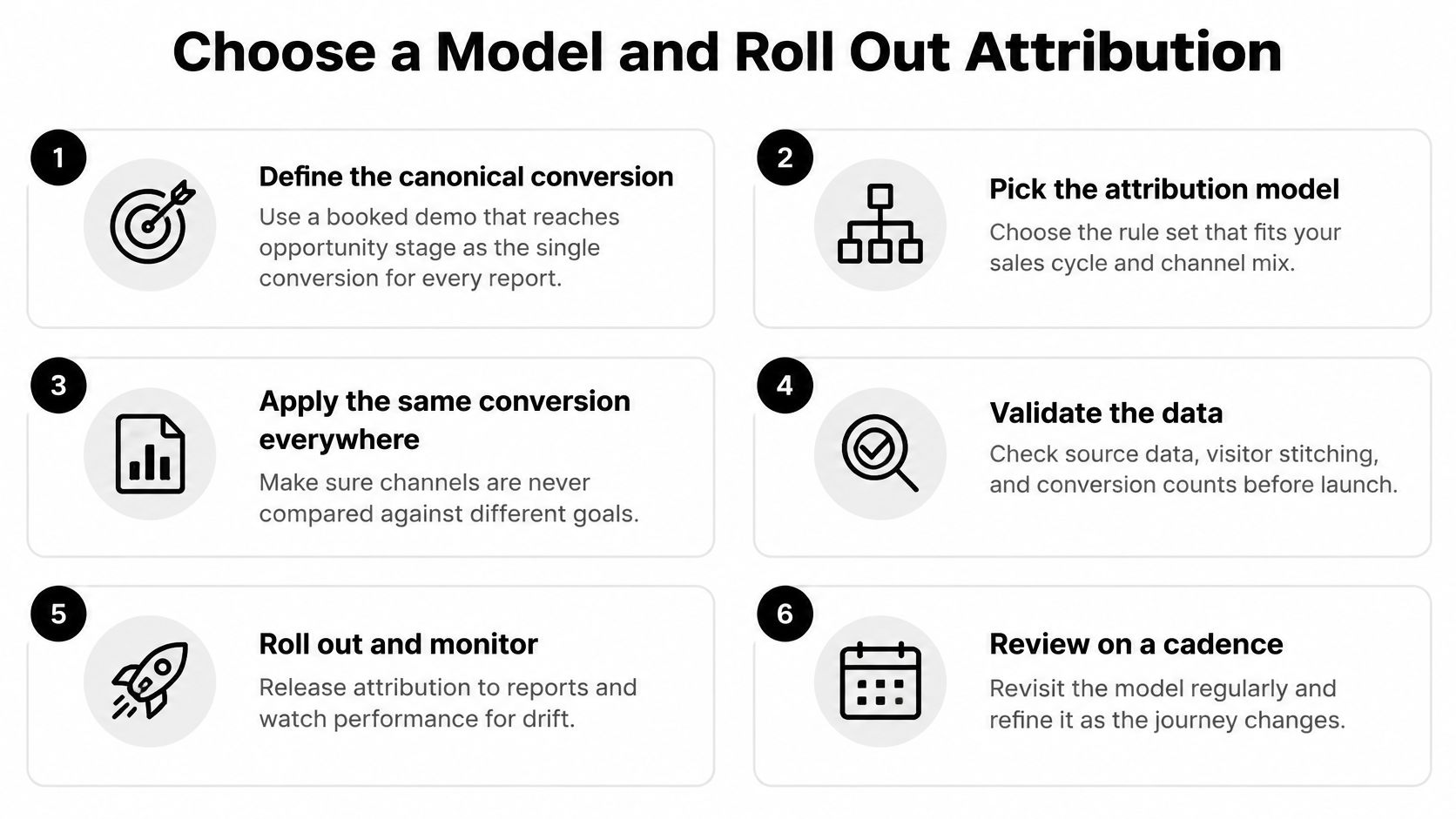
- Operationalize the conversion definition. If success means a booked demo that becomes an opportunity, specify the qualifying CRM stage and exclusions. Make spam, canceled bookings, and duplicate events identifiable.
- Standardize tagging and validate capture. Use a shared UTM naming convention, install the tracking snippet, and submit a test conversion. Check the captured source against the link you clicked.
- Connect downstream systems. Map contact, deal, and transaction identifiers before enabling automated optimization. SourceLoop syncs attribution data to your CRM and ad platforms, so field definitions need to remain consistent across destinations.
- Choose the lookback window from your sales cycle. Inspect the observed delay between acquisition and the chosen outcome. Document how journeys beginning before the window are treated.
- Release a baseline and challenger together. Keep eligibility rules identical. Review both channel totals and individual paths when results diverge.
- Prepare the first holdout. Select a high-credit channel where changing spend would materially affect the budget. Agree on the experiment's success criteria before launch.
- Assign ongoing ownership. Have a named person approve taxonomy changes, inspect broken joins, and reassess the model after material shifts in the funnel or channel mix.
Build or buy without losing auditability
Build when your engineering team can maintain event collection, identity resolution, CRM mappings, and model evaluation. Buy when maintaining that infrastructure would displace more valuable work, but retain access to exportable path data.
Include server-side event handling, deletion workflows, and model comparison in the implementation checklist. Server-side collection doesn't remove privacy obligations or make unavailable exposures observable.
Social commerce platforms define a sale and its attribution differently, so keep those platform definitions separate from your company-wide revenue definition. For platform-specific modeling, HiveHQ on TikTok Shop attribution is a useful reference.
Review collection and decisions separately
Check ingestion failures, duplicate conversions, and missing identifiers during routine operations. Revisit model assumptions on a scheduled cadence and whenever sales processes, consent settings, or campaign strategy change.
Teams that set up SourceLoop are tracking attribution within an hour. Collecting events isn't the same as validating a budget recommendation, so keep implementation completion separate from measurement approval.
Choose your baseline and comparison model this week, trace a paid customer's path from acquisition to payment, and name the channel you'll test first. If you're implementing with SourceLoop, use that same customer record to validate your CRM and ad-platform sync before making your next budget change.



 Paid Social


