
What Is Conversion Optimization: Your 2026 Guide to CRO
Discover what is conversion optimization and why CRO is vital for growth. Our 2026 guide covers the process, key metrics, tools, & using attribution data to
Conversion rate optimization (CRO) is the systematic process of increasing the percentage of website visitors who complete a desired action, such as making a purchase, requesting a demo, or submitting a lead form. Rather than driving more traffic to your site, CRO focuses on getting more value from the visitors you already have.
What Is a Conversion Rate?
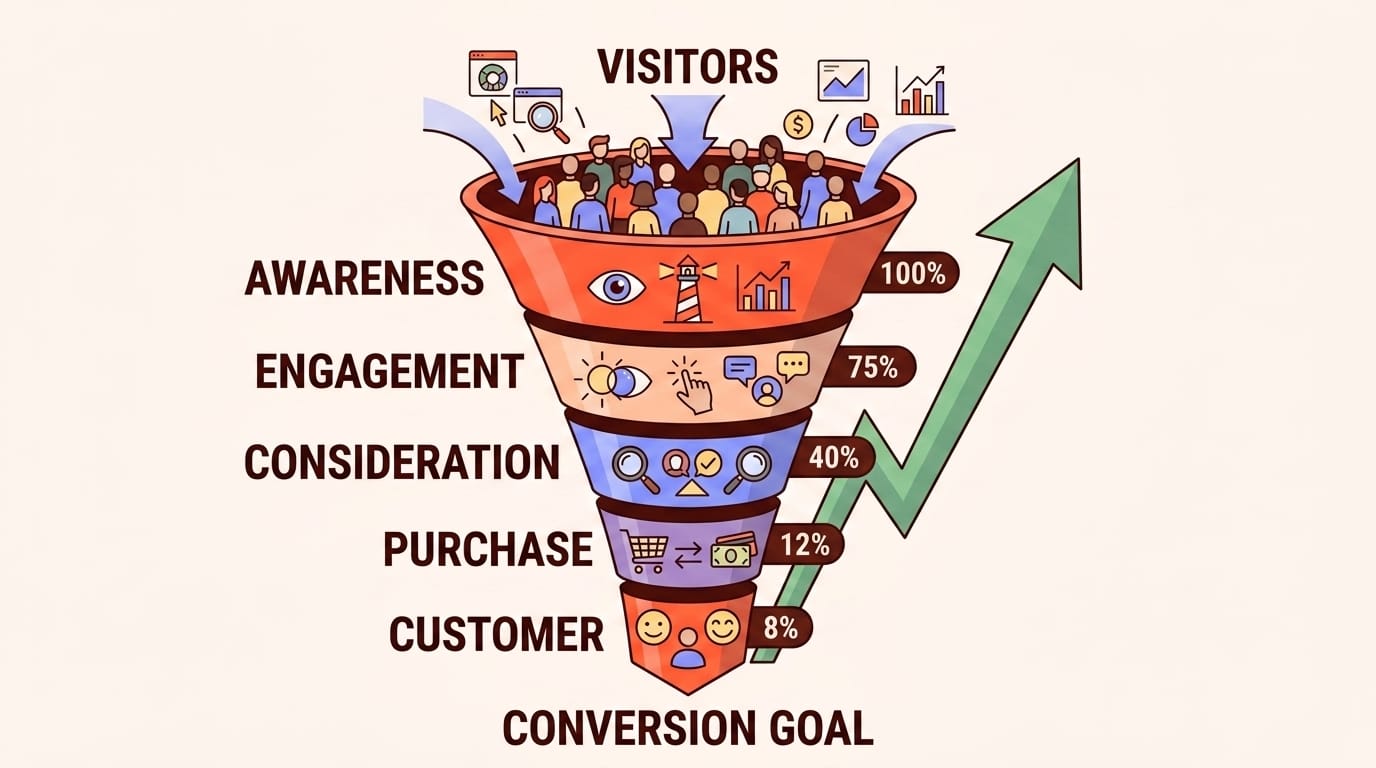
Before understanding conversion rate optimization, you need to know what a conversion rate actually measures.
A conversion rate is the percentage of website visitors who complete a specific desired action compared to the total number of visitors. The formula is straightforward:
Conversion Rate = (Number of Conversions / Total Visitors) × 100
If 10,000 people visit your landing page in a month and 250 fill out your demo request form, your conversion rate is 2.5%. That single number tells you how effectively your site turns traffic into tangible business outcomes.
Conversions fall into two categories. Macro conversions are your primary business goals: completed purchases, booked meetings, submitted quote requests, or paid signups. These directly generate revenue or sales pipeline. Micro conversions are smaller actions that signal intent: adding a product to cart, downloading a resource, watching a product video, or clicking through to a pricing page. Both matter because micro conversions predict macro conversion behavior.
Why Conversion Rate Optimization Matters
Most marketing budgets focus heavily on acquisition: paid search, social ads, content marketing, and SEO. These channels drive traffic to your site. But the moment a visitor lands on your page, that acquisition investment is already spent. CRO determines whether you get a return on it.
1. Lower Customer Acquisition Costs
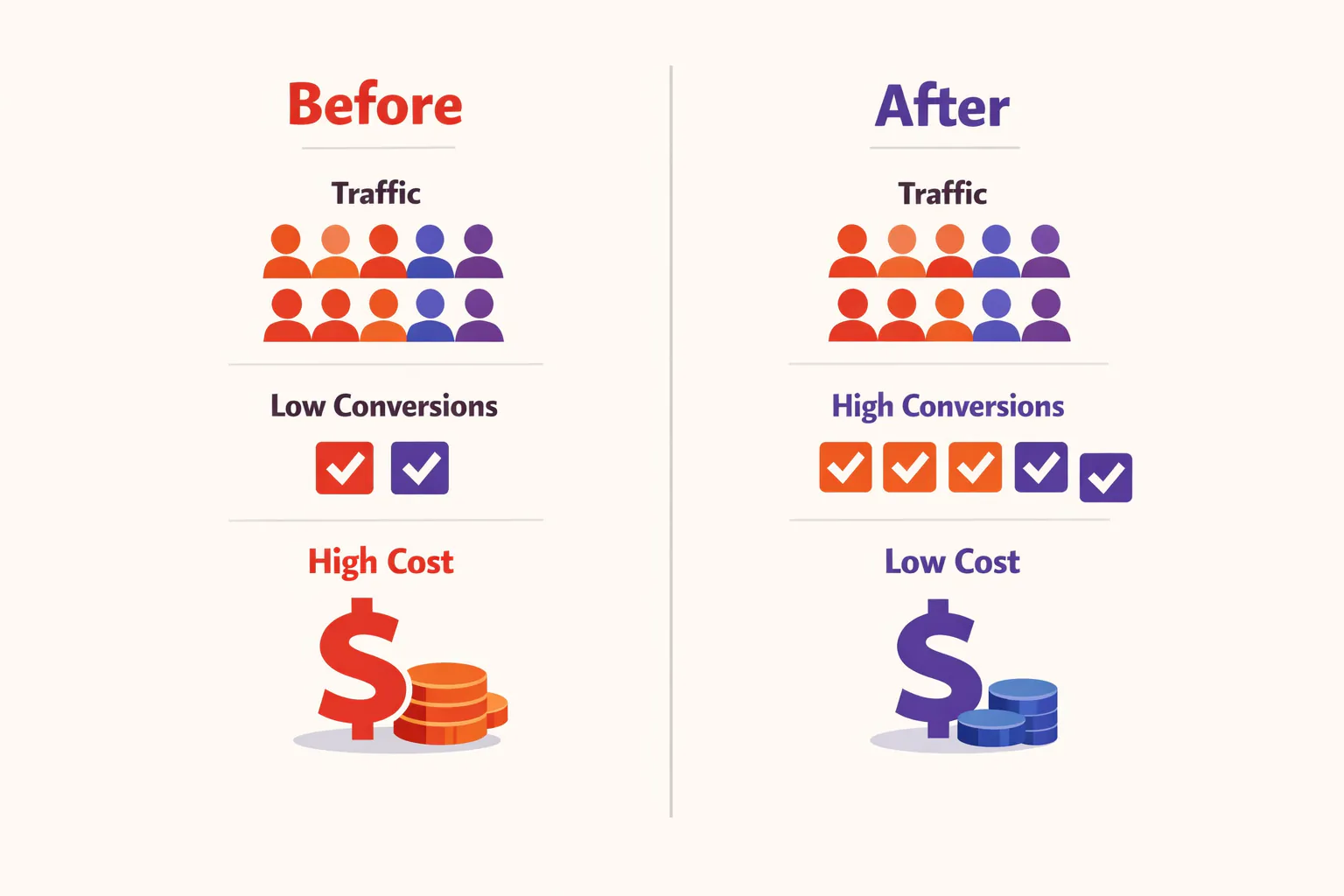
Improving your conversion rate means each customer costs less to acquire. If your current customer acquisition cost is $200 and you double your conversion rate, your effective CAC drops to $100 without changing a single campaign. This makes CRO one of the most capital-efficient growth strategies available.
2. More Revenue from Existing Traffic
You don't need more visitors to grow revenue, you need more of your current visitors to convert. The average website conversion rate is between 2% and 5% according to research from Lucky Orange, meaning 95-98% of visitors leave without acting. Small improvements in that percentage create substantial revenue gains.
A site with 10,000 monthly visitors at a 2% conversion rate generates 200 conversions. Increase that rate to 3% and you get 300 conversions, a 50% revenue lift from traffic you already paid to acquire.
3. Better User Experience
CRO and user experience are inseparable. The friction that stops visitors from converting, confusing navigation, slow page load times, unclear messaging, complicated forms, is the same friction that creates poor user experience. When you fix conversion problems, you improve the experience for everyone. That leads to higher engagement, lower bounce rates, and better search rankings as a downstream effect.
4. Deeper Customer Understanding
A structured CRO program forces you to understand how people actually behave on your site rather than how you think they behave. The insights you gain from analyzing user behavior feed back into better marketing, product decisions, and customer experiences across every touchpoint.
How to Calculate Conversion Rates
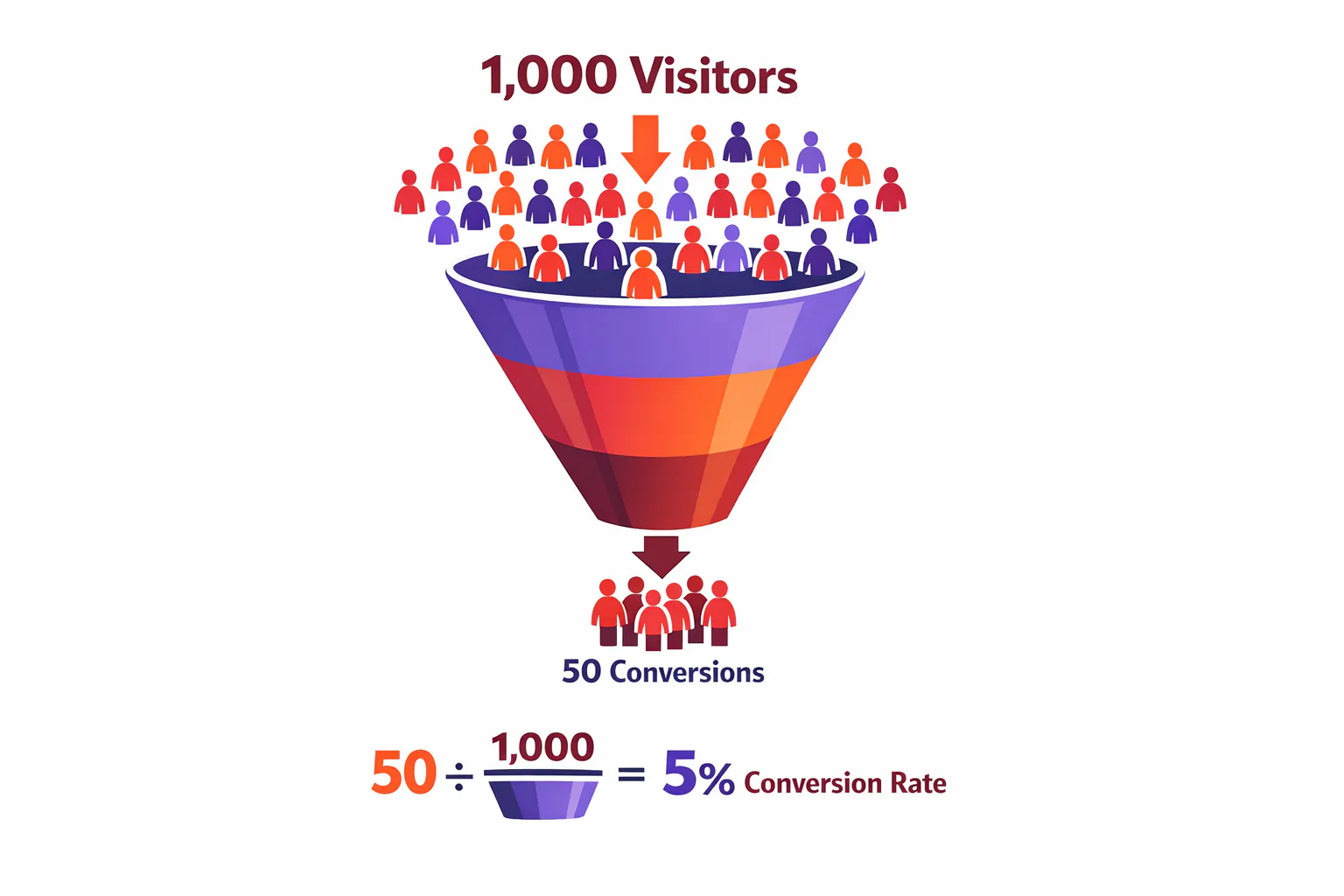
Calculating your conversion rate requires two data points: total conversions and total visitors.
The basic formula:
Conversion Rate = (Conversions / Total Visitors) × 100
For example:
500 visitors land on your pricing page
25 start a free trial
Conversion rate = (25 / 500) × 100 = 5%
Most businesses track multiple conversion rates across different pages and actions. Your homepage might have one conversion goal (clicks to product pages), your pricing page another (trial signups), and your checkout page a third (completed purchases).
Google Analytics makes this calculation automatic when you set up conversion goals. Define what actions count as conversions, and the platform tracks the rate for you. Break your conversion rate down by traffic source, device type, and visitor segment. A blended average hides the real story, your organic search traffic might convert at 4% while display ads convert at 0.8%.
Understanding these variations helps you prioritize optimization efforts where they'll have the biggest impact.
What Is a Good Conversion Rate?
The median website conversion rate across industries is approximately 6.6%, based on Unbounce's analysis of over 41,000 landing pages and 464 million pageviews. However, this benchmark varies significantly by industry, traffic source, and the specific action you're asking visitors to take.
According to 2026 industry benchmarks from ConvertCart:
Overall web average: 2.35% across all industries
Insurance: 18% (high-intent, considered purchases)
Entertainment: 12.3% (impulse buys, low friction)
SaaS: 3.8% median (free trial signups)
Ecommerce: 1-4% (transactional friction)
EdTech: 2-3% (course landing pages convert higher at 18%)
Traffic source dramatically affects conversion rates. Email marketing converts at 4-5.3% because the audience has already opted in. Direct traffic converts at 3.3-3.8% because these visitors are brand-aware. Paid social converts at just 0.7-1.2% because it's interruption-based rather than intent-driven.
Device type matters too. Desktop visitors convert at 3.5-4.0% while mobile converts at 1.8-2.5%, not because mobile users are less committed but because most sites create more friction on smaller screens.
The most useful benchmark isn't an industry average, it's your own current rate. A jump from 2% to 3% represents a 50% increase in conversions from the same traffic. Focus on consistent improvement rather than chasing arbitrary targets.
How Conversion Rate Optimization Works
CRO is both art and science. It combines quantitative data (what happened), qualitative insights (why it happened), and controlled experimentation (what to do about it).
Effective conversion rate optimization follows a structured, repeatable process:
1. Define conversion goals. What specific actions do you want visitors to take? Be precise. "More sales" isn't a goal. "Increase checkout completion rate on the pricing page" is.
2. Measure your baseline. Calculate your current conversion rate and break it down by device, traffic source, and visitor type. You can't improve what you don't measure.
3. Gather data. Review funnel metrics, exit rates, and bounce rates in your analytics. Use behavioral data, heatmaps and session recordings, to see what visitors actually do on your pages. Collect qualitative feedback through surveys, user interviews, and sales team input.
4. Identify bottlenecks. Find the major drop-off points in your conversion funnel. Where are you losing the most visitors? Focus initial efforts on the 1-3 highest-impact friction points.
5. Form hypotheses. Based on your data, create testable predictions. "If we reduce checkout steps from 4 to 2, cart completion will increase by 15%." Good hypotheses name the change, predict the outcome, and specify the metric.
6. Test your hypotheses. Run A/B tests or multivariate tests to validate your ideas. Show different page versions to different user segments simultaneously and measure which performs better.
7. Implement and monitor. When a variant wins, roll it out to all users. Then keep monitoring. A change that improves conversion in week one can plateau or decline as your traffic mix changes.
8. Iterate continuously. CRO is never done. User expectations, device capabilities, and competitive dynamics all evolve. Improve one area then move to the next.
Research from Optimizely shows that only 12% of experiments produce a winning result. That doesn't mean 88% of tests fail, it means testing is about learning. Even a losing test teaches you something valuable about your audience.
The Role of Attribution in CRO
Conversion rate optimization tells you whether visitors convert. Marketing attribution tells you which marketing efforts produced those visitors in the first place. Together, they close the loop from click to customer to revenue.
If you improve your pricing page conversion rate from 3% to 5%, attribution data reveals which channels benefit most from that improvement. You might discover that LinkedIn ads now drive more qualified leads than Google Ads, or that organic search visitors convert at twice the rate of paid social traffic.
Attribution also helps you understand the full customer journey. A visitor might arrive via a blog post, return through a paid search ad, and finally convert after clicking an email. Without attribution, you'd credit the email. With attribution, you see all three touchpoints and can optimize each one.
Connecting conversion data to revenue attribution means you're not just optimizing for form fills, you're optimizing for actual business outcomes. Sourceloop tracks the complete journey from first visit through conversion to closed revenue, showing exactly which marketing efforts produce customers rather than just clicks.
Key CRO Strategies and Techniques
Effective CRO isn't a single tactic. It's a combination of strategies applied where they'll have the most impact.
Optimize Your Landing Pages
Landing pages are where CRO delivers the fastest results. Every element, headline, hero image, body copy, call-to-action, form, should serve one purpose: moving the visitor to the next step.
Align landing page content with the intent behind the traffic source. A visitor from a paid search ad for "B2B attribution software" has different expectations than someone clicking from a blog post. Match the message to the moment, remove distractions, and make the desired action obvious.
Techniques that reliably lift landing page conversion rates include removing navigation menus from standalone pages, using directional cues toward the CTA, keeping critical information above the fold, and testing headline variations.
Write Stronger Calls to Action
Your calls to action should be direct, specific, and benefit-focused. "Start my free trial" outperforms "Sign up" because it emphasizes what the visitor gets and reduces perceived commitment.
Place CTAs in high-visibility locations: above the fold, after product descriptions, following testimonials, and at the end of long-form content. On long pages, repeat the primary CTA multiple times with consistent messaging. Conflicting CTAs create decision paralysis.
Use Social Proof
Social proof, testimonials, reviews, case study results, customer logos, usage statistics, reduces the uncertainty that stops visitors from converting. It works especially well near CTAs or during checkout, where hesitation peaks.
The most effective social proof is specific and credible. "183% increase in demo conversions" outperforms "great tool for marketers." A named customer with a job title outperforms an anonymous quote. Real results beat vague endorsements every time.
Eliminate Slow Load Times
Every second a page takes to load costs conversions. Research consistently shows that slow load times increase bounce rates and directly reduce revenue, especially on mobile devices.
Use tools like Google PageSpeed Insights to benchmark performance. Common fixes include compressing and lazy-loading images, minimizing JavaScript execution, enabling browser caching, and using a content delivery network. For ecommerce sites, checkout page speed deserves special attention.
Optimize for Mobile Devices
More than half of web traffic comes from mobile devices. Mobile conversion rates typically lag behind desktop, not because mobile users are less committed, but because most sites create more friction on small screens.
Responsive design is the baseline, not the goal. Use large touch-friendly buttons, simplify forms with autofill support, eliminate horizontal scrolling, and specifically test your checkout flow on mobile. Many conversion leaks only appear on mobile devices.
Simplify Forms and Checkout
Every field in a form is a potential exit point. The shorter and simpler the form, the higher the completion rate. Audit which fields you actually need versus which ones you're collecting out of habit.
Beyond field count, form UX matters: real-time validation, smart defaults, autofill support, and clear error messages all improve completion rates. For ecommerce, guest checkout is essential, forcing account creation before purchase creates massive friction.
Test With A/B Testing
A/B testing removes opinion from optimization and replaces it with evidence. It works by showing different versions of a page or element to different audience segments simultaneously, then measuring which version drives better conversion performance.
Test one variable at a time, a headline, a CTA button, a form layout, so you know exactly what caused the difference. Run tests long enough to reach statistical significance before drawing conclusions.
The strongest tests are grounded in behavioral data. You observe a drop-off pattern, form a hypothesis about why it's happening, then test a fix. That's the difference between a testing program and organized guessing.
Analyze User Behavior
Analytics tell you what happened. Behavioral data tells you why. Tools like heatmaps, scroll maps, and session recordings show exactly how real users interact with your site: where they click, how far they scroll, where they get confused, and where they give up.
This qualitative layer reveals patterns that aggregate analytics miss. Heatmaps show whether visitors click on non-interactive elements, ignore CTAs, or don't scroll far enough to see important content. Session recordings let you watch individual visitor journeys and identify friction patterns, rage clicks, navigation loops, form abandonment.
CRO Tools Every Team Needs
The right tool stack makes CRO more accurate and efficient. A well-configured setup gives you visibility into visitor behavior at every level.
Analytics Platforms
Google Analytics 4 is the baseline for any CRO program. It tracks traffic volumes, conversion rates, funnel drop-off, traffic source performance, and cohort behavior. Set up conversion events for each step in your funnel to see exactly where the biggest drop-offs occur.
GA4 shows you what happened. It doesn't show you why.
Behavioral Analytics Tools
This is where real CRO leverage lives. Behavioral analytics tools show how visitors actually interact with your site, not just aggregate metrics, but real human behavior.
Platforms like Lucky Orange provide heatmaps showing click, scroll, and attention patterns across key pages. Session recordings let you watch individual visitor journeys and identify friction. On-site surveys capture qualitative voice-of-customer data. Some tools now include AI features that let you ask natural language questions about visitor behavior and get answers grounded in real session data.
The distinction between behavioral analytics and traditional analytics is the difference between knowing your conversion rate dropped and understanding why it dropped. Both matter, but only the latter tells you what to fix.
A/B Testing Platforms
A/B testing tools like Optimizely, VWO, and AB Tasty give you the infrastructure to run controlled experiments at scale, handling traffic splitting, statistical significance calculations, and variant management.
The tools that test most effectively are fed by strong behavioral data. Running a test on a page element identified through a heatmap pattern is fundamentally different from testing based on a designer's preference. The former is optimization. The latter is guessing.
Form Analytics
Form analytics tools show exactly where users abandon forms, which fields cause hesitation, and where errors occur most frequently. This data is invaluable for reducing friction in lead generation and checkout flows.
How AI Is Changing CRO
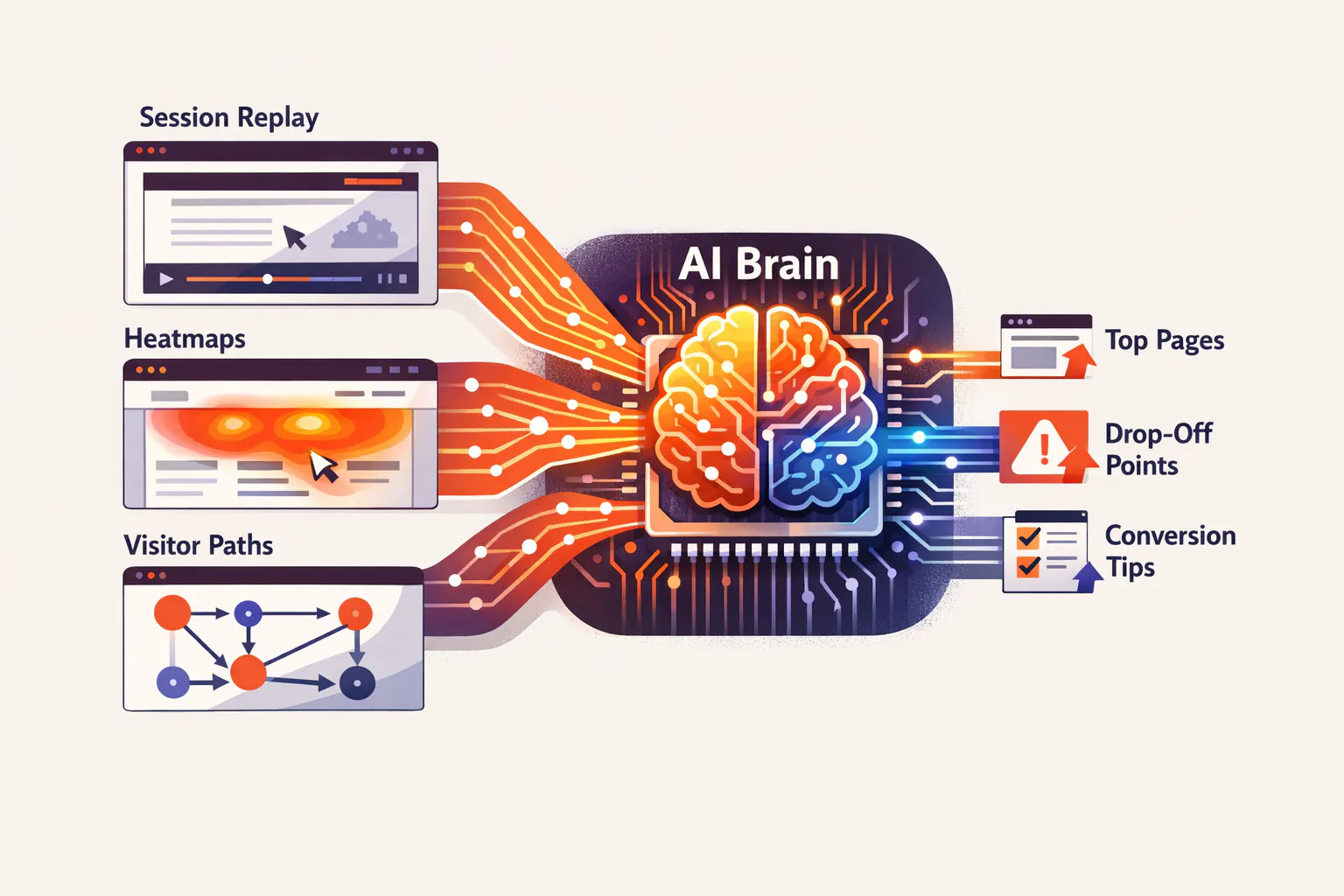
Traditional CRO required analysts to manually review session recordings, segment heatmap data, and cross-reference multiple reports to form hypotheses. It was slow, labor-intensive, and limited to whatever patterns a human could spot.
AI is compressing that workflow dramatically. Natural language tools now let you ask questions about visitor behavior the same way you'd ask a colleague: "What are mobile users doing differently on the checkout page?" or "Show me sessions where visitors got confused on the pricing page."
AI surfaces behavioral patterns across thousands of sessions, identifies anomalies, and returns specific, actionable insights in seconds rather than hours. Combined with proper visitor tracking, AI can analyze the complete customer journey from first click through conversion. A hypothesis that previously required a week of manual analysis can now be formed in a single working session.
Beyond answering specific questions, AI can proactively surface patterns you weren't looking for, unusual click clustering, unexpected scroll behavior, correlations between specific actions and conversion outcomes. These are signals manual analysis misses because no human can review every session at scale.
This matters for CRO velocity. The faster you move from observation to hypothesis to test, the more tests you can run and the faster your conversion rate improves.
AI accelerates insight generation, but it doesn't replace judgment. Which hypothesis to test first, how to frame the experiment, what constitutes a meaningful result, that still requires human strategy. AI handles the analytical heavy lifting so teams can focus on decisions that actually require strategic thinking.
FAQ
What is conversion rate optimization?
Conversion rate optimization is the systematic process of increasing the percentage of website visitors who complete a desired action, such as making a purchase, requesting a demo, or filling out a form. CRO combines data analysis, behavioral insights, A/B testing, and UX improvements to turn more existing traffic into customers without requiring additional ad spend.
How do you calculate conversion rate?
Divide the number of conversions by total visitors, then multiply by 100. If 500 people visit your pricing page and 25 start a free trial, your conversion rate is (25 / 500) × 100 = 5%. Set up goal tracking in Google Analytics to calculate this automatically for each conversion event on your site.
What is a good conversion rate?
The average conversion rate across industries is 2-5%, though this varies by industry, traffic source, and the specific action you're asking visitors to take. Ecommerce transaction rates typically run 1-4%, while SaaS free trial signups can be significantly higher. The most useful benchmark is your own current rate, any consistent upward movement means your CRO efforts are working.
Why is conversion rate optimization important?
CRO helps you get more value from traffic you've already paid to acquire. It lowers customer acquisition costs, increases revenue from existing visitors, improves user experience, and provides deeper understanding of your audience. Even a 1% conversion rate increase can translate to a 50% revenue gain from the same traffic volume.
What is a CRO strategy?
A CRO strategy is a structured approach to improving conversion rates through data analysis, hypothesis formation, testing, and continuous iteration. It includes defining conversion goals, measuring baseline performance, identifying friction points, running A/B tests, and implementing winning changes. Effective CRO strategies integrate behavioral data, user feedback, and business objectives.
What are CRO tools?
CRO tools include analytics platforms like Google Analytics (for tracking conversion metrics), behavioral analytics tools like Lucky Orange (for heatmaps and session recordings), A/B testing platforms like Optimizely or VWO (for running experiments), and form analytics tools (for identifying form abandonment). The best CRO programs use all four categories together.
How important is retargeting in conversion rate optimization?
Retargeting brings previous visitors back to your site, giving you a second chance to convert them. Returning visitors convert at 2-3x the rate of first-time visitors because trust is already established. However, retargeting should complement on-site optimization rather than replace it. If your site has fundamental conversion problems, retargeting just sends people back to the same broken experience.
Why is conversion rate optimization so important in 2026?
Customer acquisition costs are rising across every channel while third-party data becomes less available due to privacy regulations. CRO is one of the few growth strategies that doesn't require increasing ad spend or collecting more user data. In an environment where traffic is expensive and privacy matters, getting more value from visitors you already have is increasingly critical.
What is a conversion rate in marketing?
In marketing, a conversion rate measures the percentage of people who take a desired action after interacting with a marketing asset, whether that's a landing page, email campaign, advertisement, or any other marketing touchpoint. It's calculated by dividing conversions by total interactions and multiplying by 100.
How do CRO and SEO work together?
SEO brings visitors to your site through improved search rankings. CRO converts those visitors into customers. Many CRO improvements, faster page load times, better mobile optimization, reduced bounce rates, clearer content, also benefit SEO performance. The two disciplines create a positive feedback loop when implemented together.


 Paid Social


