
Best Marketing Attribution Tools for Attio in 2026
Best Marketing Attribution Tools for Attio, plus how to calculate, read and raise your lead-to-customer conversion rate with them.

Your ad dashboards show conversions, your sales team reports new customers, and Attio contains the records that should connect them. Yet when someone asks which campaign deserves more budget, the numbers don't agree. Some leads have a source but no payment, others have revenue but no campaign, and a recent import has changed the conversion rate without changing sales.
The best marketing attribution tools for Attio should help you resolve those disagreements, not just display another chart. Treat lead-to-customer conversion as a data-quality test: can you trace the people counted, explain their source, and confirm that their customer status arrived reliably?
Table of Contents
- Attribution Fit by Team Type for Attio
- What Lead-to-Customer Conversion Rate Measures
- How to Calculate the Rate in Your Attio Pipeline
- Reading the Rate Without Fooling Yourself
- A Worked Example from Lead to Paying Customer
- Fixing Attio Gaps and Raising the Rate
- Confirm Your Attio Setup Before the Next Budget Decision
Attribution Fit by Team Type for Attio
| Team type | Must-have for Attio | Check before buying | Fit |
|---|---|---|---|
| Marketing agency | Per-client reporting with source fields in each client workspace | Workspace-level authentication for each client | Agency-oriented attribution with separate client reports |
| SaaS company | First touch and revenue tied to pipeline stages | Real-time webhooks for stage changes | Revenue attribution connecting Stripe payments to the original channel |
| Ecommerce or DTC brand | Revenue and ROAS by campaign | Conversion sync to Google Ads and Meta | Cross-channel ROAS covering Google, Meta and TikTok |
| RevOps team | Deduplicated records and field mapping | Rate limits and a staged backfill plan | API-led attribution with auditable identity and synchronization controls |
Choose the integration pattern before the dashboard. An agency needs client separation. A SaaS team needs a journey that survives qualification, opportunity creation, and payment. An ecommerce brand needs campaign revenue reconciled with orders, while RevOps needs records that remain consistent when integrations retry.
Attio's international reach makes that distinction relevant. A launch announcement described in Kasper Dudek's account of Attio's growth disclosed more than 2,000 customers across over 100 countries, including free and trial accounts. For distributed teams, attribution should function as shared CRM infrastructure rather than a spreadsheet export.
Match the tool to the decision
SourceLoop is built for agencies and in-house marketing teams, provides multi-touch attribution across every channel, and syncs attribution data to the customer's CRM and ad platforms. Those capabilities fit teams that need campaign context alongside lead and revenue records. For an Attio implementation, evaluate the actual field mapping and event path rather than assuming every CRM connection behaves identically.
An agency comparing reporting methods can use GolfRep's guide to compare last click and multi-touch models. For account-based buying journeys, our guide to B2B attribution models helps frame the choice around how customers buy.
Buying rule: Require a demonstration using your records, stages, and payment events. A connector logo isn't proof that the journey stays intact.
Use lead-to-customer conversion rate as the acceptance test for whichever tool type fits your team.
What Lead-to-Customer Conversion Rate Measures
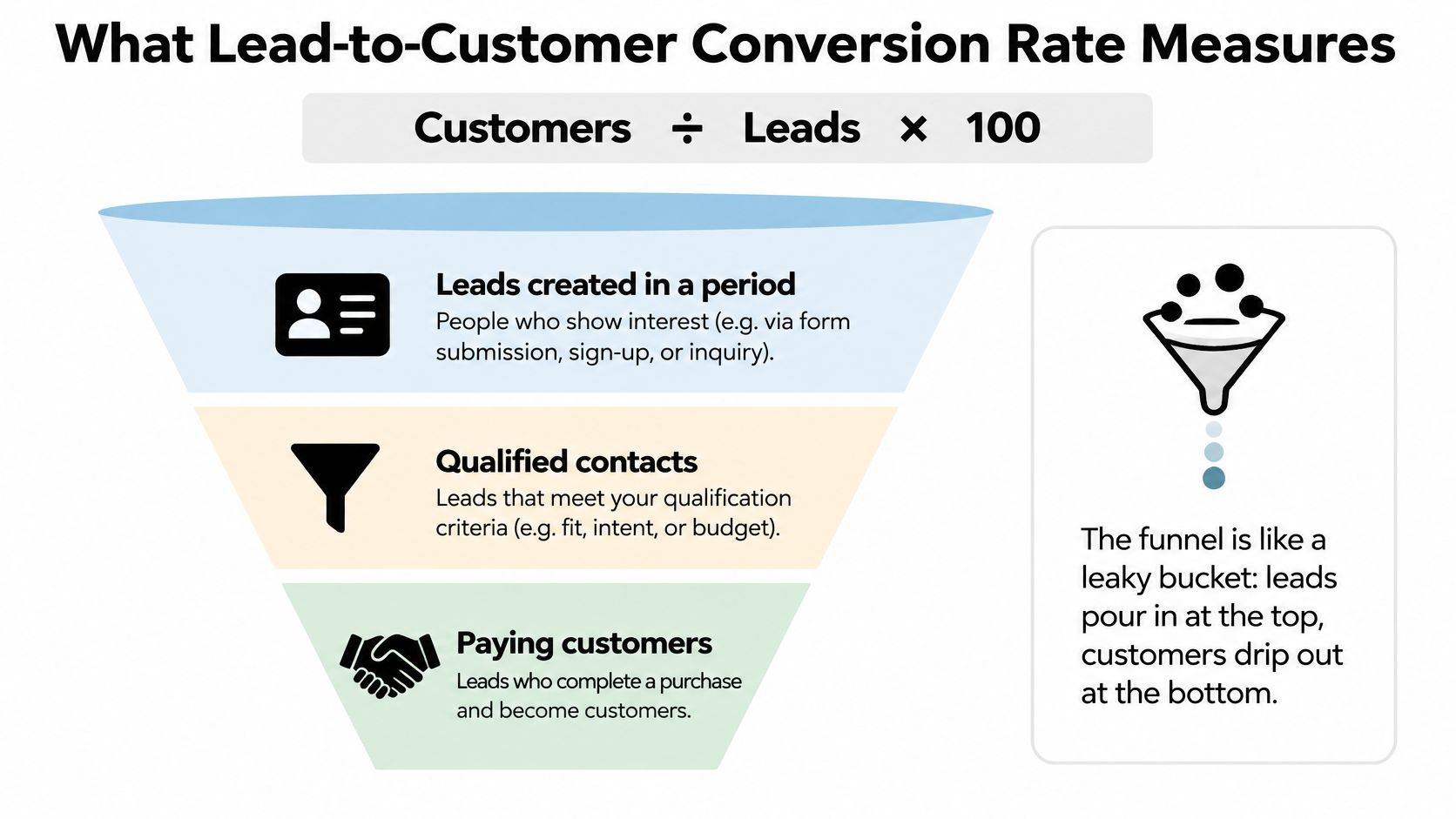
Lead-to-customer conversion rate is the share of leads created during a defined period that eventually become paying customers.
Conversion rate = Customers from the lead cohort ÷ Leads in that cohort × 100
Think of your sales funnel as a pipe system. Leads enter at the top, pass through qualification and sales conversations, and emerge as customers at the bottom. The rate tells you how much of that initial flow reaches the end, but it doesn't explain every leak.
Keep the same people in both counts
The metric is cohort-based. If you count leads created during a particular month, count customers who came from those leads, even when they paid later.
Don't divide all customers closed this month by all leads created this month. Those groups may contain different people, especially when sales conversations take time.
A lead count tells you how much attention you bought. The conversion rate helps you judge whether that attention became business worth paying for.
Cheap leads aren't necessarily economical customers. A channel can produce inexpensive form submissions that rarely become paid accounts, while a more expensive source attracts buyers who progress through sales.
Separate the stages
Your Attio pipeline should distinguish the transitions you want to diagnose:
- Lead-to-opportunity: Did the lead become a credible sales opportunity?
- Opportunity-to-win: Did sales convert that opportunity into a customer?
- Lead-to-customer: Did the original lead ultimately pay?
Define what lead, qualified, opportunity, and customer mean in your own pipeline. A booked meeting shouldn't become a paying customer merely because both are valuable milestones.
For a broader view of the handoffs surrounding this metric, Outbound Consulting's guide to business development KPIs that matter provides useful context. Keep the final conversion measure anchored to payment, not activity alone.
How to Calculate the Rate in Your Attio Pipeline
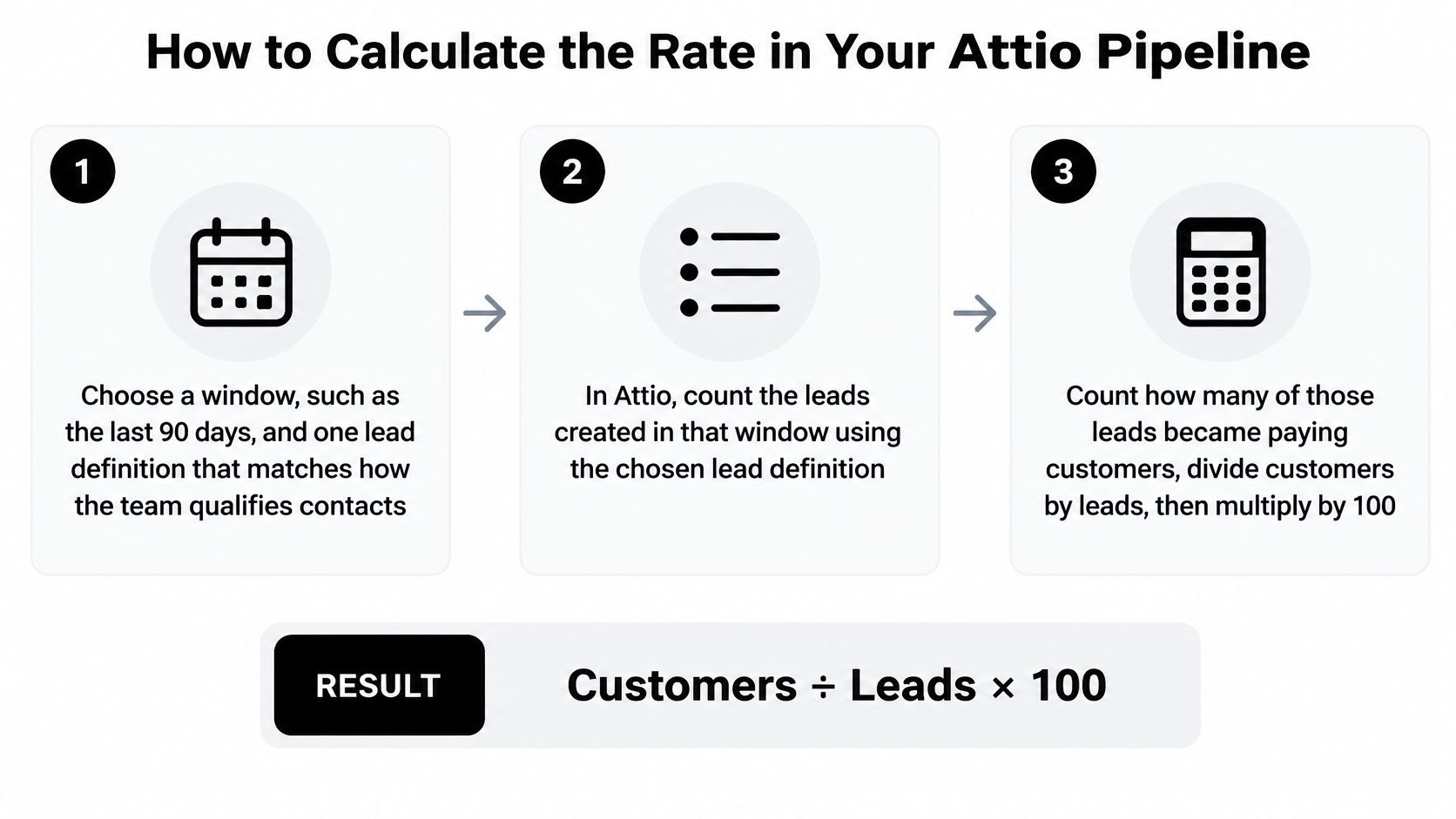
Start with a written counting rule, not a dashboard filter. Decide whether a lead represents a person or a company, and identify the event that proves someone became a paying customer.
Build a consistent cohort
- Choose the window and lead definition. Use a completed acquisition period and a consistent qualification rule, because changing either changes who enters the denominator.
- Count eligible Attio records. Filter the chosen person or company records by lead-created date and source, because the denominator must represent the acquisition cohort rather than the entire database.
- Find customers within that same group. Check which eligible records reached the paying-customer stage by your reporting cutoff, because customers acquired from older cohorts don't belong in this numerator.
- Calculate the percentage. Divide those customers by eligible leads and multiply by the percentage factor, because the resulting share is comparable across differently sized cohorts.
- Repeat by first-touch source. Apply the same rules to each source, because a channel comparison is meaningful only when definitions and observation time match.
Keep an unknown-source category during reconciliation. Excluding unattributed leads can make the published rate look better while hiding the integration problem.
Channel percentages don't add together. Channel lead counts and customer counts should reconcile to the totals, and the lead-weighted average of channel rates should equal the blended rate.
Preserve identity through the journey
Attio's CRM API overview describes the read/write and event-driven foundations for custom integrations. Test whether your attribution setup uses those foundations to preserve identifiers, map fields, replay failures, and update records without creating duplicates.
A first visit can precede the person record. A payment can arrive after an opportunity is marked won. Use a stable internal lead or customer identifier to connect those events, with consent-aware handling of visitor identity.
Our Attio CRM UTM tracking guide addresses the campaign context needed alongside those identifiers. When a lead converts through a form, chat, or booking, we attach all 8+ attribution data points to the lead and push it to the CRM.
Don't count a company and its associated contacts as separate acquisition units if your sale happens at company level. Keep contacts as participants in the buying journey.
Hypothetical calculation: suppose a cohort contains 120 leads, and 18 have become paying customers by the reporting cutoff. The calculation is 18 ÷ 120 × 100 = 15%. Your finished report should contain that blended result plus source-level counts that reconcile to the same cohort.
Reading the Rate Without Fooling Yourself
A rising conversion rate can look like permission to increase spend. First check whether you're comparing equally mature cohorts, enough actual buyers, and the same attribution rules.

Check maturity, volume, and credit
Time lag comes first. In a hypothetical pipeline where deals take longer to close than the reporting window, recent leads haven't had a fair chance to convert. Compare cohorts at the same age and display the observation cutoff.
Volume comes next. A channel with only a handful of leads can change position after a single sale. Don't treat a universal minimum lead count as statistical proof; consider customer count, normal variability, deal value, and the size of the proposed budget change.
Attribution rules come third. First-touch allocates credit to the earliest recorded interaction; last-touch allocates it to the final one. Linear spreads credit across recorded touches, position-based emphasizes selected journey positions, and time-decay gives more weight to recent interactions.
We offer first-touch, last-touch, linear, position-based, and time-decay models. Changing the model changes channel credit, not whether the underlying person paid. Keep cohort conversion separate from fractional revenue attribution.
Ask what was actually observed
CaliberMind's 2025 State of Marketing Attribution Report identifies privacy regulation, cookie changes, and reduced individual-level tracking as reasons for greater reliance on first-party and aggregated measurement.
Require clear labels in exports and dashboards:
- Observed: A recorded event supports the conversion.
- Modeled: An estimate fills an observation gap.
- Consented: Tracking occurred under the applicable permission state.
- Imported: Another system supplied the conversion.
- Deterministic: A direct identifier supports the match.
These labels can overlap. An imported payment may also be observed and deterministically matched.
Our guide to closed-loop attribution explains the connection between acquisition and downstream outcomes. Check confidence indicators, unmatched events, deletion handling, and retention controls alongside that connection.
A higher rate isn't automatically better evidence. Investigate any increase that coincides with a falling share of observed conversions.
A Worked Example from Lead to Paying Customer
Consider this illustrative example, not a benchmark or customer result. A small agency runs paid search and Meta campaigns for a SaaS client. Its quarterly acquisition cohort contains 240 leads, of which 27 eventually become paying customers, producing a rounded 11.3% blended rate.
Attio labels most visible lead records as Google Ads. The agency keeps adjusting campaigns, but the blended result barely changes, and nobody can confidently distinguish an acquisition problem from a source-capture problem.

Rebuild the source split
The agency instruments forms, chat, and booking flows, then reconstructs this hypothetical cohort only where retained identifiers support the match. It leaves uncertain journeys unattributed rather than assigning a convenient channel.
| First-touch source in this example | Leads | Paying customers | Rounded conversion rate |
|---|---|---|---|
| Meta | 60 | 11 | 18.3% |
| Paid search | 120 | 9 | 7.5% |
| Other sources | 60 | 7 | 11.7% |
| Total | 240 | 27 | 11.3% |
In this example, the best and worst source rates differ by 10.8 percentage points. The agency couldn't see that spread in the blended result.
Turn the difference into a test
Before changing spend, the team checks cohort maturity, lead validity, payment matching, and whether a concentrated customer segment explains Meta's result. It also checks customer value: a higher conversion rate doesn't necessarily mean higher profit.
The agency then tests a measured budget shift toward Meta while reviewing search queries, negative keywords, and landing-page promises. It keeps the counting rules fixed so the next comparison measures campaign changes rather than reporting changes.
The value of auditable campaign detail is reflected in this customer statement:
“Every lead now lands in their CRM with the campaign, keyword and ad behind it, so we can prove our impact with numbers clients can check for themselves.”
Maya, Halden & Wright Agency
Another customer says multi-touch attribution on every call showed which ads started a booking and which closed it. That's a useful distinction when a source initiates demand but another captures the final action.
The blended rate hides the spread. The spread identifies what to investigate, not what to scale blindly.
Fixing Attio Gaps and Raising the Rate
| Symptom in Attio | Likely cause | Fix |
|---|---|---|
| Rate drops right after a large import | Backfill writes may be throttled, leaving customer updates incomplete | Stage the import and queue writes over time |
| Leads exist but no customer is linked | A webhook failed, a subscription is missing, or matching failed | Subscribe to relevant record changes and replay failed events |
| Paid channels look weaker than expected | Browser restrictions, ad blockers, or cookie loss may have removed observations | Add consent-aware server-side conversion tracking |
| Same person appears as duplicate records | Visits and conversions aren't joined by a durable identifier | Map a stable identifier and deduplicate before counting |
| Closed deals show no revenue source | Payments aren't joined to the original first-party identifier | Attach payment events to the original lead or customer record |
These are diagnostic hypotheses, not conclusions. A post-import decline could reflect different leads, so inspect the logs before blaming synchronization.
Triage the plumbing first
Attio's webhook documentation establishes how integrations can react to record changes. Subscribe to the changes that represent your stage and revenue fields, and verify that your integration receives, processes, and acknowledges them.
Start with webhook and sync logs, then inspect the backfill schedule, then test identity mapping. Follow a known customer from the originating event to the final Attio record. Check payloads and timestamps, not just a successful connection indicator.
Capacity matters. Attio's rate-limiting documentation specifies 100 read requests per second and 25 write requests per second; at that write ceiling, a hypothetical backfill requiring a separate write for each of one million records takes at least about 11.1 hours, before retries and other traffic.
Calculate attribution externally, then write material changes rather than repeatedly updating every record. Cache record identifiers and field metadata, queue writes, and apply exponential backoff when throttled. Make retries idempotent, meaning that processing the same event again doesn't create another lead or payment.
Our server-side tracking recovers conversions lost to iOS 14, ad blockers, and cookie loss. It doesn't remove the need for consent controls, and it shouldn't be treated as permission to track visitors who declined applicable tracking.
Improve the commercial result
Once the records reconcile, use EmailScout's guide to diagnose drop-off points in your funnel to separate acquisition quality from sales-process friction.
- Compare sources on a regular cadence. Shift spend only when mature cohorts and sufficient evidence support the decision, not after a brief run of wins.
- Return qualified outcomes to advertising platforms. Send supported offline conversions to Google, Meta, and LinkedIn with valid identifiers and deduplication. Optimize toward meaningful business outcomes rather than undifferentiated form submissions.
- Keep bookings attached to acquisition context. Our meeting tracking ties every booked meeting back to the original marketing source, helping sales distinguish strong campaign demand from calendar activity.
- Route leads using evidence. Combine source-level conversion patterns with qualification signals, then assign promising leads to responders who can act promptly. Source alone shouldn't determine priority.
- Remove invalid records consistently. Exclude spam and duplicates under a documented rule before counting, while keeping legitimate non-buyers in the denominator.
Judge changes after the cohort has had enough time to complete the normal buying journey. Otherwise, you may reward a reporting repair as though it were a campaign improvement.
Confirm Your Attio Setup Before the Next Budget Decision
Confirm your attribution setup before approving the next budget shift. A polished report isn't sufficient if the underlying records can't reproduce its result.
Use this acceptance checklist:
- Shared definition: Marketing and sales count the same acquisition unit and agree on what proves payment.
- Capture coverage: Forms, chat, and bookings preserve source context, with unknown values visible.
- Event coverage: Relevant stage and revenue changes reach the integration, with failures available for replay.
- Reporting consistency: Each review uses the same cohort rules and explicitly records its observation cutoff.
- Reconciliation: Source-level lead and customer counts add back to the blended totals.
Test the workflow, not just the installation
Run a completed cohort through the calculation and inspect representative journeys, including an unattributed lead, a duplicate, a delayed payment, and a failed event. Require the tool to explain how each case appears in Attio.
Compare options against your team type and these acceptance checks rather than price alone. For SourceLoop, every plan includes the full attribution stack, lead qualification, email alerts, and unlimited users. Setup can be completed within an hour, but installation speed isn't a substitute for validating your mappings.
Put three entries on today's review sheet: your current blended conversion rate, the percentage-point spread between your strongest and weakest sources, and the next review date.
Bring that sheet and your Attio field map to a SourceLoop walkthrough. Trace a real lead through source capture, qualification, booking, and payment, then use the reconciled result to make your next budget decision.



 Paid Social


