
Best Paid Ad Attribution Tools for 2026 and How to Choose
Compare the best paid ad attribution tools for 2026, learn how attribution models and customer journeys work, and pick the right tool for your budget and CRM.
You've got three tabs open: Google Ads, Meta Ads Manager, and the CRM. Each one tells a different story about the same month, and you're the one who has to explain the gap in Monday's meeting. The instinct is to average the numbers, or pick whichever dashboard makes the campaign look best. Neither works, because those tabs aren't measuring the same thing.
Choosing among the best paid ad attribution tools is really a decision about provenance: where each conversion record came from, what the tool couldn't see, and whether its totals survive a comparison with the revenue your finance team recognises. Dashboards are the easy part. The hard part is knowing which numbers you're allowed to act on.
Table of Contents
- Why Ad Platforms Grade Their Own Homework
- Quick Picks for Every Budget and Stack
- How Attribution Models Split Credit
- Following a Customer Journey From Click to Revenue
- Privacy Gaps and Missing Conversions
- Why Attribution Is Not the Same as Incrementality
- Choose, Test and Decide in Two Weeks
Why Ad Platforms Grade Their Own Homework
Say Google Ads reports 120 conversions for the month, Meta reports 95, and your CRM shows 61 qualified leads. No one's fabricating anything. Each platform counts the conversions it can see through its own click or impression, credits itself for the assist, and applies its own window. Add the two ad totals together and you get a number that never existed.
Paid ad attribution is the practice of assigning credit for a signup, lead, booking or sale to the ad interactions that happened before it. A neutral tool does three things a platform dashboard structurally can't:
- Captures every touchpoint under one consistent identifier, so a paid social click and a search click three weeks later belong to the same person rather than two separate "conversions".
- Connects those touchpoints to outcomes in the CRM or payment system, not just to a thank-you page load.
- Reports one deduplicated number across channels, so the sum of channel credit equals the total you can defend.
The IAB and MRC measurement guidelines treat this as a data-quality problem rather than a reporting feature: outcome measurement should establish a defensible connection between ad exposure and a later action, filter invalid activity such as bots and fraudulent clicks, and disclose whether results are deterministic, probabilistic, modeled or extrapolated. That last requirement is the one most vendor demos skip.
Here's the mismatch in visual form, which is roughly what your Monday meeting looks like.
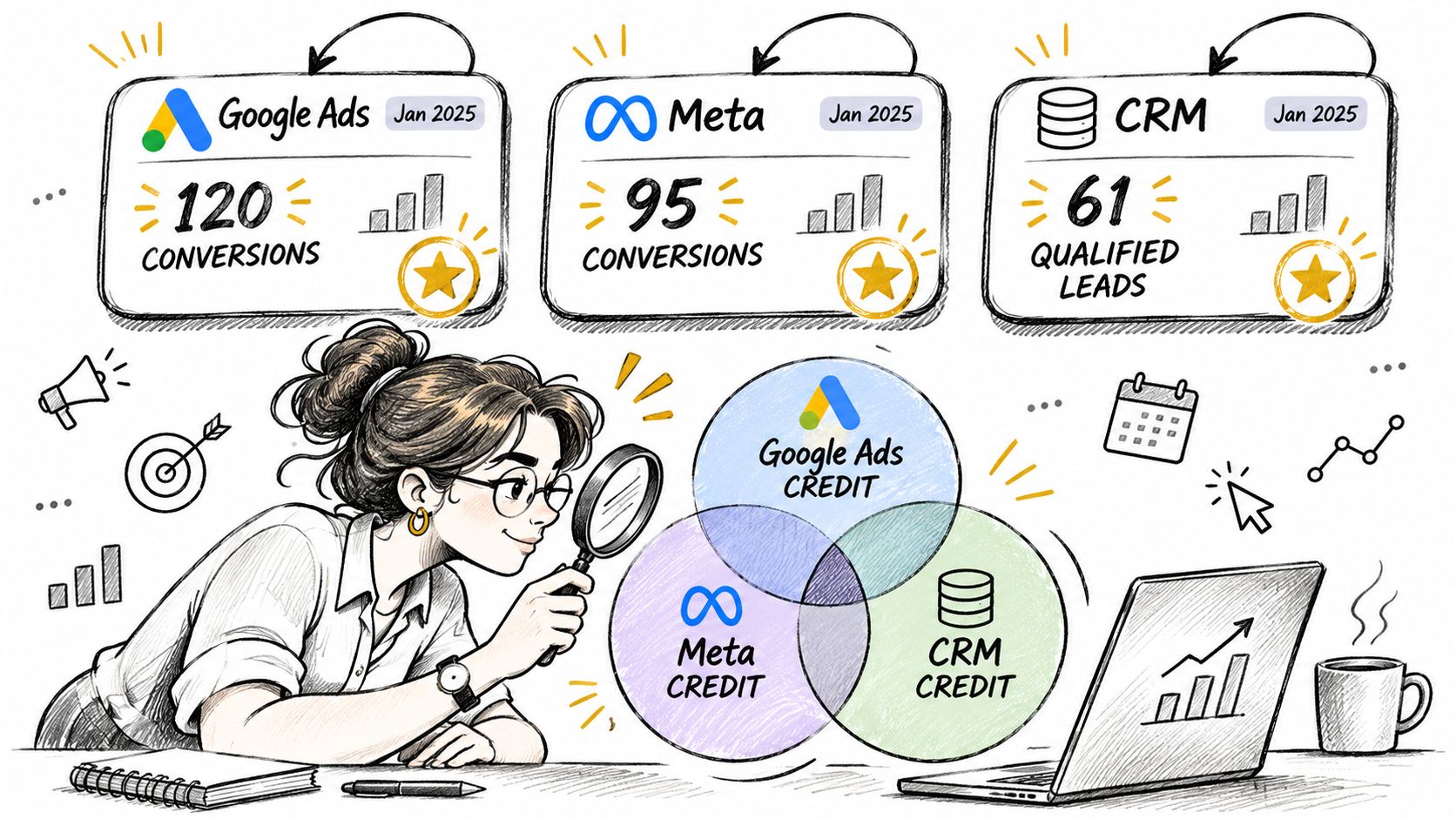
Until someone owns a single cross-channel record, every budget conversation is an argument about whose dashboard is right.
Quick Picks for Every Budget and Stack
| Situation | Tool | Best for |
|---|---|---|
| Small budget, Google-only ads | Google Analytics 4 | Channel reporting across Google properties |
| Agency or lead-gen business with calls | CallRail | Call tracking and call source attribution |
| Agency or lead-gen business with calls | CTM | Call tracking with lead routing |
| Lead-gen with CRM revenue | Ruler Analytics | Connecting calls and forms to CRM outcomes |
| Large budget with call intelligence | Invoca | Revenue and call intelligence at scale |
| Agency, SaaS, ecommerce with multi-channel ads | SourceLoop | Multi-touch attribution with CRM and ad platform sync |
| B2B with long sales cycles | HockeyStack | Pipeline attribution across channels |
| B2B with long sales cycles | Dreamdata | Revenue attribution across the account journey |
| Enterprise marketing teams | Marketo Measure | Revenue attribution inside a marketing suite |
The free baseline
Google Analytics 4 carries no software subscription fee and reports acquisition by channel, which makes it the sensible starting point when Google is your only paid channel. It only sees traffic it tags on your own site, so calls, offline deals and anything happening in another system stay invisible. Check the attribution model setting in the property before you compare its numbers with anything else, because a last-click property and a data-driven property will disagree by design.
Before you pay anyone, clean up the inputs. Our free tools include a UTM Campaign Builder, UTM Validator, Google Ads Cost Calculator, Customer Acquisition Cost Calculator, Marketing Attribution Calculator, Sales Funnel Calculator and GA4 Channel Grouping Validator. Messy campaign naming produces bad attribution in every tool on this list, and fixing it costs nothing.
Call-driven and lead-gen stacks
CallRail and CTM solve the phone problem: dynamic number insertion ties a call back to the session that produced it, and CTM adds lead routing on top. Ruler Analytics goes further downstream, pushing calls and forms into the CRM so closed revenue lands against the original source. Invoca sits at the enterprise end, where call volume justifies conversation analytics and revenue intelligence rather than simple source tagging.
Practical rule: compare the cheapest plan that actually includes multi-touch attribution, conversion paths and CRM data, not the cheapest plan on the pricing page. Entry tiers often gate exactly the features you're buying for.
Multi-channel and B2B pipeline
For agencies, SaaS and ecommerce teams running several networks at once, SourceLoop covers multi-touch journeys with CRM and ad platform sync, and multi-touch attribution, funnels and the pre-built dashboards are included on all three tiers. HockeyStack and Dreamdata suit B2B teams whose buying committee spans several people and several months, where account-level rollups matter more than individual sessions. Marketo Measure fits teams already committed to a marketing suite and wanting attribution inside it.
Start with the row that matches your monthly ad spend and how you use your CRM, then check the free trial or free tier before signing anything.
How Attribution Models Split Credit
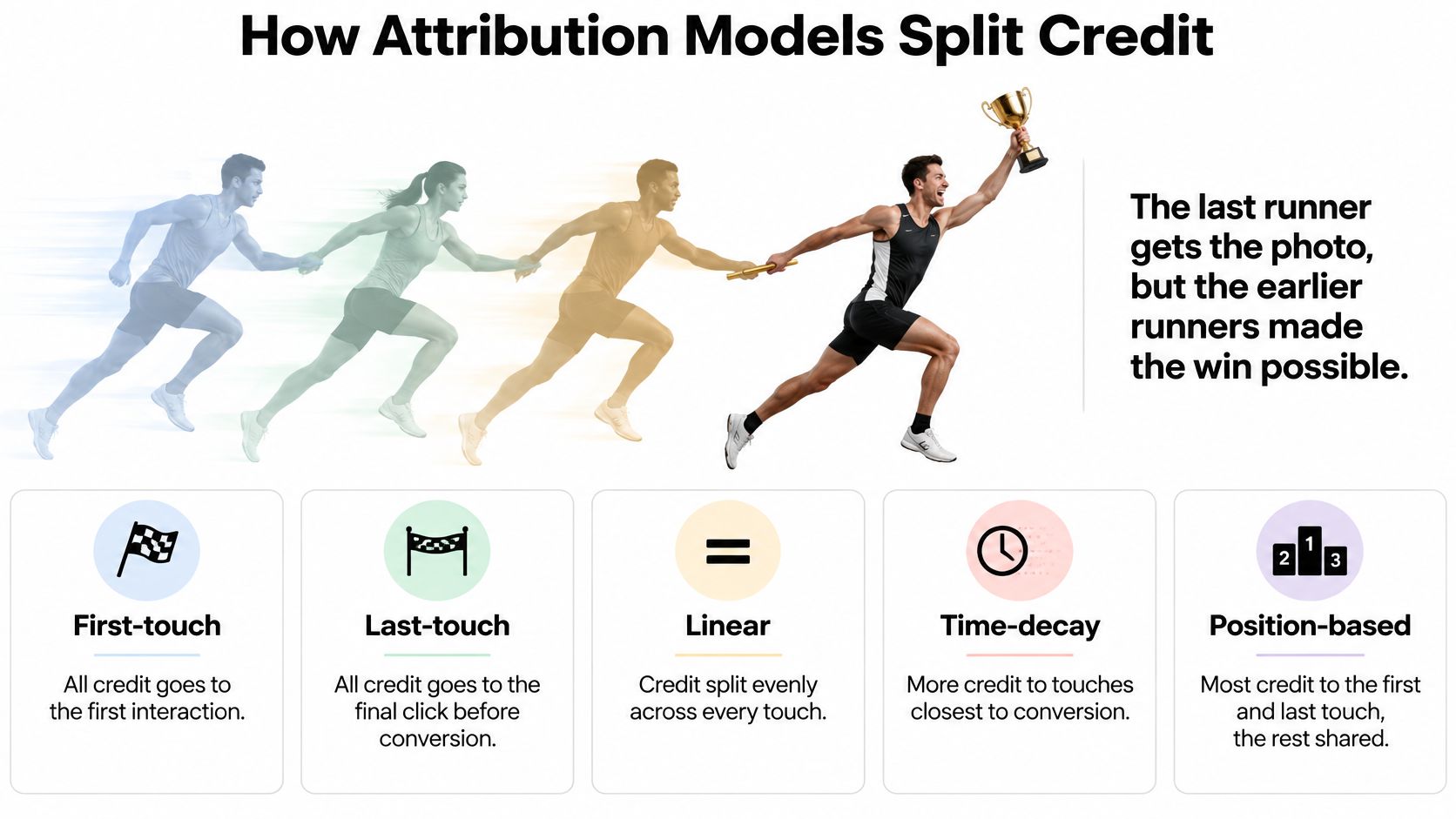
A relay team wins together, but the photographer only shoots the anchor leg. Attribution models exist to decide how much of the trophy the earlier runners get.
An attribution model is a rule for splitting conversion credit across the touchpoints that preceded an outcome. Six rules cover almost everything you'll meet in a vendor demo.
| Model | How it assigns credit | Best used for | Main blind spot |
|---|---|---|---|
| First-touch | 100% to the first interaction | Measuring discovery and top-funnel reach | Ignores everything that nurtured the lead |
| Last-touch | 100% to the final interaction | Spotting the channel that closes | Ignores early research and paid social |
| Linear | Equal share to every touchpoint | Long B2B cycles with many touches | Gives weak touches the same weight as strong ones |
| Time-decay | More credit to touches nearer the conversion | Short sales cycles | Undervalues early awareness |
| Position-based | 40% first, 40% last, 20% split across the middle | Balanced view of discovery and closing | Fixed split is arbitrary |
| Data-driven | Weights learned from the account's own converting and non-converting paths | Accounts with high conversion volume | Opaque and needs large data sets |
One booking, six different answers
Take a single lead who clicked a paid social ad, then a search ad, then a retargeting ad, then booked a demo. First-touch hands the whole booking to paid social. Last-touch hands it to retargeting. Linear gives each of the three a third. Time-decay skews the largest share to retargeting and the smallest to social. Position-based gives social and retargeting 40% each and search the remaining 20%. Same booking, same spend, six different stories about which campaign deserves budget.
That's why model comparison belongs in the product, not in a spreadsheet export. We offer first-touch, last-touch, linear, position-based and time-decay, and switching between them on identical data is the fastest way to see which channels only ever look good under one rule. For a deeper walkthrough of the mechanics, our guide to attribution modelling in marketing covers the trade-offs in more detail.
What changed at Google
Google Ads has retired first-click, last-click, linear, time-decay and position-based for new use and moved conversion actions to data-driven attribution, which Google describes as the default model for most conversion actions. Algorithmic allocation is now the mainstream baseline, not an advanced option.
The mechanics matter when you judge a vendor. Google's data-driven attribution documentation explains that the model estimates each interaction's contribution by comparing converting paths with paths from users who didn't convert, which makes the credit path-dependent on your own conversion data. Any tool selling fractional credit should expose its conversion-path reports, minimum data eligibility, lookback windows and model scope. If it can't show you those four things, treat the percentages as decoration.
Following a Customer Journey From Click to Revenue
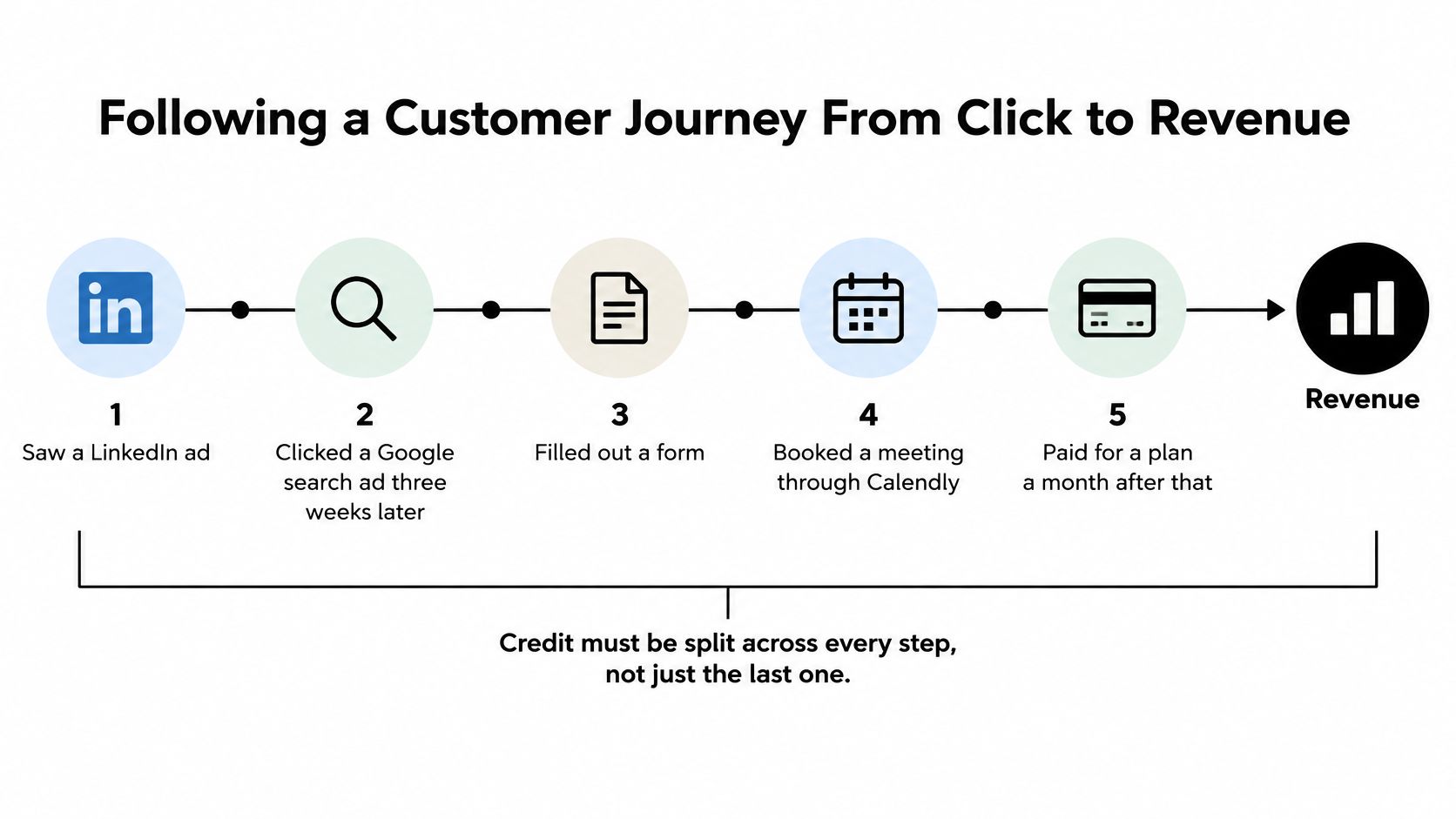
A B2B buyer scrolls LinkedIn on a Tuesday and sees your ad. Doesn't click. Three weeks later she searches a category term, clicks your Google ad, reads two pages and fills out a form. She books a meeting through Calendly the next morning, and a month after that her company pays for a plan through Stripe. Five systems touched that revenue, and the ad platforms only witnessed two of them.
Where the chain breaks
Each handoff is a place to lose the thread:
- First visit. The click ID and UTM parameters have to be written to a first-party record that survives a return visit weeks later. Session-scoped tracking loses this buyer at step two.
- Form or chat. The submission needs to carry the same visitor identifier, not create a fresh one.
- Meeting booking. Scheduling tools are separate systems with their own redirect. We list meeting tracking integrations for Calendly, Cal.com, GoHighLevel Calendar, HubSpot Meetings, TidyCal, Zoom Scheduler, YouCanBookMe and Zoho Bookings, because a booking that arrives without a visitor ID becomes an unattributed conversion.
- CRM deal. The opportunity has to inherit the original source, campaign and keyword, and keep them through stage changes.
- Payment. Stripe revenue has to map back to the contact, then to the deal, then to the journey.
Plenty of leads arrive with no UTM tags at all: dark social, copied links, bookmarked pages. We attribute those using referrer data, landing-page heuristics and direct-traffic detection, which is a documented fallback rather than a silent bucket labelled "direct". Ask any vendor what its fallback logic is, and ask it to show you a lead where the fallback fired.
Here's a walkthrough of what a connected journey looks like in practice.
What to confirm in the demo
Bring one real journey and ask the vendor to trace it live. Can they show the first visit with its tags, the form record, the booking, the CRM deal value and the payment, all under one identifier? Can they show a journey where the identifier broke, and explain why? The offline stages are exactly the ones platform pixels never see, so a demo that stops at the thank-you page tells you nothing about revenue attribution.
Privacy Gaps and Missing Conversions
Some of your conversions are missing, some are modeled, and some arrive days after the decision they should have informed. That's the current condition of paid measurement, not a bug in your setup.
Apple introduced SKAdNetwork in 2018 as a privacy-oriented way to measure app advertising without exposing individual users to ad-tech intermediaries, then updated it in 2020 and 2022 alongside the rollout of App Tracking Transparency for device-identifier sharing, according to this analysis of privacy-preserving advertising measurement. For web-to-web and app-to-web measurement, Apple's Private Click Measurement links impression and conversion events locally in the browser, limits the attribution window to as much as one week, encrypts reports and delays them by roughly 24 to 48 hours. Granularity, speed and cross-site linkage were all reduced on purpose.
What you can recover, and what you can't
Ad blockers, cookie loss and iOS restrictions remove conversions before any attribution tool sees them. Server-side tracking recovers conversions lost to iOS 14, ad blockers and cookie loss, and our server-side tracking captures 98% of conversions, compared with 62% for pixel-only tracking. That recovery is real, but it isn't a licence to ignore consent.
Cookie-free measurement still rests on consented first-party data plus privacy-preserving signals such as Google Consent Mode, as Impression's 2025 media effectiveness measurement guide sets out. The same guide points to a UK Competition and Markets Authority progress report identifying consentless or opted-out traffic as a major measurement gap. Users who opt out aren't in your journey data, and no vendor can claim otherwise. Our practical companion piece on cookieless marketing attribution covers what to change in your own stack.
If you want your analytics reviewed by an assistant rather than clicked through by hand, the NotFair Google Analytics MCP server is a useful way to query GA4 data conversationally and sanity-check channel totals against another source.
Three questions for every vendor
What share of your conversions is observed, what share is modeled, and how long do reports take to arrive?
Ask for those as separate numbers, per channel, in writing. Then ask who owns the underlying records if you leave, how identity resolution rules are documented, and what happens to an integration when a platform changes its API. Data ownership, transparent identity resolution and resilient integrations decide whether your attribution survives the next privacy change.
Why Attribution Is Not the Same as Incrementality
Most comparisons of the best paid ad attribution tools treat multi-touch attribution as the answer to ROI. It isn't. Attribution tells you who received credit. Incrementality tells you what wouldn't have happened without the ad. A retargeting campaign can collect an enormous share of credit for purchases that were already going to happen, and every model in the table will happily agree.
Incrementality means additional outcomes versus what would have occurred without marketing. In July 2025 data, 52.0% of U.S. brand and agency marketers were already using incrementality testing or experiments, yet eMarketer's reporting on incrementality notes marketers still report practical barriers including control-group design, privacy constraints, walled-garden data, time and specialist skills. Half the market is testing, and the other half isn't ignoring the idea so much as struggling to execute it.
Two tests you can actually run
A holdout holds a random slice of your audience back from seeing the ads, then compares conversion rates between exposed and held-back groups. A geo test pauses spend in matched regions while keeping it live in comparable ones, then compares outcomes across the pairs. Neither requires a new platform. Both require discipline about not touching the test mid-flight, and enough conversion volume for the difference to mean something.
Say your retargeting campaign claims most of the credit for demo bookings. Hold retargeting back for a random tenth of your audience for a full sales cycle. If bookings barely move, you were paying for demand you already had, regardless of how elegant the fractional split looked.
Layer the methods instead of picking a winner
Use journey-level attribution for daily operations: which campaigns start journeys, which keywords produce junk, where leads drop out. Use experiments for causal checks before you move serious budget. Add marketing-mix modeling only where conversion cycles and spend justify it, since it answers aggregate channel questions rather than person-level ones. Our overview of advertising effectiveness measurement goes deeper on combining the three.
The vendor question that separates serious tools from dashboards: how do you validate your model against holdouts or geo tests? A tool that answers with a nicer visualisation of fractional credit hasn't answered.
Choose, Test and Decide in Two Weeks
Pick the quick-pick row that matches your channels and CRM, then run it against your own data before you commit. Two weeks is enough to see whether a tool's numbers reconcile.
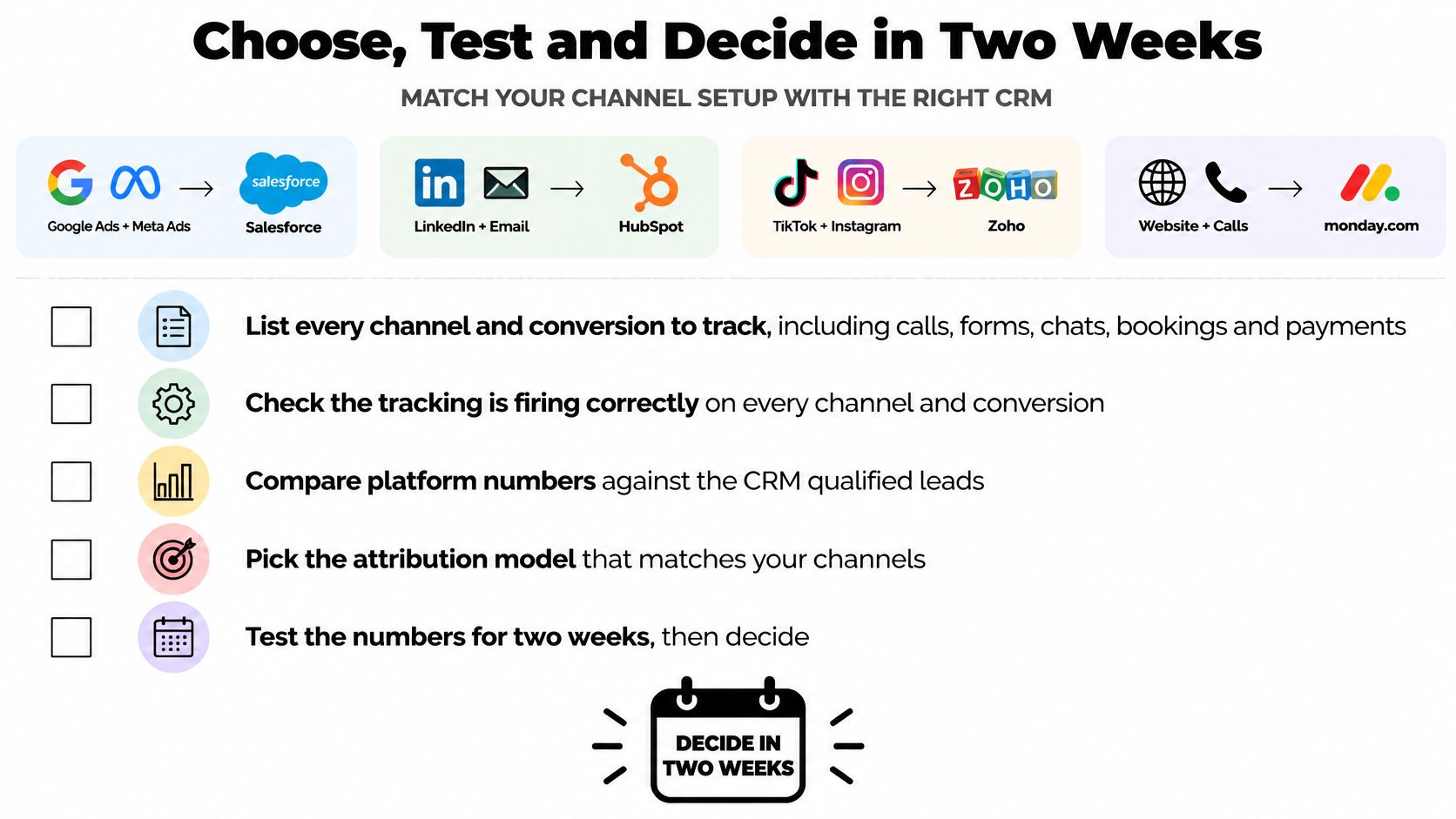
- List every channel and conversion you need tracked, including calls, forms, chats, bookings and payments. Anything missing from this list will become "direct" later.
- Check which models the tool offers and whether you can view them side by side on identical data. A single fixed model hides its own bias.
- Confirm ad platform coverage and the return path. We list integrations for Google Ads, Meta Ads, ChatGPT Ads, TikTok Ads, LinkedIn Ads and Microsoft Ads, and the question to ask any vendor is whether offline conversions go back with the original click attached, not as anonymous aggregate events.
- Verify CRM sync for HubSpot, Salesforce or Pipedrive, and whether deal value travels, not just lead count. We can sync conversions by deal value and sync only good leads to ad platforms, which stops the bidding algorithm from hunting form fills.
- Ask how leads without UTM tags are handled, and request a real example rather than a description.
- Run the tool in parallel with your current reporting for two weeks, using GA4 as a free baseline if you need one. Log four columns daily: attributed conversions, CRM-qualified leads, recognised revenue, and the gap between platform totals and tool totals.
- Compare cost against budget and check annual terms. Annual billing saves 25% on every plan, and you pay once for the year.
The decision rule
Keep the tool whose totals reconcile with CRM revenue inside a range you agreed before the trial, and whose gaps it can explain. Not the one reporting the most attributed conversions.
Agree that tolerance range on day one, in writing, with whoever owns the revenue number. A tool reporting fewer conversions with clear provenance beats one reporting more with mystery math, because you can budget against the first and only argue about the second.
This week, shortlist one or two tools from the table, start the free trial where it's offered, and confirm current trial terms before you commit. We offer a free 7-day trial, and users can track attribution within an hour of setup, so you can have your first reconciliation log running before your next reporting meeting. Bring one real closed-won deal to the trial and trace it back to the click that started it. If the tool can't do that, you've learned what you needed in an afternoon.


 Paid Social


