
Best ChatGPT Ads Attribution Tools: Time Decay Explained
Learn how time decay attribution weights ChatGPT Ads touchpoints, choose a half-life, and compare the best ChatGPT Ads attribution tools.
Your ChatGPT Ads campaign brought someone to the website on Monday. They returned through Google, attended a webinar, then booked a demo through a direct visit weeks later. At the budget review, the last-click report gives direct all the credit, and you're left defending a campaign that appears to have produced nothing.
No single attribution tool fixes that problem on its own. The strongest setup combines platform-reported conversions with an independent journey-level model. For the best ChatGPT Ads attribution tools, the deciding question isn't just whether they support time decay. It's whether you can inspect and change the half-life and reporting window that determine the answer.
Table of Contents
- Why ChatGPT Ads Need a Different Credit Model
- How Time Decay Turns Touchpoints Into Credit
- Choosing a Half-Life That Fits Your Sales Cycle
- Time Decay Compared With Other Attribution Models
- Where Time Decay Helps and Where It Misleads
- Attribution Tools That Support Time Decay Reporting
- Set Up Time Decay Reporting in Four Steps
- Confirm Your Model Before the Next Budget Review
Why ChatGPT Ads Need a Different Credit Model
In that demo-booking scenario, the reporting system hasn't necessarily lost the ChatGPT click. It may apply a rule that assigns everything to the final recorded interaction. That's a credit-model problem, not automatically a tracking failure.
ChatGPT advertising also comes with an important privacy boundary. The advertising announcement states that advertisers won't receive access to users' chats, chat history, memories, or personal details. You can't reconstruct a named customer's conversation and use it as an identity-matching shortcut.
Instead, your measurement system needs evidence from the interactions you can legitimately observe:
- Arrival details, including campaign parameters, landing pages, and click timestamps.
- Journey continuity, connecting permitted first-party visitor records across sessions.
- Business outcomes, linking those records to bookings, qualified opportunities, subscriptions, and payments.
Say the original ChatGPT Ads click remains attached to the visitor when they eventually book. You can then compare different ways of distributing the conversion's value instead of treating the final direct visit as the whole story.
Time decay gives more credit to interactions closer to the conversion and less to earlier ones. It doesn't prove which interaction persuaded the customer. It provides a transparent rule for sharing credit across the observable journey.
A recorded touchpoint and a credited touchpoint aren't the same thing. Check whether the click is missing before blaming the model.
For teams with considered purchases and extended sales cycles, that distinction matters. You need to know whether ChatGPT introduces prospects, helps them evaluate, or appears shortly before they convert. A single final-channel label can't answer all those questions.
How Time Decay Turns Touchpoints Into Credit
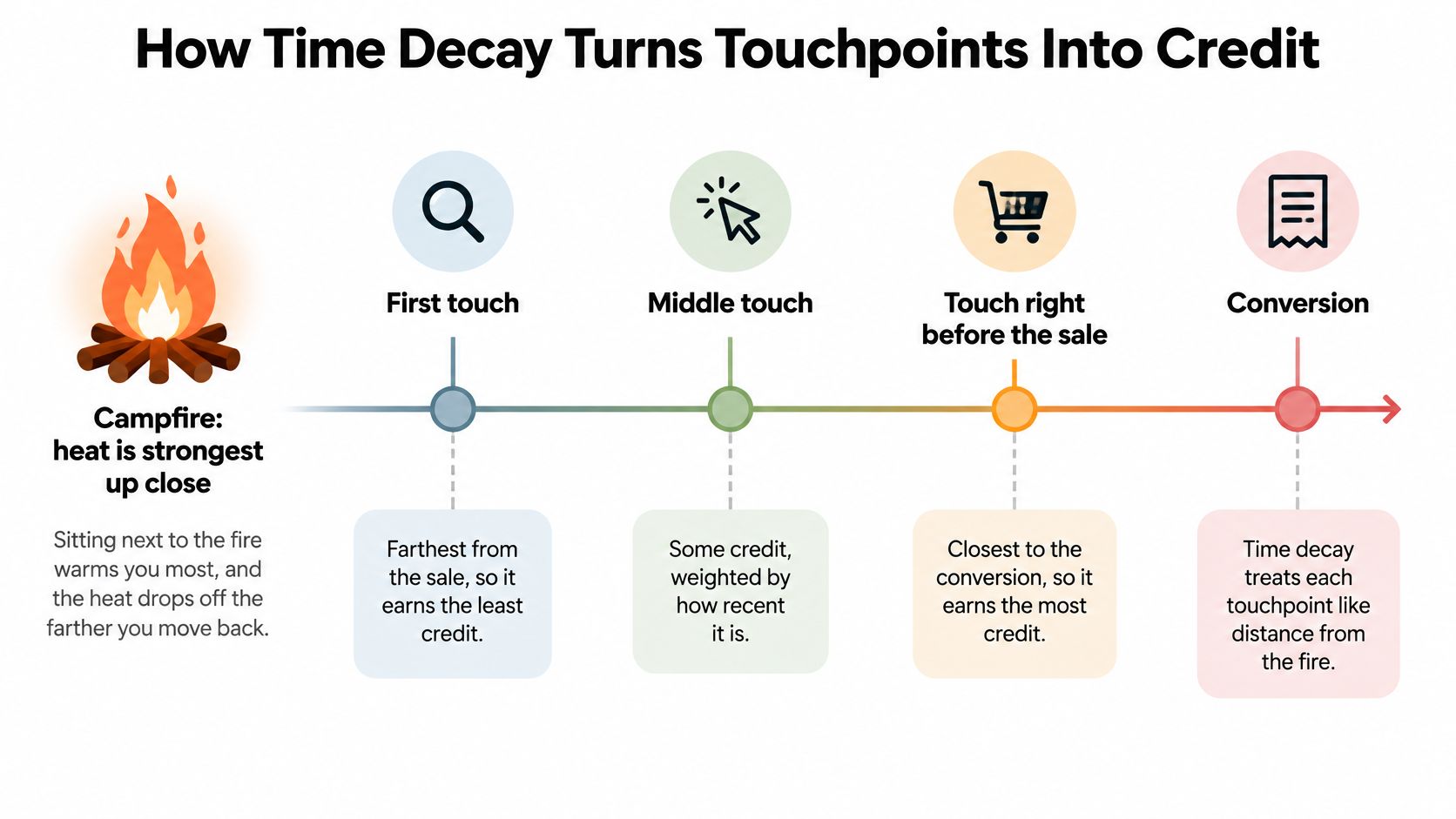
Think of a campfire. You feel more heat when you sit close to it and less when you move away. Time decay uses a similar idea, except the distance is time before conversion, not physical space.
The illustration shows that relationship.
The calculation is:
Weight = 0.5 ^ (days before conversion ÷ half-life)
The half-life is your chosen decay setting. The weight is an intermediate calculation, not yet a percentage of revenue.
A worked deal calculation
Consider a hypothetical $1,000 deal with a 7-day half-life. Its recorded journey includes organic search, paid social, ChatGPT Ads, and a final direct visit associated with the demo booking.
For this example, we're allocating the deal's value against the booking timestamp. A closed-won report would instead calculate each touch's age against the close timestamp.
Time decay credit on a $1,000 deal with a 7-day half-life
| Touchpoint | Days before sale | Credit on a $1,000 deal |
|---|---|---|
| Organic search visit | 14 | Weight 0.2500, share about 10.0%, $100 |
| Paid social click | 7 | Weight 0.5000, share about 20.1%, $201 |
| ChatGPT Ads click | 3 | Weight about 0.7430, share about 29.8%, $298 |
| Direct demo booking | 0 | Weight 1.0000, share about 40.1%, $401 |
| Total | Not applicable | Weight about 2.4930, share 100%, $1,000 |
The raw weights total approximately 2.4930. Divide each weight by that total, then multiply by the deal value to calculate its revenue credit.
Use full precision in the spreadsheet and round only the displayed results. In this example, the rounded dollar credits still sum to the deal value. In production reporting, assign any rounding residual consistently so finance doesn't see unexplained differences.
What the calculation actually means
The ChatGPT click doesn't receive its share because the customer remembers it or because the platform claims the conversion. It receives that share because of its timestamp, the chosen half-life, and the other eligible touches.
Also distinguish a direct session from a conversion event. If a booking happens during an already-recorded session, don't automatically create another marketing touch just because the booking event has a timestamp.
For a supplementary explanation of attribution, use this video alongside the spreadsheet exercise.
Rebuild the example in Excel or Google Sheets. Give each touch a row, calculate its weight and normalized share, then add a reconciliation row that must equal the deal value.
Choosing a Half-Life That Fits Your Sales Cycle
A half-life is the elapsed time after which a touch keeps half the raw weight of an otherwise identical conversion-day touch. It controls how strongly you favor recent interactions.
The table below contains calculated weights for hypothetical model settings. The sales-cycle descriptions are starting hypotheses to test, not industry benchmarks or recommended defaults.
Time decay weights by half-life
| Half-life | Typical fit |
|---|---|
| 3 days | Candidate for impulse ecommerce and same-session buying. A touch 14 days earlier has weight 0.0394; a touch 1 day earlier has weight 0.7937. |
| 7 days | Candidate for short B2C cycles and subscription trials. At 14 days: 0.2500. At 1 day: 0.9057. |
| 14 days | Candidate for agency retainers and mid-ticket B2B. At 14 days: 0.5000. At 1 day: 0.9517. |
| 30 days | Candidate for enterprise SaaS and long procurement cycles. At 14 days: 0.7236. At 1 day: 0.9772. |
Notice how differently the settings treat the same older click. Its eventual revenue share still depends on all the other touches, but you've already made a consequential judgment before choosing the tool.
Start with your CRM, then test sensitivity
Pull the elapsed time between first recorded acquisition click and closed-won from your CRM. Use the median as an initial calibration point, not proof that the corresponding half-life is correct.
Separate materially different buying motions. An expansion purchase from an existing customer shouldn't automatically use the same setting as a new enterprise account.
Then run a sensitivity comparison. For example, compare the hypothetical shorter and longer settings in the table while holding the deal cohort and eligible journey history constant.
- Stable rankings suggest your budget interpretation doesn't depend heavily on that parameter.
- Changing rankings mean you should present a range and explain the assumption.
- Very different journeys call for separate reports rather than one blended setting.
Keep the window separate from the half-life
The reporting window decides which interactions or conversions are eligible. The half-life determines the relative weight of eligible touches.
The conversion reporting documentation supports advertiser-selected click-through windows and a one-day view-through window, and states that those reporting settings don't change campaign optimization.
Practical rule: Change the half-life and window separately. Otherwise, you won't know which setting changed the result.
Extending a window can admit additional conversions or older interactions. That changes the report, but it doesn't establish that advertising caused the additional revenue.
Time Decay Compared With Other Attribution Models
Different attribution models answer different management questions. None can recover a missing touchpoint or turn an observed sequence into proof of persuasion.
Our available models at SourceLoop are first-touch, last-touch, linear, position-based, and time-decay. Comparing them on the same eligible journeys is more useful than comparing screenshots built from different datasets.
Attribution models compared for ChatGPT Ads
| Model | How credit is split | Best fit | Weak spot with ChatGPT Ads |
|---|---|---|---|
| First-touch | All credit to the first interaction | Finding which channel starts journeys | Ignores later ChatGPT re-engagement |
| Last-touch | All credit to the final interaction | Direct-response reporting | Hides ChatGPT Ads that opened the journey |
| Linear | Equal share to every touch | Reviewing participation across channels | Treats a casual visit like a demo request |
| Position-based | A chosen split favoring first and last touches, with the remainder shared across the middle | Balancing discovery and close | Fixed split isn't tied to timing |
| Time-decay | Relative weight grows as the conversion nears | Extended consideration journeys | Results depend on the half-life |
For a hypothetical position-based configuration, you could assign 40% to the first touch, 40% to the last, and distribute 20% across the middle. That's a model configuration, not a universal position-based rule. Confirm how the implementation handles journeys with no middle interaction.
Pair models with the decision
Suppose ChatGPT Ads starts a journey, while branded search appears immediately before the purchase. First-touch emphasizes the introduction; time decay emphasizes the later activity. Neither disagreement indicates a software bug.
Use first-touch to investigate where discovery begins. Pair it with time decay to inspect which recorded interactions cluster near conversion. Don't describe that second view as a definitive measure of which channels moved the customer forward.
Choose your reporting emphasis using these criteria:
- Sales-cycle length determines how much timing differences could matter.
- Touchpoint count and spacing determine whether models have meaningful journeys to divide.
- Decision tolerance determines whether the budget owner needs a stable operating metric or an assumption-sensitive range.
A short journey doesn't guarantee agreement. If several channels appear close together, first-touch and last-touch can still disagree completely, while time decay behaves more like linear.
Conversely, a long journey with only a single recorded interaction produces identical allocations. The structure of the observed path matters as much as its duration.
Where Time Decay Helps and Where It Misleads
Time decay is useful because you can explain its rule without hiding behind a proprietary score. That transparency also makes its bias visible: you deliberately favor recent interactions.
The benefits and limitations belong beside each other.
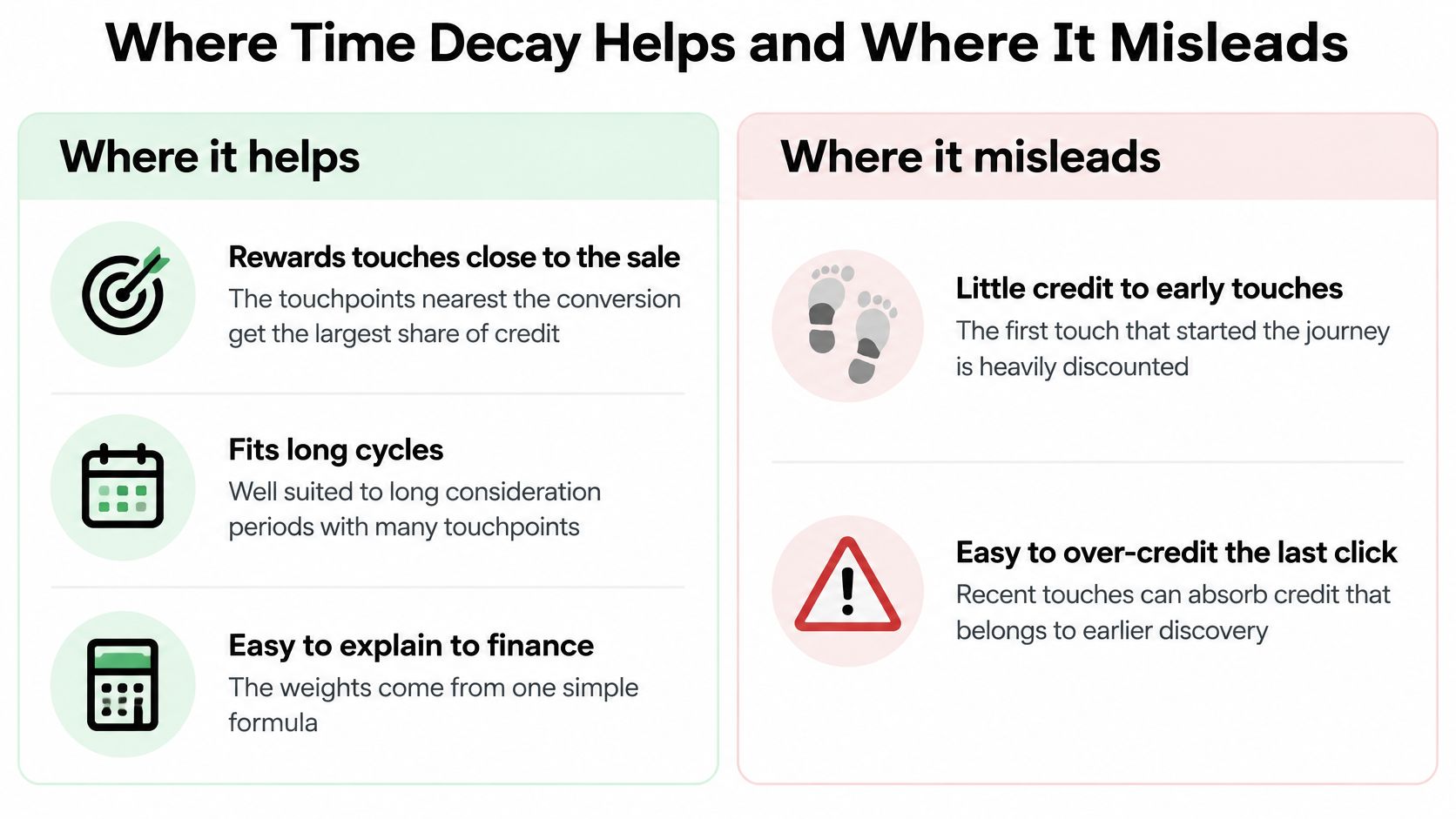
Where it helps
- Recency-focused analysis lets you inspect activity near a booking, opportunity, or payment.
- Extended journey reporting preserves some credit for earlier recorded interactions instead of discarding them entirely.
- Finance review becomes easier when reviewers can reproduce the calculation and reconcile its allocations.
Where it misleads
- Early discovery gets discounted, even when the first interaction introduced a product the buyer hadn't considered.
- Branded search and retargeting can look disproportionately valuable because interested buyers encounter them near conversion.
- Missing or incorrectly linked events distort the path, and precise arithmetic won't repair that underlying problem.
Say a buyer discovers your product through ChatGPT Ads, then spends considerable time securing internal approval. A later branded-search click may receive more credit without having created more demand.
This is why outcome quality matters. A working paper covering U.S. ecommerce advertisers, cited by Digiday, found $0.89 in revenue per paid ChatGPT session versus $2.45 per paid Google Search session. Those early findings aren't universal benchmarks, but they illustrate why traffic volume alone isn't a sufficient economic measure.
Connect attribution to qualified pipeline, acquired customers, and collected revenue. A campaign can appear productive at the visit level while generating poor-fit enquiries, and another can assist valuable opportunities without often receiving final-touch credit.
A closed-loop attribution workflow helps you connect marketing activity to those later outcomes. It doesn't remove the model's assumptions, but it gives you more relevant outcomes to allocate.
Time decay is a reporting lens, not a causal verdict. Before reallocating substantial spend, use a controlled lift test or holdout where feasible to investigate whether the channel generates additional business.
Attribution Tools That Support Time Decay Reporting
Use this scorecard before comparing interface design, dashboard templates, or vendor claims. It identifies what a candidate must demonstrate on your actual journeys.
Requirements for a time decay attribution tool
| Requirement | What to verify | Why it matters |
|---|---|---|
| Stored first-touch campaign IDs and UTMs | Persist across sessions and forms | Keeps early ChatGPT clicks in the path |
| Server-side conversion capture | Confirms permitted events outside the browser | Reduces reliance on browser-only delivery |
| CRM and payment reconciliation | Matches stages to revenue | Credit totals must equal real deal value |
| Editable half-life and reporting window | Changes inside the report without rebuilding | Enables sensitivity testing |
| Platform and independent layers kept separate | Shows platform-reported and model credit side by side | Prevents confusing different reporting definitions |
| Deduplicated, consented exports | Sends only permitted, unique events | Protects privacy and optimization signals |
Server-side capture isn't a way around consent. Your implementation still needs appropriate permissions, identity handling, and data minimization.
The conversion measurement documentation supports a browser Pixel, Conversions API, or both, with eligibility determined by the configured conversion event, applicable window, and available signals connecting the event to an eligible click. An independent reporting layer serves a different purpose: reconstructing the observable cross-channel path.
Evaluate a stack, not just a product
A practical shortlist can include native ad-platform measurement, an independent attribution platform, and a spreadsheet or warehouse model for verification. These aren't interchangeable tools. They provide delivery measurement, journey reporting, and calculation control respectively.
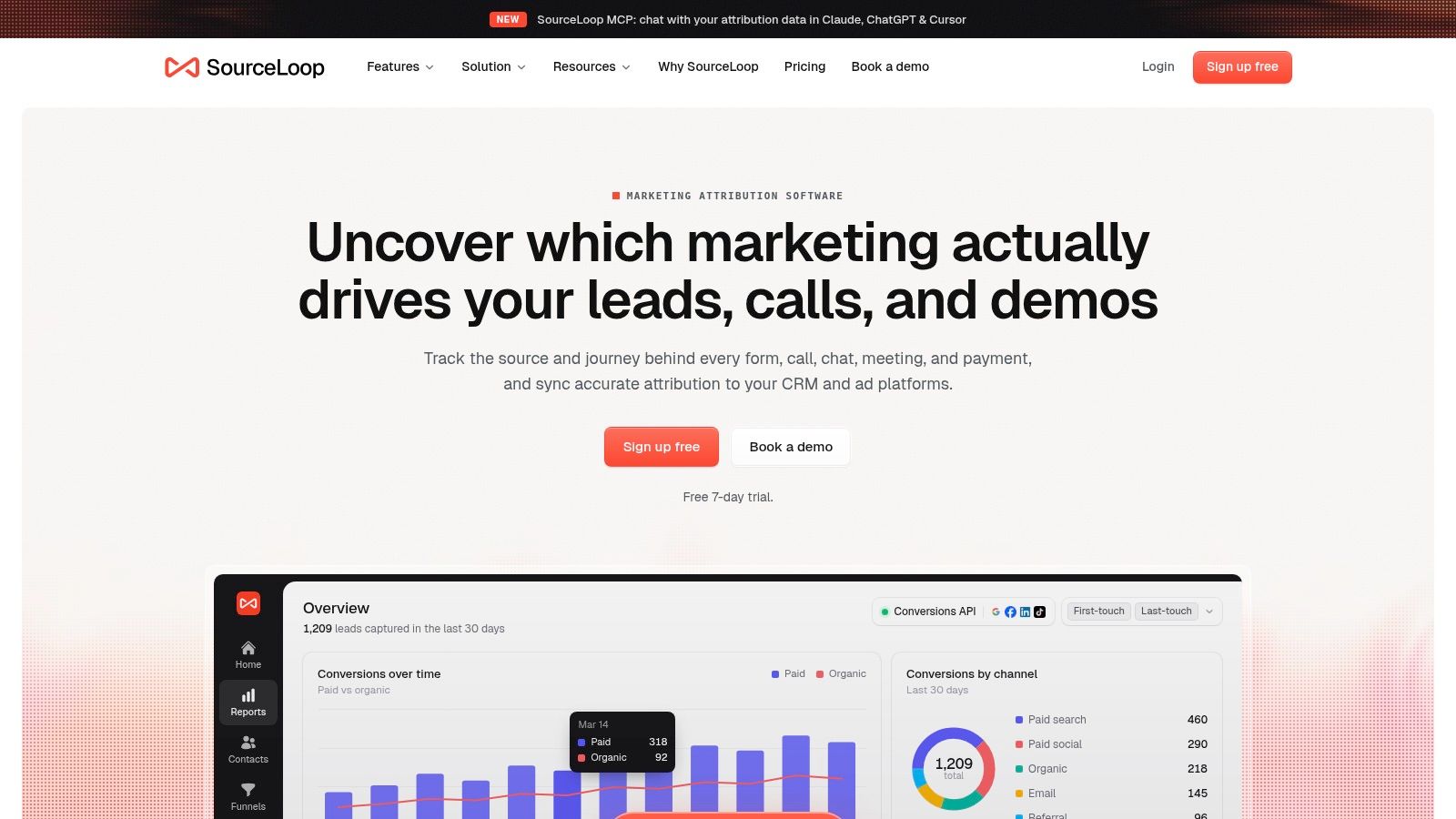
You can include SourceLoop as an independent-platform candidate. We set up the ChatGPT Ads Conversions API for customers in one step, list integrations for Google Ads, Meta Ads, ChatGPT Ads, TikTok Ads, LinkedIn Ads, and Microsoft Ads, and can sync conversions by deal value or send only good leads.
Use a dashboard view as a starting point for inspection, not evidence that every scorecard requirement has passed.
Run a reproducible buying test
Choose a fixed cohort of closed deals and import the same available touch history into each candidate. Include earlier interactions needed for the selected lookback, not just events occurring inside the close-date period.
Check that revenue reconciles, settings can be inspected, and exports preserve event-level detail. For a deal with an eligible ChatGPT click, verify that its allocation matches the timestamp-based calculation.
Don't require every ChatGPT row to be positive. A genuine absence of eligible clicks should produce no credit. Record each pass, failure, and unverified requirement before choosing.
Set Up Time Decay Reporting in Four Steps
A reliable setup follows the customer from the tagged landing page to a verified business outcome. Test that chain yourself before accepting the dashboard totals.
This process diagram gives the implementation order.
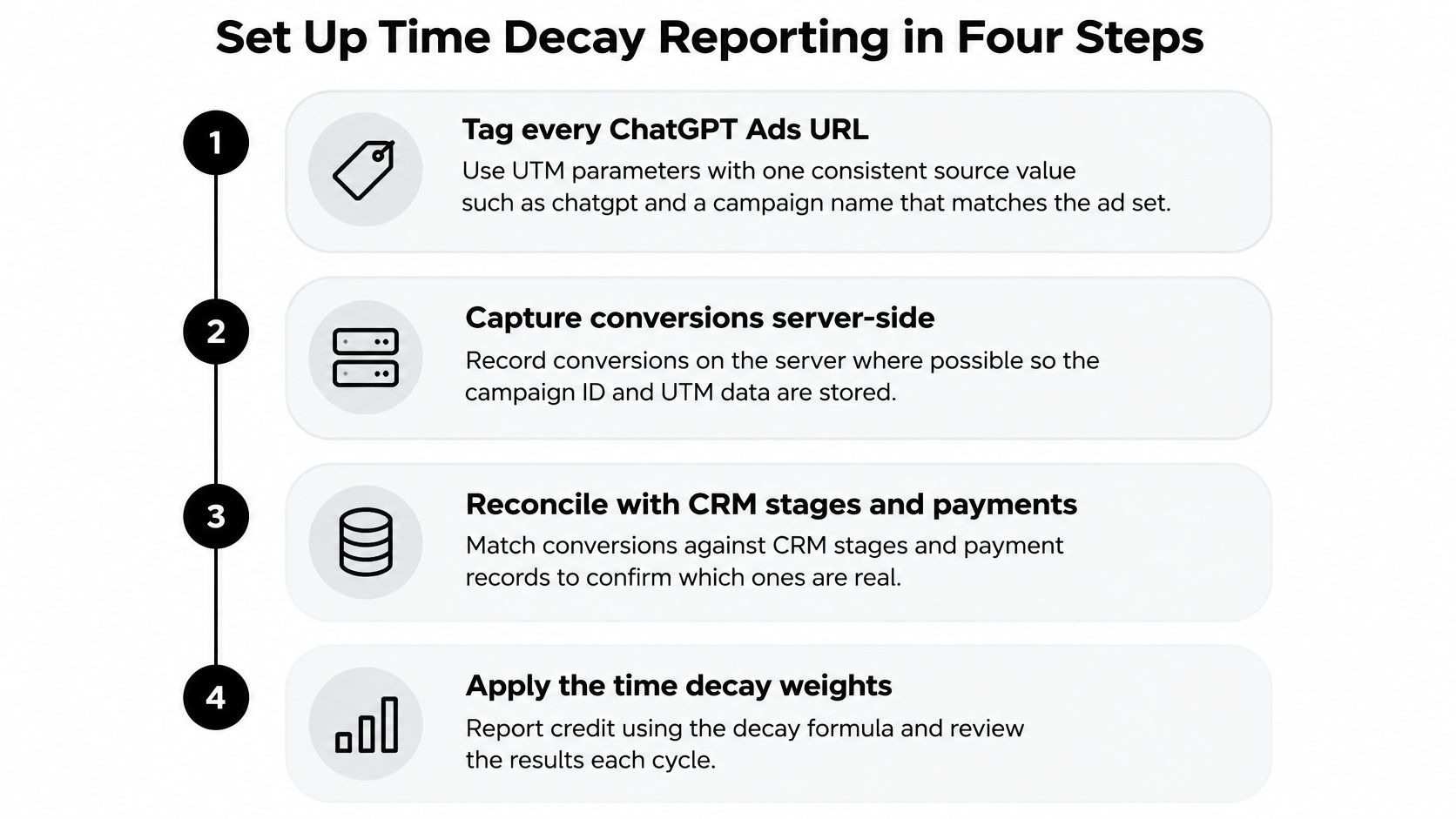
Tag every paid destination consistently. Use a convention such as
utm_source=chatgpt,utm_medium=paid, and a campaign value mapped to your campaign records. Keep unpaid ChatGPT referrals in a separate channel category so an organic answer click doesn't become paid-ad credit.Install tracking and test identity continuity. Confirm that permitted first-party visitor identifiers connect landing pages, return sessions, forms, chat widgets, and booking tools. Follow a test click through every redirect, because a redirect that drops campaign parameters can make the recorded journey start later than it did.
Connect downstream outcomes. Send qualified-lead, booked-meeting, opportunity, closed-won, and payment events to the appropriate reporting destinations. Use stable event and deal identifiers so a CRM stage update or payment webhook doesn't create another copy of the same conversion.
Apply and document the reporting configuration. Set the chosen half-life, eligible lookback, conversion timestamp, revenue definition, and direct-traffic treatment. Place time-decay and last-touch results beside each other, then export a deduplicated deal-level reconciliation for finance.
Inspect a journey before reviewing a channel
Use the ChatGPT Ads connection guide for the connection workflow, then trace a test record end to end. Confirm the campaign survives the booking handoff and that the CRM record joins to the correct visitor history.
Keep payment revenue distinct from opportunity value. A forecast amount and a collected payment can both be useful, but adding them together would inflate the value you're allocating.
Acceptance check: A healthy report explains both what it can attribute and what remains unknown.
Every closed deal should either have an observable path or an explicit unattributed status. Don't invent a touch to force completeness.
For eligible paths, allocated credit should reconcile to the chosen revenue basis. ChatGPT Ads should receive credit only when a qualifying paid interaction exists, with timing that agrees with the underlying event history.
Confirm Your Model Before the Next Budget Review
Use one decision rule: a change in attribution is a reason to investigate, not automatic permission to increase spend.
Run time decay and last-touch on the same closed-deal cohort, using identical revenue definitions and eligibility rules. If ChatGPT Ads moves up under time decay, inspect the deals behind that movement and assess acquisition cost, lead quality, and the plausibility of the recorded paths before making a bounded budget test.
If the rankings stay stable, keep the simpler view for routine reporting and reserve the model comparison for strategic reviews. Write down the half-life and why you chose it, so another reviewer can reproduce the result.
Take a concrete action this week
Export a recent CRM cohort with deal values, close timestamps, and available touchpoint history. Rebuild both allocations in a spreadsheet and compare the ChatGPT Ads row, including unattributed revenue.
For the next decision, distinguish attribution from advertising effectiveness measurement. The former distributes observed value; the latter asks whether your advertising improved business results.
Bring that spreadsheet to your next budget review. If you want to evaluate SourceLoop, use our free Marketing Attribution Calculator and UTM Validator as starting checks, then test the platform against your own deal histories and the scorecard above. Choose the tool only after you can explain why the channel received its credit.




 Paid Social


