
Benefits of Multi Touch Attribution: Budget and ROI Gains
Discover the benefits of multi touch attribution: smarter budget allocation, clearer ROI, cross-channel visibility and sales alignment, with real examples.

Only 32% of marketers measured ROI across both traditional and digital media in 2025, compared with 85% who measured marketing ROI in general, according to Nielsen's Marketing ROI Blueprint, reported in this release. Measuring marketing performance and measuring it consistently across channels are different accomplishments.
The benefits of multi touch attribution start with closing that gap. By connecting interactions to a shared conversion record, teams can challenge channel claims, recognize overlooked contributions, and make better spending decisions. But assigning credit isn't the same as proving impact. The strongest approach pairs journey-level evidence with tests of what marketing changes.
Table of Contents
- Core Benefits and the Evidence Behind Them
- How Attribution Splits Credit Across the Journey
- Where Attribution Overstates Impact and How to Check It
- Budget Allocation Gains From Full-Path Credit
- Seeing Cross-Channel Sequences Across the Funnel
- Aligning Marketing ROI With Sales Pipeline
- Confirm Your Attribution Setup Before You Scale Spend
Core Benefits and the Evidence Behind Them
Multi-touch attribution gives teams a more defensible answer to a familiar budget question: which activities deserve continued investment?
Consider overlapping platform reports. Google Ads, Meta, and TikTok might each claim a purchase after the same customer interacts with their ads. Adding those reports together doesn't create additional sales. Before debating channel performance, the team needs a deduplicated conversion record and a consistent rule for distributing credit.
The useful change isn't just a new dashboard. It's the ability to inspect the reasoning behind a budget recommendation: which interactions were recorded, which outcome they preceded, and how the selected model weighted them.
Core benefits and the evidence behind each
| Benefit | What changes for the team | Evidence from research |
|---|---|---|
| Better budget allocation | Credit spreads across the observed path instead of stopping at the last click | Magazine Luiza's model-based optimization produced improvements in acquisition cost and ROI |
| Clearer ROI measurement | Revenue is evaluated against channel contributions using consistent definitions | Nielsen's cross-media measurement findings expose a gap between reporting ROI and reconciling channels |
| Cross-channel visibility | Teams can inspect sequences and mid-funnel roles | An automotive application connected journey insights with improved campaign outcomes |
| Sales and marketing alignment | Teams share a conversion view from lead creation through closed revenue | MMA Global's attribution benchmark identifies widespread difficulty reconciling tools |
| More reliable prediction | Models can account for differences in customers' underlying purchase intent | Comparative model testing supports causal approaches, without establishing a universal performance gain |
These findings support different decisions. An optimization case offers evidence that a particular implementation helped a business. A survey identifies an unmet measurement need. Neither establishes what another company will gain after installing attribution software.
Before comparing vendors, use Come Together Media LLC's a consultant's guide to attribution modeling to frame questions about model assumptions and agency reporting.
Practical rule: Ask which decision would change if the attribution result were different. If nobody can answer, the team needs a clearer measurement objective.
Choose the benefit that resolves your largest budget dispute. For an agency, that might mean reconciling overlapping platform claims. For a SaaS team, it might mean distinguishing inexpensive leads from opportunities that reach procurement. Clean inputs and a shared conversion definition determine whether either exercise produces useful evidence.
How Attribution Splits Credit Across the Journey
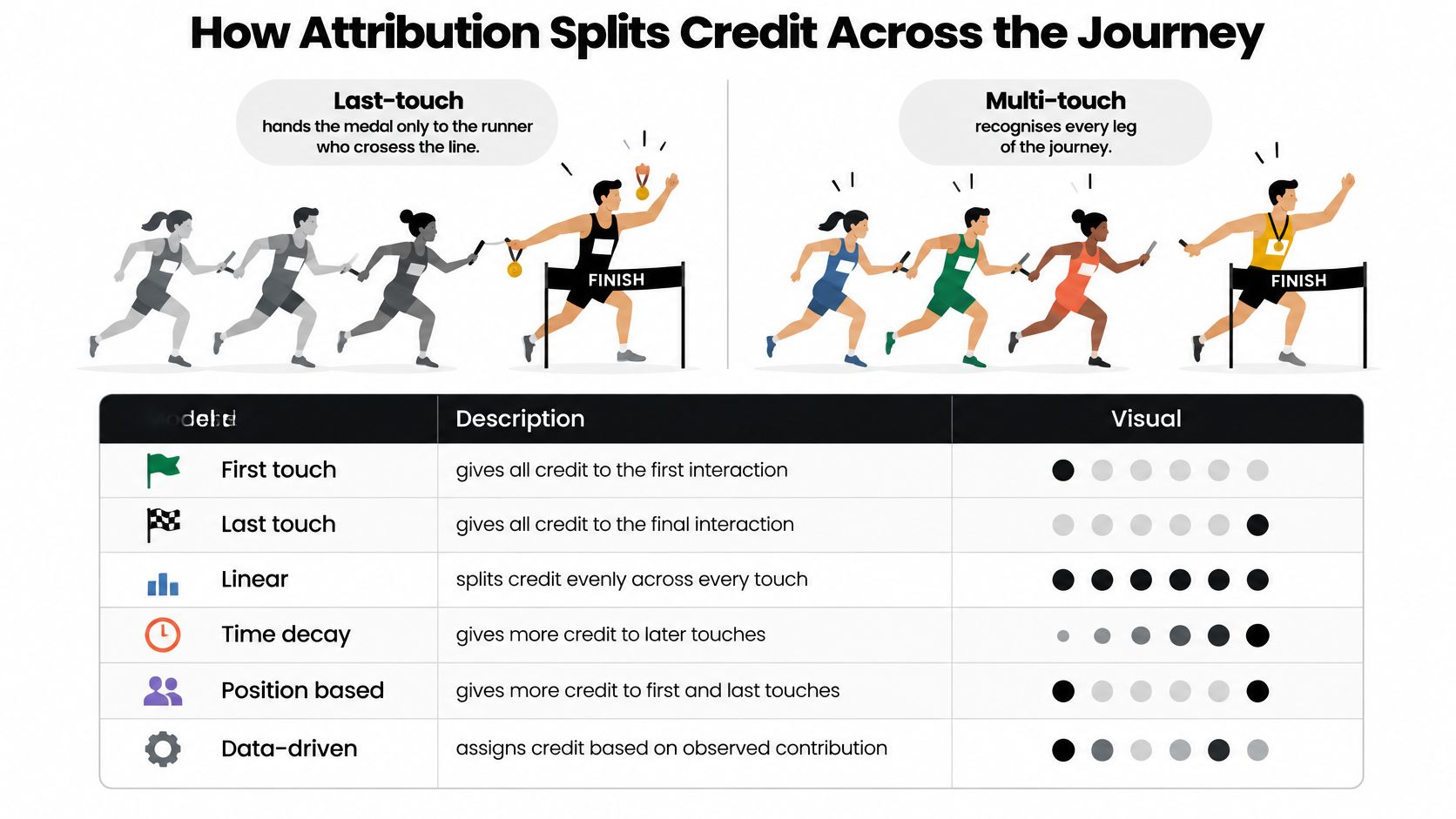
Last-touch attribution resembles awarding a relay medal only to the runner who crosses the finish line. Multi-touch attribution recognizes the preceding legs, although the model still decides how much recognition each receives.
A 2025 systematic review of multi-touch attribution identified 345 publications published between 2011 and 2024 and retained 62 original empirical studies after screening. Its coverage of predictive and causal methods shows that attribution extends beyond fixed credit-splitting formulas.
The model comparison below illustrates the underlying choices.
Attribution models and what each one rewards
| Model | Credit rule | Best use | Main weakness |
|---|---|---|---|
| First touch | All credit to the first eligible interaction | Identifying demand entry points | Ignores subsequent nurturing |
| Last touch | All credit to the final eligible interaction | Inspecting conversion entry points | Can overvalue demand capture |
| Linear | Equal credit across eligible touches | Establishing a transparent baseline | Treats minor and substantial interactions alike |
| Time decay | Greater weight nearer conversion | Examining late-stage influence | Discounts early discovery |
| Position based | Greater weight to the first and last touches | Balancing discovery and closing | Uses a predetermined weighting |
| Data driven | Weights learned from observed paths | Analyzing sufficiently rich conversion histories | Requires clean events, adequate volume, and validation |
Say a prospect sees a LinkedIn ad, reads a blog post, clicks branded search, books a demo through a calendar link, and later pays through Stripe. The result depends on eligible touchpoints, not just the model name.
If the model includes marketing acquisition interactions only, branded search receives last-touch credit. If demo booking counts as an eligible interaction, it becomes the last touch instead. Linear attribution divides credit among the included interactions; time decay favors the later eligible events. Payment can remain the revenue outcome rather than another marketing touch.
Next Point Digital's last-click insights from Next Point Digital provide useful context for that boundary. A broader comparison of marketing attribution models helps teams document the alternatives before implementation.
From events to credited revenue
- Capture touches. Record timestamps, sources, campaigns, and event types.
- Resolve identities and remove duplicate events where reliable identifiers permit it. Don't force uncertain device matches.
- Choose the rule. Specify eligible interactions and the conversion window.
- Assign fractional credit according to that configuration.
- Join outcomes. Attach pipeline stages and revenue without counting the same sale again.
Where Attribution Overstates Impact and How to Check It
Selection bias is the central risk: customers already inclined to buy may also be more likely to click branded ads or revisit product pages. Their behavior can make an exposed channel look more influential than it really is.
A comparative study of nine attribution models, tested on a synthetic dataset and public datasets, found that causal approaches improved attribution by addressing confounding from user preferences; better attribution results also aligned with better conversion-rate prediction. That supports careful model design, not the assumption that any model labeled data-driven estimates causality.
Use attribution for diagnosis and incrementality testing for intervention decisions. Journey records help identify where qualified prospects engage. Holdouts, geo experiments, or platform lift tests estimate whether changing exposure changes outcomes. Measurement guidance on incrementality recommends triangulating attribution, marketing-mix modeling, and experiments rather than choosing a universal winner.
Coverage metrics to report beside attributed conversions
| Coverage metric | What it reveals | Action when weak |
|---|---|---|
| Consent rate | Share of visitors permitting the relevant tracking | Segment reporting by consent status |
| Identifiable-journey rate | Share of conversions with a traceable path | Keep unmatched outcomes visible as a separate group |
| Cross-device match rate | Extent of supported device linking | Cross-check against authenticated CRM records |
| Missing-source rate | Conversions without a recorded source | Repair UTM capture and form tagging |
| CRM and offline reconciliation rate | Share of sales connected to recorded journeys | Investigate unmatched sales before reallocating spend |
Consent doesn't guarantee a complete journey, and an identity match doesn't guarantee a correct match. Define each metric's denominator and separate observed links from inferred ones.
A 2026 systematic review covering 108 studies reported that differential privacy reduced precision by 2–33%, depending on the privacy budget, while federated approaches retained roughly 90–95% of centralized performance in documented deployments. Those ranges describe reviewed implementations, not a correction factor to apply to your dashboard.
Make validation a decision contract
Before testing, define the business outcome, comparison group, observation period, and decision rule. If the disputed spend supports a sales pilot, plan your sales pilot with Ploot to make success criteria explicit before interpreting results.
Use an advertising effectiveness measurement framework to distinguish attributed outcomes from tested lift. Report coverage and uncertainty beside credited revenue, rather than hiding them in implementation notes.
Budget Allocation Gains From Full-Path Credit
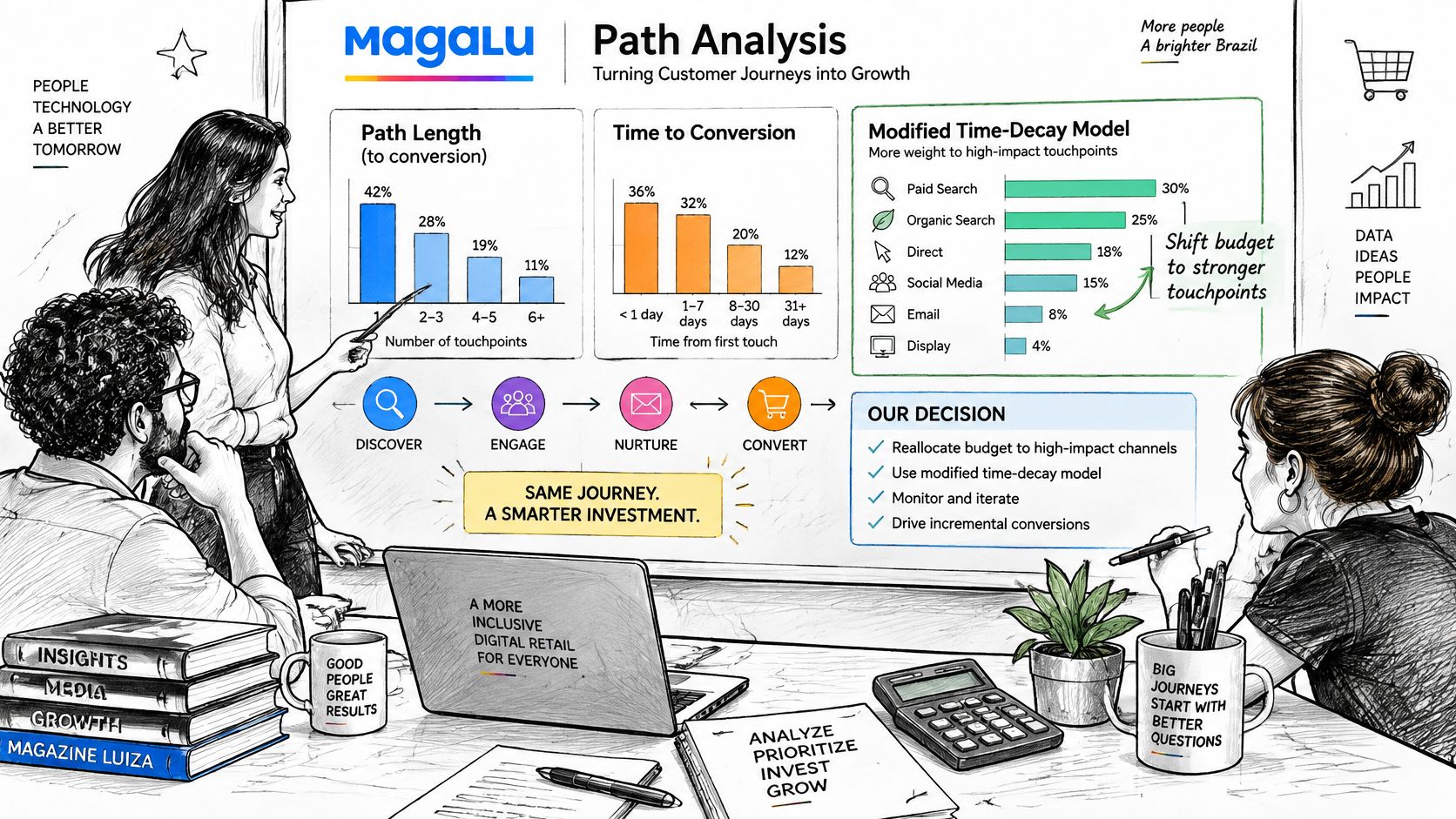
Magazine Luiza compared attribution models using path length and time to conversion, then adopted a modified time-decay approach to coordinate spending across the purchase cycle. In the case summarized alongside Nielsen's explanation of modern attribution, optimization reduced product listing ad cost per acquisition by 11%, increased ROI by 15%, and generated nearly 40% more attributed revenue for branded campaigns.
Those outcomes require different interpretations. Lower acquisition cost and higher ROI describe operating improvements. More attributed branded revenue also reflects how the measurement system assigns value. Don't treat a credit increase as equivalent to newly created demand.
A path analysis gives teams a way to inspect those distinctions before changing spend.
Use model disagreement to identify the next test
Branded search, direct visits, and retargeting frequently appear near purchase. A last-click report can therefore give those interactions credit that a full-path model distributes elsewhere.
But the appropriate response isn't automatically to cut the closer. A channel can capture existing demand efficiently while another introduces prospects. The budget question is whether additional spending in either role produces additional qualified outcomes.
Use a cautious reallocation routine:
- Compare credit under contrasting models. Keep the same conversion definition, revenue records, and reporting window so the comparison isolates the weighting rule.
- Flag channels whose apparent performance changes substantially. Inspect the underlying paths for duplicate events, missing discovery touches, or changes in campaign tagging.
- Choose a bounded spending change. Size it so the business can tolerate an unfavorable result, and preserve a comparison group where feasible.
- Review qualified opportunities and realized revenue after allowing for the sales cycle. Don't declare a winner because inexpensive form submissions appeared immediately.
The most useful output is a prioritized testing queue. A channel with strong credit across models may merit investigation; a channel whose ranking swings sharply needs an explanation before receiving more money.
A model-sensitive channel isn't necessarily ineffective. Its reported value depends heavily on assumptions the team should examine.
For agencies managing multiple accounts, document the hypothesis with the recommendation: which audience receives more exposure, which outcome should change, and what result would reverse the decision. This turns attribution from a retrospective scorecard into an accountable spending process.
Seeing Cross-Channel Sequences Across the Funnel
Channel totals hide ordering. A report can show webinar traffic, content visits, and retargeting conversions without revealing whether prospects encountered them in that sequence or whether unrelated audiences generated each total.
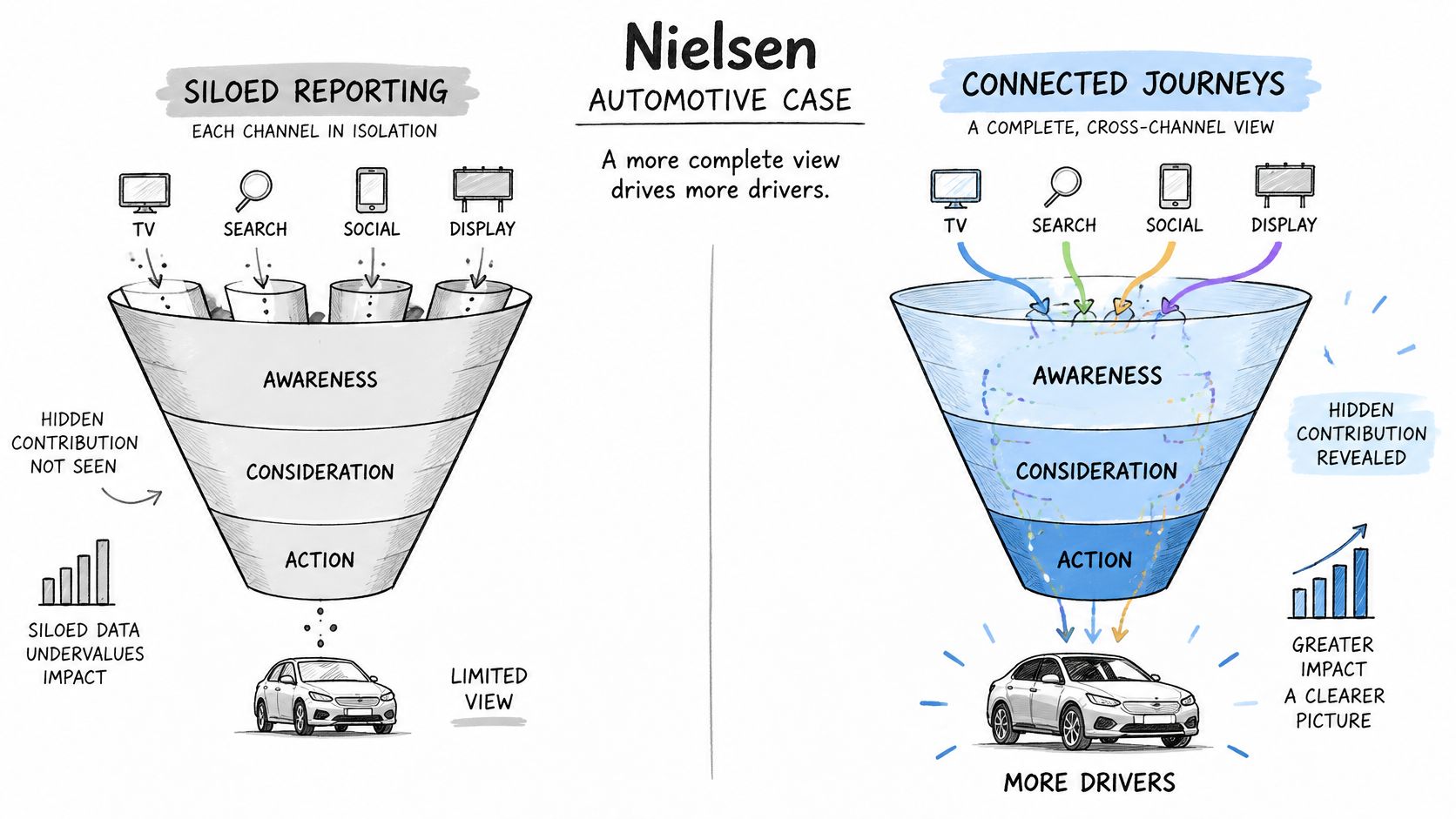
In Nielsen's automotive attribution application, fractional credit across in-market media exposed mid-funnel contributions, downstream activities, and conversion-associated sequences; after campaign changes, conversion volume increased 9.7%, conversion rate rose 27%, and media efficiency improved 7.2%. These are case outcomes following optimization, not guaranteed gains from collecting more events.
The distinction between isolated reports and a connected journey is illustrated below.
Inspect the transition, not just the channel
Consider a hypothetical SaaS journey: a webinar ad leads to a comparison article, followed by a retargeting ad and a demo booking. The comparison article doesn't close the journey, but it may help prospects evaluate alternatives.
Inspect whether qualified prospects progress after reading it, whether that pattern holds across acquisition sources, and whether sales conversations reflect the issues it addresses. Those observations can justify testing the article's distribution. They don't establish that removing it would reduce bookings.
Preserve the fields that make this analysis possible:
- Event timestamps to establish order and elapsed time.
- Campaign metadata to distinguish audiences, creatives, and placements.
- Landing pages to identify the content encountered.
- Device or identity keys to support defensible event linking.
- Lead-quality fields to separate target buyers from unsuitable inquiries.
- Downstream revenue to connect engagement with commercial outcomes.
Make the findings usable during campaigns
Deduplicate people separately from exposures. A repeated impression is not another prospect, and repeated event firing isn't another meaningful interaction. Reconcile media costs at the same campaign level used for outcome analysis so acquisition costs have consistent denominators.
Then assign an action owner. The content team might revise an unclear comparison page, while the media team adjusts sequencing or audience exclusions. In-flight visibility matters only when someone can act on it before the campaign ends.
Aligning Marketing ROI With Sales Pipeline
In 2024, 80% of marketers said they were dissatisfied with their ability to reconcile results from different tools, according to MMA Global's State of Attribution benchmark. A shared revenue view addresses that operational problem, but only if teams agree on what their records mean.
Marketing might report completed forms while sales reports accepted opportunities. Both reports can be internally correct and still support conflicting budget recommendations. Joining the records helps, but merely displaying them together doesn't resolve the mismatch.
Agree on the business event
Choose a clearly observable optimization event, such as a qualified meeting held, and document its acceptance criteria with sales. A booking that never happens shouldn't silently receive the same treatment as a completed discovery conversation.
Connect lead source and campaign history to lifecycle stages such as marketing-qualified lead, sales-qualified lead, opportunity, and closed won. Add payment and offline-conversion records where reliable identifiers permit matching. A closed-loop attribution workflow makes the relationship between acquisition activity and sales outcomes explicit.
Use the shared record to change the discussion:
- Replace lead-count comparisons with cost per qualified opportunity when evaluating pipeline creation.
- Separate pipeline from revenue so open opportunities aren't presented as completed sales.
- Return accepted outcomes to ad platforms where permitted, rather than optimizing solely toward submissions.
- Review source completeness alongside channel performance so missing records don't disappear from scrutiny.
Let commercial quality change the allocation
Suppose a paid social campaign generates many inexpensive inquiries, while a specialist partner sends fewer leads that sales accepts more readily. A cost-per-lead dashboard favors paid social.
Once the team connects accepted opportunities, closed revenue, and acquisition costs, the partner may justify additional investment. The reason isn't that fewer leads are better. It's that the business can evaluate the commercial outcomes associated with each source.
Keep the comparison fair by accounting for opportunity age. A newly launched channel hasn't had the same chance to produce closed revenue as an established campaign, especially in a long sales cycle.
Ownership matters: Give a named person responsibility for conversion definitions, field mappings, and change approval.
Sales and marketing should review pipeline by source on a recurring schedule, with finance involved when revenue treatment differs between systems. Stable definitions make disagreements useful: the team can debate spending assumptions rather than arguing about which spreadsheet is correct.
Confirm Your Attribution Setup Before You Scale Spend
Choose the disputed channel first, then configure the measurement needed to evaluate it. A complete-looking dashboard isn't a reason to expand the scope before the underlying events reconcile.
Among attribution tools, SourceLoop connects recorded visitor journeys with forms, chats, bookings, CRM stages, and Stripe payments. Assess that functionality against your existing analytics and CRM setup, including how each system handles consent, identity matching, and missing sources.
Use the interface as an audit surface, not just a reporting destination.

Verify the complete event chain
- Install the tracking snippet on relevant pages, then verify consent behavior and check for duplicate event firing.
- Tag ads, email, social, and partner links with consistent UTM parameters. Test redirects to confirm that they preserve those parameters.
- Submit test conversions through forms, chat, and calendar bookings. Inspect the resulting lead record for the expected journey.
- Connect Stripe and verify that a payment attaches to the correct customer without creating a duplicate sale.
- Map CRM fields in HubSpot, Salesforce, or Pipedrive. Check stage updates, ownership, and identifier consistency.
- Return qualified offline conversions to Google Ads, Meta through CAPI, and LinkedIn where supported and permitted. Verify acceptance and deduplication.
- Configure Slack or email alerts for meaningful changes in cost per qualified lead, with an owner responsible for investigation.
Test failures deliberately: missing UTMs, repeat submissions, a returning customer, and an unmatched payment. A system that exposes these exceptions is more useful than one that assigns a confident-looking source without detection.
The walkthrough provides a visual companion to those checks.
Before increasing spend, confirm consistent source coverage, an agreed conversion definition, and a documented validation plan. Run a holdout when the design and outcome volume support it; don't rush an inconclusive experiment to meet a reporting deadline.
This week, select the channel with the largest disputed budget. Trace its conversions into qualified pipeline and payments, inspect how its credit changes across models, and write down the test that would justify increasing or reducing spend. Scale only after the records reconcile and the decision has a defensible check.


 Paid Social


