
How Do I Get an 800 Number for My Business
Learn how do I get an 800 number for my business, from choosing a provider and vanity search to porting, SMS setup, and call routing, step by step.

Your personal cell number is on every proposal, invoice, and client email. You want a business line you can advertise nationally, but searching for one brings up phone systems, number marketplaces, and plans that don't make clear what you're buying.
If you're asking, “How do I get an 800 number?” the practical answer is to choose a provider, find available digits, reserve them, and configure where calls go. The better answer includes what happens afterward: who controls the account, how callers reach your team, and whether you can leave the provider without leaving your number behind.
Table of Contents
- Why an 800 Number Is Worth the Setup
- Choosing the Right Provider for Your 800 Number
- Finding and Reserving Your Number
- Activating Your 800 Number and Pointing It Somewhere
- Setting Up Call Routing, Menus, and Business Hours
- Adding SMS, Tracking, and CRM Connection
- Protecting the Number When You Change Vendors
Why an 800 Number Is Worth the Setup
The moment to separate your business number from your personal phone usually isn't dramatic. You're finishing a proposal, copying your cell number into the footer again, and realizing you don't want that arrangement to become permanent.
An 800 number is worth considering when you want a public-facing contact point that belongs in your business operations, not in your personal contact details. Think of it as the front door, not the office behind it. You still need someone to answer.
Buy a business contact point, not a status symbol
My recommendation is to choose toll-free service because it fits how customers contact you, not because the prefix looks established. Don't treat an 800 number as an SEO asset or expect it to fix weak follow-up.
For a consultant, the useful outcome might be separating prospect calls from family calls. For an agency, it might be advertising a consistent contact number while different employees handle incoming inquiries. These are operating decisions, not branding tricks.
Before shopping, write down what a successful call should accomplish:
- For sales: The caller reaches someone who can qualify the inquiry or arrange a callback.
- For support: The customer reaches the right team without navigating an elaborate menu.
- For marketing: You can connect the inquiry to its original campaign rather than guessing from the caller's memory.
Practical rule: Choose the number around the customer experience you can reliably deliver, not the image you hope the prefix creates.
Define success before you publish it
If you advertise the number, decide what counts as a valuable call before traffic arrives. A missed call, an existing customer's billing question, and a qualified sales conversation shouldn't all receive the same treatment.
Use this guide to setting up phone call conversion tracking to establish that measurement plan. The purchase is worthwhile when you've also planned the answer, the handoff, and the follow-up.
Choosing the Right Provider for Your 800 Number
Choose the service relationship before choosing the digits. A memorable number won't compensate for unclear billing or a provider that can't explain who administers your account.
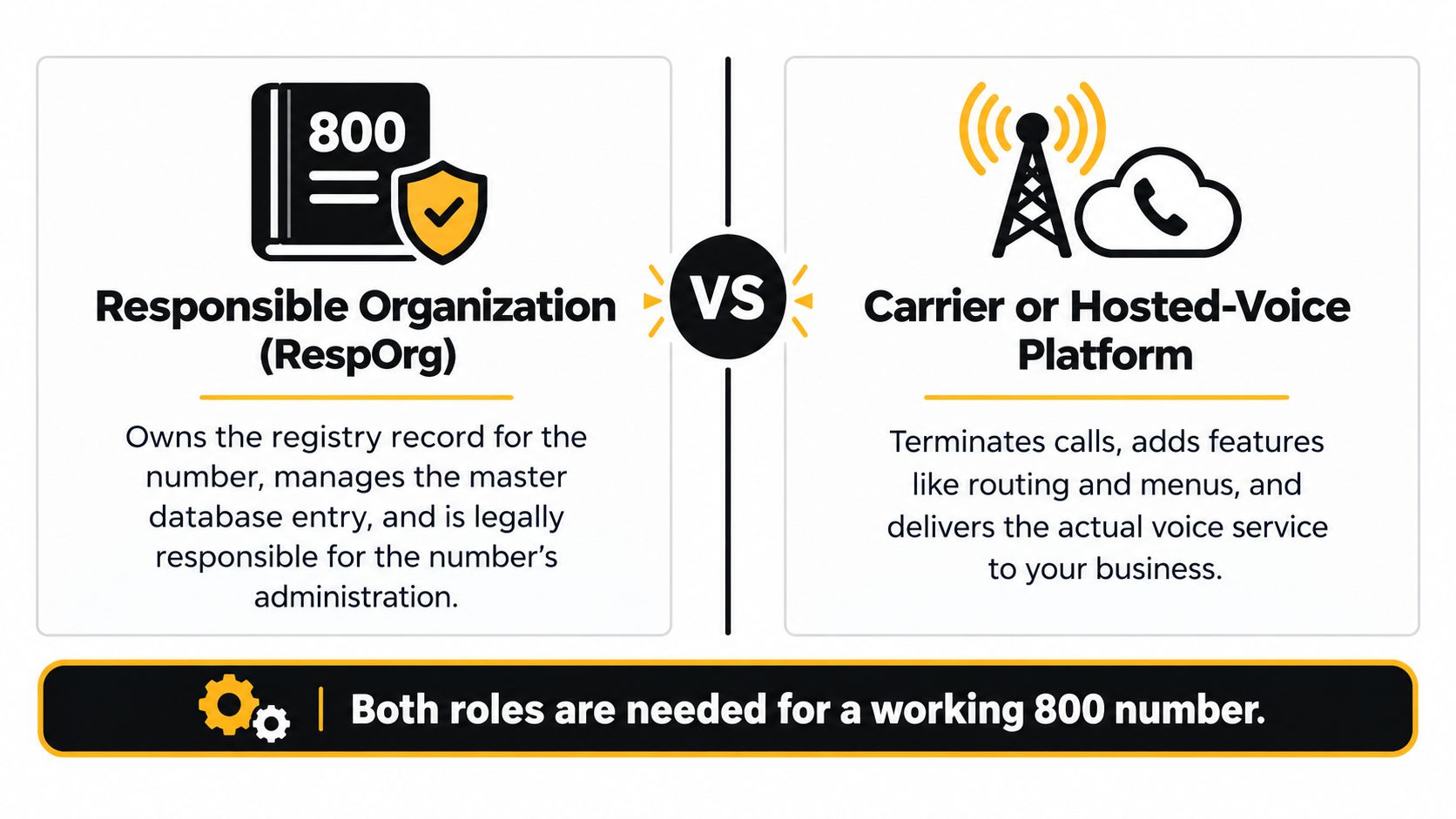
The important distinction is between the Responsible Organization, usually called the RespOrg, and the company delivering your phone features. RespOrgs reserve numbers and maintain routing records; carriers and hosted-voice platforms can provide termination, forwarding, menus, recording, and analytics, as explained in the FCC's toll-free number guide.
The roles are separate even when the same company handles both.
Compare responsibilities, not just plan names
Don't assume a provider category guarantees better pricing or support. Use the category to decide what questions to ask.
| Provider category | What I'd investigate first | What I'd require in writing |
|---|---|---|
| Traditional carrier | Fit with your existing telecom arrangement | Service scope, contract obligations, and support responsibilities |
| Hosted or consumer-facing VoIP platform | Whether the business plan supports your intended workflows | Included features, usage charges, and account administration |
| Reseller or number marketplace | Whether the offer covers reservation, ongoing service, or both | The administering RespOrg and the process after purchase |
If you already have a cloud phone system, ask its provider about toll-free service first. Don't add another vendor unless there's a clear reason, such as unavailable inventory or a missing requirement.
Ask for the complete operating cost
Request a written quote covering reservation or setup charges, recurring service, usage, forwarding, messaging, recording, and cancellation terms. Treat these as questions to verify, not charges you should assume every provider imposes.
Give the provider your expected calling pattern and ask it to explain the bill under that scenario. If you need campaign reporting, use these keyword-level call tracking considerations to define your requirements before the demo.
Keep adjacent support costs separate. If you're also budgeting for chat automation, review SignalZen's pricing for AI customer support as a separate budget input, not as evidence of what toll-free voice service includes.
Reject any proposal that leaves you unsure who handles service problems, account changes, or the registry relationship.
Finding and Reserving Your Number
Search your provider's inventory tool by digits first, then by relevant words if you want a vanity number. Prepare alternatives before you search so you don't commit to an awkward number just because your first choice is unavailable.
An 800 number is a North American toll-free number whose subscriber, rather than caller, pays the applicable charge for completed calls; it isn't a geographic area code. The original code began serving automated inbound WATS in 1966, and the later prefixes are separate codes, not interchangeable versions of the same number, according to the North American toll-free numbering overview.
Toll-Free Prefixes at a Glance
The recommendations below are selection criteria, not claims about which prefix currently has more inventory. Availability requires a live search.
| Prefix | Year Introduced | Availability Outlook | Best Fit |
|---|---|---|---|
| 800 | 1966, as cited above | Check exact digits | Your brief specifically requires the original prefix |
| 888 | Not specified here | Search separately | Your preferred digits are available under this code |
| 877 | Not specified here | Search separately | A readable numeric combination fits your brand |
| 866 | Not specified here | Search separately | You prefer its available digits to other options |
| 855 | Not specified here | Search separately | The complete number is easy to communicate |
| 844 | Not specified here | Search separately | It offers a suitable campaign or business number |
| 833 | Not specified here | Search separately | It preserves a preferred word or digit pattern |
Choose a number people can repeat
For a service business, I'd favor a short, obvious word over clever spelling. Say the complete number aloud, including the prefix, and ask someone to repeat it without seeing it.
For an ad-driven funnel, I'd prioritize tracking requirements and clear presentation over forcing a vanity phrase. Don't pay for memorability you won't use.
- Search the complete number: A matching suffix under another prefix is a different destination.
- Check the spelling: Avoid words that need an explanation.
- Request confirmation: Obtain written confirmation of the exact reserved number and any conditions attached to the reservation.
A search result isn't a reservation. Don't put the number on a proposal, website, or advertisement until the provider confirms it.
Activating Your 800 Number and Pointing It Somewhere
Reservation doesn't mean your phone system is ready. Before activation, decide who should receive calls and what should happen when that person can't answer.
Use the provider's requirements to assemble your business and billing details. Don't let an employee's personal account become the only administrative access your company has.
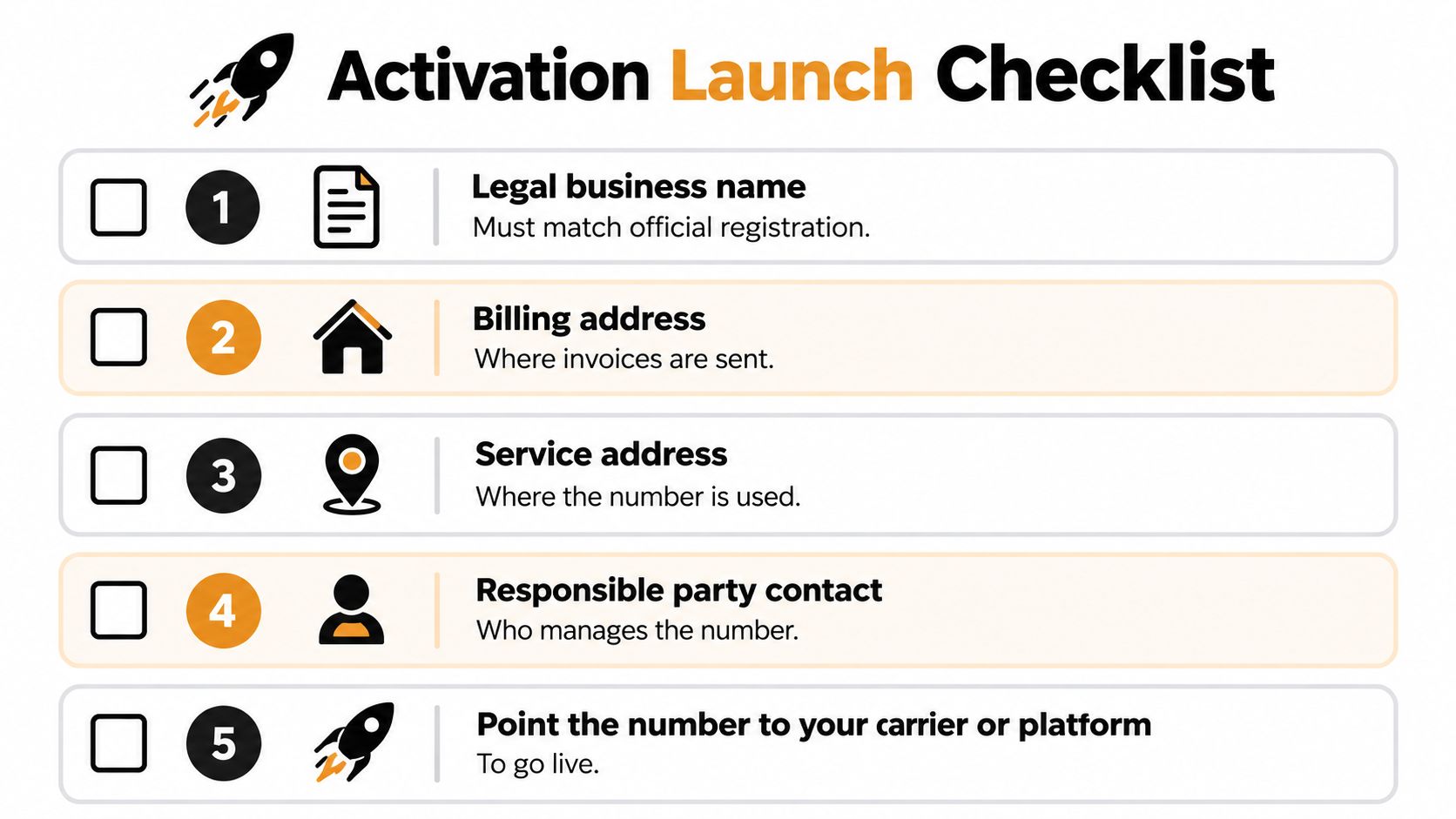
Treat activation as a launch checklist.
Submit details with an accountable owner
Have the following ready, then confirm which fields your provider requires:
- Business identity: Legal business name and relevant account information.
- Addresses: Billing address and any service address requested.
- Responsible contact: Someone authorized to approve configuration and account changes.
- Destination: Your office line, mobile, call center, or SIP endpoint.
- Operating instructions: Business hours, routing preferences, and any required emergency or contact configuration.
Choose the destination deliberately. Forwarding to your mobile may suit an owner-operated business, but an existing phone platform may be the better destination when employees need shared handling.
Keep the configuration instructions somewhere another authorized person can access. A setup that only one employee understands is difficult to maintain.
Run a caller's test, not an administrator's test
Make test calls from a mobile, a landline, and another carrier or geographic network. Ask someone outside your team to follow the greeting without coaching.
| Test | What to observe |
|---|---|
| Call during opening hours | Correct destination, clear audio, acceptable connection delay |
| Leave the call unanswered | Expected fallback, no forwarding loop |
| Call outside opening hours | Correct greeting and message destination |
| Transfer a call | Caller stays connected and reaches the intended person |
| Inspect the receiving phone | Caller-ID behavior matches your working needs |
Record what happened, who tested it, and what needs fixing. If recording is enabled, validate the disclosure as part of the caller experience.
Don't approve launch because the dashboard says “active.” Approve it because a real caller can reach the right outcome.
Setting Up Call Routing, Menus, and Business Hours
A polished greeting followed by confused routing is still a bad phone experience. Start with the shortest path to someone who can help.
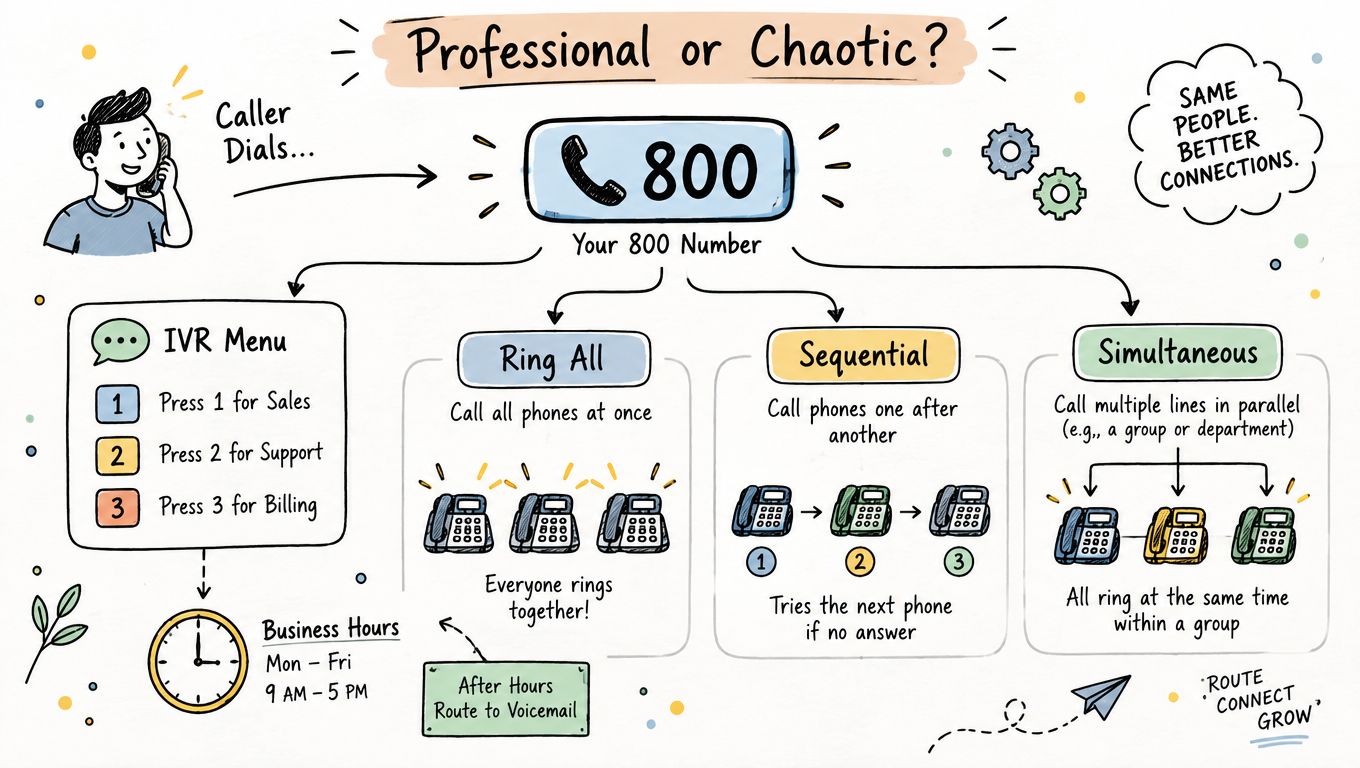
Use the routing diagram to review your intended call path before configuring it.
Match the ringing rule to the team
For a shared sales desk, consider simultaneous ringing if whoever is available should answer. For an account-led service, consider sequential routing, with the primary contact followed by a designated backup.
A solo consultant needs a different arrangement. I'd send after-hours calls to a clear voicemail greeting rather than let the business line ring a personal phone indefinitely.
- Shared coverage: Specify who is expected to answer and who handles missed calls.
- Sequential coverage: Avoid a long chain of employees who are unlikely to pick up.
- Fallback coverage: Choose a destination that doesn't depend on the same unavailable person.
If you want voicemail delivered as a transcript, check the actual forwarding arrangement. VoxNote's transcription service call forwarding info is a useful resource to review while evaluating that workflow.
Keep the menu smaller than your organization chart
For a business with sales and support, I'd offer those destinations directly, plus a clear fallback for callers who don't select anything. Don't make customers understand your internal departments.
Configure business hours and holiday handling explicitly. Ask the provider what caller-ID name registration, or CNAM, is available for your intended use, and verify behavior rather than promising staff a particular display.
For a visual walkthrough, use the video alongside your own routing test.
Launch standard: Every route needs an intentional ending, an answered call, a useful message, or an assigned callback.
Review missed calls with the people responsible for returning them. A routing rule isn't finished until someone owns the follow-up.
Adding SMS, Tracking, and CRM Connection
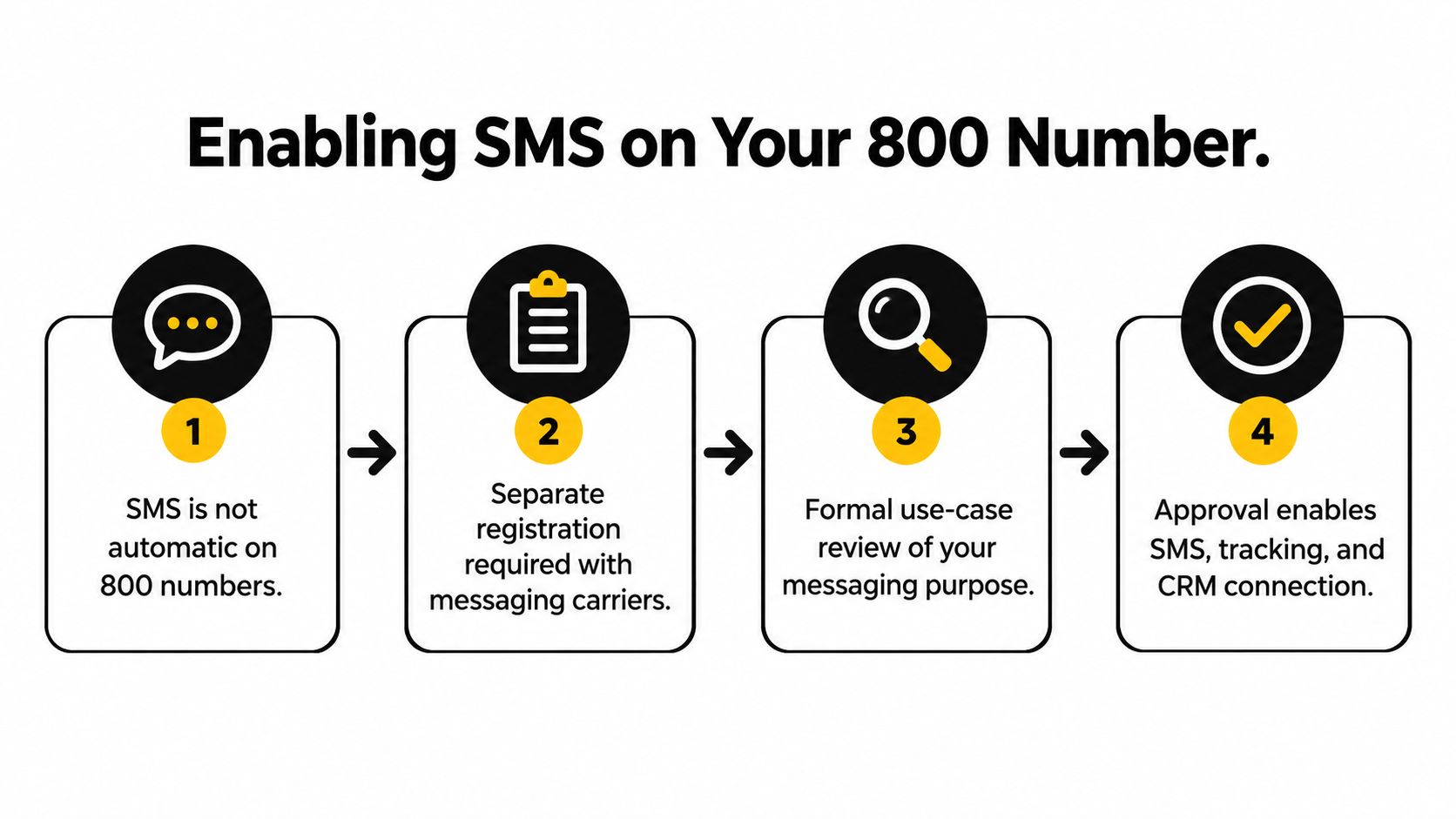
Voice activation doesn't automatically authorize texting. Treat messaging as a separate provisioning and compliance project, with an owner responsible for the application and the ongoing consent process.
Toll-free SMS registration typically involves one to two weeks of carrier review, and texting may remain restricted while verification is pending, according to 800.com's SMS verification guidance.
Use the process below to plan messaging approval separately from your voice launch.
Prepare the application around actual messages
Gather your legal business name, address, website, responsible contact, messaging purpose, and sample messages. Explain how recipients opt in, maintain opt-out handling such as STOP, and make sure your privacy policy reflects what you do.
- Describe the use case: Appointment reminders and marketing outreach shouldn't be presented as the same workflow.
- Preserve consent evidence: Keep the context needed to understand what the recipient agreed to receive.
- Separate channel decisions: Don't assume permission or approval for one messaging service covers another.
If you're considering WhatsApp alongside phone service, review Premier Broadband's Dondy marketing chat options as a separate channel evaluation. Don't confuse that decision with toll-free SMS verification.
Connect the call to the original inquiry
SMS approval isn't a prerequisite for voice-call attribution or CRM integration. Plan those connections independently.
For campaign measurement, configure unique campaign numbers where appropriate or use provider webhooks. Pass the call ID, timestamp, campaign context, and outcome into the CRM, while keeping answered, missed, transferred, and qualified calls distinct.
Use this guide to sending lead-source data to your CRM to define the field mapping. Keep call outcomes separate from messaging consent, and only transfer the data needed for the workflow.
The useful question isn't whether the phone rang. It's whether the inquiry became a qualified opportunity, booking, or customer, and which marketing activity started that relationship.
Protecting the Number When You Change Vendors
I'd worry more about losing administrative control than about choosing the wrong greeting. You can rewrite a greeting quickly; untangling an account held by a former agency or employee is a different problem.
FCC rules require toll-free numbers to be portable between RespOrgs, so a subscriber can change providers without abandoning the number, as the FCC's toll-free portability guidance explains. Preserve the account ownership, authorization records, and billing information needed to exercise that right.
Prepare the exit before signing
Ask the prospective provider what the receiving provider would need to transfer your number. Request its requirements for a letter of authorization, account number, billing details, and identification of the current RespOrg.
Don't accept a generic promise about transfer speed. Ask for a written estimate based on your account and the receiving provider's requirements, including what could delay approval.
- Confirm the exact number and prefix: Match the contract, account record, and reservation confirmation.
- Document business control: Use business-controlled administrative access and retain authorization records.
- Request written porting terms: Clarify cooperation requirements and any applicable contractual charges.
- Plan service continuity: Keep the existing service active until the transfer and inbound calling have been verified.
- Retain configuration records: Preserve the routing instructions and fallback plan you tested before launch.
Separate a rebrand from an account transfer
If your agency changes names or your company consolidates vendors, review the account identity and authorized contacts before requesting changes. Don't assume updating a public brand name also updates the records needed to authorize a transfer.
Buy the number as something your business must be able to administer beyond the current vendor relationship. That's the difference between getting an 800 number and building a dependable business contact channel.
Before publishing your number, obtain the reservation confirmation, document business-controlled access, and complete an inbound-call test. Then connect the resulting inquiries to revenue: use SourceLoop to connect your configured call touchpoints with landing-page visits, forms, bookings, and customer journeys, so your team can evaluate qualified outcomes rather than count every ring as a conversion.




 Paid Social


