
Sales Funnel B2B: Stages, Benchmarks and Attribution
Sales funnel B2B explained stage by stage: conversion benchmarks, multi-touch buyer journeys, attribution models and tactics to lift each stage.
In 2025, 67% of B2B buyers said they preferred a buying experience with no sales representative, according to Gartner's survey of 646 B2B buyers, as summarized by Empact Partners. A funnel that begins with a salesperson's first conversation starts after buyers have already done meaningful work.
Table of Contents
- Why B2B Buyers Break the Linear Funnel
- B2B Sales Funnel Stages and Typical Conversion Rates
- A Multi-Touch B2B Journey From First Visit to Revenue
- Attribution Models for Multi-Touch B2B Funnels
- How to Optimize Each Stage of the Funnel
- Reading Funnel Data Without Fooling Yourself
- Check Your Funnel Tracking Before the Next Quarter
Why B2B Buyers Break the Linear Funnel
A B2B sales funnel describes the stages buyers move through as they decide whether to buy. It isn't a sequence the seller controls. Your CRM might show a tidy progression from lead to demo to proposal, while the buyer is still comparing alternatives, asking colleagues for recommendations, and questioning whether the project deserves funding.
The familiar awareness-to-close diagram is useful for reporting. It becomes misleading when teams treat it as a description of everyone's behavior. An operations manager might discover your comparison page through search, while a technical evaluator first encounters your company through a colleague's forwarded email.
Buyer readiness isn't seller activity
A booked meeting tells you that someone agreed to a conversation. It doesn't establish that the account has budget, internal agreement, or a workable implementation plan.
Buyers can prefer independent research and still need help applying a solution to their company. Sales involvement should respond to uncertainty about fit, technical complexity, or internal approval, rather than automatically following every download.
Practical rule: Use stages to describe what buyers have demonstrated, not what your team hopes they'll do next.
That distinction changes measurement. If tracking starts at form submission, marketing can't see the earlier interactions that helped someone choose your company. If qualification happens only at the contact level, sales can mistake an enthusiastic researcher for an account ready to purchase.
Clear sales and marketing alignment means agreeing on evidence: what makes an inquiry worth pursuing, what constitutes a qualified account, and what must happen before an opportunity becomes forecastable. The useful funnel connects those decisions to pipeline and revenue, not just to a growing contact list.
B2B Sales Funnel Stages and Typical Conversion Rates
| Stage | Entry signal | Exit event | Indicative conversion | Main owner |
|---|---|---|---|---|
| Visitor | First session from search, ads, social, email, or an identifiable AI referral | Form, chat, or booking completed | Completed inquiries divided by eligible visitors | Marketing |
| Lead (MQL) | Contact details and intent captured; fit criteria met for MQL status | Sales accepts fit and need | Sales-accepted leads divided by MQLs | Marketing and SDR |
| Qualified (SQL) | Budget, authority, need, and timing confirmed to the agreed qualification standard | Demo or meeting held and an active evaluation established | Opportunities created divided by SQLs | SDR and account executive |
| Opportunity | Buying group engaged and scope agreed | Contract signed or deal lost | Won opportunities divided by resolved opportunities | Account executive |
| Closed-won | Signed contract and first payment under the agreed commercial definition | Expansion or renewal | Renewed or expanded accounts divided by eligible accounts | Account executive and customer success |
These are measurement rules, not universal benchmark ranges. A defensible typical rate requires a comparable business model, acquisition channel, deal size, and sales cycle. Without that context, a broad percentage can encourage teams to optimize toward the wrong target.
Define the denominator before judging the rate
A lead isn't automatically an MQL, or marketing-qualified lead. A support request, student download, or job applicant may supply contact details without representing a potential customer. Keep raw inquiries separate from inquiries that meet your fit and intent criteria.
An SQL, or sales-qualified lead, should represent sales acceptance based on evidence. Budget may still need approval, and the initial contact may not hold purchasing authority. Record what's known, what's unconfirmed, and who will validate it instead of forcing every prospect through a rigid checkbox exercise.
The table also separates meetings from opportunities. A meeting is an activity; an opportunity is an active commercial evaluation with a credible route to purchase. If your CRM creates an opportunity as soon as someone books, distinguish provisional opportunities from accepted pipeline.
For practical guidance on connecting acquisition to qualification, AI Optimization Services' resource on how to turn traffic into qualified B2B leads can help frame the handoff between landing-page interest and sales acceptance.
Stage rates multiply rather than add
The relationship is straightforward:
Visitor-to-SQL conversion = visitor-to-lead conversion × lead-to-SQL conversion.
A hypothetical campaign could generate plenty of inquiries but few accepted SQLs. Improving its landing page would increase inquiry volume, but it wouldn't necessarily create more viable opportunities if the campaign attracts companies you can't serve.
The reverse is also possible. A specialist integration guide may attract fewer visitors while producing more commercially relevant conversations. Judge the complete path, not whichever intermediate metric looks strongest.
Use a consistent cohort: group buyers by when they entered the funnel, then give them enough time to progress. Comparing recent visitors with opportunities created from older leads mixes different buying periods.
Find the stage furthest below its own comparable baseline, then check whether fixing it would increase qualified pipeline.
Build those baselines from CRM history, segmented by product, customer size, and acquisition motion. A sales-assisted enterprise purchase shouldn't inherit the targets of a self-service subscription. Before changing a campaign, inspect rejected leads, stalled evaluations, and lost deals to understand the reason behind the rate.
A Multi-Touch B2B Journey From First Visit to Revenue
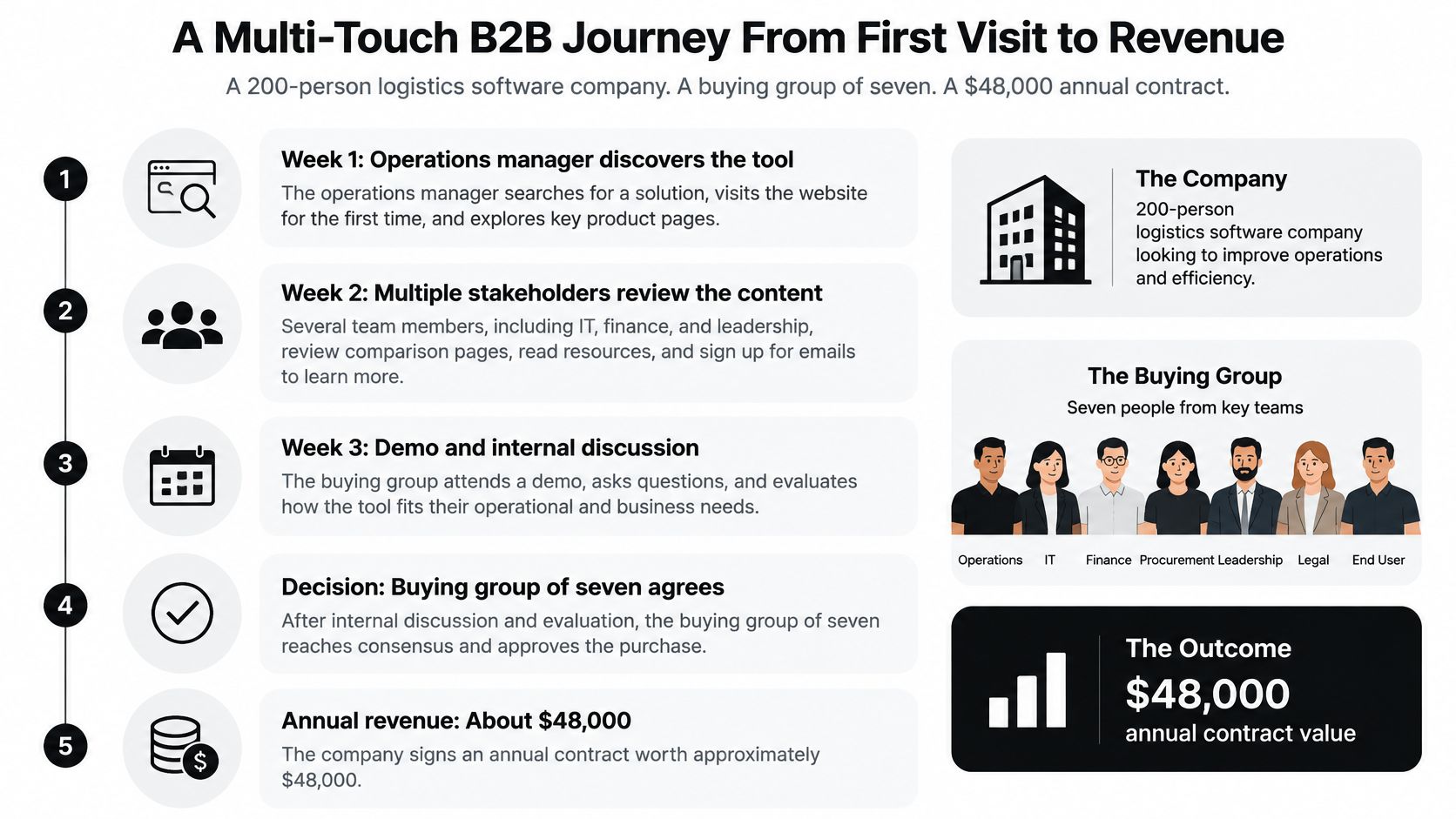
Consider an illustrative logistics software company evaluating a reporting tool. Its operations manager wants less manual work, IT needs confidence in the integration, finance wants a credible business case, and procurement needs acceptable security and commercial terms. Four people, four different questions, one account moving through the same funnel.
The simplified visual shows the broad buying process, not a benchmark schedule.
Follow the people rather than a single contact
Gartner's public description places a typical complex B2B buying team at 5–16 people across as many as four functions, according to PPC Land's buying-group summary. That makes contact-level reporting an incomplete view of the purchase: the lead who downloaded your guide may never attend the demo, and the person who signs may never visit your site at all.
In this scenario, the operations manager discovers a comparison article through organic search, then returns through a LinkedIn ad to download an ROI guide. Later, an IT lead visits pricing directly, and the CFO attends a webinar before the operations manager requests a demo. Procurement then asks for security documentation, and the account signs once the stakeholders resolve their separate concerns.
| Sequence | Person and role | Channel | Stage moved | First-touch credit | Last-touch credit |
|---|---|---|---|---|---|
| Discovery | Operations manager | Organic search, comparison article | Visitor | Receives credit | None |
| Return visit | Operations manager | LinkedIn ad, ROI guide download | Lead | None | None |
| Technical review | IT lead | Direct visit, pricing page | Lead | None | None |
| Financial review | CFO | Webinar attendance | Lead | None | None |
| Sales engagement | Operations manager | Calendar widget, demo booked | Lead | None | None |
| Procurement review | Procurement | Security document request | SQL | None | Receives credit if this is the final eligible touch |
Read the middle rows carefully. A pricing visit, a webinar, and even a booked demo all look like progress, yet none of them confirms budget, authority, need, and timing, so the account stays at Lead. Teams often mislabel this moment: a demo booking feels like a sales milestone, but on this journey it is still a lead asking to see the product. The account reaches SQL only when procurement's review surfaces those answers, becomes an Opportunity once the buying group engages and agrees scope, and closes when the contract is signed.
Here, first-touch and last-touch mean the earliest and latest eligible recorded interactions before the signed deal. A model ending at demo booking would produce a different last-touch result.
Response handling belongs in the journey too
The MIT/InsideSales Lead Response Management Study found that contacting a web lead within 5 minutes rather than 30 minutes made the lead 21 times more likely to become qualified, as reported in LeadSpot's benchmark guide. Use it as a reason to examine response handling, since benchmarks like this describe averages and results vary by deal size and sales cycle.
Follow-up delivery matters as well. If booking confirmations or requested documents aren't reaching buyers, MailGenius offers an email inbox placement test that can help investigate delivery problems before you rewrite the nurture sequence.
The useful question is whether the team supported each stakeholder's decision and recorded enough evidence to understand the account's progression. In a buying process this crowded, the form fills matter far less than the pipeline and revenue behind them.
Attribution Models for Multi-Touch B2B Funnels
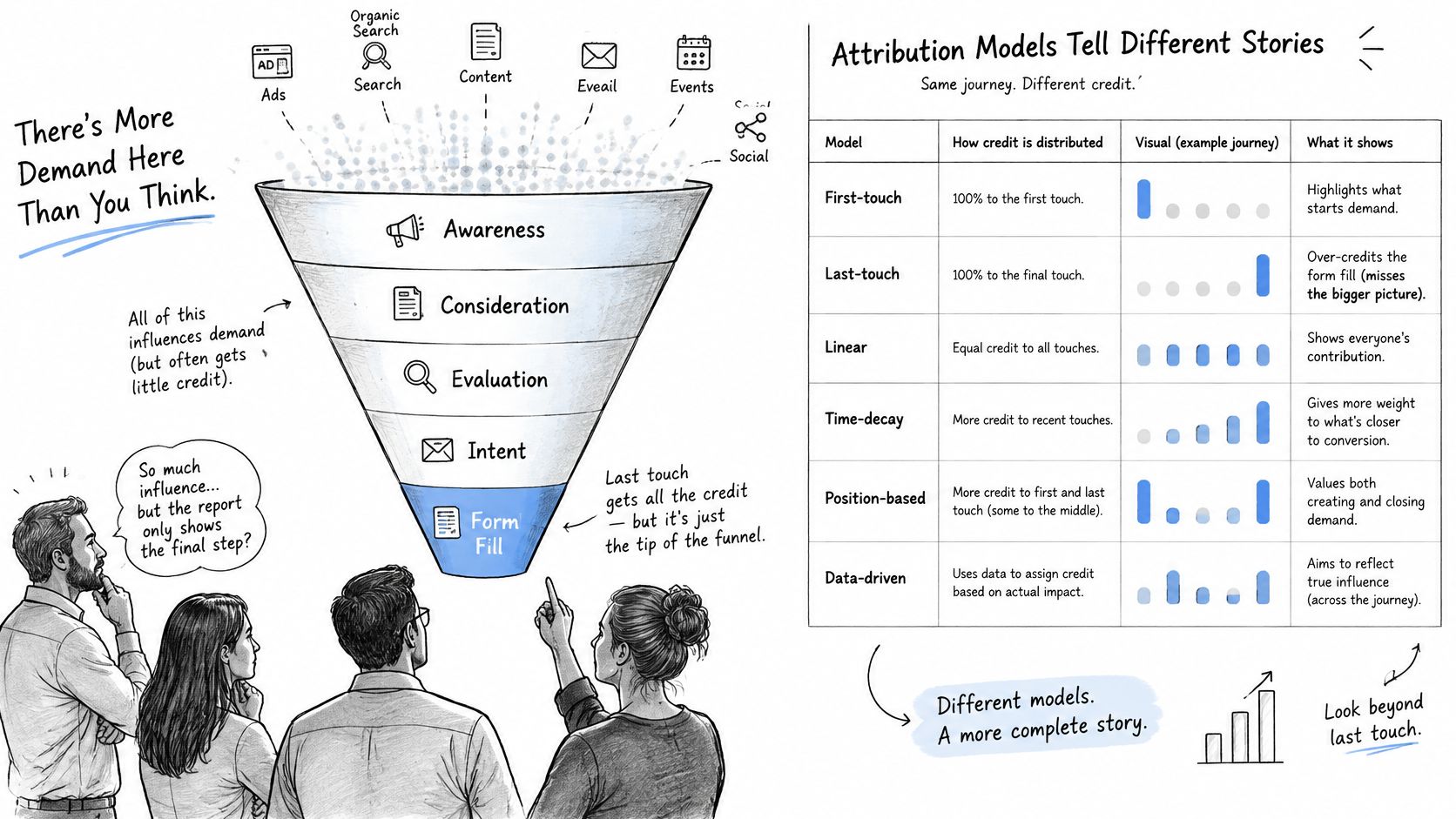
Last-touch reporting can make the final form or sales interaction look like the source of an entire deal. That can lead a marketing lead to cut discovery content while continuing to fund the channels buyers use after they've already decided to investigate.
The visual highlights how attribution models distribute credit across a recorded journey.
Choose a model for the decision you're making
| Model | How it credits revenue | Main strength | Main weakness | Best when |
|---|---|---|---|---|
| First-touch | All credit to the first recorded touch | Identifies recorded entry channels | Ignores later evaluation | Assessing discovery channels |
| Last-touch | All credit to the final eligible touch | Simple to explain and audit | Hides earlier contributions | Reporting immediate conversion paths |
| Linear | Equal credit to each eligible touch | Includes the recorded journey | Equates minor and substantial interactions | Establishing initial multi-touch reporting |
| Time-decay | More credit to interactions nearer conversion | Emphasizes recent engagement | Can undervalue early discovery | Recency reflects genuine buying momentum |
| Position-based | Greater weight to opening and closing touches, with credit shared across the middle | Preserves entry and conversion visibility | Weights are chosen rather than proven | Teams need an understandable balanced model |
| Data-driven | Uses statistical estimates to allocate credit | Adapts to observed conversion patterns | Requires sufficient deal volume and reliable inputs | Mature teams can validate model stability |
A position-based model is a practical starting point when you want acquisition and conversion interactions to remain visible. Time-decay can suit a motion where recent evaluation activity matters more, but it shouldn't be the default without a clear reason.
Neither model proves causation. Attribution distributes credit among recorded interactions; an experiment asks whether spending money on a channel changes outcomes. Use both when budget decisions warrant the effort.
Make the underlying records trustworthy
Capture touch timestamps, campaign parameters, landing pages, and conversion types. Preserve the original acquisition record when someone returns through another channel instead of overwriting it with the latest session.
Then connect sessions to contacts, contacts to accounts, and relevant contacts to opportunities. Keep anonymous visits anonymous until you have a legitimate basis to associate them; a company-level match isn't proof that a particular employee visited.
Set the lookback window to accommodate your sales cycle and earlier research. Reconcile attributed revenue with the CRM's closed-won total, and define how your team handles refunds, renewals, and currency differences.
For implementation trade-offs, this guide to B2B attribution models provides a useful companion to the model comparison.
This video offers another way to visualize attribution across interactions.
Keep reporting labels distinct:
- Sourced pipeline identifies the channel assigned as the origin of a deal under your documented rule.
- Influenced pipeline identifies deals with eligible channel exposure, without claiming exclusive ownership.
- Assisted conversions describe supporting interactions connected to an eventual conversion, including an offline sale.
Data-driven models need enough closed deals to produce stable estimates. If results change dramatically when a small set of opportunities closes, use a simpler model and retain the underlying journey records.
How to Optimize Each Stage of the Funnel
Start with the buyer's unresolved task, then choose the intervention. More traffic won't solve an unclear buying case, and more sales outreach won't resolve missing integration documentation.
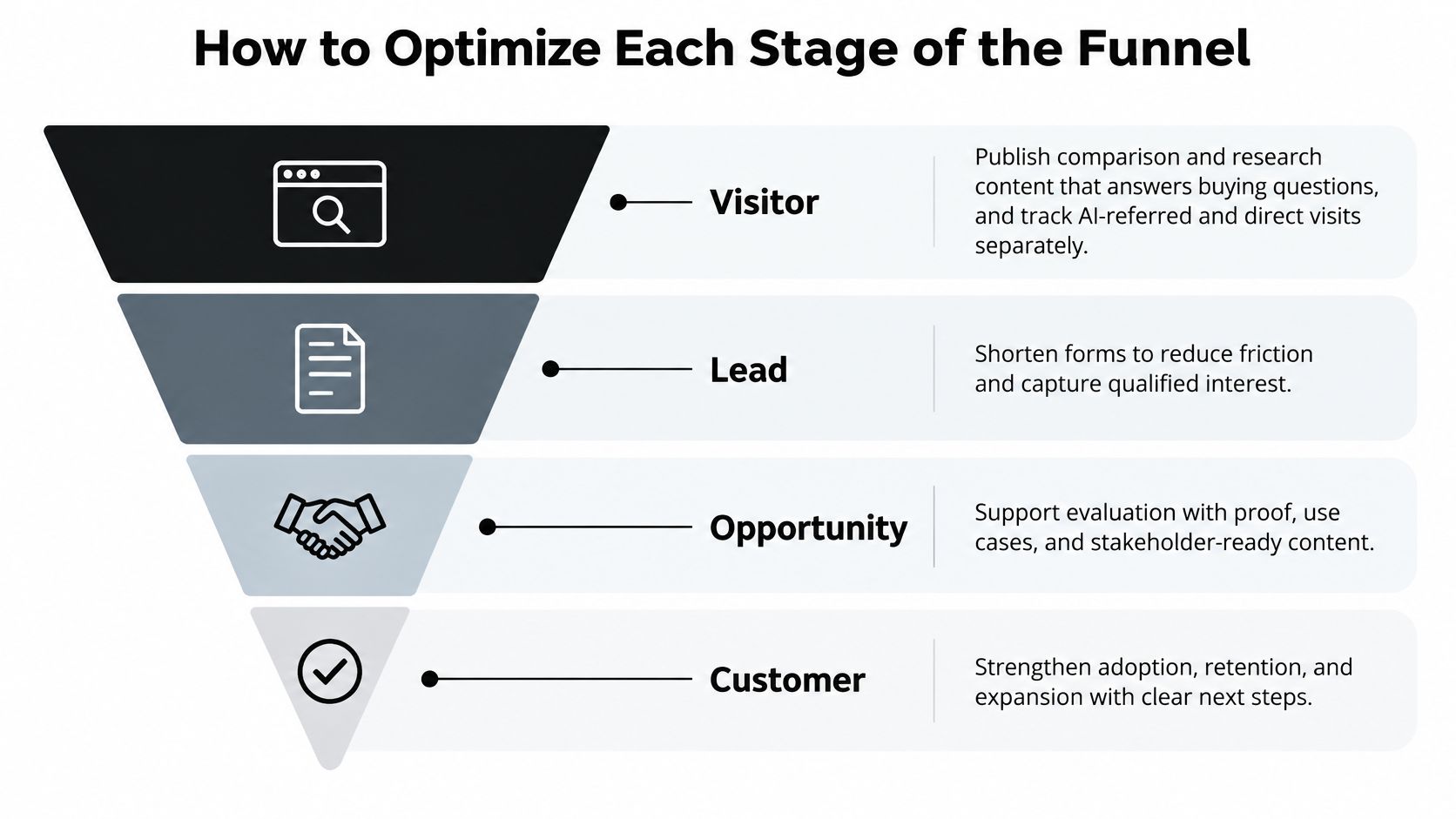
The funnel below summarizes the broad optimization work; qualification needs its own explicit operating rules between inquiry and opportunity.
Help visitors answer buying questions
Publish comparison pages, implementation guides, pricing explanations, and product limitations. A buyer should be able to establish whether you're a plausible fit without surrendering contact details.
Make content useful to different roles. The operations manager needs workflow examples; the IT evaluator needs architecture and integration information. Give each page an appropriate next action, such as viewing documentation or booking a technical discussion.
Track identifiable AI referrals separately from direct visits. Don't relabel unexplained direct traffic as AI-driven traffic.
Proof metric: Qualified pipeline associated with each content group, rather than page views alone.
Remove friction for leads and respond with context
Ask only for information needed to fulfill the request and route it correctly. Progressive profiling can collect additional details during later interactions instead of making the initial form an interrogation.
Offer a calendar booking option on high-intent pages. Preserve the page, campaign, and stated question with the booking so the account executive doesn't begin by asking the buyer to repeat everything.
Response speed deserves operational ownership. Capture the exact submission time, assign an available responder, and escalate unattended requests; an automated acknowledgment shouldn't count as a human response.
Report median response time alongside a tail measure that reveals buyers who wait unusually long. Compare lead-to-opportunity outcomes across response-time groups, separating staffed periods from out-of-hours submissions.
Proof metric: Qualified opportunity creation by response-time group, with lead fit held as consistent as possible.
Operating advice: A fast generic reply isn't the goal. A prompt response that answers the buyer's actual question is.
Qualify accounts without confusing activity with intent
A pricing-page visit or repeat session can justify closer attention, but it doesn't establish budget or authority. Combine behavior with company fit, explicit evaluation requests, and the buyer's stated problem.
Route high-intent requests automatically using territory, product, account ownership, and availability. Assign a fallback owner so routing doesn't fail when the usual account executive is away.
- Accept with evidence: Record the business problem, relevant stakeholders, and agreed next step.
- Nurture with a reason: Specify what must change before sales engagement makes sense.
- Reject consistently: Use structured reasons such as unsupported use case or unsuitable company profile.
Proof metric: Sales-accepted accounts that progress into genuine evaluations.
Help opportunities reach a shared decision
Multi-threading means developing useful relationships across the buying group, not adding everyone to a sequence. Ask which roles must approve the purchase and what each person needs to decide.
Create a mutual action plan with named owners, decision criteria, and agreed dates. Include security review, commercial approval, implementation readiness, and the buyer's internal dependencies.
Proof metric: Opportunity progression by decision milestone, supported by recorded reasons for stalls and losses.
Carry the buying case into customer success
At handoff, transfer promised outcomes, implementation constraints, stakeholder commitments, and unresolved risks. Customer success shouldn't need to reconstruct the sales conversation.
Track onboarding milestones against the customer's intended outcome. Expansion discussions make more sense after the customer demonstrates value than after an arbitrary period of account ownership.
Proof metric: Time to the first agreed customer outcome, followed by renewal and expansion performance.
For instrumentation, SourceLoop can connect web forms, chat, bookings, and payment events with CRM records; HubSpot or Salesforce can hold qualification and opportunity decisions. Assign clear system ownership so a marketing event doesn't replace a sales-validated stage.
Reading Funnel Data Without Fooling Yourself
A polished dashboard can still support the wrong decision. Before moving budget, check whether the comparison reflects the same buyers, the same definitions, and a complete enough buying period.
Mistakes that inflate confidence
- Treating a form as the origin of demand: Inspect earlier eligible interactions before assigning acquisition credit to the conversion page.
- Counting contacts as separate commercial outcomes: Aggregate related contacts to the relevant account and opportunity, then count the deal once.
- Using form volume as buying-group coverage: Examine whether users, technical evaluators, financial approvers, and procurement have participated.
- Adding overlapping influence totals: Keep channel-influenced pipeline separate from deduplicated company pipeline.
- Comparing immature cohorts with completed ones: Give recent buyers time to reach the outcome you're measuring.
For a practical reporting layout, Yalc can help you find dashboard ideas for sales leaders. Favor views that place stage movement beside deal value, aging, and loss reasons rather than presenting disconnected activity totals.
AI discovery leaves incomplete records
In G2's 2025 buyer-behavior findings, nearly 8 in 10 B2B decision-makers said AI search had changed how they research, and 29% said they begin research through platforms such as ChatGPT more often than Google. A conventional referral report can't fully explain that discovery process.
Someone may encounter a recommendation in a conversational interface, search for your brand later, and arrive without identifiable referral information. Ask buyers how they first heard about you and store their answer separately from the tracked source.
Don't assume a change in visible conversion rate establishes a change in demand. Inspect traffic composition, qualification, pipeline value, and closed revenue before deciding whether fewer recorded inquiries are a problem.
Missing attribution is uncertainty to report, not credit to assign to your preferred channel.
Low deal volume also makes short reporting periods unstable. Use longer comparisons when individual wins materially change the rate, and distinguish delayed decisions from lost demand.
A disciplined funnel conversion analysis should include cohort maturity, segment mix, and stage aging. If the sales cycle lengthens, a recent cohort may look weak even when buyers are still progressing.
Check Your Funnel Tracking Before the Next Quarter
Use an afternoon to audit a recent converted account and an unresolved opportunity. Trace their records from initial discovery through the latest commercial outcome, noting where timestamps, identities, or ownership disappear.
A practical tracking audit
- Write the stage rules. Document visitor, lead, qualified, opportunity, and closed-won definitions. Keep anonymous activity in analytics and associate it with CRM records only when appropriate.
- Inspect acquisition capture. Check UTM parameters, first-touch source, and subsequent interactions on forms, chat, and bookings. Preserve identifiable AI referrals without guessing the origin of direct visits.
- Trace offline outcomes. Confirm that held meetings, accepted opportunities, signed deals, and payments connect to the originating journey.
- Audit human response. Verify submission and response timestamps, ownership, and escalation. Examine both typical waits and delayed cases.
- Compare attribution outputs. Apply a multi-touch model to a completed reporting cohort and compare its channel allocation with last-touch reporting.
- Separate reporting views. Publish sourced, influenced, and assisted outcomes with explicit definitions and deduplicated account-level deal totals.
Make a budget decision testable
Choose the attribution model you'll test during the next quarter. Record which result would justify shifting budget, who will approve the change, and what evidence would make you keep spending unchanged.
The objective isn't a dashboard with perfect certainty. It's a shared measurement system that helps marketing, sales, and customer success make better decisions about the same buying accounts.

 Paid Social


