
Sales & Marketing Alignment: KPIs, SLAs and a 90-Day Plan
Learn how to build sales & marketing alignment with shared KPIs, handoff SLAs, CRM sync and a 90-day rollout plan your teams can run in 2026.

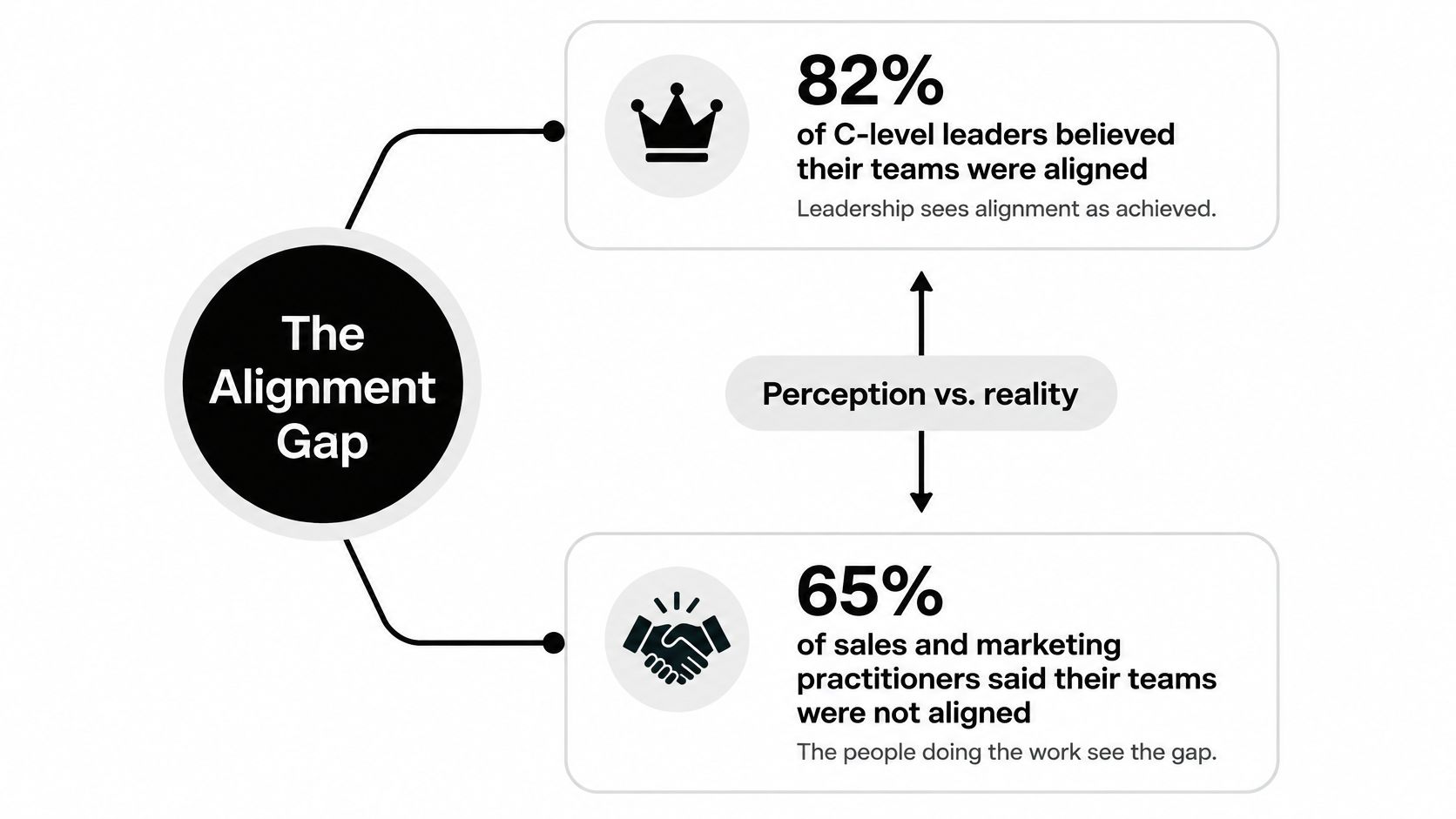
82% of C-level B2B business and technology professionals believed their product, sales, and marketing teams were aligned, including 41% who described them as highly aligned, while 65% of sales and marketing professionals said their organizations lacked alignment between sales and marketing leaders, according to a Forrester account of its 2024 surveys.
That split is the whole problem with sales & marketing alignment. Leaders hear agreement in a staff meeting. The people routing leads and closing deals do not share a definition, a target, or a record. I would not add another standing meeting, another content calendar, or another tool until both sides accept one auditable revenue dataset and a written credit rule.
Table of Contents
- What Sales and Marketing Alignment Really Means
- What Alignment Is Worth to Revenue
- Shared KPIs Both Teams Should Own
- Settling Credit Disputes Between Sales and Marketing
- Handoff SLAs for Leads and Pipeline
- Syncing CRM and Attribution Data Across Teams
- How to Build Alignment in 90 Days
What Sales and Marketing Alignment Really Means
Leadership opinion is a poor test. A confident answer in the exec staff does not mean the teams share a lead, a deal, a handoff, or a number they will both quote on Monday.
Alignment is four agreements, and nothing softer.
Shared definitions of a lead and a deal, so marketing's qualified lead is a record sales will open. Shared targets tied to one revenue number, not a lead-volume quota parked next to a bookings quota. An accepted handoff with a named owner and a time for first human contact. One revenue record both teams trust when pipeline is challenged.
Picture a relay. Marketing runs the opening leg. Sales runs the last. The baton only moves when both runners agree on the zone and on who is holding it. Miss that zone and you get a lead marketing celebrates and sales never works.
Marketing used to own reach and inquiries. Sales owned pipeline and closed revenue. That split gets expensive once a buyer hits an ad, a pricing page, a webinar, and three colleagues before anyone on your team speaks with them. The audit below is the operating test.
Six signals you can pull
| Signal | Aligned teams | Misaligned teams | Evidence to pull |
|---|---|---|---|
| Lead definition | One written MQL and SQL definition both teams use | Each team counts leads by its own rules | CRM lifecycle field export |
| Targets | Marketing goals tied to a shared revenue number | Marketing judged on lead volume alone | Goal documents and dashboards |
| Handoff | Accepted leads have an owner and a first-touch time | Leads sit unassigned for days | Lead timestamp report |
| Revenue reporting | One pipeline total quoted by both teams | Two dashboards, two totals | Source-of-truth report |
| Account coverage | One target account list shared by both teams | Sales and marketing chase different accounts | Account list overlap check |
| Feedback loop | Rejection reasons logged and reviewed monthly | Feedback arrives as anecdotes in hallway talk | Rejection-reason field counts |
Practical rule: Run the check on a CRM export and the goal document finance already has. A show of hands in a meeting is not evidence.
If two people can produce two pipeline totals for the same week, you don't have alignment. You have two stories about the same customers.
What Alignment Is Worth to Revenue
The commercial case is an association, not a magic lever. A benchmark cited in a 2015 SiriusDecisions analysis, covering 400 B2B companies observed between 2006 and 2014, found that organizations sustaining alignment grew revenue up to 19% faster and were up to 15% more profitable than less-aligned organizations. Additional research summarized by Forrester in that same write-up found that tightly aligned B2B organizations achieved 24% faster three-year revenue growth and 27% faster three-year profit growth.
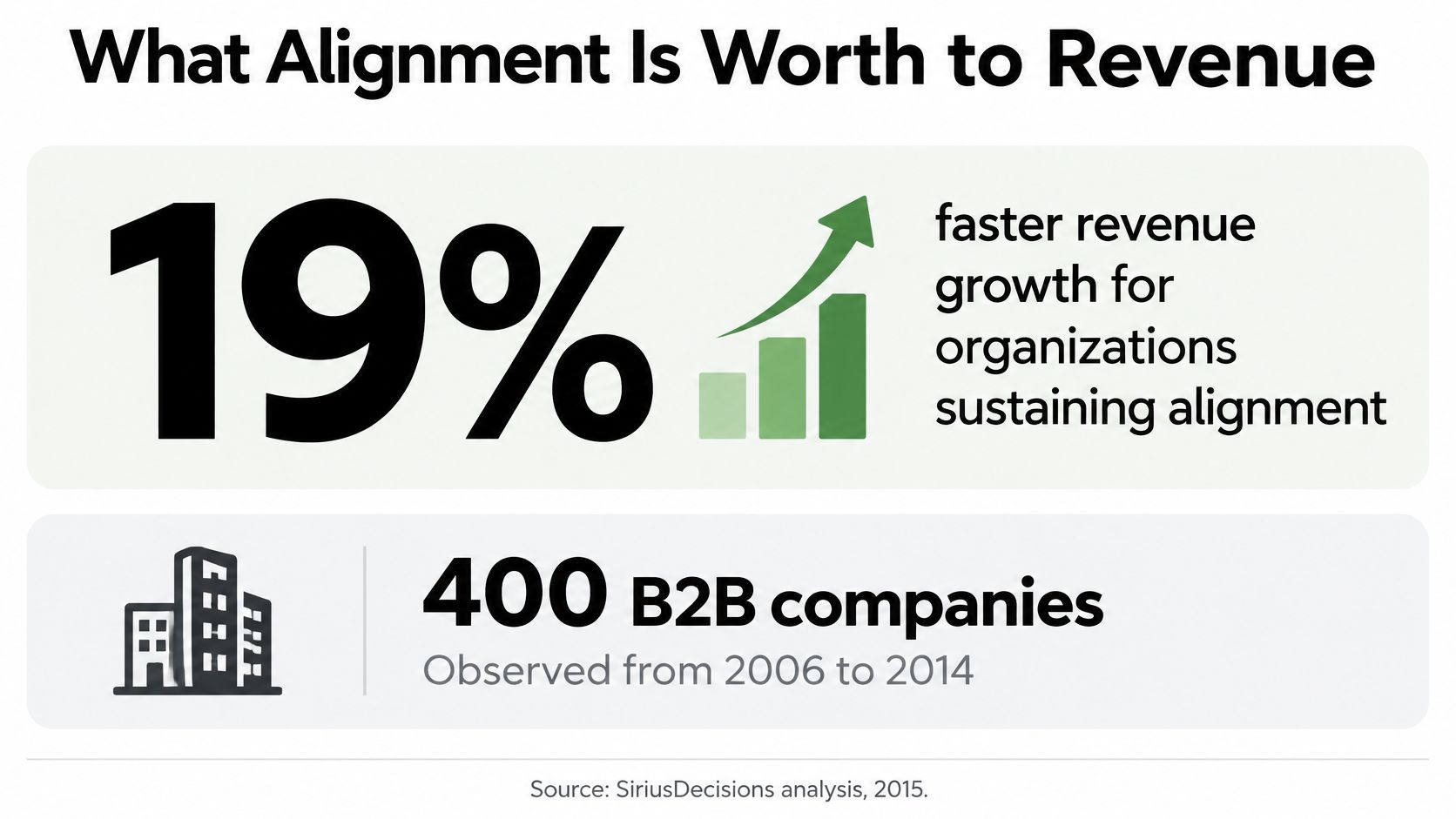
Those gaps do not prove alignment caused every point of growth. Pricing, product strength, market conditions, and plain execution all move the same numbers. What the comparison does show is that companies that kept coordinating outperformed less coordinated peers on revenue and profit, repeatedly, over long windows.
Why the gap is plausible
Three operating changes make the outperformance believable.
Shared lead definitions cut the weekly fight over whether a lead was "real." Coordinated targeting stops a rep from working accounts marketing is not supporting with air cover, and stops marketing from spending against accounts sales has already walked away from. Common attribution shows which campaigns sit on pipeline, not just which campaigns produced inquiries.
Say a 40-person B2B SaaS company reports 300 marketing leads a month and closes 9 deals from them. After one written definition and a handoff rule, leads fall to 180 and closed deals rise to 14. Volume dropped. Revenue did not. That is an illustration, not a benchmark, and it is the pattern I would rather manage.
In 2024, 75% of companies with completely aligned sales and marketing teams reported meeting their goals to a great or very great extent, compared with 53% overall, in a Pipeline360 survey finding.
Judge the work on revenue growth, win rate, retention, and profitability. Meeting attendance is not a commercial measure.
Shared KPIs Both Teams Should Own
Pick five or six KPIs. Give each one owner, one written definition, and one CRM field. Keep lead volume as a diagnostic. The moment it is the target, marketing will route anything with an email address.
Marketing owns sourced pipeline and influenced pipeline. Sales owns lead acceptance and win rate on marketing-sourced deals. Both own revenue per lead by source and CAC payback. If a metric has two owners and no field, it will become a slide, not a decision.
Sourced pipeline is opportunity value where the first known touch was a marketing channel. Influenced pipeline is opportunity value where any marketing touch appears on the journey. One deal can sit in both. A buyer clicks a LinkedIn ad in March, talks to a rep in April, and downloads a comparison guide in May. Sourced credit stays with the ad. Influenced credit still includes the guide. Mixing those two labels in one cell is how finance stops trusting the report.
The ownership table
| KPI | Definition | Primary owner | Review cadence |
|---|---|---|---|
| Marketing-sourced pipeline | Opportunity value where the first known touch was a marketing channel | Marketing | Monthly |
| Pipeline influenced | Opportunity value where any marketing touch appears in the journey | Marketing | Monthly |
| Lead acceptance rate | Share of routed leads that sales accepts | Sales | Weekly |
| Lead-to-opportunity rate | Share of accepted leads that become opportunities | Shared | Weekly |
| Win rate on marketing-sourced deals | Closed-won divided by closed deals, marketing-sourced only | Sales | Monthly |
| Speed to first touch | Median and 90th-percentile time from lead submission to first human contact | Sales | Weekly |
| Revenue per lead by source | Closed revenue divided by leads, split by channel | Shared | Monthly |
| CAC payback | Months needed for gross margin to recover acquisition spend | Shared | Quarterly |
Speed to first touch is a median and a 90th percentile, never a single average. Averages let a fast cluster of small leads hide a slow response on the accounts that actually pay. Review response time and acceptance weekly, pipeline and win rate monthly, and CAC payback with revenue per lead on the monthly or quarterly row above.
Teams that want to turn inbound leads into booked demos still need sales to own acceptance and first touch. A booked slot with no owner is activity, not pipeline. Field definitions that survive a challenge from finance are covered in this guide to measurement in marketing.
Someone outside both teams must be able to rebuild every KPI from the CRM. If they can't, the number will be a dispute, not a tool.
Settling Credit Disputes Between Sales and Marketing
Most alignment advice stops at shared goals, lead definitions, SLAs, and a recurring meeting. It rarely says what to do when the evidence conflicts: self-reported attribution, first-touch and last-touch reports, multi-touch journeys, sales-created opportunities, partner influence, offline conversions, and a nine-month cycle.
That is a governance failure, not a communication failure. You cannot sustain sales and marketing alignment while marketing is paid on lead volume and sales is paid on accepted opportunities or closed revenue.
An analysis of 105 companies found that 53% had a "broken hand-off," with sales contacting fewer than 35% of prospects who engaged with marketing advertising. Adding a meeting or another ebook does not fix a dispute over which activity created the pipeline.
The buyer is rarely one person
The form-filler is often not the economic buyer. In recent sales research, 66.3% of respondents found engaging senior executives and stakeholders during the sales process very or somewhat challenging, and 75.5% said converting marketing leads into qualified opportunities was challenging, as reported by RAIN Group. Marketing can generate real interest from one contact while sales still cannot see role, timing, or the offline conversation.
| Model | Credit rule | Works best when | Blind spot |
|---|---|---|---|
| First touch | 100% to the first known source | Measuring which channels start journeys | Ignores nurture and closing touches |
| Last touch | 100% to the last source before conversion | Short, direct-response sales cycles | Overvalues branded search and retargeting |
| Linear | Equal credit to every tracked touch | Long cycles with many touches | Treats minor touches as major |
| Position-based | 40% first, 20% middle, 40% last | Balancing discovery and closing | Weights are a convention, not measured |
| Time decay | More credit to touches closer to conversion | Short cycles with clear recency | Undervalues early research |
| Data-driven | Credit fitted to observed conversion patterns | Enough volume and clean data | Hard to explain to finance |
No single row settles a fight with finance. Use one model for budget decisions and a second for diagnosis. Write both into a one-page measurement charter. Add a tie-break: credit sales when a rep created the opportunity from an outbound touch, and say so in the charter so nobody relitigates it on a forecast call.
Measure at account and contact level. A single lead ID hides the committee, the partner, and the meeting nobody logged.
Closed-loop reporting only works after that charter exists. A practical walk-through of tying outcomes back to touches is in this note on closed-loop attribution.
Handoff SLAs for Leads and Pipeline
An SLA is a written, two-sided promise. Marketing routes only leads that meet explicit criteria and arrive with complete source data. Sales commits to a maximum first-touch time and a recorded outcome on every lead. A shared quarterly target is not that promise.
Speed is the variable people underestimate. Companies responding to inbound web leads within five minutes were approximately 100 times more likely to connect with the lead and 21 times more likely to qualify it than companies waiting 30 minutes, in research summarized by a sales and marketing SLA playbook.
Measure the clock, not a memory
Use event timestamps, not a rep's recollection of "we usually call back fast." Capture five times on the lead: form or booking submission, enrichment and routing, assignment, first human contact, and qualification.
- Report median and 90th-percentile latency separately by channel, territory, business hours, and lead type. A pretty average can hide a stalled enterprise account.
- Fire an alert when an accepted lead sits untouched past its SLA. The alert goes to a named manager, not a shared inbox nobody owns.
- Each week, compare response-time cohorts with qualification rate, opportunity rate, and revenue per lead. Then change routing capacity, the qualification threshold, or campaign spend. Don't change all three in the same week or you won't know which move worked.
The same clock applies when the lead did not come from a form. Ever Outbound's meeting-ready leads still need an owner and a logged outcome, or the meeting is a calendar event with no pipeline behind it.
| Handoff point | Marketing commits to | Sales commits to | Measured by |
|---|---|---|---|
| Qualification | Route only leads meeting the agreed score and required fields | Accept or reject every lead with a reason within one business day | Acceptance rate and rejection reasons |
| First touch | Deliver the lead with source and page history within one minute | First human contact within 5 minutes in business hours | Median and 90th-percentile response time |
| Follow-up cadence | Supply the content and sequence agreed for each segment | Minimum touch cadence per segment, for example 3 touches in 7 days | Touches logged per accepted lead |
| Escalation | Alert the sales manager when an accepted lead passes its SLA | Reassign or confirm an owner within 2 hours of an alert | Breaches per week |
| Recycling | Return rejected leads to nurture with a reason tag | Return unresponsive leads after the agreed number of attempts | Recycled lead conversion rate |
| Feedback loop | Review rejection reasons and adjust targeting monthly | Log the outcome of every opportunity in the CRM | Monthly review completed on time |
Sign the template. If a row has no metric, it is a hope.
Syncing CRM and Attribution Data Across Teams
Treat attribution sync as measurement governance. Sales and marketing need one auditable revenue dataset, agreed field ownership, and a clear rule for credit before another dashboard or tool can settle disputes. The CRM, ad platforms, and web tracking can otherwise assign different sources to the same person.
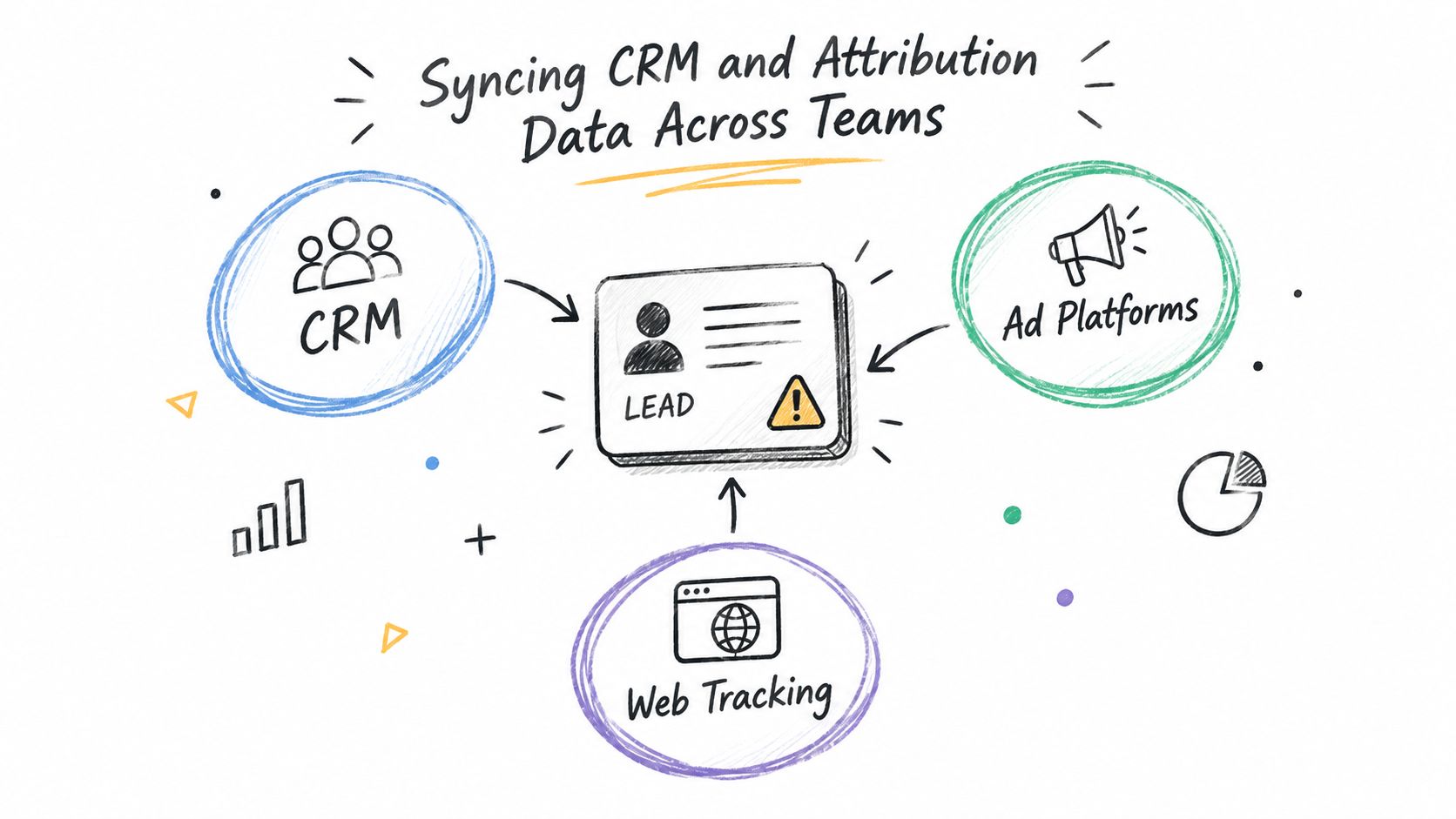
Six objects and where each one flows
- UTM source, medium, and campaign should be captured at form submission and written to the CRM lead. Keep the original values intact so both teams can trace the recorded source.
- Lead status and lifecycle stage sync both ways between the CRM and marketing automation. A rejection in Salesforce should appear in HubSpot the same day, with stage definitions mapped consistently.
- Deal amount and close date flow from the CRM to the attribution view and ad platforms whenever they change, rather than only at quarter-end.
- Booking and call outcomes belong in CRM activities, logged when the event happens. Reconstructing them later from a calendar can leave the opportunity record incomplete.
- Payments flow from the processor, such as Stripe, into the attribution report and the CRM deal. Reconcile the payment to the deal so reported revenue has a traceable source.
- Qualified offline conversions from closed-won and qualified stages flow on a schedule to Google Ads, Meta (CAPI), and LinkedIn. This gives bidding systems conversion signals tied to qualified outcomes rather than form fills.
UTM values often get lost between the form and the CRM. Use this field-level guide to sending lead source to your CRM to map the first object and preserve its values.
What usually fails
A site builder can rewrite a form post and drop UTMs. A rep may enter deal value manually, then leave it unchanged after a discount. A renamed CRM stage can also break the marketing lifecycle map. In each case, sourced pipeline becomes unreliable because the underlying fields no longer agree.
Map the fields before connecting systems. Then send one test lead through the form, enrichment, assignment, opportunity, and a payment or closed-won stage. Compare source, owner, amount, and stage in each system. If the values differ, fix the mapping before relying on the dashboard.
HubSpot, Salesforce, or Pipedrive can serve as the system of record. SourceLoop supports two-way CRM sync with those platforms, sends qualified offline conversions to Google Ads, Meta (CAPI), and LinkedIn, and offers webhooks and a REST API for custom mappings. Choose field owners and document the direction of each sync first, especially where two-way updates could overwrite a value.
A short walkthrough of how visits connect to a single profile can help teams decide which fields they need before setting up the mapping.
How to Build Alignment in 90 Days
Do the setup in the first month. A dashboard built before the definitions are signed just gives you two versions of the same number, faster.
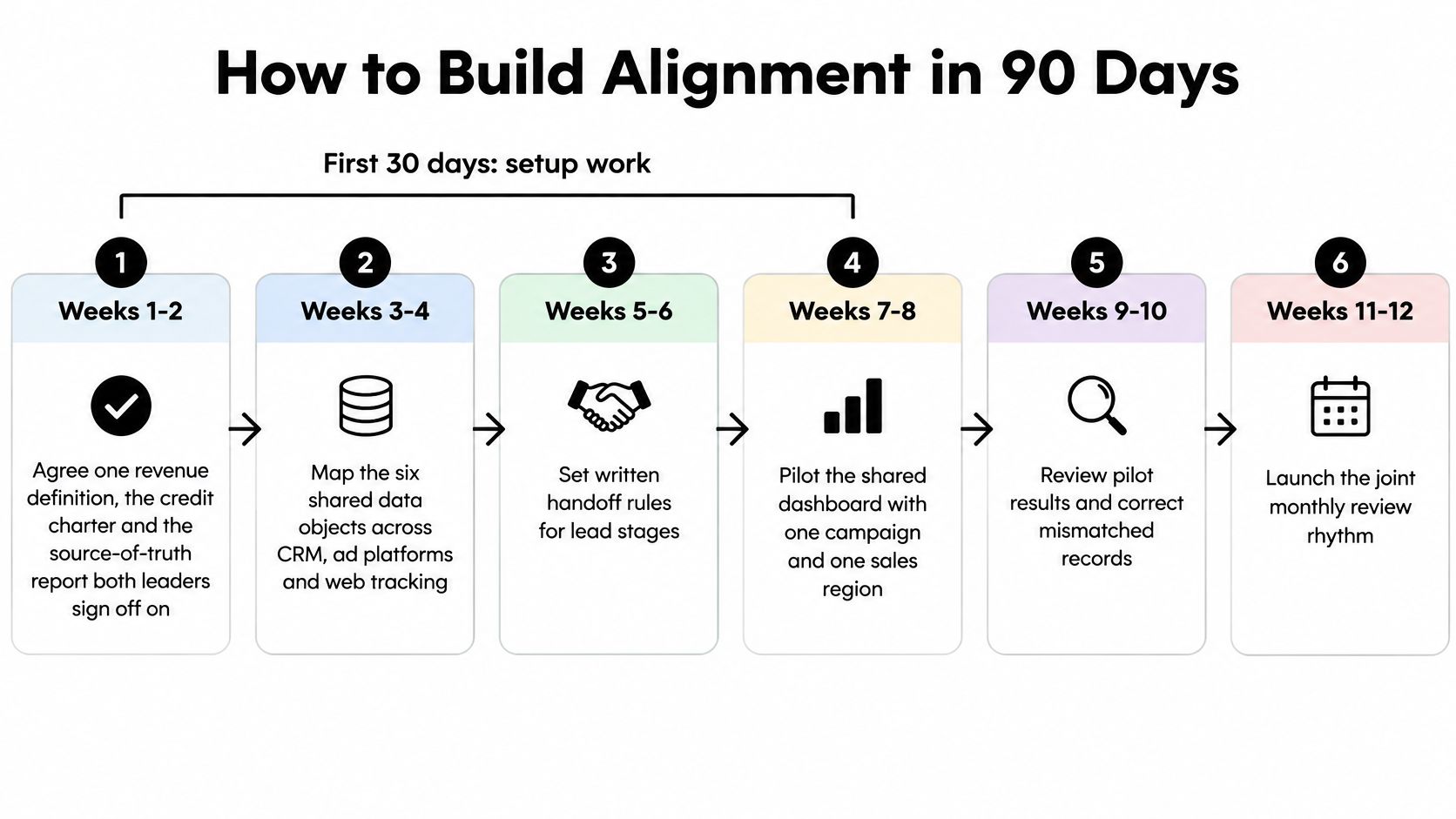
- Weeks 1 to 2. Agree one revenue definition, the credit charter, and the source-of-truth report both leaders will quote. The slip is letting each team keep a private dashboard "just for internal use." That dashboard becomes the number they defend.
- Weeks 2 to 3. Map lifecycle stages: lead, accepted lead, opportunity, closed-won. Write entry and exit criteria for each stage in one paragraph a new hire can apply. If exit from "accepted" is "a rep feels it's real," you don't have a stage.
- Weeks 3 to 4. Draft the handoff SLA from the template above. Name one owner per KPI. Both leaders sign both documents. Unsigned, they are suggestions.
- Weeks 4 to 6. Build one shared dashboard with sourced pipeline, acceptance rate, and speed to first touch. Building it earlier is the common slip, and it produces a second argument with nicer charts.
- Weeks 6 to 8. Pilot on one segment or one territory. Review rejections and response times weekly. Piloting every segment at once hides which change caused which result. A launch readiness guide for SaaS teams is a useful checklist for who must sign before you widen the pilot.
- Weeks 9 to 12. Expand to the other segments. Retire any metric the teams still dispute. Put the quarterly review date on the calendar the day you start, not the day you finish.
The first joint review
Open that review with the alignment check, using exports, not opinions. Before any campaign postmortem, run one test lead from form submission through to closed-won or a payment. If the path breaks, the rest of the agenda is theater.
The rollout is working when rejected-lead disputes drop and both teams can name the same opportunities. Check that on the review date you set the day of the first meeting. If the disputes are unchanged, the charter is not in force yet, and another workshop will not put it in force.
This Friday, export last month's leads with owner, first-touch timestamp, original source, stage, and closed revenue. Put the sales manager and the demand lead in a room with that file, not a slide. Leave only after both have signed one credit rule and one first-touch SLA. If someone outside either team can't rebuild the file, fix the fields before you buy another platform or book another offsite.



 Paid Social


