
What Is a Touchpoint in Marketing? Examples and Tracking
Discover What Is a Touchpoint in Marketing, with examples across web, email, chat, ads and bookings, and how to track them.
A marketing touchpoint is any interaction in which a person encounters, evaluates or responds to a brand on the way to a purchase.
You're looking at a new demo request in your CRM. The source says organic search, but the prospect mentions a video ad and a colleague's recommendation. Which interaction brought them in? To answer that, you need more than a channel label. You need to know what happened, when it happened and what the buyer did next.
Table of Contents
- What a Touchpoint Means in Marketing
- Touchpoint Examples Across Web, Email, Chat, Ads and Bookings
- How Touchpoints Shape the Customer Journey
- Why Last-Click Credit Misleads
- How to Map and Track Touchpoints Step by Step
- Touchpoint Blind Spots and Privacy Limits
- Map Your First Touchpoints This Week
What a Touchpoint Means in Marketing
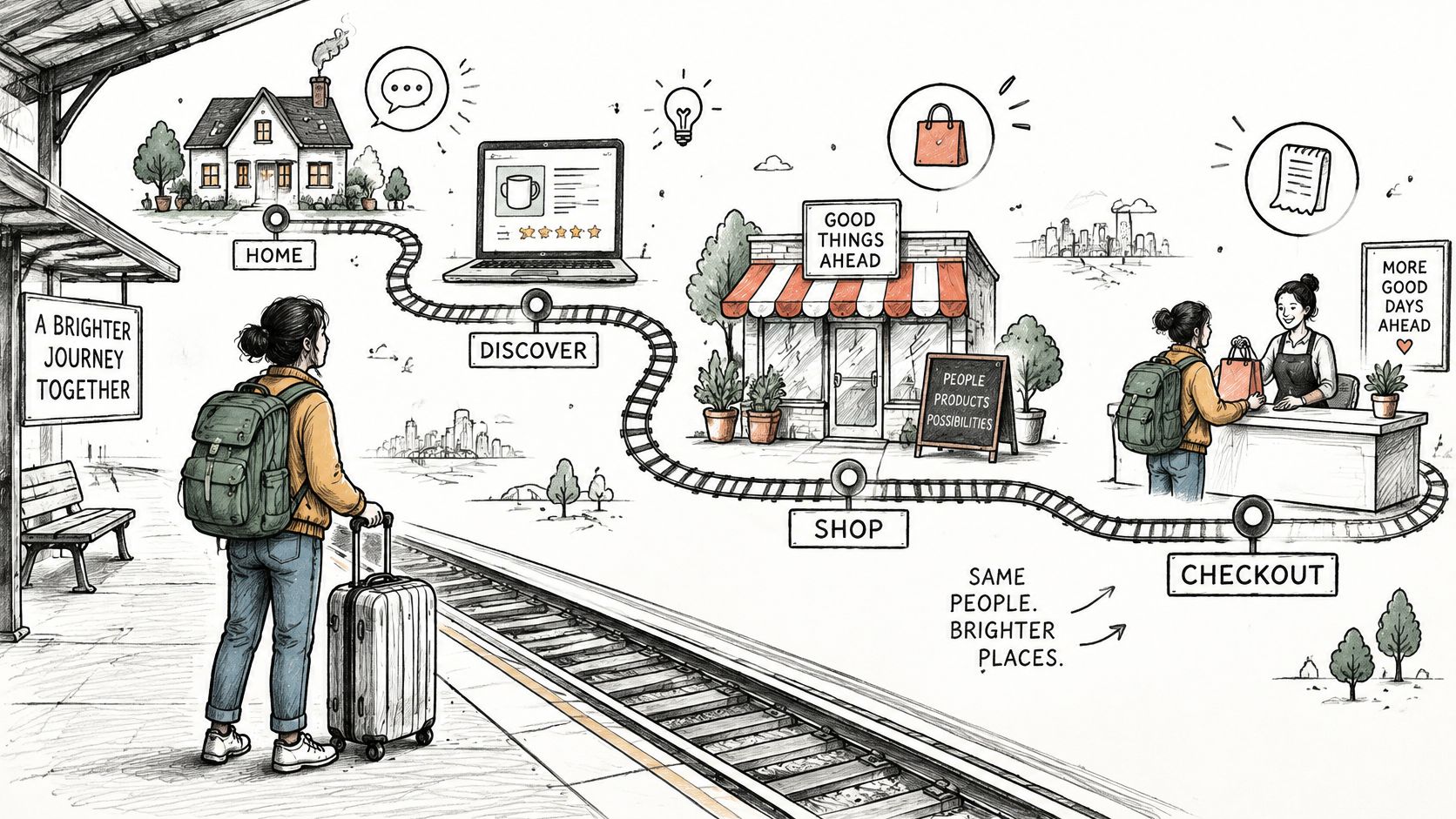
Think of a customer journey as a train trip. Each station is an opportunity for the traveler to move forward, pause or change direction. A search result, a friend's recommendation, a product review and a sales call are all possible stops.
The route isn't necessarily direct. Someone might encounter paid advertising, organic search, social content, your website, reviews, email, video, sales conversations and customer service before reaching checkout. Returning to the same website creates another interaction, not a continuation of an undated channel label.
Google's customer-journey guidance describes a consumer who interacted with more than 250 touchpoints over 73 days before buying jeans, including searches, video views and page views. That's an example of a particular journey, not a target number of interactions every business needs.
Channel, campaign, touchpoint and conversion
These terms describe different things:
- Channel: The medium, such as email or paid social.
- Campaign: A coordinated marketing effort, such as promoting a product launch through email and advertising.
- Touchpoint: A specific, dated interaction, such as clicking a case study link in a launch email.
- Conversion: A defined outcome, such as submitting a demo request or completing a purchase.
If someone asks, “What is a touchpoint in marketing?” think an event in someone's journey, not the name of the medium.
Counting only the final event can hide earlier interactions that helped someone discover or evaluate the brand. But the reverse mistake matters too: recording an interaction doesn't mean it caused a purchase. A touchpoint is evidence that something happened, not automatic proof of influence.
Touchpoint Examples Across Web, Email, Chat, Ads and Bookings
| Channel | Touchpoint example | What it signals | Record this |
|---|---|---|---|
| Web | Visit to a pricing page | Evaluation of cost and fit | Timestamp, landing page, source |
| Click on a case study link in a nurture email | Consideration after subscribing | Campaign, link, subscriber ID | |
| Chat | Question typed into a website chat widget | A specific objection or buying question | Chat start time, page, lead ID |
| Ads | Paid social video view followed by a click | Interest created by a campaign | Platform, campaign, ad creative, click ID |
| Bookings | Demo booked through a calendar link | Stated intent to talk with sales | Booking time, source, meeting outcome |
| Organic search | Branded search for the company name | Recall from earlier exposure | Query when available, landing page, date |
A pricing-page visit suggests that someone is evaluating the offer, but it doesn't establish their budget or authority to buy. An email case study click tells you which evidence interested a subscriber, rather than merely whether the email reached their inbox.
A chat question can reveal a concrete barrier, such as uncertainty about an integration. An ad view followed by a click combines exposure with an active response, so record those as distinct events.
Read the signal without overstating intent
A booking gives sales a reason to follow up, but the meeting outcome determines whether it becomes qualified pipeline. A branded search suggests existing awareness, although you might not know whether the person first heard about you through an ad, a colleague or an offline conversation.
Trust also differs across interactions. In Nielsen's 2015 global advertising study, 83% of respondents trusted recommendations from friends and family, while 66% trusted consumer opinions posted online. Those findings concern reported trust, not conversion rates, but they explain why a recommendation and a promotional message shouldn't be treated as interchangeable.
A review might reduce perceived risk. A product page might answer a technical question. A promotional email might prompt someone to return when they're ready.
For sales-assisted journeys, LeadBeast's explanation of core sales engagement capabilities is useful context for understanding how follow-up activities fit alongside website events.
Audit prompt: For each channel, identify an interaction before the buyer asks a question and another after they've decided to buy.
You may discover that you track acquisition carefully but lose visibility once someone starts talking to sales. That's a measurement gap worth fixing before adding another dashboard.
How Touchpoints Shape the Customer Journey
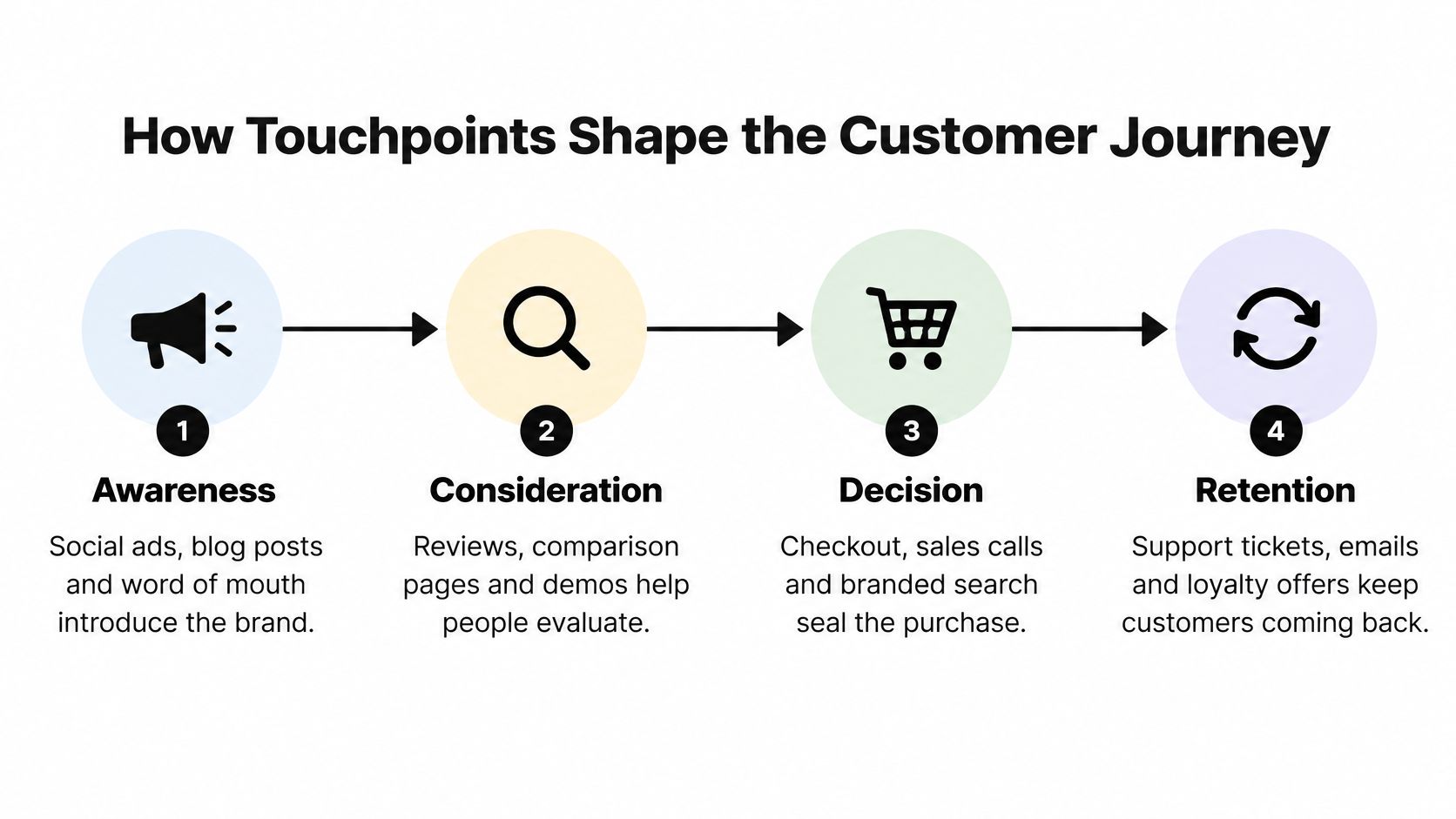
A practical journey map groups interactions into awareness, consideration, decision and retention. These stages describe the buyer's task, not a rigid route everyone follows. Someone can return to comparison research after a sales call or read a review immediately before checkout.
| Stage | Typical touchpoints | Role in the journey | What to measure |
|---|---|---|---|
| Awareness | Paid ads, social video, organic search | Introduces the brand | Reach and first-touch source |
| Consideration | Reviews, comparison pages, webinars | Builds trust and evaluates options | Repeat visits and content engagement |
| Decision | Pricing page, sales call, checkout | Removes final friction | Bookings, demos and purchases |
| Retention | Onboarding emails, support chat, renewal reminders | Keeps the customer and supports repeat purchase | Retention rate and expansion revenue |
Say a prospect discovers your software through an advertisement, compares alternatives through search and reads reviews. They return to your website, speak to a salesperson and submit an order. Each interaction has a different purpose within that sequence.
The same format can serve different purposes, too. An introductory video may explain a problem to a new visitor, while a technical video helps an existing customer adopt a feature.
Add context to the event
A 2025 operations-research study on attribution examines the complex interplay among touchpoints within and across channels, proposing a way to model their relationships rather than treating them independently. For practitioners, the useful lesson is to preserve context.
Attach metadata that distinguishes:
- First or repeat exposure: Is this discovery or a return visit?
- Anonymous or known visitor: Can you connect the event to a person legitimately?
- Qualification status: Did it occur before or after sales accepted the lead?
- Time to outcome: How long passed before the next meaningful milestone?
- Commercial result: Did the path reach pipeline, payment or renewal?
When choosing customer journey mapping tools, check whether they can represent these differences rather than drawing channel icons.
Context also includes the market. Lead Printer's guide to localizing partner campaigns for new markets offers a useful companion perspective when partners introduce buyers through different language, messaging or sales environments.
Judge an interaction by the milestone it helps the buyer reach. What happened and what changed afterward belong beside each other.
Why Last-Click Credit Misleads
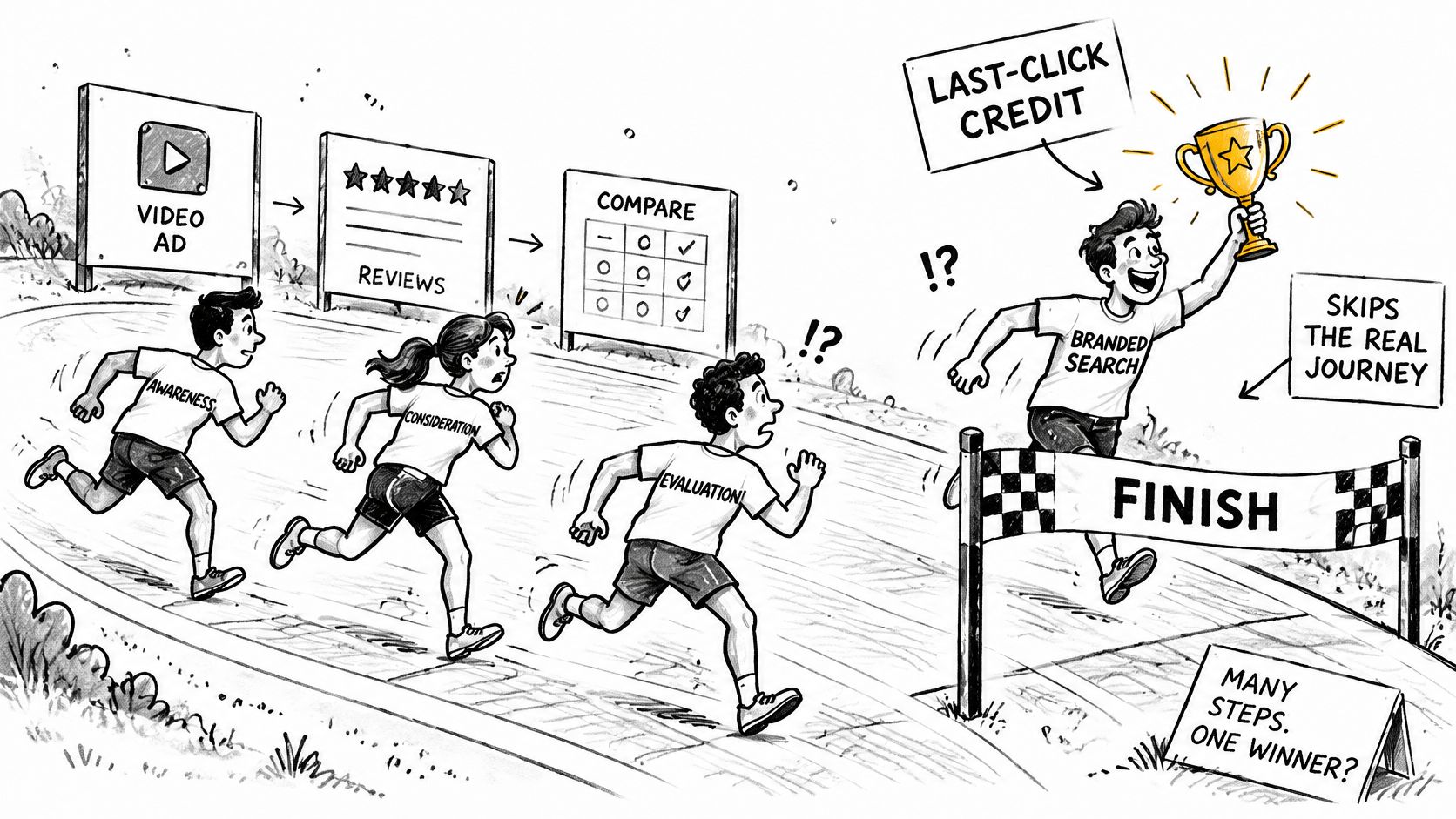
Say a buyer watches a video ad, reads a review and visits a comparison page. Later, they search for your company name and purchase. A last-click report gives the branded search the credit, even though the person already knew which company to find.
This illustration captures that imbalance.
| Model | Credit rule | Blind spot |
|---|---|---|
| First-touch | All credit to the opening recorded interaction | Ignores nurture and closing steps |
| Last-touch | All credit to the closing recorded interaction | Credits branded search and checkout |
| Linear | Equal share to every touchpoint | Treats weak and strong interactions alike |
Up North Media's comparison of crediting the first or last click helps clarify those endpoint rules. Neither endpoint tells you the whole story, and spreading credit evenly doesn't automatically make the result more accurate.
Attribution isn't proof of causation
People who visit pricing pages or click several ads may already be more likely to buy. Their activity can correlate with conversion without showing how much additional demand the marketing created.
Google's attribution guidance recommends mapping online and offline interactions and identifying touchpoints you aren't measuring. Build that map with exposure and engagement separated, events in order, elapsed time preserved and duplicate records removed.
The embedded video provides another format for exploring attribution.
Evaluate outcomes beyond form submissions: qualified opportunities, bookings, payments and retained customers. Also record whether an interaction was user-initiated, marketing-delivered, sales-assisted or customer-generated, so you don't confuse sending a message with receiving a response.
Use attribution modelling in marketing to compare plausible interpretations, not to manufacture certainty.
Optimize toward qualified pipeline or revenue. Use multi-touch paths to investigate assistance, then test whether changing the activity changes the outcome.
How to Map and Track Touchpoints Step by Step
Start with the interactions your team handles, not an idealized diagram. Sales notes, support tickets, website analytics and booking records will show where to begin.
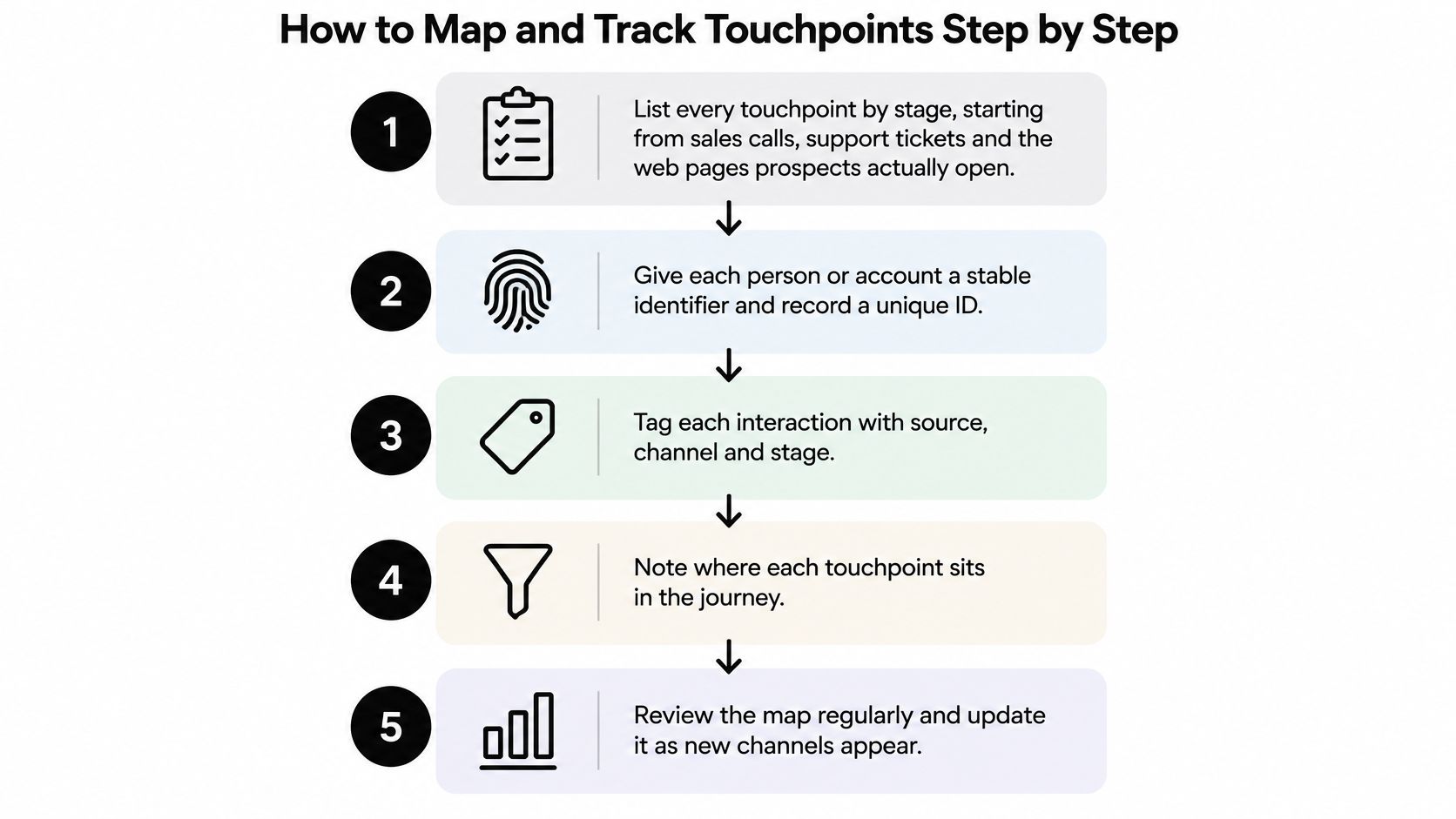
Build an event record you can follow
Inventory the customer journey. List interactions by stage, including sales calls, support conversations and the pages prospects open. Ask the people handling those conversations what customers mention, because a web-only inventory leaves out activity your colleagues already know about.
Establish identity and timing. Give each known person or account a stable identifier, and record a timestamp and event identifier for each interaction. Don't merge anonymous visitors into a contact merely because their behavior looks similar, and don't treat a shared company account as proof that every interaction came from the same person.
Tag marketing links before launch. Use UTM parameters for source, medium, campaign and content on links you control, then validate the destination and parameter values. Missing tags can obscure campaign origins, while inconsistent naming splits the same campaign across reports; keep internal navigation free of acquisition UTMs.
Carry source details into the conversion. Capture the source, campaign, click ID when available and landing page on your domain, then preserve that information through forms, chats and bookings. Test calendar handoffs and embedded widgets, because a working submission doesn't guarantee that its attribution fields arrived.
Connect the CRM and commercial outcome. Join contact activity to meetings, deal stages and payments, with retention governed by your consent and data-handling policies. Offline outcomes stuck in a salesperson's notes won't help you assess the campaign that preceded them.
Review and reconcile regularly. Compare opening, closing and assisted interactions against qualified pipeline, and inspect missing fields or duplicate events before changing budgets. A channel that appears valuable in a lead report may look different once you exclude spam and disqualified inquiries.
Check the handoff, not just the tracking script
Our snippet records source, campaign, click ID and landing page as first-party data on the customer's own domain. When a lead converts through a form, chat or booking, we attach all 8+ attribution data points and push the lead to the CRM.
Whatever implementation you choose, test the complete path with a clearly labeled test lead. Confirm that the source survives the submission, reaches the right CRM fields and remains associated with the eventual deal.
A usable record: A lead or account, an ordered list of dated events, the available source for each event and a current commercial stage.
Touchpoint Blind Spots and Privacy Limits
A prospect forwards your website in a private message, calls from another device and declines tracking consent. Your reports may capture the eventual form submission without showing how they reached it. A complete-looking timeline isn't necessarily a complete journey.
Fragmented systems create another limit. In Adobe's retail digital trends report, drawing on research involving 3,400 marketers and customer-experience professionals, fragmented data prevented 41% of retailers from delivering real-time personalization, while 35% reported inconsistent cross-channel experiences. Those are retail findings, not a benchmark for every marketing team, but they illustrate the practical consequences of disconnected information.
Make uncertainty visible
Handle missing information explicitly rather than filling the gaps with confident assumptions:
- Off-domain activity: Mark unobserved exposure as unknown. A self-reported recommendation is useful context, but it isn't a tracked click.
- Unlogged conversations: Give sales and support a consistent place to record the interaction and outcome.
- Unavailable identity: Keep anonymous events separate unless you have a legitimate basis for connecting them.
- Consent limits: Respect the person's choice and applicable regional requirements instead of trying to reconstruct prohibited tracking.
First-party collection describes where information originates. It doesn't, by itself, establish permission for every use. Review consent, collection purpose, access and retention alongside technical implementation; our guide to GDPR-compliant conversion tracking provides practical context.
A payment, refund, booked meeting or sales conversation may tell you more about commercial progress than another page view. Include those outcomes where you can do so appropriately, and disclose which systems or interactions remain outside your reports.
The right standard is a defensible connection between consented interactions, qualified outcomes and revenue, not the largest possible event count.
Map Your First Touchpoints This Week
Choose a funnel with a clear business outcome, such as a demo request or quote form. Give a named owner a month-long audit window and a concrete question: Which entry sources lead to qualified conversations?
Keep the scope small enough that someone can investigate individual records. A useful audit result is a specific finding, such as campaign details disappearing at the calendar handoff, not another dashboard nobody owns.
Choose the level of tracking you need
| Choose manual mapping when | Choose automated tracking when |
|---|---|
| You're investigating a narrowly defined funnel | Calls, chats, bookings and payments sit in separate systems |
| Sales can reconcile records without losing context | Multiple teams need the same source information |
| You need to understand the fields before integrating tools | Manual reconciliation prevents timely decisions |
In a spreadsheet, give each interaction its own row rather than squeezing an entire journey into a source column. With automation, assign responsibility for field definitions and quality checks; connecting systems won't resolve inconsistent qualification criteria.
Before the audit ends, report the share of tracked leads reaching a qualified meeting and the revenue you can trace to consented interactions. Treat channels with promising assisted paths as candidates for testing, not automatic winners, and don't cut a closing interaction merely because it happens late.
Start your audit this week by selecting the funnel and assigning its owner. Use our free UTM Campaign Builder and UTM Validator to check incoming links. If your main gap is disconnected sales activity, consider SourceLoop's meeting tracking, which ties every booked meeting back to its original marketing source, so you can evaluate the conversation alongside the interactions that preceded it.




 Paid Social


