
Best Meta Ads Attribution Tools: Which Ones Actually Work
Best Meta Ads Attribution Tools compared for agencies, ecommerce and B2B, plus a two-week test to check each one matches Meta conversions to real revenue.
The most popular advice about Meta attribution tools is to compare dashboards, count attribution models, and choose the platform with the clearest return-on-ad-spend report. That's the wrong starting point. A tool earns its place when you can reconcile the conversions it credits to Meta with qualified opportunities and revenue in your CRM.
The best Meta Ads attribution tools should help you make a defensible budget decision, not just produce a different conversion total. Start with your sales process, require evidence that downstream outcomes reach Meta, and test whether the tool can explain the gap between advertising credit and actual customers.
Table of Contents
- Best Meta Ads Attribution Tools by Situation
- Why Meta Reports Conversions Your CRM Does Not Match
- Map Funnel Stages to Find Drop-Offs
- Five Checks Before You Pay for an Attribution Tool
- Where SourceLoop Fits for Agencies and Lead-Gen Teams
- Testing Lift and Auditing a Tool Before You Commit
Best Meta Ads Attribution Tools by Situation
No attribution tool wins on dashboard appeal alone. Compare each option by whether it can connect Meta-reported conversions to CRM-qualified outcomes and revenue, then return useful signals to the ad platform. The right shortlist depends on what your team sells and where conversion data lives.
| Tool | Best for | What to verify |
|---|---|---|
| SourceLoop | Agencies, lead-gen teams, and SaaS companies tracking leads through revenue | Confirm that qualification rules and deal values shape the outcomes sent to Meta. A free trial is available. |
| Triple Whale | Shopify and ecommerce brands | Check whether the proposed setup sends the purchase outcomes you need, beyond improving ecommerce reporting. |
| Northbeam | Higher-spend ecommerce brands assessing more involved measurement | Confirm whether Meta receives conversion events, attribution credit, or both. |
| HockeyStack | B2B teams with complex journeys and long sales cycles | Check CRM lifecycle coverage and whether qualified outcomes reach Meta. |
| Dreamdata | B2B teams with clean CRM data | Confirm which qualified outcomes can be returned to Meta. |
| AppsFlyer | Mobile app install attribution | Verify that valuable post-install outcomes can be delivered, rather than relying on install measurement alone. |
| Hyros | Phone-led funnels where calls close deals | Require evidence that completed sales, not just calls, reach Meta. |
The deciding question for each tool
- SourceLoop: Can qualification rules and deal values determine which outcomes are sent to Meta?
- Triple Whale: Does the setup send the purchase outcomes your team needs, or mainly improve ecommerce reporting?
- Northbeam: What reaches Meta, and can your team distinguish raw conversions from assigned attribution credit?
- HockeyStack: Can an account journey resolve into the opportunity and closed-won records your sales team uses?
- Dreamdata: Do your CRM's contact, company, and opportunity relationships support a trustworthy revenue allocation?
- AppsFlyer: Can you assess valuable post-install behavior instead of choosing campaigns on installs alone?
- Hyros: Can a tracked call retain its advertising origin through to the sale that closes later?
These questions distinguish measurement from optimization feedback. A tool may explain a customer journey without sending Meta the outcome your media buyer wants the platform to optimize toward. Ask for a demonstration using your event definitions and CRM stages, and check what data is returned.
Check the model before believing the ranking
Meta's 2025 white paper reported that rules-based attribution models undervalued Meta advertising by 31% at the median, based on 307 studies involving 54 advertisers, according to PPC Land's coverage of Meta's analysis. That result does not identify the best vendor. It does make a vendor's default model a purchase decision, not a technical footnote.
Ask each vendor to run the same revenue cohort through its default model and an alternative. Compare campaign rankings, check whether unassigned revenue remains visible, and see whether changing models alters historical reports. A model that changes rankings without making the reasons clear can make budget decisions harder to defend.
The implementation and commercial scope also matter. Request an itemized proposal for CRM integration, event feedback, exports, and analyst support, rather than comparing headline subscription fees alone. There is no default winner when one buyer needs purchase tracking and another needs qualified pipeline.
Why Meta Reports Conversions Your CRM Does Not Match
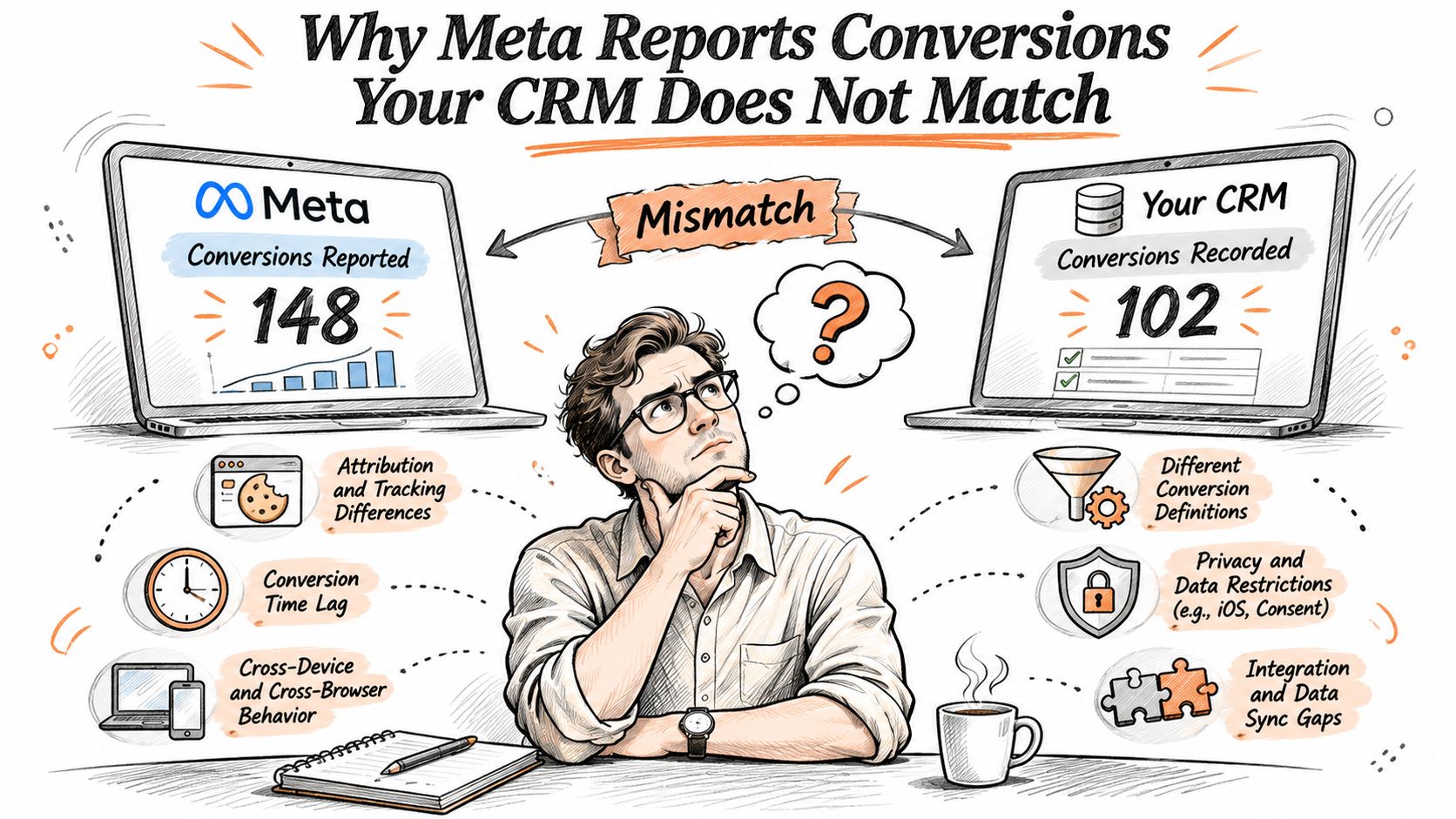
Say a customer sees a Meta ad without clicking, later clicks a Meta ad during another visit, and purchases after that. Your CRM may record the purchase under the final visit's source. Whether Meta also claims it depends on the interaction and attribution window selected for that report.
A disagreement like this is a reconciliation problem, not automatic evidence that either system has failed.
What the attribution window changes
Meta's attribution guidance describes window-based conversion credit and warns against directly comparing ad sets that use different attribution models; supported settings and historical reporting configurations include the following.
| Setting | What it counts | Watch out for |
|---|---|---|
| 1-day click | Conversion within 1 day after a link click | Narrowest listed click window; excludes slower decisions |
| 7-day click | Conversion within 7 days after a link click | Can include conversions excluded by the shorter click window |
| 1-day view | Conversion within 1 day after an impression, even without a click | Credits an ad the customer only saw |
| 7-day view with 1-day click | A configuration identified as the default in some reporting interfaces | Allows a longer period for impression credit than click credit |
| 1-day view with 28-day click | Historic default in some API evaluation specifications | Older reports may include a substantially broader click-credit period |
The important distinction is eligibility for credit versus proof of influence. A conversion inside a window can qualify for attribution without demonstrating that the ad caused the purchase.
Don't assume that a setting encountered in an API, an old export, and a current Ads Manager report describes the same counting arrangement. Preserve the configuration associated with the actual report.
Reconcile definitions before totals
Your CRM and Meta can also answer different business questions. A CRM-qualified lead is not interchangeable with a submitted form, and a closed deal is not necessarily equivalent to a payment received.
Build a closed-loop attribution process that keeps the advertising interaction alongside the customer's lifecycle record. Include the conversion event, report window, attribution model, reporting date basis, currency, and refresh time in your reporting specification.
Practical rule: Compare like-for-like events under like-for-like settings before deciding that a channel is overperforming or underperforming.
A broader attribution window can explain a larger platform total. It can't, by itself, tell you whether those additional credited customers were incremental.
Map Funnel Stages to Find Drop-Offs
A campaign can generate inexpensive leads and still be a poor place to invest. The useful question is where those leads stop advancing, and whether that weakness persists after sales has had time to work them.
Define the funnel using events that marketing and sales can identify consistently. Don't let a vendor's default dashboard decide what qualifies as an opportunity.
| Stage | Conversion metric | Drop-off signal |
|---|---|---|
| Awareness | Reach-to-click rate, with click counting defined consistently | Ads are seen but attract few link clicks |
| Consideration | Landing-page visit-to-lead rate | Visitors arrive but don't submit a form |
| Qualification | Lead-to-opportunity rate | Leads don't become qualified sales conversations |
| Decision | Opportunity-to-closed-won rate | Opportunities stall or are lost before close |
| Revenue | Average deal value and acquisition payback | Won deals don't justify acquisition and delivery costs |
Revenue isn't another stage conversion rate. Average deal value measures what closed business is worth, while payback requires an explicit revenue or margin basis. Keep those economics separate from the percentage of records advancing through the funnel.
Diagnose the weakest transition
Use this sequence for funnel conversion analysis:
- Align the cohort. Pull campaign interactions and CRM stage histories using consistent source definitions. For a long sales cycle, follow leads acquired in the same period rather than dividing this month's wins by this month's new leads.
- Calculate stage rates. Divide each advancing group by the eligible group immediately before it. Compare campaigns with similar offers, audiences, and sales maturity.
- Test the likely constraint. Change the landing page when visitors fail to become leads, or tighten targeting and qualification when submissions fail to become opportunities. Measure again after the cohort has had a full opportunity to convert.
A worked comparison without false precision
Suppose a broad-audience campaign produces more forms than a specialist-audience campaign. The broad campaign looks stronger in Ads Manager, but sales rejects many submissions because the buyers don't meet your service requirements.
The specialist campaign produces fewer leads, yet more of them enter credible opportunities and close at an acceptable acquisition cost. Your next test should preserve that qualification advantage while improving the ad or landing-page response, rather than copying the broad campaign's offer.
Don't fix a qualification problem by purchasing more of the same unqualified traffic.
Compare both the absolute opportunity count and the stage rate. A high qualification rate from a tiny campaign doesn't automatically justify scaling, just as a large lead total doesn't justify continued spend when downstream economics fail.
Five Checks Before You Pay for an Attribution Tool
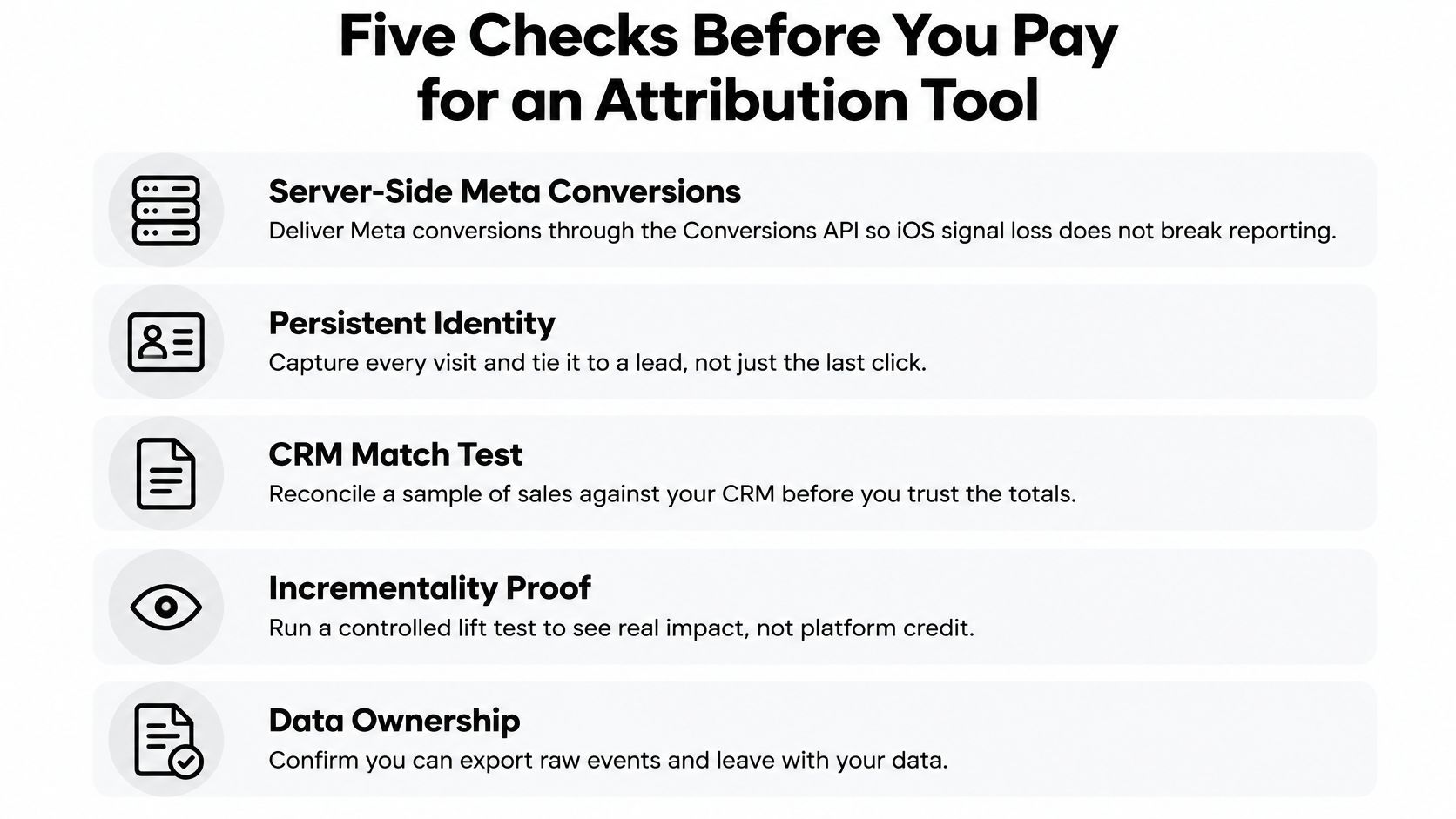
A model count won't tell you whether the underlying events are usable. Meta's Conversions API documentation supports website, app, offline, messaging, and CRM events, including downstream sales outcomes; its data-quality diagnostics also address value, currency, and event-delay problems.
Use implementation evidence as the buying gate. Require event logs and record-level examples, not just a polished report.
Require observable pass conditions
Server-side Meta delivery. Browser-only delivery makes the browser a dependency for reporting the outcome. We send Meta conversions server-side so iOS and ad blockers cannot drop that server-delivered event; a pass means you can inspect the payload and delivery result, not merely see an integration marked connected.
Identifiers and deduplication. Ask the vendor to trace the available click and customer identifiers through an actual lead record, then demonstrate how browser and server copies of the same event are deduplicated. Pass when the same business event has a consistent identity and duplicate delivery doesn't create duplicate outcomes.
Lifecycle and value mapping. Test the transition from lead to opportunity to closed-won, including the monetary value and currency. A good result preserves the distinction between stages and doesn't repeatedly count an updated deal as newly acquired revenue.
Latency and rejected events. Inspect the time between the business outcome and delivery, then review rejected, delayed, and retried events. Pass when the vendor can identify failures, explain which events arrived too late for attribution, and show how someone is notified.
CRM reconciliation. Trace an ad-originated customer through the full lifecycle and compare the eligible CRM population with the tool's matched records. Require a numerical discrepancy, plus a reason for every excluded, duplicated, or unmatched record in the test sample.
Keep the audit evidence
Export the event records, identifier coverage, deduplication results, delivery latency, and rejection reasons. Also confirm whether you can retain those exports after leaving the service.
A clean sample journey proves that the path can work. A population-level reconciliation establishes whether it works consistently enough to support spending decisions.
If a vendor can't demonstrate a complete journey, don't buy on reporting precision alone. You could receive a detailed multi-touch report while continuing to feed Meta only the form submissions your sales team rejects.
Where SourceLoop Fits for Agencies and Lead-Gen Teams
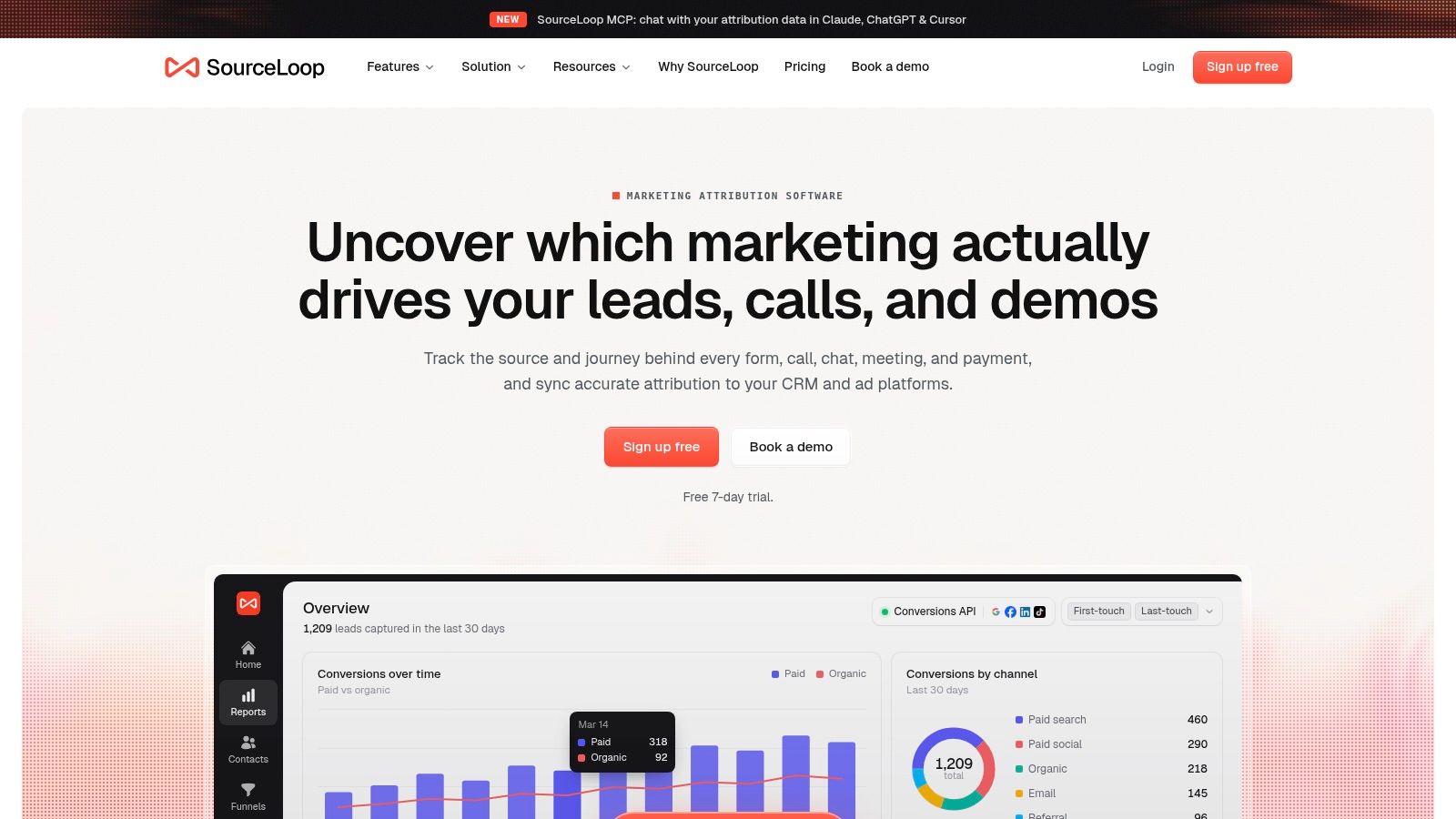
Our platform fits teams whose measurement problem continues after the form submission. We capture every visit and connect multi-touch journeys to leads, bookings, and payments, with attribution data synced to the CRM and advertising platforms.
That makes the fit strongest when an agency must explain customer acquisition to a client, or a lead-gen team must distinguish promising inquiries from completed sales. If you only need a basic dashboard of platform metrics, this is more workflow than your reporting requirement calls for.
The dashboard should be an entry point for inspecting customer records, not the final evidence of campaign performance.
What the workflow supports
We offer first-touch, last-touch, linear, position-based, and time-decay attribution. Those views let your team examine whether a campaign introduces prospects, assists their evaluation, or appears near the conversion.
The operational features matter just as much:
- Qualified feedback: We can sync only good leads to ad platforms and send conversions by deal value.
- Lead hygiene: Our lead quality filter removes spam.
- Revenue continuity: Leads, bookings, and sales carry attribution into your CRM and connected platforms.
- Cross-platform delivery: Google Ads sync sends offline conversions with the click that earned them, while qualified outcomes can also return to Meta and other supported platforms.
Don't treat a model comparison as a causal experiment. Use the models to inspect how your observed journey changes under different credit rules, then make the business definition of a valuable conversion explicit.
Setup and commercial fit
Installation uses a single lightweight tracking snippet. Teams are tracking attribution within an hour of setup, although connecting a snippet isn't the same as validating every CRM field and downstream event.
We offer a free seven-day trial. Multi-touch attribution, funnels, and pre-built dashboards are included on all three tiers, and annual billing saves 25%, paid once for the year.
The implementation still needs ownership on your side. Assign someone who understands CRM stages, someone who controls website tracking, and someone who can approve which outcomes are sent back to advertising platforms.
Use the trial to investigate a real buying path rather than populate a presentation. Select an eligible lead, inspect its acquisition history, verify its CRM stage and value, and confirm the intended feedback event reaches the correct advertising account. That test will tell you more about fit than browsing every dashboard.
Testing Lift and Auditing a Tool Before You Commit
A tool can reconcile conversions without proving that advertising caused them. Attribution assigns credit to observed interactions. A controlled lift test estimates what changed because an eligible audience could see the advertising. Use an experiment when the budget decision depends on that distinction.
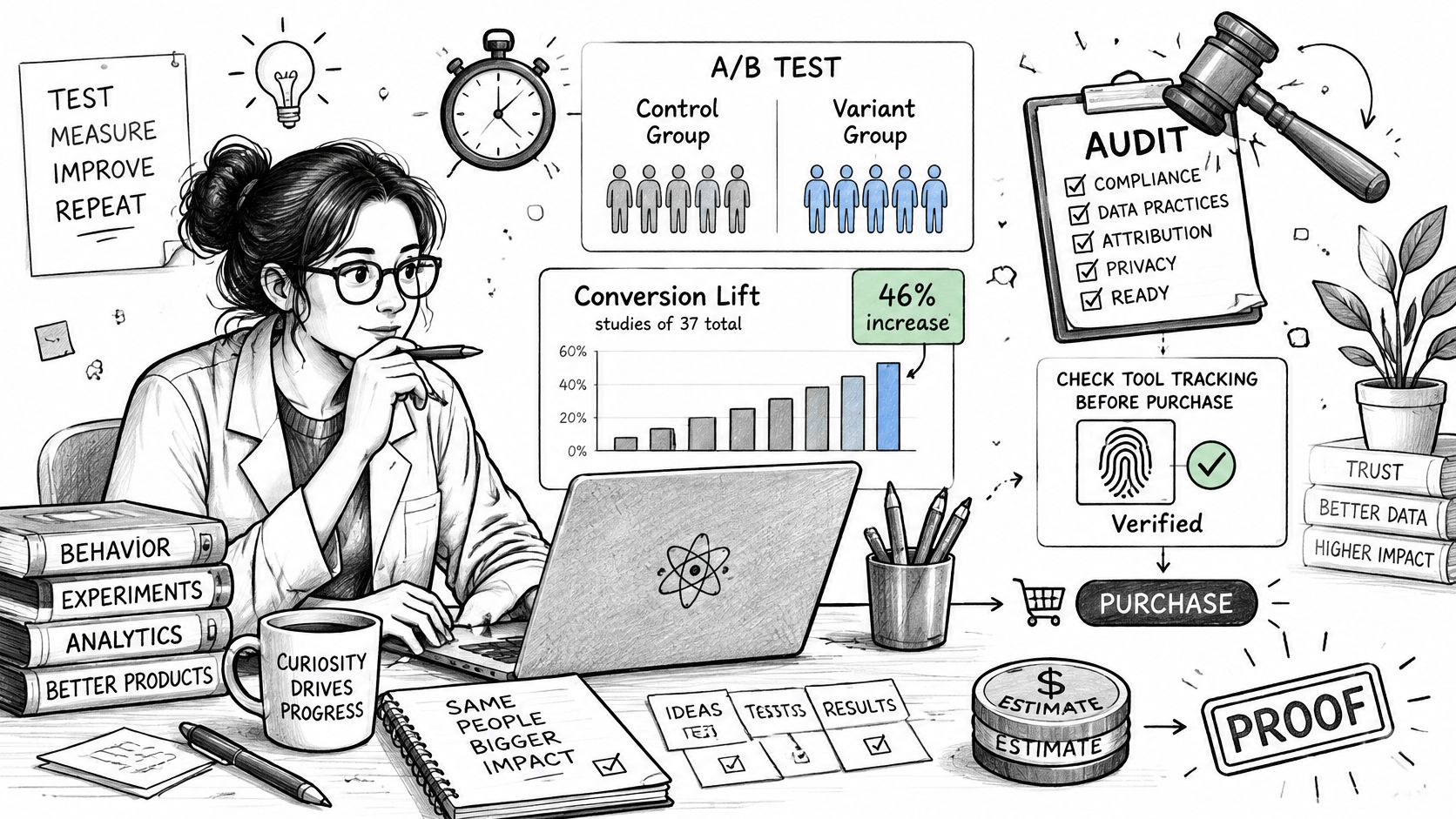
Meta's Incremental Attribution research has reported lift versus business-as-usual campaigns among participating advertisers. Treat that finding as evidence that lift can occur, not as a forecast for your campaigns or a universal benchmark. A report on advertising effectiveness measurement can help frame the distinction between attributed outcomes and evidence of incremental impact.
Design the lift test around the decision
Randomly assign eligible audiences to a test group that receives the advertising and a holdout group that does not. Compare the chosen outcome per eligible person, preserving the original assignment. Comparing people who happened to see an ad with those who did not can introduce selection bias.
Choose the outcome before launch. For lead generation, measure qualified opportunities rather than form submissions if those are the business results that matter. For ecommerce, use completed purchases and apply a consistent rule for cancellations.
Allow the conversion cycle to mature, with enough volume to distinguish a meaningful effect from uncertainty. Do not stop when the result first looks favorable, and do not treat a short software evaluation as sufficient evidence of lift. Specify exclusions, competing campaign exposure, and the conditions that would change your spend before the test begins.
This video offers an additional resource to review alongside the test design.
Audit the shortlisted tools in parallel
A tool audit can run while the lift test continues, but it answers a different question: whether the platform's reported conversions reconcile with CRM-qualified outcomes and revenue.
- Freeze the comparison specification. Export a recent Meta reporting period and record event definitions, attribution settings, and the reporting date basis.
- Prepare the CRM benchmark. Export eligible closed-won records and revenue, retain source identifiers, and document adjustments.
- Install alongside the existing setup. Keep the current measurement path in place and prevent duplicate conversion delivery while evaluating each candidate.
- Inspect the full lifecycle. Select an ad-originated customer and verify the implementation with records you can inspect.
- Classify the remaining gap. Separate missing identifiers, immature opportunities, timing differences, duplicate events, and unexplained discrepancies.
Choose the tool with the smallest unexplained gap among comparable eligible records, not the highest match total. A higher match count may reflect looser matching rules rather than better alignment with qualified CRM outcomes.
If lift and attributed conversions disagree, investigate before judging the campaign or the tool. Check experimental uncertainty, population coverage, and whether the test and CRM use the same outcome definitions.
Budget rule: Scale on reconciled business outcomes supported by credible impact evidence, not the largest platform-reported total.
Use a SourceLoop trial to inspect a CRM-qualified lead, an opportunity, and a closed-won deal. Connect the tracking snippet, validate lifecycle mapping, and check that the qualified outcome is returned to Meta before choosing a plan.

 Paid Social


