
7 Northbeam Alternatives for Every Ad Budget in 2026
Seven Northbeam alternatives sorted by ad spend, from $99/mo trackers to MMM suites, with pricing, real reviews and what each one gives up.

Table of contents
Northbeam is good at what it was built for: brands with seven- and eight-figure ad budgets, mostly on Meta, that want one view of what each channel actually drove.
The question is usually price. Its Starter plan is listed from $1,500 a month, and the onboarding asks for real time from your team.
In this guide, I'll walk through seven alternatives grouped by budget and business model, so you can see what you'd keep and what you'd give up at each step.
What we compared, and how
I've used Triple Whale on a live store and ran ThoughtMetric on its trial. Polar Analytics, Wicked Reports, Rockerbox and Lifesight sell through demos, so those sections are based on walkthroughs, documentation and the operators we know who run them.
The brands and agencies we work with include ecommerce teams as well as lead gen and SaaS businesses, so we judged each tool on who it actually suits. Reviews on G2 and Capterra fill in the long-term picture. The questions I asked of each one:
- What it costs at a few common ad spend levels
- Whether it models, tests, or tracks deterministically
- Which revenue it can see: store orders, subscriptions or CRM deals
- How much onboarding it needs before the numbers are useful
SourceLoop is ours. We put it through the same questions as the others, and we've been clear that it isn't the pick for a Shopify store.
Last checked November 2026. Confirm current pricing with each vendor.
What you're paying for with Northbeam
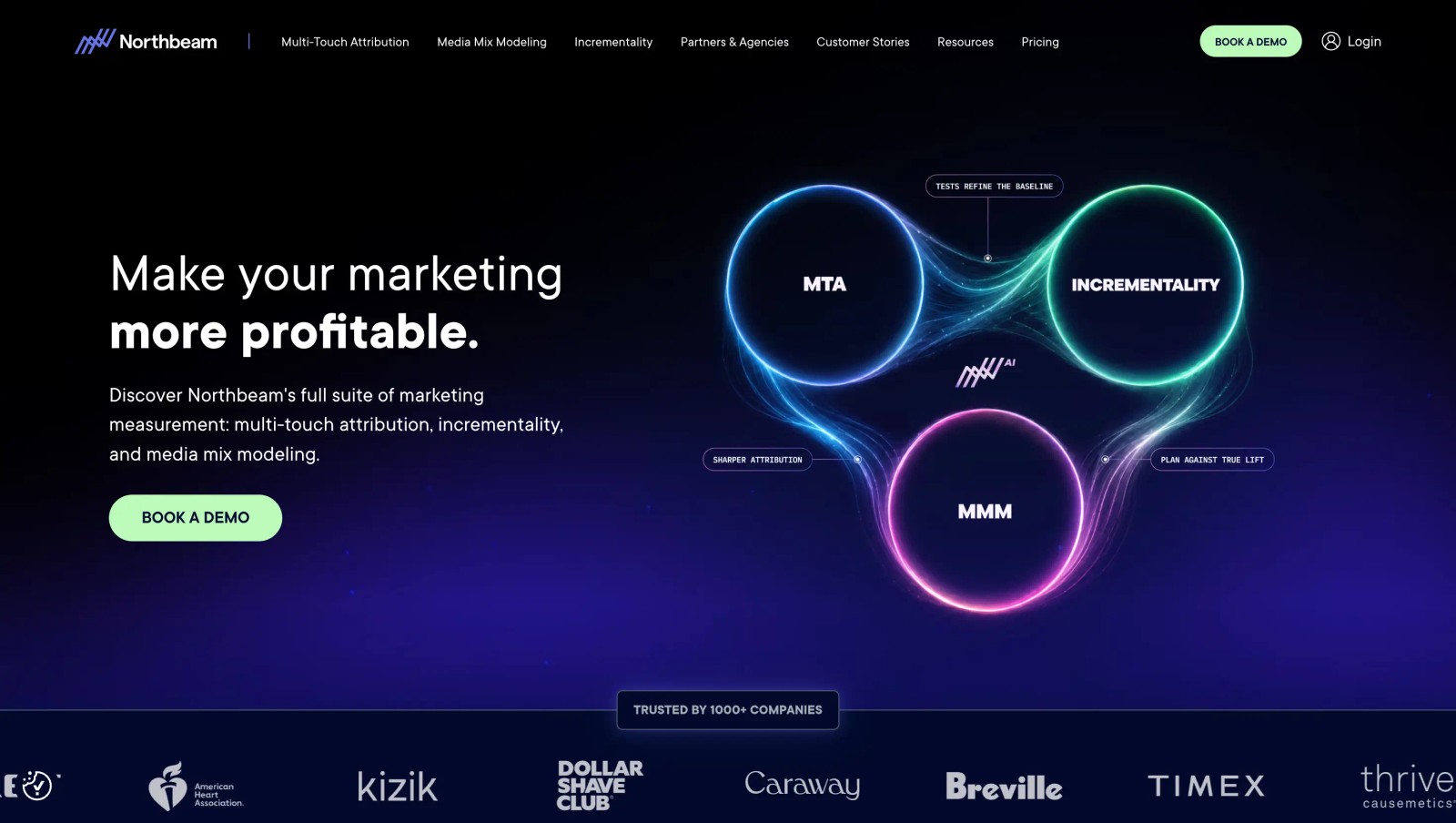
Northbeam combines multi-touch attribution with clicks plus deterministic views, media mix modeling and incrementality testing. On its pricing page, Starter is listed from $1,500 a month for brands spending under $1.5 million a year on ads, and Professional from $3,500 for spend up to $500,000 a month.
Users who fit that profile rate it highly:
"We'd recommend Northbeam to any business doing over $5 million a year, spending on paid traffic, and looking to find clarity within their numbers." (Source)
The criticism lines up with budget and setup:
"It can be a bit pricier than some other solutions (not saying it's not worth it!), but for smaller companies, may be out of their price range." (Source)
"Their onboarding process is very hard." (Source)
Our Northbeam pricing breakdown goes deeper on what drives the quote.
Northbeam alternatives compared
Here's how the 7 Northbeam alternatives compare on budget fit, method and the revenue they can see, as of November 2026.
| Tool | Best for | Starting price | Method | Revenue it sees | Free plan or trial |
|---|---|---|---|---|---|
 SourceLoop | Lead gen and subscription businesses | $49/mo | Rule-based MTA, seven models | Leads, CRM deals, subscriptions | 7-day trial |
 Triple Whale | Shopify brands of most sizes | Free, paid by GMV | Pixel attribution plus AI | Store orders | Free plan |
 Polar Analytics | Brands wanting BI and attribution together | Quote by GMV | Pixel attribution plus BI | Store and marketplace orders | Demo |
 ThoughtMetric | Smaller DTC brands | $99/mo | Pixel attribution plus surveys | Store orders | Trial |
 Wicked Reports | Repeat-purchase and long-cycle brands | $499/mo | Lifetime lookback MTA | Orders, CRM, subscriptions | Demo |
 Rockerbox | Omnichannel brands with TV or offline | Quote | MTA, MMM and testing | Store orders | Demo |
 Lifesight | Brands wanting MMM and causal attribution | Quote | MMM plus causal MTA | Store orders | Demo |
The 7 best Northbeam alternatives
I've put SourceLoop first because it answers a different question than the rest, then ordered the ecommerce tools from lightest to heaviest.
1. SourceLoop
Best for: lead generation businesses, agencies and SaaS teams that were sold on Northbeam-style attribution but whose revenue lives in a CRM or a billing tool, not a store.
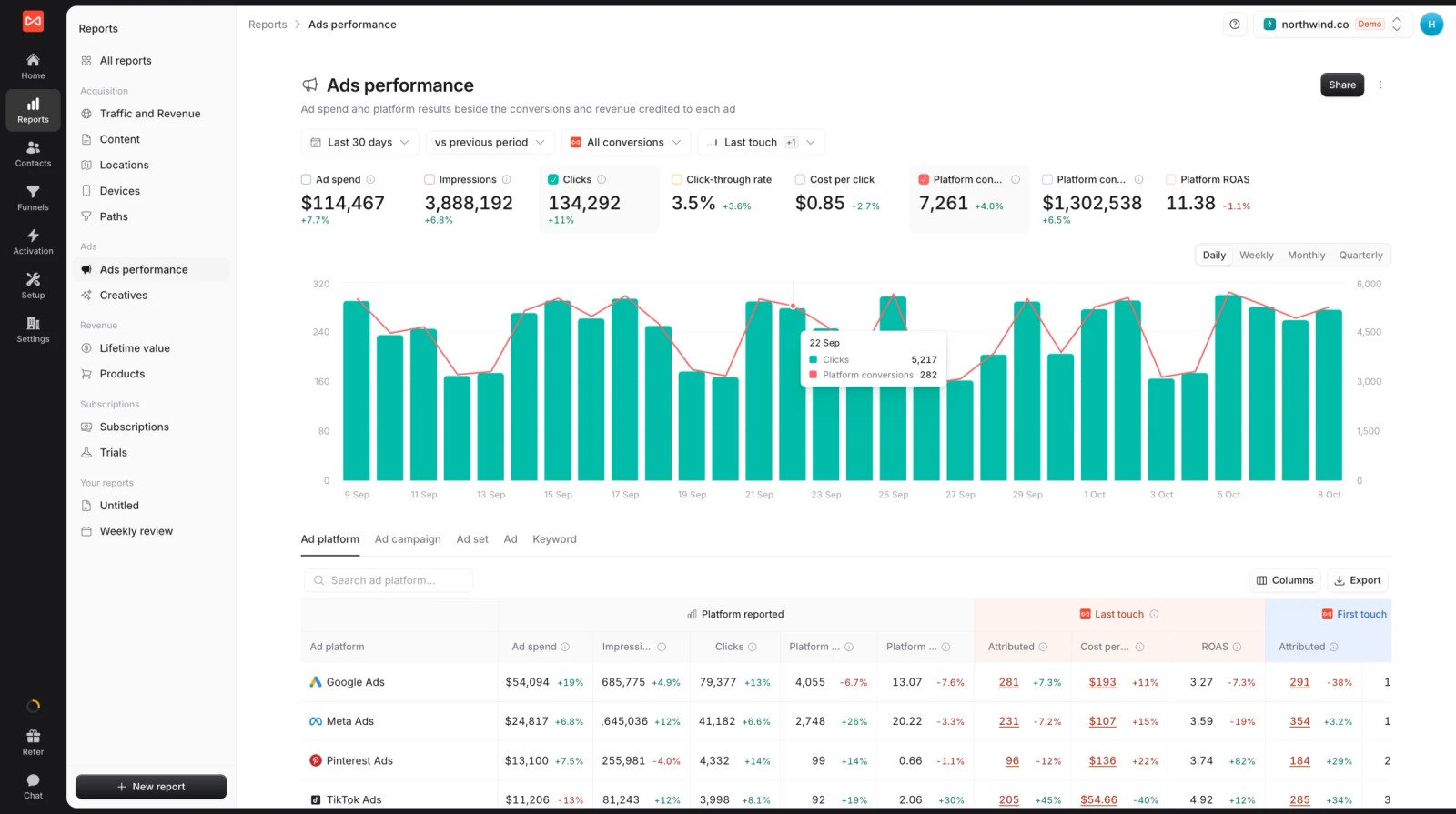
SourceLoop is a first-party marketing attribution and measurement tool. Like Northbeam, it shows ad spend next to independently credited results. The difference is what counts as a result.
Instead of store orders, SourceLoop credits leads, calls, booked meetings, CRM deals and subscription revenue. That makes it a fit for an insurance broker, a home services company or a SaaS team, and a poor fit for a Shopify brand.
It's also self-serve. There's no onboarding project, and the attribution rules are published, so anyone can check how a number was calculated.
Key features
- Spend beside credited results: ad spend and platform-reported conversions next to what SourceLoop credits Google Ads, Meta, Microsoft Ads and ChatGPT Ads.
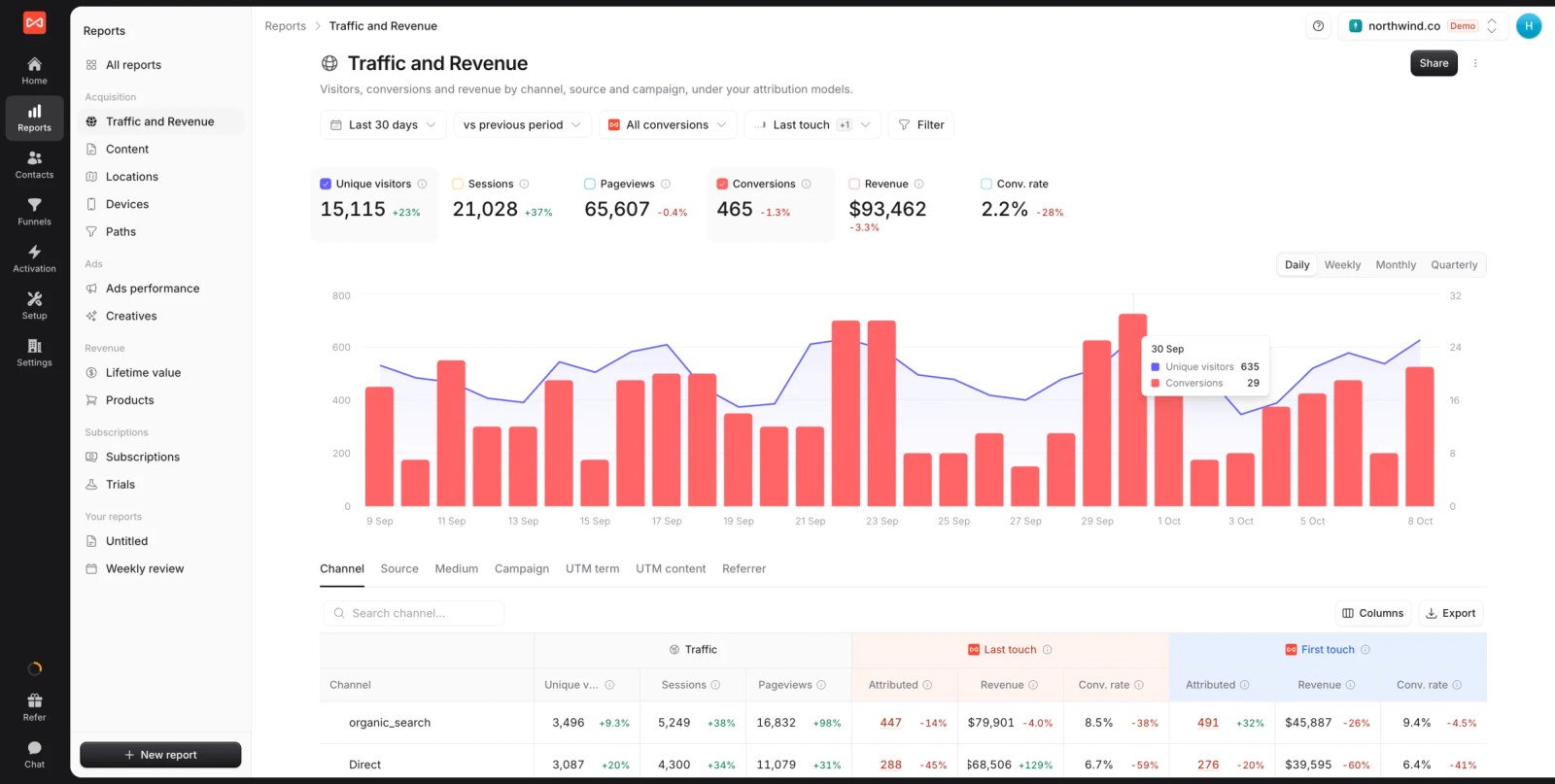
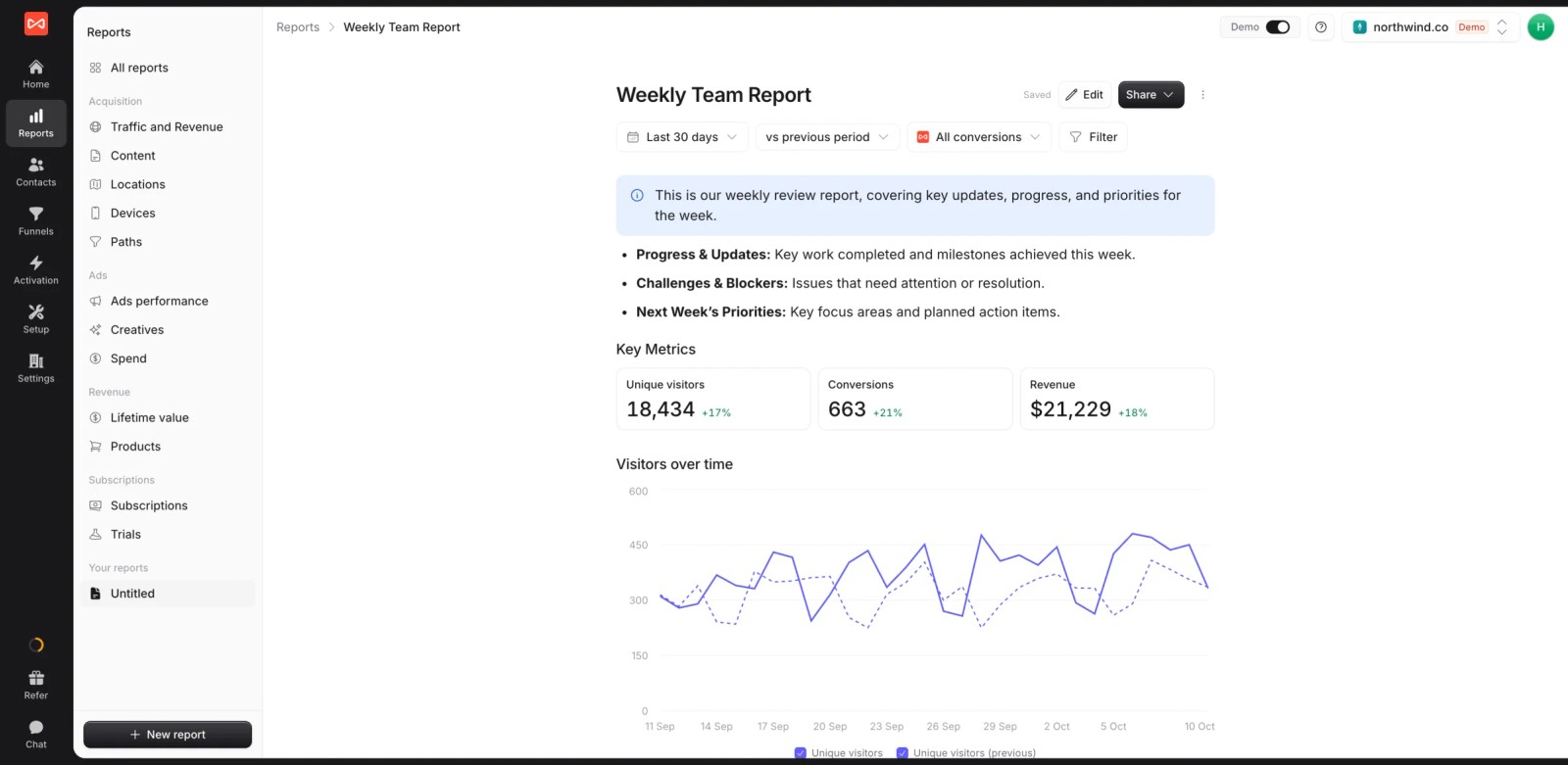
- Revenue by channel: visitors, conversions and revenue per channel under first and last touch, side by side.
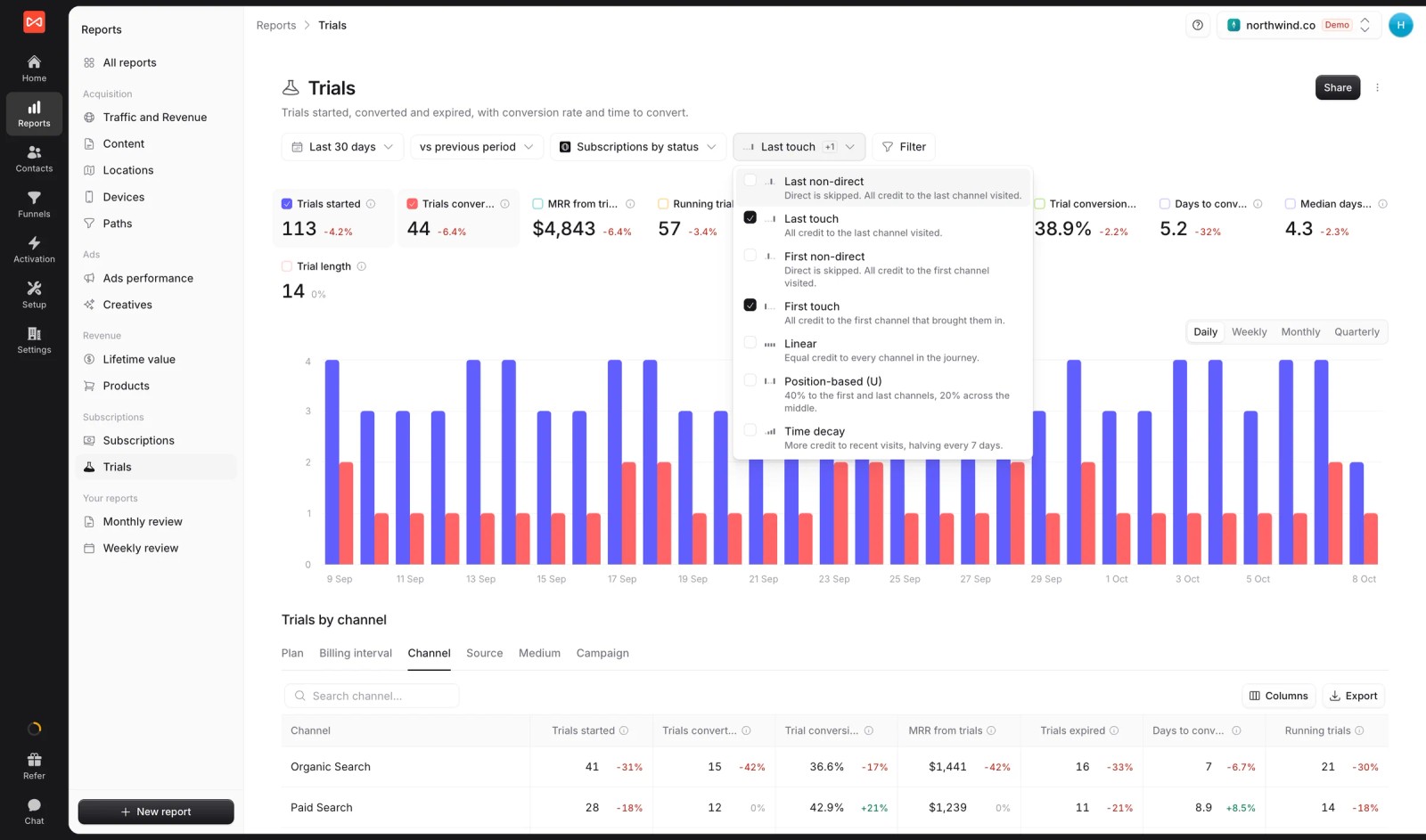
- Seven published models: first and last touch, first and last non-direct, linear, U-shaped and time decay, switchable on any report.
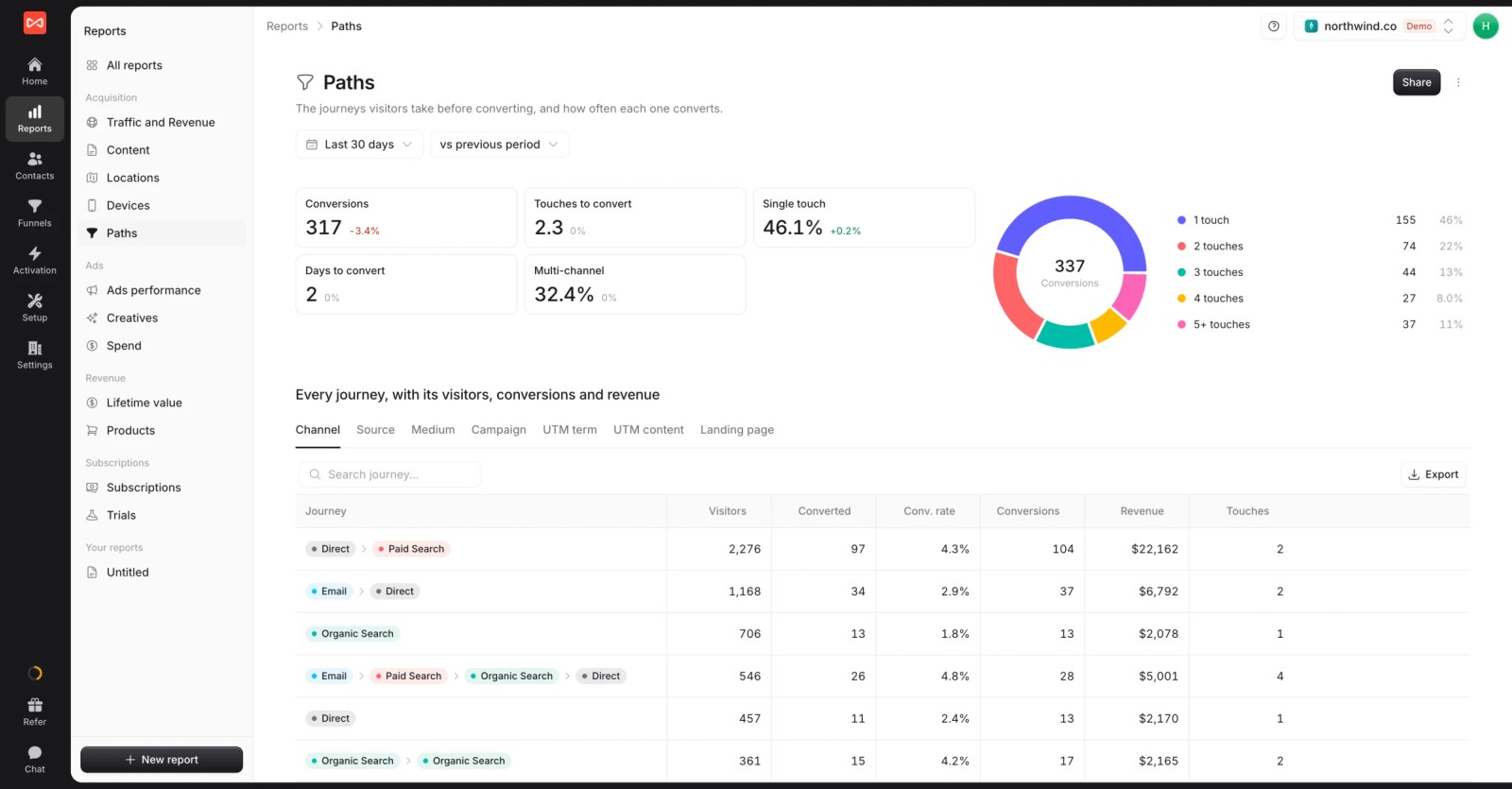
- Conversion paths: the channel sequences behind conversions, with touches and days to convert.
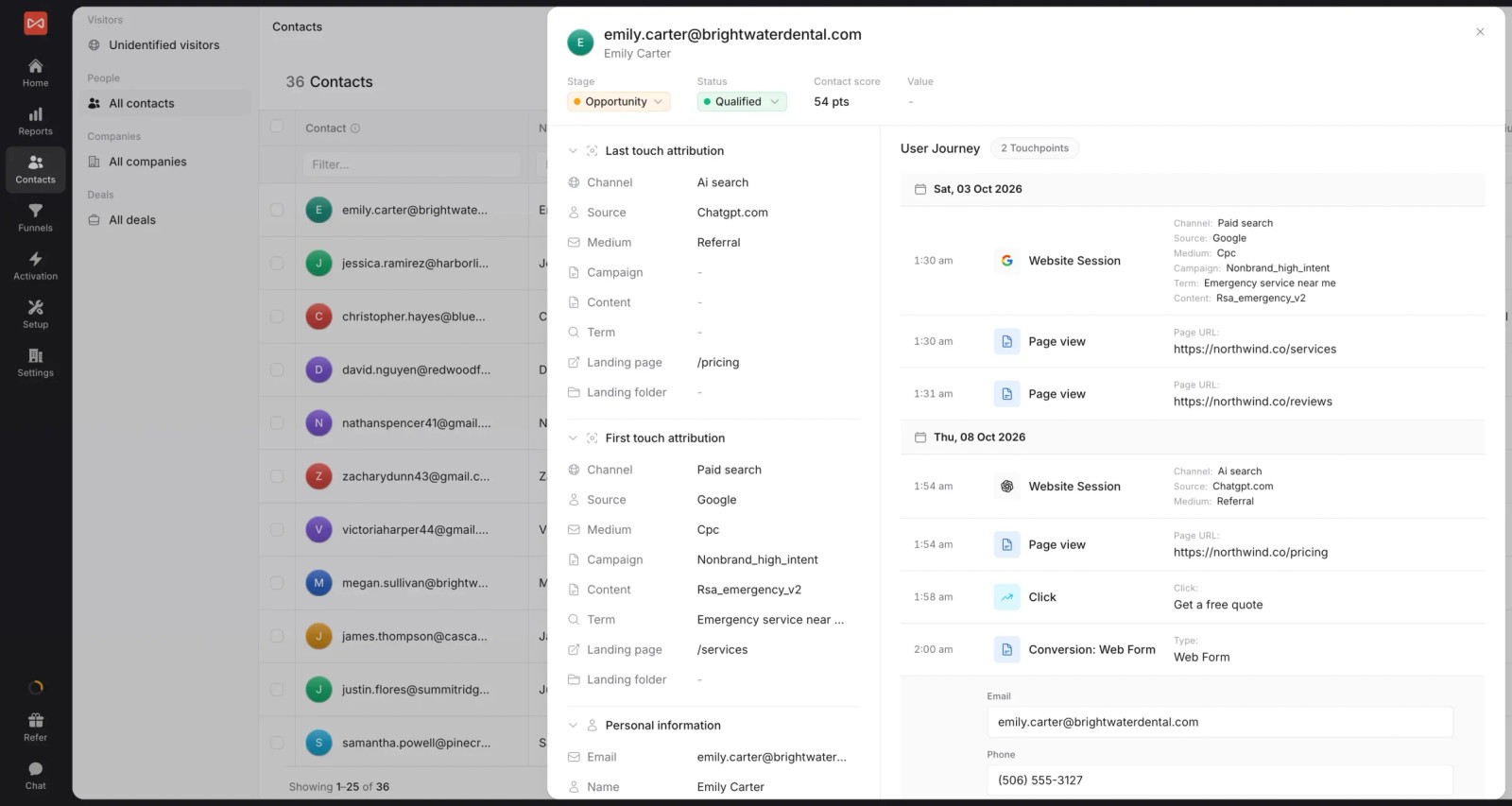
- Person-level journeys: every visit and ad click before a lead or signup, kept on the contact.
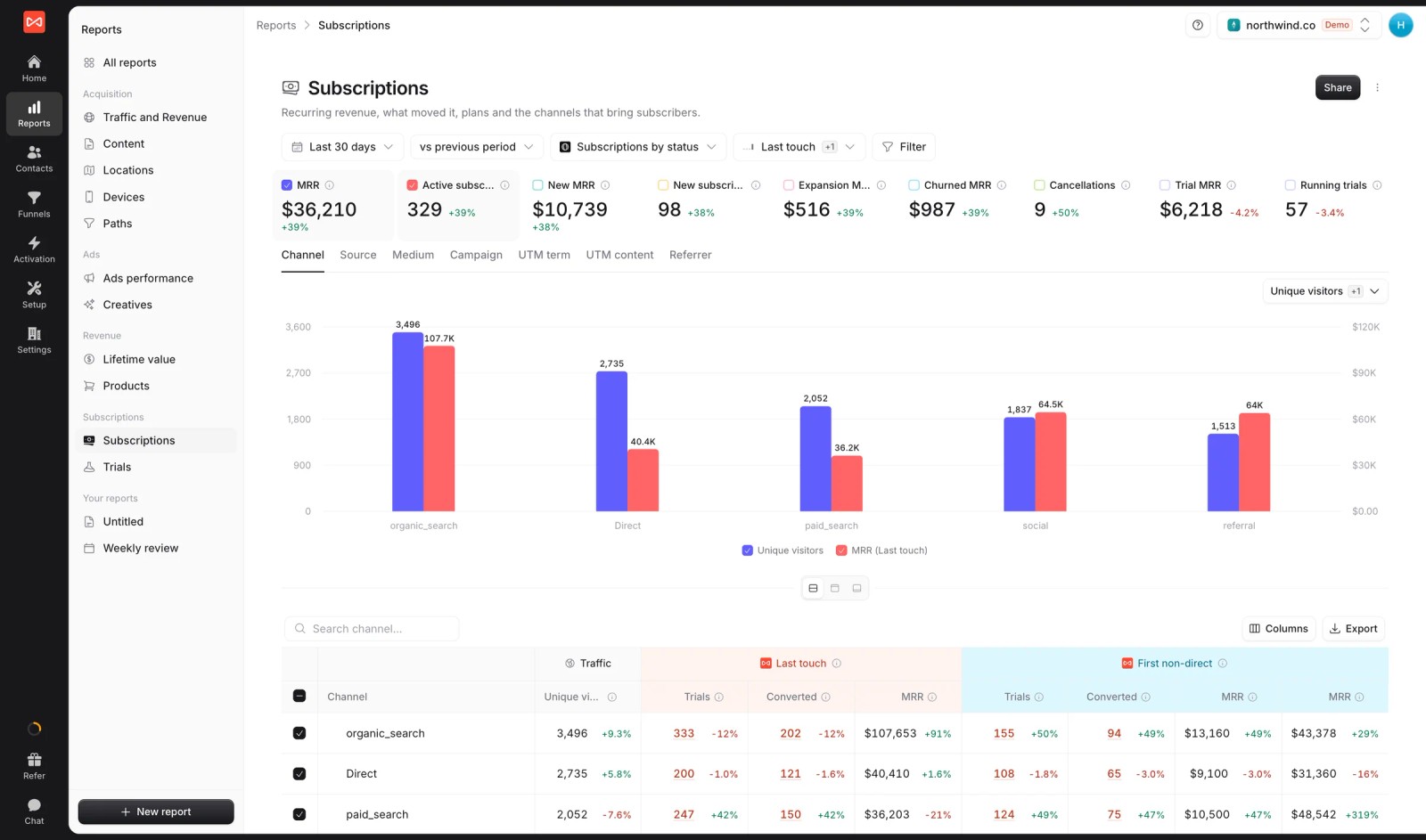
- Subscription revenue: Stripe, Paddle, Polar, Lemon Squeezy and Dodo payments become MRR, churn and trial reports credited to the channel that acquired each customer.
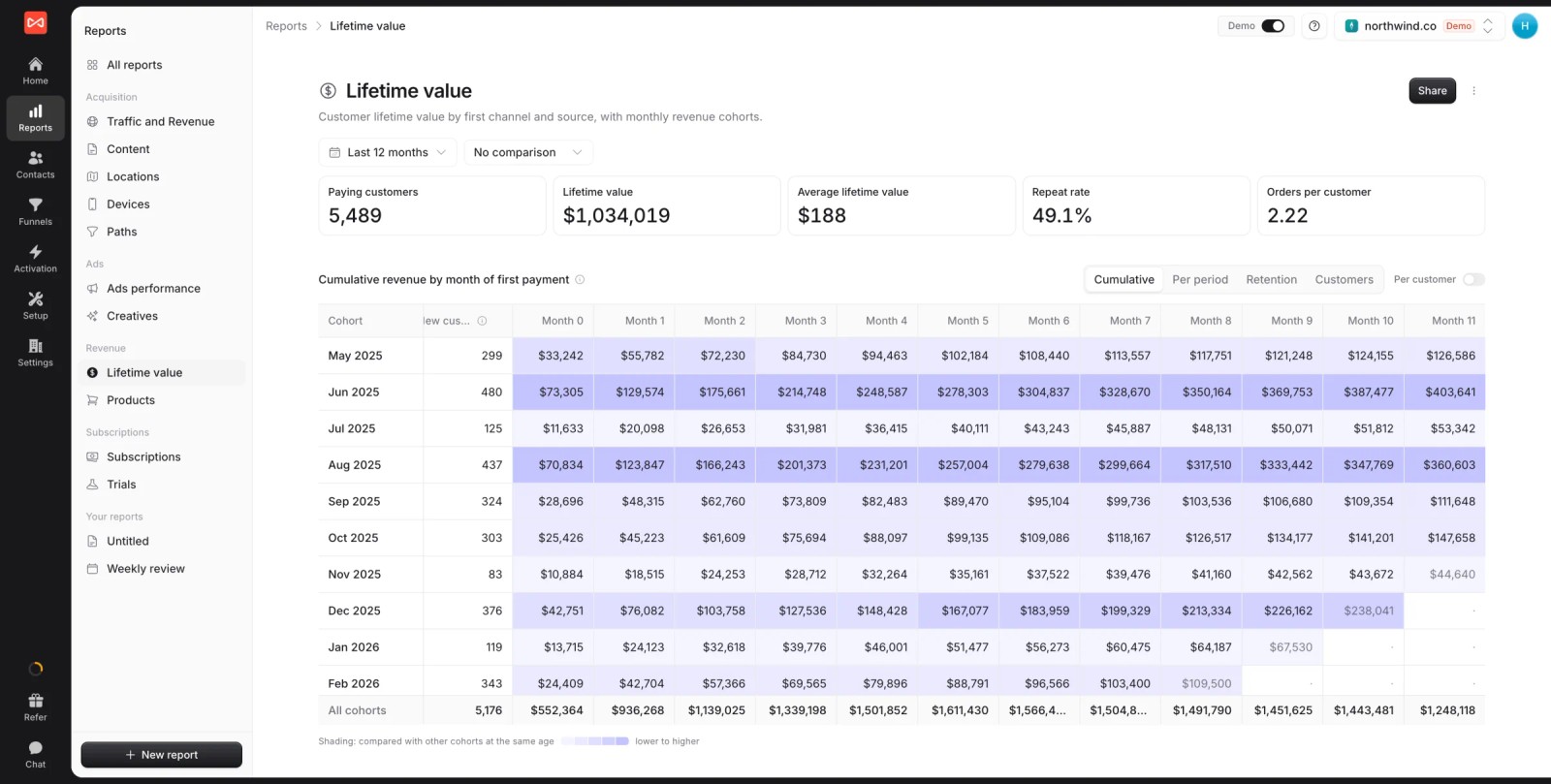
- Lifetime value cohorts: cumulative revenue by month of first payment, so you can compare channels on customers who stay.
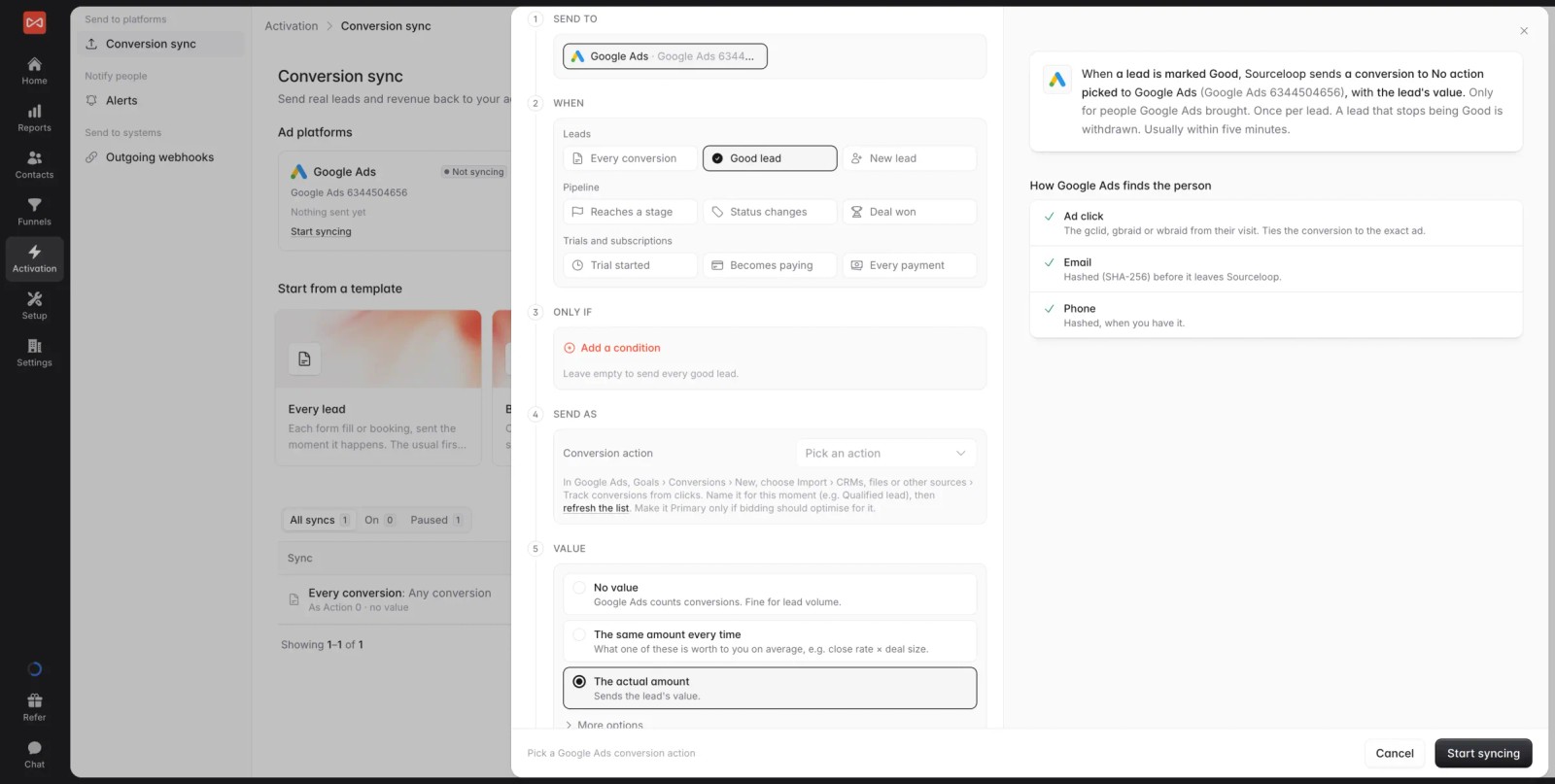
- Conversion sync: good leads, won deals and payments go back to Google Ads, Meta, Microsoft Ads and ChatGPT Ads with their value, through server-side conversion sync.
- Custom reports and MCP: build a live report for leadership, or let an AI assistant query attribution through the MCP server on Professional and up.
Where it falls short
- It isn't built for Shopify stores, so product-level ecommerce analytics and order attribution are better handled by Triple Whale or Polar.
- There's no media mix modeling, incrementality testing or view-through credit, which Northbeam, Rockerbox and Lifesight all offer.
- LinkedIn and TikTok conversion sync are still coming soon.
Pricing
- Essential: $49/mo for one site and 30,000 page views, with tracking, attribution reports, lead quality rules and alerts
- Professional: $99/mo for 100,000 page views and unlimited users, adding CRM sync, conversion sync to the ad platforms, the API and MCP
- Agency: $249/mo for three sites and 1.5 million page views, adding white label reporting
- Unlimited conversions on every plan, and a 7-day trial.
Verdict: the right swap when your conversions are leads, deals or subscriptions. If you sell physical products through a store, start with the next tool down.
2. Triple Whale
Best for: Shopify brands that want attribution, dashboards and AI analysis without a Northbeam-sized contract.
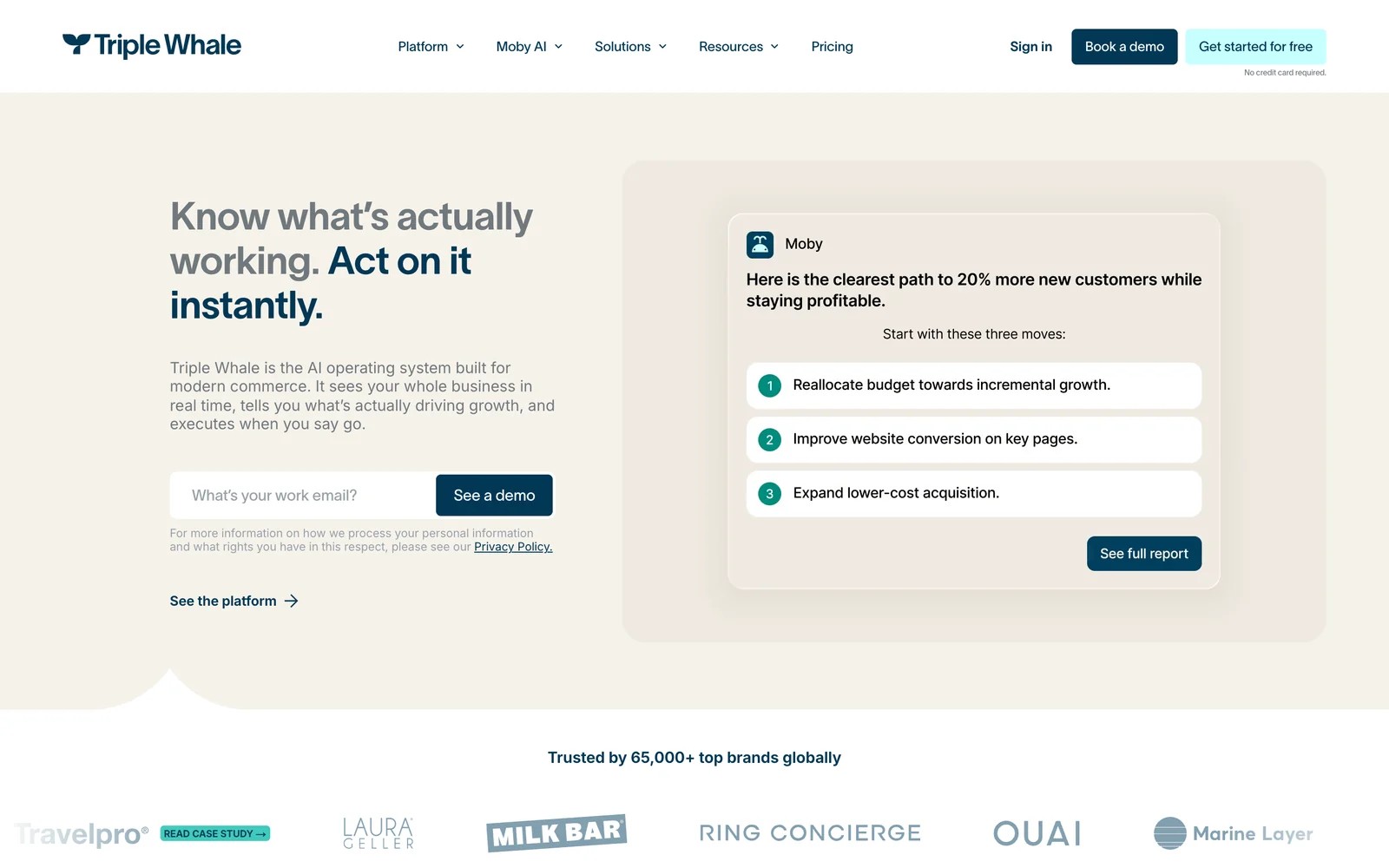
Triple Whale is the most common Northbeam alternative for Shopify brands. It pulls in orders, ad spend and its own pixel, then layers AI agents on top for questions and reports.
When I connected a store, the summary dashboard was useful within the first day. Revenue, spend, blended ROAS and new customers sit on one screen, which is what most founders actually look at every morning.
The pixel numbers took longer to trust. They rarely matched what Meta reported, which is the point of an independent tracker, but it meant explaining the gap to everyone who still checked Ads Manager.
It now has a free plan, and the paid tiers are booked through a walkthrough and priced by store revenue. That makes it cheaper to start than Northbeam, though the bill grows as the store does.
Key features
- Shopify orders, ad spend and the Triple Pixel come together in one dashboard that founders can read at a glance.
- The pixel attributes orders across Meta, Google, TikTok and other paid channels using first-party data.
- AI agents answer questions in plain English, build reports and flag sudden changes in performance.
- A free plan lets smaller brands start before committing to a paid tier.
Where it falls short
- Paid tiers are priced by store revenue, so costs climb as you grow and aren't shown on the pricing page.
- Some users report attribution bugs, including with imported marketplace orders.
- It's built around Shopify, so non-Shopify stores and lead-based businesses don't fit well.
What users say
"Triple Whale is our source of truth for marketing data." (Source)
"The transparency of the data, Triple Whale demonstrated that we had 3 times the amount of users on site vs Klaviyo's metrics." (Source)
"The attribution system is consistently buggy and unreliable, causing more harm than good." (Source)
Pricing
- Free: free plan for getting started
- Paid tiers: priced by store GMV, booked through a walkthrough
See our Triple Whale alternatives if its pricing model is the sticking point.
3. Polar Analytics
Best for: brands that want a BI layer for store, marketplace and marketing data, with attribution built in.
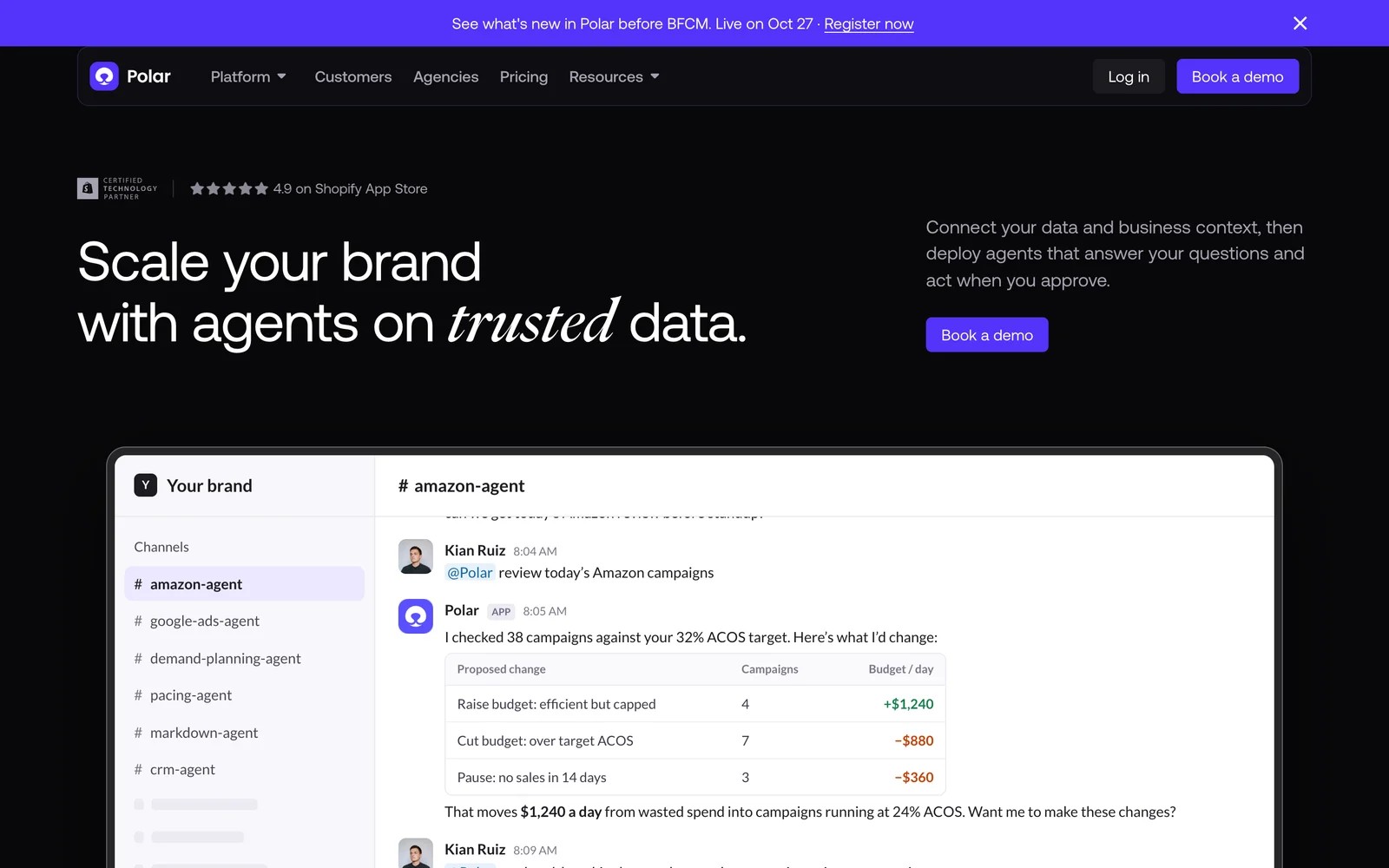
Polar Analytics is closer to a data warehouse with ecommerce templates than a pure attribution tool. It joins Shopify, Amazon, ads and email data, then adds its own pixel for attribution.
In the walkthrough, the custom metrics stood out. Building a contribution margin or a blended CAC metric is point-and-click, which suits teams that outgrew dashboard tools but don't have an analyst.
Users praise the native connectors but describe delays on custom data sources, and one recent review describes slow support when attribution went wrong.
Key features
- Native connectors for Shopify, Amazon, ad accounts and email bring revenue and spend into one model.
- Custom metrics and dashboards can be built without SQL, which helps non-technical operators.
- The built-in pixel adds attribution on top of the BI layer.
- Marketplace data sits next to DTC data, which matters for brands selling on Amazon too.
Where it falls short
- Custom connectors need a support specialist, which slows things down for non-standard data sources.
- Pricing is quoted by revenue band, so you won't know the cost until you talk to sales.
- It's built for ecommerce, so lead-based or subscription-only businesses won't get much from it.
What users say
"It’s easy to set up the native connectors (Shopify, Amazon, ad accounts), and our internal users find it very straightforward to create custom metrics, dashboards, and KPIs." (Source)
"Custom connectors require intervention from a support specialist, which slows down the integration process for non-standard data sources." (Source)
"the platform wasn't able to attribute events correctly, we where met by radio silence for a long period (continued today)" (Source)
Pricing
- Quoted by annual revenue band, with no dollar amounts listed.
4. ThoughtMetric
Best for: smaller DTC brands that want independent attribution at a fraction of Northbeam's price.
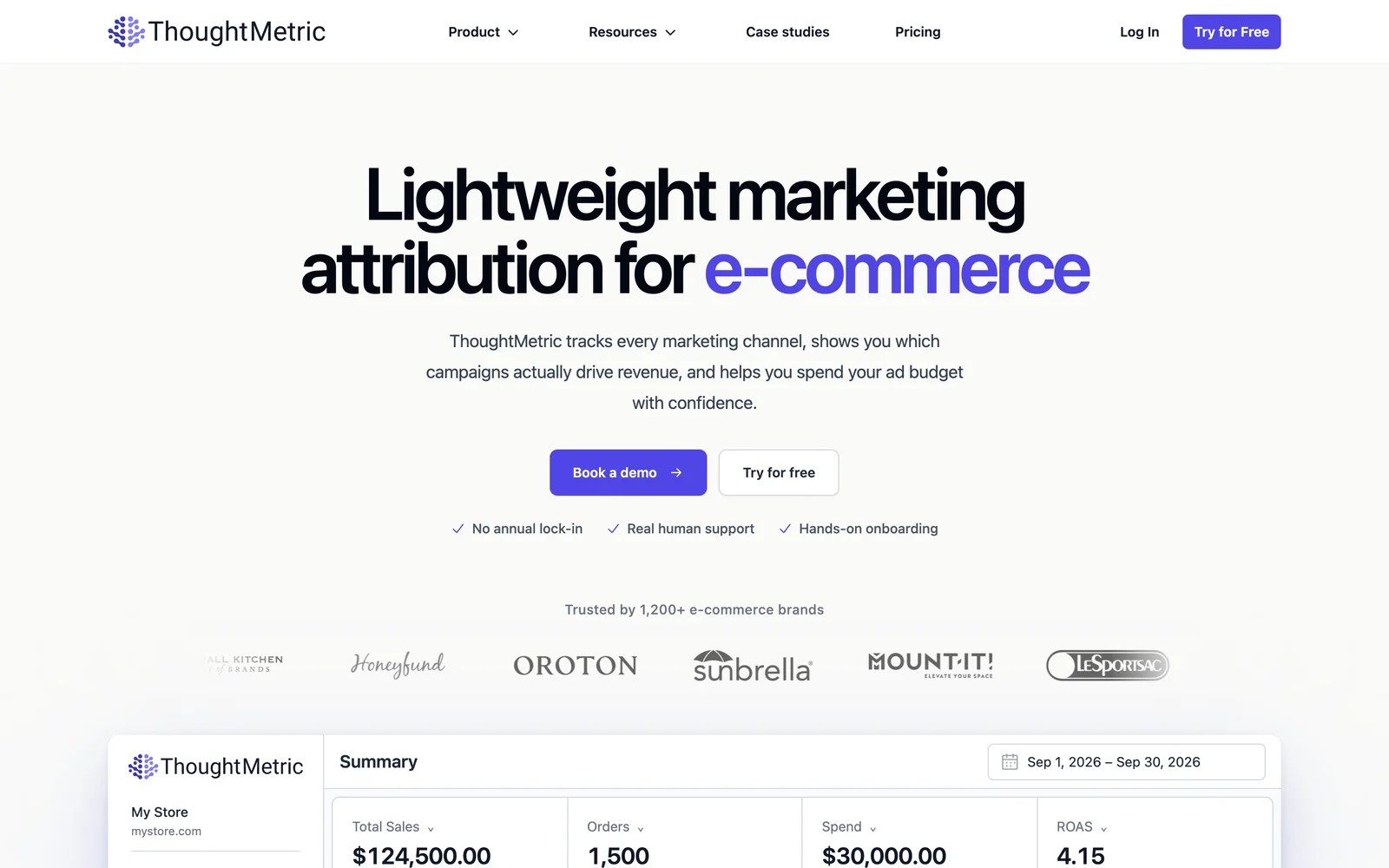
ThoughtMetric is the budget pick here. It combines a first-party pixel with post-purchase surveys, so you get click-based attribution plus what customers say brought them in.
On the trial, setup really was quick: install the pixel, connect the store and ad accounts, and reports start filling in. The interface is clean and fast.
The limits show when you want depth. Dashboards are basic, and some users want reporting down to the keyword or ad. A few reviewers also question tracking accuracy, so run it beside your current tool for a while.
Key features
- A first-party pixel attributes store orders to channels, campaigns and ads without relying on platform reporting.
- Post-purchase surveys add customer-reported sources, which helps with channels pixels miss, like podcasts.
- Setup takes minutes for Shopify and other major store platforms, with no onboarding project.
- Pricing is based on page views, which keeps it affordable for smaller brands.
Where it falls short
- Custom dashboards and charts are limited compared to Northbeam or Polar.
- Some users want analytics down to the keyword or ad level.
- A few reviewers report tracking accuracy problems, so a parallel run is worth it.
What users say
"It provides the same if not better attribution tracking as Hyros which we paid SIGNIFICANTLY more for." (Source)
"The steps to get ThoughtMetric integrated and ready to use are dead simple." (Source)
"I do wish the analytics could go down further to the keyword or ad level." (Source)
Pricing
- Starts at: $99/mo for 25,000 page views, with higher tiers as traffic grows
5. Wicked Reports
Best for: brands with repeat purchases or long consideration that need lifetime attribution.
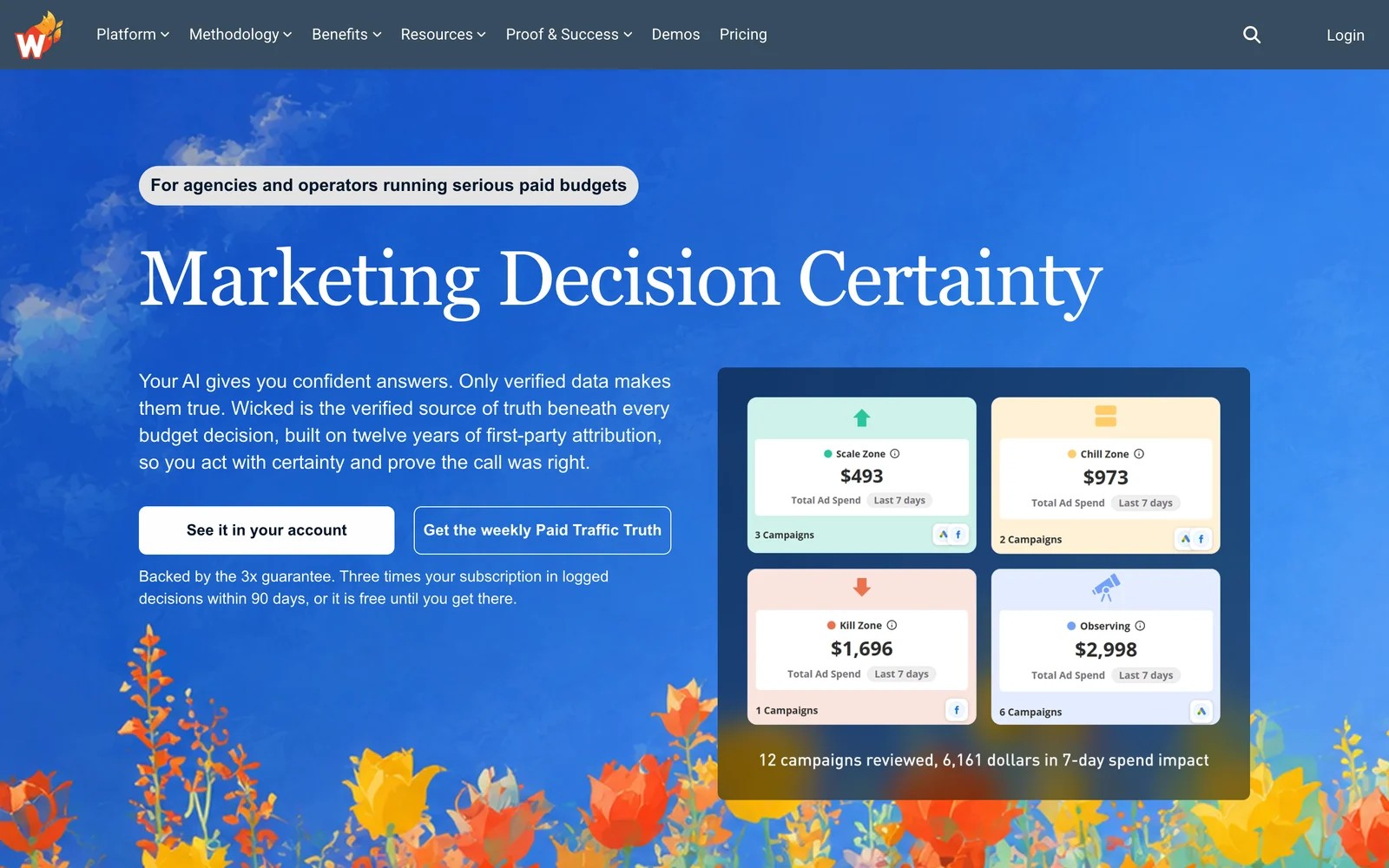
Wicked Reports focuses on what a customer is worth over time. Its lookback and lookforward windows run for the customer's lifetime, so an ad gets credit for the third and fourth purchase, not just the first.
I saw it in a demo. The FunnelVision views split results by funnel stage, which helps judge prospecting ads that rarely win on last click.
Reviews are mostly from a few years back. Users like the long windows and model choice, and some describe the interface as slow and clunky.
Key features
- Lifetime lookback and lookforward windows credit ads for sales months after the first click.
- Cohort and LTV reports show which campaigns bring customers who keep buying.
- FunnelVision splits performance by funnel stage for a fairer read on top-of-funnel ads.
- CRM and subscription integrations bring in revenue beyond the store.
Where it falls short
- There's no self-serve trial, so you'll go through a demo first.
- Its entry price of $499 a month is steep for smaller brands.
- Some users describe the interface as slow and hard to navigate.
What users say
"I really like that you can track longer than the standard 7 to 30 day attribution options available in the marketing channels." (Source)
"The user experience isn't the best, it can be pretty clunky and, not necessarily hard, but frustrating to navigate, dive deeper, and look around. It also takes forever to load." (Source)
Pricing
- Measure: $499/mo for brands up to $2.5M in annual revenue
- Scale and Maximize: $699 and $999/mo
- Enterprise: from $4,999
Our Wicked Reports alternatives guide compares it in more detail.
6. Rockerbox
Best for: omnichannel brands with TV, podcast or offline spend that want attribution, modeling and testing in one place.
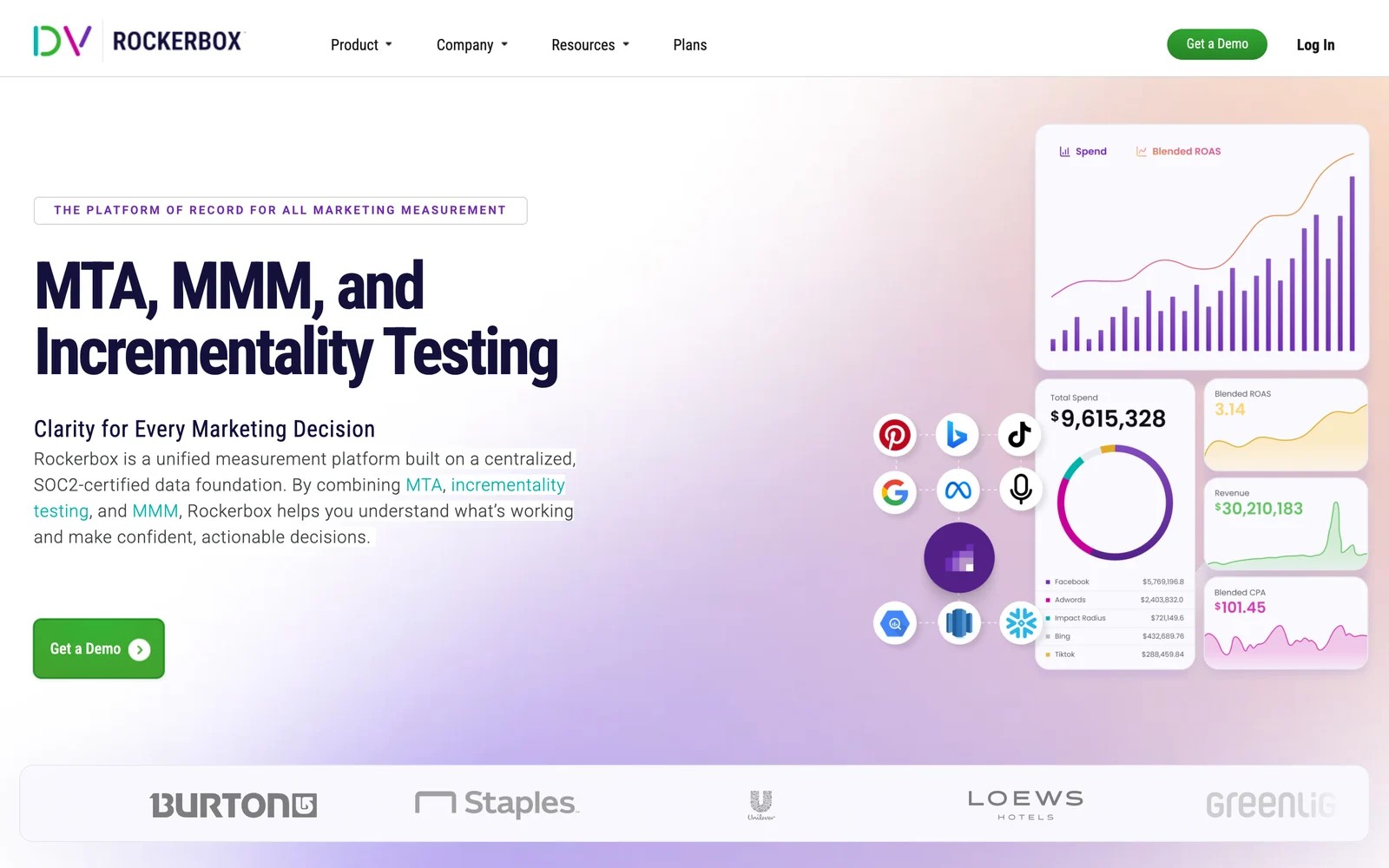
Rockerbox, now part of DoubleVerify, covers all three measurement methods: multi-touch attribution, media mix modeling and incrementality tests. That makes it the most direct like-for-like on method.
It sells through demos, so I'm going on the walkthrough and teams we know who use it. The strength is breadth, especially for brands where linear TV or direct mail is a big line item.
The setup is the cost. Reviews describe a heavy first implementation and channel terminology that takes learning.
Key features
- Multi-touch attribution, media mix modeling and incrementality testing are available in one platform.
- Offline and view-based channels like TV, podcasts and direct mail can be measured alongside digital.
- Data can be exported to your warehouse for your own analysis.
- Channel-level reporting rolls paid, owned and offline spend into one view, which suits brands with many media partners.
Where it falls short
- Prices aren't published, and it's sized for larger brands.
- First-time setup can need significant developer time.
- Some users say view-based channels like YouTube and TikTok are harder to measure well.
What users say
"The ability to track customers across all different touch points is amazing, not just ads." (Source)
"The first initial set up of Rockerbox can be very tedious it takes a full-time developer to have this done as well as continuous support on the Rockerbox side." (Source)
"The \"bucket\" terminology they use could be confusing to some, but nothing that couldn't be learned." (Source)
Pricing
- Quoted through sales. See our Rockerbox alternatives for more context.
7. Lifesight
Best for: brands that want media mix modeling and causal attribution in a single measurement platform.

Lifesight leans harder into modeling than Northbeam does. It combines MMM, causal attribution and incrementality testing, aimed at teams that have stopped trusting click-based numbers.
In the walkthrough, the unified view was the pitch: one place to see what each channel contributes, adjusted for what would have happened anyway. Teams running it describe a real learning curve before the outputs make sense.
Key features
- Media mix modeling estimates each channel's contribution, including channels without clicks.
- Causal attribution adjusts results for incrementality, not just touch order.
- Geo and holdout experiments test whether spend actually drives sales.
- Budget planning tools suggest where to shift spend based on the models.
Where it falls short
- Pricing isn't published, and users describe it as on the higher side.
- The learning curve is steep for teams without measurement experience.
- Some reports load slowly when filtering large datasets.
What users say
"Its unified measurement approach combines MMM and causal attribution, making it a comprehensive solution." (Source)
"The learning curve is somewhat steep, and the pricing tends to be on the higher side." (Source)
Pricing
- Quoted through a demo.
How to choose
Let your ad budget and your business model make most of the decision.
1. What do you sell?
- Physical products through a store: Triple Whale, Polar or ThoughtMetric.
- Leads, deals or subscriptions: SourceLoop. It suits lead generation businesses, agencies and SaaS teams, and sends good leads, won deals and payments back to the ad platforms.
2. How much do you spend on ads?
- Under about $50,000 a month: ThoughtMetric, Triple Whale's free plan or SourceLoop.
- Mid-market: Triple Whale paid tiers, Polar or Wicked Reports.
- Large, with TV or offline: Rockerbox, Lifesight or staying on Northbeam.
3. Do you need modeling?
- If you only want deterministic attribution, skip the MMM tools. If you're weighing methods, our explainer on multi-touch attribution vs marketing mix modeling lays out the trade-offs.
Frequently asked questions
-
What is the best Northbeam alternative?
For Shopify brands, Triple Whale is the most common swap, with Polar and ThoughtMetric as alternatives at different price points. For lead generation and subscription businesses, SourceLoop credits leads, deals and MRR instead of store orders.
-
How much does Northbeam cost?
As of November 2026, Northbeam lists Starter from $1,500 a month for brands spending under $1.5 million a year on ads, Professional from $3,500 a month, and custom Enterprise pricing.
-
Is there a cheaper alternative to Northbeam?
ThoughtMetric starts at $99 a month and Triple Whale has a free plan. SourceLoop starts at $49 a month for lead-based and subscription businesses.
-
Does Northbeam do media mix modeling?
Yes, Northbeam offers MMM and incrementality testing alongside its multi-touch attribution, mostly on higher tiers. Rockerbox and Lifesight also cover all three methods.
-
Can SourceLoop replace Northbeam for an ecommerce store?
Usually not. SourceLoop is built for lead generation and subscription businesses, so a Shopify brand will get more from Triple Whale, Polar or ThoughtMetric.


 Paid Social


