
How to track lead source in HubSpot Forms
Add real attribution to every HubSpot form submission, so reports show which ad, search, or content generated each lead instead of Direct.


On this page
HubSpot Forms is the default lead-capture surface for any team running HubSpot CRM, free or paid, marketing or sales. The data it sends back to HubSpot is solid for contact info, but the source attribution often shows up as a generic “Direct” or “Organic Search” entry, with very little detail about which campaign or content actually drove the lead. SourceLoop layers on the missing data: full UTM details, every page the prospect viewed, and which session ultimately converted them.
Setup takes about five minutes, works on every HubSpot plan, and runs alongside (not against) HubSpot’s own analytics.
What SourceLoop captures from HubSpot Forms
After setup, each HubSpot form submission lands in SourceLoop with:
- Acquisition source with full UTM parameters captured at the visitor’s first session
- Browsing trail before submission, every page in chronological order
- Total time invested on your site before the form fill
- Number of distinct sessions before the conversion
- Email and name captured from the HubSpot form fields
- Landing page and the referring URL from the very first session
- Last-session source, the channel that ushered them to the submission
- Device type, country, and browser for segment-level analysis
Before you start
You’ll need:
- A SourceLoop workspace (free trial)
- Edit access to the website (or HubSpot CMS pages) where your HubSpot forms are embedded
- A HubSpot account (any tier) with at least one form configured under Marketing -> Forms
Step 1: Install the SourceLoop tracking script
Inside SourceLoop, click Setup in the left navigation and pick the Tracking code tab. Copy the snippet shown.
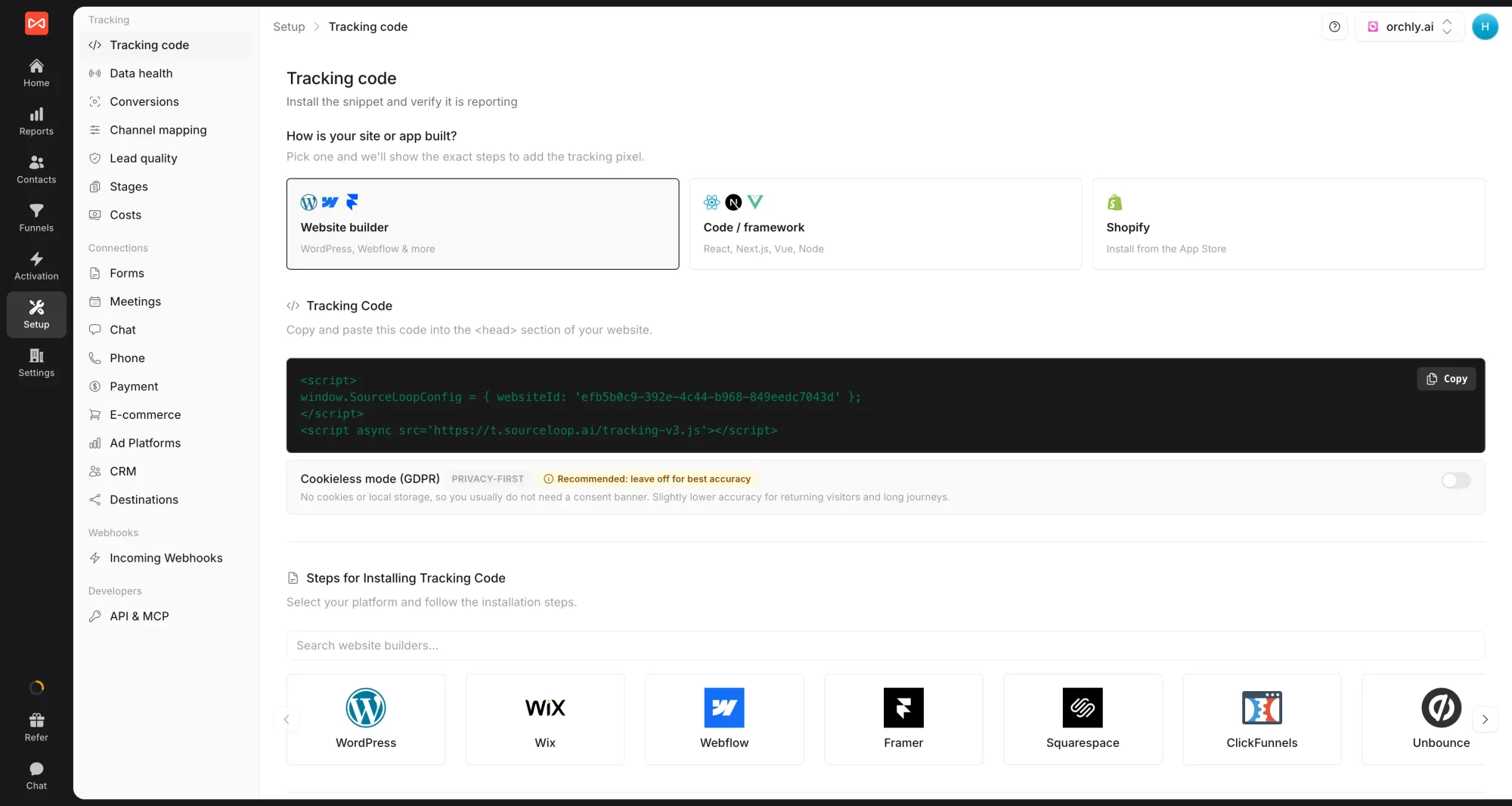
If your forms live on your own site (WordPress, Webflow, Framer, custom), paste the snippet inside the <head> tag of every page.
If your forms live on HubSpot CMS pages, open HubSpot, head to Marketing -> Files and Templates -> Templates -> Site header HTML, and paste the snippet there. HubSpot will inject it into every page on your hosted domain.
Step 2: Embed your HubSpot form on a tracked page
In HubSpot, open your form and copy the embed code from Embed -> Get embed code. Drop it onto the page where you want submissions to happen.
A few common HubSpot form scenarios:
- Inline embed on a marketing landing page: the form renders directly in the page body
- Popup form: triggered by exit intent, scroll depth, or a button click
- Native HubSpot CMS form module: when your page is built inside HubSpot, the form is added through HubSpot’s page editor
All three work the same way for attribution. The non-negotiable: the page hosting the form must also have the SourceLoop snippet from step 1.
Step 3: Verify it’s working
Open the form page in an incognito tab, add ?utm_source=test&utm_medium=verify&utm_campaign=hubspot-form-check to the URL, and submit a test entry using a real email you control.
Open Contacts in SourceLoop, your test submission should appear in a few seconds with the test UTM parameters attached to the contact record.
Where to see HubSpot form submissions in SourceLoop
Three SourceLoop surfaces give complementary views of your HubSpot form data:
Contacts
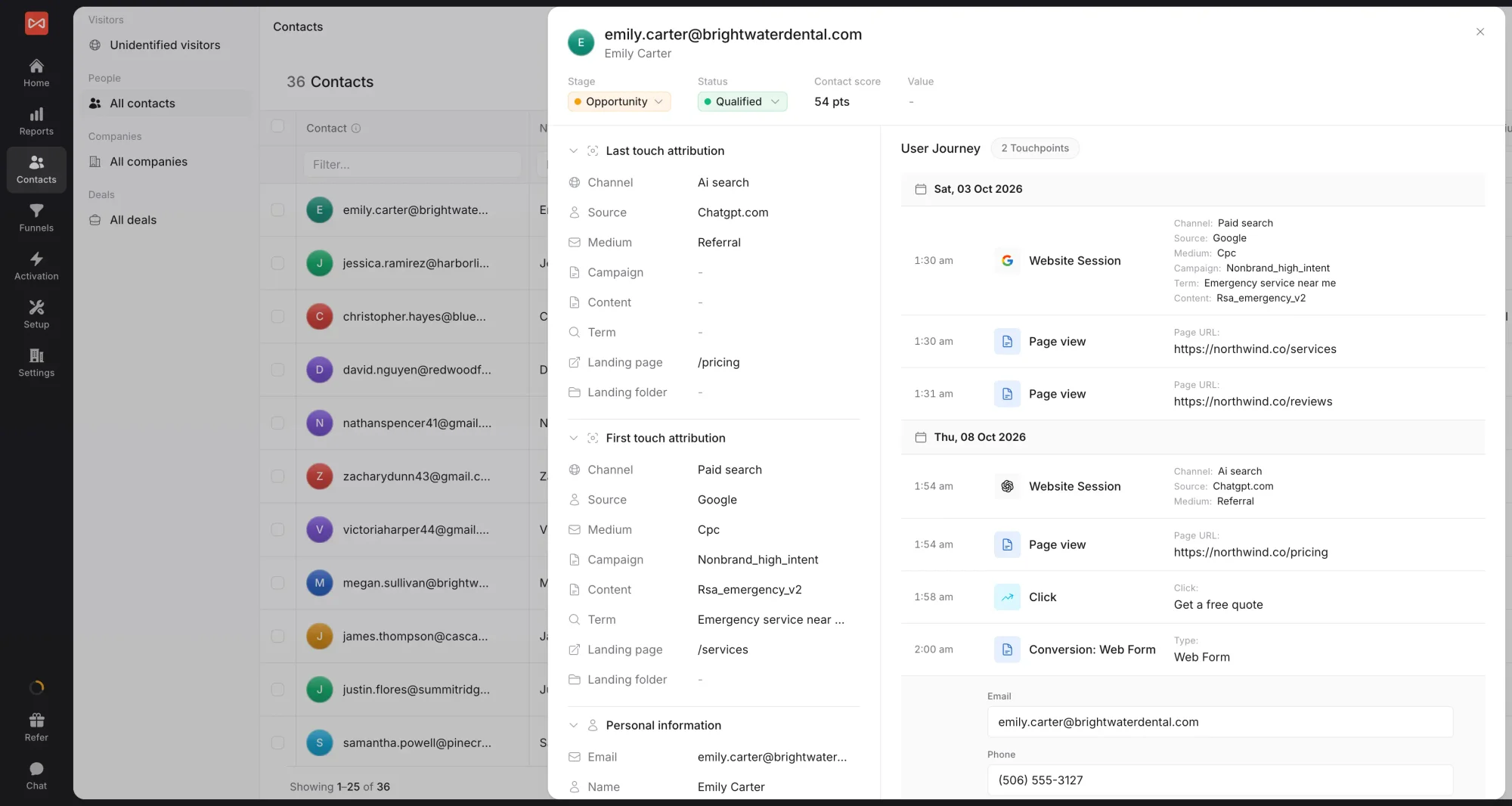
app.sourceloop.ai/contacts shows each form submission as a contact row. Expanding a row reveals the prospect’s entire pre-submission timeline, the entry channel, the pages they viewed, and how long they evaluated before filling the form.
Traffic and Revenue report
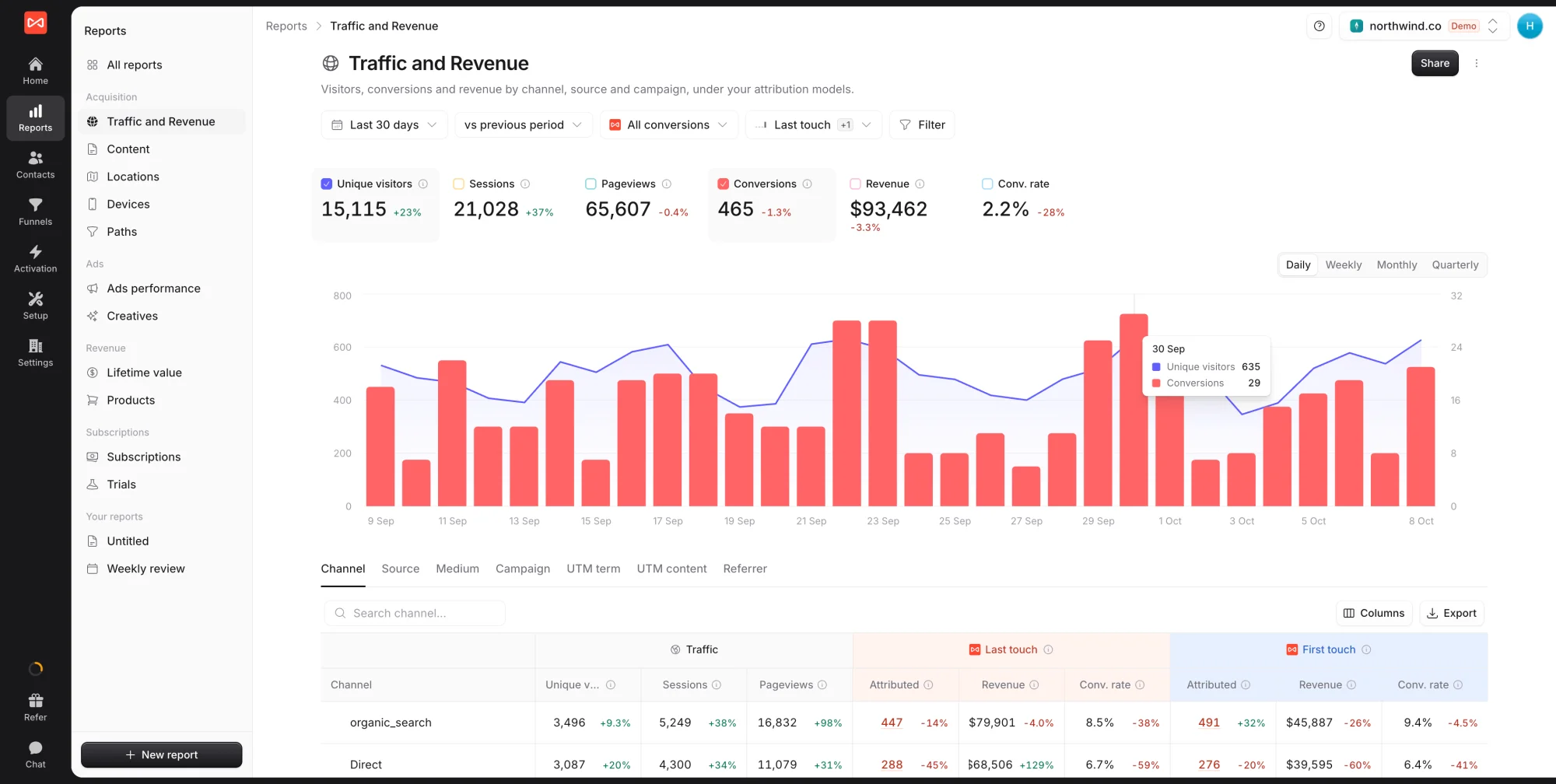
app.sourceloop.ai/reports/traffic rolls up your HubSpot form submissions by source, medium, and campaign. This is the report you bring to the next marketing review when someone asks “what’s actually generating qualified leads?”
Funnel reports
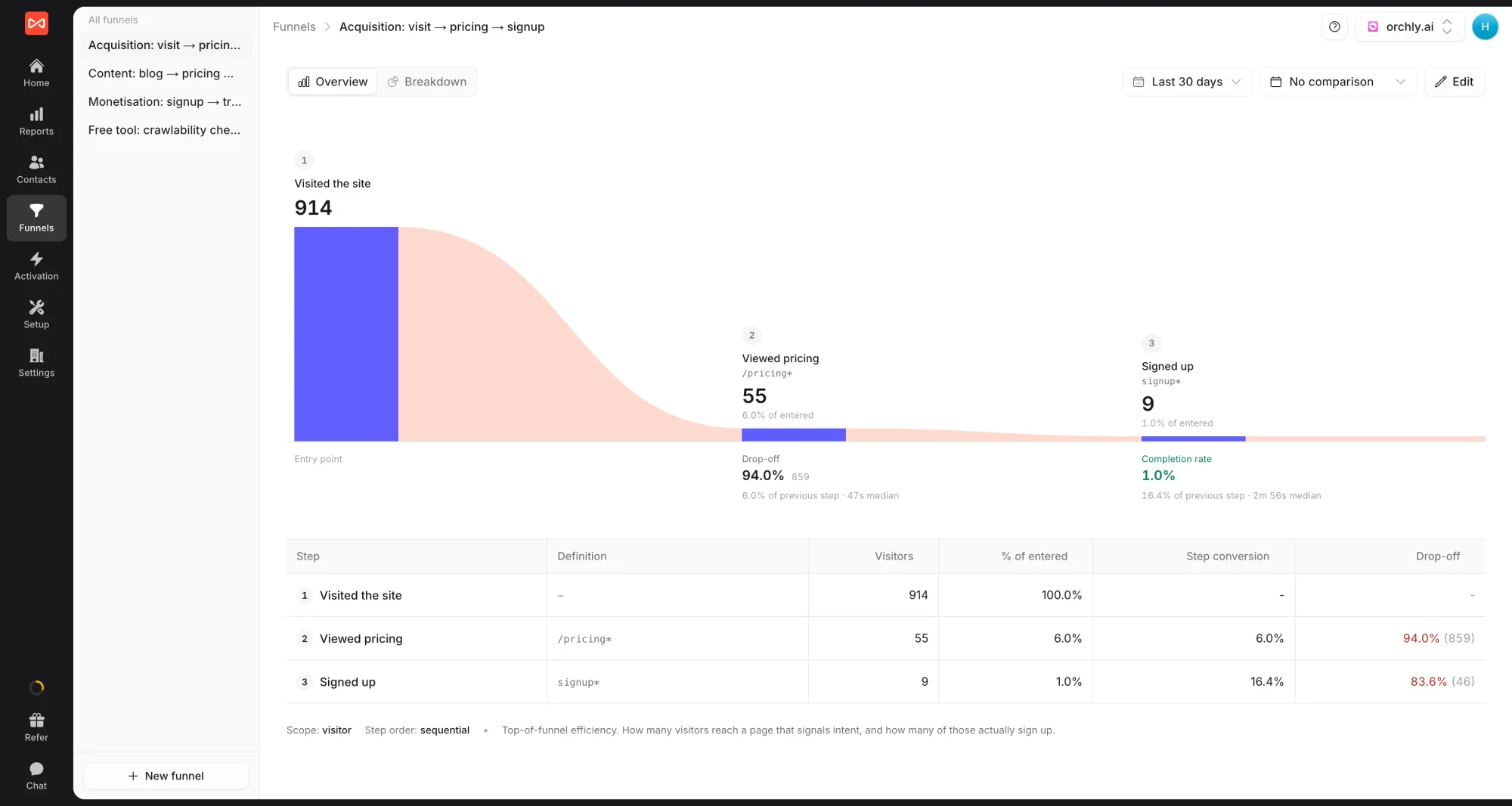
In app.sourceloop.ai/funnels, configure a funnel that ends in “HubSpot form submission”. Slice it by channel or landing page to spot the highest-converting acquisition paths.
If your marketing program runs paid acquisition, forward the HubSpot form submissions to Google Ads and Meta as offline conversions so the bidding algorithms train on real lead generation rather than vanity click counts. The conversion sync guide covers that setup.
Frequently asked questions
-
Doesn't HubSpot already track lead source on contacts?
HubSpot's built-in `hs_analytics_source` is helpful but coarse and often defaults to "Direct" when UTMs aren't pristine. SourceLoop captures the full journey including UTM details, all pages visited, and first/last-session sources, then keeps that data alongside HubSpot's own properties without overwriting them.
-
Does this work with HubSpot Free?
Yes. Whichever HubSpot tier you're on, Free through Enterprise, the form-embedding flow is the same. SourceLoop attaches attribution data to every submission made through an embedded HubSpot form on a tracked page.
-
My HubSpot forms run on landing pages built with HubSpot's CMS. Does that work?
Yes, as long as the SourceLoop tracking script is loaded on those HubSpot CMS pages. You can add it through HubSpot's site settings under Marketing -> Files and Templates -> Site header HTML.
-
Will SourceLoop overwrite or interfere with HubSpot's standard contact properties?
No. SourceLoop stores its attribution data on its own contact record. HubSpot's properties (`hs_analytics_source`, `hs_latest_source`, etc.) stay untouched. If you'd like the data flowing into HubSpot contact records, set that up via the HubSpot CRM sync.
-
I use the HubSpot non-HubSpot Forms feature (collecting submissions from third-party forms). Does that work?
SourceLoop tracks the form submission on the page where the form lives. If your third-party form lives on a SourceLoop-tracked page, the submission is captured normally regardless of whether HubSpot is also picking it up.

 Paid Social


