
How to track lead source in MetForm
Tie every MetForm submission to the marketing channel that drove it so your Elementor forms finally tell you where the leads came from.


On this page
- What SourceLoop captures from MetForm
- Before you start
- Step 1: Install the SourceLoop snippet on your WordPress site
- Step 2: Confirm the form is on a published Elementor page
- Step 3: Submit a test entry
- Where to see MetForm submissions in SourceLoop
- Contacts
- Traffic and Revenue report
- Funnel reports
MetForm is the form add-on built specifically for Elementor, drag-and-drop inside Elementor’s editor, with form-specific widgets, conditional logic, and a clean Pro upgrade path. The piece it leaves out (because Elementor doesn’t cover it either) is marketing attribution. SourceLoop slots in cleanly to add it.
Three steps, around five minutes, no MetForm-side configuration needed.
What SourceLoop captures from MetForm
For each MetForm submission, SourceLoop attaches:
- Visitor’s acquisition channel (organic, paid, social, referral)
- UTM parameter set from the landing URL
- Pages visited in chronological order before submission
- Time on site ahead of the form fill
- Number of distinct sessions before conversion
- Email + name from the MetForm fields
- First-touch landing page at the start of the visitor’s history
- Source of the converting session specifically
- Device type, country, browser
Before you start
You’ll need:
- A SourceLoop workspace (free trial)
- WordPress admin access (or another way to edit
<head>markup) - A MetForm form embedded inside an Elementor page or template on a published URL
Step 1: Install the SourceLoop snippet on your WordPress site
Inside SourceLoop, head to Setup -> Tracking code in the sidebar and copy the snippet.
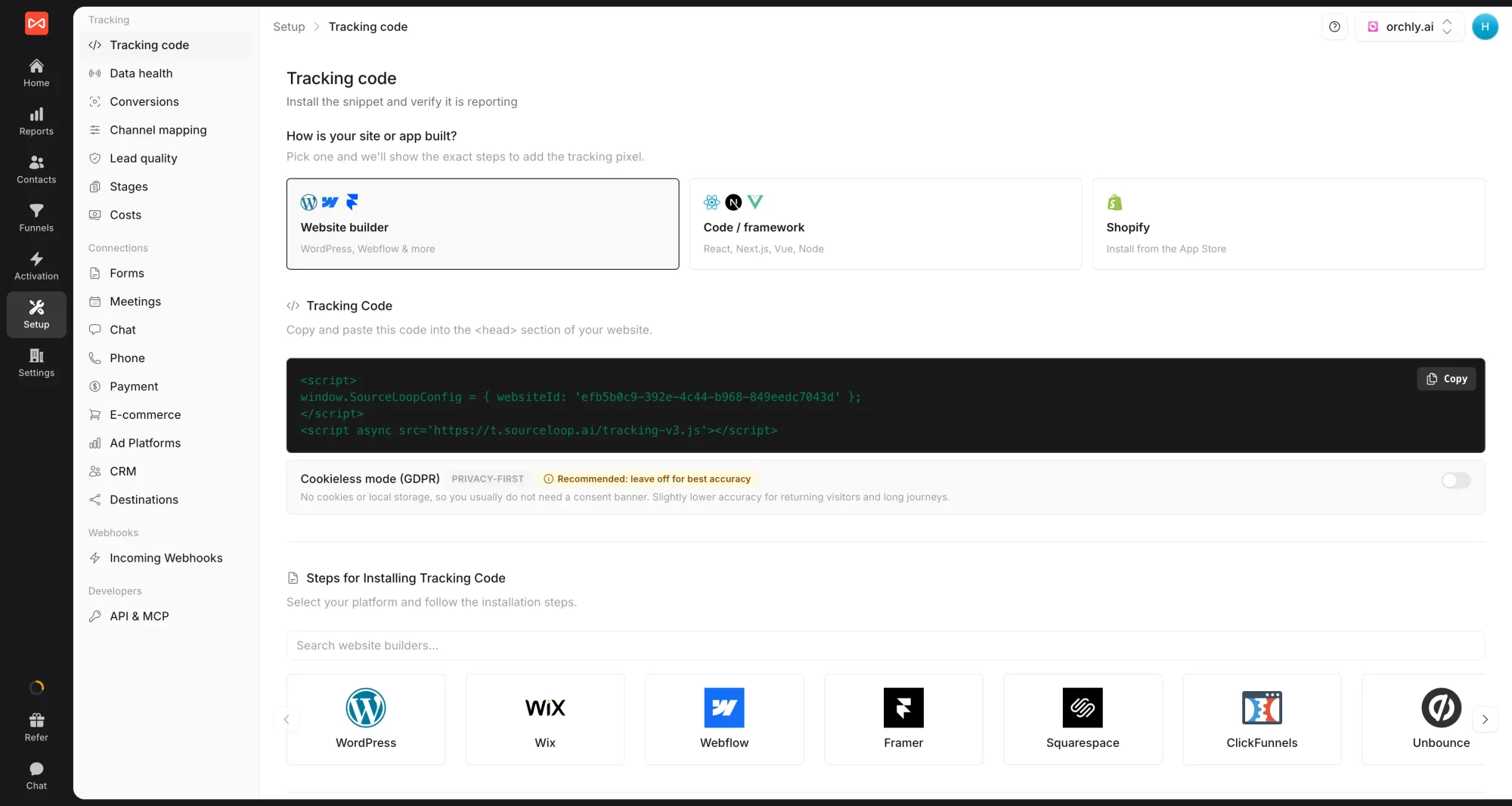
Add it to your WordPress <head>. Common paths:
- A standalone header plugin (Insert Headers and Footers, WPCode)
- Elementor’s own “Custom Code” feature (Templates -> Custom Code -> Add New, Location =
<head>) - Your active theme’s
header.phpjust before</head> - Google Tag Manager firing on All Pages
The snippet must run on every page that hosts a MetForm form (or popup containing a MetForm).
Step 2: Confirm the form is on a published Elementor page
There’s no per-form switch to flip in MetForm. Once the snippet is loading site-wide, every MetForm form inside any published Elementor page is attributable.
A quick checklist:
- The Elementor page or template is published, not a draft
- The MetForm form collects an email address, used by SourceLoop as the lead key
- Elementor’s “Custom Code” deferral isn’t pushing SourceLoop to fire after the form submits
Step 3: Submit a test entry
Open the Elementor page hosting your MetForm in an incognito tab with ?utm_source=test&utm_medium=verify&utm_campaign=metform-check appended to the URL. Submit a test entry using an email you can access.
Within seconds, the lead should appear at the top of Contacts in SourceLoop with the three test UTM values pinned to the record.
Where to see MetForm submissions in SourceLoop
Contacts
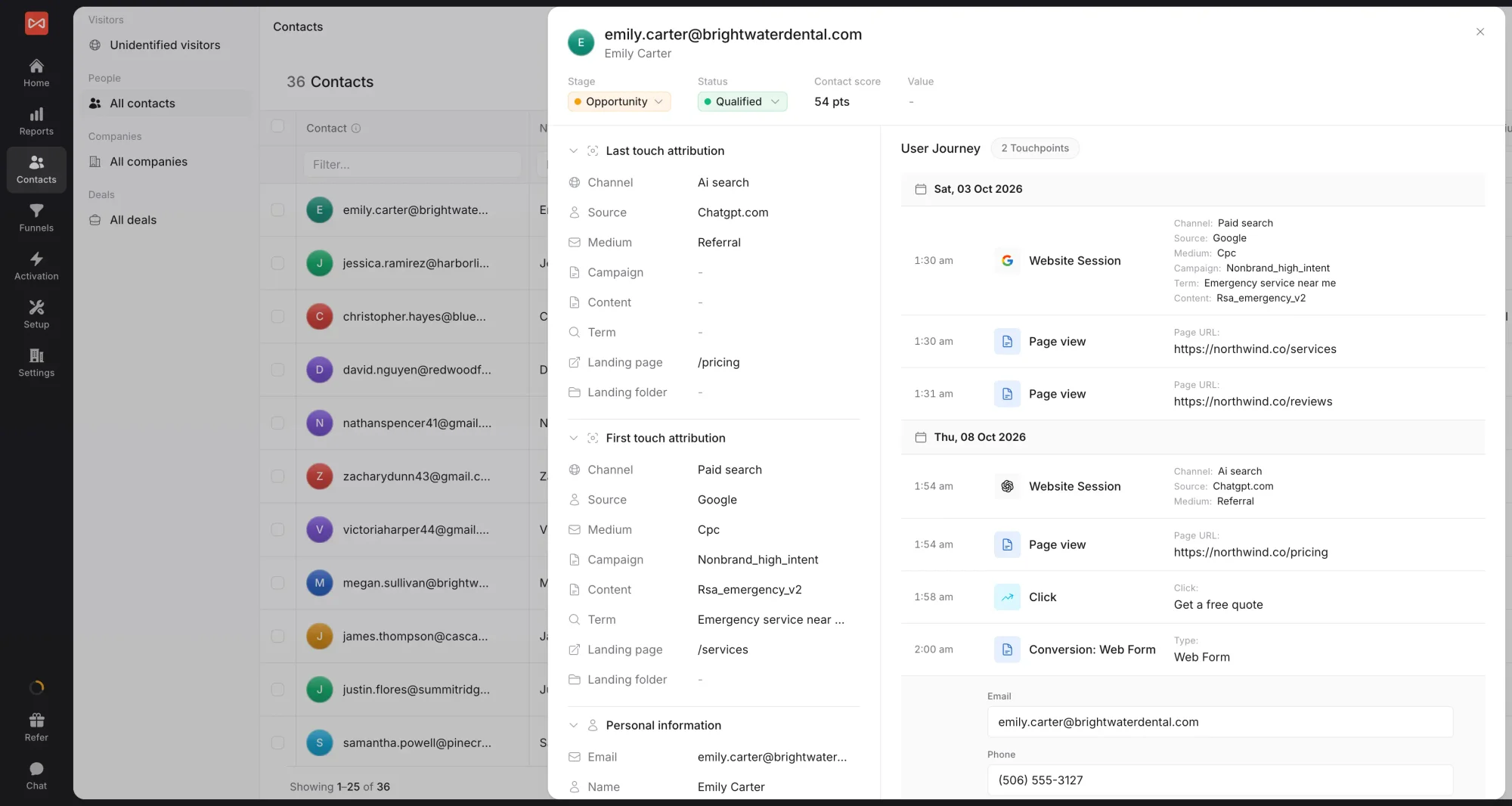
Every MetForm submission becomes a contact row at app.sourceloop.ai/contacts. Open a contact to see the visitor’s complete pre-submission browsing path.
Traffic and Revenue report
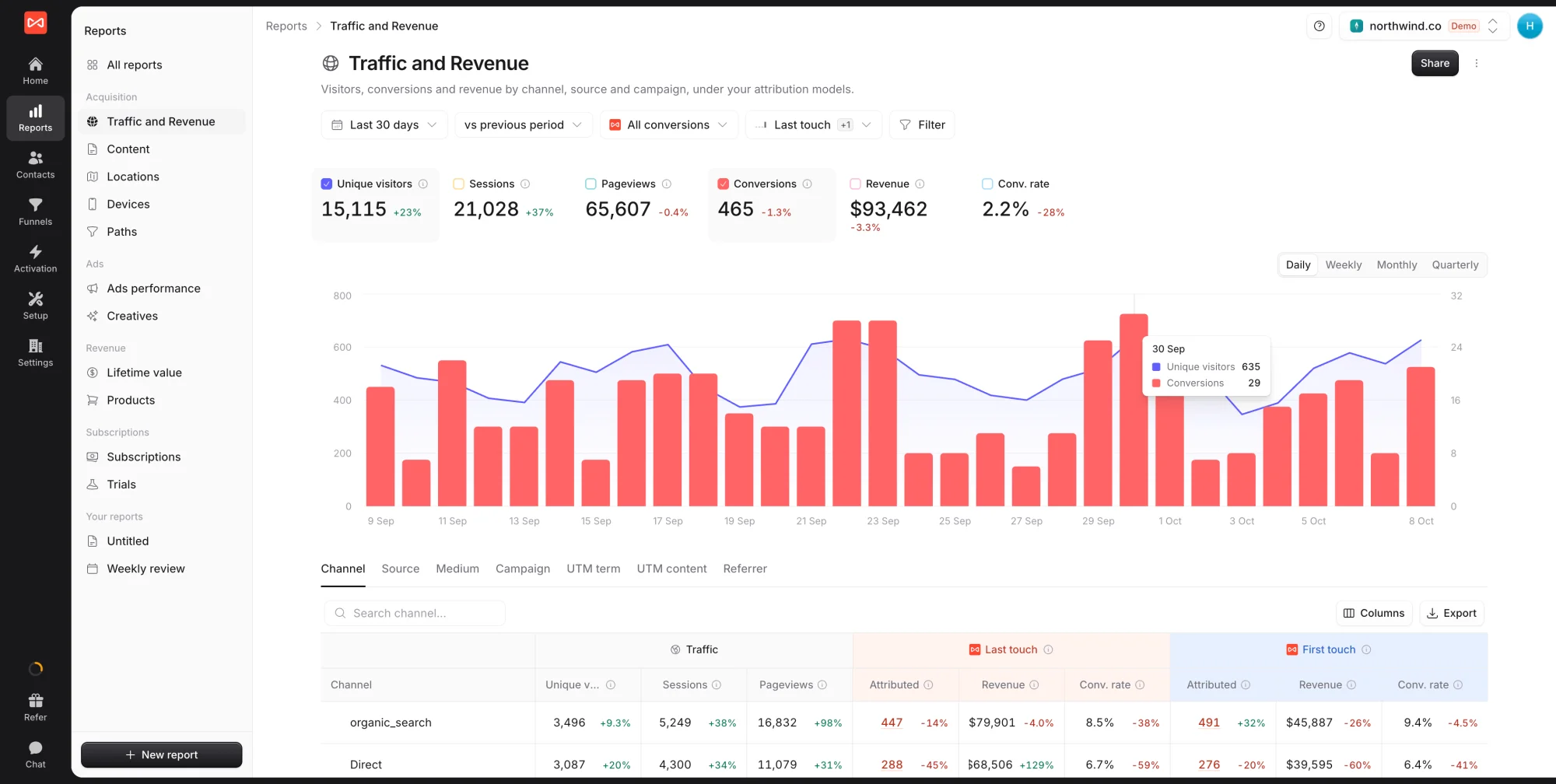
For the campaign-level read, app.sourceloop.ai/reports/traffic rolls MetForm submissions up by source, medium, and campaign.
Funnel reports
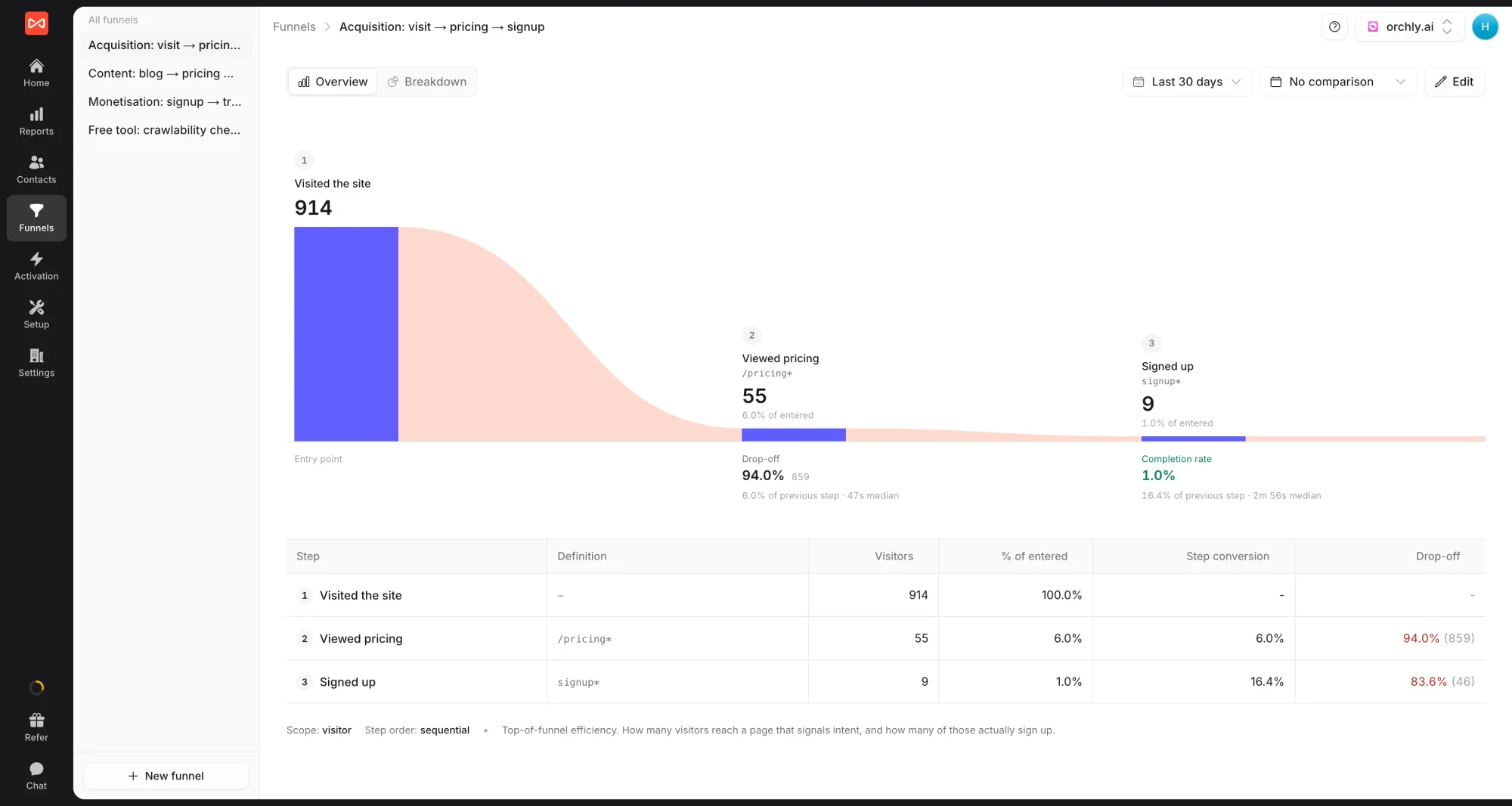
Build a funnel at app.sourceloop.ai/funnels with “MetForm submission” as the goal step. Cut by source, content, or device to find the most-converting routes.
If your stack includes paid acquisition, forward MetForm submissions to Google Ads and Meta as offline conversions so the bidding algorithms learn from real form fills. The conversion sync guide covers the wiring.
Frequently asked questions
-
Does this work on the free MetForm plugin or do I need MetForm Pro?
Both work. SourceLoop's tracking is browser-side and doesn't depend on MetForm Pro features. Free MetForm users get the same attribution coverage.
-
I built my MetForm form inside Elementor. Will Elementor's caching or its own analytics conflict?
No. SourceLoop and Elementor operate on different layers, SourceLoop on visitor sessions, Elementor on layout and design. The two don't overlap and won't conflict.
-
My MetForm uses Conditional Logic and Multi-Step features. Are all completed submissions tracked?
Yes. MetForm's conditional logic, multi-step navigation, and dynamic fields all execute inside the form. SourceLoop captures the final submission, so any flow that reaches that final submit gets attributed.
-
Will MetForm's MailChimp, ActiveCampaign, and Webhook integrations keep firing as configured?
Yes. Your MetForm integrations continue to push submissions to their destinations. SourceLoop saves an attribution-rich copy of the lead independently on its own side.
-
Can I track MetForm submissions inside an Elementor Popup?
Yes. A popup is just a placement variant on the same page. As long as the page that hosts the popup loads SourceLoop in `<head>`, submissions get attributed.

 Paid Social


